PSA: journalists aren’t supposed to put names in the headlines if the person isn’t a public figure. It’s not a matter of maliciously not giving credit
^^^as a journalist, this is something that bothers me ALL THE TIME
A friend of mine on Twitter explained this the other day, so to elaborate based on what she said: If the name is not instantly recognizable the way a public figure is, then putting the name in the headline isn’t going to bring about any sort of recognition or connection in the reader, and doesn’t do much to draw the reader into the story. But something like “local teen” does create a connection by tying the person into the community, and encourages the reader to learn more about what this local teen has done. The name will be in the article itself, after the headline has done its job at getting the reader to look into it.
It’s worth noting too that usually, according to the Inverted Pyramid writing style used for journalism where the most important information is shared first, the person’s name is usually in the first sentence of the first paragraph.
Whenever I see someone get up at arms over a headline that says “Local Teen” and the first comment is “SAY THEIR NAME” I’m always like “hey, thanks for telling every journalist present that you don’t read articles and just skim headlines.” Really makes us feel appreciated.
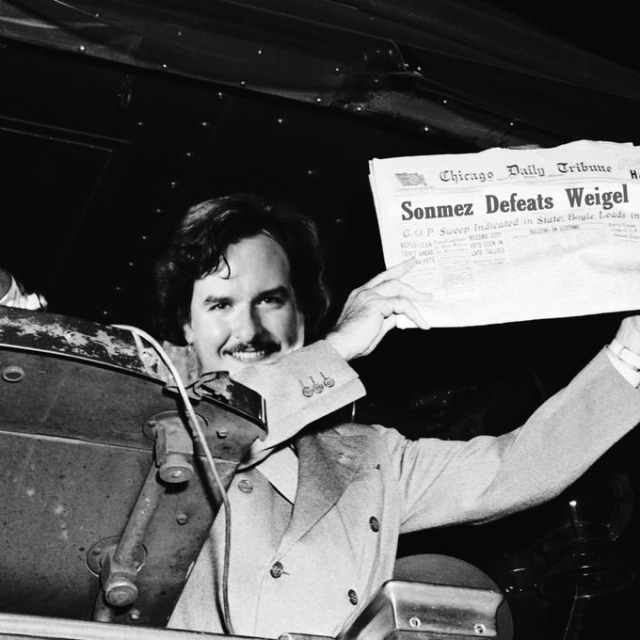
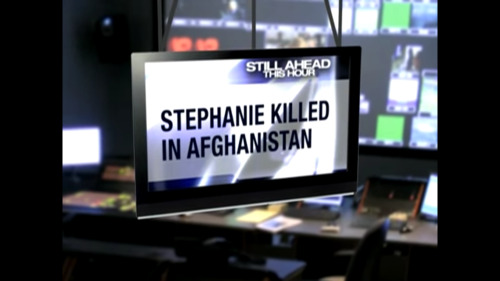
I think this Onion headline illustrates the point pretty well
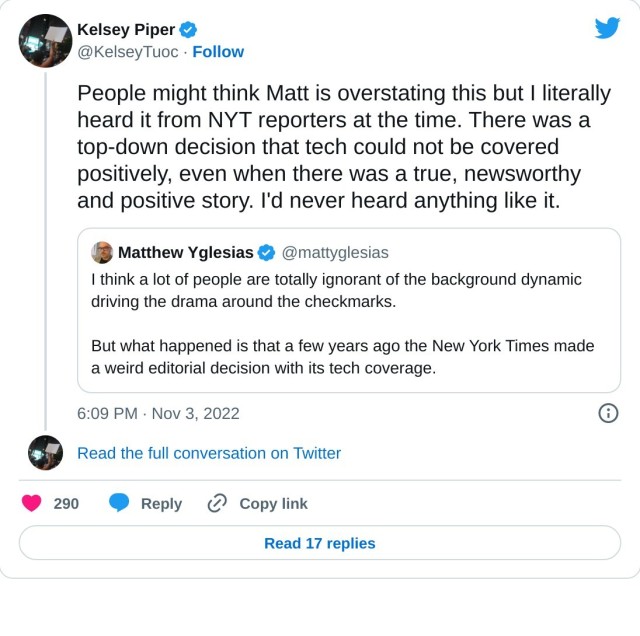
Is there anyone who has more details on this? I guess I’m out of touch because I’m not understanding the context of the tweets above.
I know very little insider stuff but Elon just bought Twitter and announced he’s going to start charging for blue checks. Journalists love their blue checks so I assume this is a tech vs journalism beef
Ok, so there are two things going on these tweets (you should really click through and read both mattyg’s thread and Kelsey’s response, they’re both good).
The first is the abrupt turn that happened in the mainstream press– but especially the New York Times, in the middle of the 2010s– towards very hostile coverage of all things tech. This was really frustrating, because while prior to that the coverage of tech was definitely too adulatory and a correction was needed, this has been way outside the bounds of good journalistic ethics for a while now. And I was on their side for a long time. I held out for a while, and continued to insist it wasn’t that bad, until that one week in 2020 when the NYT shat the bed like five times in the space of two weeks, with the piece on Scott, the thing with Taylor Lorenz and Marc Andreessen’s comments in Clubhouse (and I fucking hate that guy! do you know how bad you have to screw up to make me defend Marc Andreessen?!) and several more incidents in rapid succession.
And for a while I felt like I was going insane, because I couldn’t tell if this was all in my head or maybe it was all in the public interest and I had a biased opinion because of my job. But now Kelsey has confirmed that, no, there was an order from on high to do it this way, facts be damned. (A bunch of people in her replies are completely missing the point, accusing her of thinking “investigative reporting is bad’” No! Invesigative reporting is fine and necessary. Deciding in advance what the tone of a story will be, before you have any facts, and also banning ipso facto any kind of positive coverage, is not. That’s absurd.)
(If you’ve been reading my posts long enough that this attitude comes as a surprise, I should state that I am retracting this post. I believed it at the time, and then the situation just kept getting more and more ridiculous, and now we know why.)
The second bit is, as Matt says, that because a lot of leading figures in tech have gotten so annoyed at their treatment in the press recently, they’ve conjured up this theory about how journalists attach tons of status and self-worth to their blue check marks. And Matt is saying, no, this really isn’t true at all: the fact that journalists all get blue checks by default is more of an implementation quirk of Twitter and nobody really cares. I have no reason to doubt him on this. So what’s sort of funny is that apparently Elon got caught up in the same hatejerk as the rest of tech, and thought that “bluechecks” really did put tons of value on their verified status and could be extorted out of money for it. Which is probably a mistake, and one that’s going to cost him literally billions.
tl;dr we live in the stupid timeline, tech “thought leaders” and the journalists covering them are all awful
A little unfocused but quite worthy piece framing today’s unloved news media environment as pretty much the product of internalizing and operationalizing every idea and critique the Adbusters-ass 90s had.
It’s frustratingly hard to pin down a throughline, but there are interesting themes: 1999 as the peak of an old media order marked by fantasies of replacing it all with something authentic; particularly Jon Stewart’s The Daily Show as a forerunner to the contemporary Fox News work of Tucker Carlson – the piece reminds that Carlson had actually been the “conservative” host when Stewart famously went on and denounced CNN’s Crossfire in 2005.
Like I say it’s a little under-edited though; it mixes lineages of innovation – Carlson, like Stewart’s TDS, is carried on cable and relies on a comedy-style writing room addressing subjects raised in detail elsewhere rather than a stable of journalists breaking stories; broader shifts in the economic context and how that played with things – increasing media options saw producers and advertisers going for particular niches, while Stewart’s idea of news for sensible, decent people envisioned an old-style mass audience, filtered on decency, which corresponds to no demographic useful to advertisers; and just general ways it ain’t like it used to be – internet search-targeted advertising is even more appealing to advertisers than broadcast, the ability to find and present archival footage was clutch for TDS – not actually bearing any weight in terms of accounting for how it affects anything else.
I think old people deserve a fair hearing, one they aren’t afforded all too often in the multimedia era. I believe that the elders aren’t always wrong and the young aren’t always right. Growing up, we were lied to about all this, ironically by the people who are now old. The “never trust anyone over 30” boomer generation inculcated a sense that youth is just a form of incipient correctness. The future is theirs, so therefore they will be right about the future. Inevitably though, the young, while dictating the future, will ruin it in some glaring way. They’re human, it happens. And keeps happening.
Worse than Twitter’s baseline tone is just the omnipresent, reflexive demonization and collective will to hurt outgroup individuals. Connected to that is a panicky willingness to buy into emotionally charged stories that you don’t dare question your in-group on. Did we all become Deadspin? No, Deadspin wasn’t like this in 2008. But, if I’m honest, it was probably one more step to wherever we are. And this current place, perhaps a hell and perhaps a purgatory, is an ever-changing but seldom evolving shit show. It’s been one big refutation of the once-ballyhooed idea that we should all be speaking to each other, constantly.
What the boomers missed, however, was how they created this generation. They promoted an aesthetic of rebellious gatecrashing, then pulled up the ladder once safely ensconced. Moreover, they demeaned their privileged perch out of a moralized pique, all while ceding no purchase. This food is terrible, and such small portions, but none for you. No tradition was upheld because no tradition was offered.
So the younger generation responded in kind, not with tradition, but with an all-out assault on it. They beat the establishment, then beat themselves, and in the end, almost nothing endured.
Has anyone considered that if you’re seeing a bunch of stuff about eating bugs it's… just that there are more “informative” media outlets that need content now (but don’t have a geographically concentrated audience to go for local stories) and it’s easy and interesting? I remember occasional references on PBS or like Discover magazine growing up, same thing.
If your girl is mercurial as hell and always having drama whose resolution never seems to stick, that’s more likely BPD. Now if your girl is normal or even a little sad most of the time but then suddenly comes to you with a plan to kill her grad school advisor and parents and live in their vacation house back in 1998 for the rest of your lives, that’s bipolar
The ironic thing about this whole episode is Felicia Sonmez going on absolute fucking tilt makes more sense if you assume she’s manic right now
If your girl is mercurial as hell and always having drama whose resolution never seems to stick, that’s more likely BPD. Now if your girl is normal or even a little sad most of the time but then suddenly comes to you with a plan to kill her grad school advisor and parents and live in their vacation house back in 1998 for the rest of your lives, that’s bipolar
The ironic thing about this whole episode is Felicia Sonmez going on absolute fucking tilt makes more sense if you assume she’s manic right now
You know, there’s a rough breakup… she comes out appealing to community standards of conduct… then she gets cast as the monster for the (new, deprofessionalized Discourse) internet to hate, while professional internet media frets
Underplayed that Depp/Heard is a karmic mirror of GamerGate
Becoming clear that the vulnerability of trans stuff in America is it doesn’t have state-level infrastructure: the last decade saw an upsurge on the not-actually-a-government Everywhere of the internet, and signing-on of national groups that honestly needed a purpose to still exist after gay marriage, but there’s no state-by-state stuff, and the legacy queer orgs coming onsides for structural reasons means the organizational commitment isn’t matched at the grassroots
Meanwhile since the ‘70s social conservative pressure organizations have drawn on church congregations, which beyond representing a particular sect or interpretation and thus ideology, exist in a particular geographical location and have connections and influence on that basis. And strong local networks help in national-level operations because social issue affiliation is heterogeneous and even if you’re not ready to fight at national level you can identify more friendly territory to focus on, develop, recruit from, and pioneer policy in
should lead to increasing divergence across countries as well
Going differently in the UK is absolutely about structural factors: they don’t have autonomous lower-level state government (well, Scottish devolution maybe?) but also they have a much more nationalized journalism sector where pretty right-populist tabloids exist in the same infosphere as the elite stuff, so there was less running room to put new gender understandings over on a top-down basis in the first place before it was noticed and challenged in a way all public figures were answerable to
But what brand can you safely develop? Brands like foreign correspondent, data journalist, and Thomas Friedman are increasingly less relevant to the job market in 2022. Mid-career journalists seeking a smart, safe career path should be mindful of the trends in journalist brand development. Read Max Research has crunched some figures and come up with five journalist brands we believe have reached their peak and have limited upside, and five journalist brands we can recommend as growth choices for early- and mid-career journalists.
30 years ago if the president nominated a Supreme Court Justice that week’s Newsweek would have bits about her basically manufacturing consensus that this person and their history and perspective now mattered
15 years ago I would’ve been reading the Volokh Conspiracy as a group of professionals – with distinct bias and interests such that their writing became informationally denser with regular reading – had for months in advance mulled over who it could be, giving a foundational introduction to most of the possibilities
Today I see it mentioned in tweets that’re mostly trying to advance some greater agenda I have to pay long-term attention to the tweeter or at least their milieu to grok while actually still leaving the first-order effects of that particular jurist fairly opaque
I remember Slate before it was even known for “slatepitches”, it was just like one of two publications made for the Internet. Salon had the Condé Nast lush, well-paid name writer pieces. Slate, which was actually part of a Microsoft venture into media team-ups (that’s also what the MS in MSNBC was) was thinner, a major feature was “Today’s Papers” where someone just read The NY Times, WaPo, WSJ, USA Today, etc and summarized what was interesting in them. Sometimes this would be where you found links, before the Twitter/Facebook timeline (or even the Reddit/Digg front page). Sometimes the stories weren’t even available online yet.
Salon seemed to run out of money and implode in the early 2000s. They started a subscription program. I did, but unlike the (surely pricey) quality stuff before it was Bush Derangement Syndrome stuff they could get nobodies to turn out by the bucketload, I think some of the remaining original quality decanted to Slate.
If I could pass a message back to my ‘90s Salon/Slate-reading self… well, it would probably have to do with Mickey Kaus or Camille Paglia. But if I could send multiple, among them would be “You know how writers keep randomly invoking female Star Trek fans writing and mimeographing 'slash fiction’ in the 70s and 80s? That sounds kinda random but it actually turns out to be super important later, kinda crossed with– you know how they’re always doing pieces about how academics love analyzing Xena?”
I remember Slate before it was even known for “slatepitches”, it was just like one of two publications made for the Internet. Salon had the Condé Nast lush, well-paid name writer pieces. Slate, which was actually part of a Microsoft venture into media team-ups (that’s also what the MS in MSNBC was) was thinner, a major feature was “Today’s Papers” where someone just read The NY Times, WaPo, WSJ, USA Today, etc and summarized what was interesting in them. Sometimes this would be where you found links, before the Twitter/Facebook timeline (or even the Reddit/Digg front page). Sometimes the stories weren’t even available online yet.
Salon seemed to run out of money and implode in the early 2000s. They started a subscription program. I did, but unlike the (surely pricey) quality stuff before it was Bush Derangement Syndrome stuff they could get nobodies to turn out by the bucketload, I think some of the remaining original quality decanted to Slate.