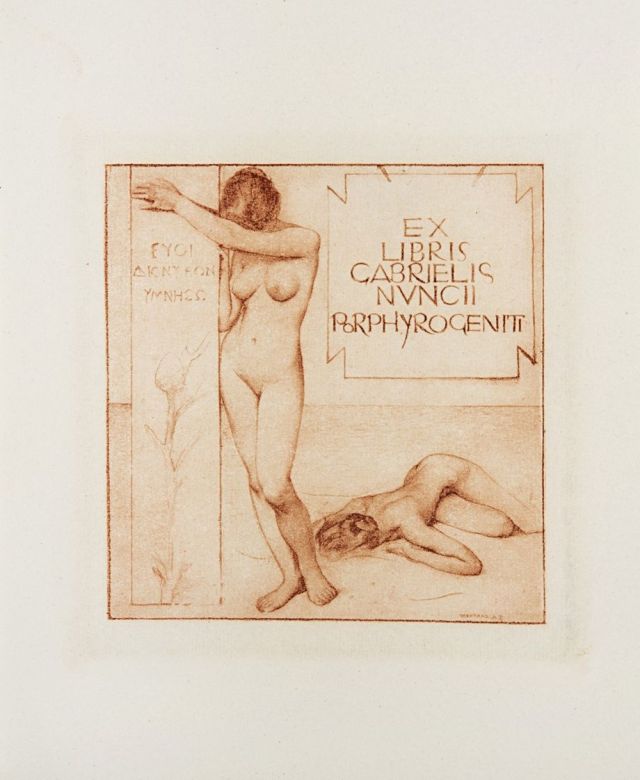
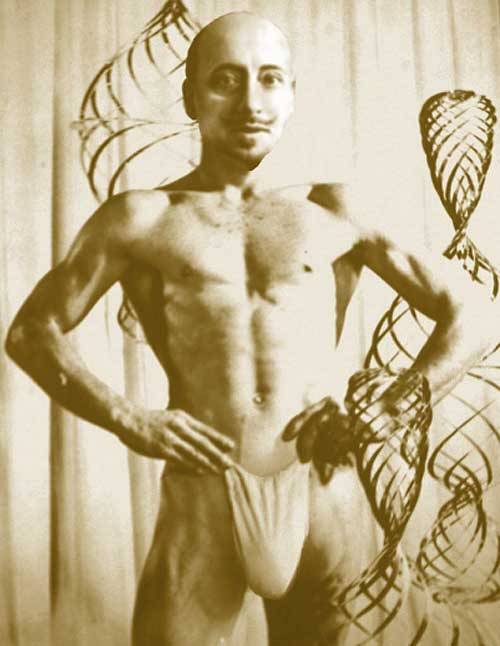
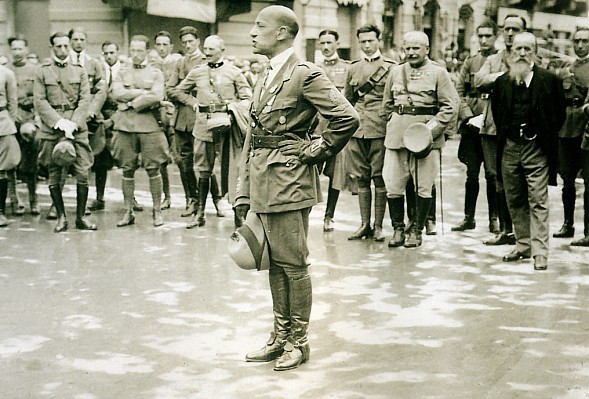
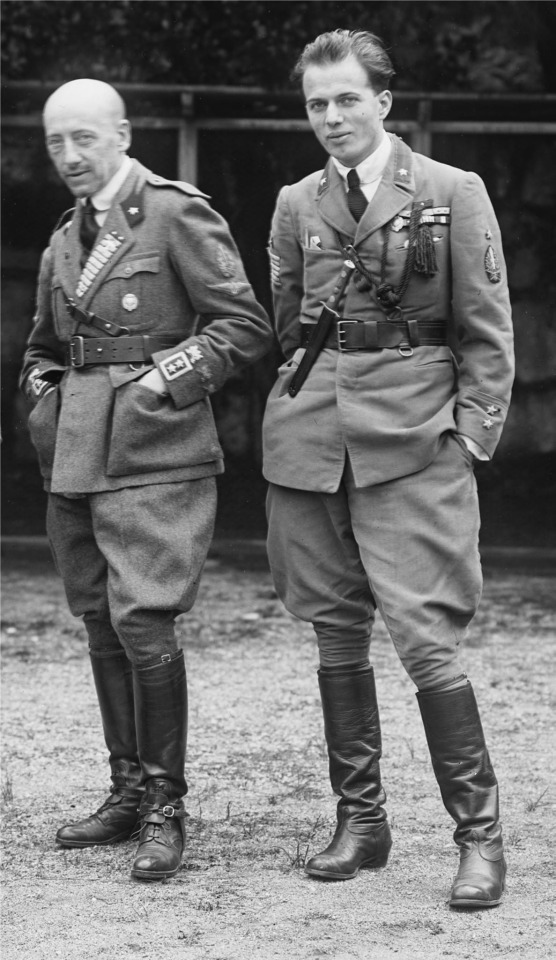
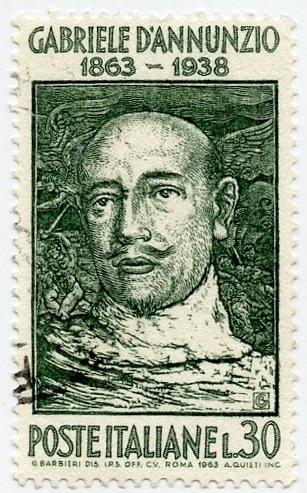
My personal hero, you will recall, is Gabriele d'Annunzio, who (correctly) regarded Mussolini as an unworthy ripoff, and built his final house with a waiting room with a mirror specifically inscribed to outline Mussolini’s profile with mockery when he paid call
So before the internet, how did 60s-70s kidnappers even know who rich people’s children were, where they were, and what they looked like? The society pages? Was it more a case of people already in their orbit becoming kidnappers than kidnappers tracking them down?
From Evelyn Waugh’s Decline And Fall, which was set and written in the 1920s:
’ “Did you try pulling out ‘is teeth and sending them to his pa?” I asks. ’ “No,” says Jimmy, “I didn’t do that.” ’ “Did you make the kid write pathetic, asking to be let out?” ’ “No,” says Jimmy, “I didn’t do that.” ’ “Did you cut off one of his fingers and put it in the letter‑box?” ’ “No,” he says. ’ “Well, man alive,” I says, “you don’t deserve to succeed, you just don’t know your job.” ’ “Oh, cut that out,” he says; “it’s easy to talk. You’ve been out of the business ten years. You don’t know what things are like nowadays.” ‘Well, that rather set me thinking. As I say, I’d been getting restless doing nothing but just pottering round the pub all day. “Look here,” I says, “I bet you I can bring off a job like that any day with any kid you like to mention.” “Done!” says Jimmy. So he opens a newspaper. “The first toff we find what’s got an only son,” he says. “Right!” says I. Well, about the first thing we found was a picture of Lady Circumference with her only son, Lord Tangent, at Warwick Races.
But what this I’ll-show-you kidnapper then does as first step is to take a menial job at the boy’s snooty private school, which would be an obvious way to pick out a suitable target at one’s leisure. Waugh makes a lot of the society pages, though - he turned out a whole book about the posho set becoming journalists simply by burbling on about which of their chums were at which party last night.
“Society columnist”, incidentally, was one of the early steps of Gabriele d'Annunzio’s rise
I am, of course, a proper pagan, with proper pagan morality, if someone places themselves In uncompensated service to me and my interests I take it as a testament they are beneath me; in contrast to the extent they use and expend me towards ends of their choosing they are my superior
He could have an entire platoon of dudes that have to do what he says, in an environment where death is almost a certainty, and so can be treated casually, and grudgingly respect only the dude that attempts mutiny (right before shooting him). He could have a young wife and an environment where not much can be done about disease.
And then die gloriously in battle on behalf of powerful interests - uninterested in his survival except as a single digit integer on a ledger - engaged in a protracted conflict that wasted enormous amounts of men and material and created an environment so dismal it baked Adolf Hitler.
Oh also one of his most beloved experiences of the war was watching a troop of soldiers who had refused to attack uphill into death be decimated.
He didn’t have a wife (or rather he did, and as ruler of Fiume granted himself a divorce) and took countesses and famous actresses as lovers. Clear femdom thing, too.
…does @kontextmaschine wish he were an officer that died in battle during World War I?
🤔
It is well established that my WWI icon is Gabriele d'Annunzio, the Italian poet, early aviator, and arguably biggest pre-war celebrity who urged Italy into the war
(Incl. with a blasphemous parody of the Sermon on the Mount: “Blessed be those who, having opposed the event [the war], will accept in silence the supreme necessity and will want to be, not the last, but the first ones [to sacrifice themselves]. Blessed be the youths who hunger and thirst for glory, for they will be sated. Blessed be the merciful ones, for they will cleanse a luminous blood and bind a shining grief.”)
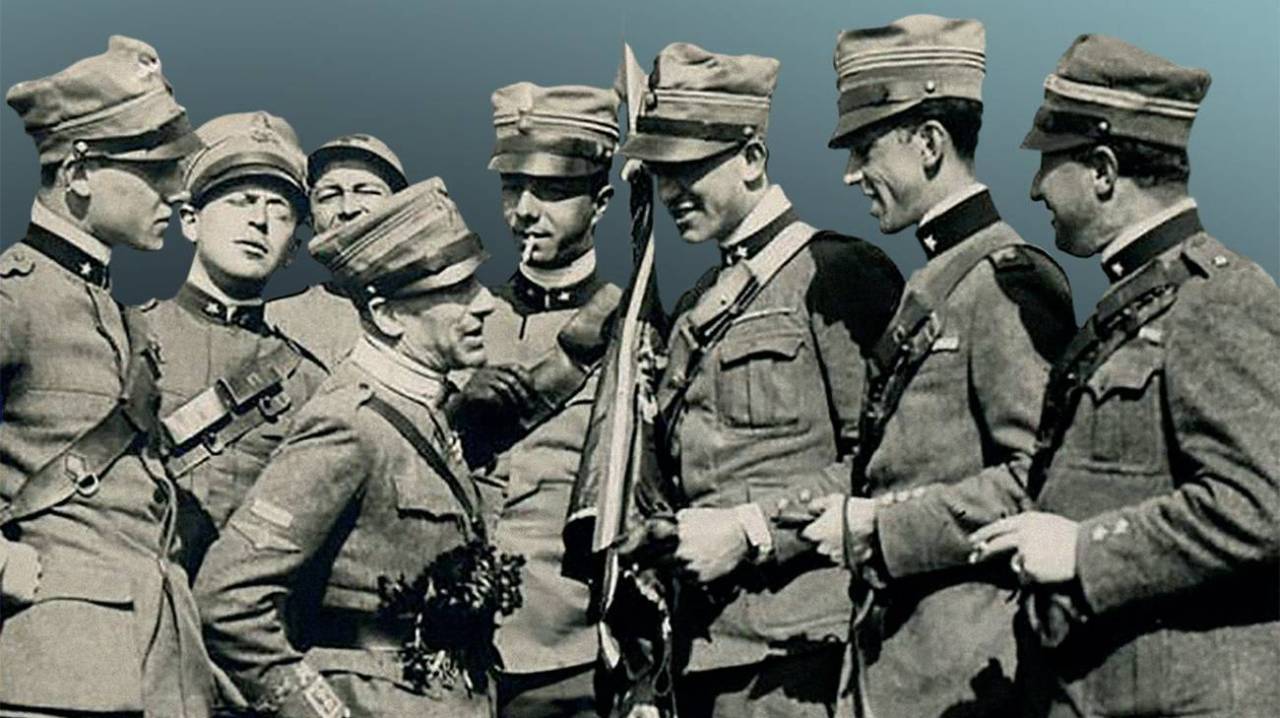
Then enlisted at age 52, essentially invented strategic bombing (he had also been predicting modern naval warfare for decades) and pulled strings to get sent to the front as an infantryman, where his most treasured memory was watching his friend die slowly in pain, killed in the course of a tactically brilliant, strategically pointless attack of his own planning.
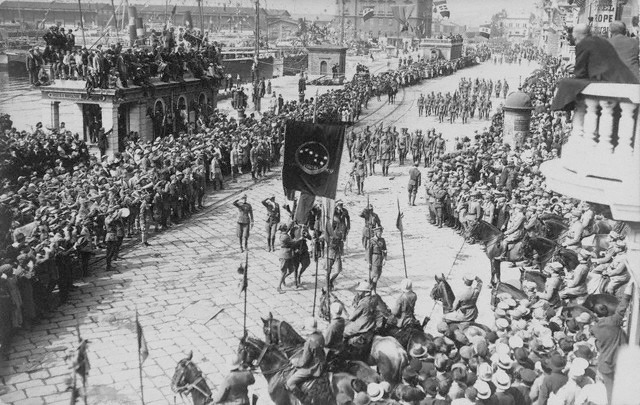
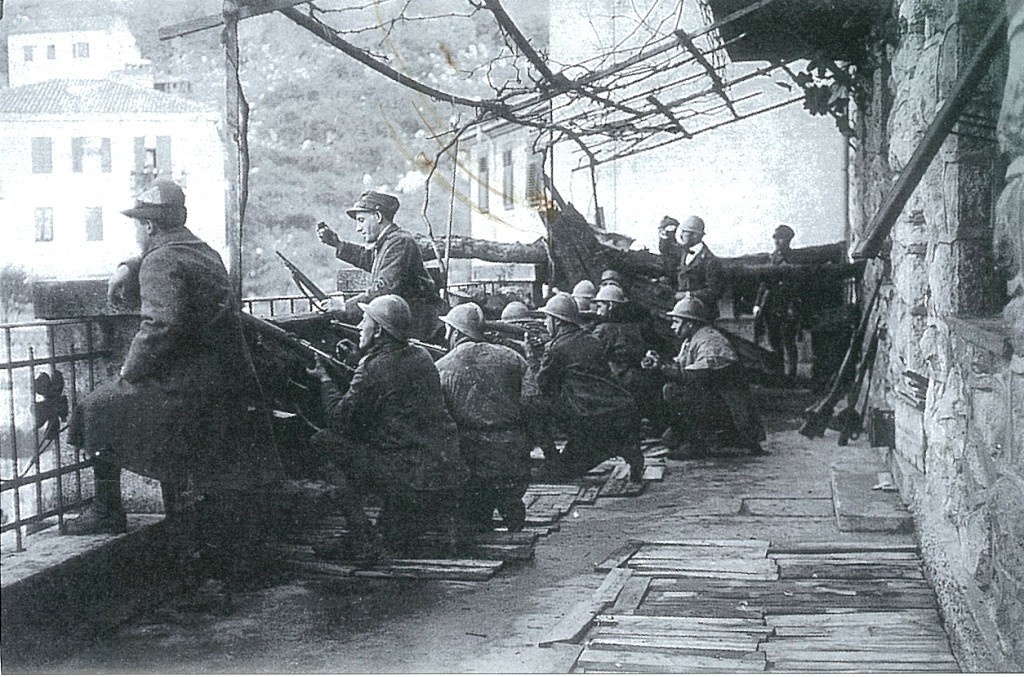
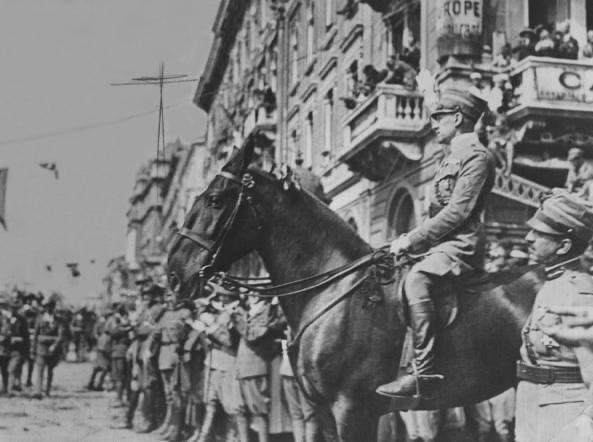
Then when Italy (as in WWII, the Comedy Option of the war) didn’t receive its hoped-for territorial gains (given instead to the ex-Austro-Hungarian nations) pushed for further war, personally led a ragtag army to conquer the Adriatic port of Fiume and there ruled a pirate utopia (this is what a lot of Porco Rosso is lifted from), intentionally weakening his army’s discipline, fueling it by capturing cargo ships at sea, and inventing the hallmarks of fascist pageantry like the balcony speech and blood-sanctified flag.
After that “failed”, in that Italy took it over like he originally wanted, he returned home and in retrospect if he knew it wasn’t over yet could have beat Mussolini to the punch (the Duce was wary of Il Poeta and moved up the March on Rome [a rip-off of the column into Fiume] to preempt him, in turn d'Annunzio built a waiting room in his hillside mansion-museum [the one with a warship mounted on the hill and a painting of him as a leper above the master bed] to specifically annoy Benito)
once you become old and infirm you're gonna blow your head off, right? no way you're going to spend the last years of your life hooked up to tubes in a lonely hospice cell. gotta go out with the shotgun. unless dementia has other plans
Gabriele d'Annunzio’s final words were complaining about how disappointingly boring it was to die in bed
“It’s time for leaders to lead,” he said. “And the words mean things.
And the words are leading to people doing things like this and I find it
appalling.”
damn straight.
“The gentleman didn’t appear to be a member of the MENSA society,” [Cohen] told CNN. “He listens to the noise, he hears the noise, the noise was telling him his people were being slaughtered. He thought it was time to rise up and do something. He’s completely confused.”
“The gentleman didn’t appear to be a member of the MENSA society” is the classiest burn I’ve heard in a while
well as chief of the entire hospital he’s also responsible for the burns unit.
always thought it must be weird being in pro-socially coded trauma care that’s only made possible by antisocially coded trauma
but I suppose this IS the thing that made d’Annunzio’s retelling of the Sermon on the Mount as a call to World War I – “Blessed are the merciful, for they shall have splendid blood to wipe away, radiant pain to bind up” – work
the interesting/good thing about tumblr tags is how they’re used for extra information
stuff that, for example, you want your followers to see, but don’t want to get passed all down the reblog chain
secondary use is categorization on someone’s blog, so you can look through all the posts they or you made on a topic. this one is kind of buggy but it’s there and useful
the use i care least for is for following, and it kind of feels like that’s the one is was designed for most?
I follow the #gabriele d'annunzio tag, (my personal icon, who was a short, eccentric Italian celebrity poet/Renaissance man who basically invented romantic interwar post-democracy by being flamboyantly awesome in public) and the experience is being shown the occasional post
(that’s half the time a poem in Italian, though I’ve realized I can read that reasonably well by reverse-engineering Latin and other Romance languages; a realization I first made re: the “zentropista” account on here affiliated with CasaPound; I suddenly realize that like Michael Ledeen my sense of Italy is weirdly focused on fascist continuity; the other leg of that stool is I took a Japanese studies minor through an effective arm of the American empire and by comparison learned how we rigged their system to lock out the communists even when they had popular mandate too)
one last thing i’d like to add! i originally said that Amharic is also considered to be a holy language for rastafarians. please disregard that point, as I have since learned that many rastafarians romanticize a man (Haile Selassie) who maintained a policy of genocide against the Oromo people of Ethiopia. i deeply apologize for my ignorance and for contributing to that romanticization
this just in: rastafarianism has been cancelled
You know what kind of person rejects the sovereignty of Haile Selassie? Fascists.
there’s like an enemy-of-my-enemy SAT solvability challenge featuring Hitler, Stalin, Mussolini, Haile Selassie, etc. and you have to try and find a non-problematic way of cancelling all of them
The answer, as I’ve been saying for years, is Gabriele d'Annunzio
[I]n the negotiations preceding Italy’s entry into the war, Great Britain
and France promised to transfer Istria to the Italian government.
Instead, the Versailles conference of 1919 sanctioned the formation of a
new nation—the Kingdom of Serbs, Croats, and Slovenes, later
Yugoslavia—whose territory, it now seemed, would include Istria. For the
Italians in Fiume, this awful prospect was due to the incompetence and
weakness of the Italian negotiators and had to be immediately corrected
by the use of force. For the demobilized soldiers who roamed the country
without any particular destination or place in bourgeois society, and
for men like Gabriele D’Annunzio, Benito Mussolini, and Filippo Tommaso
Marinetti, this denial of the fruits of victory was the most intolerable
of humiliations. Talks started between the Italianists in Fiume and
some of the new political leaders emerging in the ruins of postwar
Italy. This is where D’Annunzio enters the story…
It seemed to Fiume’s Italian elite that they had found their leader. D’Annunzio had developed connections with the arditi
in Venice during the war and had shown himself perfectly capable of
eliciting extraordinary enthusiasm in his followers. In September 1919, a
band of a few hundred ex-combatants marched under his command toward
Fiume. No one stopped them; on the contrary, the Italians among the
Allied troops charged with guarding the city joined their cause. They
entered Fiume, whose non-Slavic population initially received with
euphoria the arrival of this strange leader who had never governed
before, who had the vaguest political ideas, and who seemed to be mostly
occupied in the tiring task of self-glorification…
From the beginning, the coexistence of the diverse groups that
gravitated around D’Annunzio had been difficult. There were the citizens
of Fiume and the Italian troops (the arditi, the carabinieri),
but also Bolsheviks who rushed to the city (in a Moscow speech, Lenin
said he and D’Annunzio were the only authentic revolutionaries of
Europe); anarcho-syndicalists; futuristic, fascist Dadaists; and
oddities like the curious war hero Guido Keller, whose mascot was an
eagle, who slept naked in the tops of trees, and who was one of the new
commander’s main lieutenants. The universe around the leader quickly
fragmented into factions. Forced to take sides, D’Annunzio came to rely
mostly on the young artists, anarchists, and arditi who
constituted the radical wing of the grand alliance of Fiume, and who
formed the “Union of Free Spirits Tending Toward Perfection” (or, as
they nicknamed it, “Yoga”). The group shared an enthusiasm for Hinduism,
spiritual aristocracy, nudism, and for building an agrarian utopia
where preindustrial forms of life would be restored. Subgroups were
formed: the Brown Lotuses, who wanted to lead a simple life and
professed a return to nature; the Red Lotuses, who proclaimed the
arrival of a new world transfigured by a renewed sexuality; and a group
who identified themselves as the followers of a still-undefined “Sacred
Love.”
The poet-soldier’s occupation also saw the arrival of bohemians, artists, adventurers, fugitives, homosexuals, dandies and reformers of every type.
In essence, the contested city welcomed anyone who wanted to dethrone
the bourgeoisie who sent the youth to war and afterwards expected that
there would be business as usual.
Some of these people were part of D’Annunzio’s governing
administration. There was Léon Kochnitsky, a Belgian poet who headed the
Foreign Affairs department; Harukichi Shimoi, an Italian enthusiast
from Japan who acted as a diplomat and tried to teach karate to the Fiuman volunteers; and last but not least Guido Keller, a former war aviator known in Fiume for being a nudist, a vegetarian and a prankster, who was in charge of a ministry that organized acts of piracy.