shrine to the prophet of americana
#vidya (446 posts)
I’d enjoyed Battlefield 4 and find it really interesting how AAA games are exploring history these days, so of course I got the...
I’d enjoyed Battlefield 4 and find it really interesting how AAA games are exploring history these days, so of course I got the early-release version of Battlefield One, the first of the big military FPS franchises (Battlefield, Call of Duty, I guess Medal of Honor’s defunct now) to be set in WWI.
As gameplay, solid - took me a second to get used to the changes in weapons, vehicles, and scoring, but that all makes sense either for flavor or balance improvements, which I appreciate.
As for the theming, heard a lot of people thinking the tone would be tricky to nail but I think they got it decent. They’ve got the same ominous-to-elegaic orchestration as Valiant Hearts, so I guess bog-standard there. The breadth of the visual design is great, and really gives a sense of the scope of the war. Empires field troops from all their colonies so character models are diverse and varied, when you spawn as an American sometimes you’ll find yourself giving orders in a Harlem bass and sometimes with an Irish lilt.
The maps likewise, ranging from the Belgian trenches to Italian mountains to the Sinai Desert. Fields, forests, villages, proud brick towns - and cratered moonscapes and rubble-grey ruins, with several maps set along a “front” so you experience the passage from bucolic to hellscape. It’s that most of all that I think “gets” the vibe of WWI: a recognizably modern world - distinguished if at all by a higher degree of pastoral charm - that abruptly turned into a steampunk apocalypse.
And it’s not just the aesthetics, the gameplay also “feels” more WWI-ish. It’s more infantry focused for one, which is not to say vehicles are weak - if anything, foot soldiers feel even more weak and vulnerable by comparison to these early tanks and warplanes, but limitations in speed and maneuverability limit their utility solo in favor of support roles.
Poison gas grenades and bombs make an appearance - deadly but trivially defeated by gas maks that limit situational awareness and take hands and time to equip, and smoke grenades can lay an even thicker and larger screen than I remember. The Battlefield franchise always boasted of its terrain deformability and with a heightened role for indirect fire artillery that makes a big difference for ground cover, especially in open areas.
Which is to say, I’ve already spent quite a bit of time cowering in an impact crater with my gas mask on, either keeping my head down for fear of snipers or anxiously scanning for the forms of flame troopers emerging from the smoke.
The single-player campaign… someone must care about that. I played the intro and two segments, and I don’t know what other notes you’d hit in a WWI story, but it’s kind of grim. You’ve got “determination rewarded with death”, “fraternity rewarded with death”, and “the interplay of naivete and cynicism, resolved with death”.
Also as far as I can tell, airplanes, M.A.S. boats, the Alpine and Adriatic campaigns and no Gabriele d’Annunzio. BOOOO. Maybe in something I haven’t played yet or in an expansion - campaign seems modular. Also compared to BF4 (which I got on discount with all expansion packs, probably to build hype for this) the base unmodified game seems awful limited in weapons and modes (there’s a new “release the pigeon” one that’s fun though), but I guess that’s the business model.
Wait... is BF4′s DLC map “Operation Outbreak” a remake of Codblops’ “Jungle”? Like, it’s scaled up maybe 3x along some...
Wait… is BF4′s DLC map “Operation Outbreak” a remake of Codblops’ “Jungle”?
Like, it’s scaled up maybe 3x along some dimensions bcuz BF is a vehicle franchise, but the topography, the landmarks, the flow, the flag locations, I really think.
Queering Benedict Arnold
Queering Benedict Arnold
“Queering Benedict Arnold" is historical gay fiction. The story alternates between twenty-first century scenes in which Jake Preston and Ben Arnold (a descendent) investigate Benedict’s life, and eighteenth-century scenes imagined by Jake and Ben. Some characters and allusions hark back to “Wayward Island” (in nifty’s file on Beginnings). Jake Preston is the narrator in both works.
Most episodes are faithful to history, except for sexual encounters, which are fictional. You should not read this story if you are a minor, or if you are offended by explicit gay sex.
Benedict Arnold was an American military genius who was treated unfairly by jealous rivals while he lived. After his death, he was denounced as the archetypal traitor in history and folklore, but he was a target of inexplicable hatred long before his treasonable conspiracy with John André to surrender the fort at West Point to the British. Taken as a whole, “Queering Benedict Arnold” is an attempt to discover the origins of that hatred.
I… wait a second… 14 Feb 2013 minus… OH MY GOD I think this gay Revolutionary fanfic ripped off its framing device from Assassin’s Creed’s.
That’s like the second most meta alternate war history popular franchise queer fanfiction porn I’ve ever seen.
Just read “greatest saint of the modern era” as “greatest saint of the Madden era”
Just read “greatest saint of the modern era” as “greatest saint of the Madden era”
Finished the Witcher DLCs. (Previous on the Witcher III: 1, 2) Really good! Bioware and Bethesda have found a real worthy...
Finished the Witcher DLCs. (Previous on the Witcher III: 1, 2) Really good! Bioware and Bethesda have found a real worthy competitor in CD Projekt Red. They got me thinking about two things though:
AAA open world games now have anticlimaxes. Like, you’ll go through all the way through the main mission chain, fight the big bad, and then after you’ve beat him there’ll be some more missions as a wind-down, but the thing is they’re not apex challenges but kind of cozy scenarios.
The first one I noticed was Red Dead Redemption, where the return to domesticity was an important step to resolving themes and setting up the tone for the ultimate resolution, so fair. But last year the weird James Bond-inspired AC:Syndicate chain where you take missions from Queen Victoria, I don’t even know what that was. You could say it’s more content for people who’ve exhausted everything else but that chain ends too eventually and I’m not sure what the point was of putting that particular lump of content after the main quest rather than integrated with it like other side quests.
(It also says something about the ideological drift of the AC games, where the assassins who started out as killers-of-tyrants-and-bringers-of-freedom still do that sometimes [while being heavy-handedly reminded how much they’re mucking society up for people], but lately they’ve been resisting the French Revolution because democracy is an more insidious means of control than monarchy and helping the Queen defend the British Empire - but! cheekily mentioning that maybe she could politely consider not keeping India under the colonial yoke.)
Of course the entire Blood and Wine DLC felt like this - the environment and culture of fake Western Europe wine country is so much more pleasant than the fake Poland-and-the-Hebrides you’d been dragging ass around - but even within it after you resolve everything there’s a mission to go drink and pick flowers and bullshit with an old friend, and then a mission to laze about in the sun and muse about retirement with your girlfriend.
I wonder if some of this recent tendency towards anticlimax has to do with the concurrent rise of DLC and particularly season pass-based business models - that you can’t just blow up the world in the climax, and you need to dramatize everything settling back to normal ready for the next sitcom episode.
(BECAUSE Read Dead Redemption wrapped up so comprehensively, the only single player DLC had to go as an alternate universe zombie plot)
The second thought I had, watching the close bond of the higher vampires Regis and Detlaff play out in tragedy, was wait a second, is this relationship fucking queer-coded? Because I can’t remember the last time I’ve seen that stuff treated through metaphor. And I’m like “well, you know, Detlaff had a female paramour, it was an important plot point” but then I think.
There’s this huge world, and like I’ve said so much of your experience is driven not by the machinations of kings but in response to intimate personal lives so there are TONS of young lovers, or married couples, or people driven by lust, over and over, and I can’t remember seeing one single same-gender pairing, or even intimation of same.
Poland, huh!
So that’s a point, I’ll scoff at people who take issue with CD Projekt Red for not at all holding ~*~representation~*~ as a particularly pressing end in itself, and roll my eyes (indulgently!) at BioWare for so eagerly and transparently beavering away to stuff affirmational stuff in wherever there’s space.
But I DID just go through a 80+ hour total experience with what I took to be the best yet simulation of a coherent world full of people with actual interiority - the most humane AAA game I’d seen - that was so appealing it’s bolstered my respect and interest for the actual home culture of its creators, and only in incidental hindsight noticed that gayness had no place in this world.
(Actually in further introspection, I suppose you might be able to count the way people in Toussaint use “bumdiddler” as an insult. Poland!)
((Okay I decided to do some googling and am reminded that in the introductory area, you do encounter a man living in loathed exile in the woods because he was caught in a gay relationship with a lord’s heir [who suicided]. Okay, I remembered the tone-setting mission that used a dwarven blacksmith to establish the rural Polish-style ethnic tensions and the threat of pogrom but forgot that, fair enough.
And there was that elf tailor who liked to wear dresses, who I remember making the distinction that he didn’t identify as a woman, he identified as a shapeshifter.
Oh, and I see all these things saying Ciri is non-straight because… in what was written in the books and not at all mentioned in the game… as a younger girl living on the streets she fell in with a gang which included another homeless girl who forced herself on Ciri… and vulnerable and abused with no other place in society and and a professed desire not to be alone again, she ends up being this girl’s bedwarmer for a while. OH. WELL THEN.))
Some people forget that the late 90s were a crazy time for game development. Games were suddenly getting exponentially more...
Some people forget that the late 90s were a crazy time for game development. Games were suddenly getting exponentially more complex before the hardware had evolved to fit it. That’s why things like the fast inverse square root and Mario parallel universes exist (Mario moves in floating point space for smoothness, but collisions are calculated in integer space for speed). Nowadays it’s hard to imagine computers failing to understand floating point math, but until that era many PCs didn’t have an FPU to begin with, much less one fast enough to provide enough inverse square roots for 3D lighting before the heat death of the universe. “Bad” programming and mind boggling decisions (from a modern perspective, anyway) aren’t just hacks. They made games what they are.
I’m quite fond of fast inverse square root as it’s simultaneously both an excellent argument for C and an excellent argument against C
When I got to college in the early 2000s I was all excited to take CS courses because I (like probably a lot of people that the intro level was deliberately there to weed out) was like
Programming: The Discipline That Makes Games Like Final Fantasy 6!
except the class was all
Computer Science: A Quest For The Most Elegant Recursive Math!
in fairness the introductory programming course did introduce me to the fact that that was kinda true, I came to realize a programming standpoint the interesting part of FF6 was
* producing a smooth composite image out of multiple animated layers and sprites, which can change position independent of each other due to scripting or player input
and
* compressing the thing to fit into cartridge memory
and that’s not really something that much interested me. The people who followed that trail all the way through ended up writing absurdly complex algorithms they couldn’t fully grasp the function of but on requirements assumed must be for NSA phone tapping; though I hear if you got far enough you could sell out and write absurdly complex algorithms you couldn’t fully grasp the function of but were used for investment bank derivatives trading.
In retrospect those are two hilariously 2005-ass things right there, I wonder what it’s like now.
But then the hardware did evolve, and you had big-league PC gaming chasing video cards down a rabbit hole, but I think what’s equally interesting is how today is the reverse of OP’s setting - just an overabundance of processing power. And how, ironically, that’s allowed the return of small-team/lone genius production that typified ‘90s gaming but has fallen aside in today’s huge multi-studio AAA titles.
Like, Minecraft and Dwarf Fortress, two of the most famous self-published games, and two of the only to make names - Notch and Toady - on the level of the Carmack/Romero/Newell/Molyneux/Wright/Garriott age. They have absurdly behind-the-curve graphics but are still pretty taxing because they ran on naive un- or weakly-abstracted engines that work by checking and calculating an absurd amount of variables for the contents of every cubic foot in the world on every tick while ticking often enough to maintain some playability.
And I mean, despite that they are quite playable. Underlying CPU architecture improves to the point that lone self-taught Toady can spend his time expanding the flavor and scope of the engine - making the calculations more numerous and byzantine - while hardware keeps pace. (The biggest performance optimization I can recall being the ability to neuter cats.)
Hey, just a little gamer joke, go ahead and keep scrolling if you’re not gamer cause you’re not gonna get it. Well today I was...
Hey, just a little gamer joke, go ahead and keep scrolling if you’re not gamer cause you’re not gonna get it. Well today I was walking forward and I thought, “Boy, this is just like when you press right on the Nintendo controller’s directional pad in Super Mario Brothers to make Mario walk forward.” Is that a hoot or what?! It’s moments like this that make you proud to be a gamer.
For non-gamers who have read this and don’t get the joke, it is a reference to the gaming masterpiece A Dirge For A Black Heart which chronicles the life of an Estonian businessman who immigrates to America for better opportunities, but is instead faced with new hardships and suffers a existential breakdown. Specifically, this references the scene in which the Businessman, who is never given a proper name throughout the game, reminiscences on his past relationship with his estranged Daughter and wonders if he will ever be able to walk forward from his sins. The player accomplishes this by completing a DDR type minigame, but ultimately discovers that there is no way to get a perfect score in the minigame which represents the mistakes that we will all inevitably make in life.
Saints Row: Gat Out Of Hell
not bad, Saints Row deserves respect as comedy AAA. actually the only representation of Hell I’ve seen in a while now that I think of it
Next someone has to make an AR app with finger-flick or Angry Birds mechanics to play golf off of your surroundings After that,...
Next someone has to make an AR app with finger-flick or Angry Birds mechanics to play golf off of your surroundings
After that, Tony Hawk. The finger skateboard guys could use their brands well for that
this, about re-enchanting the world and the darkness of original fairytales, got me thinking, I’ve been playing through the...
this, about re-enchanting the world and the darkness of original fairytales, got me thinking, I’ve been playing through the Witcher DLC the other day and it really is one of the best games-as-narratives I’ve ever seen
like the gameplay itself isn’t that deep tbh. dialogue choices and a third-person melee system that’s pretty sparse by prevailing Dynasties May Creed standards
but there’s so much atmosphere, and so much of it feels like these Polish devs just getting the ground-level fedualism right
and part of it is that there’s this interesting high/low distinction where the common village people live lives full of curses and magic and wondrous beasts
on top of which are layered these grand sweeping
epics of military conquest that are just incredibly mundane, when you
get down to it it’s a bunch of unremarkable people doing tedious
logistics as a way to manipulate resource flows in a way that doesn’t at all affect lived meaning
like
great kings and nobility might tangentially encounter magic as a
macguffin on the way to resolving an incredibly petty dispute with
significant bloodshed; to the extent it touches on their lives it’s
often to the extent that they aren’t any different from the rabble
like there are flying humanoid monsters and the possibility of using them in war is lampshaded specifically to be mocked, battles are fought with armies full of village bullies slapped into cheap armor
(and there
is an absurd amount of attention paid to material logistics as an
aesthetic element, if an army is in the field there will be beachheads
and depots not as a particular mission setting but just because it makes
sense; every settlement, in environment designs that have no attached
mechanics, serves a discernable economic purpose; there are pollarded trees)
but a nobleman’s unhappy marriage or thwarted youthful romance will manifest as like, actual monsters, presented with a backstory so psychologically real it’s not til halfway through the questline you realize you’re playing a riff on a famous fairytaile
drives home the point that a lot of folk tales were #relatable by virtue of being about human suffering
for something whose aesthetic is like 1/2 “Christianity is an abuse perpetrated against innocent widdle kids” and 1/2 dead baby...
for something whose aesthetic is like 1/2 “Christianity is an abuse perpetrated against innocent widdle kids” and ½ dead baby jokes, The Binding of Isaac is a fucking mile better than anything in that flame-shirted mileiu
I think because it deploys it as an aesthetic and trusts that to bear the appropriate amount of weight?
Farbeit for me to doubt Blizzard’s ability to dominate and monetize a matchmaking-based gamespace (Oh wait Diablo III, but in...
Farbeit for me to doubt Blizzard’s ability to dominate and monetize a matchmaking-based gamespace
(Oh wait Diablo III, but in fairness that was probably internal politics overcoming their decade-old correct decision that that was not a viable gamespace)
But Overwatch ads are like “if you liked WoW for the 2006-era visual design, boy do we have something for you” and
Ninja Baseball Bat Man Quarterworld, Portland, OR
Ninja Baseball Bat Man
Quarterworld, Portland, OR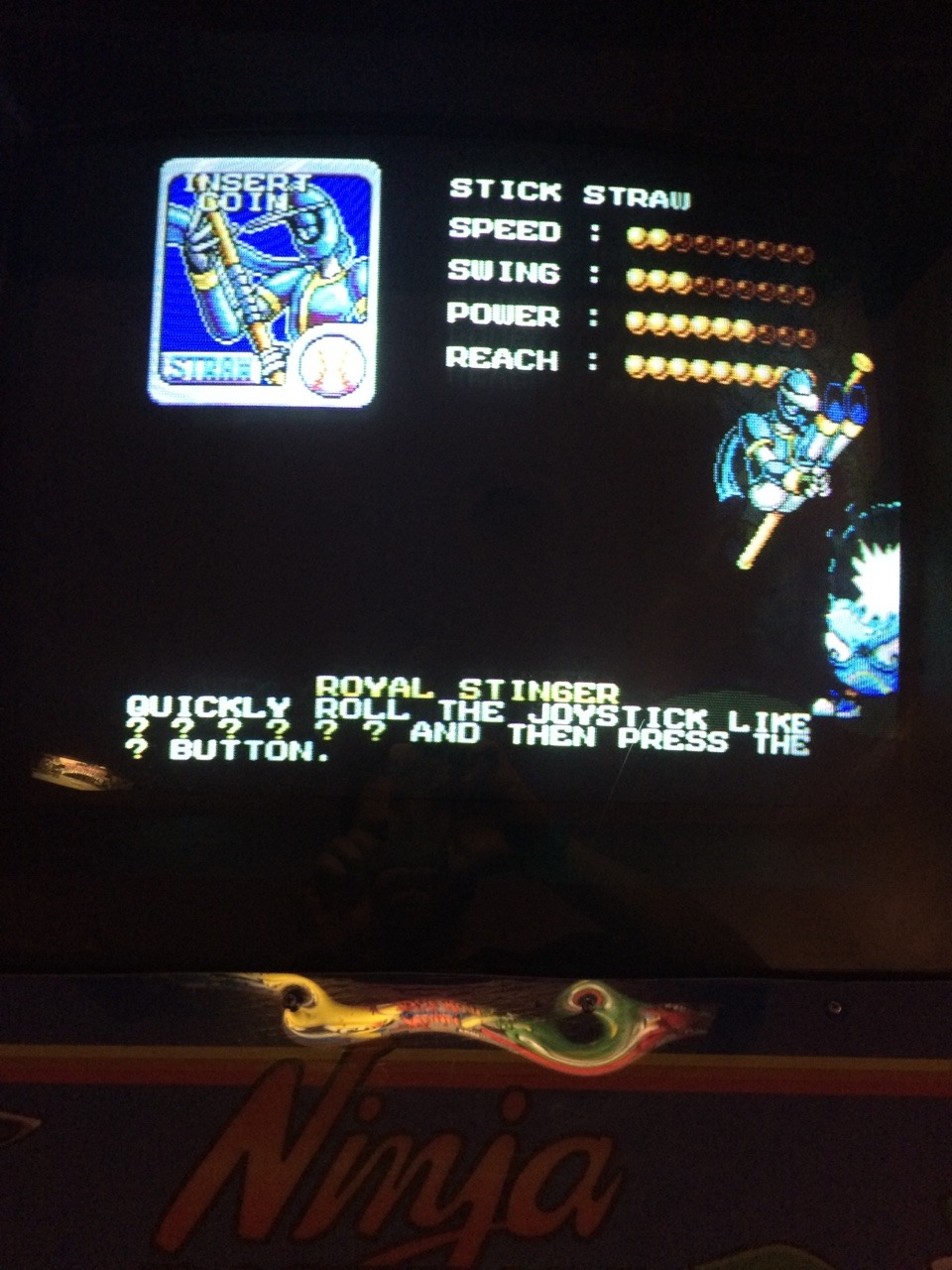
come to think of it, someone could hack Undertale and fill it with over the top Christian references, so when you face an...
come to think of it, someone could hack Undertale and fill it with over the top Christian references, so when you face an adversary you can either choose to turn the other cheek or to bring not peace but the sword
Kinda weird no one brings up the obvious, lamp-hung precedent of Paula’s “Pray” action in Earthbound tbh.
the new Hitman reminds me of Dead Rising and I approve
the new Hitman reminds me of Dead Rising and I approve
Just saw a car commercial with an Eskimo, was reminded that Infamous: Second Son is the only narrative I’ve ever heard about...
Just saw a car commercial with an Eskimo, was reminded that Infamous: Second Son is the only narrative I’ve ever heard about northwest amerindians that even bothered to try to get the accent right.
A Remake Without an Original
Hold on tight, folks. We’re going full post-structuralist.
So. I’ve been thinking about the discussions that @nostalgebraist and @cyborgbutterflies have been having about Undertale fairly recently.
And I think I’ve hit upon a Doylist explanation for why Undertale is so morally bizarre:
All the characters in Undertale have no canonical existence, they have all been preemptively rewritten as the characters that fandom would have turned them into.
Undertale as it exists now, is like the fanon version of a game that never existed.
Let’s call this hypothetical game-that-never-was “Undertale Prime”.
In Undertale Prime, Papyrus is pretty much an exact duplicate of Skeletor: an evil mastermind whose plans never come to fruition. Constantly frustrated, taking out his anger on his minions in the most hilariously melodramatic ways.
In Undertale Prime, Undyne is a deadly serious super-soldier. Even a bit of a sadist. She is acquainted with Alphys, but there’s no romance between them.
In Undertale Prime, Mettaton has no Mettaton EX form. He remains a rectangular robot for the entire game, but his personality shows small signs of the sass and flamboyance of Mettaton EX.
In Undertale Prime, Alphys is a tetchy mad scientist, more like Cumberbatch’s Sherlock than anything else. Prickly on the surface, lonely underneath. There’s no mention of anime or internet arguments or anything like that.
In Undertale Prime, Asgore is stern and serious, and completely in charge, but tormented by the necessary evils he has committed to protect his kingdom. Like a more sympathetic version of a king from a Shakespearean tragedy.
And finally, in Undertale Prime, all bosses are killed without remorse or punishment.
We’ve seen these character archetypes before, and we can guess how a typical fandom would reinterpret these archetypes:
the Thwarted Mastermind becomes a Bumbling Narcissist.
the Deadly Soldier becomes a Hot-Blooded Blockhead.
the Mad Scientist becomes an Adorable Nerd.
The Geometric Robot becomes a Svelte Bishonen.(look at Bill Cipher fanart)
The Tormented King becomes Sad Dad.
(and the most sympathetic/admirable women become lesbians)
But most importantly, all these villains would become sympathetic.
They’d become comedy relief, or even woobies.
Undertale takes the most probable fanon reinterpretations of Undertale Prime, and makes them canon. Why are the villains actions treated so cavalierly? Because typical fandom wouldn’t care. Typical fandom forgives villains, typical fandom makes villains cute.
But the discrepancy is this: in Undertale, the characters’ actions all remain the same as they would be in the dark and serious story of Undertale Prime. They play the same role in the plot, they are still Villains. The only things that change are their personalities, and the manner in which they are presented to the audience.
The result is that Undertale Prime makes moral sense, but Undertale does not.
It’s as if the Avengers canonically considered Bucky Barnes a family friend and acted as if the events of The Winter Soldier had never happened, as fandom wishes it were– But Bucky was still a terrorist.
It’s as if the characters in Borderlands 2 saw Handsome Jack as charming comic relief, the way the audience does– but Handsome Jack was still a murderous psychopath.
It’s as if, in Kingdom Hearts 2, Organization XIII were portrayed as the bickering sitcom family that the KH fandom made them into– but they were still trying to kill Sora and friends.
Every playthrough of the Kingdom Hearts franchise involves killing every member of Organization XIII.
But I guarantee you every Kingdom Hearts fan has their favorite Organization member.
None of the characters in Undertale are “held responsible” for attacking Frisk, because a game audience typically does not hold boss characters responsible for attacking the player. Instead, the audience sees them, through a Doylist/Mechanics-oriented lens, as a welcome addition to the game: a challenging battle and an entertaining character.
Undertale takes the player’s expected affectionate attitude towards bosses, and makes it the “objectively morally right” choice, according to the game’s in-world metaphysics.
Undertale is not just a game that preaches pathological altruism, it is, in itself, a pathologically altruistic text– a text that privileges the interpretation it expects to be subjected to over its own internal structure and logic, and preemptively changes itself to make those expected interpretations into objective truth, even when those changes create plotholes and morally repugnant implications.
A game, suffering to make itself everything the world expects it to be, about a child who suffers to make itself everything the world expects it to be.
oh my god
I am never going to be able to un-see this.
Page 21 of 23