shrine to the prophet of americana

#screenwriting (47 posts)

So something on my mind today from my old TV screenwriting push is the concept of a story engine Which was the mechanism, in...

So something on my mind today from my old TV screenwriting push is the concept of a story engine

Which was the mechanism, in episodic writing, by which your cast got into new plots each outing. That, more than any ideological issue, is why there are so many cop shows. Same as medical shows, or lawyers, or P.I.s, problems with stakes just show up. A patient is delivered to the ER, or our crew is dispatched to a crime scene, or a client walks in the door with a case.

They don’t even have to be that logically weight-bearing: while puttering about, an elderly mystery novelist hears of a murder, or The A-Team becomes aware of an injustice.

One thing I realized trying to write a spec script for it, Firefly has basically no story engine.

Plenty of characterization and backstory, but like, no consistent mechanism for things to happen. You have to individually justify each plot and each character’s role in it.

Like, Buffy. “Buffy Summers goes to high school, and it’s her duty to fight monsters of the week.” Even Star Trek, a setup for sci-fi short stories of any variety, you could answer “why are they there?” with “they’re on an exploratory mission” and “why are they doing this?” with “Kirk’s the ranking officer, they follow his orders”.

Whereas even putting forth a “‘cause Mal’s the captain”, you’d have to account and write for the fact that Zoë would accept that blankly, Wash would be pulled along by his emotional dynamic with both of them, Kaylee would extract emotional collateral, Jayne would expect to get paid, Simon would want an intellectual justification, Inara would have to work the right side of her push/pull dynamic to overcome her autonomy, Book and River???

That “thick characterization, weak engine” setup seems to work better for sitcoms, which might have engine-like recurring bits that usually set theme more than plot, like Frasier’s callers. Night Court isn’t about the cases, it’s about the interplay of the characters. In contrast, though there are character dynamics, House is really about the pathology cases.
Tagged: screenwriting firefly

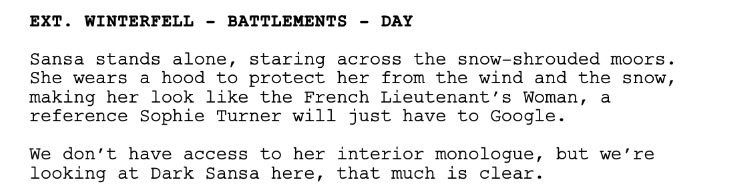
The EMMY NOMINATED SCRIPT of a Game of Thrones episode is on the Emmys website, thus is verifiable as real, and I’m McFucking...

tramampoline:

The EMMY NOMINATED SCRIPT of a Game of Thrones episode is on the Emmys website, thus is verifiable as real, and I’m McFucking Losing My Mind at how bad it is

Tagged: screenwriting

Yo the more I think about Logan the more it bugs me this is 100% the unsuccessful screenwriter angry about what he could do to...

Yo the more I think about Logan the more it bugs me

this is 100% the unsuccessful screenwriter angry about what he could do to fix it so

like part of why Laura/Logan has no weight, they structure the arc as mentor-transmitting the message of “the burden of killing”, being marked, and they just throw signifiers of solemnity at this - the Shane quotes, all that - but it just makes no sense.

Like, that worked for the Old Man Logan comics, but with the backstory changed it just doesn’t fit as *the* thing accounting for Logan’s giving up on life; Laura maybe needs to learn not to use violence as go-to problem solving but as she points out, her body count is torture orphanage soldiers come to kill her

So if you want an emotional theme that ties them together don’t pull it from their shared killing, pull it instead from their shared healing

Like, from Logan’s perspective his healing means he repeatedly survives seeing loved ones die, enduring great emotional suffering. But the flip side of that is he can channel the rage into the ability to protect his friends by enduring great physical suffering.

THAT’S an interesting emotional dynamic, rooted in plot worldbuilding, that easily sets up redemption and overcoming narratives, that it would make sense for Logan to experience some insight in the course of passing on, that Laura in particular would be uniquely capable of drawing out of him.

And that would set up a more satisfying ending. For one, from an action and effects standpoint - for all the “ooh, rated R”, it wasn’t that gory and the action wasn’t that memorable. There’s two severed head bits delivered like an ‘80s slasher or ‘70s Italo exploitation flick only with better prosthetics and no sense of playfulness. A bunch of the capture team’s forearms get severed and there’s some nice lampshading in that a lot have prosthetics already and are presumably prepared for this. (A fact that parallels the protags’ regeneration and augmented structure, deployed to little effect) Also, Logan does say “fuck” a bunch.

But reworking this angle the action climax would be a 9 year old girl charging a gun nest, getting shredded down to a screaming, meaty skeleton that proceeds to eviscerate the men inside. Now that woulda been memorable.

And from a character climax standpoint, the character that spent all this time running away and being protected would be flipping the script, advancing to protect, and this would be Logan’s legacy, paying off his arc too, making her ready for what she’ll need to endure.

I don’t think you could just drop this in as is, you’d have to do the pushy Laura/reluctant Logan stuff a bit different at least

(And while you’re at it maybe polish some other things - if you’re using that green medicine as a final-act plot device at least try to make something more of the reversal from Logan’s initial role caretaking Charles and how that puts him in a place to go chasing the final setpiece)

But it could work. Call me next time.

Tagged: Logan screenwriting

Just came out of a showing of Death to Smoochy. Audience participation for the howl scene, good stuff. Weird that never became...

Just came out of a showing of Death to Smoochy. Audience participation for the howl scene, good stuff.

Weird that never became more of a cult movie. I think might be because it represented an apex of several movie trends that didn’t continue on past.

1. the transitional ‘90s urban plot, where American cities were still depicted as playgrounds for white ethnic crime but the plot was kinda about how they were becoming playgrounds for professionals. Get Shorty, Analyze This, The Sopranos

2. Robin Williams’ self-deconstructive period (One Hour Photo, etc.) After he suicided it turns out everyone had always treasured him, but post-Aladdin into the 2000s there was a growing consensus he had always been just a cocaine-sweaty narcissist hack.

3. The Nora Ephron adult romantic comedy revival. Towards the start there’s hints toward the ‘80s/‘90s backlash “jaded businessbitch thaws out and realizes what’s important (nurturing children)” plot but it turns into a neo-screwball tension-between-equals. Even more than The 40 Year Old Virgin - 3 years later as Apatow supplanted Ephron - Catherine Keener’s is a specifically 40something fuckability, and the movie’s refreshingly upfront that the reward for being a good man is eventually a guarded but mature relationship with someone people in your circle used as a toy when she was younger and tighter.

Also, it’s a pretty good example of a 5 (as vs. the standard 3) act plot structure.

Tagged: death to smoochy nora ephron romantic comedy robin williams screenwriting

2 character introductions in search of a story

I:

EXT. - TACO BELL DRIVETHROUGH - DAY

A beaten-up 1994 TOYOTA COROLLA is 2nd in line for the window

INT. - INSIDE THE COROLLA - CONTINUOUS

The car is driven by JACK, a sloppy 28-year old man. The passenger seat and footwell are full of discarded fast food wrappers and trash.

Jack watches a smiling, attractive female EMPLOYEE lean out the takeout window to deliver an order to the PICKUP ahead.

Jack checks himself out in the rear view mirror and adjusts his hair. This does not make him any more stylish.

As the pickup ahead drives off, Jack turns his attention to his car and hurriedly rummages through the passenger side mess.

Jack reshuffles the pile so the top layer is all Taco Bell bags. Satisfied, he sits up and pulls forward.

II:

EXT. - OAK STREET - DAY

A residential avenue, lined with trees and well-kept bungalows. The sound of children’s playful shrieks.

We pan down the street, taking in the houses. Each styled differently, but all a variation of “bobo twee”.

We pass a house with beautiful NATURAL LANDSCAPING

A house with a rusted metal SCULPTURE GARDEN

A house with a tire swing in the yard and a HAND-PAINTED SIGN facing the street: “Slow down, we love our kids”

A house with SALVAGED COPPER GUTTERS

And then

EXT. - OAK STREET - NED’S HOUSE - CONTINUOUS

Ned’s house has a chain link fence, a concrete front yard stained with motor oil, and faded, detaching vinyl siding.

ANOTHER HAND-PAINTED SIGN: “Speed up, I hate their kids.”

Tagged: fiction screenwriting

Scripts I Have Covered

Scripts I Have Covered

Back when I was back in LA trying to be a screenwriter I did, as a lot of people in that situation do, a bunch of script coverage. Script coverage is basically reading a script (as a rule of thumb, scripts run one page per minute of runtime, with a lot less text per page than prose) and generating a 2-4 page summary and evaluation.

There are a few reasons you might have coverage commissioned: to evaluate a script for purchase and development; to judge its writer’s skills for employment on other projects; to judge its suitability for a particular actor or director; or just so you can pretend to have cared enough about it in Hollywood’s back-scratching favor economy.

The one constant is that it’s done by assistants or freelancers on behalf of executives, agents, or other “suit” variants who can then pretend they’ve actually read and judged the script themselves. Suits who make decisions relating to scripts are, as a rule, actively proud of the fact they don’t read scripts (or anything else).

On the one hand this makes sense; to them the script is a means to the end of making a deal and by treating it as a vestigal irrelevance they can attribute all glory of a successful deal to themselves. On the other hand, the hand that cares about human culture, this is worse than genocide, and would still be so even if I were particularly bothered by genocide.

Movies basically only have intelligible plots because movie stars have enough self-respect and pull to insist on only working on projects that do, which is why so often when you see a movie starring some interchangeable young models fresh off a fandombait CW series they don’t.

So that said, let me tell you about three scripts I remember doing coverage on (this was mostly 2005-07ish): the one that “got around”, in that I ran into the most people that also remembered having read it; the one I considered the best (but never got made as a movie); and the only one that actually got produced.

The one that got around: The Short Season

This was a script about a small-market but locally beloved baseball team and its general manager who, resigned to the fact that he didn’t have the resources to field a winning team, resorted to clever publicity stunts to keep up attendance and entertain the fans. At one point he fields an all-little people lineup only to discover that thanks to their tiny strike zones they’re quite competitive. Meanwhile the owner (and/or league, I forget) are plotting to abandon the team’s home city in favor of a more lucrative market.

This script was actually pretty decent and I could see it as a viable movie, but “mid-list sports dramedy” isn’t really something studios make very much anymore. Part of it is that the then-current* business model for movies was to finance films on foreign presales which were largely based on the brand recognition of star actors, and there weren’t really any A-list star roles here - I could see the manager/lead going to a Pierce Brosnan or Val Kilmer type, the love interest to a Cameron Diaz/Kirsten Dunst, but honestly I doubt there was a single player role strong enough to draw Peter Dinklage’s interest.

The best: Chasing the Whale

This was about a young man rising to prominence as the hospitality manager of a Las Vegas casino, and the mega-rich “Whale” super-gamblers he courted. I later read, and recognized as the source text, Whale Hunt in the Desert, the best pimp memoir since Iceberg Slim. The plot was an excuse to show off all sorts of colorful fun shit but for all that wasn’t bad, and I could see this as a great comeback vehicle for a Tobey Maguire or Daniel Radcliffe. I have no idea why this wasn’t made, particularly after The Hangover made bank and everyone in town must’ve been looking for a Vegas movie. Dumb industry politics is my guess, maybe whoever owned the rights was asking for too much money, who knows.

The one that got made: August Rush

I read this one with an eye towards a possible role for Aaron Carter (the managers I was working for seemed to specialize in child stars, former boy band members, and ex-SNL token brown girls. When the Family Guy movie came out and Stewie asked future-Stewie whether they ever found a role for Ellen Cleghorne I bust a gut because finding that role was literally my job at the time. Well, future-SNL token brown girls too, we also had Nasim Pedrad). My summary was “well a lot of this seems to be resting on the strength of the music, I hope it’s good because the rest is fucking terrible”, and though I didn’t see it that seems to be the critical consensus.


* well, for a while there before the ’08 crash they were also funded on German and Eastern European tax credits. That explains the career of Uwe Boll - his movies were absolutely terrible but he could keep to a schedule and a budget, and with all the tax credits they didn’t actually need any sales to be profitable - whatever they got was just gravy, and acquiring recognizable video game licenses was a cost-efficient way of starting off with a built-in opening weekend audience. Also some stuff with Gulf sovereign wealth funds and Asian box office, which is why even stuff like 2008’s Dark Knight will have semi-extraneous segments with Chinese locations and stars.

Tagged: script coverage coverage screenwriting kontextmaschine does hollywood

Riffing off that Sady post from a while ago, yeah, you really get an appreciation of fiction when you try to write it. When I...

Riffing off that Sady post from a while ago, yeah, you really get an appreciation of fiction when you try to write it. When I was in LA I was trying to be a TV screenwriter. Wrote some amazing stuff, but didn’t work because I don’t have connections to get anyone to read my stuff and had too much contempt for the people I’d have to schmooze to make them.

Anyway writing spec scripts really gets you a feel for the medium in general, and your selected show in particular. I ended up doing a Veronica Mars (amazing, available on request), and a pilot (ditto) but before that I started a Firefly. I abandoned it halfway through because it was really too  out of date, but one of the things I realized that’s a real problem with the show is that given that so many episodes are about the gang getting together for some heist, it’s damn-near impossible to work up an explanation for why and how Inara would join in.

You realize the actual staff - which is to say, people on the Minear, Espenson, Whedon level - couldn’t really figure this out either. In Jaynestown she kind of got a side mission that looped in at the end, but most of the episodes she’s kind of given an excuse to stay away. The only episodes where Inara had an organic part of the mechanical plot were the Saffron episodes, because Saffron was goatee-universe Inara, but there’s limits to that. (Remember how Vampire Willow episodes of Buffy were amazing, but the actual Willow Goes Evil plotline of the pentultimate season was such a mess?)

That’s a shame because for how hard she is for the mechanical plot, she’s got great potential for push/pull dynamics with each character to power the equally important emotional arc:

Mal (basic love/hate)

Simon (shared appreciation/longing for the finer things in life in the harsh emptiness of frontier space, bonding over their identity as professionals, resentment that he takes his professional status from the settled straight world as equivalent to her status from the demimonde they now inhabit)

Kaylee (shared appreciation of an unapologetic girlishness that can cut both lacy and innocent or leathery and promiscuous, conflict over the fact that their skill sets are so far apart that if they’re ever under pressure together one’s always acting the ignorant amateur to the other’s polished master)

River (motherliness towards someone who’s earned her respect but still exhibits vulnerable neediness, especially on the grounds of a ‘still waters run deep’ weaponized femininity; wary that she can’t even conceive River’s interiority well enough to manipulate her at all)

Jayne (the same direct brutishness/elegant intrigue contrast that makes for great personality conflict also makes them a pretty balanced team in pursuit of a goal, plus the Whedonian play against TV convention with the complete impossibility of romantic subtext given that Inara would never and Jayne doesn’t do subtext)

Shepherd (the shared experience of secret-keeping vs. the fact that Shepherd intentionally presents to avoid his mystique while Inara presents to enhance hers)

Zoe (envious of her easy and uncomplicated relationship with Mal/cautious that it relies on the exact kind of unquestioning deference she avoids; cautious about her role as the crew’s female icon of settled monogamy/envious that it’s the exact model of egalitarian relationship she wants.)

Wash (Actually, I don’t know how you’d write an Inara/Wash plot. Wait no, I got it. She’d depend on him for something and he’d fuck it up in a dumb way and try to joke her temper down and she’d call him on his bullshit then be catty about him to the rest of the crew. Then he’d pull a totally amazing save and she’d look like the jerk. She’d do fish-out-of-water dealing with being the least liked person around, and appreciate the way that he’s really the one holding the crew in balance, performing the same kind of emotional labor she does.)


Tagged: firefly screenwriting inara inara serra joss whedon