shrine to the prophet of americana

#screenwriting (47 posts)

Anyone see Wakanda Forever? I thought the first Black Panther was good but they were trying to run a plot arc AND an emotional...

Anyone see Wakanda Forever? I thought the first Black Panther was good but they were trying to run a plot arc AND an emotional arc AND a “relevance to modern Blackness” arc and they maybe had room for 2.25 of those

Tagged: wakanda forever black panther screenwriting

I appreciate Matt Yglesias' Letterboxd reviews because as the son of a produced feature screenwriter he brings fairly good...

I appreciate Matt Yglesias’ Letterboxd reviews because as the son of a produced feature screenwriter he brings fairly good insight on both the “what filmmakers are trying to do” and “how filmmaking affects the product” angles

Tagged: matt yglesias screenwriting

Through weird libertarian (!) connections I'm Facebook friends with the creative mind behind the Jim Carrey movie Liar, Liar...

Through weird libertarian (!) connections I’m Facebook friends with the creative mind behind the Jim Carrey movie Liar, Liar (1997) and it’s funny because his posts are the exact proportion of funny, insightful, stylized, and performing the actual act of advancing substance you’d expect from a produced feature screenwriter.

(About 1 in 10 features in development actually get made, and they’ve definitely gone through several scripts by then, it’s totally possible to be a professional screenwriter with a solid industry reputation and a decent quote for his services that earns millions over a career but never gets one of his scripts filmed)

Tagged: screenwriting

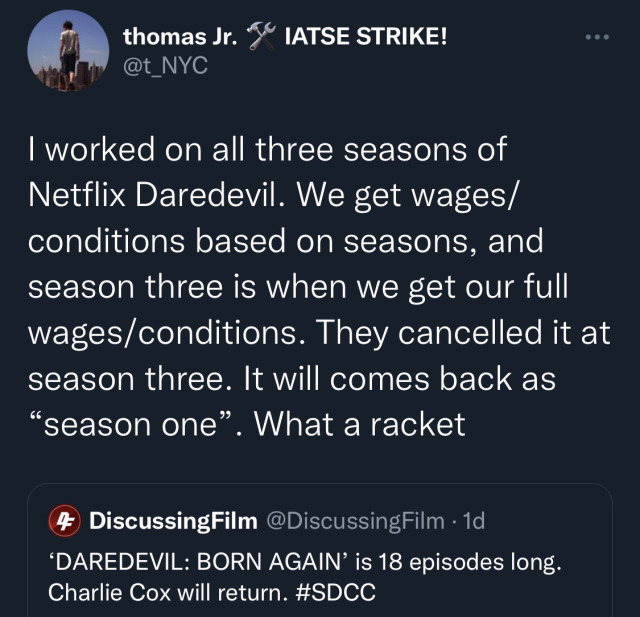
What the fuck… netflix only pay in full once a show reaches season 3? And by rebooting daredevil and restarting it as season 1,...

dirhwangdaseul-archived:

pyaasa:

What the fuck… netflix only pay in full once a show reaches season 3? And by rebooting daredevil and restarting it as season 1, Disney+ can get away with not paying the crew in full

uh that literally answers why they have a three season model that literally writers never knew about because netflix alway pulls the rug from under them, their fucking greed has always been their business model, there’s no saving that company

Like, knowing the history of Hollywood, and showbiz accounting, and how you really need to factor contracts by what parts of it can you get enforced and at what cost and whether the literal application of contract language actually gets you what you want and the background of Writers’ Guild struggles re: streaming, this is 120% believable

Tagged: screenwriting

Thinking about how important it was to Malcolm in the Middle that any given family member could conceivably act as the voice of...

Thinking about how important it was to Malcolm in the Middle that any given family member could conceivably act as the voice of reason in relation to any other

Tagged: screenwriting malcolm in the middle

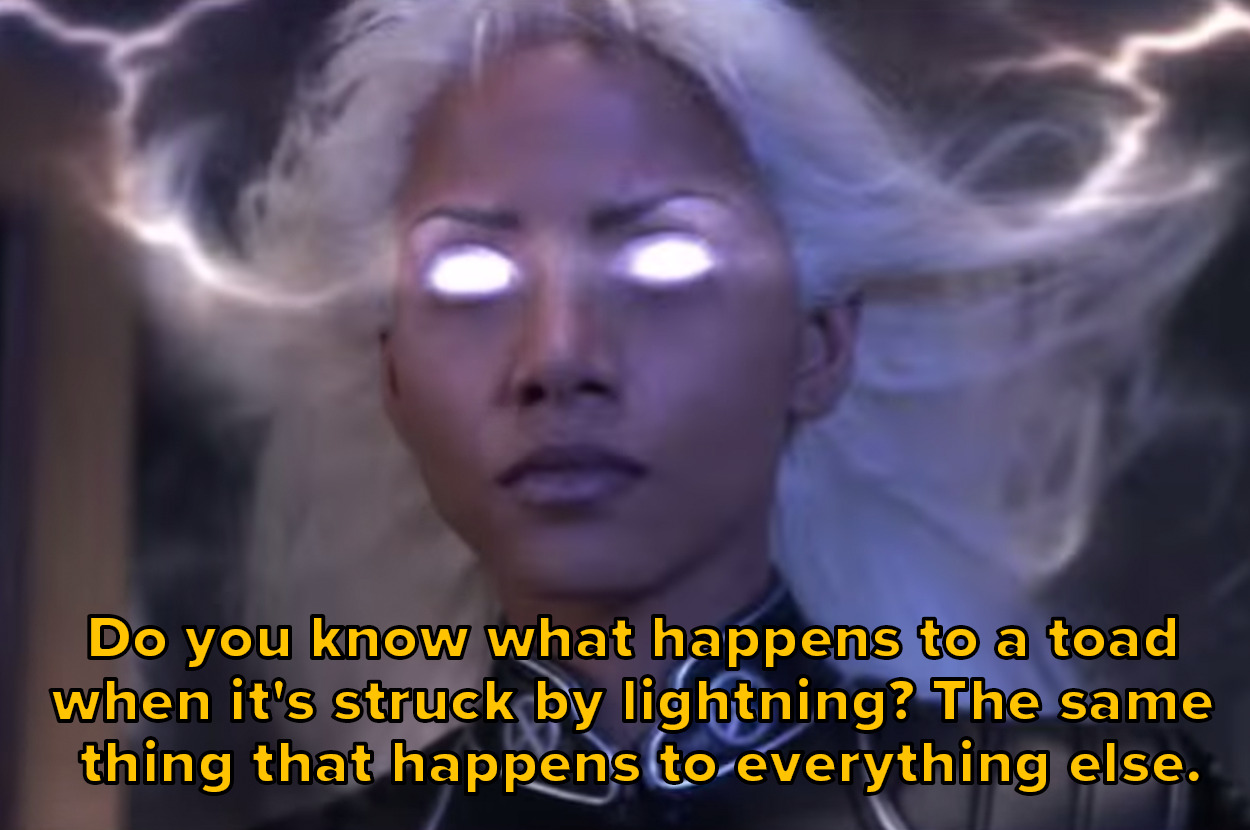
In X-Men (2000), Storm makes the bold decision to say one of the worst lines in movie history.

gcu-sovereign:

paradigm-adrift:

fipindustries:

derinthescarletpescatarian:

shittymoviedetails:

In X-Men (2000), Storm makes the bold decision to say one of the worst lines in movie history.

I loved this line actually, I thought it was hilarious

aparently in an early version of the script there was a recurring gag where toad would go around sharing weird facts about frogs and toads throughout the movie, so when storm said here at the end it was meant to be an ironic come back

in the end they cut toads lines out of the script but for some reason they left ororo’s comeback line

I’m suddenly mourning the toad facts X-men movie that I never knew could have been.

It’s still memorable, but fucking why did Berry roll with it like that?

That was a Joss Whedon line (he first made his name polishing feature scripts even before TV) and is a good illustration of why he made such an effort to advance to directing, so he’d be in a position to stop people from fucking his writing up

Tagged: screenwriting

crazy that so much tv is just so bad. don’t people literally go to school and dedicate their careers to this in a highly...

kontextmaschine:

brazenautomaton:

arbitrarygreay:

brazenautomaton:

arbitrarygreay:

pussyhoundspock:

crazy that so much tv is just so bad. don’t people literally go to school and dedicate their careers to this in a highly competitive job market. aren’t you paid to be good at this. 

The thing is, especially when it comes to TV writers, the industry inherently filters for the people who can turn in the script on time. For everyone in the notes talking about fanfic, those are the results of people having infinite prep time to think about the entirety of the canon and draw out all of the patterns in it, in order to extrapolate what “should” happen.

In real life? You have to come in with multiple well-developed pitches and spec scripts, and be prepared to hypothetically do it for any/every episode of that season, ON PRODUCTION SCHEDULE. Are your fave fanfic writers popping out a finished case fic once a week, for at least 3 months? Can they rewrite those halfway through because suddenly the favorite recurring guest star won’t be available?

It doesn’t matter how good the artistic vision is, if you can’t deliver the writing on time. If you can’t answer the phone and the emails and attend the meetings and make your pitch multiple times and talk back to the many rounds of feedback and weather all of that rejection and also write the scripts concurrently, all under time crunch.

In other words, it’s all about executive function. RIP 99% of fandom’s population.

like you can say that it’s about turning in scripts on time, and that would lead to things being bland

but this doesn’t explain CW writers. this doesn’t explain how people can be such bafflingly BAD writers and continue to be paid for it

See, what happens is that showrunners get to make shows because they could attend all of the emails and phone calls and in-person meetings with all of the execs on time, without being destroyed by their anxiety. This impacts the kind of story they even think is possible or relatable.

Then they hire the people around them who can mimic the writing the showrunner did, and turn in many scripts like that on time. This further impacts the kinds of stories they think are even possible. Also, production schedules necessarily truncate how much editing they can do before any scripts are forcibly sent off to production. Production budgeting also impacts how much time the writers can even spend time thinking about what’s happening with the characters and relationships before the script writing even happens in the first place.

I’m not saying that it’s impossible for good art to happen in such an environment. Obviously, good TV happens! But 1) several of those involve writers georg who are outlier workaholics and 2) my point is that the incentive gradients aren’t tilted towards good art, they’re tilted towards “can you get the episode to the broadcast station on time.” Bad Episode That Actually Broadcasts will automatically make more ad money than No Episode Broadcasts, ergo, bad writers who turn the scripts in on time will get paid over good writers who cannot.

The alternative to not filtering for people who can turn the content in on time (and under budget) is the shitshow the anime industry is in.

I’m saying that there is a population of people who can turn in content on time that is merely bland or below-average, so “they can turn in scripts on time” cannot be the only explanation why the CW continues to use astonishingly, bafflingly, jaw-droppingly bad writers

Netflix’s Another Life was 10 episodes, all of which premiered at the same time, at a date of their choosing. They had time to get it right. The writing in that series was not merely bad, it was nonsensical. Like there’s no amount of “on time” that makes up for the sheer fucking gibberish in these episodes, these things were not minimum viable product, they were wildly and obviously inferior to that fanfic writer with low executive function’s WIP. How did that happen?

Series that have no time pressure turn out bafflingly bad writing in exactly the same way, being on time cannot be the answer.

Jesus, you don’t bring specs and pitches to a running show unless it’s — do Star Trek shows still do that? Maybe as a legacy of TOS being Sixties SF Playhouse, they were the only ones still doing it in the ‘90s. Under Writer’s Guild rules shows are required to buy one freelance script a year but even then it’s heavily (uncreditedly) rewritten by the staff because since TV writing staffed up in the ‘80s they’re too tightly written to farm out, and even then it’s uneven. You can tell which the outside-pitched episodes on the 2000s Battlestar Galactica because they’re completely tonally incongruous and batshit characterization.

And like, lifetime showrunning careers might be filtered on executive sensibilities but no one gets Aaron Spelling’s career these days, the far more common situation is that someone who’d been on staff for years elsewhere gets a pilot greenlit on the strength of their writing and then it’s a total crapshoot how they do at the production executive side of things, that was the story behind a fair bit of “oh but that show was so good, how’d it get cancelled midsession?”

Netflix-style “dump a whole season at once” production started after I checked out of that world, can’t speak too confidently there.
But like if you can’t finish scripts in town you probably don’t even make it through your first season at “story editor” (the entry-level writing staff) to get to the point where you’re pitching pilots

Tagged: screenwriting

crazy that so much tv is just so bad. don’t people literally go to school and dedicate their careers to this in a highly...

alexanderrm:

kontextmaschine:

brazenautomaton:

arbitrarygreay:

brazenautomaton:

arbitrarygreay:

pussyhoundspock:

crazy that so much tv is just so bad. don’t people literally go to school and dedicate their careers to this in a highly competitive job market. aren’t you paid to be good at this. 

The thing is, especially when it comes to TV writers, the industry inherently filters for the people who can turn in the script on time. For everyone in the notes talking about fanfic, those are the results of people having infinite prep time to think about the entirety of the canon and draw out all of the patterns in it, in order to extrapolate what “should” happen.

In real life? You have to come in with multiple well-developed pitches and spec scripts, and be prepared to hypothetically do it for any/every episode of that season, ON PRODUCTION SCHEDULE. Are your fave fanfic writers popping out a finished case fic once a week, for at least 3 months? Can they rewrite those halfway through because suddenly the favorite recurring guest star won’t be available?

It doesn’t matter how good the artistic vision is, if you can’t deliver the writing on time. If you can’t answer the phone and the emails and attend the meetings and make your pitch multiple times and talk back to the many rounds of feedback and weather all of that rejection and also write the scripts concurrently, all under time crunch.

In other words, it’s all about executive function. RIP 99% of fandom’s population.

like you can say that it’s about turning in scripts on time, and that would lead to things being bland

but this doesn’t explain CW writers. this doesn’t explain how people can be such bafflingly BAD writers and continue to be paid for it

See, what happens is that showrunners get to make shows because they could attend all of the emails and phone calls and in-person meetings with all of the execs on time, without being destroyed by their anxiety. This impacts the kind of story they even think is possible or relatable.

Then they hire the people around them who can mimic the writing the showrunner did, and turn in many scripts like that on time. This further impacts the kinds of stories they think are even possible. Also, production schedules necessarily truncate how much editing they can do before any scripts are forcibly sent off to production. Production budgeting also impacts how much time the writers can even spend time thinking about what’s happening with the characters and relationships before the script writing even happens in the first place.

I’m not saying that it’s impossible for good art to happen in such an environment. Obviously, good TV happens! But 1) several of those involve writers georg who are outlier workaholics and 2) my point is that the incentive gradients aren’t tilted towards good art, they’re tilted towards “can you get the episode to the broadcast station on time.” Bad Episode That Actually Broadcasts will automatically make more ad money than No Episode Broadcasts, ergo, bad writers who turn the scripts in on time will get paid over good writers who cannot.

The alternative to not filtering for people who can turn the content in on time (and under budget) is the shitshow the anime industry is in.

I’m saying that there is a population of people who can turn in content on time that is merely bland or below-average, so “they can turn in scripts on time” cannot be the only explanation why the CW continues to use astonishingly, bafflingly, jaw-droppingly bad writers

Netflix’s Another Life was 10 episodes, all of which premiered at the same time, at a date of their choosing. They had time to get it right. The writing in that series was not merely bad, it was nonsensical. Like there’s no amount of “on time” that makes up for the sheer fucking gibberish in these episodes, these things were not minimum viable product, they were wildly and obviously inferior to that fanfic writer with low executive function’s WIP. How did that happen?

Series that have no time pressure turn out bafflingly bad writing in exactly the same way, being on time cannot be the answer.

Jesus, you don’t bring specs and pitches to a running show unless it’s — do Star Trek shows still do that? Maybe as a legacy of TOS being Sixties SF Playhouse, they were the only ones still doing it in the ‘90s. Under Writer’s Guild rules shows are required to buy one freelance script a year but even then it’s heavily (uncreditedly) rewritten by the staff because since TV writing staffed up in the ‘80s they’re too tightly written to farm out, and even then it’s uneven. You can tell which the outside-pitched episodes on the 2000s Battlestar Galactica because they’re completely tonally incongruous and batshit characterization.

And like, lifetime showrunning careers might be filtered on executive sensibilities but no one gets Aaron Spelling’s career these days, the far more common situation is that someone who’d been on staff for years elsewhere gets a pilot greenlit on the strength of their writing and then it’s a total crapshoot how they do at the production executive side of things, that was the story behind a fair bit of “oh but that show was so good, how’d it get cancelled midsession?”

Netflix-style “dump a whole season at once” production started after I checked out of that world, can’t speak too confidently there.
Out of curiosity, which were the outside-pitched episodes of BSG 2004? I’ve tried Googling and not found anything. I didn’t notice at the time but then I last watched it in high school and may still not have been that great at noticing things like that or just had lower standards overall.

Honestly I was thinking “Black Market”, the one where Apollo leaves Galactica for an episode to have an action-adventure with his new hooker wife, but apparently that guy was staff and they just shot a completely unpolished script (I know the signs. But later they got Jane Espenson, who was behind like 50% of the wordplay attributed to Joss Whedon!) for an unrelated reason

Tagged: screenwriting

crazy that so much tv is just so bad. don’t people literally go to school and dedicate their careers to this in a highly...

brazenautomaton:

arbitrarygreay:

brazenautomaton:

arbitrarygreay:

pussyhoundspock:

crazy that so much tv is just so bad. don’t people literally go to school and dedicate their careers to this in a highly competitive job market. aren’t you paid to be good at this. 

The thing is, especially when it comes to TV writers, the industry inherently filters for the people who can turn in the script on time. For everyone in the notes talking about fanfic, those are the results of people having infinite prep time to think about the entirety of the canon and draw out all of the patterns in it, in order to extrapolate what “should” happen.

In real life? You have to come in with multiple well-developed pitches and spec scripts, and be prepared to hypothetically do it for any/every episode of that season, ON PRODUCTION SCHEDULE. Are your fave fanfic writers popping out a finished case fic once a week, for at least 3 months? Can they rewrite those halfway through because suddenly the favorite recurring guest star won’t be available?

It doesn’t matter how good the artistic vision is, if you can’t deliver the writing on time. If you can’t answer the phone and the emails and attend the meetings and make your pitch multiple times and talk back to the many rounds of feedback and weather all of that rejection and also write the scripts concurrently, all under time crunch.

In other words, it’s all about executive function. RIP 99% of fandom’s population.

like you can say that it’s about turning in scripts on time, and that would lead to things being bland

but this doesn’t explain CW writers. this doesn’t explain how people can be such bafflingly BAD writers and continue to be paid for it

See, what happens is that showrunners get to make shows because they could attend all of the emails and phone calls and in-person meetings with all of the execs on time, without being destroyed by their anxiety. This impacts the kind of story they even think is possible or relatable.

Then they hire the people around them who can mimic the writing the showrunner did, and turn in many scripts like that on time. This further impacts the kinds of stories they think are even possible. Also, production schedules necessarily truncate how much editing they can do before any scripts are forcibly sent off to production. Production budgeting also impacts how much time the writers can even spend time thinking about what’s happening with the characters and relationships before the script writing even happens in the first place.

I’m not saying that it’s impossible for good art to happen in such an environment. Obviously, good TV happens! But 1) several of those involve writers georg who are outlier workaholics and 2) my point is that the incentive gradients aren’t tilted towards good art, they’re tilted towards “can you get the episode to the broadcast station on time.” Bad Episode That Actually Broadcasts will automatically make more ad money than No Episode Broadcasts, ergo, bad writers who turn the scripts in on time will get paid over good writers who cannot.

The alternative to not filtering for people who can turn the content in on time (and under budget) is the shitshow the anime industry is in.

I’m saying that there is a population of people who can turn in content on time that is merely bland or below-average, so “they can turn in scripts on time” cannot be the only explanation why the CW continues to use astonishingly, bafflingly, jaw-droppingly bad writers

Netflix’s Another Life was 10 episodes, all of which premiered at the same time, at a date of their choosing. They had time to get it right. The writing in that series was not merely bad, it was nonsensical. Like there’s no amount of “on time” that makes up for the sheer fucking gibberish in these episodes, these things were not minimum viable product, they were wildly and obviously inferior to that fanfic writer with low executive function’s WIP. How did that happen?

Series that have no time pressure turn out bafflingly bad writing in exactly the same way, being on time cannot be the answer.

Jesus, you don’t bring specs and pitches to a running show unless it’s — do Star Trek shows still do that? Maybe as a legacy of TOS being Sixties SF Playhouse, they were the only ones still doing it in the ‘90s. Under Writer’s Guild rules shows are required to buy one freelance script a year but even then it’s heavily (uncreditedly) rewritten by the staff because since TV writing staffed up in the '80s they’re too tightly written to farm out, and even then it’s uneven. You can tell which the outside-pitched episodes on the 2000s Battlestar Galactica because they’re completely tonally incongruous and batshit characterization.

And like, lifetime showrunning careers might be filtered on executive sensibilities but no one gets Aaron Spelling’s career these days, the far more common situation is that someone who’d been on staff for years elsewhere gets a pilot greenlit on the strength of their writing and then it’s a total crapshoot how they do at the production executive side of things, that was the story behind a fair bit of “oh but that show was so good, how’d it get cancelled midsession?”

Netflix-style “dump a whole season at once” production started after I checked out of that world, can’t speak too confidently there.
Tagged: screenwriting

I wonder if this CMT women-household sitcom is aware it is clearly being written by lesbians

I wonder if this CMT women-household sitcom is aware it is clearly being written by lesbians

Tagged: screenwriting

How can one learn to "understand tv screenwriting a bit"?

Anonymous asked:

How can one learn to "understand tv screenwriting a bit"?

Honestly Jane Espenson’s blog in the late 2000s?

Tagged: screenwriting

God once you understand TV screenwriting a bit you really appreciate how much the bits where Scully does autopsies are there to...

God once you understand TV screenwriting a bit you really appreciate how much the bits where Scully does autopsies are there to establish something while chewing up the maximum time while giving you something slightly more interesting than a Vancouver-area office building to look at

Tagged: screenwriting

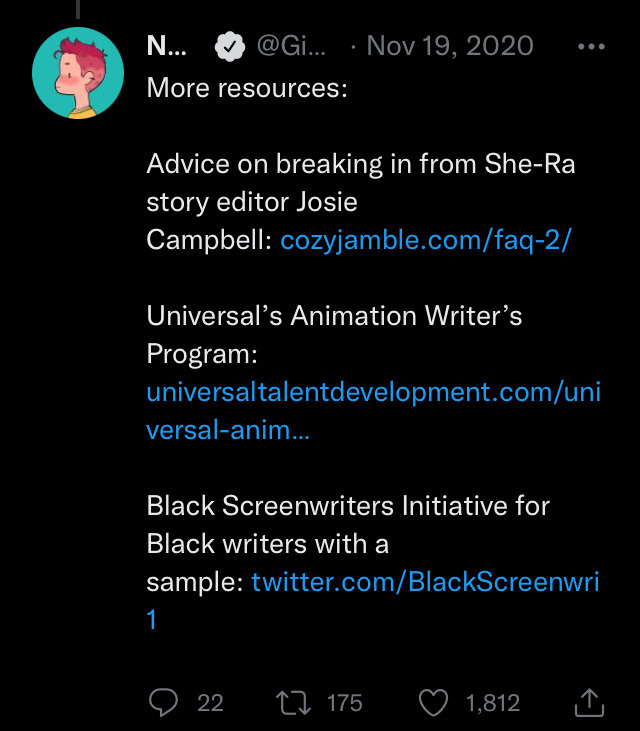
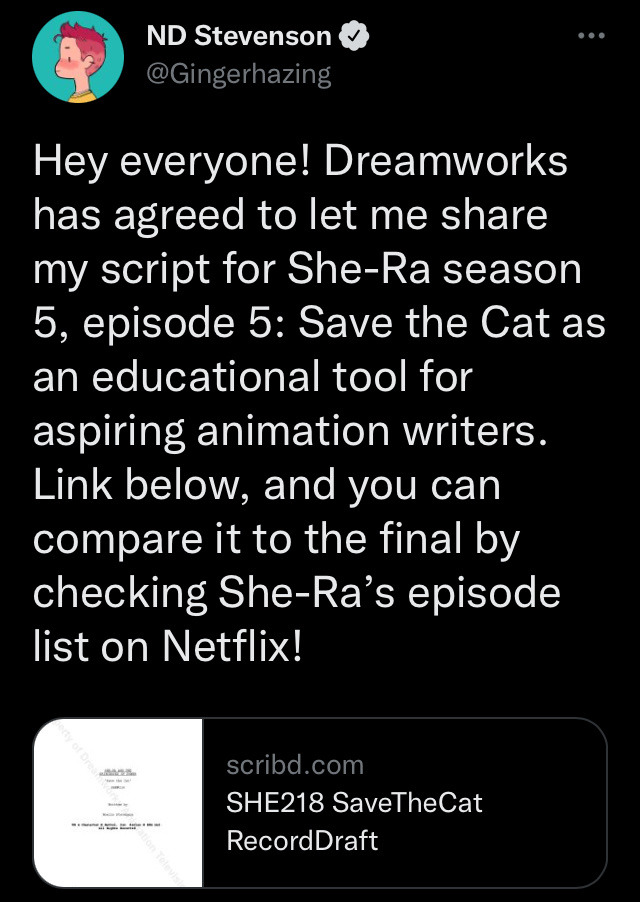
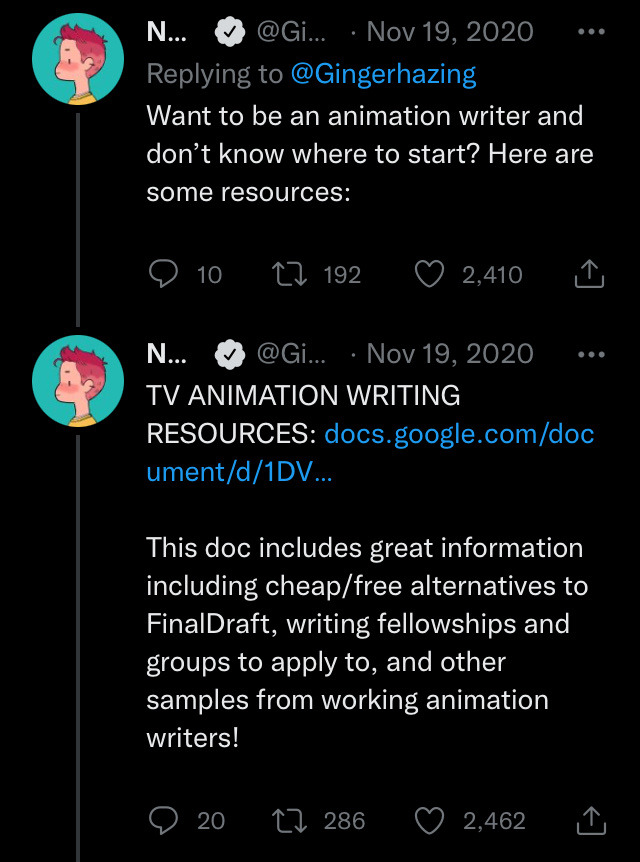
N. D. Stevenson I love you with my entire heart. Link to tweet here Screenwriter’s bible pdf here

pixelartpeach:

N. D. Stevenson I love you with my entire heart.

Link to tweet here

Screenwriter’s bible pdf here

Tagged: screenwriting

A lot of "plot holes" come down to in real life you don't interrupt things to bring up all the options that obviously won't work...

A lot of “plot holes” come down to in real life you don’t interrupt things to bring up all the options that obviously won’t work for the sake of explaining why before going with the one that might.

Tagged: screenwriting

God, Scully autopsy scenes are totally "and now, we advance the plot with a one-hander with voiceover shot on a sound set".

God, Scully autopsy scenes are totally “and now, we advance the plot with a one-hander with voiceover shot on a sound set”.

Tagged: screenwriting

crazy how many nineties sitcoms were like "five people in an office" or "a married couple on separate armchairs" and that's...

argumate:

kontextmaschine:

argumate:

squareallworthy:

argumate:

crazy how many nineties sitcoms were like “five people in an office” or “a married couple on separate armchairs” and that’s pretty much the whole show.

Yeah, like The Mary Tyler Moore Show or WKRP in Cincinnati or All in the Family, the 90s were so weird that way.

perhaps the real question is when exactly did sitcoms die

1999, with the debut of Who Wants to Be A Millionaire. Then you had Survivor in 2000, the US Weakest Link and Fear Factor in 2001, Deal or No Deal in 2005. Game shows and competitive reality TV was less expensive to produce but pulled ratings anyway, the sitcom was widely considered a dead format when I arrived in screenwriting LA until 30 Rock (which, I keep reminding, was not the SNL riff out of it and Studio 60 on the Sunset Strip that was expected to survive)

so how do you classify Big Bang Theory and Two and a Half Men in that scheme?

Chuck Lorre sopping up the dregs of the three-camera tradition like a crust of bread cleaning a plate of stew. No one was trying to prove they could write in that style.

Tagged: screenwriting

‘Fight Club’ Author Chuck Palahniuk Says China’s Censored Ending Is Actually Truer to His Vision

‘Fight Club’ Author Chuck Palahniuk Says China’s Censored Ending Is Actually Truer to His Vision

antoine-roquentin:

“The irony is that the way the Chinese have changed it is they’ve aligned the ending almost exactly with the ending of the book, as opposed to Fincher’s ending, which was the more spectacular visual ending,” he said. “So in a way, the Chinese brought the movie back to the book a little bit.”

The author also said that he saw the irony in the angry response from many Americans to China’s actions, given that his books are banned in many locations across the U.S.

“What I find really interesting is that my books are heavily banned throughout the U.S.,” he said. “The Texas prison system refuses to carry my books in their libraries. A lot of public schools and most private schools refuse to carry my books. But it’s only an issue once China changes the end of a movie? I’ve been putting up with book banning for a long time.”

He also said that having his work revised in ways he can’t control is nothing new to him.

“A lot of my overseas publishers have edited the novel so the novel ends the way the movie ends,” he said. “So I’ve been dealing with this kind of revision for like 25 years.”

If you’ve never read it, Fight Club the novel is damn near a shooting script for the film aside from the end and I think the scene with threatened castration is more directly against the narrator when he starts asking questions and takes place on a parked bus? Anyway, most authors would kill for that kind of fidelity in screen adaptation

Tagged: screenwriting fight club chuck palahniuk

Did You Know: a given movie will usually have several, wildly varying scripts commissioned from multiple writers over the course...

Did You Know: a given movie will usually have several, wildly varying scripts commissioned from multiple writers over the course of development and production, and writing credit for the resulting film (which often includes elements from multiple drafts) is determined and awarded after the fact by a guild inquisition

Tagged: screenwriting

Wonder if any screenwriters have written Hallmark Christmas movies as their calling card spec scripts.

Wonder if any screenwriters have written Hallmark Christmas movies as their calling card spec scripts.

Tagged: screenwriting

I think if they want to keep making Star Trek shows they need to quit it with the lore shit and go back to the spirit of TOS...

quoms:

I think if they want to keep making Star Trek shows they need to quit it with the lore shit and go back to the spirit of TOS where it was a borderline anthology series slash way to farm work out to the best working SF/pulp writers. Down with thematic consistency, up with letting someone who wrote a few short stories you liked go hog wild on a script

Into DS9 or maybe Voyager, the Star Trek series’ were the last shows to accept, buy, and shoot episode pitches from outsiders

That used to be the standard up til the 80s when writing staffs got bigger (that’s why that’s when multi-episode throughlines and worldbuilding coherence started to show up and before that characters were a collection of easily graspable traits and a catchphrase)

* except Writers’ Guild rules are you have to take one pitch a year but that’s manipulated and rewritten by senior writers

Tagged: screenwriting