shrine to the prophet of americana

#screenwriting (47 posts)

tragedy enjoyers when their favourite characters are brutally killed in a completely avoidable scenario of their own creation

lycanthrology:

tragedy enjoyers when their favourite characters are brutally killed in a completely avoidable scenario of their own creation

Tagged: screenwriting

Very patriotic fridge logic

gcu-sovereign:

The big speech in the last act of Independence Day.

President’s inspiring the fighter pilots that are going to be flying the climactic mission.

But at the very end, he fumbles it.

Not on delivery, but in the writing. ‘We’re going to live on.  We’re going to survive.  Today, we celebrate our independence day!’

The last sentence is bad!  You should have used a different temporal transition word.  Its the equivalent of failing to find a rhyme in composing a song’s lyrics, so you just use it again, but not as part of an obsessive point.  Say what you will about Metallica’s Frantic, but at least you know where their emphasis is!

I’ve not made a point about complaining over this line historically, but the speech’s place in popular culture has always felt a little undeserved.  Like everyone else was overlooking that the instruments and vocal parts on a major studio release just fell apart for no good reason in the last 30 seconds.

@kontextmaschine is this crazy to you?

Tagged: screenwriting

When you diagram it out, The Force in the original Star Wars trilogy is a so-blatant-it-becomes-good device to condition Luke's...

When you diagram it out, The Force in the original Star Wars trilogy is a so-blatant-it-becomes-good device to condition Luke’s progress in some character or plot arc on his progress in another that otherwise wouldn’t logically intersect really

Tagged: screenwriting

Occasional reminder that my "tried to become a screenwriter, gave up and decided to subject the world to his accumulated insight...

Occasional reminder that my “tried to become a screenwriter, gave up and decided to subject the world to his accumulated insight instead” is also Ben Shapiro’s backstory

Tagged: screenwriting

I’m gonna be honest and this is purely as a matter of taste and not about other issues pertaining to it but I think five seasons...

memecucker:

I’m gonna be honest and this is purely as a matter of taste and not about other issues pertaining to it but I think five seasons is a perfectly fine soft-limit for shows involving a continuous narrative. Stuff you can watch random episodes of like episodic conflict-of-the-week stuff, docu-series, game shows etc are different (and maybe an exception for book adaptations that use a season=book format) but like I remember when Breaking Bad ended as season 5 and people widely praised that as a show of restraint from the creators and the network because they could’ve easily milked it for two or three more seasons and the show would’ve suffered for it like has happened many times before. 2-3 seasons is way to short of a soft limit but 5 sounds fair

Tagged: screenwriting

i was reading a book on scriptwriting and it was explaining about setting up last-act payoffs and for an example started...

vintar:

i was reading a book on scriptwriting and it was explaining about setting up last-act payoffs and for an example started describing a suspense movie i’ve never seen, where in the first act the cop main character wants to hide his job from the love interest and so hides his big official police marksmanship trophy under his bed

and i was like, okay, sure, now the end of the movie’s all set up so he can do some expert high-stakes sharpshooting, but then it goes on to describe how in the climax the villain tries to murder the hero in his sleep, and in the struggle the hero… reaches under his bed and beats the villain to death with the trophy

so i guess chekhov’s gun has a fun new corollary: if there’s a gun on the wall in the first act, in the third act you can take it down and just fucking wail on someone with it

Tagged: screenwriting

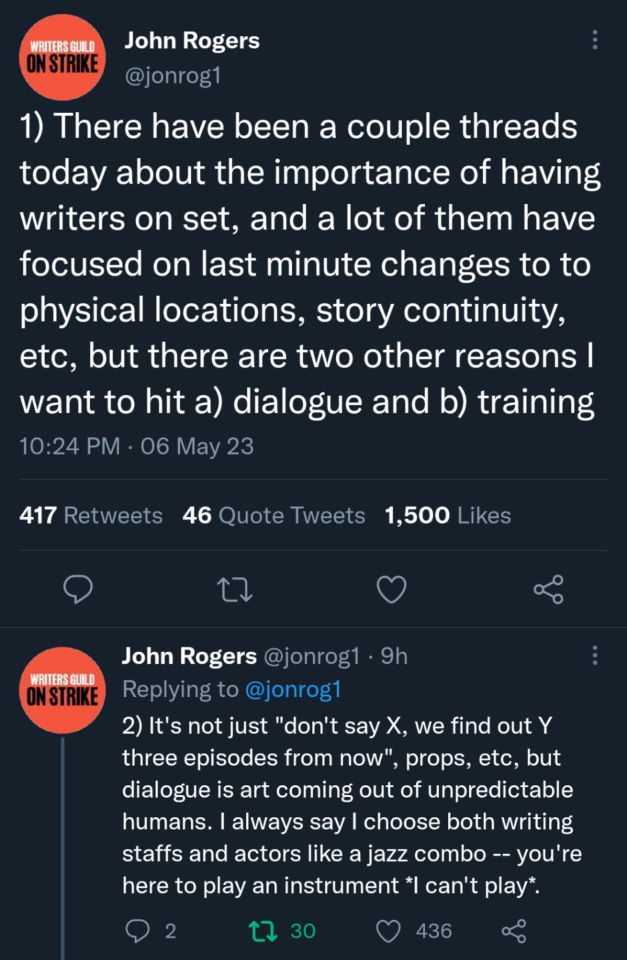
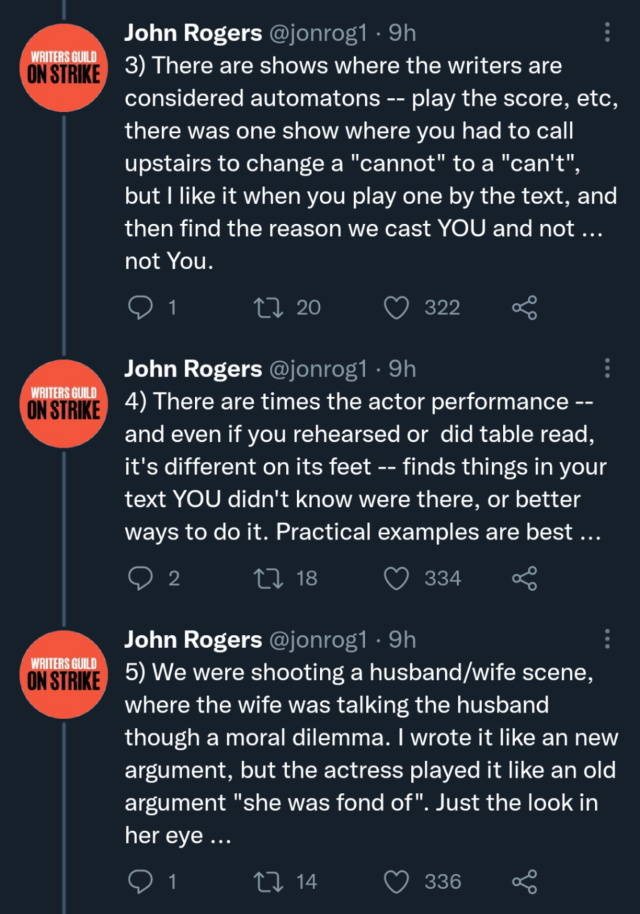
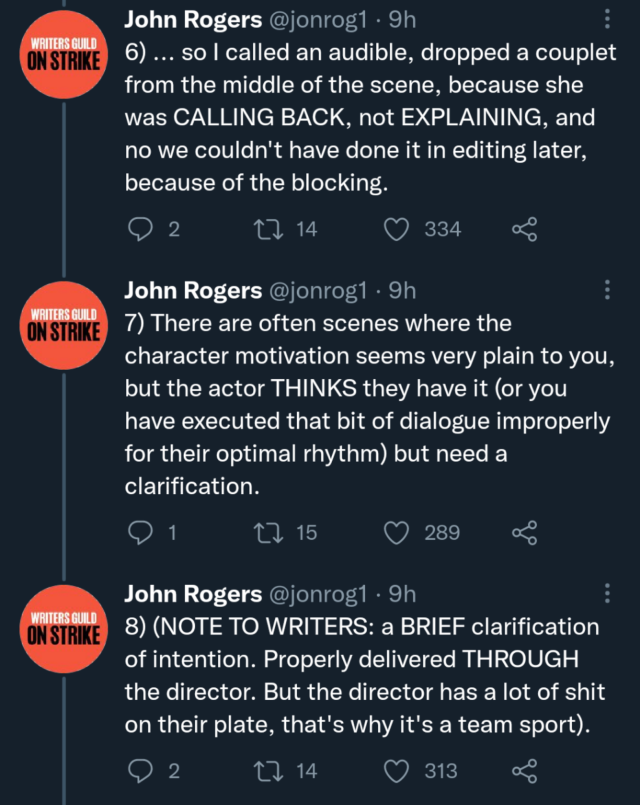
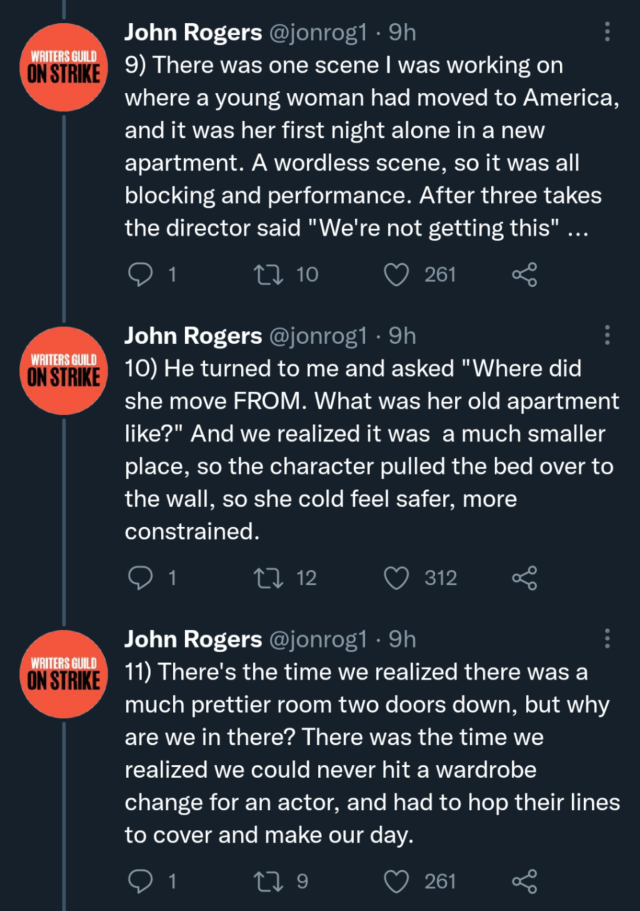
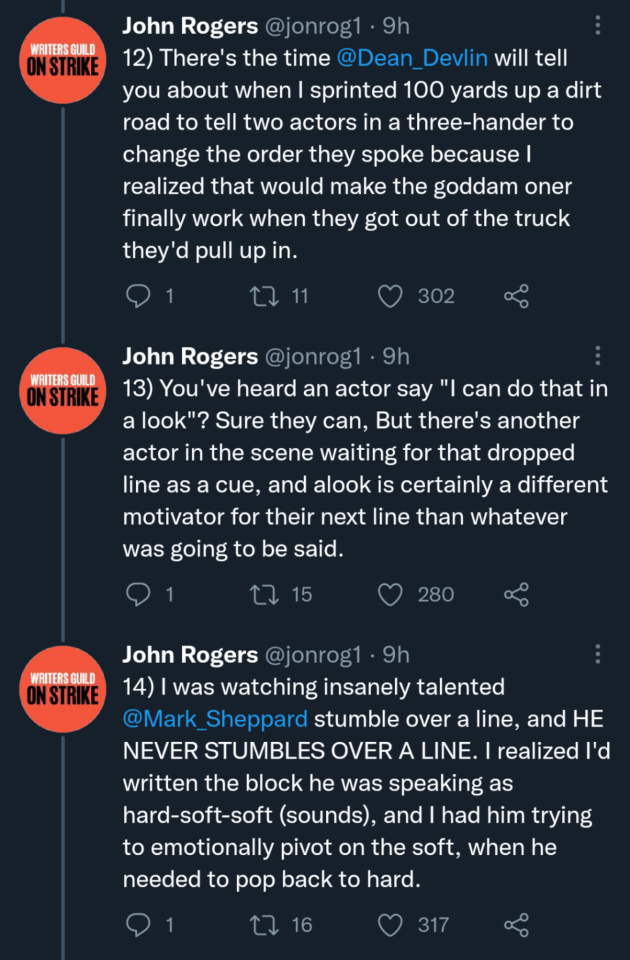
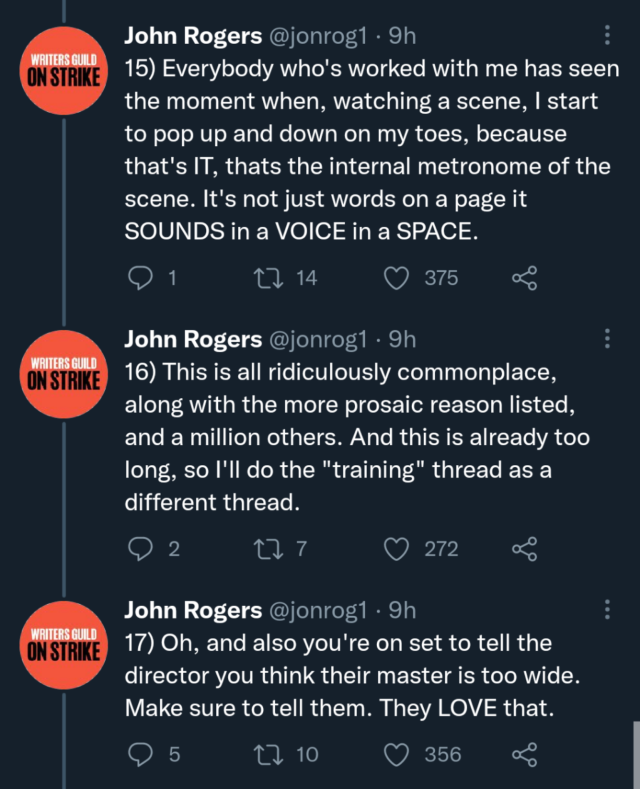
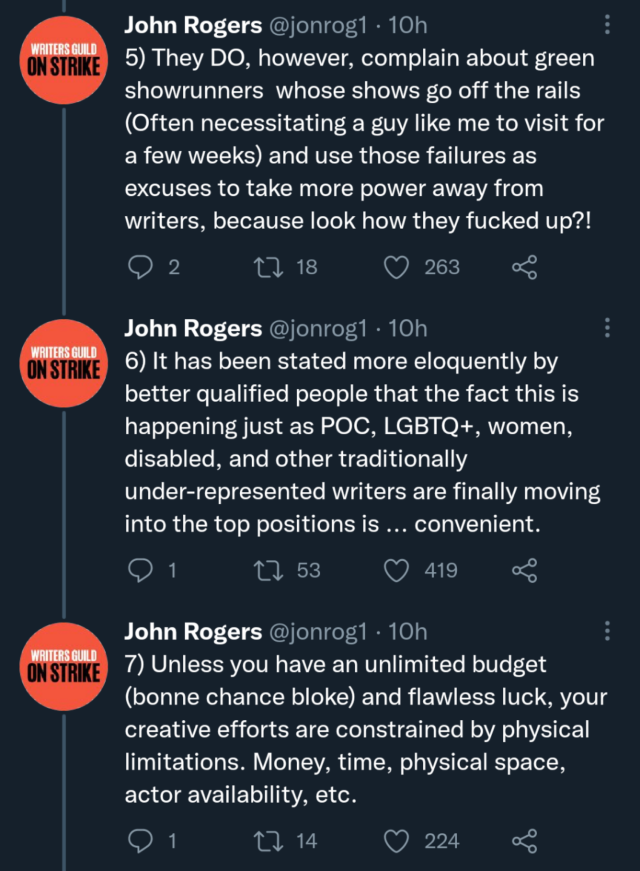
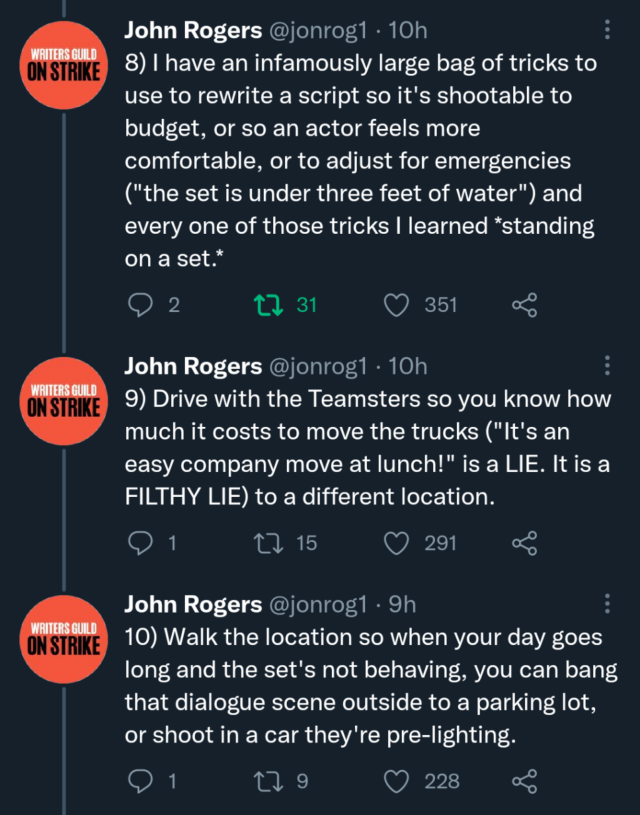
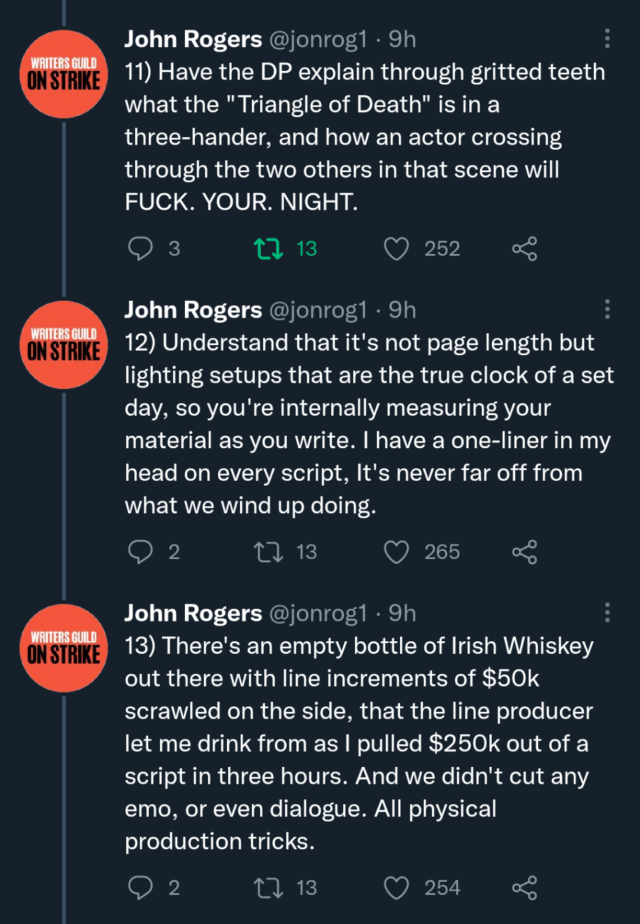
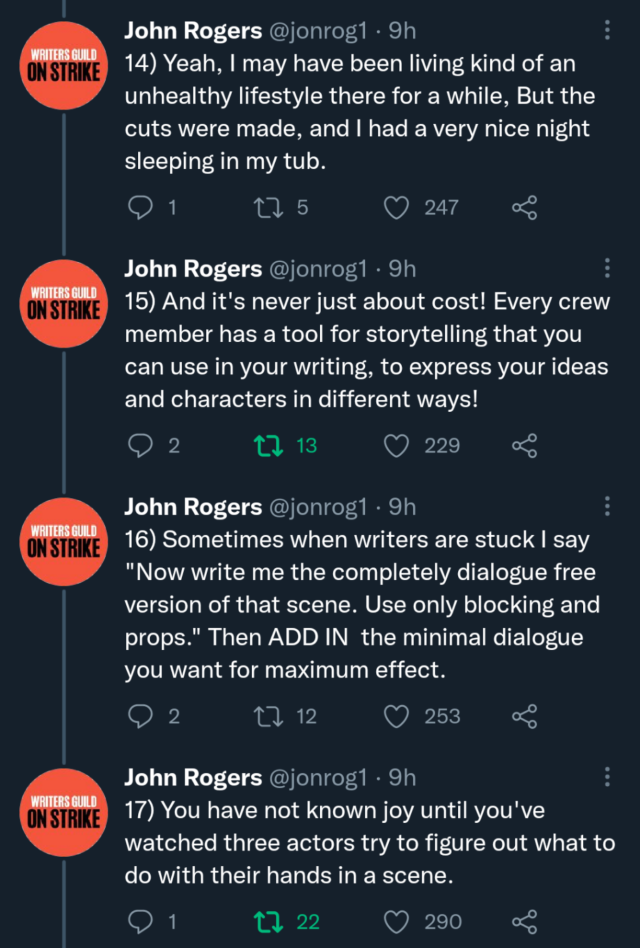
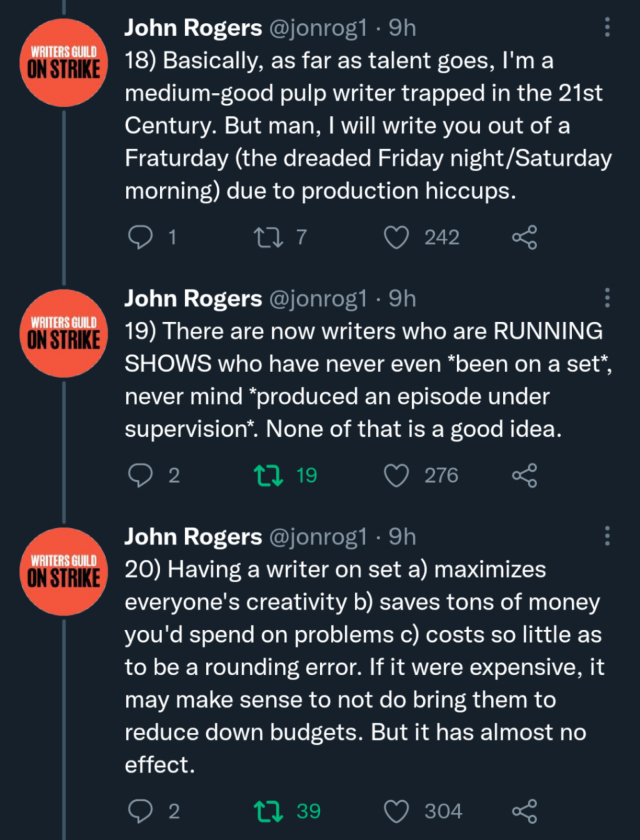
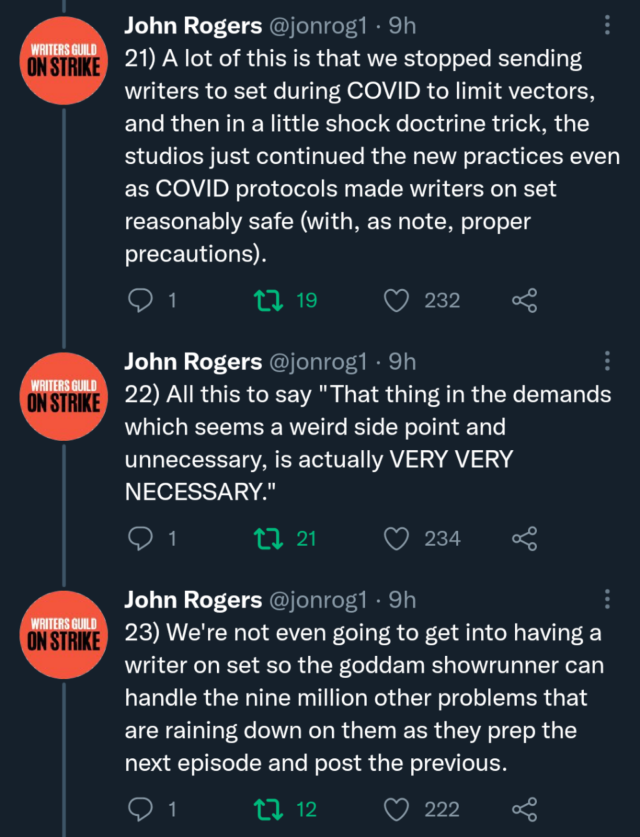
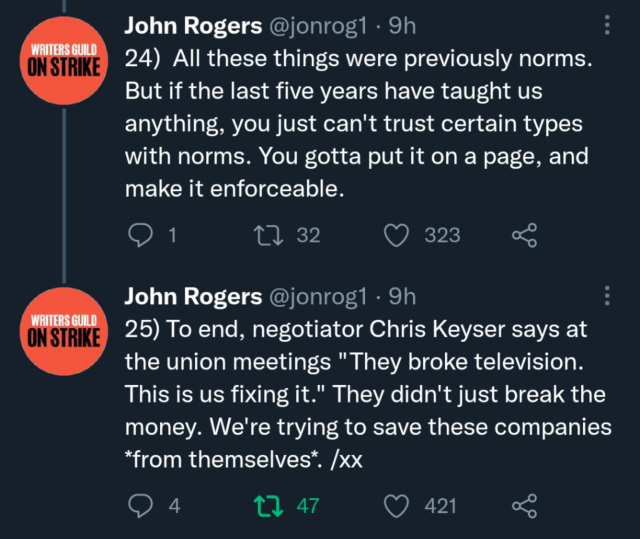
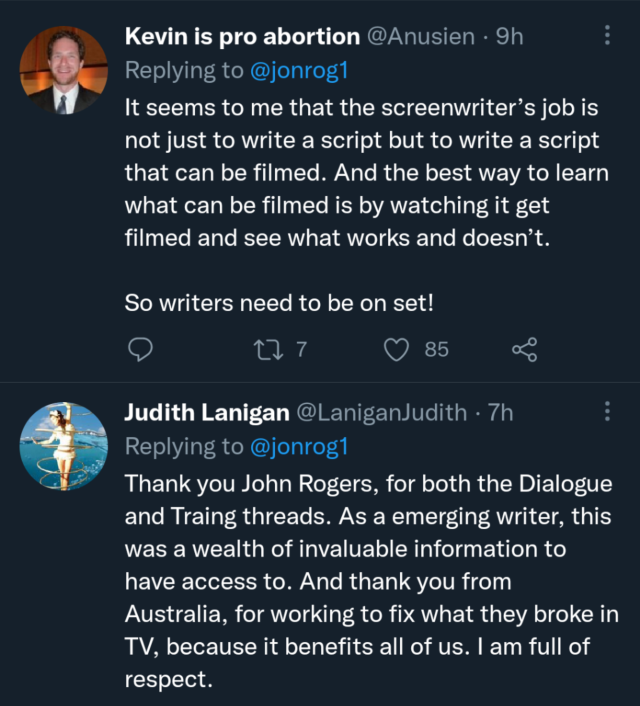
Really fantastic thread from John Rogers late on May 6th, 2023, about having writers on set for DIALOGUE.

dduane:

thefirsthogokage:

Really fantastic thread from John Rogers late on May 6th, 2023, about having writers on set for DIALOGUE.

(click to enlarge/have better quality)

(link to first tweet)

What came after Number 17 was a link to his follow up thread on training which I’m linking here.

…But reblogged here specifically for tweet #13. “You’ve heard an actor say, ‘I can do that with a look?’ Sure they can. But there’s another actor in the scene waiting for that dropped line as a cue, and a look is certainly a different motivator for their next line than whatever was going to be said.”

Tagged: screenwriting

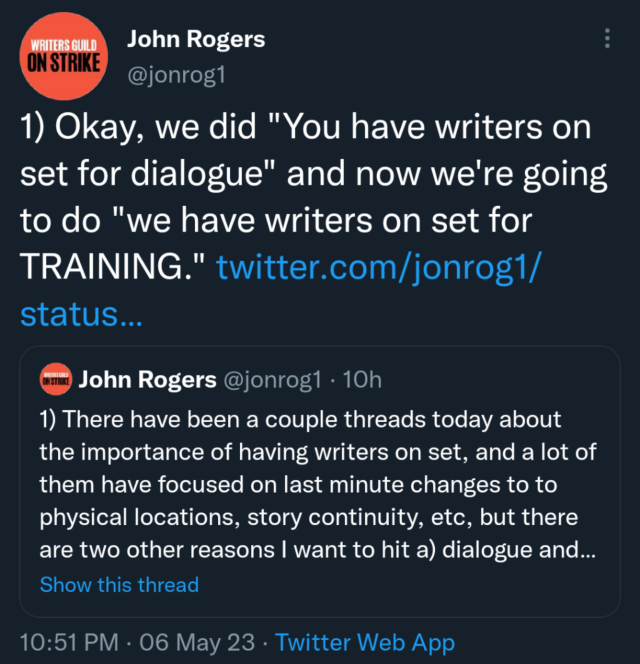
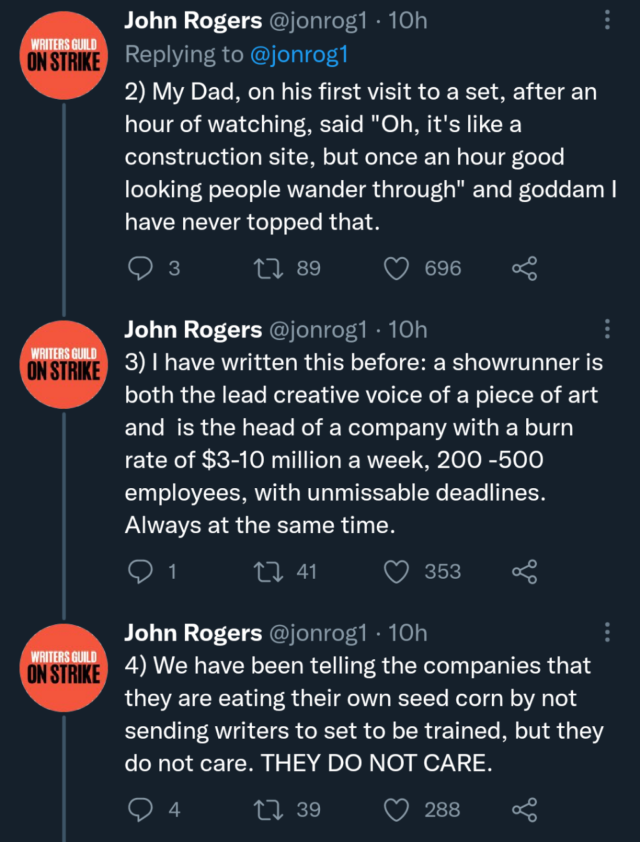
Great thread by John Rogers on why writers need to be on set for TRAINING purposes, written late on May 6th, 2023:

thefirsthogokage:

Great thread by John Rogers on why writers need to be on set for TRAINING purposes, written late on May 6th, 2023:

(click to enlarge and probably for better quality)

(link to first tweet)

Bonuses:

Link to John’s thread about having writers on set for DIALOGUE.

Tagged: screenwriting

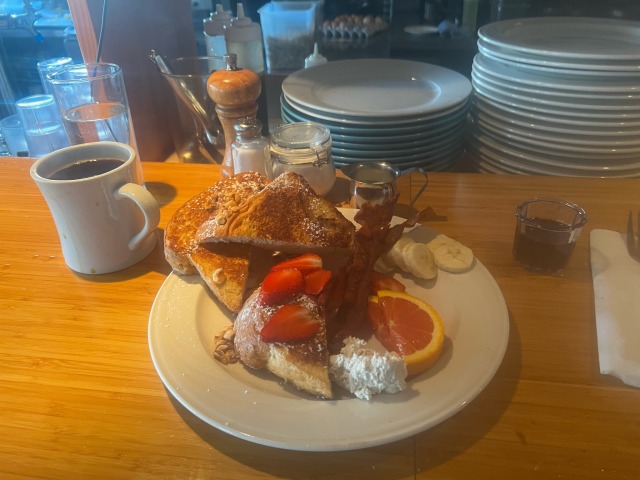
This is like the grown-up version of those "this complete breakfast" from cereal ads

kontextmaschine:

kontextmaschine:

This is like the grown-up version of those “this complete breakfast” from cereal ads

Every time I write “complete b” AutoCorrect primarily suggests “breakdown”, which was actually one of my favorite tossed-off Veronicaisms from my Veronica Mars spec (“Part of this complete breakdown!” Also, “I suffer from a congenital lack of ruth.”), but I’ve at most opened it as a PDF on this phone, I don’t know if it’s picking that up from this Apple ID on the laptop or just wordplay more obvious than the original.

Tagged: screenwriting veronica mars

This is like the grown-up version of those "this complete breakfast" from cereal ads

kontextmaschine:

This is like the grown-up version of those “this complete breakfast” from cereal ads

Every time I write “complete b” AutoCorrect primarily suggests “breakdown”, which was actually one of my favorite tossed-off Veronicaisms from my Veronica Mars spec (“Part of this complete breakdown!” Also, “I suffer from a congenital lack of ruth.”), but I’ve at most opened it as a PDF on this phone, I don’t know if it’s picking that up from this Apple ID on the laptop or just wordplay more obvious than the original.

Tagged: screenwriting veronica mars

I grew up being trained to recognize "guy who talks about not having a TV" as like, A Guy, in the negative sense, but yes oh my...

kontextmaschine:

I grew up being trained to recognize “guy who talks about not having a TV” as like, A Guy, in the negative sense, but yes oh my god just falling out of the habit of watching TV in college in the early 2000s and never picking it up again was so clutch

An ironic thing is this change happened before I tried to break into creating TV as a screenwriter, my Veronica Mars spec (“Miami Vice, Principles”) and before that, abortive Firefly were entirely based off watching DVDs after I’d heard the show was good

Tagged: screenwriting

Knowledge and Structure in Columbo

the-grey-tribe:

Knowledge and Structure in Columbo

I was writing a post about another murder mystery, and decided to spin this out into a new post. I can’t believe nobody ever spelled this out in the #Columbo tag, But first -

There is this TV show that was produced here in REDACTED in the 90s. They still air re-runs. Detective stories, murder mysteries, that stuff. Unfortunately, or fortunately in this case, the writing soon turned rather uninspired, and the show was severely hampered by the short length of each episode: In a time slot under and hour with three long ad breaks and a lengthy intro, the actual episodes take maybe 35 minutes. Every episode is extremely formulaic, must be extremely formulaic, in order to fit into the limited time budget. That makes it very easy to guess the murderer based on timing. The killer was almost always introduced around the seven minute mark. Every suspect introduced after minute 15 is a red herring, or it would feel like a solution coming out of nowhere. If they start to suspect one of the early suspects around minute 20 or 25, he’s a red herring. The guy who found the body is too obvious, so it’s never him. That means around minute 27, we get new forensic evidence or an alibi crumbles, and they start to look into the third guy from the beginning again, and then everything falls into place and the guy confesses, because it’s a TV show and we need some form of catharsis. Roll end credits.

Based on audience expectations and the structure of the narrative, it’s easy to guess whodunnit. It’s bad and formulaic, but it’s TV comfort food.

You can do a lot more with 42 or even 45 minutes. You can also do a lot wrong in a Netflix show with 10 episodes that have an hour of runtime each. Every Netflix show seems to be a bad copy of Twin Peaks, with all the loose threads and misdirection and cliffhangers.

Midsomer Murders is a guilty pleasure of mine. It was only really good during the first episodes that were directly based on Caroline Graham’s novels, but it managed to live on as self-parody and self-plagiarisation until today. What makes it work is that the episodes have 90 minutes, enough time for the plot to develop for half an hour so that characters introduced late don’t feel like they “came out of nowhere”. You can characterise the different suspects (or villagers, or victims) better, you can have more characters, you can have a second murder happen, or you can have the plot develop before the first murder has happened. The other thing that makes Midsomer Murders work is that the identity of the killer is really secondary. Everybody has a Big Secret, like a child given up for adoption, an ongoing love affair, impending bankrupcy, war trauma, or maybe their secret love child is living right next door, unknowingly. A good episode of Midsomer Murders has Tom Barnaby solve the Big Secrets of all the villagers, and that is the key to the murder mystery. There are multiple clues early on, people acting suspicious, but in the end the solution “comes out of nowhere”, and nobody remembers that one of the suspects was alone with the body for an hour after the guy who called the police left to look after his baby, but before the police arrived, and how some of the physical evidence did not make sense. A bad episode just has the means, motive and opportunity come out of nowhere, without Barnaby finding out who killed the second victim, or what the secrets of the other villagers are. You don’t mind the Ass Pull as long as at least the side plots are resolved. That’s the great misdirection of Midsomer Murders: The side plots are the main attraction.

In CSI: Miami, it is literally the point of the show that the solution comes “out of nowhere”. They analyse some residue on the victim’s shoe, and they find out that it’s alligator poop and the killer has a pet alligator, and then they match the composition of the alligator poop to the brand of pet food he buys at Wal-Mart. Also, this other guy had a Big Secret: He’s a sex trafficking hedge fund manager, but that’s unrelated to the murder. Nonetheless, he goes to jail: People like you *takes off glasses* make me sick.

It’s not just timing and setup/payoff. There are other structural-narrative considerations that make certain solutions to murder mysteries look unfair. If your suspects are Donald, Daisy, Gyro, Launchpad, Fenton, Gladstone, Hughie, Louis, and Dewey (not looking up the spelling but instead covering all my bases, I hope one of them is correct), then any one of the last three will feel weird. Either all three of them did it together, or none. If you want to make it look believable that the middle one of Donald’s nephews did it, you have to give them all distinct personalities and motives beyond having a different favourite colour, favourite food, and different hobbies.

Columbo is not constrained by all that. It’s a show where you already know who the killer is, and rather crucially, it’s a show where there are usually no big secrets and red herring characters. Here’s what tumblr posts about “why Columbo is great” seem to miss though: There are many scenes shot from the perspective of Columbo, and many from the perspective of the murderer, but most of the time, the audience knows what the killer knows, not what Columbo knows. Usually everything Lt. Columbo finds out in scenes that show his point of view is already known to the suspect, but maybe he doesn’t know that Columbo knows it. This way, there can be last minute eye witnesses, surprise twists you saw coming from a mile away, and forensic evidence that solves the case five minutes before the credits roll, but the audience only learns about the forensic evidence when the suspect is confronted with it.

In an episode of Midsomer Murders, it would be a letdown if there was some forensic evidence DCI Barnaby didn’t tell DS Troy about. At the very least, we have to see him open an envelope from forensics and look at Troy knowingly. It’s not “out of nowhere” if he doesn’t tell Troy what the result is, but the audience at least needs to know that the forensic evidence was a paternity test, or a fingerprint on the jewel box, or a ripped-up bank statement glued back together.

In Columbo, those things can literally come out of nowhere.

If you look at it through the eyes of Columbo, and not through the eyes of the suspect, he is not actually annoying suspects into confession. This is what the woman who killed her husband and made it look like a botched kidnapping observed in the first episode of the series, but it only looked like this from her perspective. It’s actually mostly regular police work. That’s just not what the audience sees. The audience looks at Columbo through the killer’s eye and sees a man in a wrinkly coat, just like the killer does not see the whole institution behind him.

Tagged: screenwriting

kontextmaschine:

This is absolutely going to be the energy of the Lego Movie (2014) crossed with the energy of Cats (2019) and I approve

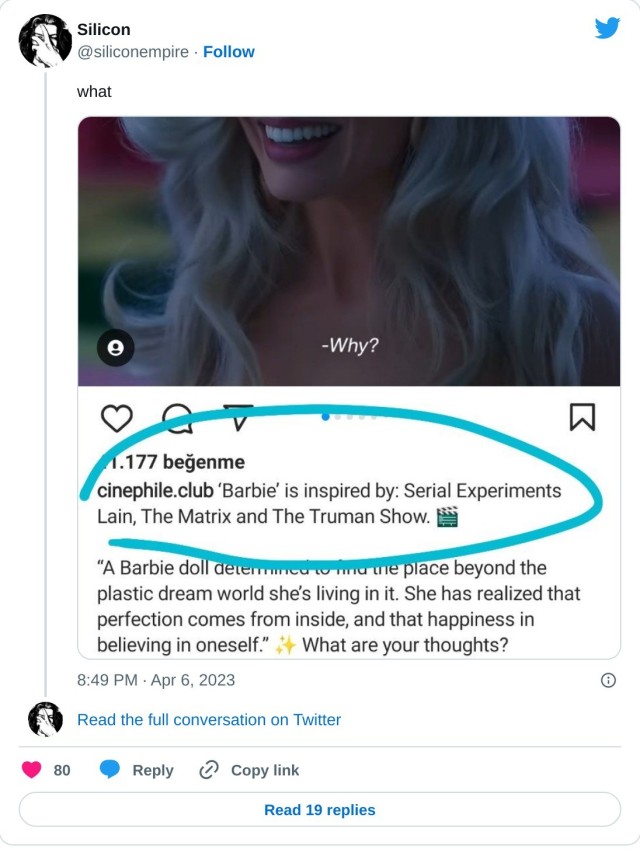
Tagged: also the google preview of that Cats page credits 'Miette Narrative' barbie 2023 reminder I was an aspiring screenwriter once and framing movie X as 'Y meets Z' is second nature screenwriting

touchdown!

space-wizards:

kontextmaschine:

theehorsepusssy:

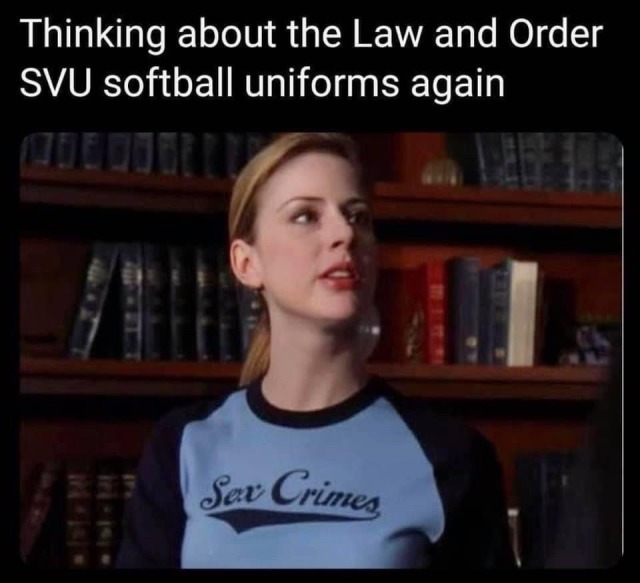
touchdown!

Actually good point, is “SVU” the police (“Order”) unit and the prosecutors (“Law”) are “Sex Crimes”? Then doesn’t the title after the colon undermine the premise of the part before?

I’m pretty sure “Law and Order” referring to the two halves of the episode is only a thing in the original, otherwise it’s just the franchise name. SVU and Criminal Intent only had the attorneys show up occasionally, and they’re the only two (US) spinoffs that lasted more than a season.

So they just worked the case and… was it at least implied that the suspects they were pursuing were convicted as the real perps?

Tagged: screenwriting

people seem to enjoy watching charismatic actors playing emotionally resonant characters in a lovingly rendered setting with a...

earlgraytay:

argumate:

brazenautomaton:

argumate:

kontextmaschine:

argumate:

thenightetc:

argumate:

people seem to enjoy watching charismatic actors playing emotionally resonant characters in a lovingly rendered setting with a consistent and unique aesthetic where the plot is merely a rough scaffolding that makes no real sense

Which is funny, because plot is at least theoretically the cheapest aspect (in some cases it can be done by one person working alone with no special equipment!), and therefore the one it makes the least sense to cut corners on.

But I suppose movies and tv involve a lot of editing, re-takes, doing things out of order for various pragmatic reasons, cutting things out for time or because they didn’t look good onscreen, and with all that maybe it’s not surprising that plot falls by the wayside, because plot is about the gestalt and not about any individual scene.

Plus, it’s easy enough to suspend your disbelief until it’s over–if you’re immersed, you probably won’t worry too much about what seems like minor inconsistencies or whatever, because you’re trusting that by the end it’ll all hang together.  And when you get to the end, well, you may have forgotten or at least no be longer thinking about various quibbles!  So it’s entirely possible to watch a movie, enjoy it, come out of it thinking “gosh that was great, very emotionally satisfying”, and only later go “wait, actually what happened there”… especially if you rewatch it.

that’s just it! you would think that good writing would be prized, considering it’s so cheap relative to a single visual effects shot, but in practice you would rather sacrifice it in favour of literally any other aspect of the production.

“it looked terrible and the acting was wooden and the actors unappealing but gosh that plot was fantastic, 10/10” just isn’t a common review summary

A lot of this just has to do with the structure of filmmaking by which the director is the boss (though accountable to studio funders/moneyman producers)

adjust to the other factors - actors and sets have already been paid for and film has already been shot, actors might be tied to production or promotions deals, but scripts can be rewritten easy separate from all of that, on the fly, even a new writer (this was how Joss Whedon really made his name)

In TV this is different writing has higher priority, some structural reasons relating to time pressure – you NEED to deliver a coherent time block by this deadline, every week, but the sets and actors are paid for for the season, at least the first 13/22s of it

A lot of the “Golden Age” of “Peak TV” has to do with the formation of writers rooms’ and the rise of the showrunner - the head writer who runs the whole production, has approval over casting, writing, directors - in the early ‘80s

Before TV tended to be more like standup comedy or magazines - you might have a core group of staff writers pitching ideas and guiding episodes but they solicited a lot of outside writers to submit stuff, or took pitches on spec, which is why a lot of old shows kind of play like commedia dell’arte, with the characters representing broad types with trademark quirks that any writer can pick up and run with

Then in the ‘80s you started to get more funding for staff, which let you bring on more writers and have them spend more time rewriting what outside stuff you had. That’s when shows started to get more distinct - Miami Vice was an obvious example but that was more in the way the action played to the visuals; that had something to do with writer-showrunner Michael Mann being one of the first-generation film school graduates coming out of the ‘70s, who’d been trained on the field as a tradition to innovate with. This is also how you get the densely knit comedy of early Simpsons, with money into writing

That was well-funded network shows at least, first-run syndicated shows – ones that weren’t run on a network but directly took bids from broadcast stations in each market – tended to be lower-funded genre pulp stuff. But even there there were standouts in the ‘90s, Xena, Babylon 5, even Star Trek: The Next Generation were syndicated

The Star Trek franchise of series was one of the last to take a lot of outside scripts, too, their tradition was always drawing on the wide pool of SF print writers. Anyway the syndicated angle kind of died as FOX and WB and the UPN gathered a lot of spare channels and regularized them, ran stuff like Buffy and Voyager themselves

So as the ‘90s went on you started to see more and more seasonal arcs as shows gained in their narrative capacity, then you saw the premium channels (which had more been doing anthology shows or soft porn for their original series) latch on and away we go

now that you mention cartoons, I guess they are one of the rare venues that can sacrifice aesthetic and actors for writing, although notably that tends to mean comedy rather than plot per se.

I think these explanations fail when you realize how many video games also have terrible writing. I’m not talking, like, excuse plots where they don’t care about the writing because it’s just there to justify the gameplay, either.

Exclusively looking at games with 3 in the title you have Bayonetta 3, The 3rd Birthday (aka Parasite Eve 3), Diablo 3, and Borderlands 3. (Mass Effect 3 is also on the list of badly written 3s but we know why that happened and only the ending was bad.) Each of these games has a story that is absolutely fucking God-awful from beginning to end such that you want to turn off subtitles and switch to a language you don’t understand, but you can’t, because then you don’t know what your objectives are.

And you can say “oh ho ho ho video games are not high art, the audience doesn’t care,” but the audience definitely NOTICES, from fucking minute one the vast majority who played these games was like “holy fuck this story is so bad.” More importantly, “the audience doesn’t care” would be an excuse to treat story as an afterthought, put no effort into it; but that’s not what happens!

Each of these games puts a huge amount of effort and pride into their stories! A lot of budget goes to their story cutscenes, they’re front and center, characters are always talking to you to bring up the story, you cannot get into the game without constantly having to interact with the story, and these are, just, I cannot overemphasize how inexcusably bad these stories are. There are games where they didn’t give a fuck about the story and it shows, but the worst ones are the ones who put huge effort into stories that are just so, so fucking bad.

The production schedule and constraints aren’t the same for a video game. You need story locked in a lot earlier to know what assets you need, but you also know well ahead of time what’s available and never have to deal with “oh shit this actor is unavailable at the last second.” It’s much easier to splice together and repurpose content when there is a last second change, but that is only a factor in 3rd Birthday and then only kind of (a different director came on last second to salvage a game with an inexcusably bad front and center plot the previous director was proud of and couldn’t manage to). You need more writing in terms of # of scenes, but your overall writing cost is much lower as a proportion of budget. There’s no reason not to get it right. And these all have stories that any person could have seen and said “This is completely unacceptable.”

So if terrible terrible writing being acceptable in films and TV is explained by the particulars of film and TV production, how come the same happens to video games without those production constraints?

maybe writing is just really hard 🤔

I CAN ANSWER THAT ABOUT THE VIDEO GAME WRITING.

So some of the assumptions Brazen has made here are just Wrong. For starters- in game dev, aesthetic and overarcing narrative in a video game are determined very early on. But story- everything from plot to scene-to-scene writing- tends to change heavily over the course of development.

This is because video games are developed in iterations, and the focus in these iterations is core mechanics and level design. If something about the core mechanics and level design isn’t working, the story has to change to match the new mechanics– and sometimes, that happens last-minute.

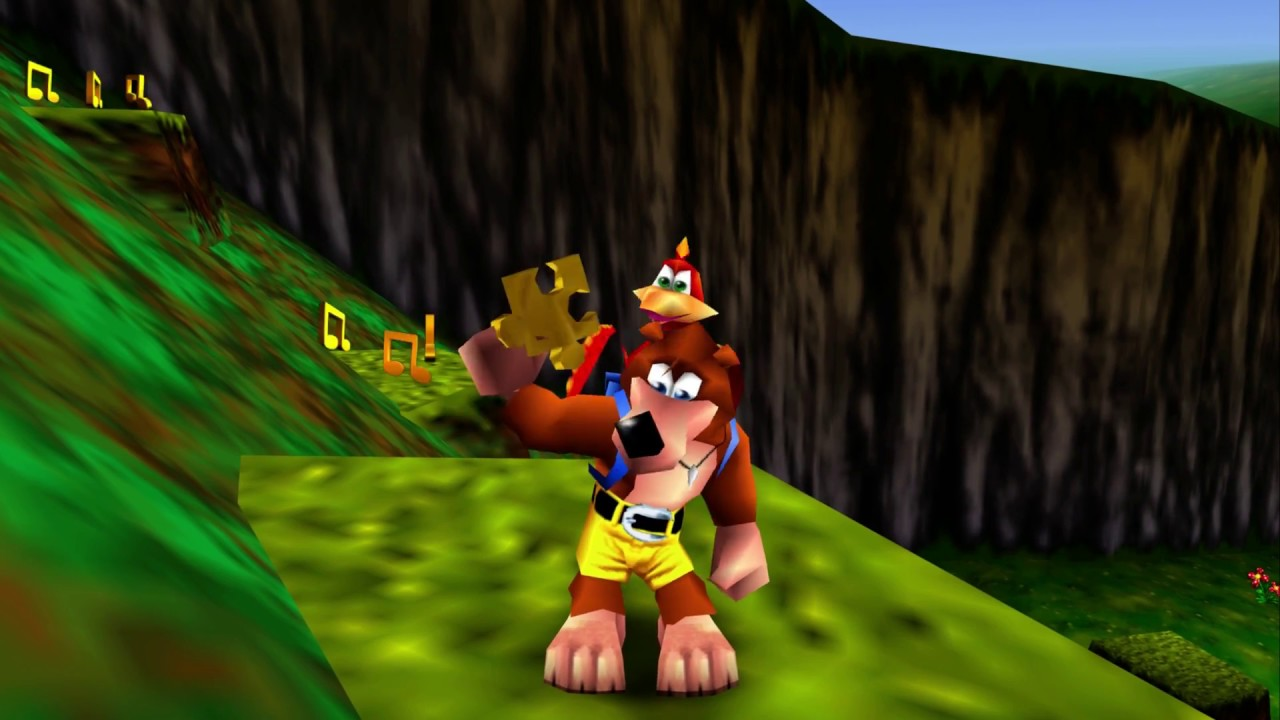
To take a pretty famous example- Banjo-Kazooie was originally intended to be an anime-style Zelda-like adventure game and was code-named Project Dream.

But Banjo went through development hell, and after changing platforms, changing genres into a 3D platformer, and changing from a 2D game to a 3D game, it came out looking like this:

Everything about the original Project Dream story had to be scrapped. And Banjo, as a collectathon platformer, has a minimal excuse plot story- but it’s still completely different from what Project Dream was going to be. The story was determined early on, but it had to change to meet the needs of the game.

Most games don’t go through this dramatic of a shift, but the principle is still there on a micro scale. Every game has to change story elements to fit the needs of the gameplay- even the ones where story is a major factor.

Tagged: screenwriting

annleckie:

septembercfawkes:

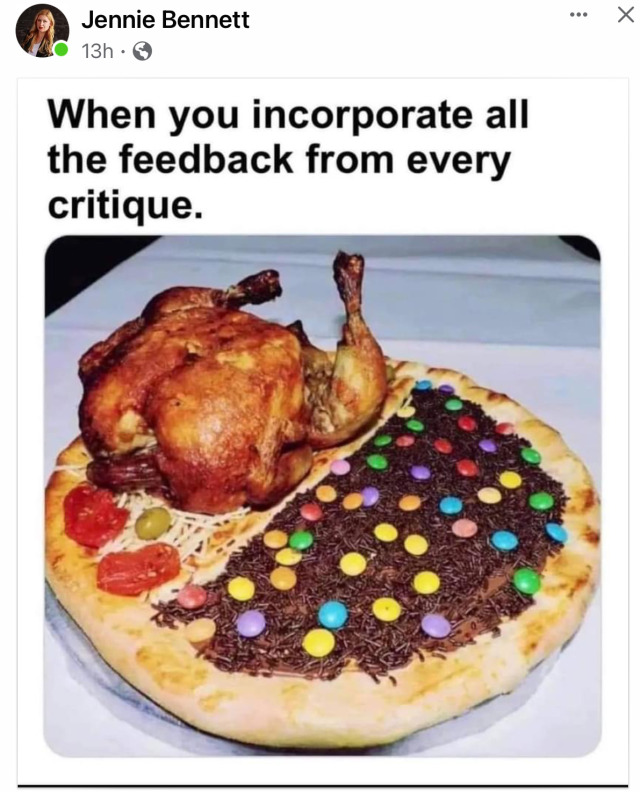
Lee says in tags that filtering feedback is a really crucial skill and they are absolutely correct.

Not every comment/critique you get will be transparently actionable or worth following as stated. And it can be really difficult to sort out what advice to take and even what it would mean to take that advice. (I mean, for instance, even after you agree that “Needs more action!” is something you should address, that could indicate a lot of different possible fixes. You have to figure out which one is going to work for your story.)

There’s no single right answer for how to sort through critiques and find some kind of useful direction in them. BUT. My rule of thumb–first, keep in mind what it is you’re trying to do, what you want your story to be. Critiquers who seem to be understanding what you’re trying to do are more likely to give advice that will help you straightforwardly–but not always.

Readers who very clearly do NOT get what you were trying to do are helpful even when their comments are completely off base. What made them read the story that way? Is that something you can or should adjust so they have a better chance of seeing what you’re doing? (Some folks just aren’t Your Readers and that’s fine, you’re not obligated to make everything obvious to those folks, but it can help in sharpening your own work, getting it across more clearly.)

Another rule of thumb–when readers note a problem, they are nearly always right that there is a problem. HOWEVER when they say what the problem is and how to fix it, they are NEARLY ALWAYS WRONG. So, let’s say your readers all trip over a particular place and tell you that you need to give them more information about X. Chances are you need to go back and cut something that made them ask the question to begin with. Or the “More action” above–do you really need more action in that spot? Or is there a pacing issue leading up to that spot? Almost always, when a reader points to where a problem is, the actual problem is actually somewhere previous.

Sorting through critiques and figuring out which ones will help you make your story more what you want it to be, and how to take that advice, is a complicated and super important skill.

Tagged: endorsed screenwriting

As Matt Yglesias leans more into movie takes for flavor, I do appreciate how they definitely come from the son of a credited...

As Matt Yglesias leans more into movie takes for flavor, I do appreciate how they definitely come from the son of a credited screenwriter

Tagged: matt yglesias screenwriting

Taylor Swift Making Feature Directing Debut for Searchlight Pictures

kontextmaschine:

Huh, it’s for a script she wrote herself, that has promise.

(And it retrospectively shows that her expansion of All Too Well into a 14-minute version with an accompanying short film was essentially an audition to prove herself)

(Recall that she essentially became a performer and a celebrity in service of getting her writing produced)

Tagged: taylor swift supergenius shapeshifter taylor swift screenwriting

How have The Simpsons not done a WWI episode titled In Flanders' Yard?

kontextmaschine:

How have The Simpsons not done a WWI episode titled In Flanders’ Yard?

Hell, I got that and I wasn’t even on staff at one of the good Ivy League humor magazines

Tagged: screenwriting kontextmaschine does hollywood

How have The Simpsons not done a WWI episode titled In Flanders' Yard?

How have The Simpsons not done a WWI episode titled In Flanders’ Yard?

Tagged: the simpsons screenwriting in flanders fields