The Partisan Leader; A Tale of The Future is a political novel by the antebellumVirginia author and jurist Nathaniel Beverley Tucker. A two-volume work published in 1836 in New York City and in 1837 in Washington, D.C. under the pen-name “Edward William Sydney,”[1] the novel is set thirteen years into the future, in 1849, and imagines a world where the American states south of Virginia have seceded from the Union. The story traces the formation of a band of Virginia insurgents who seek to free their state from federal control and adjoin it to the independent Southern Confederacy.
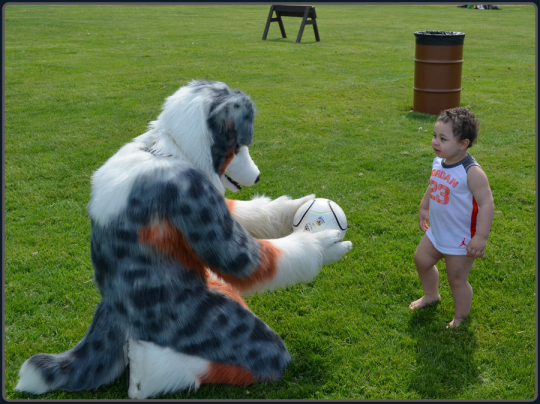
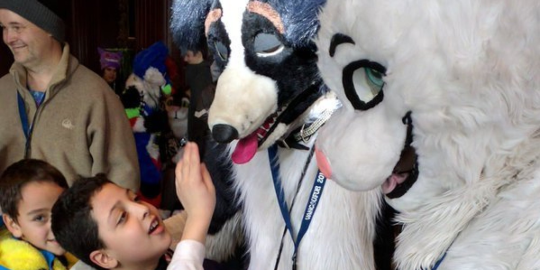
Okay real talk: I can’t be the only one who finds it incredibly creepy when furries interact with children, right? Like, going to parks in their fursuits and shit just to talk to kids, that’s super creepy, right???
To hear the right’s triumphalism of recent
years, you’d think that only smug Democrats were appalled by Reagan
while Republicans quickly recognized that their party, decimated by
Richard Nixon and Watergate, had found its savior.
The Republican elites of Reagan’s day were as blindsided by him as their counterparts have been by Trump.
A typical liberal-Establishment take on Reagan could be found in Harper’s,
which called him Ronald Duck, “the Candidate from Disneyland.” That he
had come to be deemed “a serious candidate for president,” the magazine
intoned, was “a shame and embarrassment for the country.”
A strategic memo by Carter’s pollster,
Patrick Caddell, laid out the campaign against Reagan’s obvious
vulnerabilities with bullet points: “Is Reagan Safe? … Shoots From the
Hip … Over His Head … What Are His Solutions?” But it was the strategy
of Caddell’s counterpart in the Reagan camp, the pollster Richard
Wirthlin, that carried the day with the electorate. Voters wanted to
“follow some authority figure,” he theorized — a “leader who can take
charge with authority; return a sense of discipline to our government;
and, manifest the willpower needed to get this country back on track.”
I’m reading this book about anti-religious thought during the era people call the “Classical Age” of Islamic scholarship and holy shit some of these people in the 9th century have such strongly worded polemics like basically calling all religion entirely idiotic. There isn’t too much detailed info about them with the exception of al-Razi because he was a titan when it came to discoveries in other fields like medicine (though most of his anti-religious texts are lost) and to an extent al-Rawandi though the text of his we have most intact is in the context of heavy quotation in a Sufi rebuttal but the descriptions are pretty interesting. Like one response to al-Rawandi has the author going “I realized at this point he wasn’t just attacking only our Mutazalite school but in general Islam and even all people of religion”
Like you didn’t see such forceful and explicit attacks on religion in European thought until the Enlightenment and even then it took until the 19th century for people to be as vehement especially when it came to the topic of God so like when people are like “anti-theism is Eurocentric” that’s just such an ironically Eurocentric view of the world
I love how humans have literally not changed throughout history like the graffiti from Pompeii has people from hundreds of years ago writing stuff like “Marcus is gay” “I fucked a girl here” “Julius your mum wishes she was with me” and leonardo da vinci’s assistants drew dicks in their notebooks just for the banter and mozart created a piece called “kiss my ass” so when people wish for ‘today’s generation’ to be like ‘how people used to’ then we’re already there buddy we’ve always been
The Hagia Sophia has inscriptions that were considered sacred for centuries until they were deciphered in the 70s to be Nordic runes saying “Halfdan wrote this”
my old english prof told us that theres a cave in Scandinavia where a viking gratified some runes like 14 feet up on the wall and when they finally reached it all it translated into was “this is very high”
Ancient Shitposting
Now on the History Channel
‘People have literally just always been people’ is genuinely my favorite fact about the world
trends in writing that existed in the mid 1700s and have come back into style
- randomly capitalizing words without regard to Importance - saying ‘tho’ instead of ‘though’ - excessive metaphors, analogies, and personification for/of/whatever inanimate objects and incorporeal concepts
This song, which was recorded in the degenerate Roaring Twenties, is my new problematic fave. (I literally can’t stop listening, send help)
Lyrics:
Hey, hey, women are going mad today Hey, hey, fellas are just as bad, I’ll say Go anywhere, just stand and stare You’ll say they’re bugs when you look at the clothes they wear
Masculine women, feminine men Which is the rooster, which is the hen? It’s hard to tell them apart today, and say,
Sister is busy learning to shave Brother just loves his permanent wave It’s hard to tell them apart today, hey hey
Girls were girls and boys were boys when I was a tot Now we don’t know who is who, or even what’s what Knickers and trousers, baggy and wide Nobody knows who’s walking inside Those masculine women and feminine men
Stop, look, listen and you’ll agree with me Things are not what they used to be, you’ll see You say hello to Uncle Joe Then look again and you’ll find it’s your Auntie Flo
Masculine women, feminine men Which is the rooster, which is the hen? It’s hard to tell them apart today, and say Auntie is smoking, rolling her own Uncle is always buying cologne It’s hard to tell them apart today, hey hey
You go in to give your girl a kiss in the hall But instead you find you’re kissing her brother Paul Ma’s got a sweater up to her chin Pa’s got a girdle holding him in Those masculine women and feminine men
Now wifey is playing billiards and pool Hubby is dressing the kiddies for school It’s hard to tell them apart today, hey hey
Since the Prince of Wales in ladies’ dresses was seen What does he intend to be - the king or the queen? Haha! My grandmother buys those tailor-made clothes Grandfather tries to smell like a rose Those masculine women and feminine men
I’m watching British Antiques Roadshow and the expert is explaining about how to tell high quality monkey orchestra figurines from lower-quality knockoffs
monkey orchestra being a style of hugely popular porcelain figures from the 1750s. they started making them after someone said the king’s orchestra sounded like trained monkeys during a banquet and the king thought that was so funny that someone went home and started sculpting porcelain monkeys in formal dress with musical instruments to give to the king and then suddenly everyone wanted a porcelain monkey orchestra to display at parties.
it’s a stupid in-joke that suddenly everyone needed. it’s a popular meme from the 1750s. this is like 18th century rare pepes. this is amazing.
This is thumb-sucking season in Washington journalism. It is the time when the men who report to the nation the doings and misdoings of its federal government find the springs of factual news all but dried up and are reduced to turning out, in the guise of news, dispatches that in major part are the product of the reporters’ communion with their own imaginative souls. The production of such dispatches is known to the craft as ‘thumb sucking,’ and the products themselves as ‘think pieces.’
Paul W. Ward, “Think Pieces” (The Nation, November 1936)
On the fifth day of travel across the Atlantic Ocean, we saw the gigantic buildings of New York. America was before us. But when we had been in New York for a week and had begun, as we thought, to understand America, we were suddenly and unexpectedly told that New York isn’t America at all.
Then we went to Washington, being firmly convinced that the capital of the United States would, undoubtedly, be America. We spent a day there and by evening we had fallen in love with that purely American city. However, that very evening we were told that on no account could Washington be considered America. we were told that it is the city of government clerks, while America is something completely different.
Bewildered, we went to Hartford, a city in the state of Connecticut, where the great American writer Mark Twain spent his mature years. Much to our horror, the locals announced in unison that Hartford isn’t exactly the real America either. They couldn’t say for certain where the actual America is located. Some said that the real America is the southern states, while others maintained that it is the western ones. A few didn’t say anything at all–they just pointed their fingers vaguely into space.
Nature has invented the wheel three separate times that we know of, as far as I can tell.
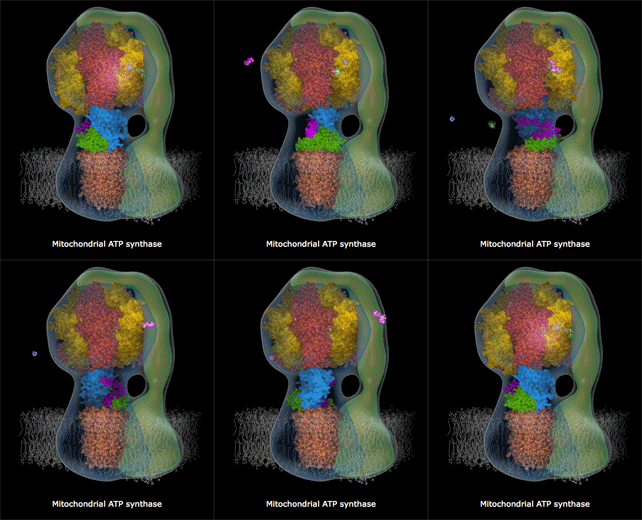
1) ATP synthase, which is found (in slightly varying forms) in archaea, bacteria, protozoa, plants, fungi, animals - basically every living thing on Earth. It is older than eukaryotic cells, placing its evolution at more than 10^9 years in the past.
2) The bacterial flagellum. I couldn’t find data on when this might have evolved, but it seems likely that it was around 10^9 years ago. The split between archaea and bacteria was about 3.5*10^9 years ago. Archaea also have flagella, but they do not rotate.
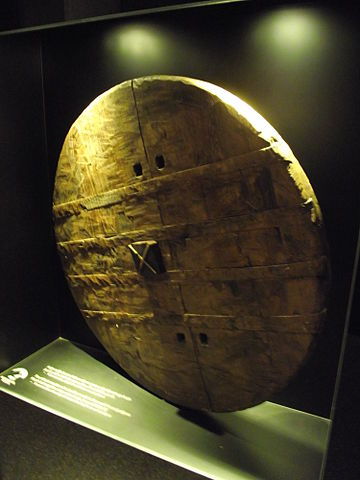
3) Homo sapiens sapiens started building wheels probably sometime in the 6th millennium BC; it seems that people in Mesopotamia, the Caucasus, and central Europe learned this skill independently and at roughly the same time. The oldest known man-made wheel is the Ljubljana Marshes Wheel, found in Slovenia and estimated to be about 5150 years old; it is pictured below. Note that this wheel-invention required both ATP synthase and bacterial flagella (since humans are symbionts with both mitochondria and bacteria), so it’s not fair to say that nature has invented the wheel three times independently.
The author is cheating the reader as soon as he writes for the sake of filling up paper; because his pretext for writing is that he has something to impart. Writing for money [is], at bottom, the ruin of literature. It is only the man who writes absolutely for the sake of the subject that writes anything worth writing. What an inestimable advantage it would be, if, in every branch of literature, there existed only a few but excellent books! This can never come to pass so long as money is to be made by writing. It seems as if money lay under a curse, for every author deteriorates directly [whenever] he writes in any way for the sake of money. The best works of great men all come from the time when they had to write either for nothing or for very little pay.
Hello, Buzzfeed…
19th-century German philosopher Arthur Schopenhauerpresages the economics of the web and modern publishing – linkbait, content farming, unnecessary pagination, endless slideshows, and other moral failures of publishing, examined in a whole new-old light.
They: Borderline Personality Disorder is a Cluster B personality disorder characterized by dramatic and unpredictable shifts in self-image, emotions, and interpersonal relationships, with no apparent external cause.
Me: Uh, I’m sure I’m not the first to notice this, but that sounds an awful lot like a description of “women” as by Shakespeare. Or Roissy.
Me: So what’s the treatment?
They: You have a figure of intimate authority explain that their emotions are illogical and wrong.
Me: …are you fucking shitting me.
They: No, no, that’s trivial, the real problem is finding a figure they’re willing to submit to, that’s a total crapshoot.