Hollywood is self-serving but at least Oprah lent this movement authentic legitimacy, but… post-Jezebel new media feminism has discredited it all by… posing women as vacuous drama-queen redpill stereotype flibbertigibbets… for example using the same breezy tone to discuss how terrible it is when men disregard your desires to use you as a sexual object and how sexy it is when men hold you down and use you as a sexual object… in the name of attention- and profit-seeking.
As such it REALLY resembles the common criticism that Caitlin Flanagan is more committed to the project of putting down #MeToo in the name of feminist principles than in any particular feminist principles themselves.
I was around and aware in the ‘90s for the last culture war, or at least the mopping-up operations, how part of that was coopt the appeal of “feminist” as an identity by propping up a (good, libertarian individualist) “equity feminism” against a (bad, left-identitarian) “gender feminism”. Like, we’re talking the exact same players from the old “Independent Women’s Forum” set, Caitlin Flanagan and Kaitie Roiphe and Christina Hoff Summers, don’t think I don’t notice that.
Second, if your goal WAS to squash the momentum of this “moment”, and I and everyone else saw a counterattack coming from the get go, this is probably the right time and point to strike. A few days prior the bluecheck goodthinkers were openly trying to threaten Harper’s over running a potentially critical piece on the media men list, clearly thought they still had command, but now moving on to the Ansari stuff, they’re just huffing and puffing to explain how actually, it’s not an issue, there’s no problem here.
Now I’m not going to say that “if you’re explaining, you’re losing” – as a descriptive statement I’m not sure that’s true, and as a normative one it’s anti-intellectual and obnoxious – but it is a sign that you’ve lost tempo, you’re not setting the terms of battle anymore, you’ll need a good push to get it back, and if they get one first you might have to retreat.
A New York Times #1 bestseller made into a 1977 film with Diane Keaton and Richard Gere, it was quite the conversation-starter but largely forgotten now because its concerns were so of-the-moment. That moment being the immediate aftermath of the sexual and feminist revolutions, figuring out how to incorporate the new “liberated woman” into society. New “fern”, or “singles” bars flourished as new places for people to meet for sex or companionship.
The plot of the book is basically this: a kindergarten teacher in New York City falls into the habit of trolling singles bars for men to have one-off masochistic sex with. That’s more or less it. I know I’ve said that before pornography was an established genre of its own, mass-market novels came a lot closer to erotica, maybe thinly masked as some sort of moral lesson, but it’s not stroke stuff. The sex isn’t that sexy or all that frequent, most of the time in between she just worries about her life - are her confidence and assertiveness too much? Too little? Is this an okay way to live? Are what she wants in bed and what she wants in life compatible?
If it’s any kind of exploitative pulp it’s true crime, starting off as an article about a 1973 killing in the Upper West Side, because the moral lesson is she gets straight-up murdered at the end.
She brings some new random home, he isn’t satisfying her so in the middle of things she just tells him to stop and leave. This is kind of presented as her finally, comfortably claiming agency. When he rolls off her and moves to finishing himself off she starts berating him, angry that he expects her to physically deal with his semen (and thematically, HIS sexual desire). Enraged, he chokes her to death with an electrical cord.
So yeah, that’s what I’m reminded of, the hit parable from the LAST time we went through this part of the cultural cycle:
“All this chase-your-desire sexual liberation is a way for women to degrade themselves as sex objects. And even if they do interpret it as empowering, they’ll mistake themselves as toe-to-toe equals with the bestial aggression of male sexuality and just get themselves hurt.”
in one of the recent episodes of vice news this chinese entrepreneur uses a marx quote about historical materialism to explain why he fucks a sex doll. this must be the socialist new man the soviets were talking about lmao
china’s number one achievement is that when this man was asked “why do you have sex with this thing?” his mind immediately went “what’s that line from the german ideology?”
If you want to know how quickly the government justifies its own existence to the point where people cannot even imagine an alternative, consider this:
ICE has only existed since 2003. When people say “abolish ICE,” they are often immediately accosted by people asking them what we would do then, because what about border security and illegal immigrants and how can you say that this organization just shouldn’t exist, what even is the alternative, etc.
ICE has only been around for 15 years and some people are already acting like it is just an inevitable fact of existence and there is no alternative. Think about what that means.
Young people in the Galilee Sea Area are being increasingly drawn to
the so-called “righteousness community”, a movement of twenty-something
fisherman types with exciting new perspectives on virtue, Scripture, and
the end of the world.
The righteousness community is based on the orations of Yeshua ben
Yosef, a self-taught rabbi who developed a cult following with his
concerns about an impending Armageddon. According to ben Yosef, problems
with Temple sacrifices and over-adherence to the ritual law will lead
to a “Judgment Day” in which God comes down to punish sinners and throw
them into a lake of fire. Although it sounds far-fetched, celebrities
like Saul of Tarsus and Joseph of Arimathea have thrown their weight
behind it, saying the threat of Judgment Day is “very plausible”.
Ben Yosef wondered: what if God, instead of wanting strict compliance
to Pharaisacal principles, actually wants us to love one another with
all our hearts? And what if those who fail to practice this, far from
fulfilling God’s will, will actually face His wrath when He returns to
judge His creatures? Frustrated that mainstream theologians failed to
pay attention to these concerns, he thought he could best spread his
message by creating a culture of righteous behavior. The righteousness
community is an attempt at creating that culture, and has attracted a
diverse crowd interested in divine judgment. The community has also come
to discuss and sometimes emulate ben Yosef’s other interests: universal
love, Messianic fervour, consorting with prostitutes and tax
collectors, and stories about lakes of fire that sound like they come
straight from fantasy books.
The righteous take a somewhat paradoxical approach to keeping hold of
their humanity. Believing that all people are sinful, many think that
in order to shed our wickedness, they will have to abandon their bodies
to become perfect spirits in Heaven (our physical selves are, for the
vast majority in the community, not intrinsic to who we are). One of the
righteous, Simon Peter, say he believes that not only could we someday
live forever, but we could purify our souls so as to abandon human
frailty and doubt, and “spend Eternity praising the Lord”.
Peter, a fisherman, was first drawn into the community by ben Yosef’s
fictional magnum opus, “The Parable Of The Prodigal Son”. He loves the
righteous’ “world-scale ambition” and lack of bias towards localness,
either in time or space. “Why care only about the Israelites when there
are so many nations out there?” He sees no reason not to take the whole
Roman Empire - indeed, the whole Mediterranean - as a playing field.
After all, it is likely that the vast majority of people who will ever
exist are Gentiles. Converting the Gentiles is a major goal, a value
that he holds because, he says, “All humans are pretty similar in the
eyes of God”.
Despite their commitment to the idea that all believers are bound
together in an intangible Church, many of the righteous have affirmed
the importance of community in the flesh as well. Galilee Area
righteous congregate into communal living arrangements, often with whimsical names invoking saints or Scriptural locations. In
building a shared culture, they draw on the example of Jewish
traditions. Last spring, the several dozen of the righteous gathered
together beneath stained-glass windows to observe “Easter”, singing
hymns and eating a communal meal. It’s a powerful visual, albeit one
that feels like a processed and repurposed Passover seder. Apart from
songs, the event featured organ music, prayers, and a “sermon” by one of
the community leaders. Peter considers it hugely successful at
capturing the trust-building and bonding functions of Jewish rituals. In
a way, the righteous’ approach to holidays is like the righteous
themselves. They avoid formal rules and rituals in the preparation of
their celebrations, preferring to rely on a shared sense of community
and divine love.
Peter and his friends are responding to a lacuna in the
present world not by shrugging but by trying to build something to fill
it. The righteous are quite right that mainstream contemporary Judaism
is in many ways legalistic, even uninspiring. But to act more
effectively on these good desires for holiness, the righteous could use a
more robust anthropology. Many of them mock the traditional institution
of marriage, preferring to remain celibate in preparation for the
coming Judgment. Some of them participate in “ordinations”, a
Galilee-area rite where people promise to stay celibate for their whole
life. Often this is combined with communal living and the sharing of
property in common. In my view, the righteous are blind to grave
dangers: they are making themselves human test subjects in a social
experiment that is bound to prove destructive.
I told my righteous interlocutors that, frankly, I feared the
righteousness community would come to represent the social equivalent of
the Divine Judgment that ben Yosef is worried about. After all, if they
convince the Romans to adopt an attitude of meek nonviolence, the
Empire could lose its military might and collapse, leading to a Dark Age
that kills millions. The righteous are a powerful, loving,
compassionate entity, interested in forgiving everybody. How can we be
sure they aren’t creating the God they claim to worship?
you laugh at the high meat people now, as if 60% of every cuisine wasn’t people improvising at how to eat old food and accidentally making something tasty
Dancers at the bar asking after the drama w/r/t a regular getting kicked out, apparently he offered one a half-full jar of his cum, “I thought you might want this”
before closing with November Rain they actually did that “silent lucidity” song, the rest of it isn’t nearly that beta as that one line huh
If YouTube vlogger culture is going suicidesploitation while matrons gasp and pop their monocles, that would be one of the most heartening signs I’d seen in a while. Youth culture embracing the rotten is the classic avenue of backlash when culture decays to sickly, ickly sweet, therapeutic, thanatophobic decadence.
Think of Mad Magazine and horror comics in the ‘50s, or Garbage Pail Kids and slasher movies in the ‘80s, rotten.com and “an hero” stuff in Web 1.5.
Sure, there’s pushback, but in the end you can’t stop generational precession and it only burns the scolds’ reputation. The “Seduction of the Innocent” thing might have pushed Mad and horror comics, back a bit, CCA self-censorship, yeah, but that spirit came back victorious as Hustler magazine.
We’ll know we’re back on the right track when young women start using the aesthetic to be playfully sexy with big hair - Elvira, corpse-painted goth chicks, Suicide Girls and those scene girls who would have alliterative fake names about murder and cannibalism and do photoshoots covered in fake blood.
Los Angeles birthed Pentecostalism and America barely even notices that it has a new religion running free taking over continents
LA was a hot scene in the 20th Century that gave us the Foursquare Church, Objectivism, Scientology and EST, also The Source Family, The Manson Family, Tensegrity, Esalen, New Age cults, UFO cults, Nazi cults, Nazi UFO cults
That’s how these things go, in waves like any other industry, Mormonism was only the most famous thing to come out of the Burnt-Over District in the Third Great Awakening
Christianity was only the most famous thing to come out of Jerusalem of the period, that’s the deepest joke of Life of Brian, that it’s not a joke
people: it’s so sad that social media and the Internet have destroyed civil, fact-based discourse in our society and replaced them with unnuanced outrage fuel
nineteenth-century newspapers: “War and extermination is inevitable! CITIZENS ARISE, ONE AND ALL!!! Can you stand by, and suffer such INFERNAL DEVILS! To ROB men of their property rights, without avenging them? We have no time for comment! Everyman will make his own. LET IT BE WITH POWDER AND BALL!”
I find this perspective exactly 50% comforting and 50% terrifying.
“Oh, thank God, humanity has survived this kind of thing before… except the millions of people who didn’t survive it, so yeah, there’s that.”
To be fair, this specific newspaper article was about Mormons, so it’s more like the couple of dozen people who didn’t survive it
My favorite thing from this book is how Christians keep denouncing these New Age movements as unsophisticated Oriental doomsday cults with dark underbellies of vice and graft.
Mystics and Messiahs: Cults and New Religions in American History, although it’s not great or anything. It should be twice as long as it is and it’s more about society’s reaction to cults than about the cults themselves, which are treated more like cultural background noise than a developing suite of beliefs. It’s fine, but if you’re just looking for a book about the occult in general, I’d recommend The Occult Underground instead.
I’ll add The Occult Underground to my booklist.
Does the book you’re reading talk about syncreticism and cults in the early 20th century, or does it mostly focus on the 60s and 70s?
It goes all the way back to early anti-Catholic and anti-Masonic propaganda and how those tropes influenced later depictions of cults, but the focus is on the late 1800s to today. The main thesis is that the 60s/70s cults were not actually unique in American history.
Anonymous asked: Current Rationalist Mood: speaking to an older person and realizing "shit, the odds of this person surviving to see the invention of immortality are very close to zero".
real “getting sad over the decay and fall of socialism” hours
idc if it makes me a tankie or authoritarian stalinist or whatever but there was a point in history where a large portion of the world’s population lived in countries where the status quo was, to some degree, caring about humanity as a whole. there was a point in time when a newly-literate sichuanese peasant mother organizing a fundraiser to support south african workers was a normal thing that could happen. when the plight of black people in the US was a huge concern for millions of soviet citizens. when the average person in dozens of countries knew their neighbor’s names, and cared about the future of humanity. i know i sound stupid, and no socialist country was a utopia, but the achievements of the hundreds of millions of human beings who worked towards a kinder world must never be forgotten.
add in eternal life and this is how Catholicism understood itself
I’m at the point where blue-collar Chad war vet marked-by-society-for-elimination Arnold Schwarzenegger has the professional girl tied up in her kink gear in her apartment
where he makes her acknowledge that she only gets away with this while he’s punished because she upholds the smooth internet-savvy media boys’ hegemony over him
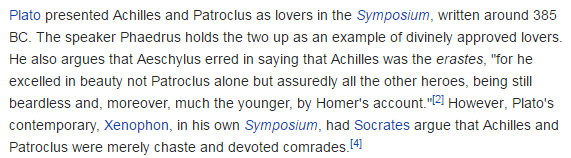
if anyone ever tries to tell you that the ancient greeks were more sophisticated than us, just remember that there was a ship war between plato and aeschylus over whether achilles or patroclus was the top in their relationship, while xenophon was off complaining that he didn’t ship that
“Is Achilles A Twink” - the greatest thread in the history of forums, locked by a moderator after 12,239 pages of heated debate,