shrine to the prophet of americana

#ronald reagan (6 posts)

Y'know, I used to think all the '80s stuff calling Reagan a Nazi was just proof of how wacky the left'll get if you let them,...

Y'know, I used to think all the ‘80s stuff calling Reagan a Nazi was just proof of how wacky the left’ll get if you let them, but in fairness he did bring about a palingenetic renewal where they had been gearing up for a liberatory moment by suppressing labor power, boosting the industrial economy through armaments spending and taking a more belligerent foreign policy to crack open rival-empire markets, revalorizing nonurban petty bourgeoisie and the iconically traditional family, and shifting law and policy to concentrate a national minority coming off early signs of inclusion into degraded and stigmatized “ghettoes”

Tagged: ronald reagan amhist

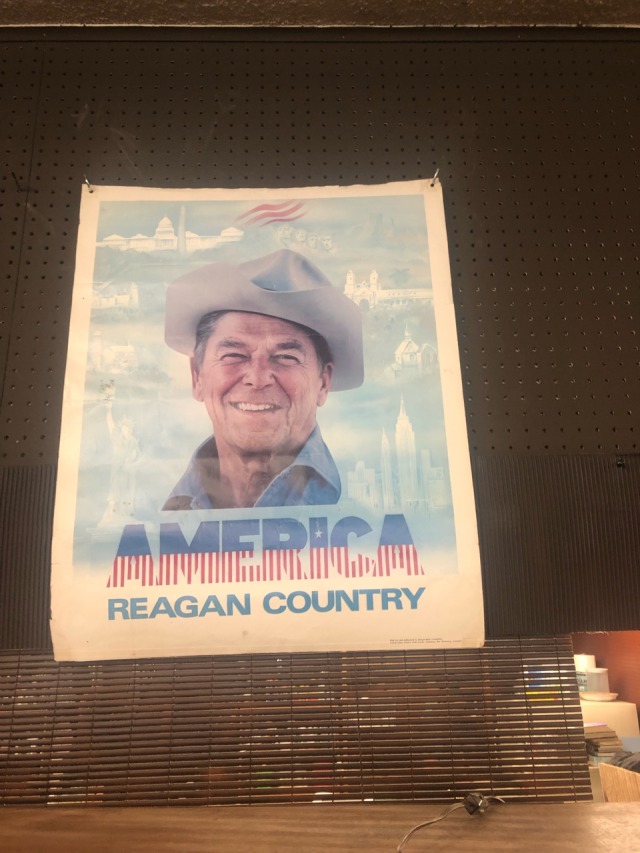
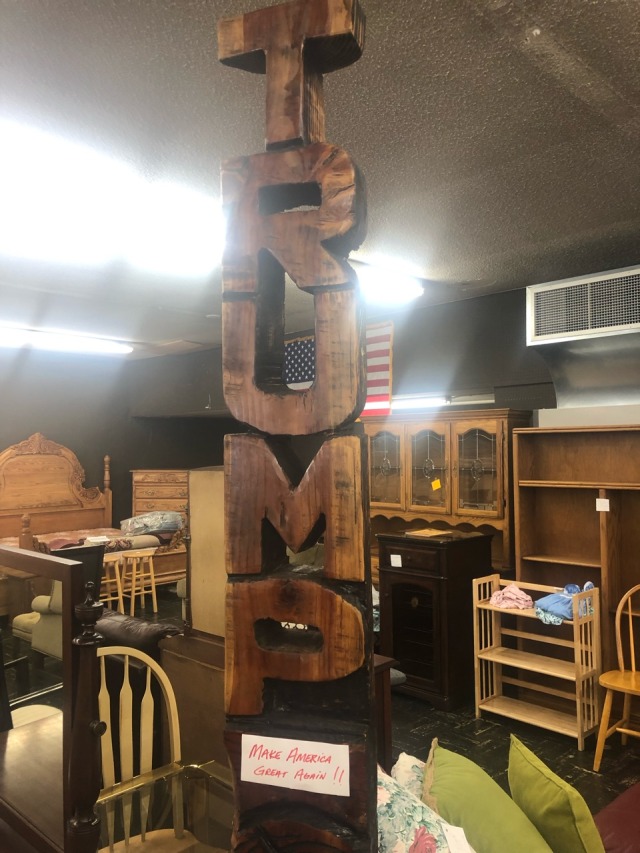
Wanted to buy this with the intention of taping a "P" over the "RE" but the Trump-hatted owner of the vintage store said it was...

Wanted to buy this with the intention of taping a “P” over the “RE” but the Trump-hatted owner of the vintage store said it was the one thing not for sale. There is this, though:

Roseburg, OR

Tagged: you see that gold fringe? that makes it an *admirality* vintage store ronald reagan reagan country

LRB · Seymour M. Hersh · The Vice President’s Men

LRB · Seymour M. Hersh · The Vice President’s Men

antoine-roquentin:

Hovering outside was a habit of Bush’s. Zbigniew Brzezinski, who had been Carter’s national security adviser, told me that he had been invited to brief the president early in his first term on the Soviet threat. When he had finished his summary, he said, he asked Reagan if he had any questions. Reagan responded: ‘Do you know the one about the newly elected black judge in Mississippi?’ Brzezinski said no. Reagan explained that the judge, after being told by his clerk that the case involved a charge of rape, said: ‘Well then, bring in the fuckee and the fucker.’ That was it. Brzezinski was ushered out of the Oval Office and found Bush waiting outside, eager to learn of Reagan’s response to the briefing. ‘I said he told me a joke,’ Brzezinski recalled. The vice president replied: ‘Oh no. Not the one about the Mississippi judge.’

Bush was petrified that the president would say the wrong thing to outsiders about what was going on, and he was hanging around the Oval Office,’ the officer said. ‘You never knew whether the president might start talking about an operation in China or into Vietnam.’​  Reagan was kept out of trouble at important national security meetings by being given a script. ‘My colleagues and I would write a talking paper for the president before meetings that resembled movie scripts, because the Old Man knew scripts as a reference. We were constantly updating the script, because if we made a dumb mistake, he would read it. We’d talk among ourselves about where to put the emphasis for certain words and phrases.’ In Deadly Gambits, his 1984 study of arms control, Strobe Talbott showed what happened when Reagan didn’t have a script. During a conversation about arms control with a group of congressmen, the president suddenly proclaimed: ‘Land-based missiles have nuclear warheads, while bombers and submarines don’t.’ ‘Even as he said these words,’ Talbott wrote, ‘his voice dropped and wavered, as though he had forgotten his lines and knew there was something not quite right about his attempt to improvise.’

in case you thought trump was the first moron in the oval office

also vice president george hw bush helped build jsoc from the ground up as his personal wetworks squad and conducted dozens of off the books operations including assassinations until, in an attempt to gain the advantage in a turf war with cia director bill casey, his underlings made the initial iran-contra leak to a lebanese newspaper and ended up almost putting bush and themselves in jail.

One thing to push back on though, even if we don’t go full SNL before he was Governor of California Ronald Reagan wasn’t just “an actor” but the head of the SAG, immersed in Hollywood industry politics

(and even the people who minimize that are like “oh, that was just scheming with Jack Warner leveraging McCarthyism”)

And the conceit that obviously the Establishmentarianist Bush could run rings around him at bureaucratic politicking and double-dealing and institutional infighting is a little eeeeh

Tagged: ronald reagan only union boss to become President

'President Reagan'

'President Reagan'

At the appointed hour, Deaver knocked on the door. Reagan grunted and Deaver heard him roll over, so he knocked again, saying: “It’s eight o'clock. You’re going to be inaugurated as President in a few hours.”

“Do I have to?” Reagan called back. Then he laughed.

Trying to make his beaten and bitter predecessor feel more comfortable, he rolled out old Hollywood stories, a couple of them about his days at Warner Brothers studios under Jack Warner.

“He kept talking about Jack Warner,” Carter said later to his communications director, Gerald Rafshoon. “Who’s Jack Warner?”

Led by former Secretary of State Henry Kissinger, the party’s elders came within minutes of persuading Reagan to take Ford as his running mate, not so much as Vice President but as a kind of co-president in charge of foreign affairs and budgetary matters. A joke, which took notice of Reagan’s supposed laziness, made the rounds on the floor of the Republican convention: “Ford will be president before nine, after five, and on weekends.”

In the weeks before his inaugural, with staff and press concentrating on who would man the new government, the President-elect spent his own time outlining the inaugural address. To him, the words were more important than the men who served him, aides he usually just called “the fellas,” often because he could not remember all their names. He was helped this time by a fellow named Ken Khachigian, a Los Angeles lawyer who had written for President Nixon and done a good deal of the heavy word-lifting on the 1980 campaign speeches. As he always did, Reagan began by chatting for twenty minutes or so about his ideas and gave Khachigian a six-inch pile of the four-by-six index cards he had used and edited for speeches over the years. In his transition meetings with Carter, Reagan had not taken a note nor made a serious comment during the President’s long and complicated issue briefings, but at the end of the first and most important session - use of nuclear weapons was one topic - he noticed that Carter used three-by-five cards listing the subjects of the hour-long talk. “Can I get copies of those?” Reagan asked as he stood up to leave.

With his writer taking notes, Reagan began dictating themes:

He also told Khachigian to find the script of a World War II movie. “It was about Bataan,” he said. An actor named Frank McHugh, Reagan remembered, said something like: “We’re Americans. What’s happening to us?” The writer found the line, which was somewhat different from what Reagan recalled, and used it as a finale in the first draft of the speech he brought to the President-elect on January 4: “We have great deeds to do…. But do them we will. We are after all Americans.”

They were watching television. Steve Bell of ABC News was talking about the crisis, about Carter and his men working on the details of transferring money to the Iranians. The image of an Iranian mob appeared; the President-elect pursed his lips and muttered: “Shitheels!”
Tagged: inauguration amhist ronald reagan same as it ever was

It’s commonly accepted that Reagan’s breaking the PATCO strike was a big deal, not for first-order reasons, as with Thatcher and...

It’s commonly accepted that Reagan’s breaking the PATCO strike was a big deal, not for first-order reasons, as with Thatcher and the miners, but for the second-order effect of signaling that this was the new normal, and the private sector had the government’s blessing to break their own unions.

A parallel you don’t see mentioned often is the Falklands War. Margaret Thatcher’s best known for her domestic policies, but I’d argue that her most important legacy is in finally halting the erosion of the empire. The Falklands yes, but also rejecting accomodationism in Northern Ireland.

Even some of her most significant “domestic” actions - crushing the miners’ strikes, taking funding streams from the hands of dissident local authorities and concentrating them in Westminster - were in part an attempt to check Scottish autonomy in the face of a very real threat that the United Kingdom might shrink to a pre-1707 rump of England and Wales.

It’s not like the British had ever just accepted the postwar dissolution of their colonial empire in the first place. But American support for decolonization was a major check on British power in this regard, particularly in the tipping point of the Suez Crisis, where America wielded its financial influence to veto the attempt to retain control over the Suez Canal. (Some of the most important British colonies mattered less as sources of direct income than for the control they gave over strategically important naval choke points.)

Reagan’s said to have considered exerting a similar pressure on Thatcher. But he didn’t, the war went ahead. Thatcher couldn’t muster the support to go up against China so Hong Kong eventually slipped through Brittania’s fingers, but since then nothing else.

(Scotland’s holding a secession referendum soon, and as of now the result is anyone’s guess. I dunno though, a lot of the motivation seems to come from the fact that the north of Great Britain’s got a stronger leftist tradition than the south, and the expectation that independence would mean trading Tory austerity for social democratic bounty. Though without an empire at its back, the ability to milk The City - the British metonymic equivalent of “Wall Street” - for cash or favorable bond market terms, or even a strong enough navy to enforce claims on maritime resources, I don’t see where they expect to find the money from.)

Tagged: history british empire margaret thatcher ronald reagan falklands war

If you’ve never seen one of Ronald Reagan’s press briefings you really should. The man was a master. He’d take a question,...

If you’ve never seen one of Ronald Reagan’s press briefings you really should. The man was a master. He’d take a question, ricochet it off two completely unrelated talking points, and then reveal he’d been setting up a joke at liberals’ expense that was so legitimately funny that the whole room cracked up and even if you were specifically looking he’d be on to the next one before you noticed he hadn’t actually answered it at all.

Tagged: history ronald reagan