1: Women should be more like badass rockstars.
2: Yeah.
1: We should encourage them to be badass rockstars.
2: Yeah!
1: 'cuz, you know, we fuck women.
2: Yeah?
1: And then we'd be fucking badass rockstars!
2: YEAH!
...
...
1: Turns out badass rockstars fuck scumbags and models.
2: Well, fuck that.
Listening again to Taylor Swift’s Red, picked up something I hadn’t - “memorize” used in two different songs
In Stay Stay Stay,
you took the time to memorize me
my fears my hopes and dreams
I just like hanging out with you
all the time
and then in Red,
memorizing him was as easy as knowing all the words to your old favorite song
and I thought on it and realize this downright sapiosexual knowledge-as-intimacy theme is pretty important in Tayswift, it’s the load-bearing element of YBWM
I’m the one who makes you laugh
when you know you’re ‘bout to cry
I know your favorite songs
and you tell me bout your dreams
think I know where you belong
think I know it’s with me
can’t you see I’m the one who understands you
been here all along so why can’t you see
you belong with me
it’s even important in negative (which is how interrogators tease personality from pretense) in Red,
forgetting him was like trying to know somebody you never met
thinking about that, and also remembering when her transparent brand strategy was accessibility and fans chosen to meet her would gush about her casually referencing something they mentioned on their tumblr long ago, and it’s like
AWW, she really IS just like us, in that her real output is multilayered invocations of accreted culture but she charms incidental humans by studying up on whatever incidental shit they happen to be and mirroring it back at them
I just want to know you better
know you better
know you better now
I just want to know you
know you
know you
I had wondered how long before the “fabulous gays who appreciate pomp and ritual as a foundation of civilization” and the “Catholic restorationist” streams of the insurgent right would converge
So here’s a site for you: the Closing Logos Wiki, a collection of production company logos from the end of shows. (This month is 2-D and 3-D Logos Month). Pretty comprehensive, still pretty compulsive in a kind of pre-2007 internet way.
Mostly seems to be the work of one guy. Fair enough, you read around, you read the descriptions of enough, and you notice each one has a “Scare Factor”, which - it’s not really clear what it’s for. Sometimes he seems to be using this for an esthetic critique - he’s not very fond of black/neon color combinations, which makes him not very fond of the late ‘80s-early ‘90s graphics. But sometimes he’s being strangely earnest about it, that the logo is scary or “terrifying”. And then you read enough of these entries, each with their own “Scare Factor” section, and you realize there’s not actually a line there, for him.
And you realize that not only is this site the product of a guy who felt compelled to compile every production company logo he could find, but one of the things he made a point of addressing for every single one is “whether this production company logo could possibly scare you”. And the answer is sometimes yes! (Another thing he addressed are “what are three or four nicknames I could coin for this logo?”)
Check out all the “Scare Factor: High” reviews. Check out the MGM one especially, where a lot of them are fine but one is terrifying because it involves a particularly scary lion, and also banner.
And now look at this “rules’ page. I mean as petty as any forum mod, though the enthusiasm for putting “BANNED” in red caps is something, but also of interest is the only rule with a listed exception:
17.) To the Writers and Up: Do not add personal comments to the articles. That includes personal scare factors, your own side notes, making the articles your own forum and telling people not to upload images or videos on the articles (that even includes locking pages where no one can edit or put up images or videos). The pages here are for logo descriptions, pictures and videos ONLY. If you want to share personal opinions, go to the Favorite Logos and Dreaded and Hated Logos pages, or use the discussion feature. If you disregard this rule, you will receive a warning. If you do it again, you will get another warning and a demotion, and if it continues, you will be BANNED!
17b.) If you must make a thread about a logo that scares you, do it on the page the logo is described on, and nowhere else. Any thread running afoul of this is at risk of deletion.
I spent a lot of time experiencing things that pattern-matched to tropes that were goddamn ridiculous, realizing the actual experience was actually like that, and accepting that actual experience was just goddamn ridiculous. Highlights:
1) I hit my head and got amnesia once. It works exactly like all the cheesy plot devices.
2) When I lived in Echo Park it wasn’t even a rough area really. The first guy I remember welcoming me to the neighborhood did end up shot in his car but that was a weird case, and I did see the tags change as Echo Parque and Big Top Locos and some other punks struggled in the aftermath but feh, boys’ play.
Anyway it was mostly an area that used to be rough so the guys who had grown up there still had some street to them ;and I used to watch ridiculous kung fu movies on channels like 57 and 17 and 29 back before they were UPN and WB and even FOX and I thought it was ridiculous the trope where local toughs would show up at the dojo to challenge the students
And I was going to a dojo there and then, boxing/American Kempo/BJJ and this actually happened on the semi-regular - not like they came in gangs with sticks but they’d swagger in individually to show the fancy boys what’s what - and the students would win against some tough beefy dudes for the same in-the-movies reason that we actually knew what we were doing
(gym rats especially. they’d have strong muscles but only punch with a few of them, while the we punched with everything between the toes and the knuckles. anyway, you realized they weren’t used to punching people who wouldn’t stay there while the punch arrived and worse, would interrupt them by punching back)
I wasn’t there for it but there was this one time this wild-haired scraggly-clothed ranting older dude showed up claiming to be a genius black-belt and wanting to challenge our sensei, and the issue was
A) we were close enough to downtown LA (and the concentration of social services that produced Skid Row) that the more ambitious crazies were a regular feature of the street landscape
BUT
B) we were also not far from American Kempo’s “hometown” of Pasadena, where (stereotypically eccentric) CalTech types and JPL rocket scientists were overrepresented as students
and people could not tell how to properly categorize him
headcanon: Joseph Smith discovered a more efficient means of extracting mana, the LDS Church drew down the reserves of the Burned-Over District and then (with the Azusa Street Revival, Taos mystics, and LA neospiritualists) drained the American Southwest and now is powered mostly by the extensive reserves of the Pacific islands
This sounds like it would be a good story. Develop it.
“story”?
Seriously, though, I’ve had a few universes in my head that might fit into. That pilot I mentioned was for sort of a Xena of the Americas - all the history and mythology mashed together. (Don’t know the native mythologies that well so it mostly would be settler mythologies OF the native mythologies) The migration of African gods with the slaves, the Mormon stories about Jesus in the Americas, the challenge of enlightenment rationalism.
Also since this was 2009 it had zombies (Baron Samedi), pirates (the protagonists) and steampunk elements (Freemasons).
Also I’ve had ideas for stories of the Wandering Jew, who’s actually a North African tribesman whose beloved was sacrificed to a river god, rebelled, and made it his mission to kill all gods, complicated by the fact that by now he essentially is the god of toolmaking and humanity. Jahweh’s his great enemy and a lot of the shit that falls on Jews was his devising, to attack God’s power base. He’s the one who gave Hitler the Spear of Destiny for example, because after all he *was* Longinus.
The Partisan Leader; A Tale of The Future is a political novel by the antebellumVirginia author and jurist Nathaniel Beverley Tucker. A two-volume work published in 1836 in New York City and in 1837 in Washington, D.C. under the pen-name “Edward William Sydney,”[1] the novel is set thirteen years into the future, in 1849, and imagines a world where the American states south of Virginia have seceded from the Union. The story traces the formation of a band of Virginia insurgents who seek to free their state from federal control and adjoin it to the independent Southern Confederacy.
People loved their work once, and it didn’t matter if they worked in the public sector or in the private one. The men who worked in the CCC would take their grandchildren to see the forests they planted, while the men from the auto plants would point out the cars they’d built as they passed them on the new interstate highway system. The women who fastened the engines on the wings would watch the B-17’s fly off to make a liar out of Goering, and the women who taught in the public schools would point with pride when one of their old students got elected mayor. Work was about making money, certainly. It was about feeding the family and keeping the roof where it was, and maybe having a little left over at the end of the day, or at the end of the week, for some amusement. Maybe a trip to Lincoln Park or White City or a hundred other places, where you could take a moment and enjoy the cool of the evening, music riding the nightwind from a dance pavilion down along the lake.
But it was also about Doing A Job, and doing it well, which was different than simply Having A Job. It was about making good cars and strong steel and sturdy furniture. It was about learning a craft, even if what you were doing wasn’t recognized as one. There was a craft in tightening rivets, or feeding the open-hearth furnace, or planing the wood just so. You had your craft, and the person next to you had theirs, and, when all the work was done, and all the craft was practiced, and practiced well, there was something you could look at with pride and say, that is something I have given to the world. Job well done, as they used to say. You could teach seventh grade civics and then, one day, you’re on a podium outside of City Hall. That kid right there, you could say. That kid is something I have helped give to the world. Job well done, as they used to say.
Unions were greatly responsible for the pride that people took in the work they did, especially in the middle of the last century, when unions helped build the most formidable middle class in human history.
There was an autoworker, Ben Hamper, who wrote a column in the Flint (later Michigan) Voice, which was the alt-weekly Michael Moore first made his name by running. A lot of his columns got collected and repackaged in an excellent book, Rivethead that I read in college.
I read it in a class by Stuart Blumin, who was my favorite professor and de facto advisor. He was an American historian, focused on labor and class and the development of capitalism, you could tell he was heavily influenced by EP Thompson and the Communist Party Historians Group over in the UK.
He was quite open that he had expected Communism to ultimately triumph, and that he had been wrong about that, and in subtext that he had wanted it to ultimately triumph, and didn’t think he had been wrong about that.
Anyway, Rivethead. The story is that Hamper was born in 1956, a fairly clever kid growing up in Flint, Michigan, the chronological and geographic apex of American industrial unionism, where everyone’s dad worked for GM.
And he could have gone to college but he gets some girl pregnant and so he goes to work on the assembly line not even really out of obligation or Catholic guilt or whatever but because that seems as good a life course as any, it’s what every man he’s known does, under the mighty UAW the pay’s on par with the kind of “educated” jobs you could get anyway, why not.
And so he goes to work on the line and eventually he ends up writing a column about it, and he talks about the color of the factory culture, playing soccer with rivets for balls and cardboard boxes for goals, drinking mickeys of malt liquor in your car on lunch break, the absurd fursuited mascot “Howie Makem, The Quality Cat” that GM would feature at rallies and shop-floor tours, being laid off in economic downturns and put into the “job bank” where you get paid waiting to be rehired in the next upswing, developing a perfect rhythm with your partner, training into a rhythm so perfect you can each trade off doing the two-person job yourself for 4 hours while the other one goes out to a bar on the clock, the dignity and solidarity of the American worker.
And time goes on and eventually his marriage fails but he takes it in stride, and his column gets recognized and he takes pride in that and then eventually he has an epiphany, and a complete breakdown, which are basically the same thing. And the inciting incident is when an older line worker, some guy he’d looked up to as a model of quiet, philosophical stolidity, just shits himself and is barely coherent enough to even notice this and he realizes the guy hadn’t been a Zen master, he’d just been checked-out mindless drunk on the line every day.
And he realizes that the rivethead life is destroying him, that the only thing holding it together was a budding alcoholism, and that it’s doing the same to all his co-workers, and looks back and realizes it had done the same to every grown-up man he knew, his father and uncles that growing up he had looked up to as models of masculine strength and fortitude really had just had their spark snuffed out and the life beaten out of them long before, and whatever pride they took in the cars out on the road was a defensive attempt to locate in an external form the sense of self-value that had been exterminated within them.
When Marx talked about “alienation”, well.
And he went crazy, and couldn’t bear to work on the line anymore, and there’s no redemption, that’s where the book ends.
And that was a theme that cropped up again in Professor Blumin’s class, that there were two great working class traditions that echoed through the ages, and they were
1) avoiding work and 2) drinking
Back in the premechanized age of small-group workshop manufacturing, workers would celebrate “Saint Monday”, which was to say just not showing up for work, hung over after the weekend.
(This was riffing off of Catholic feast days, or holy days, from which we take the word “holiday”, and as time went on counted an increasing share of the days of the year. There was a reason that poor workers were aligned with the Church, and nobility, in “Altar and Throne” coalitions resisting the development of industrial capitalist liberal democracy.)
In the ‘80s, the crap time of American auto manufacturing, one trick that was passed around (pre-internet, so by word of mouth largely) was to look at the codes stamped on car bodies, which would tell you what day of the week they were manufactured, and to avoid Mondays and Fridays. Because those days had the highest defect rates, because the workers tended to be drunk, or hungover, or absent.
And back in the workshop days, you’d drink at work. Apprentices would be sent out for growlers or buckets of beer, there were elaborate rules of who in the hierarchy of workers was expected to buy rounds for who and when. And there was hellacious resistance to attempts to get them to knock this off, as the industrial era kicked into swing.
Those great satanic mills, where women and children worked in shifts at great water- or steam-driven sewing and spinning machines, stories of little kids getting their hands mangled by the machinery? One of the major reasons women and children were preferred was because they would actually show up on time every day, and stay sober around all those hand-manglers.
And I mean, this maybe sounds like an argument for socialism. Though not of any actually-existing- variety, as capitalist propaganda will be glad to tell you, Soviet work culture, at least when the morale thrills of the Revolution and Great Patriotic War faded from personal to institutional memory, was all about shirking and vodka.
So those complaints about how America celebrates Labor Day instead of May Day, ignoring the true meaning of labor - solidarity - in favor of mindless distraction? Psssh. Labor Day is a celebration of the truest, most ancient, most fundamental traditions of labor: not working (especially on Mondays), and getting drunk.
Oh man that reminds me of the most meta- thing I’ve ever seen.
0) World War II happened.
1) In postwar Japanese pop culture, “thinly or completely unveiled reference to nuclear explosion” is rivaled in thematic popularity only by “thinly or completely unveiled alternate-WWII in which Japan wins and is totally the good guys”.
Actually I’m almost afraid they finally got over this in the late-90s with the passing of a generation. I liked that, something somber and elegaic in the culture that wasn’t pure fanservice or third-generation commercial ripoffs. Anno and Miyazaki and remember when Final Fantasy had Cyan and the ghost train instead of a bunch of fucking EZ-Bake popstars?
2) Okay so there was this recent trend, they call “moe anthropomorphism” to represent things and concepts as cute girls, because obviously, Japan. It was particularly popular in terms of military hardware, because obviously, Japan.
3) Manga, etc., etc., so comics are a big thing in Japan, and part of the farm team for that is working on basically fanfic of established properties, they call it doujin, and like all fanfic, like most pulp, a lot of time it’s only good for the sex. Which is often violent and involves 13 year old girls, because obviously, humanity.
OKAY
4) So 1) and 2) combine to create Strike Witches - it was this series about a school/force of teenage girls representing various planes from all the nations of WWII, like they strap on these leg-things to fly around, and because they’re all allied together against an alien force literally representing militarism and war descending on the world even though no one particularly wants this militarism and war oh no, they’re just all brave and innocent warriors, and they might have to put on these leg things and fight the aliens at any time, they never wear pants so you can see their panties all the time, because obviously, Japan.
5) so 4) and 3) combine to make a hentai (“pervy”) doujin of Strike Witches. Which I read, to masturbate to. The first twenty pages of this doujin is mostly lesbian dominance, all of the girls breaking down and raping one of the more innocent characters, who was the Japanese one and I think a Mitsubishi Zero?
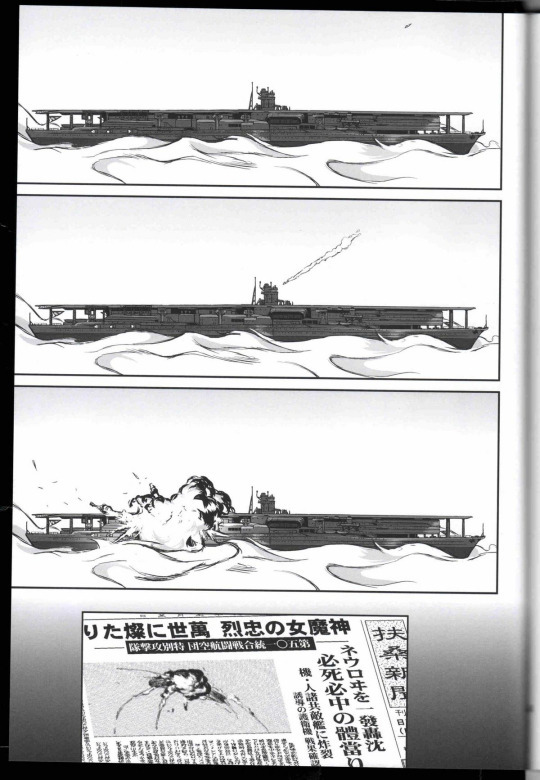
6) and then 5) combines with 1) again, which was already baked in, and the last 8 or so pages are the apocalyptic showdown with the aliens as seen from the Zero’s eyes. The American and British girls are out of the picture, dismissed in one panel. The French and Italian girls have surrendered and slunk away because they’re pussies.
The French and Italian girls have surrendered and slunk away because they’re pussies, but the two German girls went boldly into battle and lie bloodied and dying on the ground, this is the thing.
And so finally, the Japanese girl is fighting alone. She’s scared, she’s meek - she was the natural submissive for the first 20 pages, getting hazed by all the older nations^H^H^H^H^H^H^H girls but now it’s just her, now it’s her turn to prove her honor, and she jets out shrieking her vengeance, dodging alien missiles, coming straight out of the page…
And the next page is imitation newsprint, with a period photo-offset litho as the header. It’s an alien aircraft carrier, obviously American in design, with an exhaust trail streaking into one side of the island and a giant explosion blossoming out of the other.
And THAT is the most meta- thing I’ve ever seen.
(UPDATE for incoming 9/15/16: Takotsuboya’s “Witch-tachi no No-Pantsu”
ah yes, Mike Judge, creator of the breakthrough cartoon The Lower Class Progeny Of Single Mothers Are Irredeemable Refuse And Attempts To Engage Them Are Both Doomed And Farcical and its followup, Republican Voters Are Diverse And Nuanced And Apparent Contradictions In Their Worldview Are Less Hypocrisy Than Adaptations To A Pretty Functional Lifestyle
(not to mention the cult movies The Worst Thing About White Collar Life Is The Emasculating Effect Of Renouncing Violent Outlawry; Corporatization Degrades Society But It’s Ultimately A Second-Order Effect Of Dysgenic Breeding; and the lesser known You Know, Small Business Owners Have To Put Up With A Lot Of Bullshit)
Sitting in a bar in Missoula, watching Animal Planet. The rebranding of white in place of red as the outdoorsy, nature-skills race is perhaps the most interesting development in recent American race relations.
Dashiell Hammett was one of the only pulp detective authors to have actually worked as a detective, with the Pinkerton National Detective Agency, back when it was basically a countrywide mercenary police organization. The Pinkertons were actually closer to modern police than their official contemporaries in the machine politics era, who tended to fall somewhere between patronage-hire watchmen and the mayor (or sheriff)’s sanctioned gang. The establishment of the FBI was in many ways a nationalization of the Pinkertons, with key figures brought on as advisors, replicating the network of local bureaus with focuses on both investigation and the infiltration and undermining of labor radicalism. Big city police forces then remodeled themselves after the FBI - famously the LAPD under William Parker (the NYPD had professionalized already under Teddy Roosevelt, and Chicago managed to preserve its machine structure).
This process continued into the early 1970s, as the RFK/FBI-led attempt to shatter the Mafia shook out. This was part of the mid-20th century American centralization of power. If you’re ever tempted to look with contempt upon modern African states, or pre-Mao China, or pre-unification Germany, keep in mind that America was largely structured as a loose coalition of local bandit-warlords until the 1960s. At the national level, civil rights laws and the attempt to merge the two (black/white) American nations were as much a cynical front for advancing this centralization as they were an honest idealism. And not without cost - organized crime, and the permeable borders between that and urban politics, were one of the major mechanisms by which immigrant groups were integrated to and advanced within the American system, a way to translate sheer numbers and cultural affinity into structural power. American blacks largely fit the immigrant pattern, if you date “arrival” to the Great Migration, but then stall out in the ‘70s-‘80s, and a lot of that has to do with RICO laws, post-60s reformist idealism, and the nationally-sponsored “war on crime” blocking this path. In an earlier world, black local politicians and street gangs would form alliances, eventually using patronage to co-opt and take over police forces, and extract rents that would be partially redistributed down the machine ladder. As is, you still have corruption, but it accrues to politicians, pastors and other organizers, and white property developers, without trickling down to street level.
You can quote me on that - the sorry state of American blacks is because criminal gangs are too weak and police aren’t corrupt and brutally extralegal enough.
What was I saying? Dashiell Hammett. Lived in San Francisco and set his fiction there. Was an actual private investigator, and accordingly has a strong focus on tradecraft, especially with the nameless “Continental Op”, employee of a fictionalized Pinkerton, protagonist of some of his books and most of his stories. Though the climaxes could get colorful, the Op’s assignments - quietly track down a runaway heiress, locate a fled embezzler - and methods - use 3-man teams to tail people on the street, question and dig up background on the target’s acquaintances, sit around and eavesdrop on conversations - were true to actual practice. (Hammett said the major difference is that what his characters accomplished in a week would in reality take several months, while they worked multiple cases in between).
While the Op was proudly professional (a recurring theme being his contempt for hotel staff “detectives”) but otherwise opaque, Hammett pioneered detective characterization with other characters. Where the Op was based on actual detectives he worked with, Sam Spade (protagonist of The Maltese Falcon) was based on those detectives’ romantic self-image, and his stoic facade, cynical chivalry, and romantic entanglements were a *huge* influence on later writers. Nick and Nora Charles, based on Hammet and his beloved, playwright Lillian Hellman, mixed investigation with screwball banter in a more lighthearted tone, and can be considered the predecessor of Maddie and David (of Moonlighting), Mulder & Scully, and even non-(explicitly-)romantic buddy partnerships like Crockett & Tubbs.
Hammett’s real-life experience exposed him to less picturesque aspects of the private investigator’s role in society as well. He complained that employers doing background checks were interested in issues of moral character that, gambling debts aside, had no correlation to trustworthiness, and he especially disliked working to suppress labor agitation. Starting as a Pinkerton agent, Hammett ended up being blacklisted and imprisoned as an enthusiastic communist activist.
Next is Raymond Chandler, the most literary of the detective greats. Where Hammett had been an actual PI, and reflected it in his writing, Chandler was a cuttingly observant man who retreated into drink because he was way too intelligent and cynical for Los Angeles, and reflected it in his. His Phillip Marlowe inhabited a thinly-to-the-point-of-pointlessly veiled LA, and passes through it with gimlet eye and poison tongue, all backhanded compliments and sideways insults. Hard-boiled fiction’s love of brilliant turns of phrase, of meandering digressions that end with a surprise punch to the gut, largely comes from him.
While at first glance Marlowe might seem to perform the duties of a detective same as the Op, on close examination you realize that none of what transpires has anything to do with his intentions, and that the plot is moved along by coincidences he encounters while out on assignment, with the ultimate plot of a tale usually about as unrelated to the inciting incident as in golden age Simpsons. This is equally true of The Big Lebowski, which is a loving Chandler tribute, and Chandler himself parodies this (and his/Marlowe’s booziness) in one of his later stories in which the plot is advanced by the things his protagonist literally runs into while drunk driving around LA.
Chandler’s novels are usually composed of the plots of 3 or 4 of his short stories banged together, but that’s fine, because the plot was never the thing, the meat being the wonderful language, setting, and characterizations, which were crafted anew. You can still to this day drive around LA and discover most of the places he described, looking exactly as stated. And while I can’t speak to his period accuracy, I was myself once a too intelligent, cynical Angelino writer for a while, to the point I avoided leaving home sober, and I can confirm that the kind of person who inhabits LA, their nature and motivations, are exactly as he laid out back then.
Chandler’s output eventually trailed off. One story, appearing years after any others, reads like absolutely terrible Chandler pastiche. Scholars disagree whether this was the product of an alcoholic wreck of a man who had known better than to try to publish anything for years but needed the money, or his wife pretending to be him because he was an alcoholic wreck of a man incapable of even writing anymore but needed the money.
If you’re only going to read one of these three, read Chandler.
Finally, a bit of a contrast in Mickey Spillane. Spillane’s famous recurring detective character was Mike Hammer. Given the name, you might not be surprised to learn he spent less time in cautiously piecing together mysteries than punching communists in the jaw, in much the same way Captain America spent a lot of time punching Nazis in the jaw. Actually, Spillane had been a writer for Captain America in the ‘40s. Actually, the character was originally written as a comic book protagonist named “Mike Danger”. Beyond communism, Hammer often found himself arrayed against such other corrupt and corrupting trappings of the decadent elite as drugs, psychotherapy, and trial by jury.
Spillane’s writing was, I’ll say, not up to the level of Hammett or Chandler, though he has been favorably cited by prominent writers like Ayn Rand and Frank Miller. If you look at pulp of the time though, he’s appreciably above average. Pulp… basically the closest parallel we have to pulp today is fanfiction, in terms of its average quality, low cost of production and consumption, sheer volume, and the rate at which it produces critical and commercial successes. And dear god, the smuttiness. Mike Hammer banged a lot of the broads he ran into. Before barefacedly honest pornography became as ubiquitous as it is, pulp filled the role of mainstream erotic product, with much detective pulp serving the same “drugstore-available erotica” role for men that romance pulp did for women. (Appreciating this makes the “Seduction of the Innocent” comic book scare about drugstore-available pulp for kids a bit more comprehensible).
This crossed over into other formats like cinema - Deep Throat, Beyond the Green Door, and The Devil in Miss Jones were all received as at least in the same ballpark as mainstream releases, and up into the ’80s, pornographic movies had plots and runtimes that roughly approximated Hollywood product, and even in the ‘90s, softcore product at least had narrative framing devices. Between gonzo and DVD nonlinearity and the internet and the collapse of obscenity prosecution against which to offer artistic content as defense that’s faded, though as the Valley studio system’s share of the industry shrinks you’re seeing them play to their strengths in production values and plot (particularly with parody content, Tijuana Bible/H-Doujinshi-style).
On the other hand you had whole parapornographic mainstream subgenres as the erotic thriller, the rape-revenge drama, the teen sex comedy - American Pie was released in 1999, which was really pushing the limit at which it was worth it to watch 90 minutes of material for the chance to briefly see a bare-chested girl masturbating. (It’s still worth it to hear Alyson Hannigan talking dirty, though.)
The one thing that pulp still has a hold on is violence. (In addition to the jaw, there are many loving passages of Hammer battering guys in the crotch.) While splatter-horror may be a flourishing niche genre, with regular DVD releases, it’s still that, a niche genre, and not the mega-industry of pornography. Video games yes, but detective pulp and “true crime” genres have mostly just migrated to another medium and become hourlong police procedurals like CSI or Law & Order, offering the same thrills of vicarious brutality masked by the fig leaf of nominal identification with the forces of law and order. (Though cable antihero dramas and serial killer procedurals like Dexter and Hannibal seem to be moving a half- to full step beyond that.)
Mickey Spillane. Ah, fuck it, I don’t have anything else to say about Mickey Spillane.
Anonymous asked: just by the way I got into late 19th century american police corruption and politics because of you and whoa it's fascinating, I would greatly enjoy if you would go on
more like “son buddy johnny “large ears” mcmaster, my main man, my most promising recruit [agressive back pat] what’s here gonna happen is that if me your favourite mentor get the newspaper boy to get me more happy news about our beloved senator, then I can pretty much guarantee that big boss “honey pot” oreilly is gonna hear about your mom’s flower shop”
Oh nice. Def. read Plunkett of Tammany Hall if you haven’t, if that’s not the link I got you into this with in the first place.
One thing I’m looking into lately is lynching and vigilante law. Got the standard background picture of lynching as a specifically racial Dixie thing but realizing that much of the country, between the Civil War and the 1920s, was developing traditions of extralegal killing.
I talked here about the Unwritten Law, that a man was entitled to (=routinely acquitted of) stalk and kill those who put hands on his women. Meanwhile the “true man” and “American mind” doctrines set into law something like modern Stand Your Ground laws. In popular conception the list of things a true man was not expected to tolerate rather than deploy righteous violence was longer, in practical application it turned on the testimony of survivor-defendants.
Not just individuals committed individual acts but communities came together, enacted deadly purges, and then published triumphant histories about it, as Regulators, Moderators, Committees of Vigilance.
(cf. the Vehmic courts of medieval Germany, particularly the resemblance of the Gilded Age to feudalism insofar as the state secures magnates’ holdings and leaves the people to themselves)