shrine to the prophet of americana
#rerun (641 posts)
Molly Lambert: She Was A Fun Bar Slut
So I just had an uncanny moment reading This Recording, an essayistic review site from Molly Lambert, last seen appearing in this link. Specifically, reading the most recent entry, this one on 1990’s The Hot Spot. It starts off with a bunch of pictures and paragraphs about gender in nonspecific terms then when it gets concrete:
I got called a slut by three different dudes, none of whom I knew well at all.
All three of whom took it upon themselves to tell me and my female roommate (unprompted, naturally) what kind of girls we are. More specifically in one case that she is a “sexy uptight librarian” and I am a “fun bar slut.”
And I’m like “haha, I remember getting absolutely wasted and telling a girl she looked like a librarian at the Gold Room patio not too long ago”. And then it continued:
But it did have an effect on me, and the effect was “WAIT WHAT?” Because my roommate wears glasses and I am a ginger?
And I’m like “huh, that’s exactly what her friend sa…” and then I remember all those taglines including “Molly Lambert lives in Echo Park, California” and I’m like OH SHIIIIIIT.
Now I didn’t remember the “fun bar slut” line, which she returns to a few times, but it’s perfectly in character, seeing as:
- A) Back in college I had an acid trip all about How I Had Personally Failed Feminism, and it’s only been downhill from there.
- B) As she points out, it’s an absolutely amazing line.
On thinking it over, I think I told the other girl about the librarian thing and the fun bar slut bit was a quick response to “then what am I?”, but that’s a weak memory.
After I got over the shock of the essay becoming bizarrely personal, I decided to chalk this one up as a major win for my recent Meeting People strategy of drinking up my asshole charisma, going to bars, and making wild guesses at people’s names, ethnicity, and personalities. I’m either randomly right and I’ve captured their attention, or more often I’m wrong and they use it as an opportunity to correctly introduce themselves and we go from there, made a lot of one-night or longer pals that way.
Or sometimes they’ll get peevish, but really, this is the worst case scenario? Someone walks away with my words ringing in her ears for days, uses them as a framework for analyzing her life and organizing her thoughts, and then dedicates her considerable talents and audience draw to enlarging my legend?
one of my favorite stories, back before any of you knew me.
I absolutely will use “it haunted me, because nothing is funnier – Molly Lambert” as a testimonial
Jury nullification as discussed on the Internet: Keeping some who wasn’t hurting anyone from going to jail for violating some...
Jury nullification as discussed on the Internet: Keeping some who wasn’t hurting anyone from going to jail for violating some bullshit law
Jury nullification IRL: Keeping someone who was violent against someone subverting the social order out of jail
Absolutely correct. For an example, check out this series on “The Unwritten Law” - the turn-of-the-century practice of acquitting (as “temporary insanity”) men who had determinedly stalked and killed the rakes who had sex with their women.
Two interesting points here: one, that this “Law” metastasized to the point of undermining ALL murder laws, as defendants would offer this difficult-to-disprove backstory.
Two, that the government (under threat of losing the ability to credibly punish killings) responded not with crackdowns but by accommodating the desire to punish adulterers - criminal laws against adultery were passed or rediscovered, likewise “heartbalm” civil actions - “criminal conversation” and “alienation of affection”.
Defendants could even claim a formalized, if limited equivalent to “temporary insanity” defenses - a man who caught his wife in the actual act of sex with another, “in flagrante delicto” was entitled to kill either or both of them, and men who knew or suspected adultery would arrange such “surprise” discoveries for the purpose of claiming a righteous kill.
That’s not the only place in American history to show that pattern - citizens use lethal violence as means of social control, government responds by cracking down not on them but their targets in hopes of rewinning assent to a government monopoly on violence by proving itself willing to use it as they would prefer. Many southern states tightened “Jim Crow” racial codes between the World Wars as part of an attempt to stop lynchings, many victims of which were in jail awaiting trial when they were seized by mobs unwilling to trust the courts with their punishment.
And labor leftists bitch that American strike action is too constrained under the Taft-Hartley Act, but that governments that stand for the suppression of mob violence, extortion, and trespassing would at all allow a mob to forcefully lay sieges on private property with the intent of extracting concessions from its owner – let alone defend them and enforce the resultant contracts – is nonobvious. What it is is the same thing - over the course of the late 19th and early 20th centuries the people had made clear there would be labor militancy, and the government shrugged and decided it preferred it to be backed by the threat of violence by existing government institutions, rather than open violence by private actors who might eventually seek to supplant those institutions.
Friendly reminder that angry men have killed enough people that the government starts enforcing monogamy before
19th Century European Politics
People: Boo! Boo!
Monarch: Nobility, are they booing me?
Nobility: Ah, no, they’re saying “Boo-urgeoise. Booo-urgeoisie!”
Monarch: Are you saying “boo”, or “boo-urgeoisie”?
People: Booo!
Liberals: *We* were saying “boo-urgeoisie”.
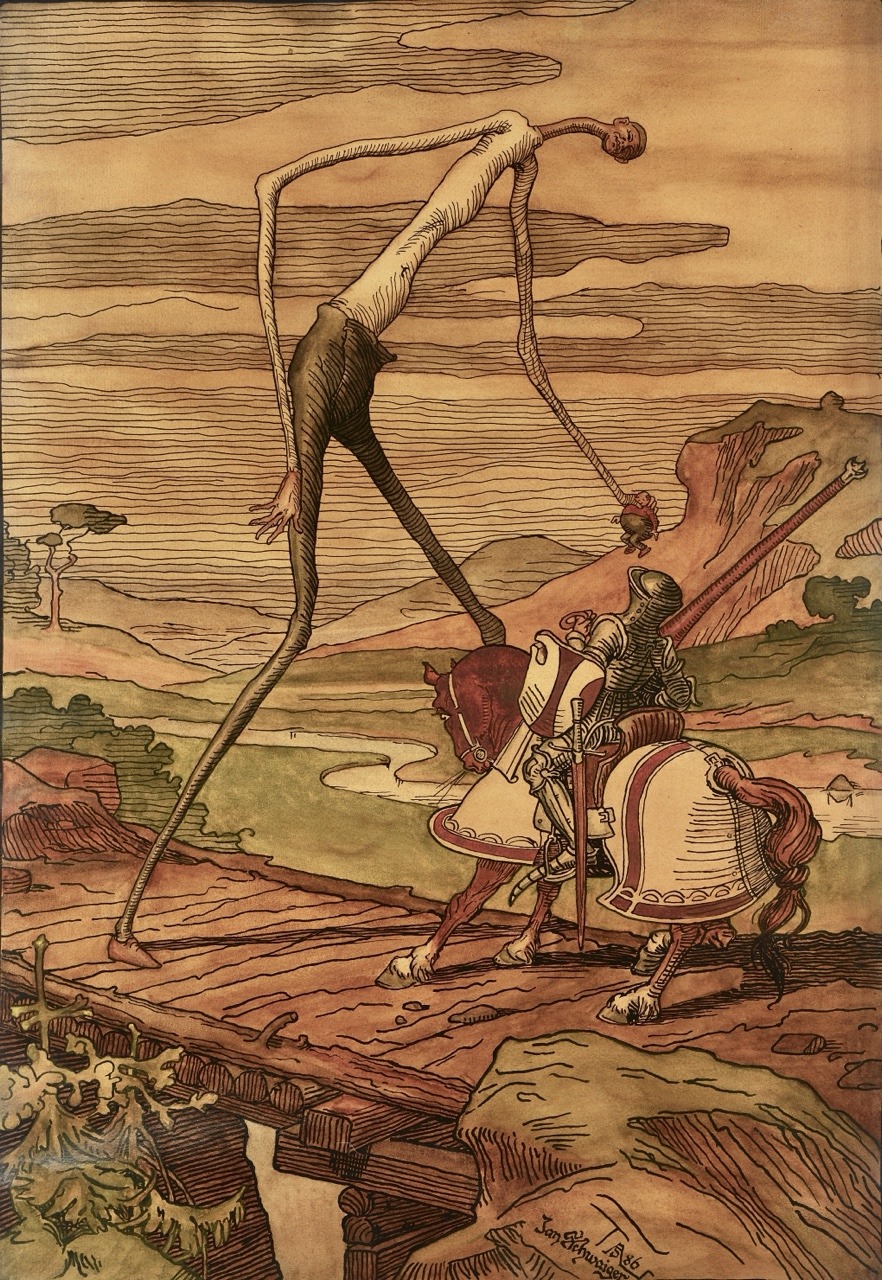
Long, Wide and Sharpeyes. Slenderman’s great-grandfather. By Czech artist, Hanuš Schwaiger (1853-1912).
Long, Wide and Sharpeyes.
Slenderman’s great-grandfather. By Czech artist, Hanuš Schwaiger (1853-1912).
Watching Aliens, the part where they all wake up from cryo together and all the ritualized griping is absolutely masking this...
Watching Aliens, the part where they all wake up from cryo together and all the ritualized griping is absolutely masking this ‘Nam vet “we’re only good for war” cameraderie, the whole Soldier of Fortune vibe, I only just get that
Of the franchises that reacted to Reagan, Rambo: First Blood II was “what if we refought ‘Nam but seriously and won”, Aliens was “what if we refought 'Nam with all our new toys and still lost”
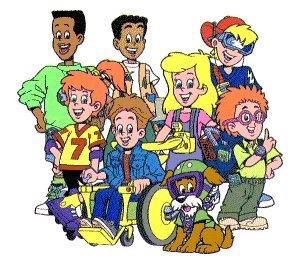
The Burger King Kids Club, representing all the ‘90s identities: Black Hispanic Nerd Tomboy Disabled Stacy Geek Dog
The Burger King Kids Club, representing all the ‘90s identities:
Black
Hispanic
Nerd
Tomboy
Disabled
Stacy
Geek
DogTechnically I think the short butchy-looking guy is the nerd and the guy with the backwards cap is a “coolkid”, which is a distinct genus. This may seem like splitting hairs, but it’s important that we recognize the cultural distinctiveness of coolkids in order to honour their sacrifices during the Cola Wars.
The coolkid was a kind of cyber-Fonz, a “women want him, men want to be him” archetype as targeted toward twelve-year-old dorks with chunky white sneakers. It was a laboratory-designed hybrid of nerd and greaser engineered to target the market sector of the former using the charisma and popularity of the latter. Toward the late 90s there was some further crossbreeding with rappers in order to counteract the diminishing relevance of greasers, but in the early 90s that was still too threatening for mainstream white suburbanites with money.
Anyhow, I went looking for some more vintage examples but it’s surprisingly hard to find ones that aren’t later parodies so I’ll just link this fucker.
Zack the Lego Maniac is, for me, the prototypical coolkid character
Hatchet Jobs #3: Ta-Nehisi Coates
(So I realize I’ve been shit-talking other writers a bit recently. And hey, that’s actually a pretty traditional way to break yourself as a writer, by tearing others apart. So let’s make that an occasional series. Here’s entries 1 and 1.5 on Fredrik de Boer, 2 on Ozy Frantz. Might as well keep doing it until sempai notices me.)
Ta-Nehisi Coates will never say in 100 words what he could in 300, and will never say in those 300 words anything new or interesting enough to justify 100.
He’s endlessly fascinated with himself, convinced the most banal observations and experiences are transmuted to gold by his involvement. I can’t count how many times he’s invoked “in college I realized my juvenile ideas had been immature and self-flattering” as some mark of distinction rather than the baseline minimum, a foundation on which actual insight can be built.
Or presenting himself as some clear-sighted visionary for reading books on the Civil War and dragging his kids out to battlefields and historic sites - which I’m pretty sure History Dads have been doing since Lee surrendered at Appomattox - and then turning it into who knows how many articles, blog posts, book proposals in which he sucks his own thumb - among other parts - over the brilliant insight that The Civil War Was About Slavery.
The thing is I’ve seen this before. Another thing he keeps coming back to is his childhood, being raised by a black nationalist father - the kind of guy big on discipline, effort, and racial pride who would be easily recognized as a conservative in an environment where his ethnic identity was THE nationality. And I really respect those guys, and a lot of it is for their ability to instill a sense of confidence and drive in their kids that propels them into a solid middle- to upper-middle class life coming from an environment where a lot of people don’t even come close.
But when those kids get there… I’ve run into a few of them. And boy are they convinced they have wisdom to bestow, and boy does it get a little ridiculous sometimes. “Son, I grew up on the streets, so I’mma tell you how to be a creative-class yuppie, son.”
Honestly a lot of time it seems like they’ve absorbed wisdom as an aesthetic, a style, and confused that with actually being wise. Now that’s a trap anyone can fall into - I spent a while mistaking people for smart when they were really just fans of spaceships and Science!, myself - but a big part of the path to actual wisdom is dragging yourself back out again.
Now I suppose the obvious counter would be I’m just repeating an old racist trope, of Black intellectuals as just simian imitators puffing themselves up above themselves. So, then, when you look at, say Spike Lee movies or ‘90s Fox sitcoms or contemporary black feminist blogs where “the ~enlightened brother~” is a stock comic trope, that’s just… internalized racism, right? Pf, nah. What it is is your low expectations, seeing someone go through the motions and taking that as good enough. ☯✟ Follow for more soft bigotry ✟☯
Now that’s his subject matter, when it comes to style - as a person, I’d put him in the 99th or 98th percentile of writers; as a professional writer he’s still above average, but making him the flagship brand of a magazine that’s constantly selling itself on its history publishing the greats of American letters? I think he needed another good five or ten years of polish before he could even contend for that level, but he’s sure not going to get it getting published in front-cover packages for what he’s turning in now, and then praised to the heavens as some kind of Second Coming. When in an earlier one of these I said Freddie de Boer was finding his voice in venom, I’m talking about things like the line about Coates’ “creepshow commenters asking him to forgive their sins”.
You see from the pulpit to the sidewalk to the, uh, movie theater, black America has kept up a tradition and practice of public rhetoric that’s really fallen out of white life. And Coates draws on that. He’s clearly angling to speak with “prophetic voice”, basically in a cadence and idiom derived from the black church, that preeminent organizing institution of African-American life, with preaching as an accessible path to esteem and power for the clever and the loquacious, preachers as a leadership corps in social activism and public life.
The thing is, again Coates is familiar with the preacherly cadence but doesn’t seem to have internalized how and why it works. It’s like when you ask a kid to draw a future airplane and they put wings everywhere, wings where they won’t generate lift, wings that would foul the air of other wings. Honestly, I think it might have to do with picking it up from a father who had in him a captive audience rather than from the actual church from preachers with an eye towards keeping souls in the pews.
You see, the preacherly cadence, like all good cadences, is about rising and falling action, building your audience up and then bringing them back down, concentrating your energy and then releasing it in a focused beam. But Coates knows how to build intensity, but not how to bring it back down again. Instead of escalating from a baseline escalation becomes the baseline, devaluing his starting point by comparison, offering no local maxima and thus no climactic moments. He knows how to build a theme through repetition - his recent work littered with the increasingly stale buzzphrase du jour, “black bodies” - but not how to break or twist the repetition and pour all that energy you’ve built up into an original, novel thought.
The end result is a plodding drone of a tone, piling words on words on words unto infinity, it’s writing as prog rock. The preacherly cadence is at root an oral form, but you can tell his first medium is text, if he ever tried to speak this stuff in front of an audience he’d at least notice them tuning out halfway through, notice that he was just making himself hoarse without eliciting more of a response.
And really, that’s the telling bit. That’s the part that gives away the game, that the promotion of Ta-Nehisi Coates, all the self-congratulatory media attempts these past few years to put black figures up front in the public eye, it’s not about putting power in black hands but as a maneuver in a status games among whites, that these guys aren’t being looked to as thinkers but as mascots.
(There’s an old joke from when the Republicans were the “black party”, but even then more in thematics than in actual power - “What do you call a black man at the [annual fundraising] Lincoln Day dinner? The keynote speaker.” [related])
Because really, what is whiter - what could possibly be whiter - than trying to distance yourself from your whiteness, trying to show how with-it you are, by latching on to some black celebrity, praising him to the heavens, wielding your fandom as a talisman, and not even noticing that you’ve managed to pick a guy with no goddamn sense of rhythm?
The flow of traffic through the U.S. circulatory system Click here to see traffic flows mapped in other parts of the world
The flow of traffic through the U.S. circulatory system
Click here to see traffic flows mapped in other parts of the world




kontextmaschine once implied that the ‘cultural marxism’ stuff was pushed by capitalism against actual marxism. was that a...
kontextmaschine once implied that the ‘cultural marxism’ stuff was pushed by capitalism against actual marxism. was that a thing?
Yeah, well, The Establishment, and the CIA, being fairly exempt from electoral pressure, had the latitude to be competent. After WWII there was a lot of actual, real support for communism in Europe, on either side of the Iron Curtain. Partially for the same reason as the fascist renaissance in ex-Warsaw bloc countries - they reaped the goodwill of being the ones to really stand up against The Hated Occupiers - partially because there really were a lot of poor ex-peasants coming from a century-long tradition of struggling to cast off the remnants of feudalism.
And the Marshall Plan and all that, we tried to guide who we could to Yay Capitalism, and rig electoral systems to keep the commies out - huge cash dumps to friendly parties, election rules weighted to get NATO-friendly results, skullduggery where necessary - above all we kept the interior ministries (who pay the police and count the votes) friendly - coups where necessary.
But there were some people we were never going to get with that, so we at least tried to guide them to less-bad fallback positions. If you want ownership of productive forces in common, in accordance with the general will of the people, how about a welfarist social democracy with nationalized industry! Like England, which spent most of the Cold War under a Labor party proclaiming Clause IV. And if they were absolutely dedicated to communism, they were guided towards a form that was at least not a cadet branch of the Lenin dynasty ruling in Moscow.
And that happened domestically, too. The Soviets did promote communism in America for their own purposes yes, but it’s not like communism hadn’t had a following in America before that, particularly among the downtrodden and the thoughtful types. Communism didn’t firmly equal Marxism equals Russia until the Russian Revolution, but Edward Bellamy didn’t even live to see the 20th century. And so they were ripe for co-opting too.
If blacks organize and press identitarian claims as blacks, or pan-Africanists, well at least they weren’t organizing and pressing their claims as communists, which was a real, live possibility. If the students are pressing their claims as hedonists… (there was major campus unrest in the 1950s over “in loco parentis” parietal rules, because what’s the point of having women around but to fuck them?)
And of course, to the extent the Soviets were actively trying to undermine and fracture our society with art and ideas, we were doing the same thing. Am I saying we were morally equivalent? Yes, of course. Everything is morally equivalent to everything at a value of null. More importantly, strategically equivalent.
Encounter magazine, dissident authors, abstract expressionism. We didn’t stir up tensions along racial lines so much as religious - Muslims in the ‘Stans, yes, also Catholics in Poland (JPII wouldn’t be the first time a papal election turned out awfully convenient for a dominant power, and we were into some darkside shit in Italy that touched the Vatican at the margins…) and Jews in Russia.
You know, in national mythology, “the Nazis were bad because” didn’t really end in “the Holocaust” until the 1970s? “The Jews” were awfully communist-associated, after all. But then the white ethnics were integrated into white, and the various Israeli wars shook things up to the point they ended up on our side (and transformed their public image from kibbutzim to Rambos), and we managed to cast “Jewish repression” as the bad thing they did, and so it goes, so it goes.
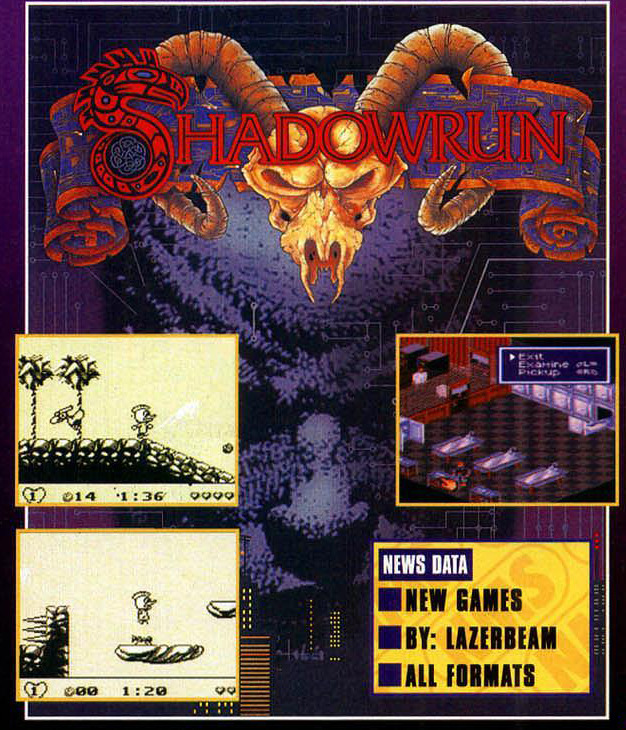
Shadowrun page from a Nintendo Magazine System preview (issue #11, August 1993). Every few months, I get to urge to play...
Shadowrun page from a Nintendo Magazine System preview (issue #11, August 1993). Every few months, I get to urge to play the Shadowrun SNES game on a handheld, which isn’t going to happen until series creator Jordan Weisman tracks down the rights. :o/
The screenshots shown on the left side of the page are from the Game Boy edition of Shadowrun that Beam Software created but never released. It was a sidescrolling platformer in which you played a Street Samurai — psyche, that’s actually Edd the Duck, a game based on the BBC character and released by Beam’s subsidiary Lazerbeam.
Buy: Shadowrun (SNES)
See also: More Shadowrun frothing
[Via Do Go On]
Holy shit, Tiny Cartridge linked to this blog! Awesome!
The SNES Shadowrun was a cool game (except wandering all the fuck over the world trying to figure out who taught Negotiate). Pen & paper Shadowrun looked kinda terrible (a lot ‘cuz of their D6 for everything fetish) but with the BBS conceit it had the best supplement books I’ve ever seen. To this day I think Corporate Shadowfiles is a perfect introduction to corporate finance.
(P.S. oh hey 1,000th post)





So the “government-issued gfs” thing going around got me thinking about Billy Joel’s Allentown again. Like, the whole conceit of...
So the “government-provided gfs” thing going around that got me thinking about Billy Joel’s Allentown again.
Like, the whole conceit of the song is “Our fathers went off to WWII and in return the country moved heaven and earth to make them patriarch-princes, we went off to Vietnam and now we’re treated as disposable.”
(He’s forgetting Korea in between, but that’s OK, everyone does.)
And given the title the focus is on the fall of the unionized Rust Belt heavy industry, but look at this line
met our mothers at the USO
asked them to dance
danced with them slowthis is literally, 100%, a lament for when we had government-provided gfs
The morale-boosting USO, now best known for in-theatre concerts and airport lounges, ran homefront clubs and canteens near soldiers’ postings, and a major role was providing the troops with female attention, recruiting girls from the area to free dances with regularly paid soldiers, hiring staff hostesses whose job was to flirt.
(This in a period where “courtesan” jobs like taxi dancer or cocktail waitress, with a career path culminating in marriage, were more of a thing)
And it wasn’t just the USO. Part of the point of the WAC was to match the supply of single women to the demand of support roles, freeing men for front-line service, part of it was just to have some young women on base. (Here I vaguely gesture at Miss Buxley, General Halftrack’s buxom secretary in Beetle Bailey)
Then there were nurses. Male military nurses in the war had a reputation as twinkle-toes homosexuals, drawn by the constant flow of strong yet vulnerable young men in uniform far from home to comfort. The male ones, of course. (Florence Nightingale’s innovation wasn’t young women going abroad to tend to soldiers – field armies ALWAYS drew trains of camp followers to attend to the men’s needs – but rather an idiom to do it compatible with Victorian sensibilities)
Like, guys, the government very much did try to provide gfs. And it didn’t stop with the war.
There’s this Rosie the Riveter impression that women streamed into factories in WWII but faded at its end, in fact post-war female factory employment was lower than before the buildup. (If women in factories started with WWII, how would you explain the Triangle Shirtwaist fire of 1911?)
And this came amidst government pressure (from an extensive wartime central planning system) to clear out women and make way for returning men. There was a fear the Depression would return (this is why the war economy was never unwound) to a country of battle-hardened men and provoke Communist revolution; it was a high priority to keep men occupied, loyal, and rewarded as patriarchs.
Daniel Moynihan took shit in his famous report for suggesting the solution to black community’s ills was government-backed patriarchy, Earl Butz took more shit for putting it thus:
I’ll tell you what the coloreds want. It’s three things: first, a tight pussy; second, loose shoes; and third, a warm place to shit.“
For how colorful the language might be, though, that formula – “rising standards of living through improved access to consumer goods and women” was the exact same deal the United States made with its whites, as the basis of the postwar golden age.
I could talk about the postwar expansion of high schools and the creation of the “teenager” and all the courtship stuff there, hosting proms and football games and teaching how to dance in gym and how to wife in Home Ec and showing film strips and Coronet 16mms on how to get a date, but that’s a bit of a stretch. The point remains, though, under the New Deal social compact, from the Depression into the 1970s, the government was ABSOLUTELY in the gf-providing business.
Friendly reminder that “callous and blithe wits push society towards revolution for profit and attention while billionaires in...
Friendly reminder that “callous and blithe wits push society towards revolution for profit and attention while billionaires in their interests underwrite smug warmongering” historically IS journalism’s workable business model.
Ready Player One
So I heard about Ready Player One, it sounded interesting, finally got a chance to read it.
Jesus.
Like, I would describe the prose as “workmanlike”, in the sense of Homer Simpson making that spice rack. The thing is seriously held together not only by ‘80s geek pop culture references, but ‘80s geek pop culture references that get called out by name and explained in depth when they appear, like the novelization of a fucking Seltzer-Friedberg movie.and this is all set in the what, 2020s? 30s? but the plot at least accounts for that, foregrounds it even and I guess there is that weird geek retro thing, girls at Ground Kontrol with 8-bit Samus tattoos across their colllarbones like wow I"m pretty sure we were into the 32 bit era by the time pooping became volitional for you
Also it’s got this quest narrative that gets interrupted for a bizarrely long middle section that’s all boy meets girl/boy gets girl/boy loses girl, except it’s really boy impresses girl on the internet through nerd trivia and then obsesses over her in a way that ultimately skeeves girl out, and maaaaybe this is a riff on John Hughes movie structure?
But it was a decent page-turner and I kept reading it, up to right before the end boss fight, and yes it was shaping up as a literal boss fight because of fucking course it was, and –
okay I’m not a “good guy” here. I’ve been reading a lot of tumblr “voice of the underdog” communists lately and honestly feminists for years, I came to tumblr by way of Sady Doyle, and maybe picking a bit up from them and that’s kind of conscious and intentional because I’ve long been aware of how impressionable I am by good writers and recently my superego was getting its eyebrow pretty high about how firmly I’d been nodding to fascists and white nationalists, and
while I’ll understand how people different from me are totally real and have totally legitimate desires that kind of only reaffirms me in looking out for #1 because I realize with everyone being real and legitimate there’s not a way everyone can win, there’s just not, fulfillment of one is always experienced as limitation of another and I want good people to win but myself first of all –
okay, when the book made the point that the liberating thing about the internet is that it enables School Choice, so that the smart deserving poor can escape the violent undeserving poor – I mean I’ll nod and affirm the critiques, but allowing the smart deserving poor to join me in ruling the world is basically the extent of my fantasy social uplift politics so whatever.
When it made the point that the liberating thing about the internet is that it makes cool old guys who think of themselves as wizards rich, so they can wisely use their money to enable the deserving poor persecuted geeks to escape their lives towards Oregon, I mean, that’s not how I’d put it but wow glass houses.
But when it made the point, and I’m barely even paraphrasing, page 320 of the Broadway Paperbacks first edition, that the liberating thing about the internet is that anyone can pass as a thin straight white boy, as long as they like Rush and objectifying women, I honestly yelled “fuck this!” and threw the book on the ground.
I would’ve used it to pick up dogshit and thrown it in the trash, too, if it were my copy.
The wonderful thing about genre fiction is the way it’ll be spiced with completely unreflective takes on the author’s kinks.
4/14/2013
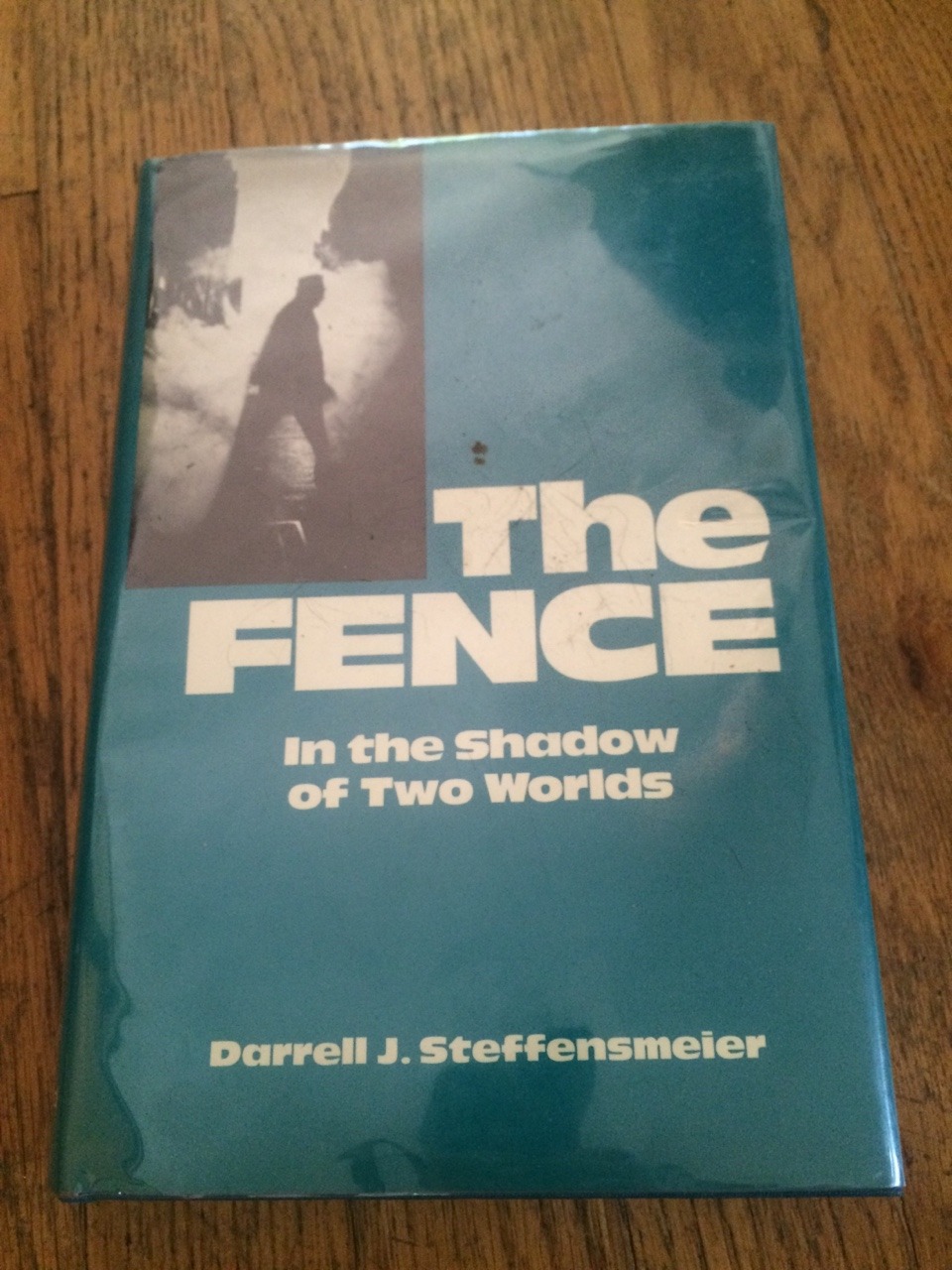
Picked this up from Powell’s. It’s a 1986 book drawing from jailhouse interviews with “Sam”, a burglar-turned-fence active in...
Picked this up from Powell’s. It’s a 1986 book drawing from jailhouse interviews with “Sam”, a burglar-turned-fence active in “American City” (from context, Philadelphia).
Sam had a secondhand/antique store, he’d buy things he knew were stolen, and then he’d sell them on the shop floor, at auction, to other shopowners, or to private buyers. dead_dove.jpg, I don’t know what I expected.
That said, there’s plenty of interesting stuff in there. Like, Sam talks about the Mafia (and lesser-known Greek and Jewish organized crime) as a force in the underworld but not a ruling one, that’s interesting. They reserved monopolies on some categories of stolen goods - cigarettes and, interestingly, sugar, and taxed the crews doing truck “hijackings” (almost all inside jobs with drivers paid off), but didn’t otherwise bigfoot around. Really, Sam was happy and proud to have the opportunity to bring them in on deals – they’d take their cut but effectively guarantee things, allowing Sam to confidently make bigger, riskier deals than he could otherwise.
Two things jump out as necessary conditions for Sam’s operations that no longer hold and explain why “the fence” isn’t a familiar figure today.
For one, the corruption. It wasn’t just that high-profile lawyers and judges would defend and acquit guys despite knowing they were “really” criminals. It wasn’t just that they would make and accept four-figure bribes for acquittals. These pillars of the legal system would tell underworld figures when a rich client was leaving town so they could hit his vacant house, in exchange for help building their private collections.
Sam paid off beat cops by offering them goods below cost (writing off the difference as haggling or encouraging custom), but any given cop, if he hadn’t been paid off by Sam, had been paid off by someone, and had no interest in bringing the system down. It seems the only thing that could make a dent (what got Sam, after all) were State Police investigations combined with too much press attention to quietly bribe out at trial or on appeal.
Second, in a pre-electronic, pre-database, pre-chain retail world how much easier things fall through the cracks.
Sales were in cash and receipts were handwritten - or not, one source of margin was selling without sales tax - and if Sam got a load of stolen Hi-Fi equipment, he could buy a clutch of junk at auction and if the law comes asking who’s to say those “radios x 5” on the receipt didn’t establish his legal ownership? Hell, who’s to say the receipt wasn’t written up and signed by his buddy in the back room?
When a law required secondhand buyers to record purchases for the police, Sam dutifully carted boxes of index cards to the precinct house, who told him to chuck ‘em ‘cause what, they seriously expect someone to go around to every station and riffle through a few filing cabinets whenever some old biddy gets her TV swiped? C'mon. And for stuff “warm” enough to draw actual police effort, Sam could just truck it to auction over state lines; with the crime in one jurisdiction and the evidence in another, there was no entity with the scope to put 2 and 2 together.
The overwhelming share of product didn’t come from guys crawling through windows but shrinkage - factory, warehouse and loading dock guys, stevedores at the pre-containerized docks, delivery drivers on rounds who stopped off to let a few items fall off their truck and then shrug to their boss it must’ve been misloaded. Sam says the hardest work there was getting the guys to stay under the radar and not to take too much too fast too regularly.
Part of it’s that there were mom-and-pop stores to unload to, that used the no-questions-asked prices as an edge against department stores and chains. Even if you got a load of great hot TVs today what would you do with them, drive to Best Buy and try to flip them to the floor manager?
(The real answer today is “eBay”, or maybe combine with fake/scavenged receipts for return fraud. Also sometimes professional shoplifters – “boosters” who put Tumblr “lifters” to shame – unload through the newer ethnic crime syndicates. I remember in LA seeing one tobacco shop in Little Armenia that had nowhere near enough product for its floor space, a sign offering heavy discounts for paying in cash, and three tracksuit-and-cigar types talking in the back office and like, hmm. Also at the meth level there’s a thriving market in stolen Tide detergent.)
ohhhh, because sugar was the key input of moonshining
Of Course, Trump Will Never Win…
Of Course, Trump Will Never Win…
March 11: The Tiger has shown himself at Gap. The Troops are advancing on all sides to arrest his progress. He will conclude his miserable adventure by becoming a wanderer among the mountains.
I honestly think Trump has the best chance of being the next POTUS. (I peg him at 35%, Hillary at 30%, Jeb at 20%)
It’d be a realignment election that pivots the Republicans to a nativist welfarism, which is a realignment they’ll have to make sooner or later - it’s where their base is at already. If he can pull it off - “it” basically being the Sailer Strategy - and swing the Rust Belt red that’d give the GOP an electoral lock until and unless Texas flips (and the threatened Republicans’ inevitable divisionist gambit fails) and/or the next realignment comes. You’d cede bankers, blacks, and professionals with postgraduate degrees, but if you’ll recall so did the New Deal coalition.
Trump and Sanders are both burning up the floor and giving their party establishments heartburn pitching Scando-German native-producerist welfarism to a white audience, whoever can grab that ring first hoo boy. And as that recent Netroots Nation demonstrated, I think any pivot attempt’s going to face more resistance from the Dem base.
(If you look at the aftermath, you realize a lot of white progressives didn’t realize it would even be a pivot, they thought that’s where they’ve been since FDR and don’t seem to have recognized the Great Society/New Democrat thing as a realignment in the first place, largely because it didn’t work for them. Remember, “we will build an invincible coalition by adding minorities, feminists, the young, and the well-educated to our established lock on white producerists” was the Democratic plan in the 1970s. Admittedly, the numbers are better now on the left side of the formula, but the right… and I don’t think anyone has a coalition lined up right to win the actual shooting war they’d have to in order to make a realignment where no one was repping whiteness-as-such.)
Historically, there are two forces in American politics that can only be matched by each other - big capital and nationalism. Nationalism being white nationalism, as “white” is the national identity America constructed to legitimate and unify itself, much as “French” was deployed as France centralized in the early modern period.
The Republicans were doing pretty well since the 1970s because they managed to get both on the same side, but the Democrats have managed to sneak a lot of capital out from under them - notice all the religious freedom opposition, all the Wall Street money, Schumer and Cuomo basically being Rockefeller Democrats.
And some of the most well-known and respected Presidents have come to power in realignments that basically mobilized (white) nationalism against money power - Jackson, Lincoln*, and both Roosevelts. (Money usually comes back through steadier erosion and cooption.)
Everyone realizes that the subtext of Obama’s 2008 electoral appeal was that his victory would represent the integration of black and white as political subjects and finally after all this time relegate racial divides to the history books. And man, isn’t that fucking ironic.
Honestly, I think he tried, I don’t at all see him coming in with the plan for racial rabble-rousing the more ridiculous rightists attribute to him. I think early in his presidency he did the minimum lip service (and little more) necessary to service his coalition and hold it together, and the stuff after the ’14 midterms was him realizing it wasn’t going to work and doing what he could to leave the forces he actually had in the best position going forward.
And if he couldn’t make it work, fuck, man. Fuck.
(What it would really take is a culture hero figure like him coming in just in time to face and triumph over a massive external force - total war, basically - that would essentially allow them to refound the nation on a new mythos.)
* Abraham Lincoln, agent of white nationalism? Yep. Remember first that plantation agriculture was the economic engine of America - slaveholders were Big Business; and second that while people today remember the Republican anti-slavery coalition as driven by New England moralists, a huge component of it was actually midwestern (remember, Lincoln was from Illinois) smallholders (read: petit bourgeois) and mechanics (read: skilled industrial workers) following a “Free Soil/Free Labor” ideology, who hated slavery in the same sense and for the same reasons as their heirs hate illegal immigration.
July 31, 2015
how have I not reblogged this til now?
Page 27 of 33