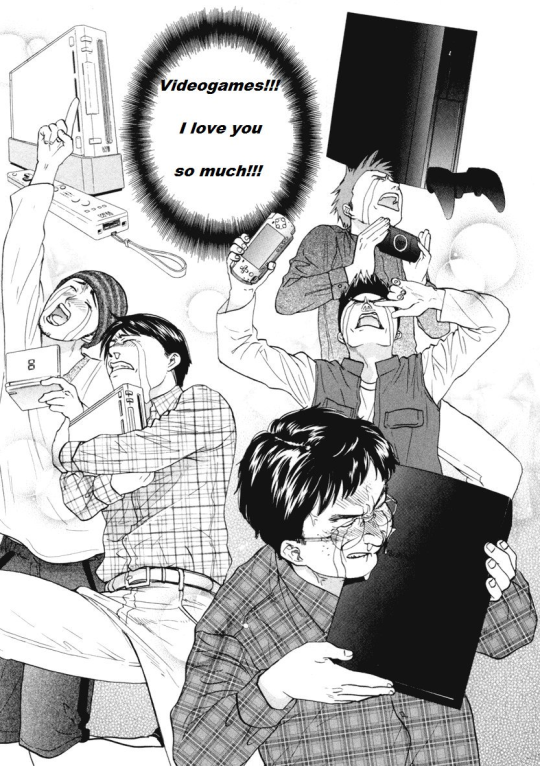
Oh man that reminds me of the most meta- thing I’ve ever seen.
0) World War II happened.
1) In postwar Japanese pop culture, “thinly or completely unveiled reference to nuclear explosion” is rivaled in thematic popularity only by “thinly or completely unveiled alternate-WWII in which Japan wins and is totally the good guys”.
Actually I’m almost afraid they finally got over this in the late-90s with the passing of a generation. I liked that, something somber and elegaic in the culture that wasn’t pure fanservice or third-generation commercial ripoffs. Anno and Miyazaki and remember when Final Fantasy had Cyan and the ghost train instead of a bunch of fucking EZ-Bake popstars?
2) Okay so there was this recent trend, they call “moe anthropomorphism” to represent things and concepts as cute girls, because obviously, Japan. It was particularly popular in terms of military hardware, because obviously, Japan.
3) Manga, etc., etc., so comics are a big thing in Japan, and part of the farm team for that is working on basically fanfic of established properties, they call it doujin, and like all fanfic, like most pulp, a lot of time it’s only good for the sex. Which is often violent and involves 13 year old girls, because obviously, humanity.
OKAY
4) So 1) and 2) combine to create Strike Witches - it was this series about a school/force of teenage girls representing various planes from all the nations of WWII, like they strap on these leg-things to fly around, and because they’re all allied together against an alien force literally representing militarism and war descending on the world even though no one particularly wants this militarism and war oh no, they’re just all brave and innocent warriors, and they might have to put on these leg things and fight the aliens at any time, they never wear pants so you can see their panties all the time, because obviously, Japan.
5) so 4) and 3) combine to make a hentai (“pervy”) doujin of Strike Witches. Which I read, to masturbate to. The first twenty pages of this doujin is mostly lesbian dominance, all of the girls breaking down and raping one of the more innocent characters, who was the Japanese one and I think a Mitsubishi Zero?
6) and then 5) combines with 1) again, which was already baked in, and the last 8 or so pages are the apocalyptic showdown with the aliens as seen from the Zero’s eyes. The American and British girls are out of the picture, dismissed in one panel. The French and Italian girls have surrendered and slunk away because they’re pussies.
The French and Italian girls have surrendered and slunk away because they’re pussies, but the two German girls went boldly into battle and lie bloodied and dying on the ground, this is the thing.
And so finally, the Japanese girl is fighting alone. She’s scared, she’s meek - she was the natural submissive for the first 20 pages, getting hazed by all the older nations^H^H^H^H^H^H^H girls but now it’s just her, now it’s her turn to prove her honor, and she jets out shrieking her vengeance, dodging alien missiles, coming straight out of the page…
And the next page is imitation newsprint, with a period photo-offset litho as the header. It’s an alien aircraft carrier, obviously American in design, with an exhaust trail streaking into one side of the island and a giant explosion blossoming out of the other.
And THAT is the most meta- thing I’ve ever seen.
(UPDATE for incoming 9/15/16: Takotsuboya’s “Witch-tachi no No-Pantsu”
People loved their work once, and it didn’t matter if they worked in the public sector or in the private one. The men who worked in the CCC would take their grandchildren to see the forests they planted, while the men from the auto plants would point out the cars they’d built as they passed them on the new interstate highway system. The women who fastened the engines on the wings would watch the B-17’s fly off to make a liar out of Goering, and the women who taught in the public schools would point with pride when one of their old students got elected mayor. Work was about making money, certainly. It was about feeding the family and keeping the roof where it was, and maybe having a little left over at the end of the day, or at the end of the week, for some amusement. Maybe a trip to Lincoln Park or White City or a hundred other places, where you could take a moment and enjoy the cool of the evening, music riding the nightwind from a dance pavilion down along the lake.
But it was also about Doing A Job, and doing it well, which was different than simply Having A Job. It was about making good cars and strong steel and sturdy furniture. It was about learning a craft, even if what you were doing wasn’t recognized as one. There was a craft in tightening rivets, or feeding the open-hearth furnace, or planing the wood just so. You had your craft, and the person next to you had theirs, and, when all the work was done, and all the craft was practiced, and practiced well, there was something you could look at with pride and say, that is something I have given to the world. Job well done, as they used to say. You could teach seventh grade civics and then, one day, you’re on a podium outside of City Hall. That kid right there, you could say. That kid is something I have helped give to the world. Job well done, as they used to say.
Unions were greatly responsible for the pride that people took in the work they did, especially in the middle of the last century, when unions helped build the most formidable middle class in human history.
There was an autoworker, Ben Hamper, who wrote a column in the Flint (later Michigan) Voice, which was the alt-weekly Michael Moore first made his name by running. A lot of his columns got collected and repackaged in an excellent book, Rivethead that I read in college.
I read it in a class by Stuart Blumin, who was my favorite professor and de facto advisor. He was an American historian, focused on labor and class and the development of capitalism, you could tell he was heavily influenced by EP Thompson and the Communist Party Historians Group over in the UK.
He was quite open that he had expected Communism to ultimately triumph, and that he had been wrong about that, and in subtext that he had wanted it to ultimately triumph, and didn’t think he had been wrong about that.
Anyway, Rivethead. The story is that Hamper was born in 1956, a fairly clever kid growing up in Flint, Michigan, the chronological and geographic apex of American industrial unionism, where everyone’s dad worked for GM.
And he could have gone to college but he gets some girl pregnant and so he goes to work on the assembly line not even really out of obligation or Catholic guilt or whatever but because that seems as good a life course as any, it’s what every man he’s known does, under the mighty UAW the pay’s on par with the kind of “educated” jobs you could get anyway, why not.
And so he goes to work on the line and eventually he ends up writing a column about it, and he talks about the color of the factory culture, playing soccer with rivets for balls and cardboard boxes for goals, drinking mickeys of malt liquor in your car on lunch break, the absurd fursuited mascot “Howie Makem, The Quality Cat” that GM would feature at rallies and shop-floor tours, being laid off in economic downturns and put into the “job bank” where you get paid waiting to be rehired in the next upswing, developing a perfect rhythm with your partner, training into a rhythm so perfect you can each trade off doing the two-person job yourself for 4 hours while the other one goes out to a bar on the clock, the dignity and solidarity of the American worker.
And time goes on and eventually his marriage fails but he takes it in stride, and his column gets recognized and he takes pride in that and then eventually he has an epiphany, and a complete breakdown, which are basically the same thing. And the inciting incident is when an older line worker, some guy he’d looked up to as a model of quiet, philosophical stolidity, just shits himself and is barely coherent enough to even notice this and he realizes the guy hadn’t been a Zen master, he’d just been checked-out mindless drunk on the line every day.
And he realizes that the rivethead life is destroying him, that the only thing holding it together was a budding alcoholism, and that it’s doing the same to all his co-workers, and looks back and realizes it had done the same to every grown-up man he knew, his father and uncles that growing up he had looked up to as models of masculine strength and fortitude really had just had their spark snuffed out and the life beaten out of them long before, and whatever pride they took in the cars out on the road was a defensive attempt to locate in an external form the sense of self-value that had been exterminated within them.
When Marx talked about “alienation”, well.
And he went crazy, and couldn’t bear to work on the line anymore, and there’s no redemption, that’s where the book ends.
And that was a theme that cropped up again in Professor Blumin’s class, that there were two great working class traditions that echoed through the ages, and they were
1) avoiding work and 2) drinking
Back in the premechanized age of small-group workshop manufacturing, workers would celebrate “Saint Monday”, which was to say just not showing up for work, hung over after the weekend.
(This was riffing off of Catholic feast days, or holy days, from which we take the word “holiday”, and as time went on counted an increasing share of the days of the year. There was a reason that poor workers were aligned with the Church, and nobility, in “Altar and Throne” coalitions resisting the development of industrial capitalist liberal democracy.)
In the ‘80s, the crap time of American auto manufacturing, one trick that was passed around (pre-internet, so by word of mouth largely) was to look at the codes stamped on car bodies, which would tell you what day of the week they were manufactured, and to avoid Mondays and Fridays. Because those days had the highest defect rates, because the workers tended to be drunk, or hungover, or absent.
And back in the workshop days, you’d drink at work. Apprentices would be sent out for growlers or buckets of beer, there were elaborate rules of who in the hierarchy of workers was expected to buy rounds for who and when. And there was hellacious resistance to attempts to get them to knock this off, as the industrial era kicked into swing.
Those great satanic mills, where women and children worked in shifts at great water- or steam-driven sewing and spinning machines, stories of little kids getting their hands mangled by the machinery? One of the major reasons women and children were preferred was because they would actually show up on time every day, and stay sober around all those hand-manglers.
And I mean, this maybe sounds like an argument for socialism. Though not of any actually-existing- variety, as capitalist propaganda will be glad to tell you, Soviet work culture, at least when the morale thrills of the Revolution and Great Patriotic War faded from personal to institutional memory, was all about shirking and vodka.
So those complaints about how America celebrates Labor Day instead of May Day, ignoring the true meaning of labor - solidarity - in favor of mindless distraction? Psssh. Labor Day is a celebration of the truest, most ancient, most fundamental traditions of labor: not working (especially on Mondays), and getting drunk.
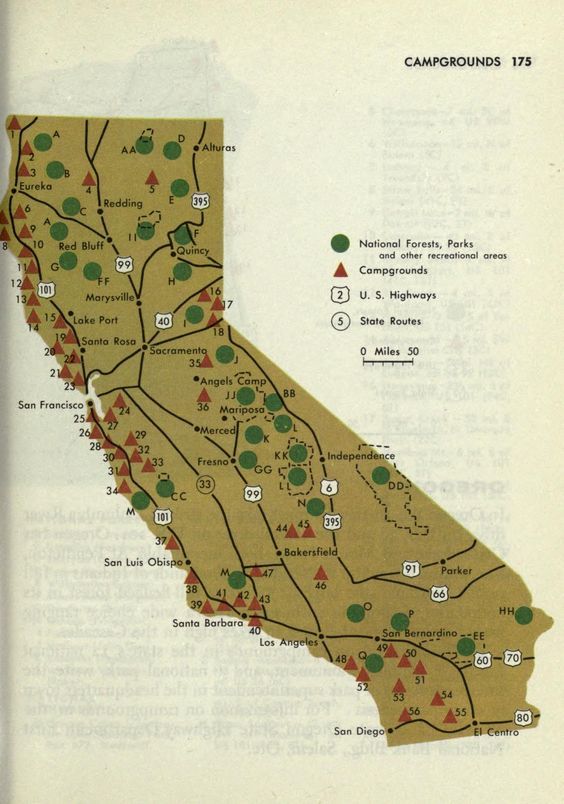
It’s really weird how this map shows US 91 just sort of ending in the desert, when wikipedia documents that it went all the way down to Long Beach. This just came to my attention because as this map is constructed, there was no direct federal route between LA and Vegas, which is again like really weird
There was a big renumbering of highway routes in California in 1964 to deal with the way that a history of road construction by multiple authorities left absurd disjunctions and redundancies between named, numbered, and natural through-routes.
oh another thing that’s worth pointing out. all those red-triangle campgrounds along the coast? the coast in that area is like a tiny sliver between the ocean and the mountains, those were areas that were owned by early land barons who raised food there when California was undeveloped and the imperial trade outpost of San Francisco had to be fed by coastal shipping or the Sacramento Delta
later on when they developed inland transportation the barons ended up giving those lands (now useless, because they’ve got terrible overland access) to the state as part of a deal to blow off a ga-huge tax bill
when I rode Blue Bitch up the PCH you’d see these campgrounds and recreation areas clustered in packs around old watering holes in areas that seemed mostly based on the tourist traffic up the coast
maintained at the request, I assume, of the lobby for people who actually live like those car ads
LA has no natural harbor, it started out as an inland nowheresville, founded as a feudal agricultural settlement by the seasonal Los Angeles River feeding the San Fernando Mission at the northern mouth of the valley. San Diego was the major city of the region.
Eventually it came time to build a southern transcontinental (“Southern Pacific”) railroad route, with San Diego as the obvious western terminus but San Francisco had issues.
San Francisco, swollen by the Gold Rush, terminus of the first transcontinental route, was the dominant power in California and didn’t want a rival, pulled enough strings to redirect to LA.
LA built an artificial breakwater and a port down by San Pedro several miles south of the city, before that they used absurdly long-ass piers off the western coast around Malibu and Santa Monica.
Then narratively unrelated to any of this there was oil discovered in the hills, which generated capital and drew Eastern money, Pasadena became the west coast WASP capital, or at least Palm Beach-equivalent. LA became self-sustaining.
Then the movie industry moved there for the weather and distance from Thomas Edison’s IP-enforcing goons
Then during WWI the aircraft industry got big because there was infrastructure and a population of workers in coastal shipping range of the NorCal/Oregon lumber industry, but WITHOUT SF/Seattle-style labor radical tendencies
Then during WWII that got even bigger and the US realized it needed to build up its Pacific (Japan- and Russia-facing) coast, which was honestly still frontier at that point
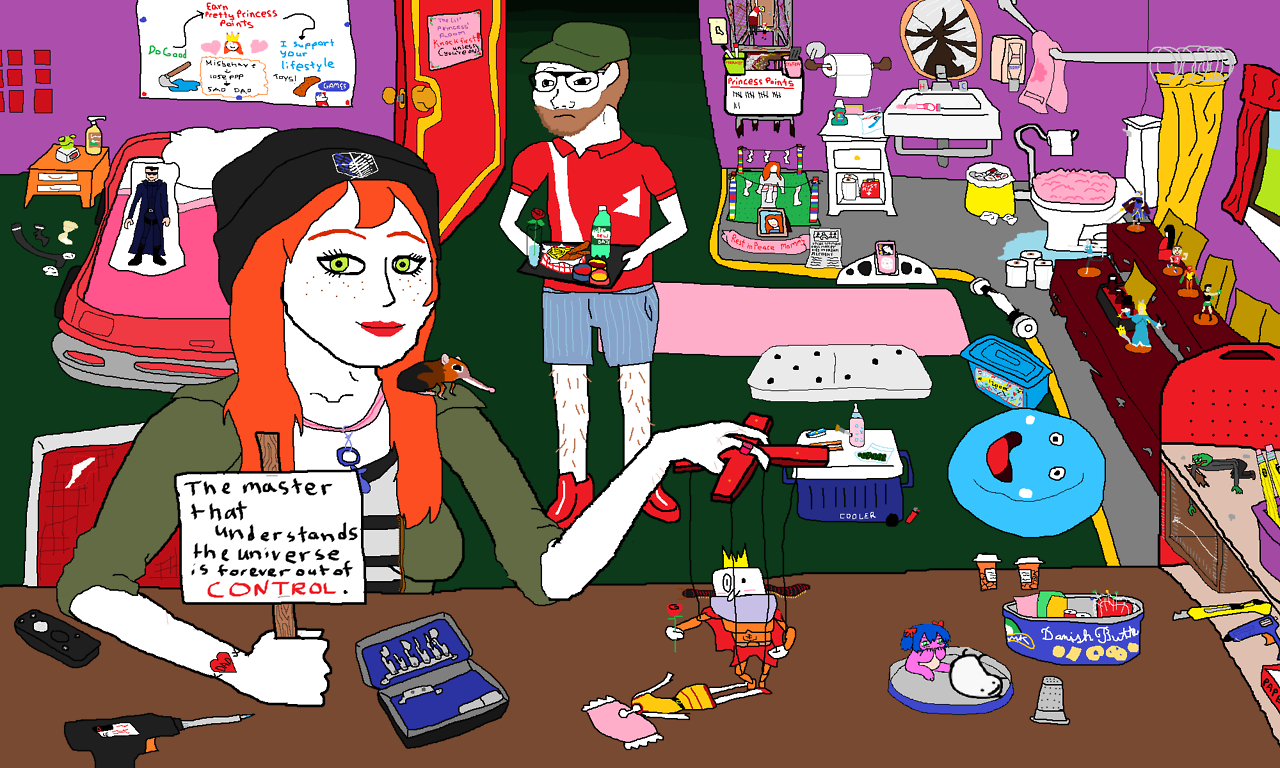
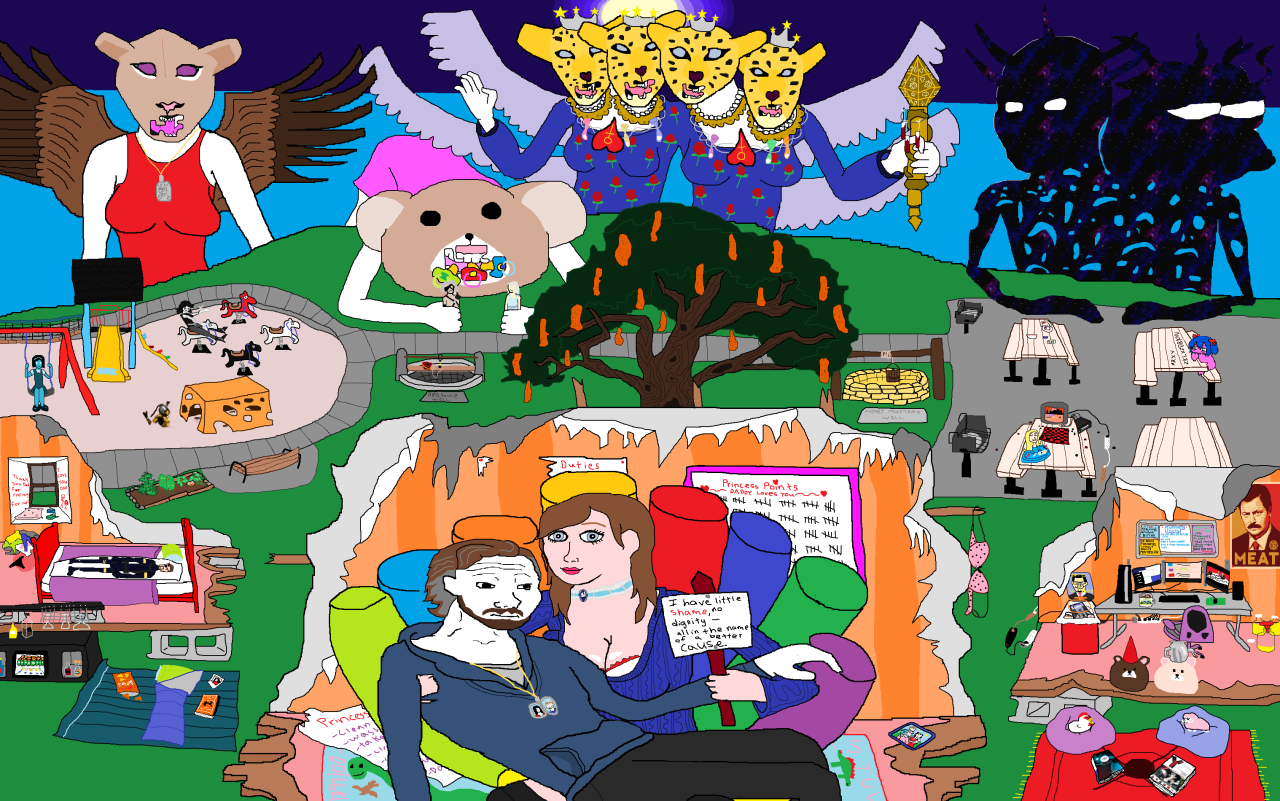
Please hit me up if you know where I can find more of these surreal ~2014 (?) 4chan memes of female NEETs that I find incredibly compelling
You fools. You can’t see the forest through the trees. This is literally revelations, complete with the mother harlot, the four horsemen, the behemoth with seven heads, and various other imagery.
In care you think I’m joking. Revelations 17:18 is when the whore of Babylon is mentioned.
this is a quote from Anne mccarfferey (wrote dragon riders of pern)
Revelations 7:13
A great multitude stand before the Throne of God, who come out of the Great Tribulation, clothed with robes made “white in the blood of the Lamb” and having palm branches in their hands. (7:9–17)
THE SEVENTH TRUMPET: (il) THE SIGN OF THE WOMAN .2 Then a huge sign became visible in the sky the figure of * a Woman clothed with the sun, with the moon under her feet and a crown of twelve stars upon her head
I dont feel like looking for more, but here you go.
this is thousands of times more terrifying and foreboding than anything else ive seen come out of 4chan
i’m all for making america great again. boo-yah, let’s do that exact thing.
my question is, when exactly is the chronological reference point for “again”? because i’m looking through our yearbook pictures, and none of them are very flattering.
“Our Band Name Could Be Your Life” is my tumblr of ridiculous hypothetical band names that occur to me as a result of reading, writing, and watching movies. I do also take submissions.
Every time I see one of those posts about “where are the fantasy stories with even remotely realistic economies and politics!” I glance over to the scattered notes and snippets I’ve made for Exactly That Story and get wracked with those why-aren’t-you-following-your-dreams shivers.
For the third edition of the Exalted rpg, they went to a lot of trouble to cajole the guy who developed the first edition to come back and write some material for the book, and he totally didn’t give a shit since he’d been doing other things for ten years at that point. He’s an economist now, so the biggest contiguous contribution he made was like two pages that just talk about about currency denominations, coinage, and seignorage in the game’s fantasy setting and how those things related to factional politics, and they cut basically the entire section because people do not want to read two pages of that in the core setting chapter of a high fantasy adventure game.
This was the same game line that hired an actual marine historian to write the book about seafaring and thus got a huge amount of material about shipboard chains of command, hull and rigging types, naval watch scheduling, and so on. I loved that book unironically, but you basically can’t use that sort of material because 95% of people will just totally skip your weird Moby Dick style digressions into whale physiology or whatever.
Anyway, regarding your specific story: if the Silmarillion teaches anything, it’s that sufficiently detailed worldbuilding can overcome the need to actually write readable fiction.
These outlets [Paula Deen’s, Sarah Palin’s, Glenn Beck’s] share a basic form—online video network—and depend on relatively steep subscription fees (the comparison that always gets used is “more than Netflix”). They are fundamentally oppositional: to the mainstream media; to political correctness; to godlessness but also a very particular formulation of uptightness. They are nostalgic for a time when certain people could say certain things without worrying about controversy or shame—they feel like public speech is a minefield, so they’ve made theirs a little more private. Among friends, almost. They long for a wholesome past that they feel has been lost. They are not especially cynical. They are, in effect, a white ethnic media, writing and publishing and broadcasting and performing about the experience of American whiteness as understood by people who genuinely feel that whites are becoming a marginalized minority. Race is not addressed directly in these networks’ contents or containers—identity establishment is left to “urban”-style euphemisms and the projection of a sensibility that is neither explicitly nor assertively white, just inherently white, familiar to whites, deemed important or compelling or novel because it is no longer the norm elsewhere.
you could imagine Roosh-like mission statements for all of them: I aim to protect the interests of white Christian families, a category I’m in…
A gaming site for men is absurd and its potential is small; a culture empire for whiteness preservation is absurd and its potential is huge. But both behave in the same way: they respond to criticism by reflecting back victimhood, and adopting a received language of oppression. This was not their idea, they would suggest. It is what they believe the other people have been doing for years.
[Swift’s] idea of pop music harks back to a period — themid-1980s — when pop was less overtly hybrid.
And, in the same quarters, more overtly white!
That choice allows her to stake out popular turf without having
to keep up with the latest microtrends, and without being accused
of cultural appropriation.
Avoiding non-white “microtrends” isolates Taylor Swift from
charges of appropriation, because they have no specific and recent
non-white influence to refer to.
[In “Shake It Off”] she surrounds herself with all sorts of
hip-hop dancers and bumbles all the moves. Later in the video, she
surrounds herself with regular folks, and they all shimmy
un-self-consciously, not trying to be cool.
Who, exactly, would interpret those signals as not “cool” but
instead “regular?” Not everybody; specifically, somebody.
The singer most likely to sell the most copies of any album this
year has written herself a narrative in which she’s still the
outsider.
You know who else suddenly
feels culturally outside of the mainstream? (Besides, as
always, anyone over the age of 30?) People who are skeptical of
America’s demographic progress! Or who, at least, don’t feel
comfortable thinking or talking about it. If Jon Caramanica is
right, the promotional theory and marketing conversations around
1989, and an overarching influence on its music, can be
summed up as: Intentional, Performed Whiteness. It’s an
artistic manifestation of the old adolescent conversation:
…i did not expect to be touched while skimming a reddit thread on fetish origin stories
that dudes fetish is called: being a loving and caring dude
straight guy: *has a human emotion* straight guy: this…this is a fucking good fetish my dudes!!
wait a second. Sugar daddy, DD/lg, raceplay, breeding, teacher crush…
While we’re looking at ruins of the old order, is the next generation relegitimating the kyriarchy in kink lifestyle idiom?
That is exactly what the radfems worried about in the 80s and they weren’t wrong
The difference is that they’re now opt in. If you like dom/sub total power exchang ein your relationship you can find a partner nad o it, if you don’t you don’t. The old system was society and the law effectively forcing everyone into it
Something I like to remind people of to highlight the fluidity of history is that well into the 20th century major Anglophone associations with Islam were “decadent sexual deviance, cosmopolitan tolerance, particularly queer-positive”.
Something similar is that if you go back to early 20th century America, stereotypes of Black manhood get a little off. You still see “bestial brute” but you also get dopey, cringing, lackadasical, henpecked, can’t get or keep a woman. (The unifying theme is lack of self-mastery) Like, a cuck. Remember, like, The Blues? And how they’re about how your woman left you, or doesn’t stay true to you, or won’t accept your love? One of the central contentions of the infamous Moynihan Report was that the reason the mid-60s black American community was unhealthy even after the 1950s civil rights movement was that repression had prevented black men from establishing *dominion* - hadn’t been able to earn a breadwinning wage, could by honest toil have less earning power than a sex worker, couldn’t offer black women enough to discipline them by threat of its withdrawal - in short, had prevented them from establishing a healthy, stable patriarchy and reaping its benefits. And one of its central recommendations was to promote this patriarchy.
A lot of 60s-70s black activism invokes “masculinity” in a way that seems incongruous to moderns because it was experienced as not only a valued but long-denied reward but a valuable resource to be deployed in service of the cause.
(Which means that the pre-X Malcolm Little strutting around Harlem in a zoot suit and a guy in a suit and a sandwich board reading “I Am A Man” and Richard Roundtree posing with a leather jacket and a gun while the soundtrack called him a sex machine to all the chicks [Shaft!] were going in on the same political project. The same one as Eldridge Cleaver reclaiming “rapist”. And, I mean, it worked. When’s the last time you associated “black man” and “harmless cuck”? [When’s the last time you did “white man”?])
In a world where Trump was competent rather than a holy fool of a d100 that got nominated because sometimes it came up “America was legitimate even before the ‘60s”, he’d take advantage of this and redo Reagan’s trick of defining himself against the “welfare queen”, updating it to be an overweight 36-something with a government/NPO social service iron triangle job she got by taking community college all through the terminal postgrad level and a sense that men are dismissably wrong for not living up to her.
(The flip side of that is the “woke bro”, the new worthy object of ridicule who tries to define his total identity, including social and sexual capital, around racism-awareness… was already comprehensively roasted 25 years ago in A Different World and School Daze, treatments of pretentious Black yuppie larva)
Of course even within whiteness this stuff’s never been as stable as either the eternal-order conservatives or the ultimate-revolution whigs would have you think. If you’ve ever harkened to the authentic masculinity of the 1950s, or Teddy Roosevelt’s kettlebell strongmen-and-Muscular Christianity, or the ruggedness of Victorian explorers, know that a lot of that stuff was considered self-conscious and borderline pretentious artifice at the time, part not of an organic maleness but deliberate initiatives to promote and assert masculine force in the face of a threateningly feminizing, white-collar, peaceful, touchy-feely world.
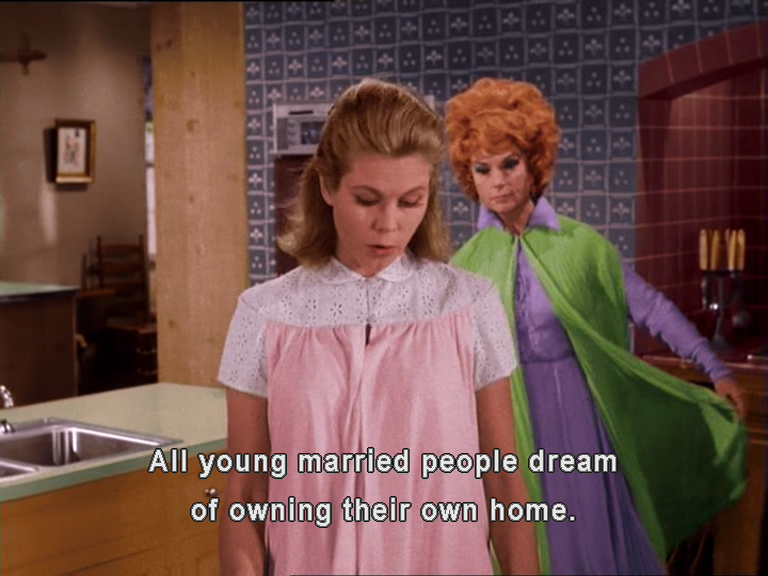
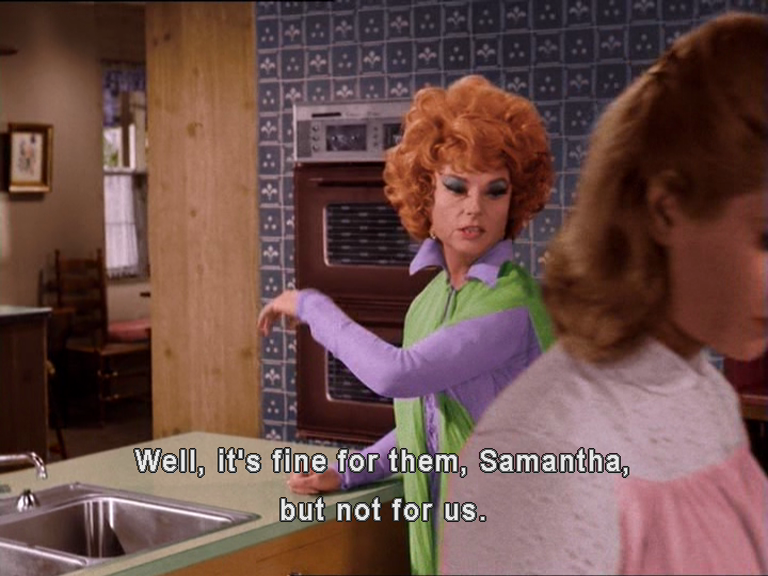
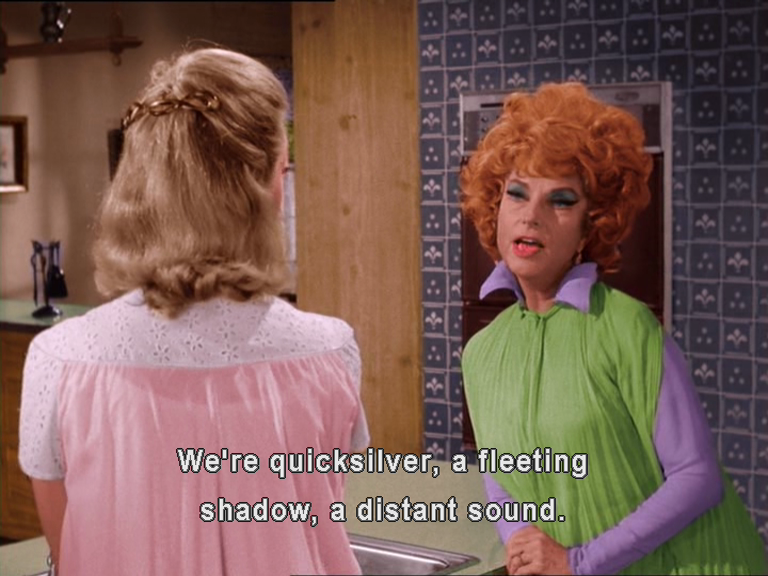
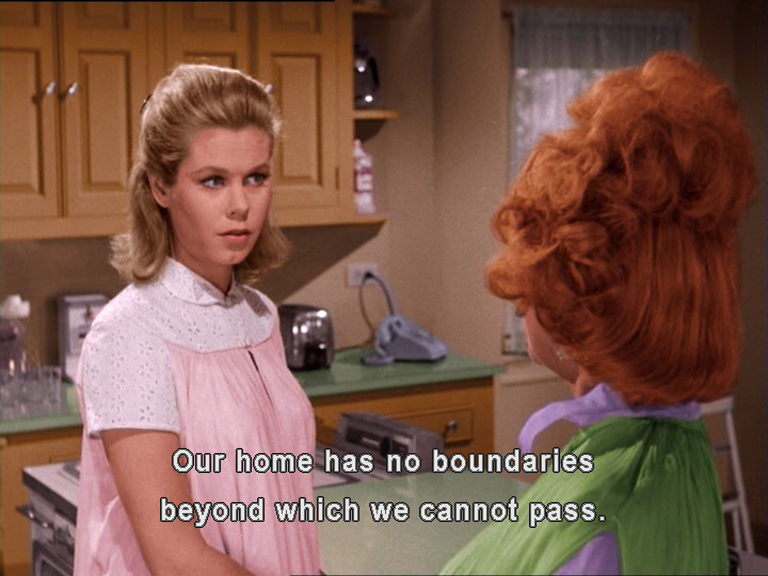
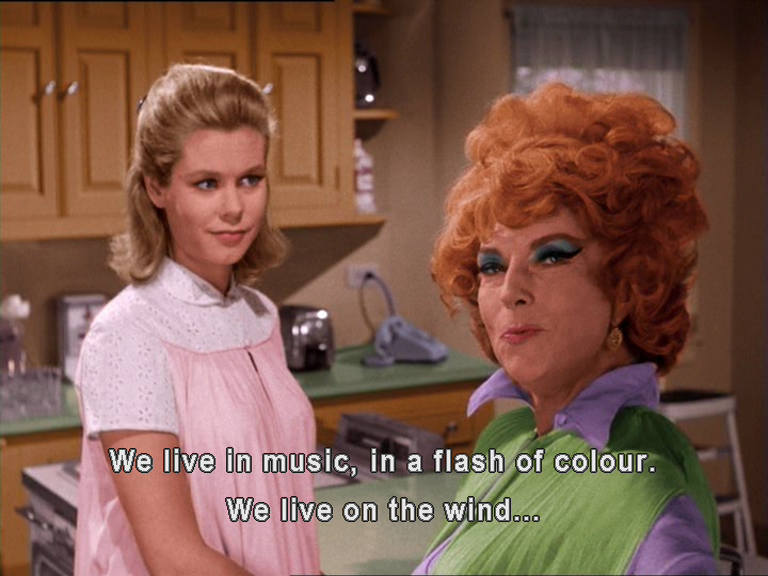
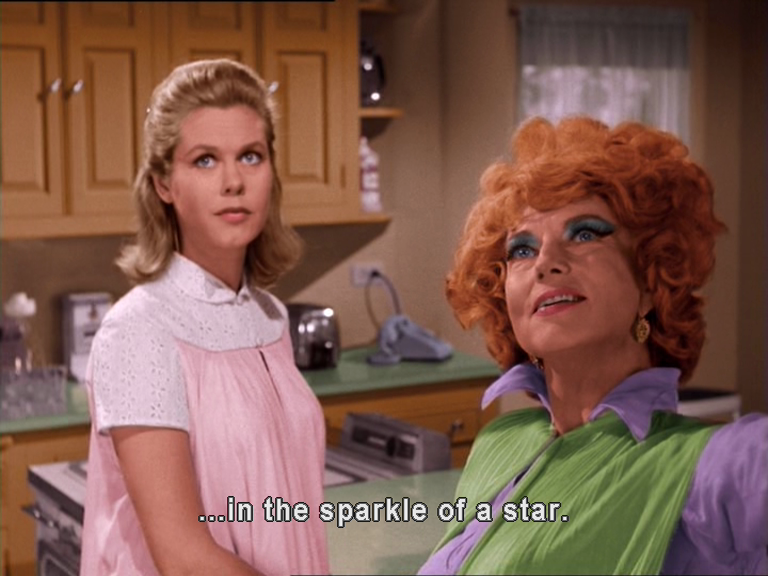
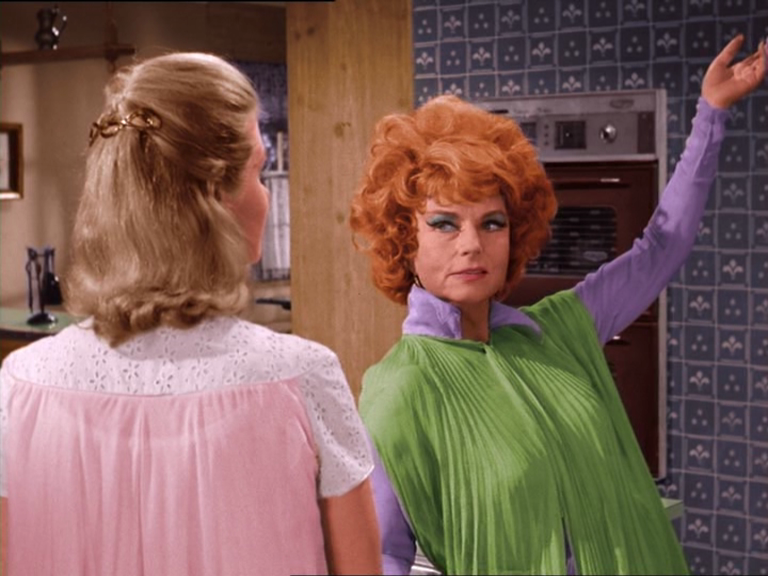
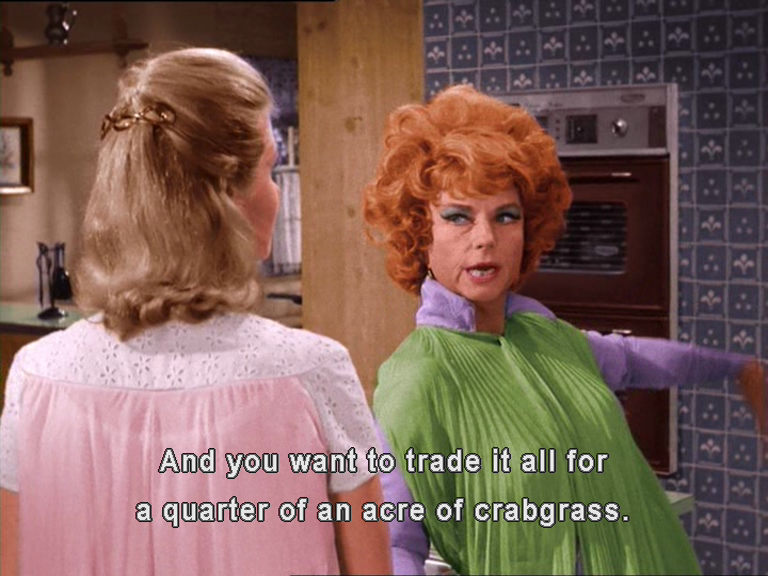
Said it before, saying it again: Endora is Gay Culture.
two things:
1) Wow, Endora was totally the basis for Lwaxana Troi on ST:TNG, huh, I just got that
2) This is a good illustration of a point I keep returning to, which is important for getting at how culture shifts back and forth, that “The Fifties” (yes, 1964 included) were NOT the last gasp of an eternal patriarchal traditional order, they were recognized at the time as a conservative retrenchment that earlier generations found disappointing.
Setting aside the backstory of Samantha and Endora as magical immortals and considering them as representing “a postwar newlywed” and “a woman from the previous generation” (coming of age in, say, the Roaring Twenties), this is a pretty good summary of the generation gap: the previous generation thought the Fifties Kids were narrow-horizoned bores who foresook worldly excitement for dreary conformity.
But if you know what you’re looking for you can see Samantha’s riposte here. For one, look at the life she gets out of committing to a love-matched partnership with a man that Endora considers unremarkably beneath her potential - a comfortable (upper-?)middle class life in a two-story house on its own plot of land, that modern decor and those modern appliances.
That’s not something the older (“Endora’s”) generation could count on before the postwar suburban Mass Middle Class. In 1940 the homeownership rate was only 43% and that’s averaging tenement-dwelling urban workers in with family farmhouses on tenuously mortgaged farms, with the middle and upper classes making up maybe a 20% remainder.
Also, just look at the two women. You notice Samantha’s not any less made-up or styled than Endora, look at the blonde halo around her radiant upturned face in panel 6. It’s just that Endora’s makeup and style is garish and vulgar. Part of that’s playing to the new format of color TV, but part of it is she’s supposed to look attention-seeking, undignified, that’s the point.
For all her theater-people rapture over the adventurous life, a central part of “adventure” for women of Endora’s generation would have been man-hunting, or rich man-hunting, as a precondition of acquiring the comfort Samantha does by settling down with a man she simply likes. And meanwhile, she has a man that she likes! Samantha legitimately loves Darrin and enjoys their life together, while Endora is the bitter, slump-faced whore-painted Avatar of Domestic UNtranquility. She’s snipingly separated from husband/warlock/stage actor/father to Samantha Maurice, who was, reading between the lines, gay anyway.
So when Endora makes that speech Samantha (and by extension a good chunk of the contemporary audience) sees it as sour grapes, putting a romantic gloss on a lack of the very stable, fulfilling home life she enjoys with Darrin. That’s really an underappreciated connection between the insular, “nesting” conformist consumerism of “The Fifties” and the unbound “flower child” hippieness of “The Sixties” – a sense that the postwar Golden Age delivered such material surplus that people could afford the luxury to kick back, take a break from competitive struggle, and live a life of their choosing based on companionship and love.
It’s been said before but if public libraries weren’t a fact of society and were proposed today they would be roundly rejected as pie in the sky communism
they started as private initiatives that were eventually nationalized as vital infrastructure and are maintained on inertia and constituency even as they and the role they were established to fill drift off in separate directions into the aether
more than either libertarians’ or statists’ idealism, that’s how things tend to go
So with Trump grumbling about FCC licensing some people are digging up Nixon-era grumbling on the same topic, that’s a start.
But the REAL way that FCC licensing was leveraged was with regards to newspaper companies getting into first radio and then TV. Newspaper barons and editors were always powerful players in the political world, often upstream of senators and even bosses, but negotiations with over the number of stations one company could own, or own in one market gave government the whip hand - newspapers might have high profit margins, especially as the number per city fell, but maximum volume and no room for expansion, while broadcasting was the future.
Liscensing of individual stations would be premised on its being found to serve the public interest, which the bright young things running things since FDR - the open-minded, college-educated, even queer-positive types of their day – might understand as eschewing dangerous politics in favor of What All Right-Thinking People Knew
Weighing heavily on their mind that when Europe just tried to mix democracy with a vibrant and competitive mass media it polarized society into extremisms that turned and fell upon each other in the greatest apocalypse the world had ever seen, so
One Sulzbergerian even-handed newspaper per city and a handful of poorly-differentiated TV networks all pushing the same Postwar Consensus, radio operating under the Fairness Doctrine, a lot of the cultural blandness people associate in retrospect with the ‘50s, that was brought about by effort
The Mayflower Doctrine, I’d never even heard of that before Wikipedia right now. FDR’s regulations on broadcast editorializing, so that they would present responsible takes on public issues, rather than any old (fake news?) ones their (maybe anti-New Deal) owners or advertisers favored.
It was a Postwar Liberal Consensus, that’s why conservatives strained against it, especially after the ‘60s when coalitions and issues had shifted, ESPECIALLY under Reagan, whose victories seemed to affirm them as the proper agents of public authority. That’s why Reagan ended the Fairness Doctrine, that’s why so much conservative/Republican infrastructure is alternative channels for mass communication and coordination – AM talk, religious broadcasting, large-scale direct mail, national networks of activist cells piggy-backing off church or housewives’ affinity groups.
Or not. I mean, Hamlet was the protagonist, right?
Chuck Palahniuk’s writing style consists of ejaculating on the wall and seeing what sticks.
“Dracula” isn’t a real person, “Commissioner Gordon” isn’t a real person, but Gary Oldman DOES count for both.
“man does it suck to get nuked, people who nuke people are total assholes”
(And this is neither here nor there but all the interior decoration guys have frosted tips and a lilting, mincing patter, which, like, 1994 called and it wants its total fucking stereotypes back.)
When I was growing up you were supposed to laugh at the rubeish naivete of the 1950s “Our Friend the Atom” stuff, but now that I think of it we never got nuked but I’ve known a lot of people who’ve had radiation therapy or MRIs.
The main advantage of such a gap between election and inauguration is it’s too long to maintain a peasant army.
If you’re crazy and you know it, self-aware! If you’re crazy and you know it, self-aware! It’s chic to be insane, just go meta with your brain If you’re crazy and you know it, self-aware!