Canonically, the United States of America once possessed a unique artifact known as the Demon Core, but it was consumed in the process of summoning a miniature star.
When someone writes the inevitable history of the “white women in wheat fields” aesthetic I hope they’re honest enough to acknowledge Hegre and Met-Art
Canada is this vision of how politics are progressing in an Anglophone nation that didn’t already run smack into a wall 2 years ago
Oh riffing off that “Canadian oil” also it’s worth pointing out that “canola oil” means “Canadian oil, low acid” because North Americans are too immature to admit it’s called “rapeseed oil”
[I tried like 30 mins to find the old field-in-blossom “YOU GONNA GET RAPE” macro, enjoy these white women in rape fields instead]
A World Where Established Orders Were Rendered Superfluous, and In the Absence Of Coordinating Forces, A Congenial Culture Arose From The Free Interplay Of All the World’s Diverse Peoples
What It Was, Apparently:
A World So Hegemonically Dominated by People In a Similar Class and Cultural Position That Our Interests Were Simply Uncritically Adopted as Local Cultural Norms, Which Could Then Be Misread as the Sensibility of the World Entire
So uh I guess it was that second one I was fond of the whole time and saw as our salvation from a broken world?
okay, i’ve gotta ask what the deal is with all these bob’s burgers character blogs that just steal *relateable humor* posts from other twitter/tumblr users, because now they appear to be stealing posts from each other? is it some sort of ad revenue scam like those CGI elsa finger family videos? are they some sort of AI gone rogue, having learned to feed off each other in an infinite loop of Quirky Humor? i need answers here
They seem to be a front for a gambling app called Qriket
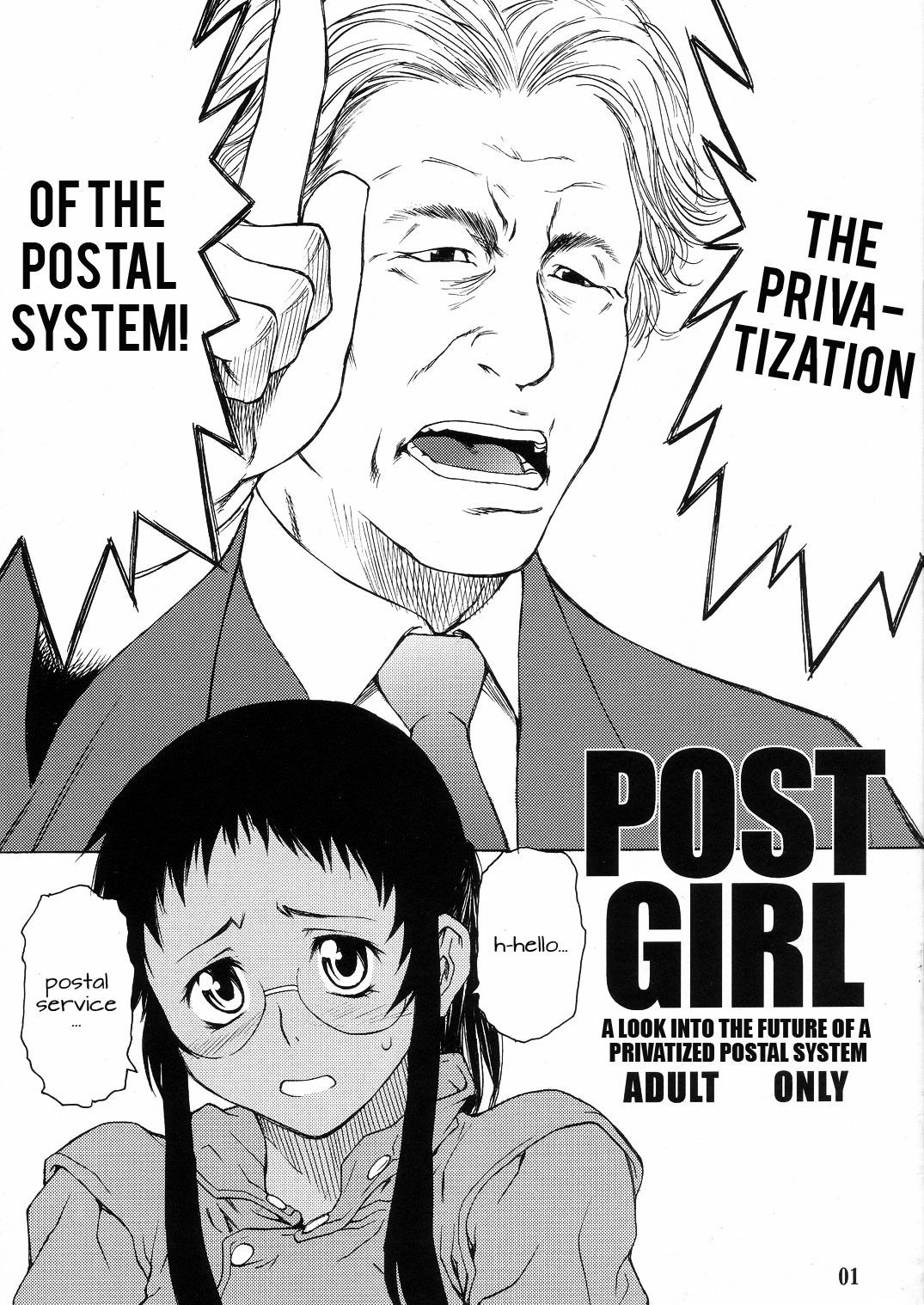
So this is the Japanese equivalent of Pounded by the Pound, pretty much? Our cultures aren’t as different as one might think.
in the sequel the post office girl drops a package into a lake, which becomes a riff on The Honest Woodcutter only it turns out the package was a masturbation sleeve and what’s she going to do with gold and silver ones of those so the goddess gives her a dick to use them with
So the reason I was thinking about Batman and Catwoman was I’ve been playing the new Arkham Knight game. It’s good! After just going off on how the Arkham games have an edge up on GTA by not having any of the (out of style) driving genre in them, the third-to-last thing I expected was for the new one to have Burnout-style driving in it, the second-to-last thing was for it to have Japanese arcade-style tactical tank combat, and the absolute last thing I expected was for them both to work so well.
Also I’m really just appreciating how well the property works for open-world gaming because unlike other games it can easily make an in-universe explanation for all sorts of stuff that’s really a function of games-as-commercial-objects with “Because Batman”. Why is the same protagonist engaging in (and skilled at) melee combat, tool-based puzzles, car combat, aerial maneuvers, and mystery-solving? Because Batman. How do you expect us to buy a plot making all sorts of bounces and turnabouts to justify a bunch of different boss battles? Because Batman. Why are we still supposed to think of this guy as good when he spends the game taking out thousands of faceless mooks? Because Batman. Why are we taking time out to track down all sorts of hidden collectables? Because the Riddler, because Batman.
The one thing though, after 4 of these they’re scraping the bottom of the barrel as far as enemies goes. Consensus is that Batman has the best rogues’ gallery in comics, and further that that’s because so many of them work as twisted reflections of Batman.
To wit, Catwoman’s thing is dressing up in sexy black leather and going off on outside-the-law missions on the rooftops of Gotham; Penguin’s an orphan with a taste for high society; Joker (and to an extent Anarky) is as obsessive about creating chaos as Batman is with order; (Joker and Penguin are also hella fond of themed gadgets;) Scarecrow uses fear as a tool and a weapon; Two-Face has a split personality; Riddler is constantly showing off his supergenius; Mr. Freeze is driven by the memory of personal loss; Man-Bat is, uh.
(Harley Quinn is really a Robin - a sidekick who maintains absolute personal and professional loyalty in the face of how much suffering the role brings. That’s a big theme of this game and I’m surprised they didn’t use her more in it.)
Even the ones that don’t have such thematic resilience make a particular kind of sense for Batman - his “no guns” thing contrasts with Deadshot’s “only guns”; his combination of fighting skill and resilience are matched by Ra’s al Ghul, Bane, and Solomon Grundy. Poison Ivy is odd - plants and poison aren’t really meaningful to Batman, and actual superpowers are kind of peripheral to the Batverse, but what she is really, deadly kiss and all, is a distillation of the femme fatale figure. Recall that Batman is heir to the pulp tradition from which that archetype comes, and that poison is a traditionally female weapon.
But when you’re getting down to Deacon Blackfire and Firefly… well, I guess bats are the natural predators of insects, but “a pyromaniac with a jetpack” is kind of a stretch. I suppose the series has used Killer Croc and Calendar Man (and Mad Hatter, who I give a pass though on what principles I can’t tell) before. At least it’s not Condiment King, I suppose.
are you the young man who is here to read furry webcomics with my daughter? excellent. welcome to the family. have a coors
I played pinball with a TV actor who got hired once to do a table read. For an audience. At a convention. A furry convention. It was a play called Fursona non Grata, and the premise is a girl taking her fiance to meet, for the first time, her family. Who are all furries.
I tracked down the script online and read it because obviously I did. It's… subpar. It’s like Borscht Belt humor, with furries in place of Jews.
The author’s not some nobody, either. He worked on the Duck Dodgers cartoon, and created another series, American Dragon, that ran two years on Disney. (He also wrote the pilot for Undressed, that weird JV Skinemax anthology series on MTV, which okay.)
First, in retrospect it should be the exact opposite of surprise that someone who contributes to a funny animal series and then makes a show about a teenager who’s secretly a dragon is a furry. On the other hand, at some level I guess I always assumed that the fandom’s relation to mainstream anthro product was parasitic on creators who had some, you know, non-furry reason to be all about furry stuff.
Second, how the fuck did this guy get a TV show made and I didn’t? That’s an actual question. In LA I wrote a pilot, and it’s awfully 2008 (It starts with two brothers, one who wants to become a pirate but doesn’t, one who doesn’t but does; and ends with zombie redcoats fighting steampunk freemasons) but if this thing was representative of that guy’s work, wow. By a mile.
I mean maybe one answers two, the industry’s about who you know, and funny animal animation’s dominated by a Furry Mafia. Hahahahahahathat'sactuallyentirelyplausiblefuck.
I hope the sequel is called The Fursuit of Happiness.
me: With time to reflect, maybe the rise of active, “transformative” fandoms and “remix culture” we so celebrated in the ‘90s really did have a downside.
me: At the mildest, with the splintering of audiences, TV viewer-creator interaction has gone so far past alt.tv.simpsons and alt.tv.x-files to the point some shows and creators seem to see their role as *servicing* a social media following in a way that seems like eating seed corn
me: And then getting to the “toxic” fandoms that claim ownership of a media property and viciously defend it even from its creators… I almost wonder if those authors like Anne Rice who cracked down on fanfiction were on to something, to say “no, this is not a LEGO kit of themes, characters, and plot elements to assemble and reassemble according to the instructions or not as you will, it is a coherent and mutually supportive work of art”
me, five hours later: Alternately, “Lestat c'est moi”
Playing Yakuza 6 and suddenly taken aback to realize the State of Japan – or rather, nation of Japan – has probably recruited at least $50k of lifetime value – maybe more! – out of me from the fact that Sony’s PS4 offered SEGA’s Yakuza Kiwami as their free game one month
Like, first off paying for 0, Kiwami 2, and 6. But also since “walking around, eating a variety of Japanese food and drinking Japanese liquor” is like a central mechanic in the series, I’ve had that on my mind. To start with, I got sushi more often.
And I got to thinking “boy, I like ikura” and then “huh we don’t have much in the local cuisine, given the salmon focus from Oregon to Alaska” and now whatever idle share of my brain is dedicated to how I can match up local resources to Japanese expertise
Gave me a better sense of ramen varieties that I bothered to order from the ramenya again after my first try was disappointingly pork-fatty. Tried the slightly-more-sophisticated-than-college packaged ramen from the convenience store. Was nice, but I thought “man I wish they sold surimi and dehydrated add-ins, though!”
They made Japanese whiskey look intriguing, tried it, and I like the light golden taste. Suntori Toki and Hatozaki are now regulars in my cabinet.
I’m not coming in as a novice. For a decade I’ve had a certificate from the Japanese state department I got by paying them to take the hardest test of my life saying I’m somewhat competent in Japanese, which I learned in a program that America uses to train spies and diplomats. I have years ago looked into how the local consulate could help with my dream of retiring to a mountainside hot spring and establishing an onsen ryokan.
So I was primed. But part of that was, I already had a latent base-level familiarity and I’ve been astounded how well this series activated it.
Like, all the faces and the types I had got just enough glancing exposure to from a childhood of Lupin III and Capcom games and Time articles about the salaryman as modern samurai, not only realized in better depth but situated in a matrix where you see how they all fit with and relate to everything else I’ve seen of Japanese culture.
And the way I could pick up things from it and apply it back to what I knew before, like oh, shit, those anime mooks were Korean-coded, huh?
The way the series covers like 30 years’ development of Tokyo (and what went before, with their Golden Gai-alike) and Osaka, and early modern rust belt Hiroshima and semitropical possession Okinawa, helping put together the pieces of Japanese geography and history and culture
(Like, the side missions in 6’s backwater Hiroshima underline how slice-of-life tropes AND pop-mystical youth tropes – “time leaps”, ghosts, “we hit our heads now we switched bodies” – are flip sides of the issue that nothing really happens there compared to the big cities)
The language – just hearing the rhythm of it. I’ve developed an instinctive sense of the uses of makaseru. The way the subtitles help me pick up things where I already know 70% of the words they’re just so fast, the bits where I actually understand every word but I’ve got to parse how the laconic yakuza speech means what the subtitles indicate.
It’s rekindled a flame! From since I was young and my parents’ old neighbor Mr. Tamura, since recalled to home office, visited on business trips. It’s given me a glimpse at the more textured understanding I didn’t even realize I wanted.
A funny thing is amidst all the walking simulators and woke checklists (Depression Quest was MAYBE the third best Twine of its era about chronic depression) of 2010s vidya criticism is AAA games have taken the place of movies as widely shared narrative experiences and have been doing interesting things!
Part of it they learned how to leverage them to promote other properties. The Arkham series got you caring about the whole Bat-collective! “Oh, Nightwing, the butt model with the sticks?” Well, yes, but also the guy who can rival Bruce but isn’t gloomy and can give him hilarious shit about it!
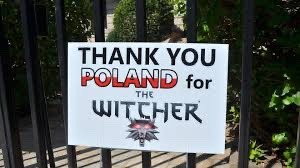
And that works for whole nations, too. Like on the one hand okay Poland is “illiberal” and “a challenge to the human rights foundation on which post-60s first world international relations have been based” but on the other
oh if we’re talking about vidya as repository of Japanese self-narratives, everyone realizes that FF6 was (in part) that classic Japanese form of “WWII metaphor, slightly kinked”?*
That royal/roughneck brothers Edgar/Sabin are England/America, captive general Celes is France
Emperor Gestahl is the old imperial Germany, and his usurping mad clown chancellor Kefka is obviously Hitler
Which means samurai Cyan of Doma is a self-pitying Japan. We only got into this cause honest feudal politics but crazy ol’ Kefka went to WMD and now everyone’s dead
The Ghost Train was about postwar Japan dealing with everyone having someone they love be dead
The World of Darkness is obviously about being nuked and ruined
* others: Strike Witches and Gate Keepers. Tag your faves!
I will say it’s kind of funny seeing secondhand the place of cults in Japanese society by seeing fictional portrayals
Like, Hare Krishna levels of ridiculous garb and ritual, sometimes a little institutionalized but small enough that followers have probably personally met the founder
It’s weird cause it generally but not perfectly matches American cult narratives – it doesn’t really line up with what we tell about Scientology OR rural compounds, (hippie or scary backwoods Prophet of God versions). Or what ex-Mormons complain about, or kids coming out of isolated tight-knit churches. Coming from the land of Aum Shinriyku you don’t pick up much People’s Temple-type menace, either.
Somewhere between ‘60s-groovy guru and Moonies, the issue presented as less that they were a danger to society or their followers, more that they were a silly scam that would divert and drain them.
Like, the concern isn’t “they will draw you into a world offering a social scene and metanarrative you needed to situate yourself but instead of enabling you these are fundamentally structured to limit you” or anything so complicated, it’s “they will make you wear silly robes and sing about their dumb UFO story while they have you give them all your money and probably have sex with you, and their central promise of powers or healing or whatever doesn’t pay off”
Japan is of course known for its “new religions”, post-WWII study there was instrumental to the development of our modern understanding of the lifecycle of religions starting as cults around a charismatic founder. And I mean, I’m only seeing caricatures across a language and cultural gap but still, that’s what I’m seeing.
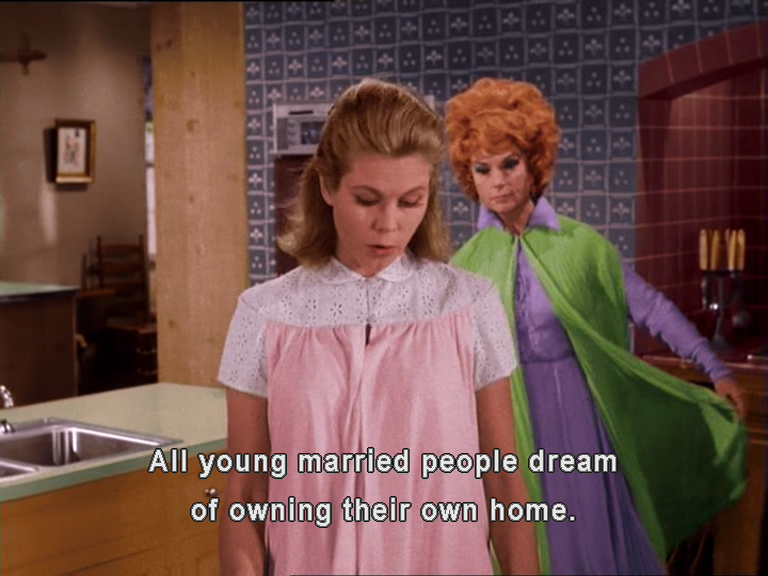
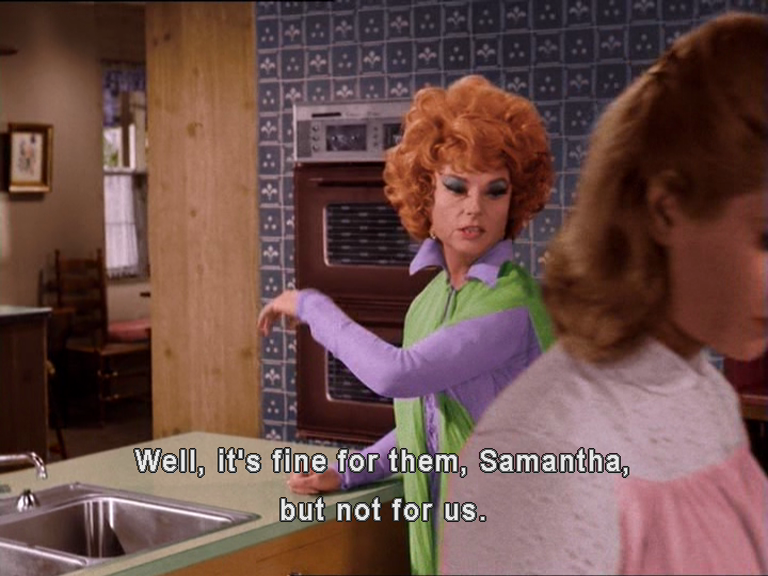
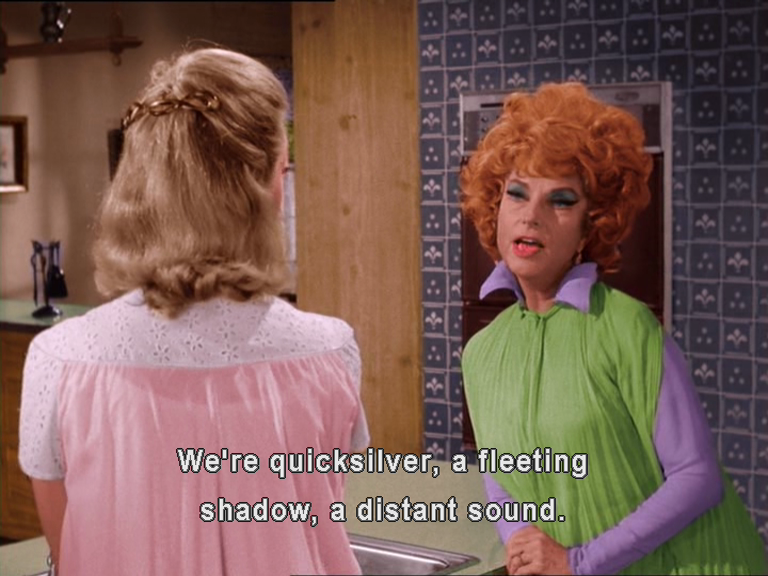
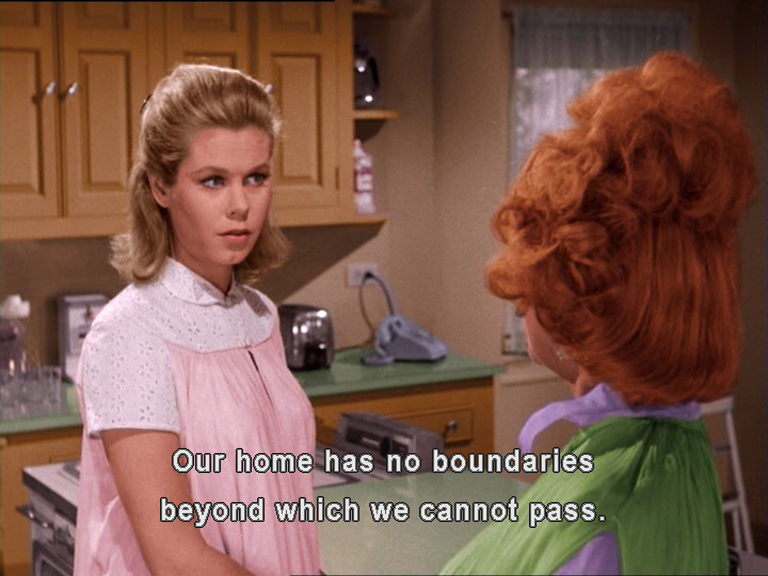
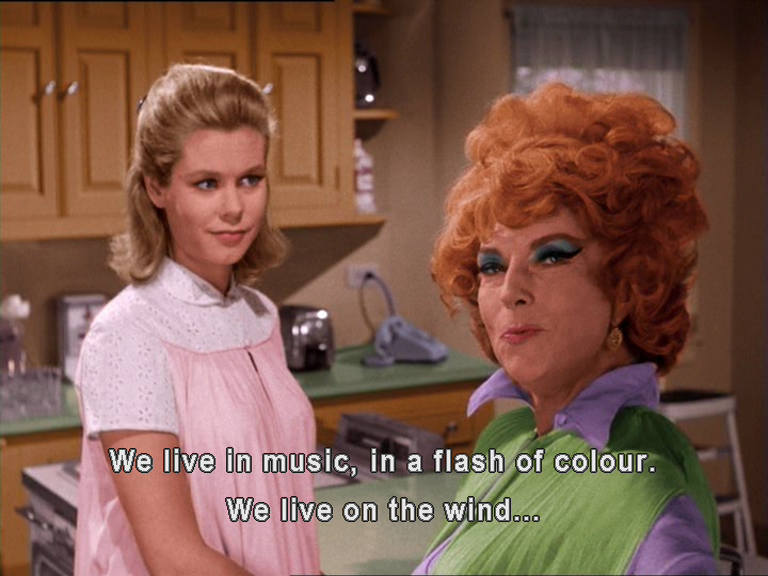
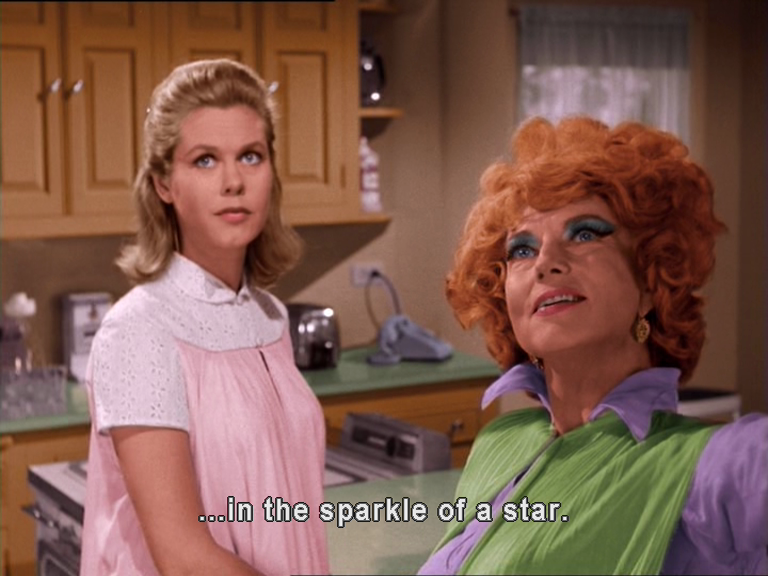
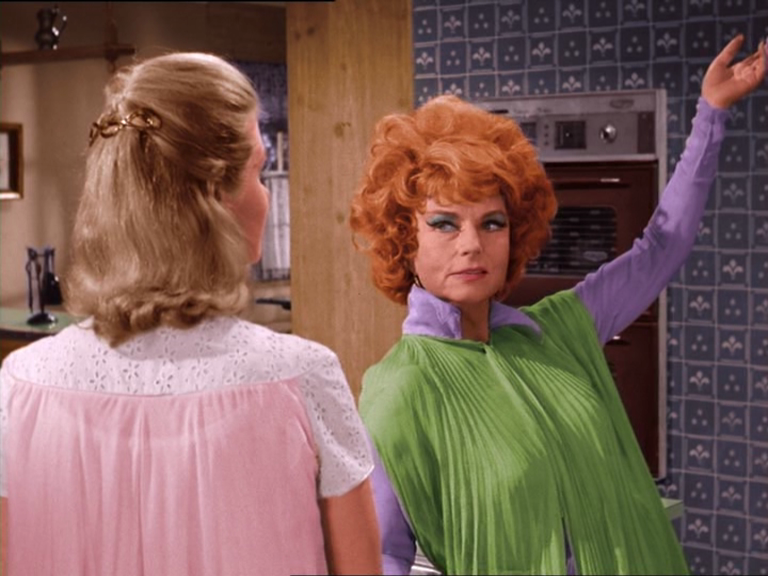
Said it before, saying it again: Endora is Gay Culture.
two things:
1) Wow, Endora was totally the basis for Lwaxana Troi on ST:TNG, huh, I just got that
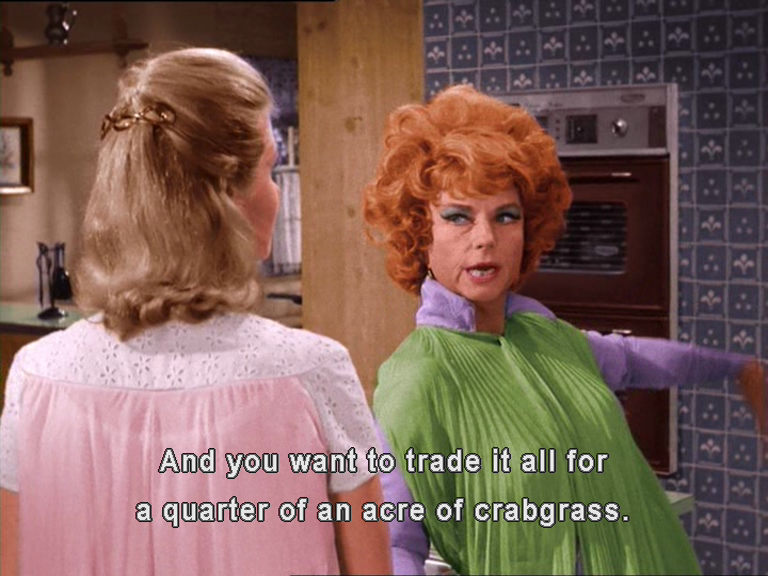
2) This is a good illustration of a point I keep returning to, which is important for getting at how culture shifts back and forth, that “The Fifties” (yes, 1964 included) were NOT the last gasp of an eternal patriarchal traditional order, they were recognized at the time as a conservative retrenchment that earlier generations found disappointing.
Setting aside the backstory of Samantha and Endora as magical immortals and considering them as representing “a postwar newlywed” and “a woman from the previous generation” (coming of age in, say, the Roaring Twenties), this is a pretty good summary of the generation gap: the previous generation thought the Fifties Kids were narrow-horizoned bores who foresook worldly excitement for dreary conformity.
But if you know what you’re looking for you can see Samantha’s riposte here. For one, look at the life she gets out of committing to a love-matched partnership with a man that Endora considers unremarkably beneath her potential - a comfortable (upper-?)middle class life in a two-story house on its own plot of land, that modern decor and those modern appliances.
That’s not something the older (“Endora’s”) generation could count on before the postwar suburban Mass Middle Class. In 1940 the homeownership rate was only 43% and that’s averaging tenement-dwelling urban workers in with family farmhouses on tenuously mortgaged farms, with the middle and upper classes making up maybe a 20% remainder.
Also, just look at the two women. You notice Samantha’s not any less made-up or styled than Endora, look at the blonde halo around her radiant upturned face in panel 6. It’s just that Endora’s makeup and style is garish and vulgar. Part of that’s playing to the new format of color TV, but part of it is she’s supposed to look attention-seeking, undignified, that’s the point.
For all her theater-people rapture over the adventurous life, a central part of “adventure” for women of Endora’s generation would have been man-hunting, or rich man-hunting, as a precondition of acquiring the comfort Samantha does by settling down with a man she simply likes. And meanwhile, she has a man that she likes! Samantha legitimately loves Darrin and enjoys their life together, while Endora is the bitter, slump-faced whore-painted Avatar of Domestic UNtranquility. She’s snipingly separated from husband/warlock/stage actor/father to Samantha Maurice, who was, reading between the lines, gay anyway.
So when Endora makes that speech Samantha (and by extension a good chunk of the contemporary audience) sees it as sour grapes, putting a romantic gloss on a lack of the very stable, fulfilling home life she enjoys with Darrin. That’s really an underappreciated connection between the insular, “nesting” conformist consumerism of “The Fifties” and the unbound “flower child” hippieness of “The Sixties” – a sense that the postwar Golden Age delivered such material surplus that people could afford the luxury to kick back, take a break from competitive struggle, and live a life of their choosing based on companionship and love.
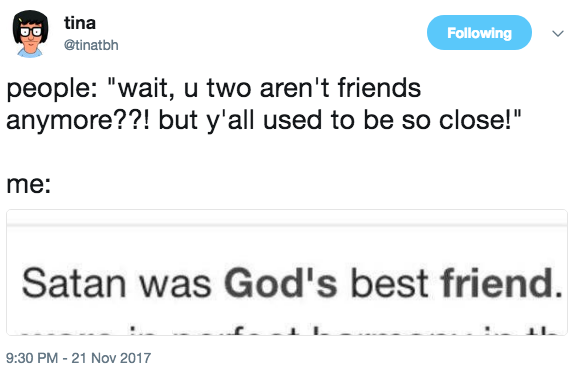
You know, it’s kind of funny when people invoke Moloch in an attempt to infuse the power of Christianity into whatever “think of the children”-of-the-day, because when you think about it it’s not like the Christian tradition is all that down on child sacrifice as such.
I mean, God called off Abraham before he went through with killing Isaac, but the takeaway message of that was that the willingness to sacrifice your child is Right And Good and will be rewarded. (As long as it’s to, you know, the right god - the Moloch slagging strikes me as more part of Jehovah’s well-established jealousy than anything.)
Hell, it’s literally the most canonical thing ever that God sacrificed his own only son. To himself. As the price for his forgiving humanity for violating the strictures that he had insisted on. Because I guess he was always kind of OCD like that.
Anyway, the next time you hear of someone who said that God told them to kill their children, keep an open mind, because that’s well in character.
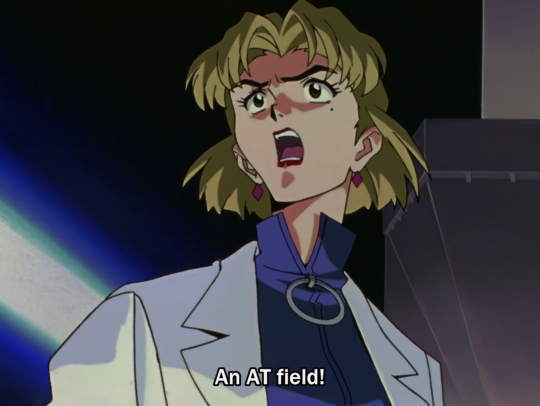
oh hey reminder that AT (“Absolute Terror”) fields are themed from the same source as “terror management theory”
reminder that that concept is about the defenses we erect to protect us from awareness of our own inevitable mortality
so the Unit-02/Mass Production Unit fight in End of Evangelion where Asuka goes balls out and channels all her perfectionist neurosis into beating them all before her power supply ends, but then they just rise up again and break through her AT field and impale her mother/avatar/self through the face to be cannibalized
the very moment where their spears, forcing their way through the field, turn into a Lance of Longinus - the very tool by which his inferiors killed God - and she exclaims in astonishment, that second when she realizes that no matter how perfect she is she’ll die anyway
that’s also a metaphor for realizing that no matter how perfect you are you’ll die anyway