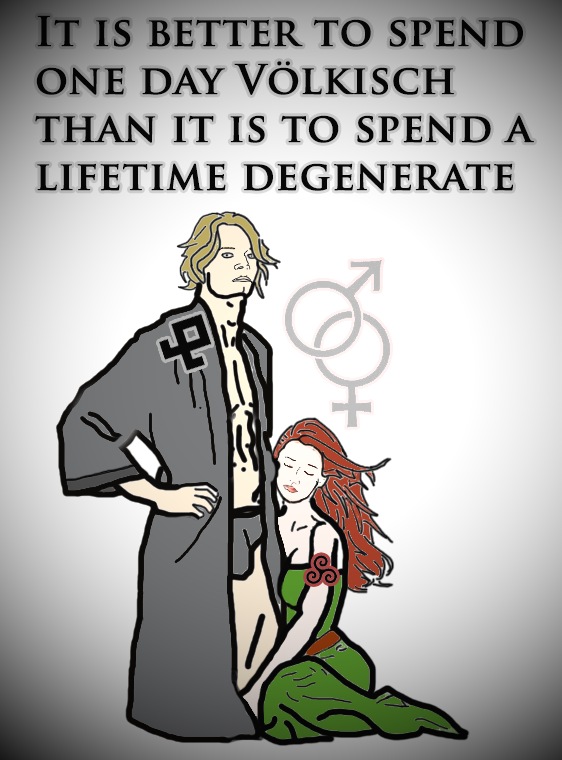
shrine to the prophet of americana

#metapolitics (7 posts)

Ironic thing is if you were really worried about Russians using internet memes to claim American mindshare and fellow-feeling...

Ironic thing is if you were really worried about Russians using internet memes to claim American mindshare and fellow-feeling you’d crack down on the “white people being #relatable with their cat” stuff

Tagged: metapolitics

Dylann Roof, 4chan, and the New Online Racism

Dylann Roof, 4chan, and the New Online Racism

This is the best mainstreamish article I’ve seen on what I’ve been talking about for a while, the internet-based development of a white male consciousness.

I will say it’s a little myopic in its American focus. I put it as

the construction of a modern, international, English-speaking Australian-American-Polish-British-Scandanavian-Serbian-etc. white volk around a core of internet-native right-masculo-populism on the chans’ “waifus, warhammer, and white nationalism” model

and the internationalism counts for something. Like I’ve said, because my sleep cycles leave me up on the internet late[/early] enough for the Strayans to show up, I now know the correct derogatory stereotypes about Aboriginal Australians, though I doubt one has ever even crossed into my physical field of vision.

And I guarantee you there are a lot of guys out there, around the world, who on hearing that Russia (or even a Danish/Finnish coalition) had invaded Sweden, would at least give a good “attaboy”, with hopes towards shifting Swedish domestic policy and culture, despite not being able to name two Swedish cities or politicians.

But really, an international bunch of alienated young male yahoos doing identitarian chest-thumping on social media, what could they really do anyway?

Well, why don’t you go ask ISIS?

Tagged: whiteness race metapolitics 4chan

Securing the existence of their culture and a future for White Media

selected John Herrman posts from The Awl

The New White Ethnic Media

These outlets [Paula Deen’s, Sarah Palin’s, Glenn Beck’s] share a basic form—online video network—and depend on relatively steep subscription fees (the comparison that always gets used is “more than Netflix”). They are fundamentally oppositional: to the mainstream media; to political correctness; to godlessness but also a very particular formulation of uptightness. They are nostalgic for a time when certain people could say certain things without worrying about controversy or shame—they feel like public speech is a minefield, so they’ve made theirs a little more private. Among friends, almost. They long for a wholesome past that they feel has been lost. They are not especially cynical. They are, in effect, a white ethnic media, writing and publishing and broadcasting and performing about the experience of American whiteness as understood by people who genuinely feel that whites are becoming a marginalized minority. Race is not addressed directly in these networks’ contents or containers—identity establishment is left to “urban”-style euphemisms and the projection of a sensibility that is neither explicitly nor assertively white, just inherently white, familiar to whites, deemed important or compelling or novel because it is no longer the norm elsewhere.

The New Identity Media Manifesto

[On the same, also Roosh’s Reaxxion:]

you could imagine Roosh-like mission statements for all of them: I aim to protect the interests of white Christian families, a category I’m in…

A gaming site for men is absurd and its potential is small; a culture empire for whiteness preservation is absurd and its potential is huge. But both behave in the same way: they respond to criticism by reflecting back victimhood, and adopting a received language of oppression. This was not their idea, they would suggest. It is what they believe the other people have been doing for years.

Everything Except Rap and Country

[On Taylor Swift’s 1989:]

[Swift’s] idea of pop music harks back to a period — themid-1980s — when pop was less overtly hybrid.

And, in the same quarters, more overtly white!

That choice allows her to stake out popular turf without having to keep up with the latest microtrends, and without being accused of cultural appropriation.

Avoiding non-white “microtrends” isolates Taylor Swift from charges of appropriation, because they have no specific and recent non-white influence to refer to.

[In “Shake It Off”] she surrounds herself with all sorts of hip-hop dancers and bumbles all the moves. Later in the video, she surrounds herself with regular folks, and they all shimmy un-self-consciously, not trying to be cool.

Who, exactly, would interpret those signals as not “cool” but instead “regular?” Not everybody; specifically, somebody.

The singer most likely to sell the most copies of any album this year has written herself a narrative in which she’s still the outsider.

You know who else suddenly feels culturally outside of the mainstream? (Besides, as always, anyone over the age of 30?) People who are skeptical of America’s demographic progress! Or who, at least, don’t feel comfortable thinking or talking about it. If Jon Caramanica is right, the promotional theory and marketing conversations around 1989, and an overarching influence on its music, can be summed up as: Intentional, Performed Whiteness. It’s an artistic manifestation of the old adolescent conversation:

“What kind of music do you like?”

“Everything. Except rap and country.”

relevant: 1, 2

Tagged: the awl it's media whiteness metapolitics supergenius shapeshifter taylor swift

The End of the World as We Know It

thenewinquiry:

image

Ancient Apocalypse films use the past to project a reactionary present into the future.

When we think apocalypse, we tend to think of the future. Accordingly, the apocalypse seems to show up on film only in the realm of sci-fi or, occasionally horror. But while every single hair on the rotting scalp of zombie cinema has been analyzed under bloodstained micro­scopes, a new subgenre has been emerging that wields the potent thought of the end of the world to even more reactionary ends. It uses the trope of apocalypse to project current power into the future by situating catastrophe and its overcoming in the past. These movies give voice to the blind hatred of the disgruntled agents of collapsing empire.

These films span a number of generic registers, from animated kid’s movie to big-budget summer ­production. You’ve probably seen one: 300, Noah, Gladiator, The Croods, Centurion, etc. These are the Ancient Apocalypse films, and they have opened up whole cinematic territories for a far-right theory of terminal crisis to play in.

Read More

Tagged: metapolitics

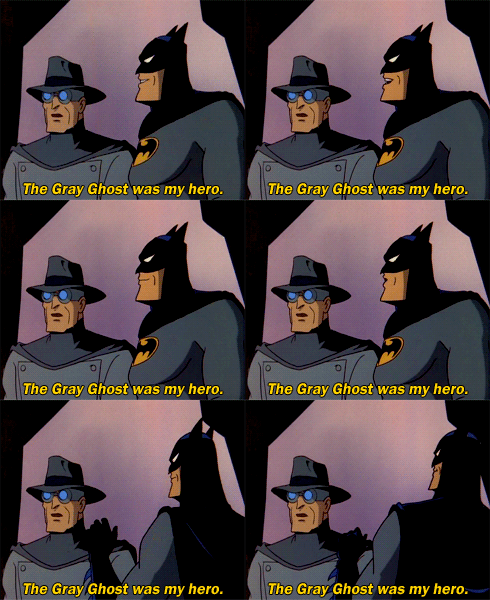
Beware the Gray Ghost Batman: The Animated Series

kane52630:

Tagged: metapolitics

See what I was saying?

See what I was saying?

Tagged: whiteness nrx dark enlightenment race metapolitics

Lot of attention lately to the Dark Enlightenment that is mostly about Moldbug. The brown menace, she rides again. As I’ve said...

Lot of attention lately to the Dark Enlightenment that is mostly about Moldbug. The brown menace, she rides again.

As I’ve said before, his one innovation, “neocameralism”, is just a rewording of the Divine Right of Kings in corporate shareholder idiom, a legitimating myth for an order that hasn’t established itself yet. It is significant that that’s exactly the idiom native to the SF tech/VC complex - if shit kicks off in America, dollars to donuts it starts in the Bay Area, which I’ll maybe go into in another post, but suffice it to say I expect the particular details of his program to be pretty much irrelevant to anything.

I will say what intrigues me more, and what could really be a prime mover in that sector, is the construction of a modern, international, English-speaking Australian-American-Polish-British-Scandanavian-Serbian-etc. white volk around a core of internet-native right-masculo-populism on the chans’ “waifus, warhammer, and white nationalism” model

things like Polandball’s (and SatW’s) western-centric resurrection of the concept of national personification, heavy metal culture and the associated Vikingism, feelsguy’s translinguistic sense of selfhood, /pol/’s kebab removal… well, just /pol/’s /pol/ness, really

Now this sounds ridiculous. I know this sounds ridiculous. This is me pointing to cultural trends particularly prominent in the dork niche circles I notice and ascribing to them world-shifting importance. I know it is.

Sure, heavy metal is not the actual historic musical tradition of any people. Sure, Norse neopaganism is not the actual historic religious tradition of any people. Sure, Tolkien-by-way-of-D&D aesthetics are not the actual historic mythology of any people.

Unless, of course, you count “2008” as being a part of history, or those then alive as counting as a people. Or, say, 1978. Or, you know, the 19th century, and the conscious, successful Wagnerian construction of Germanic identity from which these are all lineally descended.

To Golda Meir is attributed the line that there is no such thing as a Palestinian, by which was meant that the identity didn’t predate the establishment of the state of Israel. True, true. Neither was there such a thing as an Israeli. But then the state of Israel was established.


Plus okay, the celebration of western, particularly north european feudal great man realpolitik that is Paradox games is a niche thing, not quite mainstream popular culture

but how about the celebration of western, particularly north european feudal great man realpolitik that is the Canadian/Irish/American “Vikings” series?

how about the celebration of western, particularly north european feudal great man realpolitik that is Game of Thrones?

*de Benoist voice* metapolitics
Tagged: whiteness dark enlightenment nrx metapolitics