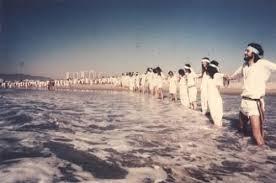
shrine to the prophet of americana

#los angeles (17 posts)

why is los angeles where los angeles is

rustingbridges:

why is los angeles where los angeles is

The first transcontinental railroad ran to San Francisco, and when a southern route was built the obvious western terminus was San Diego, but San Francisco elites feared the growth of another California power center so they pulled strings to get it redirected to Los Angeles, which was originally the agricultural lands feeding a Spanish mission and had no natural port. (They first built long piers around Malibu and then an artificial breakwater-protected harbor down by Long Beach.)

Then in 1892, the city was found to sit atop a major oil field and a drilling boom ensued, then in WWI the existence of a large labor force without strong left-labor organization like elsewhere on the west coast and in coastal shipping range of the wood-producing Pacific Northwest made it ideal to spin up a military aircraft industry.

Then after WWI, the booming Mediterranean-climate city drew a lot of immigrants from post-Ottoman lands as their national restructurings wrang out, then the motion picture industry relocated there from upstate New York for the weather and to get distance from Thomas Edison’s IP-enforcing goons, then in WWII that defense aerospace industry got even bigger, carrying the region through the Cold War.

Tagged: los angeles kontextmaschine does hollywood history amhist

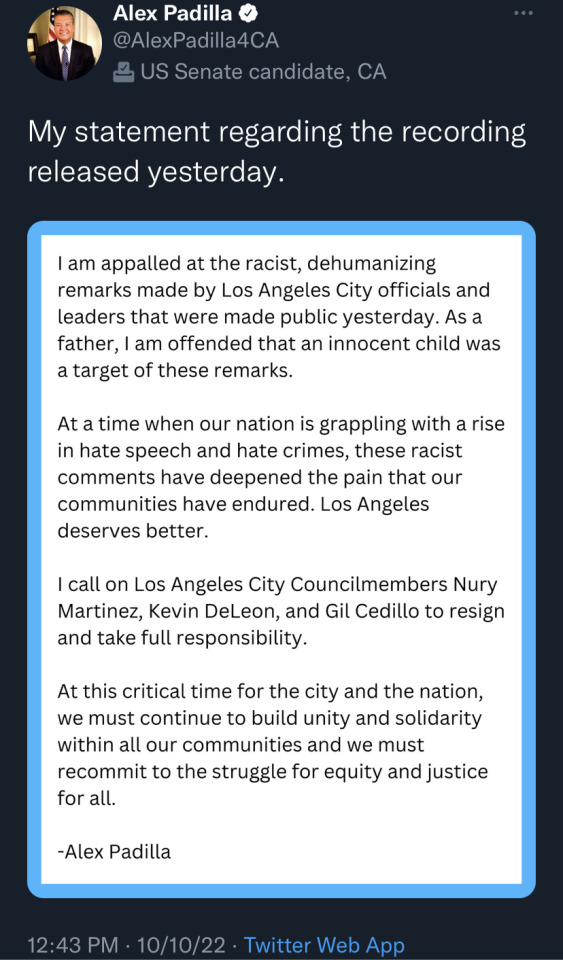
Senator Alex Padilla calls on the racist three to resign. Yesterday protestors gathered in front of Martinez’s home to blare her...

plum-soup:

radiofreederry:

Senator Alex Padilla calls on the racist three to resign. Yesterday protestors gathered in front of Martinez’s home to blare her racist comments on a loop from a loudspeaker

I would say there are really two things going on here, one is the way Latinos becoming politically powerful in Los Angeles has lead to specifically white or light-skinned Latinos becoming political representatives of powerful districts in places like Los Angeles. If you speak Spanish and spend enough time around people like this, you will generally hear them say horribly racist things about people of color, including other Latinos, as in the tape released here where they refer to indigenous southern Mexicans as “little brown people” and “tan feo”. One thing that this really reminds me of is the current scandal about workplace racism in the large warehouses of the Inland Empire, particularly the language used is almost identical to that used by the latino warehouse management about black workers.

Then there’s the other thing, which is all the elections that are fast approaching, and redistricting. I’m not as qualified to talk about the little political intrigues there, because I don’t live in LA anymore or follow the politics closely enough to fully explain it, but there are currently some very serious fights between various groups of city council members over districts and upcoming elections, and they seem to be very focused around the racial demographics of these districts and how they will come into play during future elections. I’m almost positive that that’s why Padilla is making this statement, because he’s up for re-election.

Then there’s the reason and method by which this statement was recorded and leaked, which is a bit suspicious in my opinion. There’s a mayors race coming up pretty soon, and iirc the leaked conversation was posted to Reddit with a caption saying something like “looks like city council is in bed with organized labor” or something to that extent. So I would not be surprised if this leak was an attempt to create infighting between the dominant liberal political bloc in Los Angeles, create splits between black and Latino communities, and make the endorsements of establishment organized labor useless politically, or even harmful. That’s not to say that these people shouldn’t be held to account for the frankly disgusting things they’ve said (I’m particularly disgusted with DeLeon, who I met when he was running to try and replace Diane Feinstein, and who seemed to at least have the rhetoric of a legitimate “berniecrat”. Apparently, he’s just as racist as other light-skinned Latinos in SoCal, which is extremely disappointing, because we need young, progressive latino political leaders desperately who are actually legitimately committed to the cause), but I think it is important to be aware of the context that this recording is being disseminated in, because it will almost certainly be used in attack ads in the coming elections, if it isn’t already.

I mean, if we’re really going to be honest, the whole project of “representation” for minority groups within Los Angeles politics has failed spectacularly, and this is just one sad example of that. What they’ve done is just elect a bunch of white Latinos, a token gay white guy, a few token black people, etc, to fit the racial demographics of each district, but these people are generally not truly progressive or anti-racist activists in any way, they are all professional politicians, businessmen, and the like; in general, people who are continuing with more of the same in politics, just with a black, Asian, gay, or spanish-speaking face. I mean, they even made a latino dude the sheriff, and somehow he seems to be even worse than the previous white dude. It’s almost as if we can’t vote our way to equality in a fundamentally corrupt and racist political system! Who woulda thunk it??

Well, Gil Cedillo and the Latino Caucus did manage to get Villaraigosa as mayor 2005-2013, which was an absolute shambles, so much that they lost City Attorney – who contracting runs through – to Carmen Trutanich, a Republican(!), so they couldn’t even get the usual spoils from it. All they managed to do was waste the opportunity of the new city charter – explicitly designed to centralize power – while the council adapted.

Well, as I understood it it was also about the eastside labor-latino scene (and cliques) starting to elbow out the Westside Jewish-professional one in city party and government structures, how’s that coming along?

Tagged: los angeles kontextmaschine does hollywood

One thing about LA's freeze on building and attempt to hold "neighborhood character" is that the commercial mix of an area is...

One thing about LA’s freeze on building and attempt to hold “neighborhood character” is that the commercial mix of an area is often like, 15 years behind the neighborhood demographic.

Like, there were parts of Melrose Boulevard that I went to in 2008 that I was like “oh, this makes Melrose Place (1992-1999) make a bit more sense!”

I visited back down to Echo Park in like, summer 2019? after leaving in 2011, and like, the only new construction I saw – some townhouses up by the terminus of the 2 in this hot neighborhood you heard about on the other coast – was about equal to the amount of change I would expect on any given Portland eastside block between 13th and 48th over the same period.

But the stores on Sunset, which had been like, cheap/blue collar work clothes, or storefronts that carried all, but only, the stuff you got with WIC vouchers, or these 3 restaurants that were owned in common as basically identical meh Mexican cafeterias, finally matched what I’d’ve expected from the block down from The Echo/Echoplex

Tagged: kontextmaschine does hollywood los angeles gentrification echo park

@wirehead-wannabe said What’s the deal with L.A. then? LA has no natural harbor, it started out as an inland nowheresville,...

kontextmaschine:

@wirehead-wannabe said What’s the deal with L.A. then?

LA has no natural harbor, it started out as an inland nowheresville, founded as a feudal agricultural settlement by the seasonal Los Angeles River feeding the San Fernando Mission at the northern mouth of the valley. San Diego was the major city of the region.

Eventually it came time to build a southern transcontinental (“Southern Pacific”) railroad route, with San Diego as the obvious western terminus but San Francisco had issues.

San Francisco, swollen by the Gold Rush, terminus of the first transcontinental route, was the dominant power in California and didn’t want a rival, pulled enough strings to redirect to LA.

LA built an artificial breakwater and a port down by San Pedro several miles south of the city, before that they used absurdly long-ass piers off the western coast around Malibu and Santa Monica.

Then narratively unrelated to any of this there was oil discovered in the hills, which generated capital and drew Eastern money, Pasadena became the west coast WASP capital, or at least Palm Beach-equivalent. LA became self-sustaining.

Then the movie industry moved there for the weather and distance from Thomas Edison’s IP-enforcing goons

Then during WWI the aircraft industry got big because there was infrastructure and a population of workers in coastal shipping range of the NorCal/Oregon lumber industry, but WITHOUT SF/Seattle-style labor radical tendencies

Then during WWII that got even bigger and the US realized it needed to build up its Pacific (Japan- and Russia-facing) coast, which was honestly still frontier at that point

And the rest is history

Tagged: rerun los angeles

The Last Station

xhxhxhx:

In the summer of 1964, Christopher Rand visited Los Angeles on assignment from the New Yorker. His writing for the magazine, published in Los Angeles: The Ultimate City (New York: Oxford University Press, 1967), feels like an artifact from the last moment when ordinary Americans felt that science and engineering could remake the world for the benefit of humankind.

Rand visits a base in the Santa Monica Mountains that directs the fire control planning for the 330 square miles around it:

I was shown a large map-room there, with consoles full of communications gear, these tended by two or three men around the clock. The man in charge said that the post had seventy-six fire companies and seven ambulances available, and patrols on the move in all directions. If a brush fire was even suspected in the hills, he said, the post would get six fire companies and two chief officers onto the scene as soon as possible; they would be sent from various quarters because movement was so hard in that terrain. Then if the blaze got serious, more and more equipment would be sent from nearby points, and meanwhile still more would be moved up, as reserves, into the vacancies. “In a big fire we keep redeploying constantly,” he explained, and it all reminded me of our infantry operations in Korea – even to the possibility of air strikes, which the station could call in, if they were needed, much as a regimental command post might.

He heads to Irvine, where the architectural firm William Pereira is creating a whole community from ranch land. (“This is Irvine Ranch,” his guide tells him. “It was the only thing that could stop those suburbs from spreading.”) Pereira himself speaks: “Right now my kind is in command,” he says. “We have sold the idea that planning is necessary, and we have generations of development ahead of us. We have the palette here and we’ll see what we can do with it.”

Rand speaks to the Pereira partner running the Irvine field office, James Langenheim, who tells him about the firm’s plans for Catalina:

“Catalina,” said Lagenheim, “can’t be developed for a few years anyway, because its population can’t increase much till the water and transport problems are solved. We think desalinization will take care of the water; it is being studied now, you know, in Southern California. We hope it can be done economically in a few years, which would free us on that score in a decade. As for transport, the island is now served by airlines and, in the summer months, a boat from Wilmington, in the Los Angeles port area, but the boat is too slow and infrequent for the population we visualize. We are looking forward to cheaper, more efficient helicopter service or to improved hydrofoils that can operate in the channel there, which is often choppy. This, too, should take a few years. It all delays our plan, but at least it gives us a lead-time for more thorough research; we are, for instance, trying to find just where the Indians used to live on Catalina, so we will know more about the ground water. And we are getting a chance to indoctrinate the Catalina population about planning in general. Not to mention indoctrinating Los Angeles County, to which the island belongs, about its problems and its future.”

Rand saw in Century City, a high-rise community built with capital from Alcoa, Lazard Frères, Tishman, and the Pennsylvania Railroad, a new Los Angeles. “Capital is coming from many directions,” he wrote, “and this force, together with others – the influx, the technology, the dreams of the planners – is pushing the projected Los Angeles toward realization.”

Like Century City, Los Angeles would grow up:

It accords, also, with certain accepted ideas about the modern city. For one thing it should have much high-rise living in it. Heretofore L.A. has run to single-family houses. This has been partly due to a fear of earthquakes and partly to the small-town, or rural, Midwestern background of so many Angelenos. The idea of every-man-his-own-landlord-and-every-man-his-own-chauffeur has been thought a key to freedom of some sort. (And also to social standing. “There was a matter of image,” an L.A. write has said in discussing the aversion here to high-rise. “A homeowner had more status than an apartment dweller.”) But now that prejudice is passing. Real-estate economists and analysts, who abound in L.A., point out that the big U.S. crop of war-babies recently attained their early twenties, an age that favors apartment living; they say this has sped the change. They also say, more simply, that close-in land prices (not to mention taxes) preclude one-family homes for most people. There has recently been a slump in all real-estate activities in L.A., but prior to that slump – in the early ‘sixties – three-quarters of the dwelling units built were going up into the third dimension, and this is making it more like other cities.

Rand says this all without a hint of irony or doubt, even when he compares fire control in the Santa Monica Mountains to the land campaign in Korea. There is confidence and optimism in the people he speaks to, and Rand himself is not anxious or fearful.

It is hard to imagine anyone writing like this in the New Yorker today.

Los Angeles may be the ultimate city of our age. It is the last station, anyway, of the Protestant outburst that left northern Europe three centuries ago and moved across America: the last if only because with it the movement has reached the Pacific. There are other cities on our West Coast, but none so huge or dynamic as Los Angeles, or so imbued with the Northern wilfulness in battling nature. L.A., as its people often call it, is the product to a rare degree of technology. Though built on a near-desert, it is the most farflung of the world’s main cities now, and probably the most luxuriously materialistic. It is also – apart from the big “underdeveloped” cities, with their shantytown outskirts – the fastest growing in population. With its hinterland, of Southern California, it is gaining nearly a thousand inhabitants a day, and is expected to go on gaining indefinitely. The Angelenos, its people, are prone to live in the future and to project their statistics forward; the visitor hears them talk more about 1980 than about next year. “This is an optimistic city,” a friend here told me recently. “If something is built wrong it doesn’t matter much. Everyone expects it to be torn down and rebuilt in a decade or two.”

These are the opening words of a piece that end with the same sense of optimism about human potential: “the builders of L.A. keep building,” Rand writes. “L.A. is bound up with technology like no other city in history, and technology has a will of its own.”

But what is striking is how little has changed, and how little the city of today reflects the dreams of 1964. They stopped building, and everything we had hoped for – “the influx, the technology, the dreams of the planners” – never came to be. It is as though the country went into the darkness and never emerged.

Catalina never became much bigger than it was in 1964. Today, there are fewer than five thousand people on the island’s 48,000 acres. Philip Wrigley, chewing gum magnate and owner of the island, deeded 42,000 of those acres to a nature conservancy in 1975.

Catalina never became a haven for golf carts and pleasure craft. Los Angeles did not become Century City. Pereira’s firm designed the airports of Baghdad and Tehran, but they did not indoctrinate Los Angeles. Instead, the Californians came to fear growth and change. They stopped building. 

Every day I pray that they will tear it down and build again.
Tagged: jfc the california ideology amhist los angeles history

@wirehead-wannabe said What’s the deal with L.A. then? LA has no natural harbor, it started out as an inland nowheresville,...

@wirehead-wannabe said What’s the deal with L.A. then?

LA has no natural harbor, it started out as an inland nowheresville, founded as a feudal agricultural settlement by the seasonal Los Angeles River feeding the San Fernando Mission at the northern mouth of the valley. San Diego was the major city of the region.

Eventually it came time to build a southern transcontinental (“Southern Pacific”) railroad route, with San Diego as the obvious western terminus but San Francisco had issues.

San Francisco, swollen by the Gold Rush, terminus of the first transcontinental route, was the dominant power in California and didn’t want a rival, pulled enough strings to redirect to LA.

LA built an artificial breakwater and a port down by San Pedro several miles south of the city, before that they used absurdly long-ass piers off the western coast around Malibu and Santa Monica.

Then narratively unrelated to any of this there was oil discovered in the hills, which generated capital and drew Eastern money, Pasadena became the west coast WASP capital, or at least Palm Beach-equivalent. LA became self-sustaining.

Then the movie industry moved there for the weather and distance from Thomas Edison’s IP-enforcing goons

Then during WWI the aircraft industry got big because there was infrastructure and a population of workers in coastal shipping range of the NorCal/Oregon lumber industry, but WITHOUT SF/Seattle-style labor radical tendencies

Then during WWII that got even bigger and the US realized it needed to build up its Pacific (Japan- and Russia-facing) coast, which was honestly still frontier at that point

And the rest is history

Tagged: amhist geography los angeles history

That whole “Florida Gun Range Will Serve Alcohol” viral story, like in that it will have an on-site restaurant that serves...

That whole “Florida Gun Range Will Serve Alcohol” viral story, like in that it will have an on-site restaurant that serves drinks?

Set aside the “LOL guns”, it’s the “LOL Florida” part of the reception that really bugs me, because like, you realize this whole time there’s been a gun range in Los Angeles with an on-site bar and grill?

I’ve been there! To discharge firearms and consume alcohol. One time I was there and all of a sudden everyone up and left so I assumed it was closing and downed my drink, apparently it had been an earthquake I didn’t even notice sitting on my barstool.

Tagged: gunblr daytona beach los angeles florida man

Los Angeles is an evil city that taints otherwise pleasant people, Boston is an otherwise pleasant city tainted by evil people

Tagged: boston los angeles evil

Why Does Los Angeles Attract So Many Cults?

di-kot-o-me:

“We went deep on the Los Angeles obsession with cults, cultists, cult-like groups, organizations we’d never refer to as cults for legal reasons, organizations that are definitely not cults but are kinda weird, and other related subjects. You don’t have to go into a trance or commune with any ancients to relive it—here it is, in all its alien superbeing glory:

An introduction:

· An Introduction to the Long History of Los Angeles Cults
· Ask the Experts: Why Does Los Angeles Attract So Many Cults?
· How to Start Your Own Los Angeles Cult in 14 Easy Steps

The buildings:
· 8 Notorious Los Angeles Cult Locations: Then and Now
· 7 of LA’s Most Magnificent Examples of Masonic Architecture

The juicy stories:
· The Pasadena Haunts of the Occultist Who Cofounded JPL
· The Earliest and Weirdest LA Cult Stories: 1700s to 1940s

The Manson Family:
· The Story of the Abandoned Movie Ranch Where the Manson Family Launched Helter Skelter
· Mapping 13 Key Locations in the 1969 Manson Family Murders

The health-obsessed:
· How Cultists, Quacks, and Naturemenschen Made Los Angeles Obsessed With Healthy Living
· The Respectable LA Houses of 1970s Hippie Cult The Source
· Café Gratitude and the Cult of Commerce

image

- Curbed LA’s Cults Week

Tagged: amhist los angeles

It's weird that LA (but as far as I can tell no where else) uses "photog" as an abbreviation for "photographer" but not, say,...

It’s weird that LA (but as far as I can tell no where else) uses “photog” as an abbreviation for “photographer” but not, say, “cinematog” or “choreog"  or "biog” or “pornog”

Tagged: photography photog los angeles hollywood

Hey remember when the paparazzi got some shots of Lindsay Lohan and Paris Hilton’s cooters as they stepped out of cars and TMZ...

Hey remember when the paparazzi got some shots of Lindsay Lohan and Paris Hilton’s cooters as they stepped out of cars and TMZ and all them were like “is flashing your clam the new LA fashion trend”?

And you were like “no, obviously it isn’t, you scumbags”.

Haha, joke’s on you, flashing your clam was totally the new LA fashion trend. This was the Les Deux era, and the dawn of the Cahuenga corridor (NYC translation: “meatpacking district”) for the plebs, and for six months or so that was totally a thing, girls going out without panties and dancing up on tables where everyone could see, lifting up their skirts and going “woooo!” for the photogs camped out on the street.

Whether the celebrity stuff was following or starting that trend, who knows. But “showing strangers your labia” was an honest-to-god Thing for a bit.

Your impressions of anywhere you’ve never personally been come from creatives based in LA. And every cultural product about LA is centered on the message “LA is fucking terrible”, have you noticed that?

But you’re like “nah, it can’t be that bad, it’s just an exaggeration in a telling direction”.

No dude, it’s not, LA is fucking terrible.

Tagged: los angeles

Motoring my way very slowly around Los Santos in a submersible turns my mind to the geography of LA. LA has no natural harbor,...

Motoring my way very slowly around Los Santos in a submersible turns my mind to the geography of LA.

LA has no natural harbor, the LA/Long Beach port is protected by artificial breakwaters. The natural seaport of the region is San Diego, and indeed SD used to be the power center of SoCal. LA was founded because the seasonal LA river allowed crops to be grown for the nearby missions, and this origin in a command economy meant it didn’t initially develop the market institutions that characterize regional capitals.

What really did it is that when the southern transcontinental railroad was planned it was originally supposed to have its western terminus in San Diego, but state legislators from SF, the Gold Rush-swollen power center of California, feared this would shift power south and redirected it to LA on the premise that such a desert hellscape could never grow into a rival.

The funny thing is that from this to the streetcars (built by land developers to increase the value of their holdings in distant suburbs like Hollywood, then abandoned as unscaleable and unprofitable) to the subways (planned to alleviate gridlock between the eastside and westside, then redirected up into the valley instead because riches vs. poors) to the green line (going from nowhere in particular almost to the airport as a sop to the black neighborhoods cut down for a freeway) to the proposed high speed rail lines (connecting SF and Vegas to like an hour out of town), the development of LA has been almost entirely driven by laying rails in the obviously wrong places.

Tagged: los angeles geography history

That said, when I was in LA I was always, always waiting for some New Yorker to ask "what's Echo Park got that Brooklyn...

That said, when I was in LA I was always, always waiting for some New Yorker to ask “what’s Echo Park got that Brooklyn doesn’t?”, just so I could respond “The Dodgers?”

(Lore is that LA destroyed a thriving Latino community in Chavez Ravine to build Dodger Stadium. That’s not true, they destroyed it to build public housing, but then didn’t because that’s communism. Then later hey, there’s all this open space going to waste & a desire to show off that LA Is A Real City Now)

Tagged: la los angeles history

i feel like the only reason there’s a small part of downtown LA with skyscrapers is because people felt like a large city is...

avrillavigneamvs240p:

i feel like the only reason there’s a small part of downtown LA with skyscrapers is because people felt like a large city is just supposed to have them in some part

Those skyscrapers are the result of a slum clearance project on Bunker Hill, which was previously old Victorians, once upon a way-back time the classy suburbs of tiny little baby LA, that had become flophouses. Also it was an attempt to lure banks, and their taxes, back from independent cities like Glendale and away from the planned office development of Century City which turned into a giant traffic clusterfuck. (In part because of terrible midcentury modernist planning, in part because of its defeat - the freeway system was designed on the assumption of a freeway decked over Santa Monica Boulevard, but Beverly Hills got it cancelled because ugly and poors and the rest was built intact.)

At ground level a lot of these buildings are blank, multi-story high stone walls. In City of Quartz Mike Davis talks a lot about how this is all militarized fortress architecture in response to riots and poverty but also that hill is really steep such that one side of the building is three floors deeper (or taller, wevs) than the other, and there’s basically no demand for Class A office space in which half of the floor has no windows, and not much foot traffic with any money to spend. So you might as well just stick infrastructure (electrical, water, HVAC, elevators, anti-earthquake suspension systems) in there.

LA has basically been trying to make downtown happen again ever since the 1950s, and it’s always just around the corner, there are some hilarious stories in there. Like, the Walt Disney Concert Hall, a classic Gehry design, had to have its curved metal surfaces roughed up after they focused and reflected light so well it was blinding drivers and raising the temperature by 20 degrees in nearby office buildings.

Also LA had this strong-council weak-mayor system where the council kind of lets each councilman run their district themselves with no coherent citywide vision, while departments like the DWP and LAPD got to run themselves. So when Governor Reagan shuttered the asylums and people initially tried to make a “neighborhood services” system to replace it, under NIMBYist pressure everyone refused things in their district, except downtown which didn’t really have any residential constituents of any influence, so all the shelters and rehabs and services ended up there, and in consequence parts of downtown became the homeless district, with tent cities on the sidewalks and addicts wandering zombie-eyed in the street. Downtown’s revival is right around the corner for real this time though promise you guys, lofts and artwalks, so the city’s been sparring with the ACLU and whatnot to get the authority to hassle them away.

It was a big part of the new city charter a decade or so to fix that system (also to preempt Valley secession, also to create Neighborhood Councils as a Potemkin government timesink for Concerned Citizens) but then Villaraigosa (a weak mayor indeed) pissed it away and the council’s clawed most of its power back. Villaraigosa’s election was basically the story of the Eastside Latino/labor branch of the Democratic machine affiliated with Gil Cedillo’s Latino Caucus triumphing over the Westside Jewish/professional branch to install its smile-in-a-suit figurehead.

LA is a terrible place. You’ll notice that anyone who makes money in LA immediately spends it on not living in LA, either through migration or seclusion, or else is an absolutely horrible person.

Tagged: la los angeles history

The Problem With Los Angeles

Is that every two months you get six weeks of things being terrible, one okay to decent week, and one week where you’re like “yeah, everything’s awesome! only two months until it all works out!”

Tagged: los angeles such a lovely place such a lovely face

Since the literal literal moment I got L.A. Noire at midnight release, it's been overcast and drizzly in L.A. 1) This is...

Since the literal literal moment I got L.A. Noire at midnight release, it’s been overcast and drizzly in L.A.

1) This is wonderful for playing L.A. Noire, all the driving and atmosphere and shit!

2) This is terrible for owning a motorcycle in real L.A., all the driving and atmosphere and shit!

Also the map drops off literally 4 blocks from where me and everyone else I know live, buuuuullshit.

Tagged: los angeles l.a. noire

Los Angeles, I love you.

lifetreats:

Los Angeles, I love you.

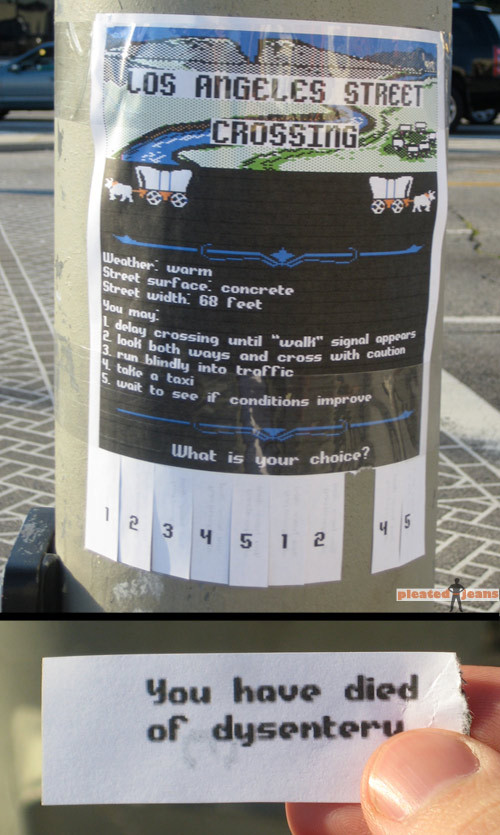
Tagged: los angeles oregon trail