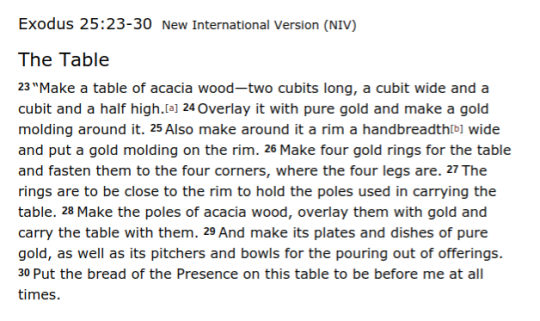
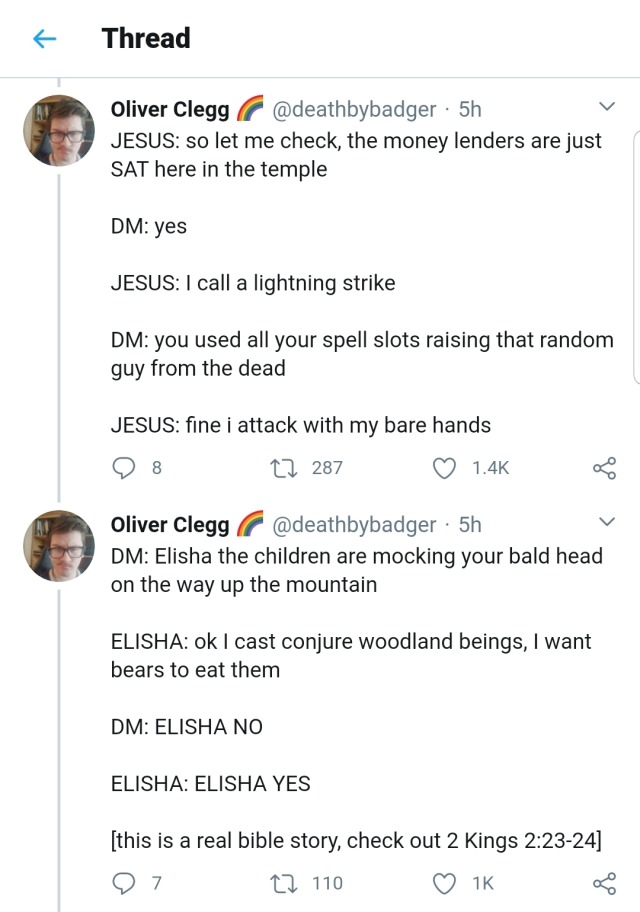
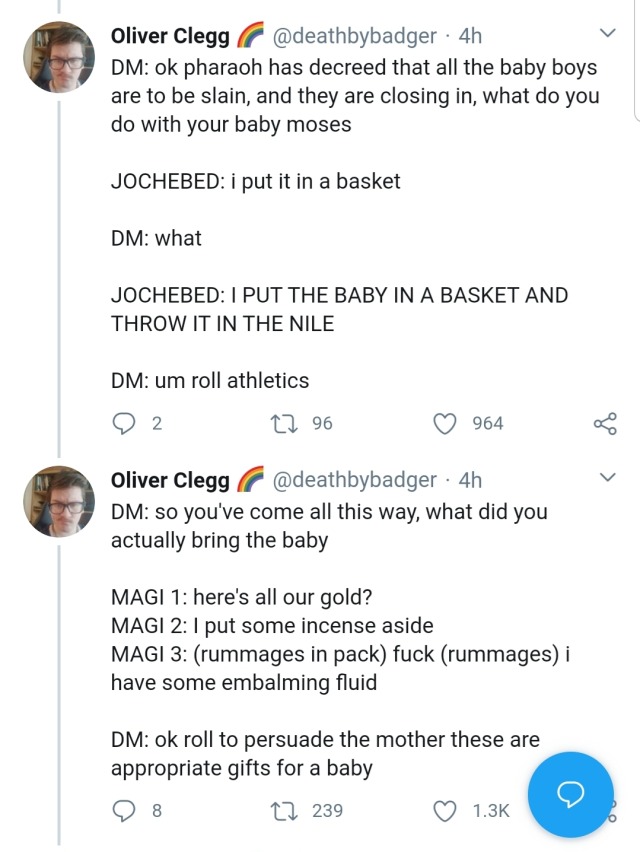
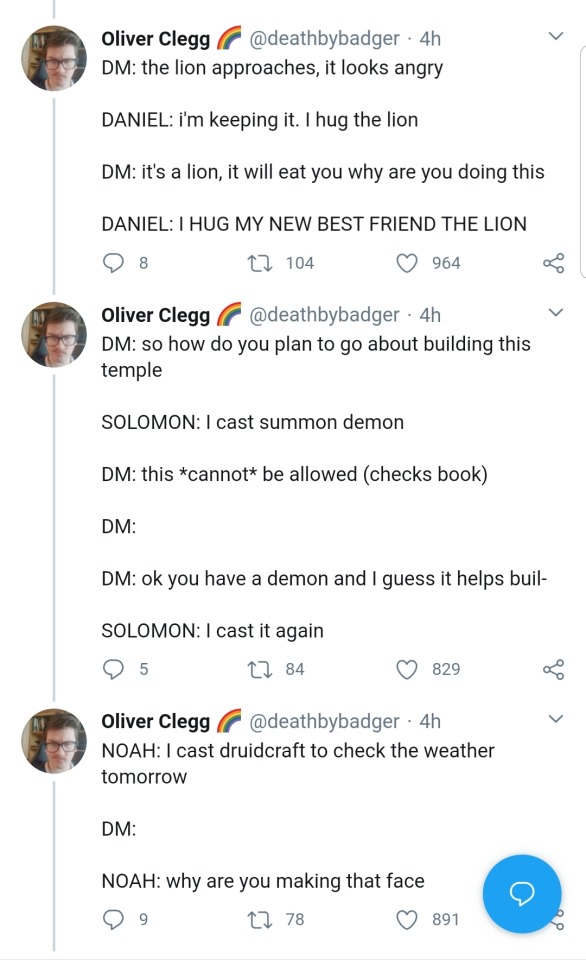
anyone who says “the bible is clear” about an issue, is 100% of the time wrong. the bible wasnt clear once. the bible couldnt be clear about how to make a table if it came in an ikea box
The Christian Church was an upgrade of Roman syncretism, the stuff about Yahweh and Jesus was just the introductory demo scenario that comes packaged in
“The first beast comes ‘out of the sea’ and is given authority and power by the dragon. The second beast comes 'out of the earth’ and directs all peoples of the earth to worship the first beast.”
if i was jesus i would of got a disciple to tape a pistol to the back of the cross. soon as they put me up there blam blam i take out the roman legionaries. hop down and reload. steal a chariot. before pontius pilate can do anything i’ve rappelled over his balcony. blam blam. that’s his knees
also me: You know how you talk about how the Torah contains speeches, laws, proverbs, genaeologies, censuses, economic records, and romantic poetry, so everyone who learns from it will have a sense how to do that?
me: yeah?
also me: have you thought through that the Gospels are records of charismatic rabblerousing against the powers that be?
The teachings of Jesus were, in fact, a plausible development of the Judaism of its time, which was periodically, before and after, reinvented in substantial ways by prominent figures, including ones in Jewish scripture that the Christian New Testament is known for paralleling.
Though early Christianity drew most converts from gentile nations, there were in fact Jews who followed his way – the 12 Apostles were all Jews! (Paul was Roman)
The thing is really that Jews as we know them today are the product of two millennia of mimetic evolutionary pressure against taking the Jesus path where it forks.
Among the many great little stories in Jonathan Rose’s book The Intellectual Life of the British Working Classes, one that has always stuck in my mind concerns a guy who read the Bible on his own, with dedication but without any external guidance.
On the basis of the other books he’d read, he assumed the Bible was a chronological narrative in which each section happened after the previous one. So when he got to the gospels, he assumed that they actually happened sequentially: that Jesus was in a sort of Groundhog Day time loop in which he experienced slightly different versions of the same set of events four different times, dying at the end of each version. (I guess would make sense that final loop was John, which is significantly different from the other three.)
That’s fantastic! And like most misinterpretations, it considerably improves upon the original text! :)
Really though, without context I’m not sure how else you would read it. If I was reading a book that had four repeated chapters with minor variations I would assume it was either an editing mistake, a sci-fi story, or a post-modern critique of intertextuality ??
Kinda curious now why the First Council of Nicaea didn’t just combine all the gospels into one super gospel and promote that.
What's the official Kontextmaschine™ take on Jesus?
That there was a human who corresponds to the biblical figure, who was a clever and charismatic genius living in the early Roman occupation of Judea, who challenged the sitting priesthood manning the vassal state and was executed by the Romans, in a manner at least roughly preserved in the Gospels.
That he was not in fact the son of God or capable of performing miracles, that he was not resurrected and that his death did not resolve any particular issue of sin and thus allow life after death. That Pentecost – the Apostles going into reclusion upon his execution and returning months later with the story of his resurrection and of the Holy Spirit where their teachings were exactly as divine as Jesus and God – was made up, in that When Prophecy Fails way.
That all the Gospels were written after and in service of this reading and that even where they include actual teachings of Jesus that support it they may pass over issues pertinent to the immediate cultural and geopolitical contexts that were not relevant to a greater cause or the contexts the Apostles scattered to to found churches.
That the most likely origin of “he provided more quality wine when a wedding feast found itself running out” and “he provided more food at an outdoor gathering than expected” tales has to do with his links to major local landholders – note how the “literal” reading of his parables, to be recognizable and understood, is about the operation of fields and vineyards.
That even if you take the religious aspect of the New Testament seriously it strikes me the message isn’t about the victory of the God of the Jews, it’s about the victory of the Roman Empire.
According to Epiphanius, certain women in then-largely-pagan Arabia syncretized indigenous beliefs with the worship of Mary, and offered little cakes or bread-rolls. These cakes were called collyris (Greek: κολλυρις), and are the source of the name Collyridians.
Mary-as-God is such an obvious inference I’m surprised it’s not more common.
I thought Mary as Eve worked better – God’s allowing the crucifixion not only as a twist on Abraham and Isaac but his doing it in the face of her lamentations as a redeeming of the Fall coming from Adam’s following Eve’s womanly direction
This is something I’ve been meaning to write up for a long time: a guide to reading the Bible for people who don’t want to commit to the full 2000+ pages. In theory you should read the whole thing, but realistically large parts of it are repetitive, dull, or just not very rewarding to the casual reader. So I came up with a list of what I consider to be the most essential books. If you read these you will “get” the Bible. I think it covers all of the main narrative portions, as well as enough theology for you to get the gist. It’s still probably half the Bible, so a formidable ~1000 pages, but with fewer of the boring bits, so it should go more than twice as quickly.
I read part of the Bible using the King James Version, but mostly I used this edition of the New Revised Standard Version. It has lots of annotations and good introductory material, plus it includes all the apocrypha. From the perspective of English literature, the KJV is definitely the one you should read. But my interest was in understanding what the Israelites themselves were thinking, so for me a modern translation, built on our better philological knowledge, was more appropriate than a highfalutin archaic translation, which puts up an extra barrier between you and the text. Which version you should pick depends on your goals. KJV can be read, but it is more difficult and you do have to work for it much more.
I list these books in the order of the Protestant Bible, just because
that’s what I know. Books which I do recommend are in bold, while books I
don’t recommend but still wanted to mention are in parentheses. And
there are too many genealogies and lists in the Bible to mention them
all, but whenever you see one you can skip it.
Obviously this is my opinion as a reader, not as a scholar.
Old Testament
Pentateuch/Historical Books
Firstly, you should start off by reading most of Genesis through 2 Kings. This is the main narrative chunk of the Old Testament, and it tells the story of Israel from the creation of the world through to the Babylonian Exile, and it contains most of the Biblical stories you’re likely familiar with. There are some large skippable sections within these books though. In particular, the genealogies and some random non-narrative bits like instructions on how to build a tent to protect the Ark of the Covenant. There’s no need to read any of that other than literary masochism. Also, large portions of the Pentateuch (the first five books of the Bible) are just laws and rules for how the Israelites should live. E.g. how should you properly sacrifice a sheep. I find that as interesting as the narrative parts, but if you don’t you can skip it.
(1 and 2 Chronicles are just a retelling of the previous few books from a slightly different perspective.)
Next you should read Ezra and Nehemiah, which conclude the story of Israel with the end of the Babylonian Exile. These books aren’t terribly interesting, but they are important, and again you can skip all the lists of names.
(Esther is a silly folk tale. Highly inessential.)
Wisdom Books
Job feels like an interesting story which got kind of messed up by later editors, but it’s important enough that you should probably read it anyway.
(Psalms and the Song of Solomon are important as literary history, but I can’t imagine the casual reader getting much out of them. You could try reading a few of the most famous psalms just to get the flavor of them, since each one is only about the length of a sonnet.)
Proverbs is just a list of Iron Age sayings and life advice. If that’s interesting to you, read part of it. If not you can skip. And even if you do read it, you don’t have to do the whole thing, since it’s repetitive.
Ecclesiastes is in my opinion the most interesting book of the Bible, and certainly the most sophisticated. A fascinating, almost Epicurean approach to theology, very different from anything else in the Bible, and probably very different from your expectations of the Bible. If you only read one book, make it this one.
Major and Minor Prophets
In general, the actual prophecies in these books are super tedious. It’s all “And God shall smite the city of so-and-so for their iniquities” or “And God shall smite the Israelites for their iniquities but then He shall forgive them”. No personality. So you can skip all of the books that are just prophecies, and focus on the ones with narrative elements.
Jeremiahis the best of these, the story of a prophet during the fall of Jerusalem. It’s a ground level retelling of events which were previously described from the perspective of a distant chronicler, which makes it a good counterpoint to other, less personal parts of the Bible. Read the whole thing, including the prophecies, so you can get the gist of what the prophecies in the other books are like.
Daniel has some well known folk stories at the beginning, but you can skip the dream interpretations of the second half.
Jonah is the only one of the Minor Prophets with a story. Him getting swallowed by a whale and all that.
(Probably the most important prophetic book without any narrative is Ezekiel, which has some interesting visions and was very influential later on. I can’t say I recommend it, but if you were to read another prophetic work this is the one I’d go with.)
(Lamentations is more poetry, but it’s also short.)
Apocrypha
The only apocryphal work I’d consider to be essential is 1 Maccabees, which fills in an important narrative gap in between the Old and New Testaments.
New Testament
Gospels
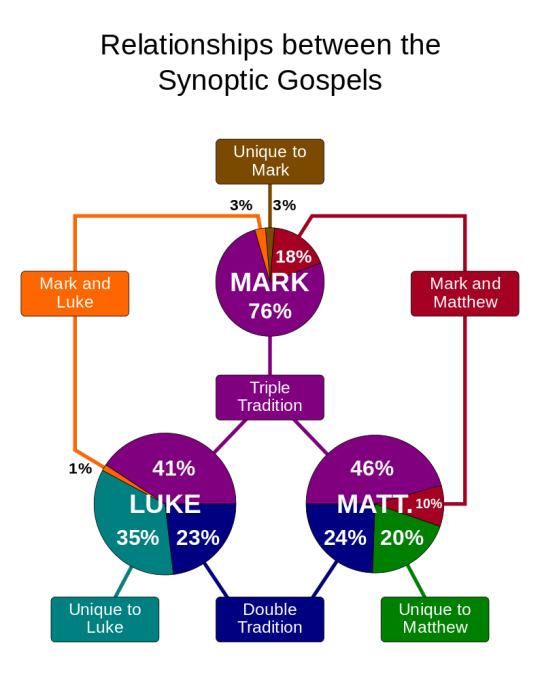
I guess the gospels are important enough that you should read all of them. Certainly you should read John, which is the most unique of the four. But the other three gospels, Matthew, Mark, and Luke, share a lot of material:
So if you wanted to, you could skip the parts which you’ve already read in the other Gospels. If you only had the energy to read two, I would go with Luke and John.
Also, I might recommend reading them in the order they were written (Mark, Matthew, Luke, John), instead of the order they were placed in the Bible. If you read the Gospels that way, you get a very clear sense of how Jesus became more and more revered over time. In Mark, Jesus is a cranky human, more or less. But by John he’s become primarily divine.
Acts of the Apostles tells the story of the early church just after the crucifixion. The stories aren’t as well known, but it’s still essential.
Epistles
The epistles are just a series of letters from various Church Fathers, mostly Paul, to churches around the Mediterranean. They deal with various doctrinal issues, how to run a church properly, and so on. Very important theologically, but not rewarding to the casual reader. I’d say read Hebrews to get a feel for what these books are like, but that’s it. Maybe Romans as well if you’re ambitious.
And finally, you should of course read Revelation. Not only is it the conclusion of the Bible, it’s also a fun read at points. The apocalyptic prophecies are gaudy and weird. They do get repetitive though, so you can skim parts if you want to.
i was worried my cat is dehydrated because i never see him drink water so i’ve started leaving a cup of water that’s “mine” (aka he sees me drink out of it once before he does) in my room so he thinks he is being a rebellious naughty by drinking out of it but rlly he is just following my plan & being hydrated .
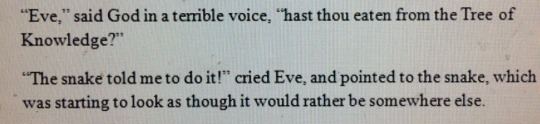
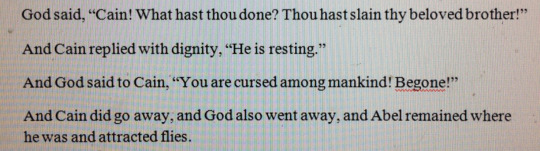
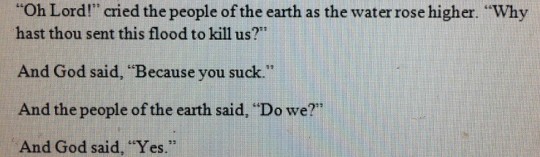
God in the Garden of Eden
Absolutely obsessed with the implications of this comment
greek mythology and those nuns who claimed to have sex with jesus or whatever and probably a whole bunch of other religions make a whole lot of sense when you consider the “what kind of idiot would make a robot you can’t fuck” angle
just realized that this is kind of ambiguous between “what kind of god would make a human you can’t fuck” and “what kind of human would make a god you can’t fuck” which makes it a much better post than it was intended to be
going through my microsoft word archives is great fun because i always find the wildest shit in there and by “the wildest shit” i mean the time i tried to rewrite the entire bible from scratch at the age of eleven and a half
“And so Adam and Eve were cast out of the Garden of Eden, and Eve turned to Adam and said, 'Nice going, loser.‘”
iconic
whilst you were listening to avril lavigne, i learned the way of the Lord
Publish this I will buy it
Once by the creek behind our houses we found a dead frog and I felt weird about it and the older boys taunted “then why don’t you have a funeral for it” so I did, with a sermon about rolling back the rock and realizing Jesus was risen, and they didn’t know the countermove
Kind of hilarious that the New Testament ends with a psychedelic trip report, but
As the original canon, the Bible is a lot of different genres of writing! The “begat” lists are genaeologies, Numbers is a census, there are livestock ownership records
Exodus is an epic narrative, Deuteronomy is a collection of speeches, Leviticus is a book of law, Proverbs is self-help, Songs is erotic poetry
The gospels are first-person accounts, the epistles are letters, written directions from superiors to their branch offices, and/or persuasive essays
And Revelations is a trip report.
Like you hear about Jewish/Protestant traditions of literacy as so important, and by now that’s pretty abstracted like “a broad worldview”
Well first off, in a world where literacy isn’t a given, just being able to transfer information between people who are not physically close at the same time is key, but even if it’s not so rare just the fact that anyone who learns from scripture has been exposed to a variety of written forms which they can then mimic is an advance far past just learning to record speech as writing.
Have decided to read Mary as a minor villain of Christian myth
Because of how she would have stopped the crucifixion if she had her way
It is absolutely canonical – Abraham and Isaac, Lot in Sodom, the crucifixion itself – that God favors a willingness to sacrifice your children to advance his interests; that she would have abandoned God’s greatest plan – the redemption of humanity through sacrifice of his own son – in the name of her maternal love is a key example of how man’s fallenness leads them to place their own petty wills before God’s
bröther this is hërësy
the holy cross is the new tree of life, mary is the new eve.
the original sin was when eve took the fruit from the tree of knowledge of good and evil, making eve the original sinner. edenologists all agree, eve should have waited and then eventually god would bid her to eat from the tree of life and so on in saecula saeculorum. they disagree about whether the tree of life was the same as the tree of knowledge of good and evil
when mary stood at the foot of the holy cross, then it was the tree of knowledge good and evil (because just look at it). mary taking the fruit down from this tree would be repeating the cycle of trauma again. any other mother, conceived in original sin, would of course have tried, but mary didn’t, confirming new eve status.
the reward for doing god’s will - which as i remind you, mary being without sin means it is her will also - was that she, and through her all mankind, instead got to take the fruit from the tree of life. yes, that’s jesus again, the multivalent fruit. the image here is the pieta.
this stuff is edgy enough without ur turning people on their heads
Oh, that’s just girls’ fanon that the creative team started indulging, totally contrary to the spirit of the original creator
Have decided to read Mary as a minor villain of Christian myth
Because of how she would have stopped the crucifixion if she had her way
It is absolutely canonical – Abraham and Isaac, Lot in Sodom, the crucifixion itself – that God favors a willingness to sacrifice your children to advance his interests; that she would have abandoned God’s greatest plan – the redemption of humanity through sacrifice of his own son – in the name of her maternal love is a key example of how mankind’s fallenness leads them to place their own petty wills before God’s
i need feminism because when jesus does a magic trick it’s a goddamn miracle but when a woman does a magic trick she gets burned at the stake
fabulous
i mean they did also kill jesus. that was a pretty significant thing that happened. like i understand where you’re coming from here but they very much did kill jesus.