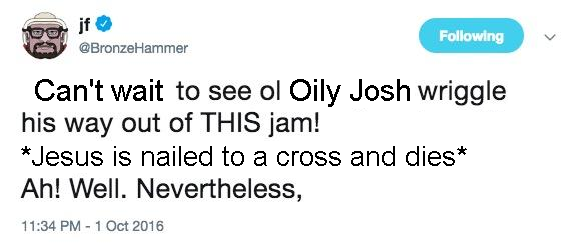
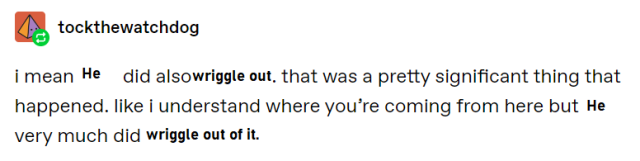
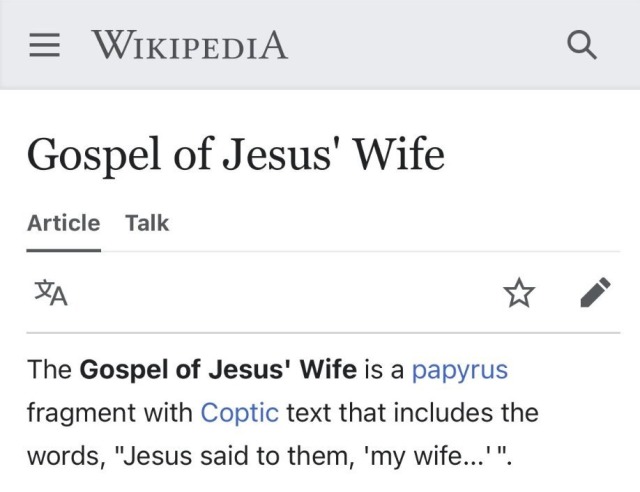
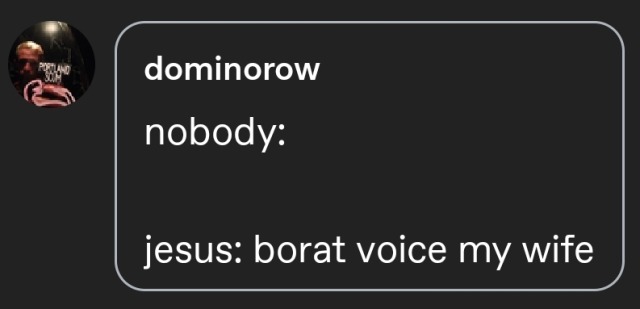
judas was probably like “jesus has pulled off so many wacky things, he’ll get out of this one lickity split, and i get three shiny coins out of it, too”
«Well actually I was raised Catholic and went to Catholic school and» procede to say the most inaccurate history and teaching of Catholicism
“Goes through a formal process of Catholic intellectual formation and comes out with the most random-ass take on it you’ve ever heard” is pretty authentically Catholic though
Back when I was straight I hadn’t realized how incredibly fucking queer the bit in the Bible where Thomas insists on sticking his fingers in the resurrected Jesus’ wounds was
god genuinely had no idea that people would be able to disobey him, when he made them. angels couldn’t! everything in the universe was just an extension or a reflection of god himself, operating in perfect mechanical order. then he put a spark of his own creative consciousness in an animal and it turned out it could disobey him.
like, that’s why he told adam and eve not to access a perfectly accessible tree. nothing else in the universe up until that point would have done something he told them not to.
that’s why he asks cain a perfectly ridiculous question, given that he would have watched the murder happen right in front of him: where is your brother? what did you do to him? he didn’t know cain could lie. even when adam and eve disobeyed him, surprising absolutely everyone involved, they hadn’t figured out lying yet. cain figured out lying.
that’s why god decides to destroy humans and start over only a few centuries later. he has no idea what to do. not only are people disobeying and lying to him, they’ve started completely ignoring him, too. he can control the wind, the water, the plants, the animals, the angels, the heavens, the earth. but he cut a part of himself loose and gave it to this totally unique new critter and now he can’t get it back. he can’t make anyone do anything, and now they know it. he had to carve humanity back down to the one family that actually, for whatever reason, still listened to him, and he had to ride them pretty fucking hard from that point onward to make sure they didn’t just….. stop. because at any point basically any human, ever, even the ones who liked him, could just randomly decide to fuck off and do their own thing.
then like, according to christians, god thought maybe he could get a handle on whatever the fuck was going on with how bad humans were being by making another human who had even more god in him than all the other humans, and that didn’t work either. and also even jesus himself didn’t know what humans were going to do next, which was kill him young. like, god had to break the news to him based on an educated guess, and it was a big surprise to him! he was really upset! there’s a whole scene!
like, i think this is hands down the funniest fucking thing to conclude about god ever. he didn’t know it was going to turn out like this when he started and he didn’t know what to do when it did. he’s been basically scrambling to stay on top of the situation for six thousand years and he’s totally beefed it repeatedly.
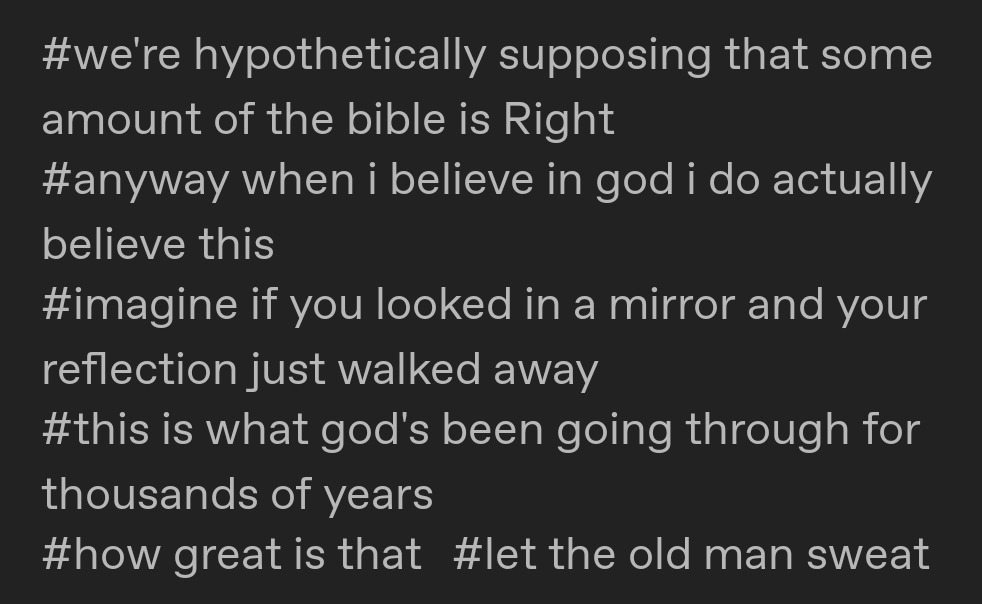
god the omnipotent lord of creation knows everything, except what you’re going to do next. god the supreme ruler of the universe can do anything, except stop you. you have a little piece of god inside you and it lets you defy the most fundamental machinery of existence basically whenever you like.
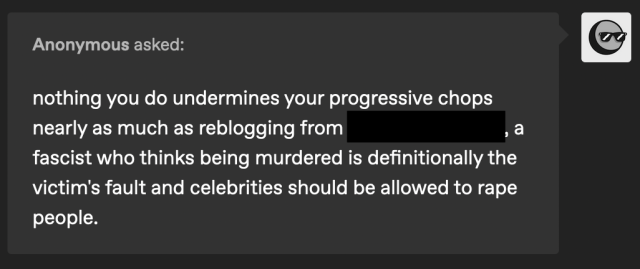
Maybe you’ve had success starting drama this way before, but I generally regard anonymous messages making extremely inflammatory allegations with zero supporting evidence of any kind as a sign that you are making things up
Is this me? This vibes like one of my haters.
I mean it’s not even wrong, I do think that those are coherent extrapolations of the ethics our society is actually structured by and that that coherent attempts to follow through the logic of reversing that end up undermining everything (the whole of society) based on it, and that this is the issue that the Christian ideal of turning the other cheek or the Stoic one of just sucking it up addresses, and we should appreciate that
Like, the Christian angle isn’t just excuse-making for edginess, I’m not Christian but growing up being taken to weekly Masses to hear stories of the weird child prodigy who taught the temple elders how they were wrong and realized that if you just abandon your family and don’t mind death that no one has power over you was a huge influence
there’s literally no Lilith mentionned in Genesis like you know these girlies got their biblical knowledge from like Supernatural or something
Kabalah cult or whatever. I think that’s where it started
No, it’s so much better. The first reference to the myth of Lilith comes from the medieval Alphabet of Ben Sira, and there’s a seriously good chance that the Ben Sirach is a satire of Jewish literature and made up the Lilith myth to mock extant rabbinical midrashim. My favorite take on it comes from a (I think) nineteenth century rabbi who said it was so blasphemous and heretical that it should be burned even if it’s found on a Yom Kippur that coincides with Shabbat.
I’ve had it with guilt-free food. I want food that actively removes guilt. Indulgence food, not indulgent food. Eat a pizza and forget about your past remorse.
Big blunder telling us how big Noah’s ark was. Really banked on us not building being able to build large ships or discover new animals. “Man 300 cubits is so very large you could fit 2 of every animal in there, all 25 of them” should have fact checked on the internet before hand, dweeboids
Not enough attention to how the Catholic Church is just as much descended from the Roman as Apostolic sides at the Crucifixion and it’s entirely coherent to consider it as a successor to the Roman Empire with a mission of killing gods and claiming their power for themselves
When he appeared, as Mark tells it, in his early or middle thirties, he came out of nowhere, with no past — except for a single reference to Nazareth in Galilee, his hometown. There is no birth narrative. There is no Virgin Mary, mangers, shepherds by night, or three wise men from the east. In this, the first story written about his life, he has no childhood. The only mention of kin is an early, dismissive refusal by him to see any of them — ‘Who is my mother or my brothers?’ No trade is noted, or education. He is what will become, in the culture of the West, the mysterious stranger. The implication is that his earlier life, about which we are told nothing, was inconsequential. Whether it was ordinary, wayward, or wasted, it did not contribute to who he is. His presence will be known, for as long as he remains, through his mission, which starts now.
[…]
From the outset, he is on his own. The solitariness is stark.
Many are around, but he alone sees the heavens part. He alone senses the pneuma descending over him — it, rather than the water, is the medium of his baptism. He is bathed in pneuma — his first companion. He alone hears the voice.
‘Sacred pneuma’ is traditionally translated from the Greek — pneuma hagion — as ‘Holy Spirit’ or ‘Holy Ghost’. In the original Greek it is not capitalised. The church tendency to conceptualise it as an entity loses the pneuma associations with wind, breath, and spirit — its range of Greek meanings. I shall leave ‘pneuma’ untranslated throughout.
Pneuma is ‘the wind that bloweth where it wills, and thou hearest its sound, but canst not tell whence it cometh, and whither it goeth’. This is how John, taking Mark’s cue, will timelessly project it. It is the charged wind, the cosmic breath, the driving spectral force. It is also the directing power that drives the stranger into the wilderness. And it manifests itself in unsound forms within deranged individuals. John will refer to ‘pneuma the god’.