People loved their work once, and it didn’t matter if they worked in the public sector or in the private one. The men who worked in the CCC would take their grandchildren to see the forests they planted, while the men from the auto plants would point out the cars they’d built as they passed them on the new interstate highway system. The women who fastened the engines on the wings would watch the B-17’s fly off to make a liar out of Goering, and the women who taught in the public schools would point with pride when one of their old students got elected mayor. Work was about making money, certainly. It was about feeding the family and keeping the roof where it was, and maybe having a little left over at the end of the day, or at the end of the week, for some amusement. Maybe a trip to Lincoln Park or White City or a hundred other places, where you could take a moment and enjoy the cool of the evening, music riding the nightwind from a dance pavilion down along the lake.
But it was also about Doing A Job, and doing it well, which was different than simply Having A Job. It was about making good cars and strong steel and sturdy furniture. It was about learning a craft, even if what you were doing wasn’t recognized as one. There was a craft in tightening rivets, or feeding the open-hearth furnace, or planing the wood just so. You had your craft, and the person next to you had theirs, and, when all the work was done, and all the craft was practiced, and practiced well, there was something you could look at with pride and say, that is something I have given to the world. Job well done, as they used to say. You could teach seventh grade civics and then, one day, you’re on a podium outside of City Hall. That kid right there, you could say. That kid is something I have helped give to the world. Job well done, as they used to say.
Unions were greatly responsible for the pride that people took in the work they did, especially in the middle of the last century, when unions helped build the most formidable middle class in human history.
There was an autoworker, Ben Hamper, who wrote a column in the Flint (later Michigan) Voice, which was the alt-weekly Michael Moore first made his name by running. A lot of his columns got collected and repackaged in an excellent book, Rivethead, that I read in college.
I read it in a class with Stuart Blumin, who was my favorite professor and de facto advisor. He was an American historian, focused on labor and class and the development of capitalism, you could tell he was heavily influenced by EP Thompson and the Communist Party Historians Group over in the UK.
He was quite open that he had expected Communism to ultimately triumph, and that he had been wrong about that, and in subtext that he had wanted it to ultimately triumph, and didn’t think he had been wrong about that.
Anyway, Rivethead. The story is that Hamper was born in 1956, a fairly clever kid growing up in Flint, Michigan, the chronological and geographic apex of American industrial unionism, where everyone’s dad worked for GM.
And he could have gone to college but he gets some girl pregnant and so he goes to work on the assembly line not even really out of obligation or Catholic guilt or whatever but because that seems as good a life course as any, it’s what every man he’s known does, under the mighty UAW the pay’s on par with the kind of “educated” jobs you could get anyway, why not.
And so he goes to work on the line and eventually he ends up writing a column about it, and he talks about the color of the factory culture, playing soccer with rivets for balls and cardboard boxes for goals, drinking mickeys of malt liquor in your car on lunch break, the absurd fursuited mascot “Howie Makem, The Quality Cat” that GM would feature at rallies and shop-floor tours, being laid off in economic downturns and put into the “job bank” where you get paid waiting to be rehired in the next upswing, developing a perfect rhythm with your partner, training into a rhythm so perfect you can each trade off doing the two-person job yourself for 4 hours while the other one goes out to a bar on the clock, the dignity and solidarity of the American worker.
And time goes on and eventually his marriage fails but he takes it in stride, and his column gets recognized and he takes pride in that and then eventually he has an epiphany, and a complete breakdown, which are basically the same thing. And the inciting incident is when an older line worker, some guy he’d looked up to as a model of quiet, philosophical stolidity, just shits himself and is barely coherent enough to even notice this and he realizes the guy hadn’t been a Zen master, he’d just been checked-out mindless drunk on the line every day.
And he realizes that the rivethead life is destroying him, that the only thing holding it together was a budding alcoholism, and that it’s doing the same to all his co-workers, and looks back and realizes it had done the same to every grown-up man he knew, his father and uncles that growing up he had looked up to as models of masculine strength and fortitude really had just had their spark snuffed out and the life beaten out of them long before, and whatever pride they took in the cars out on the road was a defensive attempt to locate in an external form the sense of self-value that had been exterminated within them.
When Marx talked about “alienation”, well.
And he went crazy, and couldn’t bear to work on the line anymore, and there’s no redemption, that’s where the book ends.
And that was a theme that cropped up again in Professor Blumin’s class, that there were two great working class traditions that echoed through the ages, and they were
avoiding work
and
drinking
Back in the premechanized age of small-group workshop manufacturing, workers would celebrate “Saint Monday”, which was to say just not showing up for work, hung over after the weekend.
(This was riffing off of Catholic feast days, or holy days, from which we take the word “holiday”, and as time went on counted an increasing share of the days of the year. There was a reason that poor workers were aligned with the Church, and nobility, in “Altar and Throne” coalitions resisting the development of industrial capitalist liberal democracy.)
In the ‘80s, the crap time of American auto manufacturing, one trick that was passed around (pre-internet, so by word of mouth largely) was to look at the codes stamped on car bodies, which would tell you what day of the week they were manufactured, and to avoid Mondays and Fridays. Because those days had the highest defect rates, because the workers tended to be drunk, or hungover, or absent.
And back in the workshop days, you’d drink at work. Apprentices would be sent out for growlers or buckets of beer, there were elaborate rules of who in the hierarchy of workers was expected to buy rounds for who and when. And there was hellacious resistance to attempts to get them to knock this off, as the industrial era kicked into swing.
Those great satanic mills, where women and children worked in shifts at great water- or steam-driven sewing and spinning machines, stories of little kids getting their hands mangled by the machinery? One of the major reasons women and children were preferred was because they would actually show up on time every day, and stay sober around all those hand-manglers.
And I mean, this maybe sounds like an argument for socialism. Though not of any actually-existing- variety, as capitalist propaganda will be glad to tell you, Soviet work culture, at least when the morale thrills of the Revolution and Great Patriotic War faded from personal to institutional memory, was all about shirking and vodka.
So those complaints about how America celebrates Labor Day instead of May Day, ignoring the true meaning of labor - solidarity - in favor of mindless distraction? Psssh. Labor Day is a celebration of the truest, most ancient, most fundamental traditions of labor: not working (especially on Mondays), and getting drunk.
I remember the military veterans in 4th of July parades being like WWII vets riding surplus Korea equipment, what’re the parades like now it’s down to like, ‘Nam and Iraq?
Or is it like the turn of the 20th century where the institution of military parades trailed off (into things like the Salvation Army and Second KKK!) as the Civil War veterans died out
The big speech in the last act of Independence Day.
President’s inspiring the fighter pilots that are going to be flying the climactic mission.
But at the very end, he fumbles it.
Not on delivery, but in the writing. ‘We’re going to live on. We’re going to survive. Today, we celebrate our independence day!’
The last sentence is bad! You should have used a different temporal transition word. Its the equivalent of failing to find a rhyme in composing a song’s lyrics, so you just use it again, but not as part of an obsessive point. Say what you will about Metallica’s Frantic, but at least you know where their emphasis is!
I’ve not made a point about complaining over this line historically, but the speech’s place in popular culture has always felt a little undeserved. Like everyone else was overlooking that the instruments and vocal parts on a major studio release just fell apart for no good reason in the last 30 seconds.
Also, why were they marketing it as “ID4”? To remind people that when they were releasing Independence Day on Independence Day, that meant the Fourth, as Independence Day is often known?
you hear this a lot, but what does it mean, specifically?
the pre-1776 americans who came from a sex, race, and class background that enabled them to participate in the conventional history of america sought to buy into aristocracy as a system of production. they were the youngest sons of minor aristocrats, the children of men with rank and no land, successful but socially limited military officers. there were people other than white men in america, but our history is not defined by them, they were not in power, they struggled to survive and their voices are faint and hard to hear. even the reality of working-class life in america among white men is largely silent; children read thomas paine’s agitation for the bourgeois revolution in america but nothing about his labor agitation in the us and england, nothing about his work as a corsetmaker or his parallel struggles to break into the bourgeoisie personally and defend workers as a class. we learn about the composition of washington’s teeth.
more people know washington had teeth extracted from slaves than know he was rich, and had an obvious and immediate material interest in the revolution as a wealthy planter.
george washington was arguably the richest man in america. not in money, although there is that. he was rich in land; he was a successful surveyor, planter, and politician. “politician” makes sense to us, and while it meant different things in the 18th century (and certainly he would have rejected any attempt to identify him that way) it’s something we can comprehend pretty well.
the planter class were slaveowners. this was a universal fact of revolutionary america; there was nowhere near enough ‘free’ labor in america to maintain their massive, highly inefficient cash crop farms. expanding the population of slaves in america was a major priority to intensify production.
before the cotton gin made cultivars of cotton that grew outside of fertile bottomland economically viable under even plantation slavery by reducing the titanic amount of labor necessary to make their bolls usable for fiber, the major cash crop of america was tobacco.
in america, because of peculiarly american mythology, we tend to believe that in the late 1700s and most of the 1800s people didn’t understand crop rotation or soil nitrogen. even in the context of european agriculture this is incorrect. soil nutrition was an incomplete science, and the primary fertilizer in the west was not an efficient nitrogen source but bone meal, yet american planters understood the basics of crop rotation and fertilization. they simply refused to use them because they would have driven up costs.
the rudiments of the agricultural revolution were things that wealthy american planters chose to forget. this is why america is larger than europe and has only been a food exporter in living memory - not because it is infertile, but because its economy was one of indifference to fertility, and this set down powerful cultural roots and industrial norms. the dust bowl was a product of this history as much as anything.
in slavery times, wealthy american planters planted a crop of tobacco on every surface available to them on good land - and they could tell if land was good for tobacco by means of both common knowledge about agriculture and surveyors’ trade secrets. a good way to tell in virginia was to count the pines.
they continued to plant tobacco season after season, crop after crop. the land was never given rest, never allowed to lay fallow. no land capable of raising tobacco was used for anything else; food and feed crops that would have partially restored soil were grown on bad, rocky, marginal soil.
in a few years, the best land used this way would become utterly infertile, and would be allowed to revert to barrens. the semi-indigent white smallholders of the antebellum south filled this vacuum, and in struggling to make do with an agricultural technology adapted for intensive, land-destructive agriculture, degraded soil still further.
the planters who had used up land then acquired more. land was cheap; formally it was necessary under english law to acquire title from natives, the english system of transfer of title was not a native institution and was easy to use to steal land. the american mythology includes a story about settlers buying manhattan for $50, and a riposte that this represented an easement and not a permanent purchase to the native lenape. there are also stories about natives selling land they did not own. these are both applicable in some cases, inapplicable in others; the interface between white settlers and natives was unstable and heterogeneous. in most cases, white title to land under english law was only ever ambiguous at best, and the land bought in this way rapidly became incapable of supporting people outside of the deformed european style of agricultural production prevalent in america. even if the system were not rigged against natives, economic pressure would still have created a comprador class which sold out and moved north and west, and this would still have intensified political struggles among natives and between natives and white settlers.
these conflicts, and legal hassles for the british government, lead to the proclamation of 1763. we hear mostly about it forbidding squatting - white settlers moving over the mountains and claiming land without title. in the american popular imagination this is what the revolution changed.
the reality is that the main thrust of the proclamation of 1763 was that the purchase of native land in america by private agents was forbidden, and all such purchases had to be formal purchases by agents of the crown itself. to a planter class whose bloated, vampiric way of life depended on shady and frequently illicit private land deals between themselves and natives, this was a deadly threat. from the word go, it was challenged by planters - who, being sustained by the legal system in a basically predatory life, in general took pains to be literate in the formal law of england and keep copies of significant precedents in common law courts - using a forged version of the pratt-york opinion.
the pratt-york opinion held that the british east india company was within its rights to purchase land from princely states in india. it held, unambiguously, that its decision did not apply to america, and american skeptics always expressed scorn and ridicule about the idea it suggested of dealing with indian “princes” and “governments”. (after the war, john marshall made it clear that there was no homology in the eyes of anglo-american law between the formal, legitimate governments of the raj and american indian nations.) but when you think about it, the same logic was really at work: the british east india company was an agent of the crown in its own right so its expropriating land from natives was in the crown’s interest even without its formal say-so. and so in a sense were american planters agents of the crown in this capacity. if george washington, the richest man in america, was not an agent of the crown in north america, who even was?
forged versions of this opinion, which clipped off language making it unambiguous that the decision was inapplicable to america, circulated widely. they are in evidence in the personal effects of washington, jefferson, lewis and clark. whatever the crown said, the land grab would continue, be damned any border or line. more land was needed so more land would be taken.
before, during, and after the revolution, washington was a surveyor; he wrote down the characteristics of land which white people had seen but had not investigated in depth for its suitability for plantation agriculture. he took the best land of the west for himself. it was not considered unseemly or ridiculous that he would do this even while on campaign; it was a necessary part of his profession and a universal behavior of the plantation aristocracy.
the use of land in this way continued after the war, and especially after the war with tecumseh’s confederacy was won at tippecanoe; land was close to free for the first white people to survey it, and cheap as dirt for the rich planters that came after them.
this is how americans became rich. this is how american capital came to exist. this land grab logic extended into the west, and this is part of the reason oregon was settled so far in advance of the great plains - the thick, dry grasses of the modern breadbasket of the us were not suitable country for cash crops, and only at its southern margins did plantation slavery ever successfully advance.
it is sometimes treated as inevitable that this should have ended, that plantation slavery reached its zenith before the civil war and the civil war was part of its decline. but this country was literally founded by people who stole land to farm so intensively with slave labor that it was destroyed for agriculture for generations - and those people would never have imagined most of what we think of as ‘the south’ being subject to their economic system. it was not suited for tobacco or long-staple cotton. but american and european industry, whose hunger for production was insatiable, found a way.
this form of production followed exploration, opening, and exploitation of native nations distant from white settlement by a diverse class of explorers and outdoorsmen. it followed that exploration and opening more or less everywhere. when we read histories of the rest of america we encounter other, less discussed cash crops, far outside of the main area of plantation slavery: ginger, indigo. (ginger in particular was a cash crop because of british merchants’ penetration of markets in china.) the same economic logic that applied in plantation slavery applied everywhere, and while some crops were limited by the absence of free labor, enormous families and punitive economic policies against the indigent were tailored to minimizing that. the same economic idea - land is limitless and can be destroyed without consequence, and labor can be someone else’s problem - underlay everything america did. it underlaid acquisitions of millions of acres of land with no conceivable economic use to agriculturists.
it underlies, in distant echoes, the modern american system, where the acquisition and mortgaging of domestic land is one of the primary ways capital disburses to the middle-class; where intensive use of land in existing settlements under gentrification follows a predictable pattern of exploration, exploitation, expropriation, and transfer to large investors. state violence is not the end-all and be-all of this legalized theft but it is always present and always on the side of capital and its agents.
and the american innovation, the core of the american experiment, is that if you have enough money you’re as good as god’s vicar on earth. it worked for washington and it works for your landlord.
MYTH: Americans set off fireworks on the 4th of July, in honor of our Independence Day
FACT: Americans set off fireworks from approximately June 20th—July 20th, for no reason other than this is the time of year that you can literally buy them at any grocery store
It’s Cinco de Mayo, a Mexican holiday which is unusually popular in the United States among white northerners who are currently at their favorite Mexican restaurant eating tacos and drinking flights of margaritas. The hospital where I work at is serving bad “Mexican” food in the cafeteria and later in the day I’m going to attempt to make fried ice cream in my air fryer. Like seriously I don’t think people outside of the US understand how popular Cinco de Mayo is to Americans. In addition I doubt few Americans who are not of Mexican ancestry know why Cinco de Mayo is celebrated. Many assume it has something to do with Mexican independence. It is not. Rather it is a part of Mexican history that few know about outside of Mexico. And like many things that few Americans know about, it also involves the French.
In the 1860’s Mexico owed a lot of money to France which it could not pay back. In 1862 France demanded their money back, and when Mexico couldn’t pay up, France sent an invasion force. While the French invasion of Mexico was justified as a large repo operation, in reality it was Emperor Napoleon III’s opportunity to take control of the county, install a puppet ruler, and restore French influence in the Americas. At the time the French Army was considered the best in the world, with the best training, the best equipment, the best commanders, and the best tactics and organization. The Prussians would disprove this notion in less than a decade but that’s another story. By contrast Mexico could barely afford to have an army. The Mexican Army was poorly trained and poorly equipped. Many of the weapons used by Mexican regulars were old and obsolete, often leftover British muskets from the Napoleon Wars which were sold as cheap military surplus. Much of the Mexican Army were militia forces which were armed with whatever they could get their hands on, sometimes just machetes and farm tools.
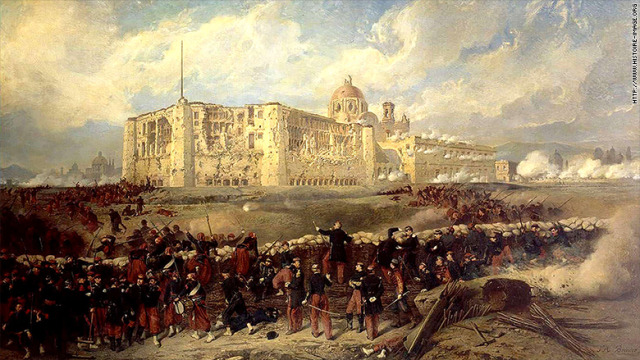
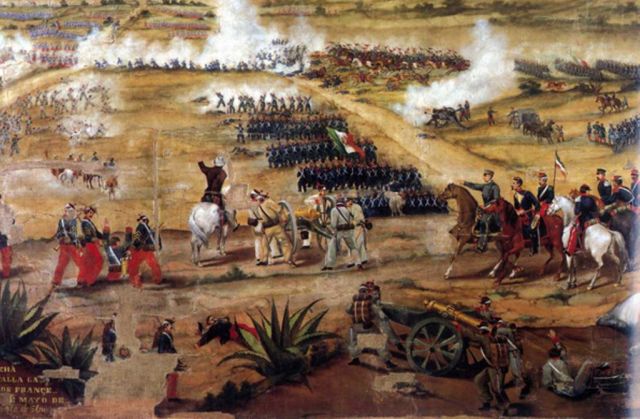
The French invaded with ferocity and quickly dealt out defeat after defeat against Mexico. On the advance towards Mexico City, the French Army was halted at Puebla, just 80 miles southeast of the capitol. There Mexican forces under the command of Gen. Ignacio Zaragoza had gathered together a force of 4,500 men, most of whom were local militia. The outskirts of the city were flanked by two large hills atop of which were two fortresses, Fort Loredo and Fort Guadalupe. Around the hills Zaragoza ordered the construction of a network of trenches, ramparts, and other defensive obstacles. On May 5th, 1862 6,500 French soldiers assaulted Puebla under the command of Gen. Charles de Lorencez. While the Mexicans were outclassed in every way possible, they had a large advantage in that they held an extremely well fortified position. The French tried to bombard Puebla into submission, however Mexican fortifications were at such a height that few French cannons had the elevation necessary to hit the Mexican trenches and ramparts. Thus the French conducted three attempts to storm the Mexican fortifications without effective artillery support. Each attempt failed with heavy casualties. After the third attempt, Zargoza ordered his troops and light cavalry to counterattack, and the Mexicans drove the French off the field. The Mexicans suffered 220 casualties, the French suffered around 770.
News of victory over the French spread across Mexico, providing a much needed morale boost for the Mexican people. President Benito Juarez even declared the day a national holiday; Cinco de Mayo. The victory was short lived, however, as the French simply reorganized, counter attacked, and successfully took over the country. Regardless the Mexicans showed that they could stand their ground against the best army in the world and even get in a good stiff right hook now and then. And of course the French found out that invading Mexico was the easy part. Controlling and occupying Mexico was much more difficult. But that’s another story and my margarita is getting warm. Happy Cinco de Mayo.
You know if we’re lazily smearing things as anti-Semitic based on long-forgotten historical resonances can we do people who complain about the commercialization of Christmas?
This really started at the 19th Century dawn of the German Empire, contemporary with the growth of a thick commercial retail culture – “Christmas” as we know it is essentially an epiphenomenon of the department store – and much early criticism focused not on how it detracted from a religious cast the holiday had once had, but on how it was becoming a yearly ritual of riches flowing from Christian pockets into the tillers of Jewish retailers, manufacturers, and traders.
As time progressed and the Second Reich fell, this was the theme of infamous interwar antisemitic newspaper Der Stürmer’s editorial cartoons at Christmastime every year.
(This was also, coincidentally, when and where the traditionally minor Jewish holiday of Hannukah was glowed up into a rival gift-giving celebration, so as to undercut Christmas as a draw for [then much more common, often with secular motives of cultural belonging] conversion.)
i need feminism because when jesus does a magic trick it’s a goddamn miracle but when a woman does a magic trick she gets burned at the stake
fabulous
i mean they did also kill jesus. that was a pretty significant thing that happened. like i understand where you’re coming from here but they very much did kill jesus.
The only one of my grandparents that didn’t live past 80 died of heart issues that would be trivially treatable today, so this probably isn’t even midlife!
It’s actually kinda neat that 2 of America’s seasonal festivals (Thanksgiving/fall and Independence Day/summer) are coded nationalistically and the other 2 (Christmas/winter and Easter/spring) religious
You would be the first to admit that Big Capitalism is not America’s religion, but it is a dominant force in the country. And I think Christmas is more capitalist than it is religion. So 2/1/1
Yeah, the draining religious content is an interesting synecdoche for the national culture here (Pilgrims giving thanks used to bear religious overtones!)
Now Easter’s the tougher case, that’s still more religious-coded as religiosity declines, we worked up the bunny, eggs, and candy baskets to give it some secular content but that’s not really thick enough to bear weight on its own, in my childhood you might dress “up” for church and then go to a nice lunch with your extended family (in town, this wasn’t a holiday you traveled for – actually that itself is an interesting distinction, you’d travel for Thanksgiving and Christmas but not Easter or the 4th [though summer holiday road-tripping was a thing]), but that was kind of the small-town “Sunday best” model the previous generation had experienced every week