shrine to the prophet of americana

#hm (6 posts)

Divergent is a bad book, but its accidental brilliance is that it completely mauled the YA dystopian genre by stripping it down...

qwertybard:

roach-works:

weaver-z:

thatbassistbitch:

weaver-z:

Divergent is a bad book, but its accidental brilliance is that it completely mauled the YA dystopian genre by stripping it down to its barest bones for maximum marketability, utterly destroying the chances of YA dystopian literature’s long-term survival 

please elaborate

Sure. Imagine that you need to make a book, and this book needs to be successful. This book needs to be the perfect Marketable YA Dystopian.

So you build your protagonist. She has no personality traits beyond being decently strong-willed, so that her quirks and interesting traits absolutely can’t get in the way of the audience’s projection onto her. She is dainty, birdlike, beautiful despite her protestations that she is ugly–yet she can still hold her own against significantly taller and stronger combatants. She is the perfect mask for the bashful, insecure tweens you are marketing to to wear while they read.

You think, as you draft your novel, that you need to add something that appeals to the basest nature of teenagers, something this government does that will be perversely appealing to them. The Hunger Games’ titular games were the main draw of the books, despite the hatred its characters hold for the event. So the government forces everyone into Harry Potter houses. 

So the government makes everyone choose their faction, their single personality trait. Teenagers and tweens are basic–they likely identify by one distinct personality trait or career aspiration, and they’ll thus be enchanted by this system. For years, Tumblr and Twitter bios will include Erudite or Dauntless alongside Aquarius and Ravenclaw and INTJ. Congratulations, you just made having more than one personality trait anathema to your worldbuilding. 

Your readers and thus your protagonist are naturally drawn to the faction that you have made RIDICULOUSLY cooler and better than the others: Dauntless. The faction where they play dangerous games of Capture the Flag and don’t work and act remarkably like teenagers with a budget. You add an attractive, tall man to help and hinder the protagonist. He is brooding and handsome; he doesn’t need to be anything else. 

The villains appear soon afterward. They are your tried and true dystopian government: polished, sleek, intelligent, headed by a woman for some reason. They fight the protagonists, they carry out their evil, Machiavellian, stupid plan. You finish the novel with duct tape and fanservice, action sequences and skin and just enough glue and spit to seal the terrible, hollow world you have made shut just long enough to put it on the shelf. 

And you have just destroyed YA dystopian literature. Because you have boiled it down to its bare essentials. A sleek, futuristic government borrowing its aesthetic from modern minimalism and wealth forces the population to participate in a perversely cool-to-read-about system like the Hunger Games or the factions, and one brave, slender, pretty, hollow main character is the only one brave–no, special enough to stand against it. 

And by making this bare-bones world, crafted for maximum marketability, you expose yourself and every other YA dystopian writer as a lazy worldbuilder driven too far by the “rule of cool” and the formulas of other, better dystopian books before yours. In the following five years, you watch in real time as the dystopian genre crumbles under your feet, as the movies made based on your successful (but later widely-panned and mocked) books slowly regress to video-only releases, as fewer and fewer releases try to do what you did. And maybe you realize what you’ve done.

one quibble: hunger games was intense and sincere and the writer had worked for tv and knew exactly what she was talking about when she wrote how media machines create golden idols out of abused kids and then leave the actual people inside their glamorous shells to rot. hunger games had a genuine core of righteous anger that resonated with a lot of people. the hunger games was genuinely angry about shit that is genuinely wrong. 

but divergent was clumsy make-believe the whole way through. it aped the forms and functions of dystopian lit but the writer didn’t actually have any real, passionate, sincere anger to put on the page. she didn’t know what it was talking about, so she didn’t have anything worth listening to.

there’s a difference between anti-authoritarianism as a disaffected, cynical pose and anti-authoritarianism as a rallying cry by people who believe in a bitter world. and the former is something corporations and industries and publishing houses are so much more comfortable with. so divergent and the flood of books published and marketed alongide and after it showed how the dystopian genre was no longer truly revolutionary, no longer a sincere condemnation of corporate oligarchies. the mass-market dystopian genre was now nothing more than an insincere playspace for people who were writing dystopia as a safely distant, abstract make-believe stage for their pretty girl heroes, rather than a direct allegory for everything that needs to be torn down in this world today. 

This is the second branch of this post I’ve reblogged and like the fourth I’ve seen and I’m just thinking about how the Uglies series, a pre-Hunger Games forerunner of the YA Dystopia boom, had significantly less staying power than it could have specifically because…with the toxic beauty standards forced on teenagers being a Big Theme, studios couldn’t figure out how to make a profitable movie out of it. The book got optioned multiple times, but a film version made in Hollywood was destined to fall apart at casting & makeup - their marketing methods relied on exactly what the series was criticizing, which is…part of what made it so popular with teenage girls to begin with.

You contrast that with how the marketing for the Hunger Games films directly contradicts the messaging of the text, and how Divergent seems ready-made for the big screen, and it becomes really apparent why the genre folded in on itself. Capitalism tried to recuperate dystopian fiction criticizing capitalism, and in doing so, butchered the genre.

There’s also something rattling around my brain about a correlation between how made-for-screen a dystopian book is and how much it Doesn’t Understand Dystopia, with the culmination being Ready Player One, a piece set in a dystopia that somehow still actively glorifies capitalism & that was literally optioned for film before the book was published, but I don’t…know how to expand on that point.

Tagged: hm

its sad that the internet would die during a nuclear war id love to see what you guys had to say abt it

digitalsandmandala:

its sad that the internet would die during a nuclear war id love to see what you guys had to say abt it

Tagged: hm

30 year old Haruhi is now canon. U_U

neoteros:

30 year old Haruhi is now canon. U_U

Tagged: hm

Tagged: hm

Boomers stuck in a circular unfunded liability they will never break out of...

deuxetvingt-blog-blog:

I read an interesting interview with Robert Shiller here:

http://www.zerohedge.com/news/2015-05-29/robert-shiller-unlike-1929-time-everything-stocks-bonds-and-housing-overvalued

What is interesting is this: (1) Shiller finally acknowledges that valuations of all financial assets are related; and (2) Shiller’s supposed cause for the overvaluation is that “people are not confident in their future.”

He also makes the comment that this will end badly.

I have a different take.


I will try to illustrate through a simple example.

-Assume you are nearing retirement and trying to calculate how much you need to save for your golden years.  

-Assume also that due to advances in medical technology, you really have no idea what your lifespan will be.  It could be 5, 10, or 50 years.

-Assume you need $50,000 year for living expenses and that there is no inflation (just to make things simple).


How much will you need?

This equation tells you what you will need: 

Present Value = Cash Flow / Rate of Interest (lets make Rate of Interest = r)

So, you will need $50,000/r.  


OK, what the hell is r?  (I’m simplifying here, bear with me…)

-In 1980, r was around 20%…for both stocks and bonds.

-In 2000, r was around 5%…for both stocks and bonds.

-in 2015, r is 2%….for both stocks and bonds.


So, if you did this exercise in 1980, you needed $250k ($50,000/.2)

-If you did this exercise in 2000, you needed $1.0MM ($50,000/.05)

-If you did this exercise in 2015, you needed $2.5MM ($50,000/.02)

See, what’s happening?


The way the math works, the lower the yield goes, the more money we need.  Halve returns again and the liability goes up to $5m…


The more time goes by, the more you need.  The more you need, the higher the price of the assets you are buying and hence the lower the expected return.  And hence the more you need.  If you are unfunded, your “hole” just gets bigger and bigger…You are in a trap you may never get out of.  No wonder you don’t feel great about your situation.

Now, imagine if you were going through this same exercise along with millions of other people in your exact same situation in developed markets around the world….All chasing basically the same financial assets.  They are all in a massive prisoner’s dilemna with each other.  The more they bid, the more they need.

This is what is happening right now.  All the DMs are aging.  This is a global phenomenon.  Insurance companies, pension funds and others trying to store assets for the next 30 years are screaming for returns.  And we are thus seeing correlation amongst DM financial assets skyrocket.

It explains so many things:

-This is why CAPE has been inflated for 30 years running.  

-This is why there is a never-ending bid to E-minis.  The “plunge protection team” are boomers looking to fund their retirement, not some government bogeyman.

-This explains why all financial assets are in a “bubble”; they are just substitutes for each other in the quest to get funded.

-This is why low bond yields in Europe infected US bond yields.  Dutch pension funds in a hole just want yield & they could care less about F/X risk…

-This is why Hussman just gets wronger and wronger.

-This also explains volatility in the back end of the yield curve.  Pensions dominate this space; when yields go down, their unfunded liability shoots up and they chase yields lower.  When yields back up their unfunded liability goes down massively and we get liquidity holes in the back end like we just saw in Euro 30yr rates.  They are effectively very short gamma in the back end.  (Which means also that all boomers are short gamma on their liability…)


The boomers are in a hole and chasing a carrot that just gets farther and farther away….Don’t bet any time soon that financial assets are going lower.  The boomers aren’t going away.

This is why it is quite painful being a Gen Xer.  The boomers have literally drained all value out of financial assets in their desperation to fund their unfunded liability.

This is a demographic shift we have NEVER seen.  That is why CAPE has NEVER been this high for this long.


Shiller doesn’t understand the valuation and thinks it may crash.  It won’t crash until all the boomers are funded….Sure, there may be temporary selloffs, particularly in risk assets.  But any sell-off is a boon to these guys.  They are effectively short them.

Shiller needs to walk into a Financial Advisor’s office and spend a day and he will immediately understand what is happening.  It’s not lack of confidence in the future.  On the contrary, it’s confidence in a LONG future for boomers.

Shiller gets so close in that interview to hitting on this….without going there.  He keeps saying people need to save more because returns will be lower.  He doesn’t make the connection to the circular loop of what this does to asset prices; i.e., more funds chase limited assets, driving the expect returns on those assets still lower.   I found myself screaming when I read the interview.  As an options trader, I understand this negative gamma intuitively.

In many ways, the boomer’s have given us a free put on financial assets: they basically have to buy them at lower prices.  When we see panic sell-offs, we should literally all start front-running the boomers.


What will solve this?  Increasing the retirement age.  This will have a massive effect on the perceived unfunded liability.  Social security in theory could help, but there aren’t enough young workers to pay for the boomer’s retirement.  

We as a global society need to wake up to the fact that a life expectancy of 100 is not consistent with a retirement age of 65-70 (or for government/military, 45, but don’t get me started on that…).

The other thing that this opens up which I won’t go into is this: is the Central Bank rate repression effectively increasing the angst among the boomers with regard to their unfunded liability?

Many have this view and I am sympathetic.  After all, if CDs yielded 5-10% like they did 10-20 years ago, a potential retiree would feel less pressure to save for retirement.  If you are 70 and rolling CDs at zero, you are hating life.  [Imagine how you would feel if you were a Swiss 70 year old who is very close to PAYING interest on his/her bank deposits? ]

So, yes, Mr. Shiller, people don’t feel confident about the future.  But it is because the financial asset prices are telling them they can’t fund it…

And it will end badly, but not because asset prices crash.  If anything, this is what Boomers are rooting for so they can buy them cheaper!  From everything I’ve read and understand there are trillions really upset they missed the bargains of 2008/2009 and desperately hoping it happens again.

Tagged: hm

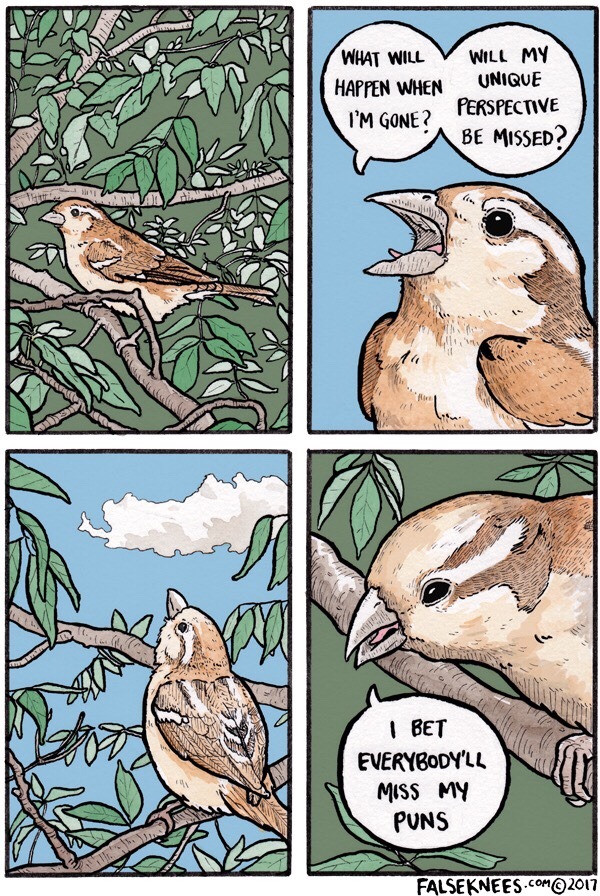
They’ll remember that one time I said that funny thing

falseknees:

They’ll remember that one time I said that funny thing

Tagged: hm