shrine to the prophet of americana

#history (385 posts)

so what TF is up with America rn?

Anonymous asked:

so what TF is up with America rn?

Okay so most European states or postcolonial states derived from their empires trace back to the punctuated shift from lords/church feudalism to national welfare state – the rise of parliaments, then language and nationality standardization, then coopted nationalism post-French Revolution/1848, then broader universal polities post World Wars

America didn’t have that trajectory. It broke free from any particular church and nobility with its Revolution at the dawn of the liberal era, but didn’t replace it with 19th century nationalism but rather a liberal system that allowed lots of local elites and dynamics.

As it expanded in the 19th century it built a syncretic “white” nation but also a “black” one of imported slaves-later-serfs and excluded populations of “Native Americans” and “white ethnics” (incorporated into “white” by the 1960s, also “Asians” out west)

The state consolidated power in the Civil and World Wars and their following occupations, but the “New Deal” of the 1930s was probably the closest attempt to replicate the European national-welfare state

Loyalists of the old system never accepted this, you could hear sponsoring President Franklin D. Roosevelt declaimed as tyrant like Trump is now into the 1990s, he really did break through a lot of norms and established systems (like taking 4 terms, not accepting Supreme Court rebuke, intervening in matters not traditionally considered eligible for government involvement, choking off rival media with the “Mayflower Compact” and paper rationing)

They constituted the “conservative” tendency and ever since, they built up with the aim of undoing the illegitimate New Deal and never allowing such a thing again. Starting in the 1970s they incorporated resistance to the “Civil Rights” movement which sought to raise the “black” nation to parity with the “white” one, the conservatives through the Republican Party started to earn electoral power in 1994 and are now at a maximum.

So, there has never been established a consensus that the US state owes anything to the “American people” as such, rather than an “American system” in which certain people might thrive, OR that the “black” nation is equally legitimate and American as the “white” one, and the legitimately elected government is dedicated to opposing both notions as an existential matter at ANY human or PR cost.

Tagged: amhist history

What next for the urban uprising? Historical precedents

kontextmaschine:

kontextmaschine:

  • French Revolution - deposes national government, several waves of terror, co-opted by messianic figure who suppresses unrest with anti-personnel artillery into crusading empire, remakes much of advanced world, ultimately defeated, the heirs of the pre-uprising elites restore the old regime but it’s never the same
  • June Rebellion of 1832 (the Les Mis one) - heartwarming unity, suppressed by military force
  • 1848 Revolutions - suppressed by military force one by one, some advances in bourgeois nationalism, extensive systems of secret police and political crime established to suppress future repeats
  • Paris Commune - formed under foreign siege, not applicable
  • Russian Revolution of 1905 - after initial attempts at suppression catalyze more unrest, Tsar makes concessions to liberals, managing to split them from radicals. Remnants suppressed with military force but return in 1917.
  • Russian Revolution of 1917 - after defeating war-weakened central government and resisting expeditionary forces from foreign states, eventually forms Leninist government
  • Spartacist Uprising - radicals transition to armed insurrection with partial buy-in from more moderate leftists. Undermanned government suppresses them by loosing private rightist veterans’ militias
  • post-war Italy - country held together in very loose federalism with drastic variation in local political climate from hard-right to hard-left, socialists, communists, anarchists, and fascists all maintain organizations, power bases, autonomist zones, and parties. National electoral system is rigged to maintain function as a client state of foreign power anyway. System lubricated by occasional political and state terrorism, extensive corruption, and organized crime.
  • July Rebellion of 1830 - attempts by king to suppress bourgeois coalition of urban workers and non-noble propertyholders, through force and law, yield further unrest, which escalates to armed mob violence. Regime forces yield, king is deposed, bourgeois government and rights established. With 1832 and 1848, inspires total redesign of city in mid-1800s to render less capturable by mobs.
  • May 68 (Paris, 1968) - initial effort at suppression fails, country experiences two-months largely peaceful suspension of regular order, government makes concessions, regular order resumes, event largely understood in cultural terms
  • Long Hot Summer 1967/MLK Assassination Riots 1968 - unrest aligns along racial lines. Suppressed by military force. Concessions granted in Civil Rights Act of 1968 and others. Whites increasingly leave inner city to blacks, becomes chronic “urban crisis”. Nixon elected, offers mix of concessions and repression while snuffing out resource streams into inner cities. Nixon deposed in parliamentary maneuvering. Intermittent political violence while crime rises. By 1980s black organized crime has established substantial hegemony. Reagan undercuts enforcement mechanisms of civil rights law while continuing blockade on urban funding. In 1992 Clinton elected, government suppresses organized crime with police force, resumes urban funding streams through allied neoliberal “New Democrat” local machines. Cities recover, whites return.
  • [anon submitted] 1911 (Xinhai) Revolution: Crumbling government falls quickly, mad scramble for power leads to several decades of ineffective military despotism and subversion by “sympathetic” foreign powers, 20+ years of constant warfare, invasion by a nearby state while internal strife leaves the nation unable to defend itself, Communist dictatorship.
  • 1973 Athens Polytechnic - suppressed by military force. As the regime moves to reorient itself in response, coup ultimately leads to war with Turkey and the fall of the junta. The successor regime recognizes universities as autonomous of state power. In the form of “Exarcheia”, Athens Polytechnic shelters much of Greece’s anarchist capacity.
  • 1989 Tiananmen Square - suppressed by military force. Extensive systems of secret police and political crime reinforced to suppress future repeats, including damnatio memoriae.

Tagged: history the insurrection

What next for the urban uprising? Historical precedents

  • French Revolution - deposes national government, several waves of terror, co-opted by messianic figure who suppresses unrest with anti-personnel artillery into crusading empire, remakes much of advanced world, ultimately defeated, the heirs of the pre-uprising elites restore the old regime but it’s never the same
  • June Rebellion of 1832 (the Les Mis one) - heartwarming unity, suppressed by military force
  • 1848 Revolutions - suppressed by military force one by one, some advances in bourgeois nationalism, extensive systems of secret police and political crime established to suppress future repeats
  • Paris Commune - formed under foreign siege, not applicable
  • Russian Revolution of 1905 - after initial attempts at suppression catalyze more unrest, Tsar makes concessions to liberals, managing to split them from radicals. Remnants suppressed with military force but return in 1917.
  • Russian Revolution of 1917 - after defeating war-weakened central government and resisting expeditionary forces from foreign states, eventually forms Leninist government
  • Spartacist Uprising - radicals transition to armed insurrection with partial buy-in from more moderate leftists. Undermanned government suppresses them by loosing private rightist veterans’ militias
  • post-war Italy - country held together in very loose federalism with drastic variation in local political climate from hard-right to hard-left, socialists, communists, anarchists, and fascists all maintain organizations, power bases, autonomist zones, and parties. National electoral system is rigged to maintain function as a client state of foreign power anyway. System lubricated by occasional political and state terrorism, extensive corruption, and organized crime.

Tagged: history

So inspired by recent popular epistemology on twitter, I wondered, how would I establish that you shouldn’t inject bleach while...

So inspired by recent popular epistemology on twitter, I wondered, how would I establish that you shouldn’t inject bleach while entirely staying in my lane, i.e. only speaking where I had previously established authority, rather than claiming it with my speech

And I flatter myself that I have some reputation in American cultural history, so I figured I would talk about the 19th century antiseptic revolution and the 20th century antibiotic revolution in medicine, how they were both necessary for the mid-20th Golden Age of Surgery and modern medicine generally but if internal disinfection with antiseptics worked antibiotics wouldn’t have been so important

(I would have digressed about Listerine and the invention of “halitosis” and the whole institution of the vaginal douche, about the dawn of advertising as a meaning-making force and OTC pharmaceuticals as Industrial Age folk medicine and about the liminal and shifting statuses of the mouth and vagina – between interior and exterior, purpose and pleasure, for self or for others. Then I’d be tempted to talk about the “water cure” fad for enemas, but then that ties into the contemporary discovery of nutrition and digestion and it’s a lot.)

Tagged: history amhist

Like it's not just rape (but it definitely included rape and serial killing), the development of motor vehicles totally changed...

Like it’s not just rape (but it definitely included rape and serial killing), the development of motor vehicles totally changed crime in America. Bank robberies, now that you could suddenly roll into and out of town on the route to ???, that took off in the 1920s and wasn’t really stifled til the 1980s. Kidnapping, that was the other thing that the FBI rose to power off.

The backwoods speedsters by which moonshiners outran “revenuers” is where NASCAR came from.

The rock and roll troubadour touring lifestyle, tied up with statutory rape, was enabled cause they’d be gone before you could do anything.

Aerosmith’s Sweet Emotion - “can’t catch me cause the rabbit done died”. This was an (inaccurate) reference to early pregnancy tests, rabbits react to human hormones so you’d inject them with the subject’s urine, dissect, and look for reaction in the reproductive system.

(Aerosmith songs were all about how rock & roll was all about fucking teenagers, which is why it was so weird the 90s videos were about how fuckable Steven Tyler’s daughter was.)

Adam-12 and Dragnet dramatizing the novel significance of police cars with two-way radio communication

Even check fraud, the impetus to accept checks from more banks with driving-boosted customer range conflicting with the new ability to lift a checkbook (or just pass bad ones and move on) and go on a spree

Tagged: history amhist

Immunity, Capital, and Power in Antebellum New Orleans

Immunity, Capital, and Power in Antebellum New Orleans

antoine-roquentin:

Antebellum New Orleans sat at the heart of America’s slave and cotton kingdoms. But it was also the nation’s “necropolis,” with yellow fever routinely killing about 8 percent of its population. With little epidemiological understanding of mosquito-borne viruses—and meager public health infrastructure—a person’s only protection against the scourge was to “get acclimated”: fall sick with, and survive, yellow fever. About half of all people died in the acclimating process. Repeated epidemics generated a hierarchy of immunocapital whereby “acclimated citizens” (survivors) leveraged their immunity for social, economic, and political power and “unacclimated strangers” (poor recent immigrants) languished in social and professional purgatory. For whites, acclimation was the quintessential demonstration of calculated risk-taking: that people had paid their biological dues, were worthy of investment, and could now justifiably pursue economic advancement in slave racial capitalism. For black slaves, who were embodied capital, immunity enhanced the value and safety of that capital for their white owners, strengthening the set of racialized assumptions about the black body bolstering racial slavery. By fusing health with capitalism, this article presents a new model—beyond the toxic fusion of white supremacy with the flows of global capitalism—for how power operated in nineteenth-century Atlantic society.

Tagged: history same as it ever was

Herman Khan, The Emerging Japanese Superstate (1970): [The] Japanese are something between the West, with its general...

youzicha:

xhxhxhx:

Herman Khan, The Emerging Japanese Superstate (1970):

[The] Japanese are something between the West, with its general Faustian attitudes and concept of “dominion over land and animal,” and China, India, and many primitive cultures, which usually try to fit man into the environment in a natural, noncoercive, and nondisturbing manner. The Japanese are somewhat willing to make changes in the environment and to assert their will and fulfill their objectives, but they tend to do so less grossly, less starkly, and with greater moderation, care, and even love for the environment than is characteristic of the root-and- branch restructuring common in Western tradition.

Alex Kerr, Dogs and Demons (2001):

Writers on Japan today mostly concern themselves with its banks and export manufacturing. But in the greater scheme of things, for a wealthy nation does it really matter so much if its GNP drops a few percentage points or the banks falter for a few years? The Tang dynasty poet Du Fu wrote, “Though the nation perishes, the mountains and rivers remain.” Long before Japan had banks, there existed a green archipelago of a thousand islands, where clear mountain springs tumbled over mossy stones and waves crashed along coves and peninsulas lined with fantastic rocks. Such were the themes treasured in haiku, bonsai and flower arrangements, screen paintings, tea ceremony, and Zen – that is, everything that defined Japan’s traditional culture. Reverence for the land lies at the very core of Shintoism, the native religion, which holds that Japan’s mountains, rivers, and trees are sacred, the dwelling place of gods. So in taking stock of where Japan is today, it is good to set economics aside for a moment and take a look at the land itself.

When we do, we see this: Japan has become arguably the world’s ugliest country. To readers who know Japan from tourist brochures that feature Kyoto’s temples and Mount Fuji, that may seem a surprising, even preposterous assertion. But those who live or travel here see the reality: the native forest cover has been clear-cut and replaced by industrial cedar, rivers are dammed and the seashore lined with cement, hills have been leveled to provide gravel fill for bays and harbors, mountains are honeycombed with destructive and useless roads, and rural villages have been submerged in a sea of industrial waste.

Similar observations can be made about many other modern nations, of course. But what is happening in Japan far surpasses anything attempted in the rest of the world. We are seeing something genuinely different here. The nation prospers, but the mountains and rivers are in mortal danger, and in their fate lies a story-one that heretofore has been almost entirely passed over by the foreign media.

H. P. Lovecraft, describing a creepy New England hamlet doomed to be the setting for one of his horror stories, would say, “On viewing such a scene, who can resist an unutterable thrill of ghastliness?” For a modern traveler seeking something of that Lovecraftian thrill, nothing would do better than a trip to Japan’s countryside.

During the past fifty-five years of its great economic growth, Japan has drastically altered its natural environment in ways that are almost unimaginable to someone who has not traveled here. In the spring of 1996, the Japan Society invited Robert MacNeil, the retired co-anchor of The MacNeil/Lehrer News-Hour, for a month’s stay in Japan. Later, in a speech presented at the Japan Society in New York, MacNeil said that he was “confused” about what he saw, “dismayed by the unrelieved banality of the [800-kilometer] stretch from Hiroshima to Tokyo, the formless, brutal, utilitarian jumble, unplanned, with tunnels easier on the eyes.”

Across the nation, men and women are at work reshaping the landscape. Work crews transform tiny streams just a meter across into deep chutes slicing through slabs of concrete ten meters wide and more. Builders of small mountain roads dynamite entire hillsides. Civil engineers channel rivers into U-shaped concrete casings that do away not only with the rivers’ banks but with their beds. The River Bureau has dammed or diverted all but three of Japan’s 113 major rivers. The contrast with other advanced industrial nations is stark. Aware of the high environmental cost, the United States has decided in principle not to build any more dams, and has even started removing many that the Army Corps of Engineers constructed years ago. Since 1990 more than 70 major dams have fallen across America, and dozens more are scheduled to be dismantled. Meanwhile, Japan’s Construction Ministry plans to add 500 new dams to the more than 2,800 that have already been built.

To see at close hand how the construction frenzy affects one small mountain village, let us take a short journey to Iya Valley, a picturesque fastness of canyons and peaks in the center of the southern island of Shikoku. When I bought an old thatch-roofed farmhouse in Iya in 1971, people considered this region so remote that they called it the Tibet of Japan. Villagers subsisted on crops such as buckwheat and tobacco, as well as forestry.

Over the next twenty-five years, young people fled Iya for the prosperous cities, and local agriculture collapsed. With its dramatic landscape and a romantic history going back to the civil wars of the twelfth century, Iya had a golden opportunity to revive its local economy with tourism and resorts in the 1980s. Yet in a pattern that repeats itself in countless regions across Japan, Iya failed to develop this potential. The reason was that the village suddenly found itself awash with cash: money that flowed from building dams and roads, paid for by a national policy to prop up rural economies by subsidizing civil-engineering works. Beginning in the 1960s, a tidal wave of construction money crashed over Iya, sweeping away every other industry. By 1997, my neighbors had all become construction workers.

Most foreigners and even many Japanese harbor a pleasing fantasy of life in the Japanese village. While driving past quaint farmhouses or perusing lovely photographs of rice paddies, it’s tempting to imagine what bucolic country life must be: oneness with the seasons, the yearly round of planting and harvesting, and so forth. However, when you actually live in the countryside you soon learn that the uniform of the Japanese farmer is no longer a straw raincoat and a hoe but a hard hat and a cement shovel. In 1972, for example, my neighbor Mrs. Оto farmed tea, potatoes, corn, cucumbers, and mulberry for silkworms. In 2000, her fields lie fallow as she dons her hard hat every day to commute by van to construction sites, where her job is to scrape aluminum molds for concrete used to build retaining walls. In Iya Valley, it makes no sense to ask someone, “What line of work are you in?” Everyone lives off doboku, “construction.”

More than 90 percent of all the money flowing into Iya now comes from road- and dam-building projects funded by the Construction, Transport, and Agriculture ministries. This means that no environmental initiative can possibly make headway, for Iya has become addicted to dams and roads. Stop building them, and Mrs. Оtо and most of the other villagers are out of work. Without the daily pouring of concrete, the village dies.

The most remarkable paradox is that Iya doesn’t need these roads and dams; it builds them only because it must spend the construction subsidies or lose the money. After decades of building to no particular purpose, the legacy is visible everywhere, with hardly a single hillside standing free of giant slabs of cement built to prevent “landslide damage,” even though many of these are located miles from any human habitation. Forestry roads honeycomb the mountains, though the forestry industry collapsed thirty years ago. Concrete embankments line Iya River and most of its tributaries, whose beds run dry a large part of the year because of the numerous dams siphoning water to electric power plants. The future? Although traffic is so sparse in Iya that in some places spiderwebs grow across the roads, the prefectural government devoted the 1990s to blasting a highway right through the cliffs lining the upper half of the valley, concreting over the few scenic corners that are left.

If this is what happened to the “Tibet of Japan,” one can well imagine the fate that has befallen more accessible rural areas. To support the construction industry, the government annually pours hundreds of billions of dollars into civil-engineering projects-dams, seashore- and river-erosion control, flood control, road building, and the like. Dozens of government agencies owe their existence solely to thinking up new ways of sculpting the earth. Planned spending on public works for the decade 1995-2005 will come to an astronomical ¥630 trillion (about $6.2 trillion), three to four times more than what the United States, with twenty times the land area and more than double the population, will spend on public construction in the same period. In this respect, Japan has become a huge social-welfare state, channeling hundreds of billions of dollars through public works to low-skilled workers every year.

It is not only the rivers and valleys that have suffered. The seaside reveals the greatest tragedy: by 1993, 55 percent of the entire coast of Japan had been lined with cement slabs and giant concrete tetrapods. An article in a December 1994 issue of the popular weekly Shukan Post illustrated a ravaged coastline in Okinawa, commenting, “The seashore has hardened into concrete, and the scenery of unending gray tetrapods piled on top of one another is what you can see everywhere in Japan. It has changed into something irritating and ordinary. When you look at this seashore, you can’t tell whether it is the coast of Shonan, the coast of Chiba, or the coast of Okinawa.”

Tetrapods may be an unfamiliar word to readers who have not visited Japan and seen them lined up by the hundreds along bays and beaches. They look like oversize jacks with four concrete legs, some weighing as much as fifty tons. Tetrapods, which are supposed to retard beach erosion, are big business. So profitable are they to bureaucrats that three different ministries – of Transport, of Agriculture, Forestry, and Fisheries, and of Construction – annually spend ¥500 billion each, sprinkling tetrapods along the coast, like three giants throwing jacks, with the shore as their playing board. These projects are mostly unnecessary or worse than unnecessary. It turns out that wave action on tetrapods wears the sand away faster and causes greater erosion than would be the case if the beaches had been left alone.

It took some decades for this lesson to sink in, but in the 1980s American states, beginning with Maine, began one by one to prohibit the hard stabilization of the shoreline; in 1988, South Carolina mandated not only a halt to new construction but removal of all existing armoring within forty years. In Japan, however, armoring of the seacoasts is increasing. It’s a dynamic we shall observe in many different fields: destructive policies put in motion in the 1950s and 1960s are like unstoppable tanks, moving forward regardless of expense, damage, or need. By the end of the century, the 55 percent of shoreline that had been encased in concrete had risen to 60 percent or more. That means hundreds of miles more of shoreline destroyed. Nobody in their right mind can honestly believe that Japan’s seacoasts began eroding so fast and so suddenly that the government needed to cement over 60 percent of them. Obviously, something has gone wrong.

Also via Alex Kerr, apparently in 1957 the Japanese Ministry of Construction commissioned some big-name composer and singers to make a ministry anthem, the Utopia Song:

風がそよぐよ ドライブウェイ
軽いリズムで どこまでも
歌は流れる リボンはゆれる
山も谷間も アスファルト
ランラン ランラン
ランラランラン ランラン
素敵な ユートピア 

something like

The wind is blowing on the highway
With a light rythm, going on forever
The music flows, the ribbon waves
Both mountains and valleys are covered in asphalt
La la, la la, la la la la la la,
Wonderful utopia

The sound of progress! Sadly there doesn’t seem to be any recordings on the internet.

Yeah, Japan’s postwar politics were

The Liberal and Democratic Parties merged into the Liberal Democratic Party (LDP), under American pressure and supported by American money, which dominated national power from 1955 to 1993

In cities, with significant leftist presence (Japan had a powerful Communist movement similar to Italy) the left vote was limited by multi-member districts so, i.e. if the Communists had a 45% plurality in a city with 8 legislators they’d get 3 or 4 seats, not 8

Rural districts were not reapportioned for decades as the country urbanized, creating a “rotten boroughs” issue where their legislator:voter ratio was multiples of the cities’. The LDP in the Diet spent heavily on concrete projects here to prop up economies and create patronage ties, that’s the stuff described above.

Power within the LDP took the form of policy- and ideologically-empty cliques with a practice of rotation such that each clique would take power in turn and leading members would be cycled through cabinet positions of influence.

Like Italy, it was a system jerry-rigged with American support because under any presumably “neutral” system at some point the Communists would hold power, at which point they were expected to dismantle the democratic system and realign with the Soviet power bloc

Tagged: history meanwhile in japan

“It might be interesting to consider what fascism might have been without Hitler, but suggesting that Hitler without fascism...

joe-biden-hole-pics:

“It might be interesting to consider what fascism might have been without Hitler, but suggesting that Hitler without fascism would have become a coprophiliac speed-freak is absurd.“

This sentence was written by an actual historian in an article in an academic journal…. King

It’s absurd cause like, you can have senses of what “fascism without Hitler” would be but what does “Hitler without fascism” even mean?

Like, he’s a WWI veteran who rises within a nationalist postwar party to become authoritarian chancellor but doesn’t draw inspiration from Mussolini-inspired-by-d'Annunzio’s pageantry and mixed-economy post-neofeudalism?

Like Mussolini never happened to draw inspiration from? (And instead the Italian precedent was…?)

Like the Central Powers won WWI and Adolf Hitler was a painter-orator reacting to their attempts to consolidate rule?

C'mon here

Tagged: history

A giant crane in London docks, no date[627x801]

architectureofdoom:

historyarchaeologyartefacts:

A giant crane in London docks, no date[627x801]

Old harbor crane with tread wheels, Mechelen, shortly before this originally 15th-century crane was demolished in 1887.

Tagged: history infrastructure

History department recruiter: You there! Do you like historical fiction? Period dramas? Historically themed films, tv shows, and...

jacopo-belbo:

History department recruiter: You there! Do you like historical fiction? Period dramas? Historically themed films, tv shows, and video games?

Prospective student: Yes!

History department recruiter: Would you like not to?

Tagged: laugh rule history

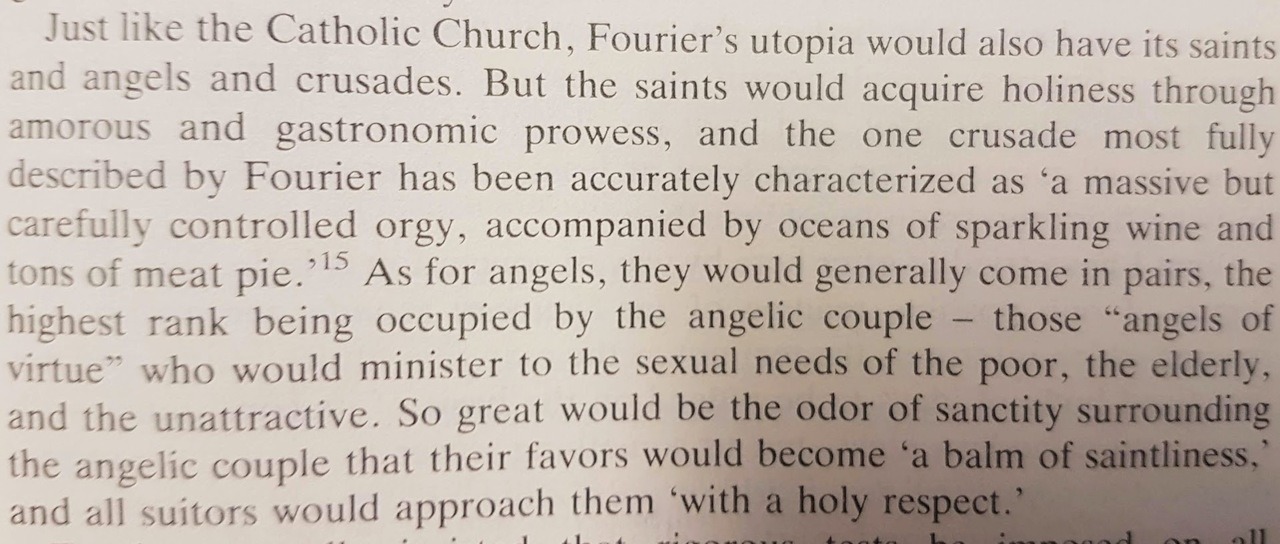
Charles Fourier was what you call an ‘’ideas man’

class-struggle-anarchism:

Charles Fourier was what you call an ‘’ideas man’

Tagged: history same as it ever was

Around the turn of the 2010s, so not too many years ago but 2 or 3 paradigm shifts in "what the internet means for sex work",...

Around the turn of the 2010s, so not too many years ago but 2 or 3 paradigm shifts in “what the internet means for sex work”, the big thing was escort review sites. “The Erotic Review” nationwide, but also RedBook, particularly in San Francisco, an epicenter with its openminded Internet-forward rich male techie workforce.

This advantaged the clients (they preferred “hobbyists”) who were able to raise standards and institute the “RBGFE” as the norm, which if I remember was 1hr DFK, BBBJ, CFS, DATY, MSOG for $200.

(That’s “RedBook Girlfriend Experience”, with Deep French Kissing, Bareback Blowjob, Covered Full Service, Dining at the Y [cunnilingus] and Multiple Shots on Goal [sessions not concluded upon first orgasm])

And the providers were this bottomless pool of Korean AAMPs (Apartment Asian Massage Parlors) in the big apartment buildings on the edge of the valley, packs of 4 or 5 girls living on 2-year rotations in one apartment and sharing another as a workspace.

And the story put out was that for generations, poor rural Korean girls had gone to the cities to build a nest-egg in the hot-sheets trade and then returned to the village to start their real lives, and this was a continuation of that, especially now Korea is connected enough what happens in the city isn’t guaranteed to stay in the city.

The point of the story was that no, these girls hadn’t been lured by false promises of tourist jobs, they knew what they were getting into all along. Notions of “sex trafficking” have metastasized* and valid consent narrowed since then, but at the time if you were okay with escorts in the first place that was sufficiently kosher.

* this would be, to my count the third major national “sex trafficking” panic in America (previous ones called it “white slavery”), the Mann Act came out of one of the first two. After-the-fact investigation showed they were in reaction to no particular “crisis”, the world’s oldest profession chugging along as always. Which, pace centuries-old English folk songs, includes young women sweet-talked and seduced by pimps who take them to the city and turn them out.

And now I’m realizing that that “village-girl tradition” is basically continuous with an American military brothel system under a right-wing dictatorship that forced-marched the population to industrial capitalist urbanity (the “Miracle on the Han River”), rural people’s movements having been suppressed in the extremely bloody Korean War.

And that is in turn basically continuous with the same pimps and comprador elites under Japanese occupation and the same system

Like, on the Japanese side, okay there’s a lot of unreconstructed nationalist foof, but the more coherent pushback is “there were no slave raids, it’s just that occupation a/o colonialism rendered rural subsistence agriculture unsurvivable, as thousands of years experience tells, prostitution will follow, we organized it by best practices”.

And that the only reason they’re even asked to indulge the Koreans is because they have to share an alliance structure that’s basically the American continuation of the old European empires, and there’s nothing it can coherently damn them for without first damning itself ten times over

Tagged: rbgfe history

I like how Nero, the main antagonist from Star Trek (2009), isn’t even a dictator or soldier. He’s a miner. But he can terrorize...

captain-price-official:

charlesoberonn:

I like how Nero, the main antagonist from Star Trek (2009), isn’t even a dictator or soldier. He’s a miner. But he can terrorize the galaxy because his mining vessel has technology from the future.

It’s like if a 15th century France was terrorized by a guy with a bulldozer.

To be fair anyone with a bulldozer today is capable of terrorizing most communities.

It probably couldn’t take down a serious reinforced defensive wall through ramming but it could take a door or gate, divert a water feature, undermine a wall.

Armor it up like Killdozer or one of those tank-body combat engineering vehicles or one of those Israeli armored dozers, give it reliable maintenance and fuel support, yeah, it could take 15th cen. France.

Oh that reminds me, you ever hear how Hannibal’s elephant army was eventually defeated?

He knew he couldn’t take Rome’s defenses directly, he had to lure them out, so he menaced the area, sacked a city close enough Rome could see the plume of smoke

And the competent leaders were like “wait him out” but the effete citizens were like “we can’t just LET THEM DIE we have to do something, we HAFF to” so they mustered armies that got their ass kicked

So instead the Romans instituted a dictatorship that could crack down on that shit, and turtled up in Rome while he rampaged, sending expeditionary forces far off to chip away at his supply chain.

And then once the elephants had mostly died from the foreign food and climate, and his armies and allies had deserted from unrenumerative boredom, they mopped him up

Tagged: history

what's a historical fact you wish more people knew?

Anonymous asked:

what's a historical fact you wish more people knew?

Germany starved during WWI, that makes a lot of WWII and the Nazis make a lot more sense.

The German Empire was the most advanced civilization on Earth but it couldn’t feed itself, didn’t even have significant farming colonies of its own. In good times it imported by sea, but during the War its colonial rivals refused to sell and blockaded those who would.

This explains a lot!

This explains the dolchstosslegende, the “stab-in-the-back-myth”. Winning was out of the question with the American arrival and the exhaustion of reserves, but they could have probably got a better peace than Versailles, except with no hope of victory the starving German people revolted, overthrew their nobility and governments, and left Germany crippled with its enemies bearing down.

This explains the WWII U-Boat campaign, as an attempt to inflict the same fate on Britain. And the importance of the American “Victory Ship” campaign in averting this. American wartime rationing was to free up food for export.

This explains why Germany turned on Russia before securing its western front, to capture and secure the Ukrainian breadbasket, a massive food exporter with secure overland transport routes.

(This explains the Holodomor, the engineered Ukrainian famine - the Russians predicted the Ukraine would be invaded, and that the local elites, the Catholic Church and landholding magnates, would welcome the turning-back of communism, so they prophylactically weakened the nation and killed off a source of recruits or farm labor. Also, each bushel diverted from local consumption to export meant more foreign currency reserves with which to equip up for the looming war.)

This explains Aktion T4, the widespread killing of the disabled. “Useless mouths” wasn’t a metaphor, Germany was shedding calorie consumers who did not contribute to the war effort in advance of the inevitable conflict.

This explains the camp system, which might not have always been execution camps (that happened after the Russian front turned, as an attempt to scuttle the condemned lest they come for revenge in the aftermath) but were always death camps – the idea was to work them to death, supporting war production on drastically reduced rations, but segregated from society and under direct control so they couldn’t revolt and their misery wouldn’t affect domestic morale.

Tagged: history

The American narrative kind of groups the American and French Revolutions on one side as liberation! And the whole...

The American narrative kind of groups the American and French Revolutions on one side as liberation!

And the whole WWI-Interwar-WWII thing on another as totalitarianism!

And in between faffs about with its own expansion and Civil War

You know what gets left out? 1848, and the fact that every leading state thereafter was modeled after Prussia in taking The People seriously and starting out by conquering its own population

Tagged: history

Happy Labor Day

Happy Labor Day

kontextmaschine:

People loved their work once, and it didn’t matter if they worked in the public sector or in the private one. The men who worked in the CCC would take their grandchildren to see the forests they planted, while the men from the auto plants would point out the cars they’d built as they passed them on the new interstate highway system. The women who fastened the engines on the wings would watch the B-17’s fly off to make a liar out of Goering, and the women who taught in the public schools would point with pride when one of their old students got elected mayor. Work was about making money, certainly. It was about feeding the family and keeping the roof where it was, and maybe having a little left over at the end of the day, or at the end of the week, for some amusement. Maybe a trip to Lincoln Park or White City or a hundred other places, where you could take a moment and enjoy the cool of the evening, music riding the nightwind from a dance pavilion down along the lake.

But it was also about Doing A Job, and doing it well, which was different than simply Having A Job. It was about making good cars and strong steel and sturdy furniture. It was about learning a craft, even if what you were doing wasn’t recognized as one. There was a craft in tightening rivets, or feeding the open-hearth furnace, or planing the wood just so. You had your craft, and the person next to you had theirs, and, when all the work was done, and all the craft was practiced, and practiced well, there was something you could look at with pride and say, that is something I have given to the world. Job well done, as they used to say. You could teach seventh grade civics and then, one day, you’re on a podium outside of City Hall. That kid right there, you could say. That kid is something I have helped give to the world. Job well done, as they used to say.

Unions were greatly responsible for the pride that people took in the work they did, especially in the middle of the last century, when unions helped build the most formidable middle class in human history.

-— -— -—


There was an autoworker, Ben Hamper, who wrote a column in the Flint (later Michigan) Voice, which was the alt-weekly Michael Moore first made his name by running. A lot of his columns got collected and repackaged in an excellent book, Rivethead that I read in college.

I read it in a class by Stuart Blumin, who was my favorite professor and de facto advisor. He was an American historian, focused on labor and class and the development of capitalism, you could tell he was heavily influenced by EP Thompson and the Communist Party Historians Group over in the UK.

He was quite open that he had expected Communism to ultimately triumph, and that he had been wrong about that, and in subtext that he had wanted it to ultimately triumph, and didn’t think he had been wrong about that.

Anyway, Rivethead. The story is that Hamper was born in 1956, a fairly clever kid growing up in Flint, Michigan, the chronological and geographic apex of American industrial unionism, where everyone’s dad worked for GM.

And he could have gone to college but he gets some girl pregnant and so he goes to work on the assembly line not even really out of obligation or Catholic guilt or whatever but because that seems as good a life course as any, it’s what every man he’s known does, under the mighty UAW the pay’s on par with the kind of “educated” jobs you could get anyway, why not.

And so he goes to work on the line and eventually he ends up writing a column about it, and he talks about the color of the factory culture, playing soccer with rivets for balls and cardboard boxes for goals, drinking mickeys of malt liquor in your car on lunch break, the absurd fursuited mascot “Howie Makem, The Quality Cat” that GM would feature at rallies and shop-floor tours, being laid off in economic downturns and put into the “job bank” where you get paid waiting to be rehired in the next upswing, developing a perfect rhythm with your partner, training into a rhythm so perfect you can each trade off doing the two-person job yourself for 4 hours while the other one goes out to a bar on the clock, the dignity and solidarity of the American worker.

And time goes on and eventually his marriage fails but he takes it in stride, and his column gets recognized and he takes pride in that and then eventually he has an epiphany, and a complete breakdown, which are basically the same thing. And the inciting incident is when an older line worker, some guy he’d looked up to as a model of quiet, philosophical stolidity, just shits himself and is barely coherent enough to even notice this and he realizes the guy hadn’t been a Zen master, he’d just been checked-out mindless drunk on the line every day.

And he realizes that the rivethead life is destroying him, that the only thing holding it together was a budding alcoholism, and that it’s doing the same to all his co-workers, and looks back and realizes it had done the same to every grown-up man he knew, his father and uncles that growing up he had looked up to as models of masculine strength and fortitude really had just had their spark snuffed out and the life beaten out of them long before, and whatever pride they took in the cars out on the road was a defensive attempt to locate in an external form the sense of self-value that had been exterminated within them.

When Marx talked about “alienation”, well.

And he went crazy, and couldn’t bear to work on the line anymore, and there’s no redemption, that’s where the book ends.

And that was a theme that cropped up again in Professor Blumin’s class, that there were two great working class traditions that echoed through the ages, and they were

1) avoiding work
and
2) drinking

Back in the premechanized age of small-group workshop manufacturing, workers would celebrate “Saint Monday”, which was to say just not showing up for work, hung over after the weekend.

(This was riffing off of Catholic feast days, or holy days, from which we take the word “holiday”, and as time went on counted an increasing share of the days of the year. There was a reason that poor workers were aligned with the Church, and nobility, in “Altar and Throne” coalitions resisting the development of industrial capitalist liberal democracy.)

In the ‘80s, the crap time of American auto manufacturing, one trick that was passed around (pre-internet, so by word of mouth largely) was to look at the codes stamped on car bodies, which would tell you what day of the week they were manufactured, and to avoid Mondays and Fridays. Because those days had the highest defect rates, because the workers tended to be drunk, or hungover, or absent.

And back in the workshop days, you’d drink at work. Apprentices would be sent out for growlers or buckets of beer, there were elaborate rules of who in the hierarchy of workers was expected to buy rounds for who and when. And there was hellacious resistance to attempts to get them to knock this off, as the industrial era kicked into swing.

Those great satanic mills, where women and children worked in shifts at great water- or steam-driven sewing and spinning machines, stories of little kids getting their hands mangled by the machinery? One of the major reasons women and children were preferred was because they would actually show up on time every day, and stay sober around all those hand-manglers.

And I mean, this maybe sounds like an argument for socialism. Though not of any actually-existing- variety, as capitalist propaganda will be glad to tell you, Soviet work culture, at least when the morale thrills of the Revolution and Great Patriotic War faded from personal to institutional memory, was all about shirking and vodka.

So those complaints about how America celebrates Labor Day instead of May Day, ignoring the true meaning of labor - solidarity - in favor of mindless distraction? Psssh. Labor Day is a celebration of the truest, most ancient, most fundamental traditions of labor: not working (especially on Mondays), and getting drunk.

Happy Labor Day!

Tagged: rerun work: the curse of the drinking class history holidays

A really big history pet-peeve of mine is people saying the Russo-Japanese War was the first time in the modern era where...

memecucker:

A really big history pet-peeve of mine is people saying the Russo-Japanese War was the first time in the modern era where Europeans were defeated by non-Europeans in a way because not only is that incredibly false (eg; the spectacular failure of the Italian invasion of Ethiopia had already happened and even then there was the First Anglo-Afghan War which ended in British humiliation, Alaungpaya founder of the Konbaung dynasty of Burma crushed a joint Franco-Mon force (supplanted by Dutch and Portuguese mercenaries) during his war of Burmese unification an act which expelled the French from SE Asia until their entrance to Vietnam a century later, the British defeat at Islandwanda is also notable because while the Zulu war ended in a British victory at Islandwana it was shown that Europeans were not invincible even when their opponents were armed largely with spears) but at the same time if people would just add the word “naval” to the sentence it would become accurate and more fully capture the uniqueness of that historical moment because Westerners in the 19th century were seen as invincible at sea and it wasn’t until Tsushima that European capital ships were sunk by non-Europeans.

Another thing that is actually exceptional about that was was that it wasn’t simply a European defeat because those happened plenty of times before but rather that it was a defeat where the non-Europeans were imperialistic in their victory. There was no illusion that the territories Russia was forced to give up as well as custodianship over Korea was a “restoration” of traditional Japanese territory, it was understood that this was Japan seizing foreign territory for imperialistic reasons and that it had joined the club of imperialist nations.

Tagged: history

Eric Hobsbawm, the Communist Who Explained Historyp

Eric Hobsbawm, the Communist Who Explained Historyp

Tagged: history historiography eric hobsbawm

Something that surprised me when I learned was that South African apartheid only started in 1948, as the result of an election...

Something that surprised me when I learned was that South African apartheid only started in 1948, as the result of an election widely expected to go the other way (in which the losers actually got 12% more votes but got swept in rural seats)

Tagged: history

some fun quotes i got while researching one of the essays i was doing instead of blogging, from lloyd gardner, three kings ...

antoine-roquentin:

some fun quotes i got while researching one of the essays i was doing instead of blogging, from lloyd gardner, three kings

Oilman James Moffett, a personal friend of Roosevelt and board chair of SoCal, had a proposal to offer. Why not see the king through the war with a direct subsidy? The U.S. government could purchase up to $6 million a year in petroleum products from the king and everyone would be happy. Unless Ibn Saud received such financial assistance, warned Moffett, “there is grave danger that this independent Arab Kingdom cannot survive the present emergency.” FDR liked the idea, but navy secretary Frank Knox could not imagine what to do with the oil. What was being produced in Saudi Arabia was not yet suitable for use in airplanes or even ordinary purposes.21

Mr. Fix It, Harry Hopkins, had another idea. What about LendLease? Passed originally by Congress in the spring of 1941, LendLease was the administration’s answer to the problem of sending economic and material aid to Great Britain without creating a new “war debts” issue, which had plagued American relations with Europe in the interwar era. The plan was then extended to the Soviet Union in the fall of 1941, and later to other nations at war. But Saudi Arabia was not at war with the Axis powers, and, as Hopkins ruefully confessed, “just how we could call that outfit a `democracy’ I don’t know.”“ A year and a half later, in February 1943, the president suddenly found “the defense of Saudi Arabia … vital to the defense of the United States.” Lend-Lease aid started to flow into Saudi Arabia. What brought about this landmark change? Saudi Arabia was still not at war, still not a democracy, and a possible Axis threat had receded after the North African campaign. So whence came the threat?

Washington officials now suspected the British-despite their financial plight-of trying to “edge their way into” Saudi Arabia at the expense of the American oil companies. Saudi Arabia was “probably the greatest and richest oil field in all the world,” declared Harold Ickes, petroleum administrator for war, and the British “never overlooked any opportunity to get in where there was oil."23 But British ambassador Lord Halifax was so upset over presumed threats to postwar British interests throughout the Middle East that he asked for an audience with Roosevelt to clear the air. When he arrived at the White House, FDR produced a rough map he had drawn of the Middle East: "Persian oil, he told him, is yours. We share the oil of Iraq and Kuwait. As for Saudi Arabian oil, it’s ours.”

With the Truman Doctrine in 1947 the Americans repeated the assurances that the Athenian representative Euphemus gave to Sicilians at Camarina in 415 B.c.: “We are forced to intervene in many directions simply because we have to be on our guard in many directions; now, as previously, we have come as allies to those of you here who are being oppressed; our help was asked for, and we have not arrived uninvited.” Euphemus added, however, that “it is not for you to constitute yourselves judges of our behaviour or to act like schoolmasters and try to make us change our ways. That is not an easy thing to do now.”`…

Mossadeq twitted Sir Richard about his religion. Was he a Catholic, asked the prime minister? Yes, said Stokes. Well, he was probably unsuited for his mission, then, because Catholics did not believe in divorce, and Iran was in the process of divorcing AIOC. Sir Richard was not amused. …

Acheson reported that the British-with Churchill back in power-were adamant all down the line, through the ranks of the civil service. Allowing Iran to “despoil” the British company would surely destroy confidence in British power and the pound sterling, they told the secretary of state, and within months all British property abroad would disappear, and soon after all Western investments. “In my judgment,” summarized Acheson, “the cardinal purpose of British policy is not to prevent Iran from going Commie; the cardinal point is to pre serve what they believe to be the last remaining bulwark of Brit solvency; that is their overseas investment and property position.”“…

Mossadeq had stopped off in Philadelphia on his way to Washington, where he visited Independence Hall and linked his nationalization policies with the "ideals that inspired the United States to wrest freedom and liberty from Britain in 1776.” …

Defense secretary Charles Wilson lamented bygone days when other right-wing dictators replaced deteriorating right-wing dictatorships: “Nowadays, however, when a dictatorship of the right was replaced by a dictatorship of the left, a state would presently slide into Communism and was irrevocably lost to us.”

stephen kinzer, all the shah’s men:

Iranian agents who came in and out of Roosevelt’s villa knew him only by his pseudonym, James Lockridge. As time passed, they naturally developed a sense of comradeship, and some of the Irani- ans, much to Roosevelt’s amusement, began calling him “Jim.” The only times he came close to blowing his cover were during tennis games that he played regularly at the Turkish embassy and on the campus of the French Institute. When he missed a shot, he would curse himself,shouting,“Oh,Roosevelt! ”Several times he was asked why someone named Lockridge would have developed such a habit. He replied that he was a passionate Republican and considered Franklin D. Roosevelt to have been so evil that he used Roosevelt’s name as a curse….

In those early years,Mossadegh developed more than a political perspective. He also began showing extraordinary emotional quali- ties. His boundless self-assurance led him to fight fiercely for his principles, but when he found others unreceptive, he would storm off for long periods of brooding silence. He did this for the first time in 1909, when Mohammad Ali Shah launched his bloody assault on the Majlis.Rather than stay and fight alongside his fellow democrats,he concluded that Iran was not ready for enlightenment and left the country….

In one cable to Washington, he described Mossadegh as “lacking in stability,”“clearly dominated by emotions and prejudices,” and “not quite sane.” In another, he asserted that the National Front was composed of“the street rabble, the extreme left …extreme Iranian nationalists,some but not all of the more fanatical religious leaders, [and] intellectual leftists, including many who had been educated abroad and did not realize that Iran was not ready for democracy.”

At a meeting of the National Security Council on March 4, Eisenhower wondered aloud why it wasn’t possible “to get some of the people in these down-trodden coun- tries to like us instead of hating us.”

Tagged: history