arihndas-pryce replied to your post “I feel like early (and late?) Christianity might be underestimated as…”
what do you mean by civilizing? not to be snotty, not sure how to phrase is smarter, but it’s a genuine question.
I think I mean the obvious meaning that lots of people overlook because they’re so used to civilization – ‘a thing that causes a society to move towards a state of civilization’. Civilization is a state of affairs that is less likely to have things like human sacrifices, slavery, and more likely to have things like art and multi-nation scientific research collaborations.
I’m not sure if my original post is right. My knowledge of early Christianity’s history is pretty patchy, and I may have made incorrect assumptions. And I definitely don’t think Christianity has an unambiguous record as ‘psychological/cultural event that decreases evil in the world’. But if I had to say whether Christianity is better on this front than the things it was usually competing with, I’d bet yes.
My question is why, if Christianity was so memetically fit, did it take as long as it did to be invented and propagate?
Christianity propagated extremely rapidly!
Here’s Rodney Stark’s The Rise of Christianity (Princeton, NJ: Princeton University Press, 1996):
Studies of the rise of Christianity all stress the movement’s
rapid growth, but rarely are any figures offered. Perhaps this
reflects the prevalence among historians of the notion, recently
expressed by Pierre Chuvin, that “ancient history remains
wholly refractory to quantitative evaluations” (1990:12).
Granted, we shall never discover “lost” Roman census data giving authoritative statistics on the religious composition of the
empire in various periods. Nevertheless, we must quantify – at
least in terms of exploring the arithmetic of the possible – if we
are to grasp the magnitude of the phenomenon that is to be
explained. For example, in order for Christianity to have
achieved success in the time allowed, must it have grown at
rates that seem incredible in the light of modern experience? If so, then we may need to formulate new social scientific propositions about conversion. If not, then we have some well-tested
propositions to draw upon. What we need is at least two plausible numbers to provide the basis for extrapolating the probable rate of early Christian growth. Having achieved such a rate
and used it to project the number of Christians in various years,
we can then test these projections against a variety of historical
conclusions and estimates.
For a starting number, Acts 1:14-15 suggests that several months after the Crucifixion there were 120 Christians. Later,
in Acts 4:4, a total of 5,000 believers is claimed. And, according
to Acts 21:20, by the sixth decade of the first century there were
“many thousands of Jews” in Jerusalem who now believed.
These are not statistics. Had there been that many converts in Jerusalem, it would have been the first Christian city, since
there probably were no more than twenty thousand inhabitants at this time – J. C. Russeli (1958) estimated only ten thousand. As Hans Conzelmann noted, these numbers are only “meant to
render impressive the marvel that here the Lord himself is at
work” (1973:63). Indeed, as Robert M. Grant pointed out, “one
must always remember that figures in antiquity … were part of
rhetorical exercises” (1977:7–8) and were not really meant to
be taken literally. Nor is this limited to antiquity. In 1984 a
Toronto magazine claimed that there were 10,000 Hare
Krishna members in that city But when Irving Hexham, Raymond F. Currie, and Joan B. Townsend (1985) checked on the
matter, they found that the correct total was 80.
Origen remarked, “Let it be granted that Christians were few in the beginning” (Against Celsus 3.10, 1989 ed.), but how many would that have been? It seems wise to be conservative here, and thus I shall assume that there were 1,000 Christians in the year 40. I shall qualify this assumption at several later points in the chapter.
Now for an ending number. As late as the middle of the third
century, Origen admitted that Christians made up “just a few”
of the population. Yet only six decades later, Christians were so
numerous that Constantine found it expedient to embrace the
church. This has caused many scholars to think that something
really extraordinary, in terms of growth, happened in the latter half of the third century (cf. Gager 1975). This may explain
why, of the few numbers that have been offered in the literature, most are for membership in about the year 300.
Edward Gibbon may have been the first to attempt to estimate the Christian population, placing it at no more than “a twentieth part of the subjects of the empire” at the time of Constantine’s conversion ( [1776–1788] 1960:187). Later writers
have rejected Gibbon’s figure as far too low. Goodenough (1931) estimated that 10 percent of the empire’s population
were Christians by the time of Constantine. lf we accept 60 million as the total population at that time –which is the most
widely accepted estimate (Boak 1955a; Russell 1958; MacMullen 1984; Wilken 1984) – this would mean that there were 6
million Christians at the start of the fourth century. Von Hertling (1934) estimated the maximum number of Christians in
the year 300 as 15 million. Grant (1978) rejected this as far too
high and even rejected von Hertling’s minimum estimate of 7.5
million as high. MacMullen (1984) placed the number of Christians in 300 at 5 million. Fortunately, we do not need greater
precision; we assume that the actual number of Christians in
the year 300 lay within the range of 5–7.5 million, we have an
adequate basis for exploring what rate of growth is needed for
that range to reached in 260 years.
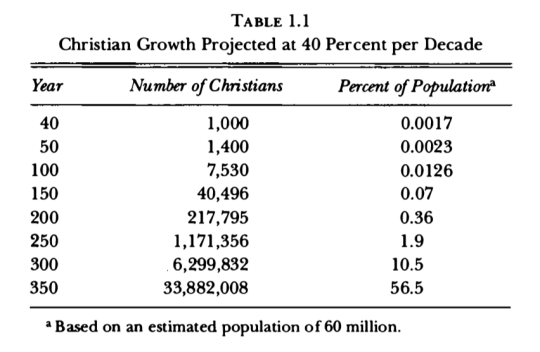
Given our starting number, if Christianity grew at the rate of
40 percent per decade, there would have been 7,530 Christians in
the year 100, followed by 217,795 Christians in the year 200 and
by 6,299,832 Christians in the year 300. If we cut the rate of
grow to 30 percent a decade, by the year 300 there would
have been only 917,334 Christians – a figure far below what anyone would accept. On the other hand, if we increase the growth
rate to 50 percent a decade, then there would have been
37,876,752 Christians in the year 300 – or more than twice von
Hertling’s maximum estimate. Hence 40 percent per decade
(or 3.42 percent per year) seems the most plausible estimate of
the rate at which Christianity actually grew during the first several centuries.
This is a very encouraging finding since it is exceedingly
dose to the average growth rate of 43 percent per decade that
the Mormon church has maintained over the past century
(Stark 1984, 1994). Thus we know that the numerical goals
Christianity needed to achieve are entirely in keeping with
modern experience, and we are not forced to seek exceptional
explanations. Rather, history allows time for the normal processes of conversion, as understood by contemporary social science, to take place.
Rodney Stark reviews estimates of Christian populations during this period, and finds them generally consistent with this general framework:
There was a
greater increase in numbers by the middle of the second century, but still the projection amounts to only slightly more than 40,000 Christians. This projection is in extremely dose agreement with Robert L. Wilken’s estimate of “less than fifty thousand Christians” at this time–“an infinitesimal number in a society comprising sixty million” (1984:31). Indeed, according to
L. Michael White (1990:110), Christians in Rome still met in
private homes at this time. Then, early in the third century, the
projected size of the Christian population picks up a bit and by
250 reaches 1.9 percent. This estimate is also sustained by a
prominent historian’s “feel” for the times. Discussing the process of conversion to Christianity, Robin Lane Fox advised that
we keep “the total number of Christians in perspective: their
faith was much the most rapidly growing religion in the Mediterranean, but its total membership was still small in absolute
terms, perhaps (at a guess) only 2 percent of the Empire’s total
population by 250” (1987:317).
As an additional test of these projections, Robert M. Grant
has calculated that there were 7,000 Christians in Rome at the
end of the second century (1977:6) . If we also accept Grant’s
estimate of 700,000 as the population of Rome for that year,
then l percent of the population of Rome had been converted
by the year 200. If we set the total population of the empire at
60 million in 200, then, based on the projection for that year,
Christians constituted 0.36 percent of the empire’s population.
This seems to be an entirely plausible matchup, since the proportion Christian should have been higher in Rome than in the
empire at large. First of all, historians assume that the church in
Rome was exceptionally strong – it was well known for sending
funds to Christians elsewhere. In about 170, Dionysius of
Corinth wrote to the Roman church: “From the start it has been
your custom to treat all Christians with unfailing kindness, and
to send contributions to many churches in every city, some
times alleviating the distress of those in need, sometimes providing for your brothers in the mines” (Eusebius, Ecclesiastical History 4.23.6, 1965 ed.). Second, by 200 the Christian proportion of the population of the city of Rome must have been substantially larger than that in the whole of the empire because Christianity had not yet made much headway in the more westerly provinces.
Now, let us peek just a bit further into the future of Christian
growth. If growth held at 40 percent per decade for the first half
of the fourth century, there would have been 33,882,008 Christians by 350. In an empire having a population of at least 60
million, there might well have been 33 million Christians by
350 – for by then some contemporary Christian wriiters were
claiming a majority (Harnack 1908: 2:29). Looking at the rise of
a Christian majority as purely a function of a constant rate of
growth calls into serious question the emphasis given by
Eusebius and others to the conversion of Constantine as the
factor that produced the Christian majority (Grant 1977). So
long as nothing changed in the conditions that sustained the
40-percent-a-decade growth rate, Constantine’s conversion
would better be seen as a response to the massive exponential wave in progress, not as its cause.
Several years after I had completed this exploration of the
arithmetic of early Christian growth, when this book was nearly finished, my colleague Michael Willaims made me aware of
Roger S. Bagnall’s remarkable reconstruction of the growth of
Christianity in Egypt (1982, 1987). Bagnall examined Egyptian
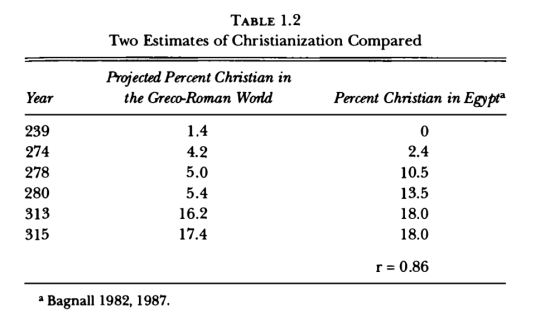
papyri to identify the proportion of persons with identifiably Christian names in various years, and from these he reconstructed a curve of the Christianization of Egypt. Here are real
data, albeit from only one area, against which to test my projections. Two of Bagnall’s data points are much later than the end
of my projections. However, a comparison of the six years
within my time frame shows a level of agreement that can only
be described as extraordinary–as can be seen in table 1.2.
Bagnali’s finding no Christians in 239 can be disregarded.
Obviously there were Christians in Egypt then, but because
their numbers would still have been very small it is not surprising that none turned up in Bagnall’s data. But for later years
the matchups are striking, and the correlation of 0.86 between
the two curves borders on the miraculous. The remarkable fit
between these two estimates, arrived at via such different
means and sources, seems to me a powerful confirmation of
both.
AO3 started with astolat’s post An Archive of One’s Own on Livejournal. Details at Fanlore here.
(And no, it wasn’t originally supposed to be the actual archive’s name. It’s just that no one liked any of the other proposed names. There was a poll and everything.)
Cesperanza and various other friends (or more like acquaintances in my case) of astolat are all over the comments and were involved in the initial building. It was a who’s-who of LJ era big Western slash fandoms, so if you’re into stuff like SGA, you’ll see many familiar names.
The comments are still up if you want to go see what fandom was thinking in 2007 about this pie-in-the-sky proposal that was definitely never going to work.
I—-I followed them back in the day on LJ. Wow.
Everybody did. I guarantee if you were active on LJ and into m/m for live action Western fandoms, you followed at least somebody in those comments too.
It was a smaller world than now (or than all of fandom everywhere), and AO3 really was a community project.
I remember when I had to wait patiently for an AO3 invite from a friend of a friend…and that friend of a friend was a fic author who followed those named above.
I’m so proud to be an AO3 member since 2010.
The account number thing on everyone’s profile page is presumably for the future block feature, but it also gives you obnoxious bragging rights:
I waited a year - mostly watching to see how it was going first. ^^
astolat is 8. elz is 10. I assume 1-7 are deleted test accounts. The really low numbers are the primary coders, unsurprisingly. The rest of the 2-digit numbers are committee members of the first round of committees (writing the ToS and so on). Then come whatever testers joined during closed beta.
Closed beta started on October 3, 2008. That’s when a bunch of staff’s imported old fic was visible to the public and people could start commenting and hammering on the archive.
Open beta, when anyone could request an invite, started on November 14, 2009.
#16 reporting in. :D Also, btw, the Archive of Our Own phrase comes right out of Virginia Woolf’s A Room of One’s Own: “A woman must
have money and a room of her own if she is to write fiction.” I take blame/responsibility/credit for this, though overall I still think it was the best name on the table and I like the history baked into it (arguably A Room of One’s Own kicked off the discipline of Women’s and Gender Studies and led to a search for women writers to include in the canon.) What I remember more though was people being like, “The Organization for Transformative Works is a terrible name for an archive!!” which–(one of my jobs was to explain this over and over and over)–yes, yes, it is, it’s NOT the name of the archive, it’s the name of the nonprofit company we have to set up to run the archive if we’re serious about this” (spoiler: we were serious about this) “and also it’s the name of the legal defense - transformativity - that the whole project is based on!” And the truth is, seriously, every time I see someone–someone I don’t know, in a fannish community I’m not in, or randomly on YouTube or wherever–announce “this is a transformative work” I sit back with a happy little warm feeling (and I also bow a couple of times in the direction of the OTW Legal’s team without whom etc.)
2759 here. One particular flood of new members in Dec. 2009 was Yuletide participants - that year we did signups and matching through the old Yuletide site, but we had to post our gifts on the new site (AO3). I became a tag wrangler about two weeks later and I’m still working.
It’s so interesting to track the various little explosions of users.
I was a late joiner, 3 months after I got an account I was a member of the systems committe.
I joined on:
2010-09-13
My user ID is:
9262
\o/
Are there posts showing how the number of accounts and/or users has grown over time? I recall a couple of news posts, but I don’t remember if they show the whole history. It would be interesting to see how 2012 affected things.
This is crazy to see I joined in 2012 and oh my gods it was like winning the lottery I stg felt so amazing.
I joined on: 2012-06-30
My user ID is: 55564
50K in three years and it’s insane to me to think that there’s another 10+ years of this. I always smile when I see the user / fandom counts pass a milestone but it’s crazy to see how fast this place has grown.
Anywho - donate if you can, it’s definitely something that helps keep the growth going!
So you’re telling me the website grew by 10,000 users within two months?
That is exactly what I’m telling you.
When I talk about AO3/OTW being hit with “curveballs” (and this is why some coding things didn’t happen or didn’t happen fast), this is the kind of thing I’m talking about.
AO3 was a shaky baby colt taking its first steps. Nobody was even interested in the invitations I had. A little growth was happening, but not much.
And then FFN decided to go be a gigantic choad and delete all the porn again.
SIGNUP-POCALYPSE!
Jan 14, 2012 - 632 people on the waitlist
May 3, 2012 - 5,834
May 14, 2012 - 18,707
Jul 10, 2012 - 28,415
–
It stayed around 30k for months, finally dropping to like 20k in December.
And from what I remember, this whole time, AO3 was increasing the invites-per day to try to accommodate new users!
–
Feb 8, 2013 - 26
–
By the end of 2013, they’d added the ‘per day’ count to the page.
–
Dec 23, 2013 - 528 people waiting, 750 per day
I don’t recall when the next massive wait times were, but around 2013-2014, things were back to the norm where you requested an invite and got it in a day or two.
2012 was fucking bonkers.
2012 was really hard work, with traffic doubling over 12 months.
AO3: Too God Damn Popular For Its Own Good
(And this, kids, is why we hope our projects get popular… but at a steady and moderate rate.)
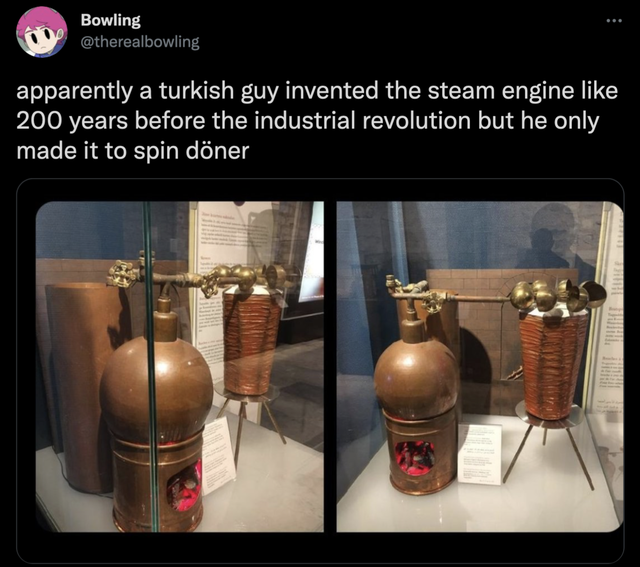
Roasting jacks, devices to automate the turning of meat, as found in public establishments keeping fresh hot meat on immediate offer, were until the spread of clockwork some of the most advanced mechanical devices the general population were likely to encounter in the course of life; at one point they employed wheels run by specially bred dogs.
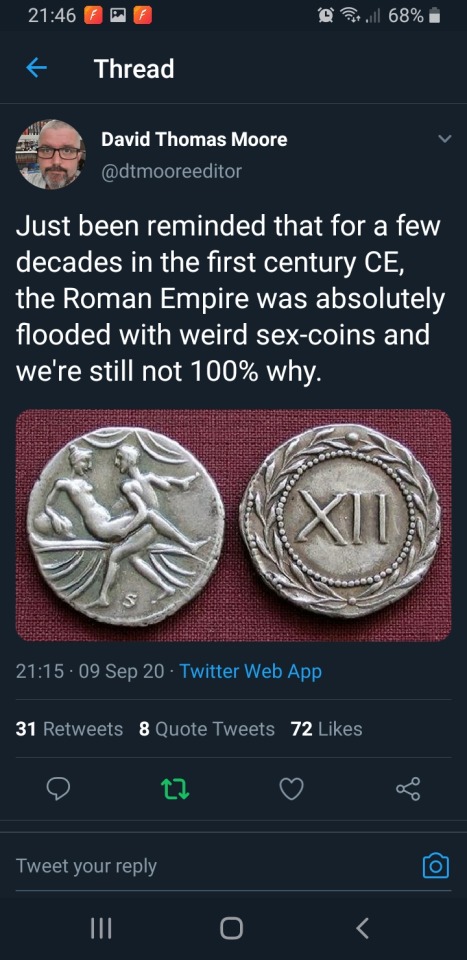
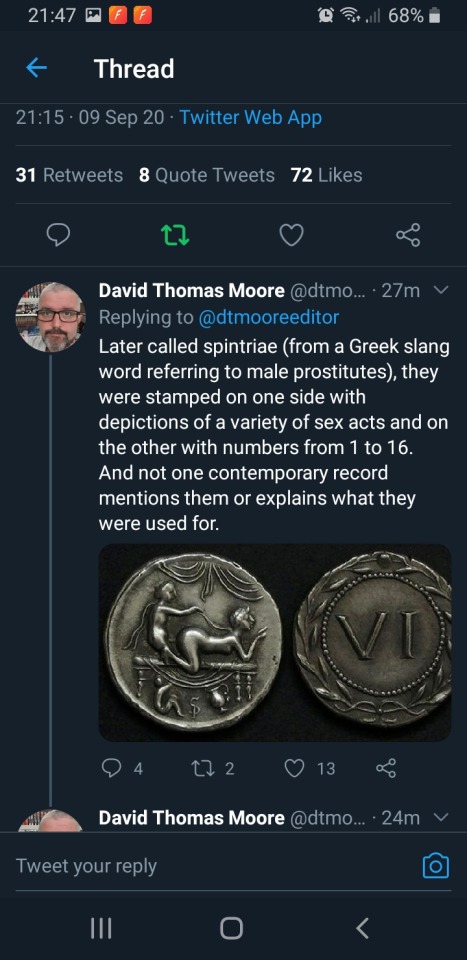
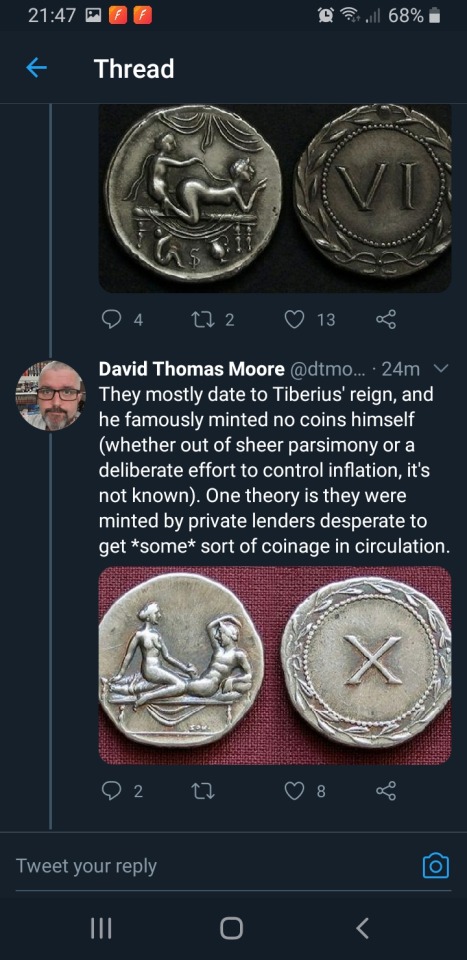
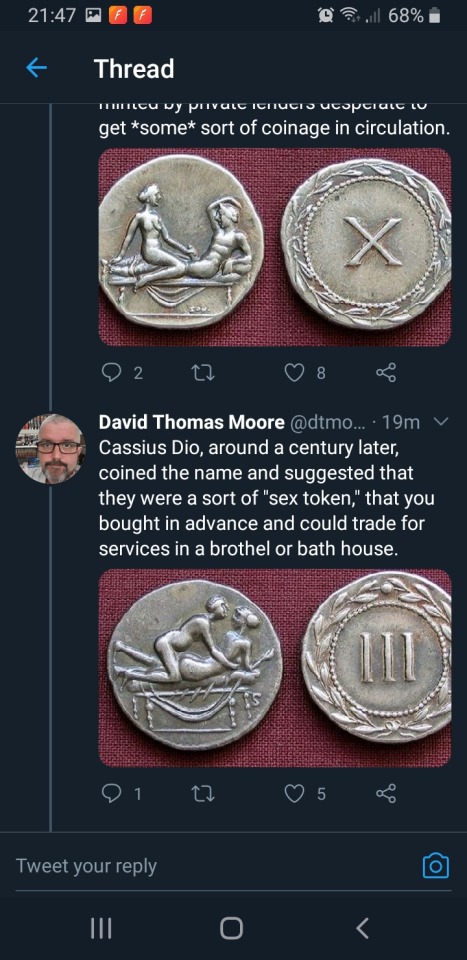
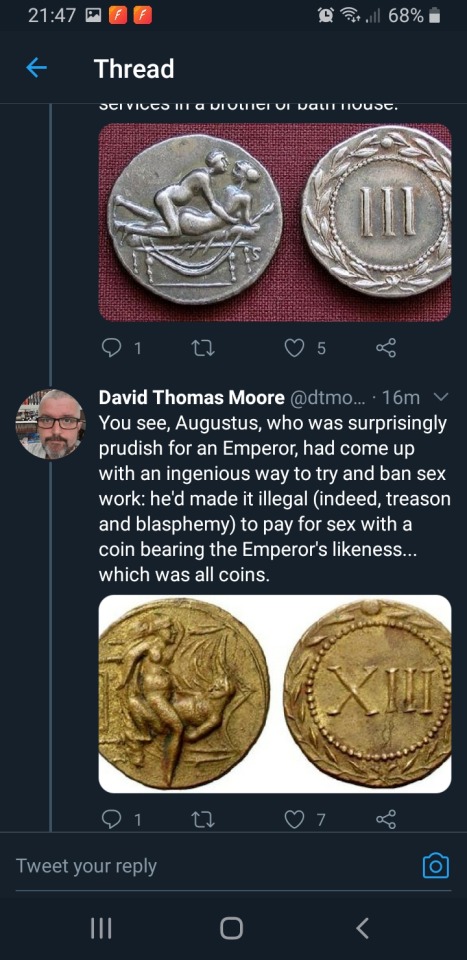
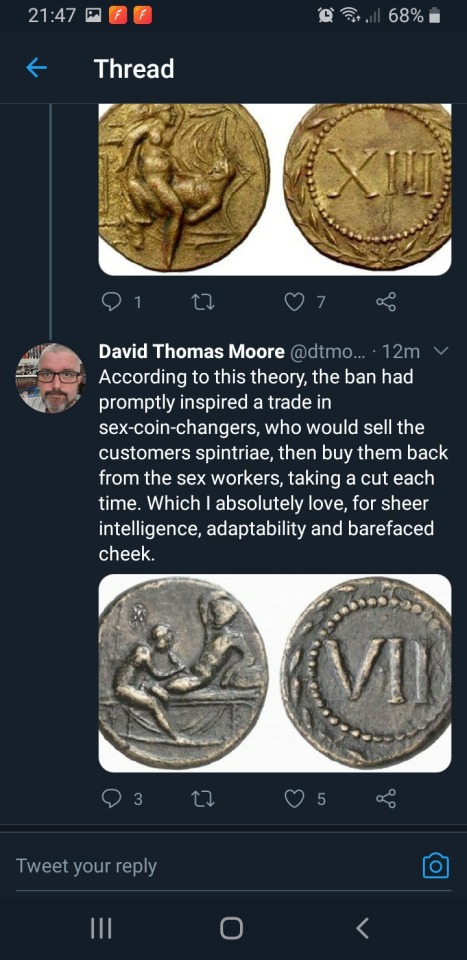
My mate Dave delivers some important information about Roman sex coins on the Twitters. (Source)
I just wanted to let you all know that my appeal on the Sex Coins post was accepted.
There are still a great many entirely innocent posts that I can’t even appeal, but somewhere out there there’s a human who loves history who let this one go, and I’m grateful to them!
imagine you are an early Christian, already convinced that Caesar is Antichrist, Rome is Mystery Babylon the Great and not entirely happy about the caesar coins and now people are expecting you to take the fuck coins
Hot take: the relationship between the People’s Republic of China and the Soviet Union continued to be a live issue through and beyond the 1960s, and the notion that there was a point where they definitively split is a retrospective judgement on the basis that they didn’t later find common ground
Like, communist regimes often adopted “this is the final take” lines that they revised later under changing conditions
I love when people are like “this character is a war criminal” and show a character from a setting where we have no idea what the rules of war are. Like yeah they’re a torturer or murderer or whatever but if you wanna call them a criminal over it you gotta back it up with some kind of indication of what things might be in their conventions.
I don’t Star Wars so I have no idea about Obi Wan’s surrenders but I think it’s worth pointing out that in general, people often misunderstand that particular rule. It’s illegal to falsely surrender, as in, you can’t pretend to surrender to let your enemy’s guard down and then ambush them or attack them during the surrender or use it to get close to their base for a sneak attack or anything. Once you have properly, genuinely surrendered, it is NOT illegal to try to escape, or take advantage of opportunities to spy and sabotage that are handed to you by your enemy, or just generally be an inconvenience in ways that aren’t violating the terms of your surrender. A POW escaping a prison camp isn’t committing a war crime. A POW who overhears their captors planning and manages to get a warning out to their own army isn’t committing a war crime. Someone who surrenders their unit because they know they know that doing so will stall the enemy more than fighting or fleeing, and give the rest of the army a better fighting chance, is not committing a war crime. If the enemy decides to take prisoners and then can’t control those prisoners, that’s their own fucking problem; if they weren’t prepared or equipped to deal with prisoners, they should’ve taken the territory and made the surrendering party retreat peacefully instead. the surrender itself must be genuine but once the surrender is complete you are under no obligation to continue to be cooperative outside the terms of that surrender.
Yeah, no, Obi-Wan literally pretended to surrender as a “clever trick” to stall the enemy leadership negotiating the surrender terms until Anakin could reach him and help kill them all, IIRC. It’s in the first Clone Wars episode I believe.
Like, it worked for the story, but that’s definitely going to undermine any legitimate surrenders the Jedi ever need to make and potentially get people killed because it “could be a trick” if you think about it.
Peasant uprisings were repeatedly crushed by nobles offering a parlay to the leaders and then capturing/executing them, because the riled-up illiterate peasants were unlikely to have even known about something that happened on the other side of the country 50 years ago.
Like it’s not just “ooh Marx, nifty!” the 19th century really did expect, on a reasonable basis, that a permanent international network linking commoners with literacy and historical education would be able to turn the tables
i think one thing about the ‘maybe the curtians were just blue’ issue is that the kind of education that post is responding to is actually a strange, outmoded form of literary criticism known as the ‘close reading’ which has long since faded into obscurity for being, essentially, a psuedoscience with unrealizable pretensions to positivism, but which continues to be taught in English classes in America and the UK because it produces readings which are homogenous and, for this reason, gradable (the questions will actually have correct answers on the grading sheet which is an approach to reading we would consider highly unusual). it doesn’t need your defense; it probably bears a lot of responsibility for the incurious attitude towards literature that we’re worried about. in highschool i was able to get my classmates interested in medieval Germanic poetry by producing dramatic renditions every time we had a public speaking assignment (no matter what the topic was), enough that my boyfriend stole my copy of the Edda, and these were cynical proletarian students who under normal conditions were bored to tears by Macbeth!
I don’t think this is accurate, or at least it’s not true to my experience in the mediocre end of the American public education system. Maybe at one point close reading was taught in public school, but I never saw it. Instead, I think “the curtains are just blue” acts more often as a strawman argument where literary criticism of any stripe is substituted for the obvious bullshit of close reading in an attempt to discard the entire concept, or a guilt-by-association where just because somebody did close reading once, all literary criticism has been revealed to be bunk through and through. In thinking about the popularity of the “curtains” meme (which was certainly the dominant memeplex among e.g. people I went to college with), I think that you’re confusing cause and effect—it’s popular less because people need a way to resist the overly broad application of close reading, but instead because close reading is so widely derided that it’s seen as a knock-down argument against any type of literary criticism, no matter how distant.
This is absolutely correct, “close reading” was a signal technique of the “New Criticism” about after WWII and suitable to rapidly expanding educational offerings (G.I. Bill-swollen colleges and an aspiration of universal high school graduation). American high schools largely drew from that at the time and then never really updated, which is why high school still treats the then-recent Hemingway and The Great Gatsby as particularly relevant. It’s also that this was really the first successful attempt to create a purely American canon of English literature.
The social adjustment to studying in schools of grammar and rhetoric could be just as jarring. Though pedagogues continued to monitor most boys, the physical and social environment both within and beyond a school greatly influenced their behavior. When a student enrolled at a school he entered into a new social world. The majority of late antique students probably continued to live at home and attend the classes of a local teacher, but many young men also traveled to teachers based in Athens, Alexandria, Rome, Antioch, Bordeaux, and any number of less famous centers of teaching. Both Libanius and the fourth-century rhetorician Himerius (who was himself a child of the 310s) make it clear that teachers worked hard to court students from abroad through a process that mixed recruitment with admissions. Himerius, for example, delivered two orations, one in person and one in print, to Arcadius, the father of a student whom he particularly wanted to admit.103 Libanius simultaneously courted and vetted new students through a series of letters that advertised his teaching and attempted to measure the quality of the prospective student’s skills.104
This type of personalized recruitment mattered because both teachers and students understood that enrollment in an intellectual circle symbolized the beginning of a new life. Teachers and students alike commonly described the members of their school as a second family. Ausonius, Libanius, and their peers called their teachers “father” or “mother” and their peers “brothers.”105 Teachers saw the boys they taught as their children.106 This was not empty rhetoric; the correspondence of Libanius and Ausonius offers many examples of students depending on their professors for protection and assistance.107 Himerius gave orations that recounted students’ achievements on their birthdays and celebrated their recovery from serious illnesses.108 Students reciprocated by cheering if their professors gave a public performance,109 avoiding the lectures of other professors,110 and even fighting the students of rival schools.111 In the years that they remained at school, students were expected to function as a part of this scholastic family.
Most students arrived fully prepared to participate in this new world. Libanius, for example, grew up hearing “from older men about Athens and the affairs there.”112 Sometimes these accounts highlighted great rhetorical triumphs, but many of the stories involved “tales of the fighting between the schools … and all of the deeds of daring that students perform to raise the prestige of their teachers.”113 Later in his life, Libanius even speaks fondly about the fathers who used to take pride when they saw “on their sons’ bodies the evidence of the battles they fight on their teacher’s behalf, the scars on the head, face, hands, and on every limb.”114 Among the other activities Libanius had heard about and longed to take part in were “the kidnapping of arriving students, being taken to Corinth for trial on kidnapping charges, giving many feasts, blowing all [his] money, and looking for someone to give him a loan.”115
Libanius’s words show that students, teachers, and even magistrates understood that schools operated under a different set of rules than the rest of late Roman society. Students were encouraged to develop new loyalties to their scholastic families and permitted to demonstrate those loyalties through actions (like brawling or kidnapping) that would normally be considered criminal. Indeed, in a justly famous passage, Augustine comments that students “often commit outrages that ought to be punished by law, were it not that custom protects them.”116 One’s student status legitimized normally unacceptable behaviors and, in some cases, even marked them as positive contributions to the fabric of an intellectual community.
Rituals of inclusion particular to intellectual communities helped to reinforce the sense that students lived in a social world with its own particular set of rules. The best-attested such rituals come from the Athenian rhetorical schools of the mid-to late fourth century. When students arrived at an Athenian school, they swore an oath to study under a specific teacher.117 Himerius treated his newly enrolled students to a welcoming oration in which he greeted them individually by noting the regions from which they came.118 The welcoming address concluded with a call for the students to be initiated. They were then divided into senior and junior initiates before they processed past their fellow students on the way to the baths.119 This procession was intended to be a frightening thing and included screamed threats and some physical violence.120 Once the initiates reached the bathhouse, they were “washed, dressed, and received the right to wear the scholarly robe.”121 When this was completed, Gregory Nazianzen says, the students received the newcomer “as an equal.”122
Reverse Harry Potter about a girl from a magical country that is sent to study in a land of engineering and industry.
In 1982, to prop up their “we’re communists, we swear” thing, the IRA sends some dreamy faerie-loving girl to Moscow U
Also that reminds me, you know how in the US, with its big Irish diaspora and its Anglophone background, the IRA and The Troubles didn’t seem like a communist thing, they seemed like a national self-determination thing?
That’s basically how every communist revolution ever was understood by the locals
One thing to keep in mind when visualizing the past is as recently as the 1980s, consumer fabrics – which means clothes but also draperies, bedding and upholstery – were significantly more flammable than they are today, which (in addition to older and less fireproof construction), meant that fire was a much more present, immediate, and intense threat.
George W. Bush was, in retrospect, very much a continuation of his father as President. Domestically, a continuation of an attempted Christian Democratic turn that harnessed religious enthusiasm to a pre-conservative tradition fundamentally okay with social spending.
Internationally, a continuation of post-Cold War cleanup. The lands of the Ottoman Empire fell largely under British and French influence after WWI and America succeeded as their patron after WWII, ending up supporting local autocrats as a guard against the Soviets. By the 2000s, a decade after the Cold War and two after a significant shift from pan-Arabism to political Islam, this system had outlived its purpose and was showing strain.
This played out as a conflict with local regimes as in Iraq, which had been one of the first to be reined in the “hyperpower”, "global cop" moment after the superpower conflict, but the overall story was an attempt to shift from American-backed autocracy to American-backed democracy. (Afghanistan was mostly one more installment of failed effort to integrate remote Afghanistan into any broad order of sovereignty)
This continued into the Obama era with Robert Gates and the “Arab Spring”, a major issue was that with ISIS and even more moderate jihadists, we grew more convinced that these autocrats really were far more compatible with US interests than any forces likely to hold power in their absence – the abandonment of regime change in Egypt and the inability to generate any enthusiasm for war with Russian proxy in Syria seems to have marked the end of this. The Arab world might require proper modern national institutions, but no one really wants to reenact the French Revolution and the 19th century to get there.
In domestic affairs, the “No Child Left Behind” national education framework was largely abandoned, and Medicare prescription drug coverage probably does something in the background to shore Republicans up with the elderly.
Barack Obama’s task was to take Bill Clinton’s relegitimating the Democrats as a governing party and do something with it. National health care had been a dream since the 50s at least, failed under Clinton, and with Obamacare it is an established thing now, as much as Social Security or Medicare of food stamps. DACA obviously failed to resolve illegal immigration as an issue, though it presumably benefited its beneficiaries a bit for a while.
The New Democratic relegitimation had largely been about gathering politicians, media, activists, and funding streams together and uniting them around fairly moderate messages. It was really organized for a cable TV media ecosystem. The late blog era could kinda work by analogy (the Nation and National Review had definitely been part of the 90s) but social media was another beast entirely.
Obama’s praised “cool” relationship with the media was largely oriented around impressing gatekeepers who then relayed his mythos. Though an impressive orator, the President making a speech about something no longer was necessarily the defining thing about it. In contrast, Trump’s McLuhanite “hotter” social media style, if you were aware of some national political issue, first off you were on Twitter, second off so was the President, he was aware of it, and you were aware that he was aware of it. He was in your head, more precisely he was in all your narratives.
By the end of Obama’s term, the Democratic Party was significantly delegitimized again. Tellingly, his largest accomplishment – being the fabled First Black President – was not one that particularly involved actively doing much of anything. I think it is still an open question whether we can consider his presidency or Bush’s as more successful.
Thinking about how “after World War II, the First World recognized the unique moral horror of the Holocaust, while the Warsaw Pact understood the war as a universal anti-fascist action” gets passed as some knock on the communists when the thing is postwar America played up anti-Semitism as the defining thing about the Nazis because the thing their contemporaries would have mostly seen them as, anticommunist, was the mantle we took over.
So one thing about country clubs, Elks Lodges, etc is that their systems are often structured such that your spending on meals, etc. there counts against your dues for the month, so no less than Blue Apron they were a subscription meal service for young professionals who did not have a dedicated food-preparer at home.
Lodges also formed a network of, uh, private public houses, where travelers could find vetted sociality and lodging away from home. (The “motel”, “motor hotel”, is called and iconically looks like that because it only arose with the development of a motorway network; earlier rural travelers, including early car travelers set up tent-and-campfire encampments in empty fields along the way.)
With Joe Biden in the White House it’s worth pointing out Delaware’s experience with the last wave of unrest, there was a 1967 riot in Wilmington so in 1968 when stuff was heating up after the MLK assassination the Dixie-style governor attached the National Guard to the police and maintained the city under soldiers-in-the-street occupation for most of a year until his successor (who had defeated him in an election where the issue was very salient) was installed in office
And that Delaware’s role – including in the form of Senator Joe Biden – in America’s midcentury Civil Rights crisis is as a bridge between the Dixie South and the industrial Northeast
I finished my reread of Adam Tooze’s The Wages of Destruction, a breakdown of the Nazi regime’s economic mobilization efforts and a personal “fuck you” to Albert Speer by the author. It was a great read, though you can tell where the scholarship isn’t quite perfect on the edges once discussion of the non-core topic comes up. You have moments like stating that Allied Lend-Lease was irrelevant to the Soviet war effort in 1942, which, while the extant of the aid’s impact is debated, is no longer at all the consensus but is exactly the kind of “myth” that the book spends its time debunking on the Nazi side. But time in academia marches on, and those errors don’t impact the core of the book, so you can’t blame him.
What stands out as the most compelling point of the book on this read is how fundamental globalization was to not only the conflict’s outcome but to how it was prosecuted. By the 1930′s Europe was not only no longer the center of economic power in the world, but had positioned itself as deeply dependent on international trade for its day-to-day functioning. Imports of oil, food, fertilizer, and ores were all necessary for their industries to operate at a basic level. But it was a one-sided globalization - the United States was, on the other hand, virtually self sufficient, and the USSR could at least cope under autarky. The Nazis were of course aware of this - it was in fact their entire raison d'etre for the conflict, to build a German state that was as self sufficient as the United States was.
That desire of course ran aground precisely on its premise - the lack of such self-sufficiency paralyzed efforts to win a war to obtain it. Whenever you play a Hearts of Iron or similar game, the ability to win as Germany is always built around conquering other European nations and channeling the conquered industrial capacity of those nations to punch even with the Allies. In reality the effort by the Nazi regime to mobilize the occupied industries floundered dramatically - occupied France barely contributed to the war effort on its own terms. Upon being occupied its GDP plunged to 48% of its pre-war levels and never recovered; its aircraft industries never achieved output any more than 5% (!) of German levels, despite being a world power before. And this was because France was just the end-point of a huge supply chain - producing little of the coal, metals, and fuel that such efforts required. It went down the chain for all of Germany’s allies, none of whom (besides Romania and neutral-ish Sweden) produced material inputs to match their needs. A perpetual “what-if” of the war often asks “why didn’t Spain join the Axis?” and a big part of the answer is that Germany openly did not *want* them to - if they joined, they could no longer import oil from the US and Germany had none to spare!
Nowhere is this more apparent than in the agricultural sector, with the most dire consequences. Another classic question of the war is “given the Nazi regime’s severe manpower constraints, why would you waste millions of lives on genocide?”. Of course ideology/insanity are core motives, but once you understand the food economy of Europe efforts like the Holocaust gain a macabre strategic sheen. Places like Germany and France were in peace time “agriculturally self-sufficient” only on paper - in reality they specialized, exporting some food while importing others, and Germany in particular had a terribly pre-modern agricultural sector, with productivity rates literally 50% that of the UK. Additionally, all the productivity they did have relied on fertilizer, equipment, etc, than none of them produced on their own terms in full. Once Germany & occupied Europe was stripped of its imports via the UK blockade while existing stocks of things like fertilizer & coal were instead being channeled to explosives and steel making, the European agricultural system collapsed. Meanwhile, Germany’s answer to its manpower shortages, and the one big contribution occupied Europe had to the war effort, was to draft literally millions of workers into Germany to man the factories so that native Germans could serve in the army - by the end of the war fully 34% of the industrial workforce was foreign. This massive import of people, particularly if they were going to be good, productive workers, needed to be fed off a backward and collapsing German agricultural base. It just wasn’t possible.
Unless, of course, you reduce the number of non-factory worker, non-farmer mouths to feed. Suddenly you realize Germany didn’t have a manpower shortage, but a manpower *surplus* - far more people in the Nazi “empire” existed than could credibly contribute to the war effort, given the limited economic capacities of the region. Mobilizing them a la the US into the economy wasn’t possible due to lack of resources & capital; throwing them as bodies into the front a la the USSR made no sense as they weren’t going to be loyal and they lacked the logistics to deploy them. The solution is obvious when, as the Nazi’s bragged about in their meetings and memos, you have actively embraced being the Bad Guys because it gives you a sort of edgy, “we are hard while our opponents are soft” vibe you can use to justify how your strategic position isn’t utterly hopeless.
I mentioned the Hearts of Iron genre of war sim before, and its pretty rare for those games to model food in the economy. It seems logical to skip it - after all for most combatants it appears like, in the “modern war” of World War Two, food was a sort of solved issue that didn’t affect the outcome. For the US and the UK, that is pretty true. For the USSR & China, it was far from true, but a topic for another time. But for the Nazi’s, it seemed true - the Nazi armed forces and German civilian populace never suffered widespread, long-term starvation until the regime had collapsed in 1945. And if you were playing Hearts of Iron, and you got a “conduct Holocaust?” pop-up, you would look at your manpower box and go “lol fuck no” and throw that decision away. Because the game isn’t modelling food, because it thinks that wasn’t a big factor in the outcome of the war.
Which it technically wasn’t, for the Nazis. They murdered or starved to death tens of millions of people to make sure of that.
When we think of the invention of the Gutenberg press, we often
associate it with the spread of the Reformation a few decades later. We
imagine presses hidden away in people’s basements, where ordinary
citizens might churn out subversive tracts. The printing press, with the
benefit of hindsight, seems inextricably linked with the spread of
heresy, radicalism, and revolution. Yet in the late fifteenth century,
before the Reformation, it was a technology that usually enjoyed, and
perhaps even required, extraordinary encouragement from the
authorities. Printing presses on their own are huge and heavy, even
before accounting for the cases of type, the moulds or matrices required
to cast new type when it began to wear out, and the punches used to
make the moulds in the first place. It was a costly, capital-intensive
business, requiring huge investment before you could print your very
first page.
Many of the very first printers were either directly
funded by rulers, or else obtained special privileges from them. The
Gutenberg press didn’t immediately spread from Mainz to the major nearby
cities of Stuttgart, Heidelberg, Würzburg, or Koblenz, as we might
expect, but leapfrogged them all to Bamberg, where one was set up by the
secretary to the city’s prince-bishop. Many of the much closer and
larger cities don’t seem to have got their first presses until decades
later. Even Venice gained printing earlier, in 1469, when its senate
granted a five-year patent monopoly to a German to introduce the art.
And when the printing market became over-crowded, Venice also granted
temporary monopolies over the printing of particular texts — an
extraordinary level of interference in an industry, which was only
justifiable in light of the major up-front costs of deciding to print a
book.
Such policies were soon replicated abroad. The first press
in France was set up by the university of Paris, and the king granted
citizenship to the foreign workmen who installed it. The first Italian
press, too, was introduced with the support of a cardinal to the
monastery of Subiaco, after which it moved to Rome. When it ran into
financial difficulties after printing too much, it was bailed out by the
Pope. And as the press spread even further afield, the greater the
encouragement it required. Far-off Scotland in 1507 granted a monopoly
to two printers not just over the use of a printing press, but over all
imports of printed works too.
…
The Arabic alphabet may have a
similar number of letters to the various alphabets that were used in
Europe in the fifteenth and sixteenth centuries. But Arabic is a cursive
script, with its letters connected into words using ligatures, and with
very different characters for letters at the beginning, in the middle,
and at the ends of words, as well as for letters that stand alone. This
meant having to design, cast, and re-cast many more types. From the
get-go, it meant that an Arabic-script printing press had a much higher
capital cost. And it meant that the process of typesetting each page was
significantly more time-consuming, resulting in higher running costs
too (or, put another way, much higher capital costs for each book). The
typical case of type used in Europe was only about 3 feet wide, with
about 150 or so compartments. A typesetter could pick out the letters
while more or less standing in place. One of the earliest Arabic-script
printing presses in the Ottoman Empire, however, reportedly had a case
of 18 feet, with some 900 compartments — six times larger, and probably
even more cumbersome, requiring the poor typesetters to walk up and
down, rummaging around for the types they needed for each page.
One
solution to the cost of all those additional Arabic characters might
have been to use a less joined-up Arabic script. But this was the sort
of thing that would have required an especially reckless entrepreneur —
one who would bear the costs of designing an unfamiliar typeface,
cutting the punches for it, using those punches to create new moulds,
using those moulds to cast the new type, and only then printing with it,
all with the hope that works printed with their novel ligature-less
script would actually sell. (And that’s assuming potential customers
were even able to understand it!)
Or it would have required the
state to enforce the adoption of a new, cheaper alphabet. This would
eventually happen in the early twentieth century. Following the rise to
power of the “three pashas” in a coup in 1913, the Ottoman government
tried to impose a new, simplified Arabic script without ligatures,
apparently with the idea that this would make the work of military
telegraphers easier. (Its attempted introduction during the First World
War only seems to have caused confusion.) Ottoman intellectuals had
also, since at least the 1860s, proposed moving to simpler alphabets,
with such efforts eventually succeeding in 1929 when the nascent Turkish
Republic officially adopted a Latin-based alphabet.
The thing about the Tulsa Massacre, Tulsa had been “Black Wall Street” okay but not in the sense there were stock traders there, like there was black capital for deployment there
Why?
Because these black homesteaders had been finally allowed in on the weakest-ass lands down in Oklahoma once they decided for it to not be totally Indian Territory and they got these shitty-ass rock farms and then oil was discovered and they got Beverly Hillbillies rich
And the money brought new people in and Tulsa was noted as the only place in America where white people were servants in black households
So it makes sense it was so radical, biplanes dropping flaming pitch balls on tar roofs to burn – in an interwar period of racial and class conflict, it wasn’t just running out the darkies, it was also rising up against the wealthy bosses
Marching from Ohio, picking up adherents as they go, this mass is the first protest march on Washington, calling for spending programs to prop up an economy in recession. On arriving in DC, the leaders are arrested and the mass disperses.
The 1932 Bonus Army
World War I veterans had been promised bonuses structured for future payout; amidst the Depression they pushed for earlier redemption. Coming from as far as Portland by rail, up to 50,000 unemployed veterans and their family members came to DC, in the manner of the earlier-that-year Cox’s and Coxey’s Army marches.
Living rough, including in a 10,000 person shantytown on the Anacostia Flats, the Army sees the House vote to advance payment of bonuses but the Senate reject.
Six weeks later, the establishment having grown convinced that in a revolutionary age, no good can come of allowing a sullen encampment of veterans festering among them, an over-bold Douglas MacArthur disperses them with tear gas, tanks, and cavalry charges.
The 1963 March on Washington for Jobs and Freedom
This is the “I Have a Dream” one. After WWII Coxey and his march were embraced as a model for (defanged) civil enthusiasm and the “March on Washington” becomes a favored idiom for national issue-based spectacle-petitioning, seeking some particular benefice from the government. In this case, they get the 1964 Civil Rights Act.
The 1967 March on the Pentagon
In 1967, drafting off a National Mobilization Committee to End the War in Vietnam-organized rally, Yippie activist Abbie Hoffman plans and leads a 50,000-strong march on the Pentagon, which he claimed they would levitate. (Hoffman was known for straight-faced absurdity).
For reference, the Chicago DNC “police riot” was in 1968, Woodstock was 1969, the Kent State shootings were 1970, US involvement in the war officially ended in 1973, and the Fall of Saigon was 1975.
US forces mobilized to repel the crowd and largely held the line peacefully. The iconic image of a hippie chick placing flowers in the barrel of a guarding soldier’s rifle comes from here. The focus on imagery and mythmaking through limited but symbolic conflict would be characteristic of the coming age of politics.
The March for Life (1974-)
Arguably the culmination of the post-WWII spectacle-petitioning mobilization, first held on the anniversary of the US Supreme Court’s Roe v. Wade decision and yearly thereafter, against abortion and its legality.
Powered substantially by Catholic groups able to mobilize their membership (particularly, students of Catholic schools) the yearly event prides itself on attaining attendance in the half-million range but is perhaps self-limiting; observers are made aware that they represent a movement of formidable logistical capacity, but also that this does not reflect or predict any disruption of several decades’ status quo.
The 1995 Million Man March
March organized by questionably Islamic black men’s advancement brotherhood Nation of Islam leader Louis Farrakhan, pledging to turn out a million black men. Attendance estimated at around 40% to 80% of this, still quite impressive for such a focused demographic.
Though paired with some voter registration elements, the march largely eschewed a political program in favor of a focus on “atonement, reconciliation, and responsibility” as part of a validated male role, reminiscent of the mythopoetic men’s movement and the contemporary Promise Keepers
Arguably represents Farrakhan bidding to place himself as MLK’s successor as leading black movement leader, amidst similar positioning from Al Sharpton and Jesse Jackson, Jr. If so, unsuccessful and single largest lasting effect probably is inspiring what’s generally considered the best Spike Lee movie, Get On the Bus.