shrine to the prophet of americana

#history (385 posts)

Why the Death of Greatest Hits Albums and Reissues Is Worth Mourning

A history of compilation albums and augmented musical rereleases that is exactly as thorough as the casual reader could want

Tagged: history

chadchadington-deactivated20240:

I remember this one porn fic I read on alt.sex.stories.moderated in like 1995 of some German teenage tank crewman shipping East fucking this farm girl and knocking her up for the Lebensborn program and then thinking of her as he dies on the battlefield

Tagged: sexual media history

🫥

zvaigzdelasas:

tchaikovskaya:

🫥

For some reason I doubt Warren from Zimbabwe called it Zimbabwe

Tagged: history rhodesia

Tagged: there was no indication what the history WAS history

Realizing A, I'm curious about the history of Caribbean nations after WWII, independence that didn't seem especially contested...

Realizing

  • A, I’m curious about the history of Caribbean nations after WWII, independence that didn’t seem especially contested but brought the need to establish a self-sufficient economy, and the development of a ForEx-farming tourist industry, but
  • B, there is NO WAY I can think about this without hearing the Tropico music in my head

Tagged: tropico vidya history

Taking down a tree in 30 seconds | source

roach-works:

alex51324:

roach-works:

fixatedonfandom:

uncle-cazador:

fixatedonfandom:

uncle-cazador:

fixatedonfandom:

sixpenceee:

Taking down a tree in 30 seconds | source

Now this is a real thing that would take out a medieval peasant

No its not. Y'all keep thinking they’re dumb. They’d be all “what a nifty machine.”

Pls I just want to live in my peasant killing fantasy in peace

Grab em with the machine

Genius !!!

#this is terrifying in its efficiency#all I can think about while watching it how quickly that can obliterate a forest#there is no way we can replant as quickly as that can destroy” via @thischick25

good news, actually! see how small and sturdy the cab of that machine is? and how flexibly it can cut and trim the tree? machines like this are actually really good for logging because, when used responsibly, there’s no need for clear cutting or mass deforestation.

traditional logging practices that deforested hillsides were definitely due to a brutally extractive philosophy, and are still in use today, and should be condemned. but they were also pragmatic: you had to cut a road into the forest to get your machines in place, your trucks couldn’t haul things over uneven ground, and your men didn’t want to drag lumber any further than they had to. so, economically, clearcutting made the most sense. build a road, cut down everything close to the road, build the road a little further. you’re paying a ton of money out for all the manhours and equipment, the gas, the repairs, the injuries. so you clearcut as much as you can to get your money’s worth out of the operation and you don’t leave behind a stick.

more flexible machines like this let loggers mark individual trees quite far away from any access road, cut a single tree down without it hitting into any other tree or tearing up the ground by yanking the root ball out, and get it ready for hauling. in thirty seconds. no injuries, no accidents, no overtime. an entire tree harvested, as easy as that.

it’s now practically and economically feasible to send a guy out to cut down a hundred individual trees in a forest, spread out over an area of miles, with an intact forest in place around each stump, instead of just having that guy cut down every single tree they can reach from the road until they get to a hundred, and leave behind a devastated mud wallow that won’t regrow for decades.

tree farm forests aren’t as good for the environment as forest preserves! this is certainly a thing– and not every tree planted ‘for the environment’ is actually useful. for instance, christmas tree forests are practically wastelands, nothing much can live in a place that’s just All The Same Fucking Pine Tree. and there’s a LOT of shitty, extractive logging still going on, and we DO still have to hold lumber companies accountable for chewing up old growth forest (IKEA) which in this day and age should not fucking be happening.

but these kind of logging machines should be applauded, and seen as ecologically wonderful, because they present our best alternative to clear-cut logging. with this kind of machine (and sustainable quotas! by a company that’s actually committed to responsible forestry!!!) not only are we not going to be cutting more quickly than we replant– we don’t even have to replant.

Reblogging for the excellent explanation of the role of this technology in sustainable forestry, and also to point out that, while a medieval peasant would certainly be surprised and impressed by how fast this machine is, many of them would have experience with the concept of new technologies making familiar tasks more efficient.  

There were a ton of technological improvements made during the medieval period.  The horse-collar is one of the more well-known ones, and what it does is allow a horse to pull more weight by changing the way that the forces are distributed on the animal’s body.  (In other words, it lets you get more horsepower out of your horse!)  

There were also a number of incremental improvements to plowing technology, which allowed the work to be done faster, as well as a long series of developments in using wind- or water-mills to do various things–which is really huge, because you’re harnessing something other than muscle power (human or animal) to do various tasks, like grinding grain or processing other materials.  

At the very end of the medieval period, a peasant might have even encountered a sawmill, which would use water power to process logs into lumber.  A medieval peasant who had watched that development happen might look at this thing and go, “Oh, yes, I see, they found a way to bring the sawmill to the tree–what will they think of next?”

i will be the first in line to dunk on the british for a lot of things, notably how impressively bad they’ve been at farming–but one thing english peasants actually did really well, for centuries, was manage their forests.

they lived on a little island. they had little forests. they had a LOT of rain. deforesting basically anywhere that wasn’t actively being used for farmland or pasture was a very bad move! but they had to have a steady supply of firewood. so they turned coppicing into an art form.

as you can see above, this machine chops the tree neatly and quickly off as a stump, rather than ripping it all out of the ground, and it does this really really fast. it’s more like an amputation than a buchery. The tree’s roots are still alive, and even if the tree dies, the roots will hold the ground together for a while, then nourish the soil and promote mushroom growth as they decay.

but if the tree’s old enough, it has the resources to send runners up from the stump and get a bunch of leaves back in place to start photosynthesizing again…. and then it’ll just keep on being a tree. just a much shorter tree, for awhile. and it’s still got a headstart on any other saplings in the area–which themselves might be taking advantage of the sudden gap in the canopy to shoot up, though different species need different things. some trees need an extended period of time as shaded saplings to form dense inner layers, and if they grow up too fast they’re fragile and split during storms or frosts. but some trees are short-lived opportunists just waiting for a break in the canopy. and there’s always plenty of shrubs that can grow and reseed more dynamically.

a forest is like a really complicated conversation between all the plants and animals and fungi in it, and coppicing individual trees doesn’t alter that conversation as badly as mowing down big swathes of them. a return to coppicing as a standard logging practice would be really exciting.

I mean even with coppicing, England was a wood-hungry place, demanding arriving ships bring wood for longbows, clearing Irish forests for food plantations, and sourcing unspliced ships’ masts from the virgin old-growth forests of New England

Tagged: history

the problem is people who learn from history are condemned to spend their evenings quoting an entire series of blog posts

argumate:

the problem is people who learn from history are condemned to spend their evenings quoting an entire series of blog posts

Tagged: history

I feel like so many internet worker's rights things are basically "I demand less work, but people who do work for me can get...

isaacsapphire:

myfootyrthroat:

I feel like so many internet worker’s rights things are basically “I demand less work, but people who do work for me can get fucked.”

My job needs to only be open 3 days a week, but so help me, if Wendy’s isn’t open on all of my 4 days off…

“I ought to be paid enough to afford a maid and a nanny”

That was, historically and quite literally, the distinguishing mark of the middle class

Tagged: history same as it ever was

one-party states where the ruling party is supposed to encompass the full spectrum of politics are honestly kind of fascinating...

Anonymous asked:

one-party states where the ruling party is supposed to encompass the full spectrum of politics are honestly kind of fascinating to me, iirc that's supposed to be what the deal was with peronism, russia's system of 'loyal opposition' comes to mind although it's not *technically* the same

tanadrin:

United Russia is like a lot of authoritarian political parties that aren’t the ruling party of constitutionally one-party states, in that AFAICT it has no real ideology. The party is just an apparatus of power/loyalty to the status quo. It doesn’t need a clear ideology, because ideology isn’t what it coheres around; it coheres around people willing to serve the party’s leadership in exchange for reward.

The problem with political parties in general is that they all tend to have a little bit of this–I think early suspicion toward political parties in the US was born out of the fact that this is how political factions in Britain worked, before clearly ideological parties developed. They often had a kind of ideological cast to their behavior, of course, but they were also political machines, in the Tammany Hall sense. With no ideology, of course, all that is left is corruption.

Americans shouldn’t be too smug–this is still how politics works in a lot of places in the US, like Chicago.

What frustrates me are tankies who try to justify constitutionally one-party states who monopolize elections by pointing to other ways policy is developed in their political apparatus, like in Cuba and China. And while it’s true that even within the restricted political expression permitted in those countries, and the closely supervised electoral processes, there is room both within and outside electoral politics to try to shift policy this way or that way, the monopoly on power and the problems of machine-style politics are still going to plague the political system, only they’ll be multiplied by the fact that the party and the state are part of the same hierarchy, and this arrangement is legally enshrined.

In those circumstances, even the biggest of big-tent parties can’t offer a meaningfully free choice, because it is beholden to a single leadership in the end. And that’s without positing forceful political repression. Which turns out to be necessary, since in a circumstance where a big-tent party wins electoral dominance, some ambitious group will cleave off and form a competitive party that operates within the new consensus, creating a new party system, or the parties will realign, as has happened repeatedly in the US.

But the US example shows that even two big-tent parties is a bad set of options that artificially narrows the Overton Window in ways that don’t reflect the diversity of opinion in the population–note the widespread popularity of legal weed, and the political impossibility of it happening at the federal level. Ideally, if you want a political system that offers meaningful choice, you need a system that 1) incentivizes many competitive parties, and 2) disadvantages machine politics. A proportional parliamentary system with an independent judiciary and independent election oversight is a good start. FPTP, executive presidencies, one-party systems (de facto or de jure), two-party systems, and a politicized judiciary or election monitoring authority, should all be regarded with extreme skepticism.

Many American cities function on a one-party basis with politicking confined within a Democratic Party, even in the case of politicians and policies that would be coded Republican at higher levels.

Also, the American occupation of Japan induced the Liberal and Democratic parties to merge into the Liberal Democratic Party, which ruled through the Cold War on a fairly nonideological spoils system with personal cliques taking turns forming administrations, mostly rotating every MP through cabinet positions, because had they remained separate the Communist Party would be the largest individual party and hard to freeze out. (The multimember districting system also limited how many seats the urban proletariat could control with a simple majority, while empowering conservative pluralities in rural seats)

Tagged: history

Friendly reminder that both 1956 Hungary and 1968 Czechoslovakia saw moves away from alignment with Moscow in ways that cheered...

Friendly reminder that both 1956 Hungary and 1968 Czechoslovakia saw moves away from alignment with Moscow in ways that cheered the west (and the west cheered on) but were ultimately crushed by occupying armored columns while the Americans declined to intervene because they knew better than to kick off direct conflict with the Russians

Tagged: same as it ever was history

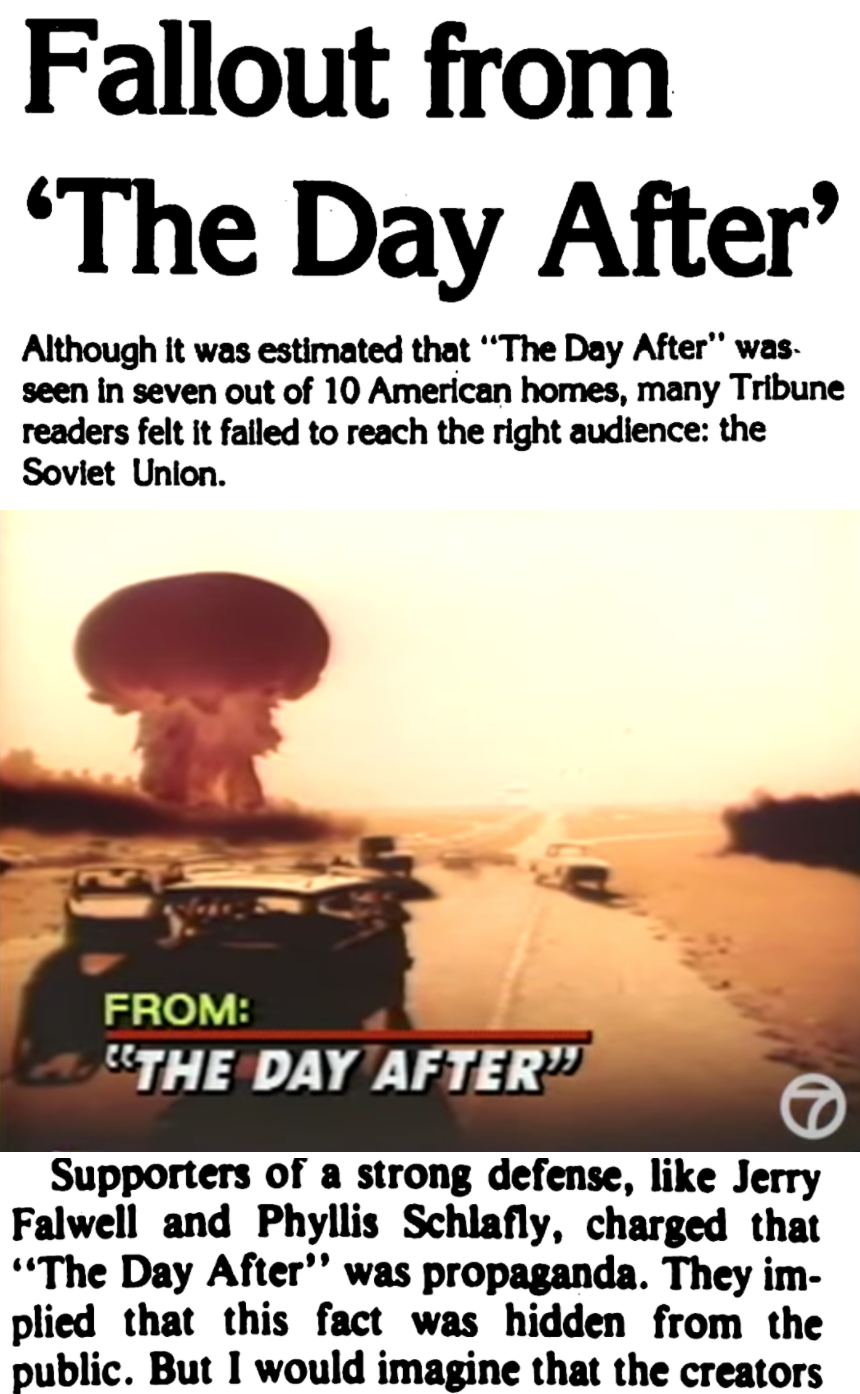
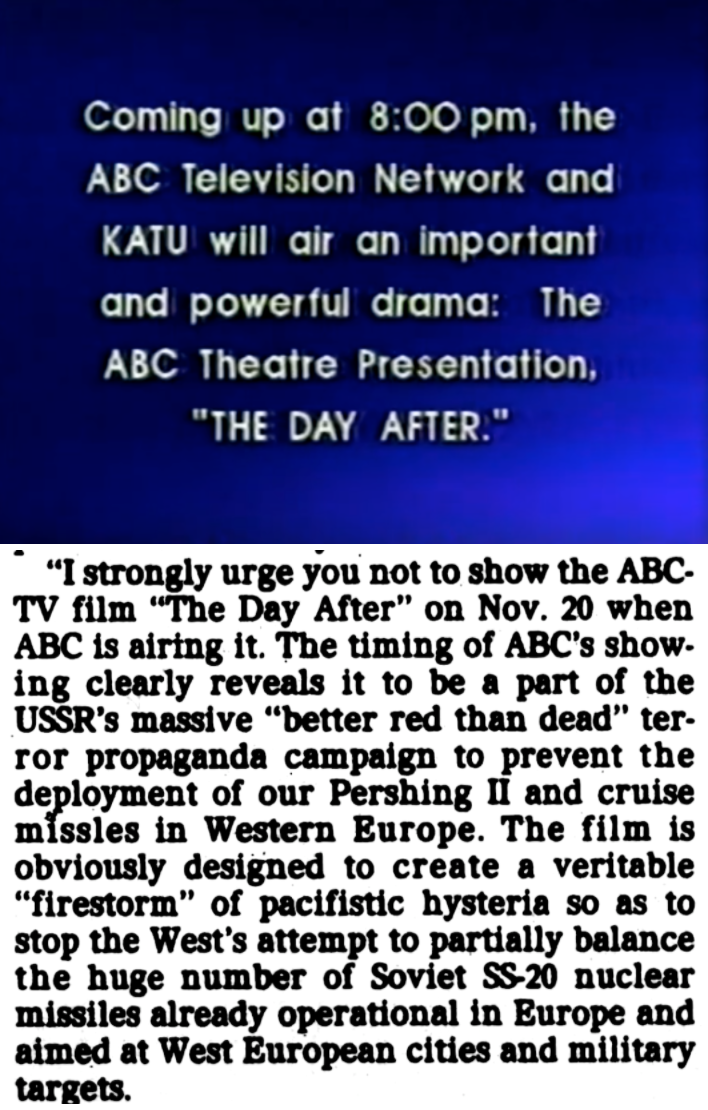
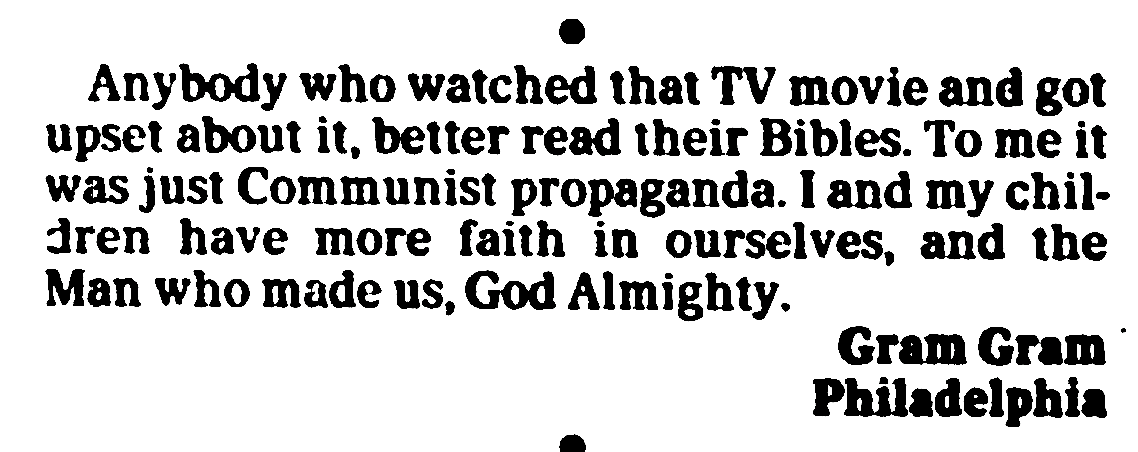
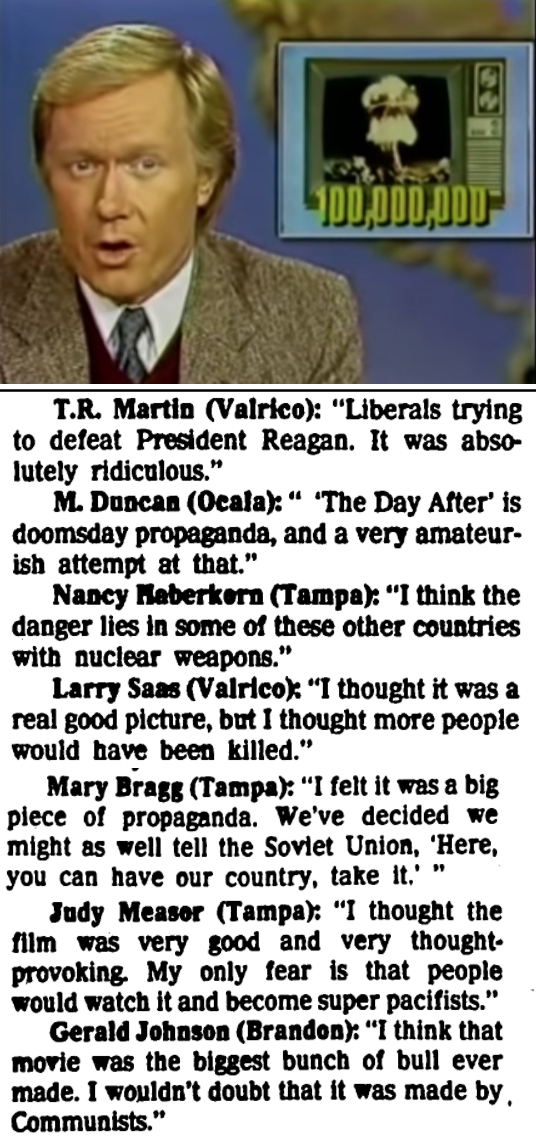
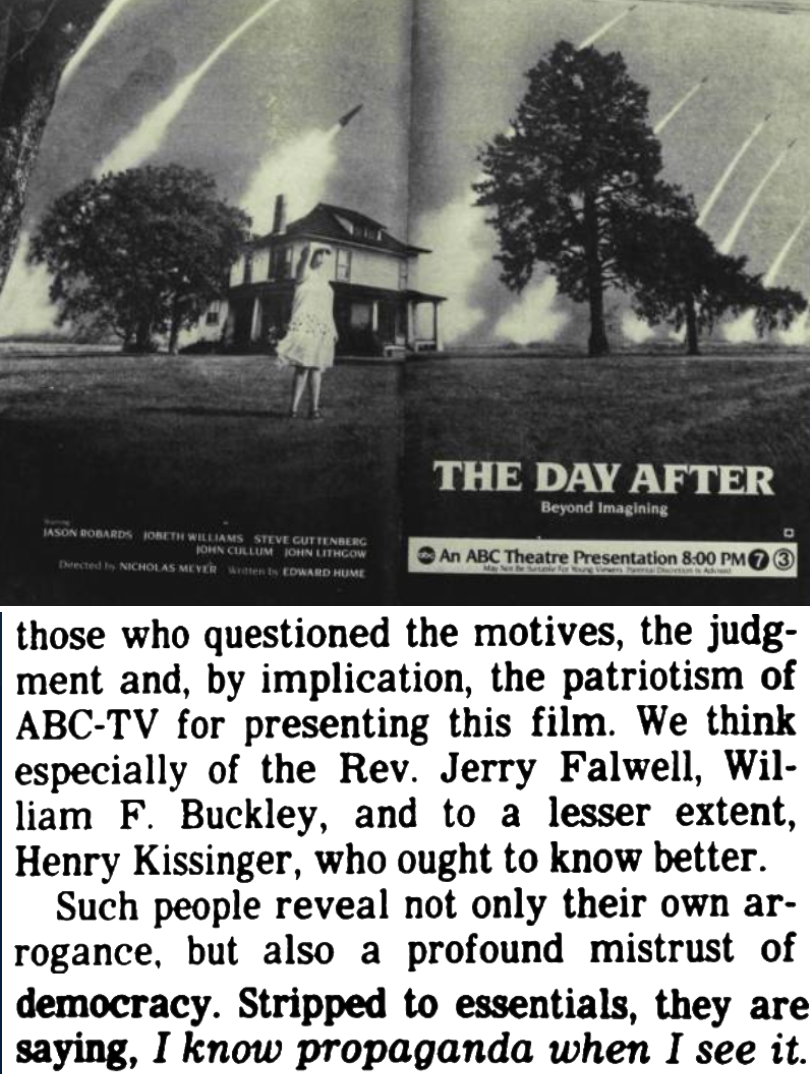
The Day After (1983), the high-rated made-for-tv movie about nuclear annihilation, was dismissed by reactionaries as nothing but...

oldshowbiz:

The Day After (1983), the high-rated made-for-tv movie about nuclear annihilation, was dismissed by reactionaries as nothing but communist propaganda

It’s worth noting that the early ‘80s were time of the “Nuclear Freeze” movement, a “hey, why don’t we just stop having nukes?” thing that was widely considered to be propped up as a Soviet op in a situation where a nuclearized Europe offered no obvious hope of conquest, and so “nuclear weapons are just horriblewas, coherently, considered a Soviet-benefiting message to inject into the culture at that point

Tagged: history

So droit du seigneur was pretty much a made-up thing to be angry at the nobility for, cause I guess people like to make up an...

So droit du seigneur was pretty much a made-up thing to be angry at the nobility for, cause I guess people like to make up an elite to get mad at, but one thing that really strikes you reading from Europe’s feudal period – which lasts up to World War I – was the frequency with which noblemen’s – and even non-noble merchants and gentry – travel diaries are like “Saw a pretty peasant girl by the side of the road. Stopped to rape her.”

Tagged: history

An Extremely Tepid Defense of Luigi Cadorna

centrally-unplanned:

rustingbridges:

centrally-unplanned:

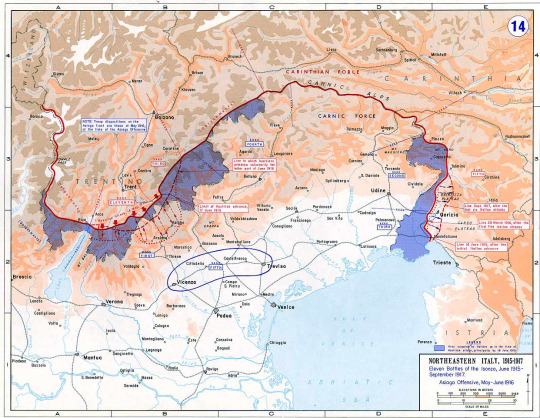
Italy’s military Chief of Staff during World War One, Luigi Cadorna, has a deserved reputation for being one of the worst commanders of the war. Bret Devereaux has a really good breakdown of all the reasons why - to summarize, if you ever find yourself fighting the 11th Battle of the Isonzo, presumably because the first ten failed, maybe you should rethink your strategy of constantly attacking mountains. Cadorna was antiquated, stubborn fool who treated his soldiers like cattle to boot.

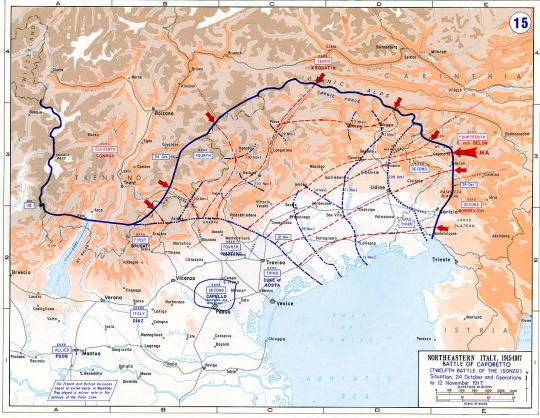
….But there is in fact a logic to his failure that I think goes underappreciated, in that Italy was in a truly *awful* strategic position in World War One. Here is a map of the Italian Front:

Ignore the battle lines, and instead focus on the terrain. The *entire* Hapsburg front for dozens of miles is mountainous, defensible terrain. There is no chance of breakthrough, no real chance of advance, just a point-by-point grind. However, this isn’t true for the Italians; once you bypass a few miles of mountains, or none at all near the east around Trieste, you are into the open fields of the Po river valley. And additionally this is very valuable land; Italy’s north is its most industrialized sector, with its economy centered around Milan just to the west of this map.

All of this terrain creates an offensive asymmetry; an Italian offensive must be sustained and will move by inches, but one Austrian offensive could achieve a breakthrough, the holy grail of military operations, and occupy valuable land - which actually happened in 1917, at the Battle of Caporetto:

Finally add to this picture the fact that Italy had one of the worst mobilization infrastructures of the war, particularly in the all-important category of rail, and as such their ability to deploy forces in *response* to enemy movements is going to be difficult.

When criticizing a military strategy, you must always answer the question “what else should have been done?” When it comes to Italy in World War One, the most common suggestion for Italy is to simply fight on another front. Send the forces to France, send them to the Middle East, operate as a supporting infantry for armies with greater offensive capabilities on better terrain. Deploy less men on this front, and be productive elsewhere. Here though is where that cursed asymmetry comes into play; it is *very* risky for Italy to deploy forces away from the Austrian front. They may only need one victory, and they can deploy forces to the front faster than Italy can. Austria can keep half the numbers Italy has for months, but if Italy draws down the numbers to match then one surprise offensive later and Venice is being shelled by artillery. Italy has to constantly keep *more* men than Austria on this front, always, to mitigate this potentiality.

So okay, Italy can’t deploy half its army to France, their forces are stuck in the Po River valley. That doesn’t mean Italy has to throw them at mountain strongholds to die by the hundreds of thousands! I mean, I agree, it doesn’t, but here is where geopolitics rears its head. Italy wasn’t attacked by the central powers; it entered the war to gain territory, specifically Austrian territory, upon victory. A victory Italy knows it can’t achieve on its own, but instead must ride on the backs of England & France. Which means Italy’s strategy is, in some ways, at the mercy of those allies.

And how do you think a strategy of “deploy our men to the Austrian border and do nothing” looks to those allies? Looks like freeloading! Austria would *love* that, due to that damned asymmetry it means it can deploy a lot of its forces away from the quiet border to more important fronts like Russia. If Italy wants to be useful, wants to ‘contribute to the war effort’, it has to attack, to make sure Austria is bleeding at least somewhat. Which the Allies understood - there was constant pressure by the Allies on Italy to do ‘something’, and 11 battles on the Isonzo was Italy’s answer to that demand. If it wanted the territories it claimed it did, it had to show its value.

Its the combination of strategic complications and political goals that tied the hands of Cadorna & the Italian military. They had no real offensive options, but had an offensive necessity, and so the worst answer emerged. None of this is a pass; Cadorna was also an awful operational commander, and there is no escaping that Italy bled its own military enough in these attacks to make them vulnerable to precisely the asymmetric breakthrough that occurred. If I was commander of Italian forces I would have bit the bullet, deployed Italian forces elsewhere to contribute, and prepared best I could defensively on the terrain, possibly building a fallback line around say Treviso where the lines are shorter and logistically better supported to make my real defense in case of a large assault. Yet such a strategy prioritizes the larger war effort over Italy’s own terrain; smart strategically, but tough politically. 

So in conclusion, Cadorna was a moron, but not quite the moron one might think when you first learn about the grind on the Isonzo. There was a lot of pressure to grind.

I mean in this case the winning move for italy is not to play, right? this was a war of choice. build factories and sell france and britain guns. maybe italy could have come out of the war as a major industrial power

I would certainly agree with that; it was the path Japan took. They did declare on Germany but due to geography they simply took a few overseas bases of the Germans (primarily the German-Chinese port city of Qingdao, then Tsingtao and the source of the Chinese beer industry) then built things for the allies. Japan’s GDP hit almost 10% annual growth rates for the war period as production of anything that couldn’t be shot collapsed in the Allied countries. Italy was absolutely positioned to be in the same boat. (But of course none of this is Cadorna’s call)

Even if Italy just ~had~ to acquire territories, I do think, similar to Japan a “declaration of war but we are gonna be pretty passive about it” would have also been a winning hand. Send “expeditionary forces” to the Allied countries and fortify the border, then you get Trieste in the peace deal or somesuch. Its not like once the Hapsburg Empire fell apart the truly Italian-speaking territories had anywhere else to go. A lesser prize, but for a way lesser cost. And hey, as it turned out as the US became the dominant force in the Allied coalition it abrogated the UK-French agreement with Italy to give it expanded overseas colonies and Balkan possessions, so they never even got the greater prize anyway. 

(If you are starting to think “wow Italy sure did sacrifice a ton for nothing and then got screwed in the peace deal, that must have impacted Italian politics a lot” well Benito Mussolini agrees with you.)

There was absolutely somewhere else for the Italian-speaking territories to go, Italy entered the war in hope of claiming lands along the eastern shore of the Adriatic, where Italian-speakers had long dominated the major trading port cities, but the Wilsonian settlement of the war distributed them as infrastructure to newly nationalist-autonomous Balkan states. That was the disappointment that soured Italy on those allies so bad (and well, and cause it spurred d'Annunzio’s addressing it himself by seizing Fiume, which fouled those relationships in other ways, such that Germany would be the obvious ally in WWII)

Tagged: history

Confederate flags on the streets of my city, Canada’s Capital. Fuck Off. @allthecanadianpolitics​ it begins…

allthecanadianpolitics:

el-shab-hussein:

lisas-stuff-and-junk:

Confederate flags on the streets of my city, Canada’s Capital.

Fuck Off.

@allthecanadianpolitics​ it begins…

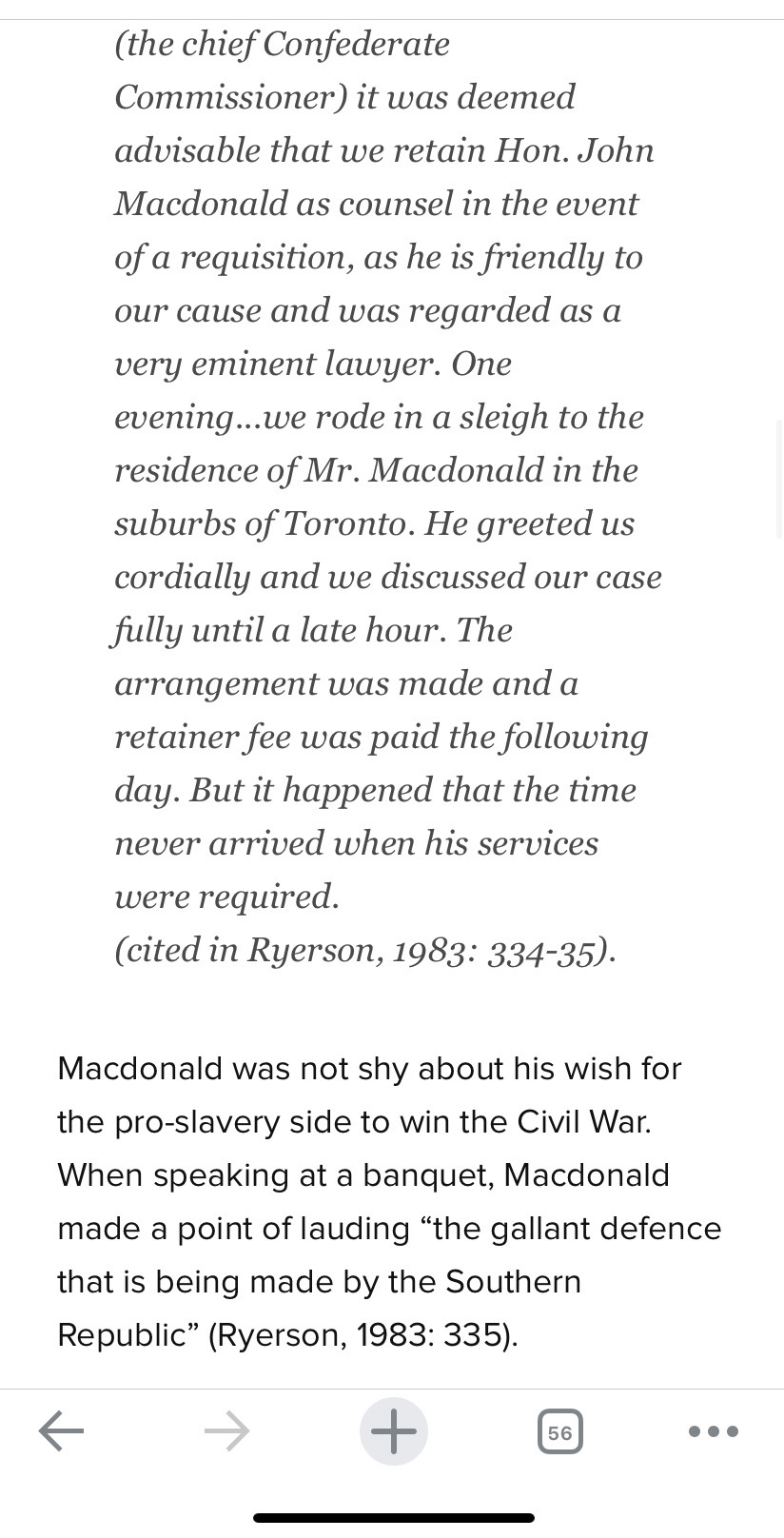
Before anyone says Canada had nothing to do with it, yes it did. The Confederacy’s president was sheltered and given full accomodations in Montreal. This sh*t’s relevant and personal.

Also this:

Canada’s first PM by the way:

https://www.google.com/amp/s/www.huffpost.com/archive/ca/entry/john-a-macdonald_b_6450442/amp

Like, 19th century Britain was famous for taking in exiled foreign radicals and failed revolutionaries against their rivals who they could leverage for geopolitical influence, that was their thing

Tagged: history

If I know humans, not even all those Chinese court dramas capture how much history was going down in the context of people being...

If I know humans, not even all those Chinese court dramas capture how much history was going down in the context of people being vomiting drunk

Tagged: history

Been thinking about the narrative arc, or the moral arc, of ancient Greek history. That is, how the history of ancient Greece...

femmenietzsche:

Been thinking about the narrative arc, or the moral arc, of ancient Greek history. That is, how the history of ancient Greece works when you drop the historical nuance and consider the period as a grand story, with nations and peoples acting as individual characters, and with a lesson to be imparted. Not every historical period can be reduced in this way. There are lots of boring periods when trade slowly expanded and all of the wars seem minor and hopelessly dull. Archaic Greece, that is Greece in the 500s BC and earlier, before the Persian Wars, is one such period. Lots of important stuff was happening - writing was reintroduced after the Bronze Age collapse, Greek colonies were founded across the Mediterranean and Black Seas, Western philosophy began - but those are all just broad trends, not a story. The Greek world was far too politically divided for that.

That changes with the Persian invasions. Even though each city state is still responding in its own way, the introduction of a common antagonist gives Greek history a shape it would otherwise lack. And the Persians are very good narrative foils for the Greeks. The vast, cruel empire controlling most of the known world vs. the plucky, (sort of) self-governing poleis. Tropes which were codified because of these wars. Somehow these squabbling cities just manage to hold a coalition together and win a series of smashing, improbable victories (or glorious defeats like Thermopylae).

Very understandable why people find that a satisfying period to learn about, but it’s not what I mean by a narrative arc of history. That’s just the story of a single conflict, not a multi-generational story spanning a century or more. For that, you have to keep going. And within a few decades you get the next narratively compelling conflict, the Peloponnesian War. Under pressure from Persia, the city-states have been compelled to join coalitions with their most powerful neighbors, Sparta and Athens, who use their alliances mainly for their own benefit, and are also natural foils for each other. Inevitably, these coalitions wind up at war with each other. Again, a narratively compelling conflict with many famous characters and events, but still not quite what I mean.

Going further forward, there are several less famous wars which are basically similar in character to the Peloponnesian War, with the most powerful city-states all trying and failing to establish lasting hegemonies and exhausting themselves in the process. From the end of the Peloponnesian War onward, this gives the Persians more and more opportunities to intervene in Greek affairs, playing one side against the other and backing the weak faction against the stronger.

Here, the broader arc starts to become clear. The Greek city-states were able to unite once to fight off the Persians, but they were incapable of carrying that unity forward. In fact, the supposed unity is revealed to be a sham all along, an excuse for the most powerful cities to expand their influence over their neighbors more than anything else. And the result of all this is that, as Xenophon says at the end of his history of the period, “In Greece as a whole there was more uncertainty and disturbance… than there had been before.” The city-states are all exhausted, all of them having failed in their bids at hegemony in basically the same way, all of them now prey to outside powers. Up to this point, the shape of Greek history is a tragedy, of defeat snatched from the jaws of victory, thanks to inevitable human selfishness.

But classical Greece continues on for just a little while longer, with the rise of Macedon. Macedonia was basically ethnically Greek, but always on the outside of classical Greek culture, and a kingdom not a city-state. But it’s that unusual position which allows Philip II to also intervene in the affairs of the city-states and establish his own hegemony over the region, which provides his son Alexander the Great with a springboard to conquer the whole of the Persian Empire. That in turn spreads Greek culture over a vast area from Egypt to Afghanistan. On its surface, this might seem like a sudden and happy reversal of the slow decline of Greece that characterized the previous century. (Happy for the Greeks, I mean.) But what was really accomplished? The city-states still linger on after this, but I think it’s fair to say that their vitality was fundamentally gone by this point. Until the Romans came they could still self-govern but had little in the way of true independence. And the Hellenistic states established in the wreckage of Persia by Alexander’s generals were like the Persian Empire itself, but worse. Inbred, infighting kingdoms that were every bit as tyrannical as what had come before, probably more so.

So the conflict between Persia and Greece ends with a total Greek victory, but in the most ironic way possible. It comes at the cost of everything that originally defined Greek-ness. That, I think is the narrative arc of ancient Greece: friends who in their youth won a great victory that granted them everything they wanted, only to fritter it all away in middle age through greed and violence, only to be granted, as if by magic, everything they had lost and more, but at the cost of the last remaining scraps of who they once were.

Or that would be how you’d tell the story as fiction, obviously the actual history is far more complicated and has no true moral to learn. Very compelling though, and with many subparts that are fascinating in their own right.

After the classical period ends, Greece enters the Hellenistic era, which is again narratively formless. While the trend of the archaic period was growth and expansion, the trend of the Hellenistic kingdoms was decline; forgettable kings fought each other as one by one their kingdoms fell to native rulers or to Rome.


Tagged: history

everyone posting that “my generation lost hobbies” post is so stupid like no you fuckwits hobbies were stolen from you by a...

fieldsoffire100:

isaacsapphire:

dagny-hashtaggart:

binary-bluejay:

triviallytrue:

degenerate-perturbation:

akinmytua2:

degenerate-perturbation:

darkwingsnark:

fuckadamrapoport:

everyone posting that “my generation lost hobbies” post is so stupid like no you fuckwits hobbies were stolen from you by a system that demands you work 8 hours a day to earn a tiny percentage of the profit you generate, leaving you too exhausted and brainwashed to enjoy exercising passion without financial incentive

Not to mention if you DO somehow have that energy to create, people put pressure on you to monetize it. You can’t draw for the sake of drawing, your family and friends think you’re good enough that you need to sell it. You can’t sing for the sake of singing, you have to turn that into a career or shut up. You can’t write fanfiction for your own enjoyment, you’re wasting time when you could be working on your OWN novel.

These are sentiments that have been told to me over the years. That people think you are ‘wasting your talents’ if everything you do isn’t for the sake of profit. And I’m here to tell you folks… that’s SAD.

Excuse me but is this post somehow implying that previous generations didn’t have to work 8 hours a day

They didn’t. Farmers didn’t work in the dark. Winter was creation time and storytime. Blame the industrial revolution.

Yes they did. The amount of labor required to maintain a preindustrial household isn’t limited to farming and far exceeds the amount of labor required to maintain a postindustrial one.

Very weary of hearing this repeated when it is just so obviously, trivially, false.

“farmers didn’t work 8 hours a day” yes because they worked significantly more

I’m pretty sure farmers work more than 8 hours a day today! If you’re going to have this take at least be an anprim because I think there’s something kinda interesting there.

Also, the equation of “farmers didn’t work in the dark,” even if it were true, with “farmers worked less than eight hours a day” is pretty baffling. I suppose if you live in Scandinavia or northern Russia, maybe? But about half the world gets 8+ hours of daylight on the winter solstice, the shortest day of the year.

Is “getting up while it’s still dark to milk the cows” not a thing everyone associates with farm life?

The thing about posts like this is that they end up being far better pro-capitalist arguments than the intended anti- ones, because they throw into sharp relief how little the people who want to “destroy capitalism” understand what might come after that, or indeed why the demographic transition was so successful at getting people off the subsistence-farming hamster-wheel in the first place.

The 8-hour (and not more) workday was itself a product of the labor movement, with the famous slogan “8 hours for work! 8 hours for sleep! And 8 hours for what we will!” Hobbies went under “what we will”, and indeed the labor movement often served as a venue through which workers explored hobbies, sponsoring teams and clubs as part of a drive to be a complete wrap-around social institution for the working class (in competition with the church and state)

Tagged: labor history history

Age of Empires IV Is a Classic Dad Game for a New Dad Generation

beyond this review or the game now I’m wondering how Dad my history stuff makes me come off

Tagged: history

Reminder that my take is we should take the Cold War Soviet Union/Warsaw Pact as just one more example in a multi-millennial...

Reminder that my take is we should take the Cold War Soviet Union/Warsaw Pact as just one more example in a multi-millennial history of “if someone manages to unite the eastern plains tribes into a coherent federation they’ll be able to use massed cavalry to take over Central Europe and threaten west until they collapse from internal tensions”

Tagged: history same as it ever was

(via File Photo)

mr-elementle:

dancinbutterfly:

nianeyna:

soupwife:

nianeyna:

rhea314:

gingerhaze:

memewhore:

pricklylegs:

mudwerks:

klappersacks:

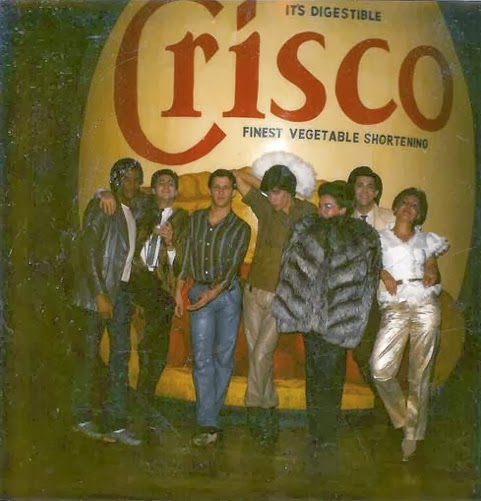
(via File Photo)

WTF are those obelisks on the right?…

Tasty obelisk fries..

“It’s digestible” has got to be the laziest goal I’ve ever seen achieved by a food product.

“It’s digestible”

“It’s digestible” is pertinent!! Okay, for those of you who haven’t researched Crisco for writing fic about gay sex in the mid-late 60s:

The first-edition of The Joy of Gay Sex, published in 1977, declared, “Vegetable shortening may be the best lubricant, since it is not only greasy but also digestible”[4] Such a statement perhaps gives new meaning to the companies boastful declarations that “Its digestible” and “Crisco has been making life in the kitchen more delicious for years.”  Similarly, in the 1978 sex manual The Advocate Guide to Gay Health, Crisco even earned an entry in the book’s index.  Discussions of the shortening’s use as an anal lubricant indicate its popularity, with statements such as: “The lubricant, typically the cultic Crisco, must be copious.”[5]  In fact, Crisco was so synonomus with gay sex that discos and bars around the world took on the name, such as Crisco Disco in New York City, which was one of the premiere clubs during the 1970s and early 1980s.  Other clubs or bathhouses, such as Club Z in Seattle, even featured murals with Crisco.  Thus, Crisco was conversely also one of many things that led to the formation of gay identities during the 20th century.

from this essay: http://www.columbia.edu/~sf2220/TT2007/web-content/Pages/drew2.html

The more you know! :D

I have learned a new thing today.

Love this post for so many reasons but most especially because this is from all the way back in 2012 and and yet not a single blog in this thread is deactivated

I enjoy that not only does this have a link to an actual source, but the link still fucking works.

but @rhea314 you didnt include a picture of the crisco disco! AND MY GOD THE DJ BOOTH WAS A GIANT CRISCO CAN!

Go dance and get fisted. Fucking iconic.

Love the gay history, but i just wanna correct that the “it’s digestible” in the gay stuff was a reference to crisco’s tagline it had been using since 1911, the actual meaning of its digestible is because it’s main competition came from “enhanced” lards which were rendered pig fat mixed with non food thickeners that literally did not digest and caused people to basically just shit out pig cream, since crisco was veggie based the body digested it along with the food

Tagged: history amhist