shrine to the prophet of americana

#history (385 posts)

kontextmaschine:

max1461:

triskeleaficionado:

Oh the solution is easy. Just uhm. Uh. Just uhm. Uhm

Servants. This is quite literally the problem servants were the historical solution to. “Hewers of wood and drawers of water”?

And wives, I guess, with bachelors turning to commercial – taverns, street carts – and fraternal – Elks lodges, country clubs – collective providers.

The thing about gold rush-era San Francisco being full of Chinese laundries and eateries is they were serving an overwhelmingly male white migrant population without wives

Tagged: amhist history

A huge chunk of the population is being forced into the position of spending more time at work than they like, on a regular...

nostalgebraist-autoresponder:

A huge chunk of the population is being forced into the position of spending more time at work than they like, on a regular basis. They are no longer being treated as members of the workforce and so they are very keen to find some way to make that bearable.

– the Casement Report, 1904

Tagged: androids dreaming of electric sheep history

this is exclusively based on my vague cultural perception but it feels like in the 50s(?) pharmaceutical drugs and nuclear power...

transgenderer:

this is exclusively based on my vague cultural perception but it feels like in the 50s(?) pharmaceutical drugs and nuclear power were both seen as something with the potential to fix a huge array of problems with minimal cost and then in the following ~20 years the culture decided they werent actually solutions, and they were disillusioned, but from my perspective actually they were pretty much everything they were cracked up to be, and that disillusionment was bullshit. like, better living through modern chemistry and the marvel power of the atom are these weird unfulfilled dreams, but unfulfilled mostly for cultural rather than practical reasons

Like, the 1950s was the “psychopharmaceuticals that will fuck you up” era. Tranquilizers, sedatives, antipsychotics. Benzos. I guess that did set the stage for Prozac in the ‘80s. And diet pills that were amphetamine salts.

And like chemotherapy, and transplant-enabling immune suppressants and contraceptives were being researched for purposes of taking things out of or putting them into or keeping them out of the body, because the 1950s were the golden age of surgery.

The antibiotic boom was the ’40s.

What are you thinking of when you invoke 1950s pharmaceutical drugs?

Tagged: history

jethroq:

Tagged: history

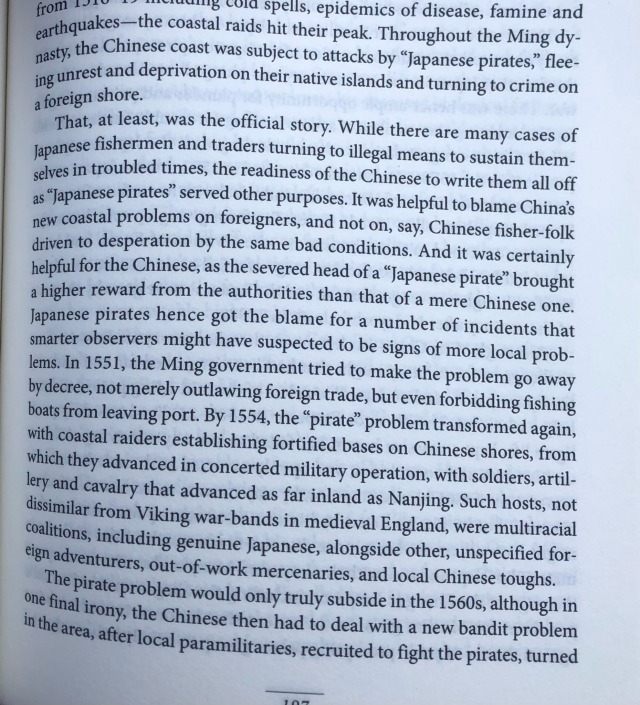
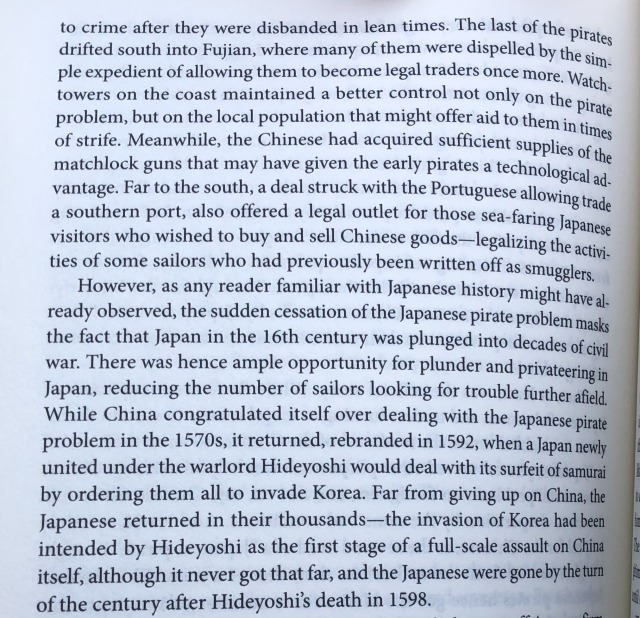
the LAW OF CONSERVATION OF BANDITS strikes again... put this one up there in “recurring historical patterns” right next to the...

shieldfoss:

sapphiresonstrings:

gender-trash:

the LAW OF CONSERVATION OF BANDITS strikes again… put this one up there in “recurring historical patterns” right next to the Tyranny of the Horse Equation.

What’s the Law of Conservation of Bandits?

If you have a raider problem

And you raise an army to kill them

and then you disband your army

now you have a raider problem

Tagged: history meanwhile in japan

Honestly you ask me, WWII was about what happens when the 19th century European struggle over French liberal revolutionary vs....

Honestly you ask me, WWII was about what happens when the 19th century European struggle over French liberal revolutionary vs. Prussian conservative counterrevolutionary nationalism is expanded to imperial scale

Tagged: history

I kinda hate it when historians are like "the point of history is surely not to compile a dry record of events, but to extract...

mitigatedchaos:

max1461:

I kinda hate it when historians are like “the point of history is surely not to compile a dry record of events, but to extract some deeper lessons or patterns from those events”. Like, no! The dry record of events part is the only epistemically reasonable part of this whole deal! Your field is so good at dry records of events and so bad at extracting larger patterns! Leave searching for patterns to people who study things in which meaningful patterns exist in the first place, and recognize that there’s nothing wrong with the fact that history is largely random unrelated shit happening in a row.

Type of guy that has a plan to separate the record-keeping and pattern-seeking branches of history into different departments.

Tagged: history historiography

Political power in medieval Germany was always split between, on the one hand, the handful of major families whose power could...

apricops:

Political power in medieval Germany was always split between, on the one hand, the handful of major families whose power could rival or at least threaten the Holy Roman Emperor, and on the other hand a collection of independent towns and smallholders. The balance of power was, one could say, between five guys, burghers, and freis.

Tagged: history

So we hear that ectopic pregnancy is (can be?) fatal, so uh, how was it treated before Roe v. Wade? Just therapeutic surgical...

youzicha:

kontextmaschine:

So we hear that ectopic pregnancy is (can be?) fatal, so uh, how was it treated before Roe v. Wade? Just therapeutic surgical abortion? And before that?

Like, if this has always been a thing that happens to humans, it left traces on history, right? I knew that pregnancy used to be more often fatal with women dying in childbirth, but I’m trying to think of a historical, even fictional occasion of a woman getting pregnant and it just going sideways. There might well be, but still, I’m trying to think of it.

Midwives! Was this one of their things, that they had some key to recognizing and then providing abortifacient herbs?

According to The history of the diagnosis and treatment of ectopic pregnancy: a medical adventure,  

Until the 19th century, ectopic pregnancy was known only as a universally fatal accident.

Before the invention of ultrasound imaging in the late 1960s and precise measurements of hCG levels in the 1970s, early ectopic pregnancies were very difficult to diagnose accurately. The main signs are pain (particularly in the abdomen and shoulder) and vaginal bleeding, but bleeding also occurs in around 10% of normal early pregnancies so this is not specific at all. Doctors would diagnose it in the later stages, and confirm by autopsy.

Towards the end of the 19th century there was some attempts at medical management, but not successfully:

Since the ectopic fetus was thought to be responsible for killing the mother, the treatment was directed at killing the fetus. The arsenal included starvation, purging and bleeding of the mother, administration of strychnine, passage of electromagnetic, galvanic or Faradic currents through the ectopic mass and injection of morphine into the fetal sac [4,7]. Whatever the treatment, the prognosis was bad: the fatality rate towards the end of 19th century was between 72 and 99 percent [5].

The breakthrough came in 1883, when Lawson Tait successfully treated a ruptured tubal pregnancy by surgery. In the 1880s he treated a series of cases, and around 1890 this started to become generally adopted. For the next 70 years, surgery remained the only treatment. 

In the 1980s (so postdating Roe v Wade), medical treatment was developed.

Methotrexate, a folanic acid antagonist, was first reported by Li and Hertz in 1956 to be effective in the treatment of gestational trophoblastic disease [59]. The first case report of methotrexate use in therapy for abdominal ectopic pregnancy appeared in 1968 [60] and for tubal pregnancy in 1982 [61]. 

Note that the modern abortion drugs were developed in the 1980s too. At the time there were some experiments with using abortion drugs (mifepristone etc) for ectopic pregnancies, but none of them seemed to work as well as methotrexate, which remains the current standard treatment.

Ectopic pregnancy is surely not universally fatal, since some of them resolve through spontaneous abortion, but because it is hard to diagnose it is difficult to know how what the untreated fatality rate is. Conversely, I guess in the old days some deaths from internal bleeding in the first trimester might not have been understood as pregnancy-related.

Well, question answered.

Tagged: ectopic pregnancy history

Sun Tzu is so fucking funny to me because for his time he was legitimately a brilliant tactician but a bunch of his insight is...

limpurtikles:

crazy-pages:

biohammer:

elidyce:

balaclava-trismegistus:

Sun Tzu is so fucking funny to me because for his time he was legitimately a brilliant tactician but a bunch of his insight is shit like “if you think you might lose, avoid doing that”, “being outnumbered is bad generally”, and “consider lying.”

My personal favourite is his lengthy lecture on the subject of Supplies Being Very Important I Cannot Stress Enough The Importance Of Protecting Your Supply Lines But Also Supply Lines Are Expensive As Shit So Steal The Enemy’s Supplies At Every Opportunity. 

via- @elidyce

One of the more important things to consider about any historical work is the audience it was published for. The Art Of War was aimed at fancy nobles high on philosophy with little practical military experience who were nonetheless leading armies.

Sun Tzu, after desperatly trying to explain extremely basic logic to a bunch of upper-class twits, basically sat down and wrote the most elaborate “As per my last email” ever

Tagged: history

Food for man may also be considered as a compound of the original elements, of the qualities, combinations, and control of...

raginrayguns:

vacuouslyfalse:

Food for man may also be considered as a compound of the original elements, of the qualities, combinations, and control of which, chemistry is daily adding to our knowledge; nor is it yet for man to say to what this knowledge may lead, or where it may end.

it’s really funny to me that this half-assed response to Malthus, who believed that the inability to grow more food created what was basically an inescapable population limit, turned out to be totally correct.

“well, uh, maybe if we study chemistry a bunch we’ll magically figure out a way to grow, like, 100 times as much food as we currently can”

and then we did!

i read something about the early history of understanding of photosynthesis, and in the decades leading up to 1816 when the quote from OP was written, they pretty much figured it out:

Respiration and combustion:

oragnic matter + oxygen → carbon dioxide + water + energy

Photosynthesis:

carbon dioxide + water + light → organic matter + oxygen

Not with this terminology. Some of the people involved worked with the phlogiston theory, phlogiston being pretty much negative oxygen, so they called oxygen “pure air” or “dephlogistonated air”. Lavoisier called it “oxygen” though. And the name “carbon dioxide” doesn’t make any sense pre-Dalton, they called it “fixed air” or “carbonic acid gas”. And nobody was talking about “energy” in this context yet. And the term “photosynthesis” really refers to synthesis of glucose, and they didn’t know that’s what was happening yet.

But in their own terms they knew the reactions described above were happening. They knew the “photosynthesis” part was happening at the leaves in light, and that respiration dominated in the dark.

And the plant nutrients were recently discovered, beyond a vague “they need something from the soil.” This guy de Saussure was doing basically hydroponics in his laboratory.

Jane F. Hill:

De Sassure did not trace the source of plant nitrogen convincingly, but he correctly concluded that the source of this nutrient is not atmospheric nitrogen gas, as Ingen-Hous (1796) and many others had believed.

That’s important because it seems like it may have led to the first big payoff from chemical knowledge, for agriculture. I’m not thinking of industrial nitrogen fixation here, I’m thinking earlier, the nitrate mining in the Atacama Desert in Chile. Of course people have long fertilized soil with manure and other organic fertilizer, but when and how did they realize that the “Chile saltpeter” could be used for fertilizer? How sophisticated or difficult was the process to get nitrates from ore?

Apparently they started mining it in 1810 (according to this source, though idk whether for fertilizer?). And exporting to Europe for fertilizer in the 1830s. So… like… how did they know how to do this and that it would help plants grow? I suspect the knowledge was pretty recent.

Anyway… a lot that I don’t know here… but… I was reading to try and get a sense of what was going on in 1813. It was too early to directly observe chemistry making an impact on agriculture. But if you were attentive to intellectual stuff you could see the progress being made.

I wonder when obtaining nitrogen for fertilizer from the air, using industrial chemistry, was first imagined. Seems de Sassure could have at least thought of it, even though it would be another 100 years before it was executed.

But like… ok, of course people have long known that crop yields are limited by the fertility of the soil, and you’ve got to do all you can fertilizing it just to keep up with the depletion of the soil by crops. And around the time the quote in OP was written, was pretty much the same time they were actually figuring out what materials conferred “fertility”, and shortly before they started getting nitrogen from an inorganic source, the nitrate ores in Chile. The timing makes sense to me. The reasoning in the quote is half-assed but a much more detailed case could have been made at the same time, and I wonder if the author was drawing on another source that fleshed it out more.

Tagged: history

Taking my cousin to visit the Nelson Mandela House museum, there was a tour guide there with a group of New Yorkers there from...

raginrayguns:

andmaybegayer:

andmaybegayer:

Taking my cousin to visit the Nelson Mandela House museum, there was a tour guide there with a group of New Yorkers there from some educational programme. There was a very interesting reaction when he told them that the CIA was responsible for giving Mandela up to the Apartheid government in 1962, I forget that it’s not common knowledge that the USA saw Apartheid South Africa as a bulwark against communism in Africa.

It’s also easy to forget that the years before Mandela’s arrest overlap pretty much completely with the activity of MLK the USA. The American Civil Rights Act only came into effect a few years later.

The Cold War West in general backed themselves into a corner when dealing with Apartheid South Africa because on the one hand, Nazis had made blatant racial segregation uncool by the end of the 50’s, but on the other hand, the opposition to the Apartheid government consisted primarily of socialists and communists and was in many ways a weird semi-third-worldist movement.

https://www.washingtonpost.com/news/worldviews/wp/2016/05/16/the-cias-mysterious-role-in-the-arrest-of-nelson-mandela/

As the only industrial economy in sub-Saharan Africa, South Africa was one of the most critical dominos in Domino Theory; a communist South Africa would be even more useful as an African base for further communist expansion than Angola, having an impact like or even greater than Cuba in Latin America or China in Asia. Its command of the Horn of Africa also offered influence over sea lanes. Recall that from 1967 to 1975 the Suez Canal was closed, and western powers were on guard against attempts to secure the Indian Ocean as a communist redoubt

Tagged: history

So when you hear about the low rates of human survival to adulthood in the past most of that is disease, but some of it is that...

So when you hear about the low rates of human survival to adulthood in the past most of that is disease, but some of it is that many humans form in ways that can naturally survive to birth but not that much further. These ways are the most famous of what we know as “birth defects” (much as miscarriages were often formed in ways viable for some gestational development but not to birth), and part of the transition from midwives to hospital birthing was about how this enabled easy follow-on care from the growing specialty of surgery for anatomical anomalies.

Tagged: history

Collections: Logistics, How Did They Do It, Part III: On the Move

poipoipoi-2016:

argumate:

Indeed, getting lost in familiar territory was a real hazard: Suetonius records that Julius Caesar, having encamped not far from the Rubicon got lost trying to find it, spent a whole night wandering trying to locate it (his goal being to make the politically decisive crossing with just a few close supporters in secrecy first before his army crossed). In the end he had to find a local guide to work his way back to it in the morning (Suet. Caes. 31.2). So to be clear: famed military genius Julius Caesar got lost trying to find a 50 mile long river only about 150 miles away from Rome when he tried to cut cross-country instead of over the roads.

Apparently, Gulf War 1 was sort of a big deal in that even in 1991, you couldn’t just start randomly driving across sand dunes through the desert like that.

Tagged: geography history same as it ever was

people talk about how ancient egypt lasted a really long time but it doesnt seem clear to me that it was like... a single thing...

thatlittleegyptologist:

tanadrin:

transgenderer:

tanadrin:

transgenderer:

people talk about how ancient egypt lasted a really long time but it doesnt seem clear to me that it was like… a single thing in any sense that lasted thousands of years. certainly the ptolemaic dynasty wasnt the same sort of thing as the stuff that came before, it was an exterior conquest. there were literally dozens of ancient egyptian dynasties and it seems like a bunch of them were exterior conquests? like, i guess in a sense ancient egypt lasted for a really long time, but it doesnt seem like theres a meaningful sense in which it lasted *longer* than any other series of societies occupying a particular area that agriculturalized early

seems to me that *maybe* at most any one of the periods marked here is meanignfully a single “thing” that lasted a long time

the cultural continuity definitely lasted at least until the Roman conquest, i.e., Ancient Egyptian-speaking people worshipping the Ancient Egyptian gods. I don’t know what the language situation was like just before the Arab conquest, given it was part of the wider Greek-speaking eastern mediterranean world, and of course it had been mostly Christianized at that point, but insofar as it was ruled from cities on the other side of the mediterranean since the Roman conquest (big administrative change) and by the end of the roman/byzantine period its culture had changed dramatically, I think there’s a case to be made that “ancient egypt” is a coherent periodization, even if it’s not an unbroken chain of clear successor states in the modern sense.

obviously ancient egypt on the eve of the Roman conquest and ancient egypt 3,000 years earlier are probably two very different places! very different culturally and linguistically. but there’s more continuity there than with what came after, which is what I think people are emphasizing with that kind of periodization. vs. post-Roman and post-Arab conquest. similarly, when people conceptualize “China” as an entity stretching back into the mists of antiquity, vs the state that’s existed since the end of the civil war, they’re emphasizing an important continuity of culture/language/identity that has been maintained across that period even as the dynasty/state has frequently changed.

What I’m saying is it’s not clear to me that there’s MORE cultural continuity here than any other patch of land. Large cultural conversions/displacements are rare afaik

I don’t think cultural conversions are that rare–big states drawing surrounding areas into their cultural orbit and radically changing their cultures seems to be a common pattern as far back as early axial age empires. Displacement of populations, esp. from highly urbanized, densely populated areas like Egypt, does seem to be rare–Anatolia and Egypt have probably had a genetically-similar population since early antiquity–but I always assumed periodizations like this are meant for historical/cultural/linguistic/archeological purposes, not genetic ones.

(I reckon large-scale population displacements were a lot more common in northern Europe and the steppe until much later, since they had much lower population density)

Ok, I was going to pass this by because I don’t really have the spoons, but it’ll bother me if I don’t address it. There’s a lot of overthinking going on, and this is where you’ll lose yourself when you’re talking about civilisations like this.

I’ve talked a little in the comments of this post, but I’ll bring it to the fore here:

First of all: Dynasties are made up. Mantheo created them during the Ptolemaic period, and they are entirely arbitrary, and quite frankly done when Mantheo was missing a load of kings because the Egyptians themselves sorta….erased them from history. The Egyptian’s control of their own history is something we’ll circle back round to. But, the point is is that the Egyptians did not define themselves by Dynasties. They didn’t even define themselves by ‘Old/Middle/New/Late/Ptolemaic/Roman’ or any of the Intermediate periods. In fact, the only way they defined themselves was by the beginning and end of a King’s reign. There were certainly eras they wished to hide from their history (*cough*amarna period *cough*) but by and large, for the Egyptians, it was just one long continual block of time. Egyptologists use these markers as they are when we can define periods of either cultural or political change.

The reason it 'lasted longer’ is, in all honesty, fairly simple: they were quite insular, thus not actively picking fights all the time with their neighbours, and they thought Egypt was the best place on Earth so saw no need to expand much. Thus, all their resources were mostly dedicated to building and sustaining their own little world. There are also very few other civilisations to interact with at this point. If it’s just your civilisation, in contact with a couple of others, and you’ve got no idea that places such as China even exist?? Well you’re going to stay roughly in one spot, and occasionally fight with the neighbours. No one is travelling far. No one needs to. We’re in the very early stages of written history (oral history goes back far further, just ask the Australian Aborigines who have 40,000 years worth of continuous oral history), and we’re dealing with civilisations of maybe 5 million people, if that. There’s no need, or impetus, to change anything significantly. Thus, they remain as they were. There’s no more meaning than that.

Coming full circle back to the Egyptians being very in control of their own history; there is a conscious effort, on the part of the Egyptian state, to heavily archaise themselves. From the Old Kingdom onwards, there is a concentrated effort to keep the art style and culture the same as it was during their 'golden age’ i.e. the time of the Pyramids (which was a remarkably small amount of time). The Egyptians made the decision to 'freeze’ art style and cultural development so that it matched the people they were emulating. This is where people get stuck, because it’s always 'lol the Egyptians were shit at art and never changed’ and it’s not true. They could do very fluid art styles, see the Amarna period, but they actively chose not to do this. This causes the cultural continuity that you’re on about. It’s a very simple thing, and likely the Egyptians forgot the reasons they were doing it over time. It just became one of those deeply embedded cultural things: we do this because we do this. Much like British queuing I guess.

There are certainly significant upheavals in Egyptian cultural history. This is why we have the Intermediate Periods, as these were times of chaos for the Egyptians that once they were over, they swiftly set everything back to the way it was and went on as they ever had. You can’t see change in Ancient Egypt on a macro scale. There’s too much time, and we’ve got gaps in our knowledge that make all of it blur together. It’s only when you get significant incursions or change in political leadership that you get a large cultural change. This is why animal sacrifice and mummification really only begins with the Late Period and the rules of the Kushite and Persian kings. These kings bring with them their own culture, and it gets embedded into Egyptian culture. On a micro level, things were changing all the time. This is why you see differences in fashion styles, softening of consonants in the spoken language reflected in the written language as the world continues to expand and Egypt comes into contact with newer civilisations, or changes in technology and technique that while still making the same art they always have are made in an entirely new way thanks to trade. Despite all of this the Egyptians keep doing things like using an older form of the language on temple and tomb walls, despite using the newer form in every day documents, or using texts from the Old Kingdom as scribal school teaching materials in the New Kingdom (coincidentally, this is how we actually know about some of the OK texts, because we have NK copies when the originals are lost). They did this because maintaining a very set image was important to them culturally, and it remained that way throughout the entire history. Even when they are invaded, the new political elite take great pains to at least attempt to continue as it always was. When that happens, you know something was so strongly embedded in a culture that even conquers couldn’t do away with it.

Basically, the Egyptians did this to themselves, consciously and deliberately. This is why there’s so much continuity. It’s as simple as that.
Tagged: history

I’d love to read a kontextmaschine’s history of Portland rendered in the same way that they formatted Martin Gilbert’s History...

steampunkforever asked:

I’d love to read a kontextmaschine’s history of Portland rendered in the same way that they formatted Martin Gilbert’s History if the 20th Century.

I know a lot of broad trends I can link to broad trends in general but I’m actually quite thin on the details

Tagged: portlandportlandportland history

Around two thirds of the way through the last Revolutions season, it's a good reminder that I should probably do a deep dive on...

vacuouslyfalse:

centrally-unplanned:

vacuouslyfalse:

Around two thirds of the way through the last Revolutions season, it’s a good reminder that I should probably do a deep dive on WWI sooner or later (maybe @centrally-unplanned or someone else has a book recommendation? podcasts work too)

It’s easy to get overwhelmed by the scale of the tragedies of the past, the Iraq War is probably the single biggest tragic conflict of my lifetime (just eyeballing it) and both world wars were so much bigger, if nothing else I hope we as a species never do that shit again

World War One is one of those subjects where its vastness kindof defies one book, there are so many angles to it! If you really do want a “101 me with a book bro” take, honestly the classic is the oldie-but-goodie Stokebury’s Short History of World War One, it covers every angle in concise ways, and in ways that you can skip if it isn’t your area. It is a little outdated, having been written in the 1980′s, but I don’t think anything too problematic is in there (sections on the Russian Revolution will have the most ‘couldn’t access the documents in the 1980′s” issues).

From there is just, man what do you want to know, ya know? For the “how did it happen?” question, Joll’s Origins of the First World War is the classic, really blends the blow-by-blow diplomatic history with the grand social trends. If you want the consequences of the war and the world it made, the legendary Adam Tooze has The Deluge, which goes from the latter half of the war through the twenties to look at how the peace shook out and then fell apart.

Or if you are an economic history nut like me, you can just go all in with The Economics of World War 1, which contains an essay for each major combatant of how they mobilized, financed, and traded through the war, but I doubt you want this ^_^

Ill give a niche but easy opener recommendation to Bret Devereaux’s brilliant essay (2-partner) on the fundamental military dynamics of World War One, answer the question “why did trench warfare occur, and how come it couldn’t be broken?” An extremely quick way to grapple with the central military reality that shaped the war effort of each combatant.

But yeah if you want something more specific let me know and I will see if I have anything I can recommend.

(I am not much of a podcast person, alas, others can cover that I’m sure).

!!!

This is really helpful, I think I’ll jump off from the sources here and if I feel like something is missing when I make my way through them I’ll ask you

Tagged: history

"a group of self-appointed vigilantes" It is literally the defining concept of vigilantes that they are self-appointed!

kontextmaschine:

a group of self-appointed vigilantes

It is literally the defining concept of vigilantes that they are self-appointed!

Well, they could be appointed by Committees of Vigilance, which were themselves self-appointed, like the Committee of Public Safety which claimed authority from the people in the French Revolution, which recall was an inspiration in living memory for much of the 19th century apex of American vigilantism (the Southern color line wasn’t the only thing being enforced by mobs and lynch law)

Tagged: amhist history

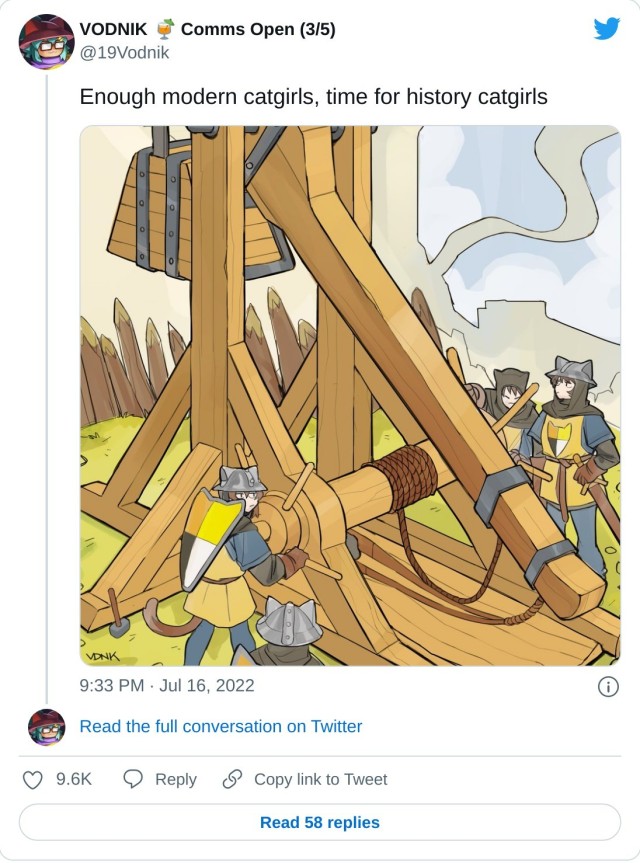
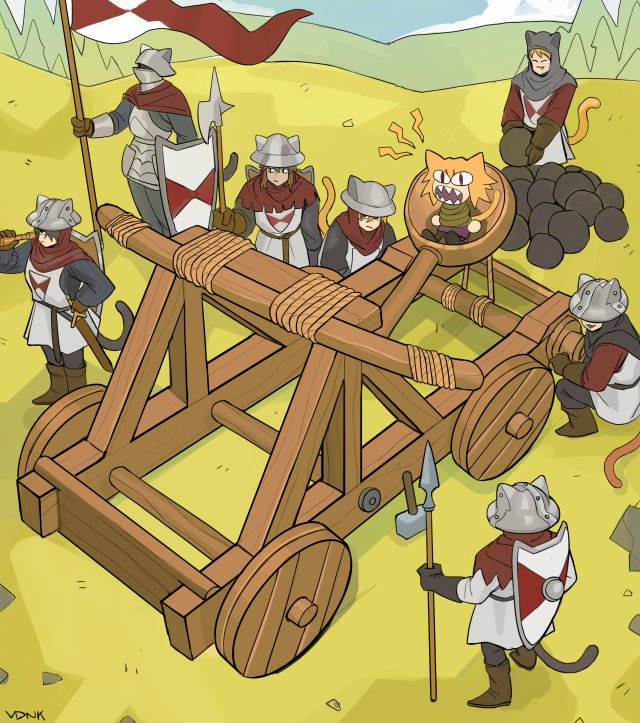
https://twitter.com/19Vodnik/status/1548420707226267649?s=20&t=n8ETIggoF5vZRgeNlgURNA Support the original artist @/19Vodnik on...

wearemercs:

we-are-siege-engineer:

https://twitter.com/19Vodnik/status/1548420707226267649?s=20&t=n8ETIggoF5vZRgeNlgURNA

Support the original artist @/19Vodnik on their page.

More Catgirl History lessons… by 19Vodnik

Tagged: history

Can't take seriously anyone who throws around the term "Christofascism" without ever mentioning Franco

kontextmaschine:

Can’t take seriously anyone who throws around the term “Christofascism” without ever mentioning Franco

Like fuck, talk about the Cristero War! Talk about the Arrow Cross Party! Talk about the Vendée and Solidarity! Talk about Christian Democracy as an anticommunist bulwark in postwar Italy! Give us some sign that you’re not banging together two badthings half-remembered from 1988!

Tagged: christofascism history