The term national socialism seems to have been invented by the French nationalist author Maurice Barrès, who described the aristocratic adventurer the Marquis de Morès in 1896 as the “first national socialist.” Morès, after failing as a cattle rancher in North Dakota, returned to Paris in the early 1890s and organised a band of antisemitic roughs who attacked Jewish shops and offices. As a cattleman, Morès found his recruits among slaughterhouse workers in Paris, to whom he appealed with a mixture of anti capitalism and antisemitic nationalism. His squads wore the cowboy garb and ten-gallon hats that the marquis had discovered in the American West, which thus predate black and brown shirts (by a modest stretch of the imagination) as the first fascist uniform.
this feels almost too on the nose to be a historical fact
What’s the source for this op?
sorry I didn’t mean for this to get passed around, it’s from Chapter 2 of Anatomy of Fascism by Robert Paxton
There was a dude who showed up to a 40k tournament in nazi shit and GW had to like. “The empire sucks please it’s satire the empire is terrible it’s the entire point we Will ban you for being a nazi here.”
I think *everything* about the lore even stuff they still put out screams that they are fascist and evil and yet people still don’t get it, or actively are drawn to it anyway like yes they are fascist more of this please!
i’m gonna have to disagree with you on this, tbh–i think the fascists who love the empire are ‘getting it’ just fine.
sure, the stuff that comes out about the empire and space marines is clear that they are cruel and violent. but they are cruel and violent and right. but they’re also very very big on the heroism of the space marines, the glorious power of the god-emperor, how real the threat of chaos is. chaos as it exists in warhammer 40k is basically the fantasy of the fascist made reality–a creeping, ever-infiltrating, ontologically evil force that will take root and destroy everything if perfect purity and control are maintained for even a second. like, yes, the empire is very clearly fascist, but they exist in a setting in which fascist propaganda is fundamentally true. fascists are able to see themselves in the empire because empire is, again and again, justified and vindicated by 40k’s writing.
and tbh this was barely better in the early days, as much as people like to cry 'well it was meant to be satire’, but at least the empire used to be also extremely fucking textually useless and incompetent to the point where they were doing more harm than good. but over the years this has entirely given way to the hypercompetent Tough Men Doing What Needs Doing space marine wank that makes up 99% of 40k output nowadays
Honestly I even think ‘a universe where the premises of fascist mythology are true’ isn’t, like, an impossible conceit to do something interesting and worthwhile with. But 'and our protagonists are the literal spartinate unbermensch action heroes’ does kind of close off like 99.99% of them.
The Empire is totalitarian continental Europe as seen from late-20cen Great Britain: the Space Marines, all technologically-advanced ubermenschen stormtroopers but not enough of them, are the Nazis; the Imperial Guard, all masses of tanks and infantry kept in line by ruthless commissars, are the Red Army; and all the rococo gold-filigreed God-Emperor stuff and heresy-hunting are the Catholic Church
The British themselves are… the orks, as a spirited, rowdily violent bunch of football casuals and assorted lads
The loose overarching relationship of said God-Emperor to the various practically autonomous, warring worlds and chapters of the Imperium is not unlike the relationships of the Popes and/or Holy Roman Emperors to various feudal states and structures
“Environmental degradation resulting from trade in Ezo [old name of Hokkaido] cautions against the argument that commercial growth in early-modern Japan was confined to, as some suggest, a “total environment”. In the Tokugawa years, the Japanese did not set their collective sights exclusively on resources that lay within the traditional provinces or confine themselves to a “total environment,” but rather cast their gaze widely over Hokkaido, the Kuril Islands, and much of Sakhalin Island, searching for new resources to fuel the flames of markget growth, to fertilize cash crops, and to feed a stable urban population. In this way, even in early-modern Japan, the environmental context was not fixed but was, as Conrad Totman insists, “shaping and beaing shaped by human activities.” Environmental changes were “crucial variables in the Tokugawa economic experience.” This economic expansion into Ezo, in addition to having implications for Ainu and other groups in the North Pacific, raises intriguing questions concerning whether Japanese colonialism in East Asia should be viewed as an exclusively post-Meiji phenomenon, or in other words, as the imperialist implications of modernization shaped predominantly by Western models. To begin with, in the realm of what Alfred Crosby calls “ecological imperialism,” the exchange of contagions in Ezo and the demographic and cultural consequences of massive epidemics introduce the horrible specter of the interactions between semi-insular populations such as the Ainu and endemic-disease carriers such as the Japanese. Of all the many facets of the Ainu-Japanese relations […] disease clearted the way for the Japanese settlement of Hokkaido possibly more than any other factor and, hence, pushes historians to confront the ecological implications of expansion in Japan’s pre-Meiji world. On a political leve, moreover, the link between the state, merchants and foreign conquest in Ezo resembles the later Japanese colonial experience in Korea, where, as Peter Duus argues, the “symbiotic ties” formed between government and business facilitated the national enterprise of the annexation of Korea. The political process of colonizing Korea, writes Duus, was associated with the “penetration of the Korean market by an anonymous army of Japanese traders, sojourners, and settlers,” resembling with important distinctions, the situation in Ezo.”
— Brett L Walker, The Conquest of Ainu Lands: Ecology and Culture in Japanese Expansion 1590-1800
Prissy urbanists fainting over “traffic violence” just don’t have their reference frame set right; by comparison to the industrial era, the odd thing about today is all the other machinery in regular use that isn’t killing and mutilating people all the time
So if we’re all doing our retrospective takes on the Iraq War, mine was… it wasn’t that big a deal? In scale, direction, and costs borne and imposed it was basically well within norms for what the country might get distracted with over a two-decade period.
Already within my lifetime the specter of the Vietnam War, once much more significant in national affairs, looms not nearly as large as I remember it doing in the ‘80s (indeed, the easy victories of the “Desert Shield/Storm” Iraq excursion of the early '90s were specifically hailed for dispelling this “Vietnam Syndrome”), as colorful but not particularly important chapter of 20th Century American history.
While the action did not serve to renew America’s post-Cold War unipolar “hyperpower” moment, I honestly don’t think it accelerated its end any, which looks to be more a product of the development of China and reassertion of Russia than any “Clash of Civilizations”.
…the Iraq War – the (cultivated) reaction to it, and then the backlash to that reaction, and then the fallout from the actual war being such a huge debacle – ended the decade-and-a-half End of History.
Even if it had no lasting geopolitical impact whatsoever (which seems like a stretch), its impact on the American psyche was quite enough to be a History-Defining Big Deal all by itself.
Which seems like it would be your jam.
I mean that was the way it happened, but if not for that then…?
Like, if it didn’t have military commitments at the time the US might’ve engaged harder in the Crimea crisis, and the Syrian civil war would have been obviated and the big refugee flow to the EU preempted. That’s the two things I can see going differently.
If the Iraq and Vietnam wars aren’t major events, what qualifies? I assume you’d say that the world wars were more important globally, and the civil war was more important nationally, but are there any non-war events that make the cut?
The World Wars were, the Civil War was, the Cold War as a whole was, Iraq’ll get put with Afghanistan and Granada, the old Desert Storm/Shield, Yugoslavia and the “R2P” era as “miscellaneous post-Cold War search for purpose”
just like the Gilded Age is “miscellaneous post-Civil War search for purpose”
So if we’re all doing our retrospective takes on the Iraq War, mine was… it wasn’t that big a deal? In scale, direction, and costs borne and imposed it was basically well within norms for what the country might get distracted with over a two-decade period.
Already within my lifetime the specter of the Vietnam War, once much more significant in national affairs, looms not nearly as large as I remember it doing in the ‘80s (indeed, the easy victories of the “Desert Shield/Storm” Iraq excursion of the early '90s were specifically hailed for dispelling this “Vietnam Syndrome”), as a colorful but not particularly important chapter of 20th Century American history.
While the action did not serve to renew America’s post-Cold War unipolar “hyperpower” moment, I honestly don’t think it accelerated its end any, which looks to be more a product of the development of China and reassertion of Russia than any “Clash of Civilizations”.
history will vindicate me! I mean you can’t prove it won’t; we’re both going to be dead for most of it. but I can’t prove that history won’t vindicate you either, I guess. so in a way we can both win. this is the gift of history
<Such-and-such figure> has won the verdict of history… For now.
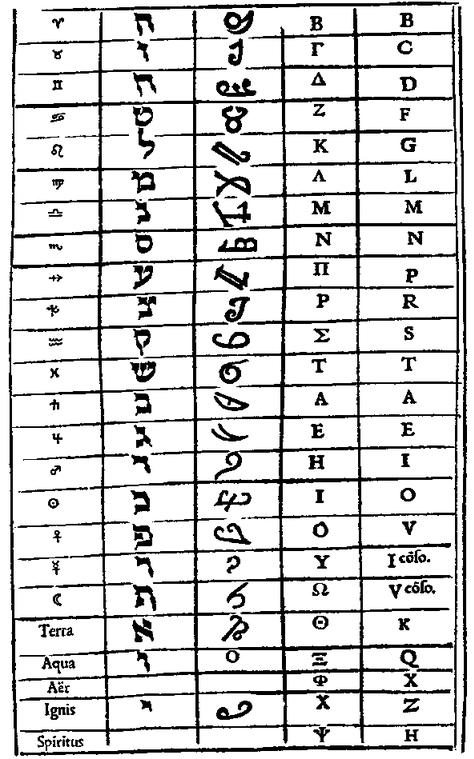
Mods are asleep post the Agrippa wacked up hebrew table
Late medieval magic was largely characterized by two things: renewed interest in neoplatonism, and fringe theologians getting their hands on second or even third-hand kabbalistic ideas, specifically the ones that were useful to Catholic theologians.
These (largely catholic) occultists were trying to find the bridge between ontology and semiotics. Meaning; they were trying to figure out what the exact metaphysical relationship was between a dog, a picture of a dog, and the concept of a dog in the mind of God.
To vastly over-summarize; Jewish philosophers of the era basically said “language, specifically Hebrew, is what unites semiotics and ontology” and the neoplatonists said “they’re already unified, we just don’t know how, it’s probably geometry.”
What Agrippa is trying to do here is make the argument that all languages must descend from the original language of divinity -the one spoken by Adam and Eve in the garden of Eden- and that therefore all language shares some fragment of the divine will. So what we have to do is look for linguistic similarities between the oldest languages we know, and try to figure out how they might fit together. Then we might uncover that hidden magical unity between Hebrew/Latin/Greek/etc.
For his historical context, this was pretty damn groundbreaking. Which is only made funnier by the fact that his Hebrew, and to a lesser extent his classical Greek, are just complete garbage, can’t speak em to save his life. It’s why this is one of my favorite images in all of occult history.
the way that liberals talk about communist revolutions without acknowledging what came before them is so shockingly deceptive. there are many real criticisms of the USSR but the hegemonically accepted way of talking about it is like if you complained that the fire department came to your house and soaked all your possessions in high-pressure water and hacked down your door and literally never acknowledged that before they arrived your house was on fucking fire
I think this gives too much credit to the USSR, as many of their worst policies were just entirely unnecessary from the perspective of “putting out the fire”, but in broad strokes: yeah, endorsed.
“And then a psycho fascist took over, because the newborn communist state had none of the institutional safeguards that can keep murderous fascists from taking over, and thus was born what we know as the USSR” is probably the way to put that
like the “put out the fire” stage was brief, and very quickly got taken over by someone who liked setting fires and was big into murder
(This is why “Get rid of the Bad People who are in power” will never be the plan that creates utopia, because there are always more Bad People and if you think the solution is more killing then the Bad People have already hijacked your revolution)
Yeah, also agreed—I don’t think Stalin classifies as a fascist (after all, fascism means something particular, and is not just synonymous with “bad guy”), but he certainly seems to have been disinterested in the higher ideals of the early USSR. Maybe @vacuouslyfalse could comment in more depth on how this transition occurred. But the fundamental point is that the revolution of 1917 was reasonable, and at least in the broadest historical strokes, seems to have left Russian people better off than continued rule by the tsar would have. Of course, Stalin not taking power would have left them even better off than that, it hopefully goes without saying.
Sure, let’s talk about it. The early Bolsheviks are this fascinating mix of extreme cynicism and extreme idealism.
So worth noting first that there is no “revolution of 1917” - there is the February revolution, which put liberals and moderate socialists in power, and the October revolution, which put the communists in power.
The February revolution overthrew the tsar, mostly gutted his authoritarian state, and established a provisional government. There is a narrative among many anticommunists that this is the only revolution that needed to occur (the “true” revolution), but let’s talk about what the provisional government didn’t do:
-They did not end Russian involvement in WWI.
-They did not offer any promise of land reform, the principle demand of the Soviet peasantry, and indeed actively avoided it.
-They did not establish a democratic mechanism (unlike the soviets*, which were elected).
*If you aren’t familiar with soviet being used in this way, it’s the Russian word for council, and at this point in history it refers to a set of elected bodies emerging from Russian strike councils, which ran cities during general strikes starting in the 1905 revolution and eventually became the revolutionary mechanism that the Bolsheviks used to take power (“All power to the soviets!”). Also, shocker, it’s where the Soviet Union got its name.
-They did not have any broad base of support. The Bolsheviks had a narrow base of support (really just workers and radicalized soldiers), but when they took over, no one liked the provisional government enough to try and stop them.
The first point here is the key to the whole puzzle, imo. Of all factions right and left in 1917, the Bolsheviks were the only faction that supported ending Russian involvement in WWI. There were a small group of Menshevik internationalists, but they did not control their party.
It’s also worth noting that in the immediate aftermath of the October revolution, the Bolsheviks did not run a one-party state - they had taken power along with the left wing of the Socialist Revolutionary party, who were the peasant party of the time.
The Bolshevik platform at this point was simple and overwhelmingly popular: end Russian participation in WWI, all power to the soviets, and all land to the peasants. In truth, they could not have stopped land reform even if they had wanted to, but their adoption of the SR platform on land reform was surprising at the time.
Then, a lot of things happened pretty quickly:
The civil war started, with opponents ranging from disgruntled liberals to archreactionaries, all with the goal of ousting the Bolsheviks and left SRs from power.
The Bolsheviks began to set up a secret police and employ terror as a means of keeping control over areas. Both sides of the civil war (though the white side is like, 10 different sides stitched into one) routinely murdered random people they perceived to be their political enemies and expropriated the peasantry - neither had anything to pay the peasantry with for their grain, so they outright stole.
The left SRs had been useful as a check on Bolshevik power, and indeed, they’d been embedded in the secret police precisely to curb abuses of power.
The left SRs were morons, which is to say, in mid 1918 they decided the thing to do to save the revolution would be to try and force the Bolsheviks to re-enter WWI (????). This led into an attempted coup, which failed rather miserably and made the USSR into a one-party state once the left SRs were purged. Remember how the left SRs were supposed to be the check on the abuses of the secret police? Yeah, none of that. Fortunately, secret police orgs are notoriously trustworthy and capable of regulating themselves.
To say the peasantry supported the Bolsheviks during the civil war would be an exaggeration, but between the two sides that were murdering them and expropriating their grain, the Bolsheviks at least promised to support land reform - most of the white armies wanted to reverse those gains. This was one of many things that helped the Bolsheviks win the civil war.
Fast-forwarding - there was a huge famine as a direct result of the civil war, Lenin had a very smart plan for putting everything back together (the NEP) which made the peasants very happy, and the resulting Bolshevik state was the most radical in the world at the time, doing things like legalizing abortion, decriminalizing homosexuality, legalizing no-fault divorce, secularizing the state, etc.
These times still sucked, mostly because the entire country was poor as hell, but it was notably different from the times which preceded and succeeded it. The end of the NEP period tends to be marked as 1928 or 1929. Stalin won a series of internal party struggles for power, outmaneuvering his rivals and using his position as party secretary to secure a base of support, and by 1929 was firmly in control. If people are interested in how this happened I can write more about it, but this post is long as hell as it is.
The 1930s are complicated and tragic. Stalin was not insane or a fascist or completely uninterested in socialism - indeed, he pushed through an ultraleft platform previously advocated by Trotsky that collectivized the peasantry and rapidly industrialized the country - but he was ruthless, paranoid, dedicated to his own personal power, and utterly unconcerned with spending human life to accomplish his goals.
What liberals tend to miss is the USSR accomplished an economic miracle almost without parallel in the 1930s. What Stalinists miss is that many of his actions, especially in the purges from 1936 to 1938, inhibited this transformation (and were moral atrocities) instead of aiding it. In many ways, the USSR succeeded in spite of Stalin more than because of him.
Post-Stalin, the USSR would become less murderous, but it would never again be revolutionary - it would never again have the idealism along with the cynicism, or any illusion of widespread democratic participation from below. Stalin ripped that out root and branch - he annihilated the possibility (no matter how slim) that it would be something better.
Been reading about the history of nuclear weapons and chuckling every time I hear about how the development of high-altitude anti-aircraft missiles and the switch to low-altitude penetration missions made it more important that bombs be retarded
the one fun thing about if the PRC naval blockades Taiwan would be half of America comparing it to the Berlin Crisis and the other half comparing it to the Cuban embargo.