Okay so everyone’s gone off about another ooh-aah Vienna public housing article. So, for context,
The Thing About Red Vienna Is
That as the Austro-Hungarian Empire modernized from an agrarian economy, nobility from rural areas diversified their economic bases by selling or mortgaging their local holdings and buying land in the capital, which they then developed for rent. In this way industrial workers’ monthly rent replaced annual harvests as their income stream – Marx was really quite literal about the continuity between the feudal liege and the urban landlord.
So when the empire collapsed Vienna ended up in a shrunken Austria in which urban residents outvoted all domestic rural power and felt no obligations whatsoever to nobles now in other countries, so if “control of Viennese housing” was the nexus of economic power they could just seize it themselves and blow raspberries.
How’d that go? Well, eventually the old money types raised an army in the countryside and those Vienna housing projects were actually the final redoubt of the leftists before artillery softened them up and the rightists established one-party “Austrofascism”.
Recently I saw some news articles online claiming that an infant was jailed because its parents possessed a Bible in North Korea. And everybody’s eating that shit up
i think i do remember hearing somewhere that if the primary caregiver of a family goes to prison in north korea then the whole family goes with them so that they stay together as a social unit, but definitely don’t quote me on that because like 90% of what comes out about north korea is completely unable to be verified.
there also seems to be a massive industry of english language NGOs set up in South Korea to take advantage of that fact. they conduct “independent investigations” into human rights abuses in the DPRK and report their findings from these investigations to the U.N., which gives them more access to human rights grants and other massive funds.
the methodology for the investigations published by these NGOs is interviewing and giving surveys to a couple dozen north korean defectors. it pretty much starts and ends there. Yeonmi Park is a pretty notorious example of one of these defectors who found monetary incentive to lie and become a media figure, which is what she did. other defectors also usually aren’t going to have a positive opinion of the country considering they left in the first place (if you don’t count the people who defect back to north korea after living in south korea for a while). it’s not exactly rigorous investigation, and there’s usually not a verifiable way to prove that what they’re saying is true.
in the case of religious stuff specifically, north korea has a long history of being harassed by christian missionaries as well as a christian-led reactionary backlash to the revolution that makes this even more complicated. people seem to think that north korea destroys all christians on sight because they hate God and Freedom and are Satan Loving Communists or some shit but historically christianity has existed in NK entirely as political opposition. i made another post on that here (x)
but generally speaking if you google something and it was first reported in the New York Post it’s safe to assume it’s fake and laugh about it
Prophylactically suppressing children of Christian families in defense against Christianity as an avenue for foreign influence of your East Asian country is a tradition!
(The thing was Japanese diplomats at the Chinese court saw Indian nobles complaining about losing their domains to Christianity-as-European-entryism, and when they brought word back to the home islands the Shogunate looked up to notice the Portuguese following the exact same script there and was like “hmmm”, and after Christians joined a local rebellion proceeded to crucify them all for the rest of the bakufu’s rule)
Recently I saw some news articles online claiming that an infant was jailed because its parents possessed a Bible in North Korea. And everybody’s eating that shit up
i think i do remember hearing somewhere that if the primary caregiver of a family goes to prison in north korea then the whole family goes with them so that they stay together as a social unit, but definitely don’t quote me on that because like 90% of what comes out about north korea is completely unable to be verified.
there also seems to be a massive industry of english language NGOs set up in South Korea to take advantage of that fact. they conduct “independent investigations” into human rights abuses in the DPRK and report their findings from these investigations to the U.N., which gives them more access to human rights grants and other massive funds.
the methodology for the investigations published by these NGOs is interviewing and giving surveys to a couple dozen north korean defectors. it pretty much starts and ends there. Yeonmi Park is a pretty notorious example of one of these defectors who found monetary incentive to lie and become a media figure, which is what she did. other defectors also usually aren’t going to have a positive opinion of the country considering they left in the first place (if you don’t count the people who defect back to north korea after living in south korea for a while). it’s not exactly rigorous investigation, and there’s usually not a verifiable way to prove that what they’re saying is true.
in the case of religious stuff specifically, north korea has a long history of being harassed by christian missionaries as well as a christian-led reactionary backlash to the revolution that makes this even more complicated. people seem to think that north korea destroys all christians on sight because they hate God and Freedom and are Satan Loving Communists or some shit but historically christianity has existed in NK entirely as political opposition. i made another post on that here (x)
but generally speaking if you google something and it was first reported in the New York Post it’s safe to assume it’s fake and laugh about it
Prophylactically suppressing children of Christian families in defense against Christianity as an avenue for foreign influence of your East Asian country is a tradition!
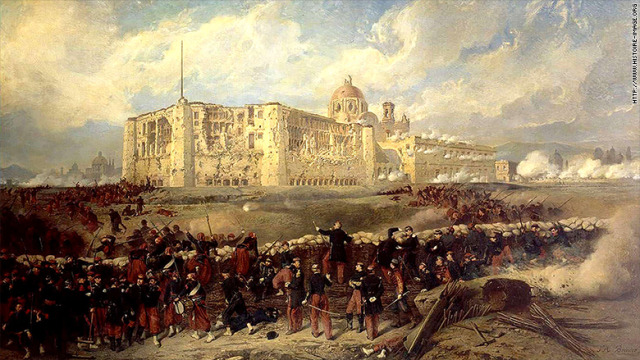
It’s Cinco de Mayo, a Mexican holiday which is unusually popular in the United States among white northerners who are currently at their favorite Mexican restaurant eating tacos and drinking flights of margaritas. The hospital where I work at is serving bad “Mexican” food in the cafeteria and later in the day I’m going to attempt to make fried ice cream in my air fryer. Like seriously I don’t think people outside of the US understand how popular Cinco de Mayo is to Americans. In addition I doubt few Americans who are not of Mexican ancestry know why Cinco de Mayo is celebrated. Many assume it has something to do with Mexican independence. It is not. Rather it is a part of Mexican history that few know about outside of Mexico. And like many things that few Americans know about, it also involves the French.
In the 1860’s Mexico owed a lot of money to France which it could not pay back. In 1862 France demanded their money back, and when Mexico couldn’t pay up, France sent an invasion force. While the French invasion of Mexico was justified as a large repo operation, in reality it was Emperor Napoleon III’s opportunity to take control of the county, install a puppet ruler, and restore French influence in the Americas. At the time the French Army was considered the best in the world, with the best training, the best equipment, the best commanders, and the best tactics and organization. The Prussians would disprove this notion in less than a decade but that’s another story. By contrast Mexico could barely afford to have an army. The Mexican Army was poorly trained and poorly equipped. Many of the weapons used by Mexican regulars were old and obsolete, often leftover British muskets from the Napoleon Wars which were sold as cheap military surplus. Much of the Mexican Army were militia forces which were armed with whatever they could get their hands on, sometimes just machetes and farm tools.
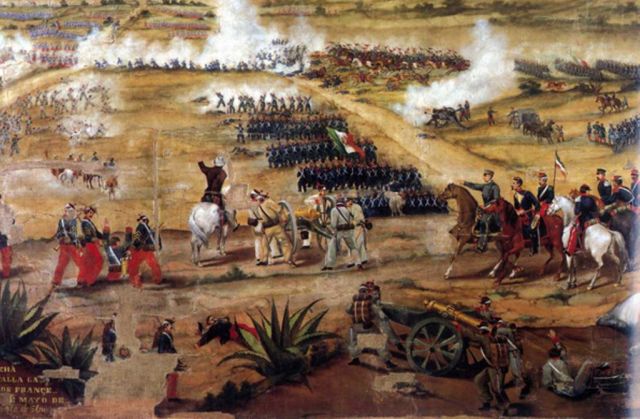
The French invaded with ferocity and quickly dealt out defeat after defeat against Mexico. On the advance towards Mexico City, the French Army was halted at Puebla, just 80 miles southeast of the capitol. There Mexican forces under the command of Gen. Ignacio Zaragoza had gathered together a force of 4,500 men, most of whom were local militia. The outskirts of the city were flanked by two large hills atop of which were two fortresses, Fort Loredo and Fort Guadalupe. Around the hills Zaragoza ordered the construction of a network of trenches, ramparts, and other defensive obstacles. On May 5th, 1862 6,500 French soldiers assaulted Puebla under the command of Gen. Charles de Lorencez. While the Mexicans were outclassed in every way possible, they had a large advantage in that they held an extremely well fortified position. The French tried to bombard Puebla into submission, however Mexican fortifications were at such a height that few French cannons had the elevation necessary to hit the Mexican trenches and ramparts. Thus the French conducted three attempts to storm the Mexican fortifications without effective artillery support. Each attempt failed with heavy casualties. After the third attempt, Zargoza ordered his troops and light cavalry to counterattack, and the Mexicans drove the French off the field. The Mexicans suffered 220 casualties, the French suffered around 770.
News of victory over the French spread across Mexico, providing a much needed morale boost for the Mexican people. President Benito Juarez even declared the day a national holiday; Cinco de Mayo. The victory was short lived, however, as the French simply reorganized, counter attacked, and successfully took over the country. Regardless the Mexicans showed that they could stand their ground against the best army in the world and even get in a good stiff right hook now and then. And of course the French found out that invading Mexico was the easy part. Controlling and occupying Mexico was much more difficult. But that’s another story and my margarita is getting warm. Happy Cinco de Mayo.
Compared to ecologically and topographically similar regions of Europe or east Asia, the northeastern United States is unusually heavily forested. One might think “well, yeah, the U.S. hasn’t been settled by agriculturalists for as long and is less densely populated, obviously there’s going to be less percent land cleared for farms,” but this is not so! Everywhere in the northeast, our forests rise from what were once old fields. In 1860, for instance, Maine was only 60% forested by land area. Today, that proportion is closer to 90%.
We owe our current landscape to two great waves (and several smaller ones) of farm abandonment. The first happened in the decades after the Civil War, when for various reasons* northeasterners (mostly from New England) packed up their pitchforks and decamped to the midwest. This had been going on before the war too, of course, but up until then it had not been in numbers enough that the northeastern farms stopped being worked. There was always a son or two left to till up more stones from the Vermont field. But that changed after the war, and the fields started to revert to oak and maple and pine. Indeed, much of the early formal scientific study of American forestry and ecology happened in these old Yankee fields and young Yankee forests, by outdoorsy young men from Harvard with names like a Lovecraft protagonist.
The second great wave was in the Great Depression and World War 2, when for various reasons** people from all the rougher sorts of terrain the east has to offer - from West Virginia to Indiana’s Brown County to the Ozarks and back to the Catskills - left their farms to come down and seek work in the then-thriving industrial cities. Much of the hilly landscape of the east that had previously been dotted with small subsistence farms, full of exactly the barefoot gap-toothed hillbillies who captured the imagination of urban popular culture with their exotic poverty and folkways when they suddenly appeared in Cleveland, or wherever, in 1933.
These pulses of farm abandonment have left very specific patterns written in the ecologies of the northeast. For instance, the fact that the poor ridgetop farms that were once extremely common in Southern Ohio and Indiana were nearly all abandoned in the 1930s and ‘40s means that the forests that now grow there are uniformly approaching their first century (excepting, of course, where there’s been logging in the meantime.) This is almost exactly long enough for the process of ecological succession to complete itself, and the forests to move into their mature phase.
And so you read books written in the '50s, '60s, or '70s about these areas, and you notice how common early successional species are, everywhere chokecherry and black birch. Whereas today the only evidence you may see of the forest’s relative youthfulness is a few very large bigtooth aspens nearing the end of their lives, surrounded by tulip poplars and chestnut oaks that will endure for many years after all the aspens are dead.
*Young men returning from war with a restlessness and a desire to leave home again; those same young men posted far from home during the war and realizing just how awful the New England soil is, lmao; Republican government policy writtrn explicitly to favor small homesteaders heading west; the late 19thc. crash in agricultural prices (as, in a few short decades, the Great Plains, the Australian wheat belt, parts of the Kazakh and Siberian steppes, the plains of South Africa, and the Argentine pampas were all put under the plow for the first time, and during an era of global free trade) making many small farms entirely unsustainable.
**Years of erosion on fields carelessly laid out on steep terrain; the Great Depression making running a small farm, ah, difficult; economic modernisation making staying as a subsistence farmer a damn foolish thing to do; new roads and automobiles making fleeing to the city easier than ever; and the TVA and other federal land grabs displacing hundreds of thousands of people.
You know if we’re lazily smearing things as anti-Semitic based on long-forgotten historical resonances can we do people who complain about the commercialization of Christmas?
This really started at the 19th Century dawn of the German Empire, contemporary with the growth of a thick commercial retail culture – “Christmas” as we know it is essentially an epiphenomenon of the department store – and much early criticism focused not on how it detracted from a religious cast the holiday had once had, but on how it was becoming a yearly ritual of riches flowing from Christian pockets into the tillers of Jewish retailers, manufacturers, and traders.
As time progressed and the Second Reich fell, this was the theme of infamous interwar antisemitic newspaper Der Stürmer’s editorial cartoons at Christmastime every year.
(This was also, coincidentally, when and where the traditionally minor Jewish holiday of Hannukah was glowed up into a rival gift-giving celebration, so as to undercut Christmas as a draw for [then much more common, often with secular motives of cultural belonging] conversion.)
Occasional reminder that the American intervention into WWI really was to secure our investments, American money had funded the war but it was necessary to conclude things before the European nations were totally exhausted if the loans were ever to be repaid (between the Dawes, Young, and Marshall Plans, many were not!)
Occasional reminder that America invested the payment on this debt on industrialization that first yielded the Roaring 20s boom but went on to enable the country to serve as the WWII arms-producing “Arsenal of Democracy” and produce a postwar Golden Age of consumer bounty, which is to say this expenditure of American lives to fatten bondholders’ pockets really was key, as much as (rather, continuous with, as a succession crisis of the global order) WW2, to its later global dominance and world-beating quality of life
One thing in comparing today to the “days of rage” 60s-70s American unrest is that for people born into the 20th century from WWI through the 1980s, “country experiences violent revolution, changes form of government and power balance within society” was a much more regular background noise of the world, that people could far more intuitively hope to evoke in their own country.
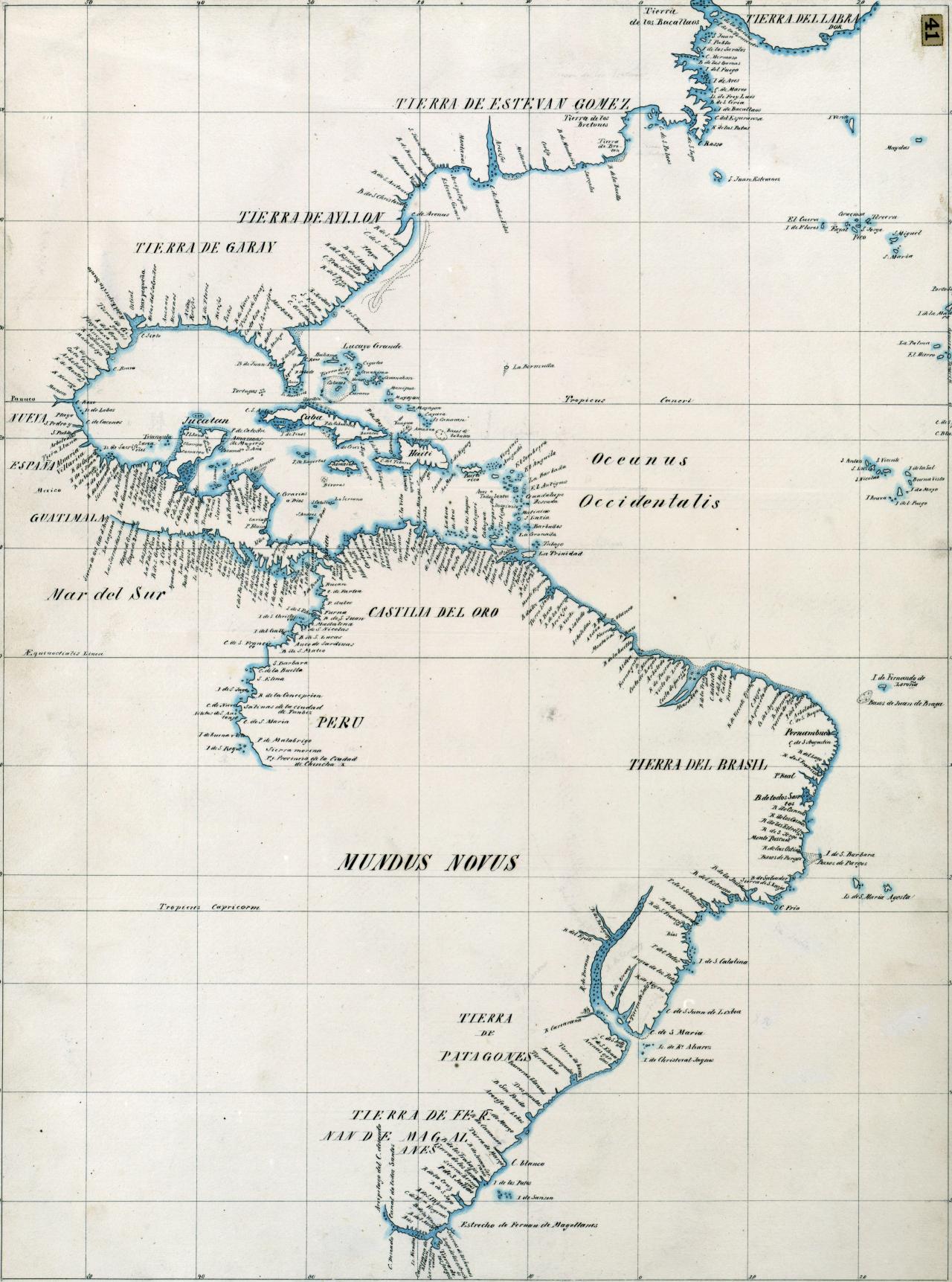
That’s interesting, it implies Pacific coast exploration began from shipyards built on the far side of the isthmus of Darien? I don’t have much background on the period.
There are many canards about that generation, but the most persistent is that the boomers were central to the social and cultural events of the nineteen-sixties. Apart from being alive, baby boomers had almost nothing to do with the nineteen-sixties.
So the American occupations rigged the Italian and Japanese post-WWII election systems pretty steeply, as a necessary condition of keeping Communists out of power (who were expected from Iron Curtain precedent to eliminate any possibility of being removed from power and defect to the Soviet Bloc).
If you will remember your economic materialism this is what you would expect from industrial powers without imperial hinterlands. (This is what the WWII authoritarian culture-states were meant to prevent while they assembled empires!)
@youzicha said: Didn’t @xhxhxhx discuss this petty exhaustively, concluding that the Japanese election system wasn’t rigged?
Maybe? My context is the Cornell Asian Studies program, which is a feeder for/academic arm of the American foreign service/intelligence/military area experts, where my professors were like “oh, my grad advisor was at that postwar conference, he told us how they rigged it”
The major elements were
Orchestrating a merger of the Liberal and Democratic Parties into the pan-establishmentarian LDP, supported by advisors and cash drops
Multi-member districts in cities, where Communists having greatest strength, 22 individual districts would elect 22 communists but one unified proportional city would send 12 and a smattering of others
Not updating district borders as rural population flooded into cities, creating “rotten borough” districts the LDP could buy with agricultural subsidies
So I minored in Asian Studies (Japan) but beyond just learning about Japan, it was in part an education in mechanics of postwar American empire.
My context is the Cornell Asian Studies program, which is a feeder for/academic arm of the American foreign service/intelligence/military area experts,
Huh, is that why my Japanese classes had surprisingly few weebs? Everyone there was planning to go into foreign service and I just didn’t notice?
(I think another factor was that Cornell had a class on Japanese pop culture, and some friends who took it reported that it was full of weebs, so I just assumed that was the quarantine keeping them out of the language class)
That’s more at the grad level (and FALCON) really, but those types make it into normal language classes too. (Well, the good 6/7 credit linguistics track sleeved down from FALCON, which is really built for the Defense Language Proficiency Test, not the 4 credit “functioning as a businessman” one built for the Japanese State Department’s JLPT).
Oh god, I took the pop culture class the first year it was offered, as one of the last ones leaving class once the nihonjin Anthropology professor wearily sighed that he had NOT expected this (a sophomore girl with striped armwarmers challenging his authority on “being a person living in Japan” based on her dad having been at the branch office there in childhood)
Was Nakanishi-sensei still there when you were taking classes? She was my fave.
I think I am team “not rigged” but its really just like definitions (I have no Cornell inside gossip, sorry!) Like the Liberal Party and the Americans absolutely sat down and tried to coordinate together against leftist parties at times, and they did so aggressively. But at a certain point, that is just politics - coalition partners, funding political parties, making deals with unions or businesses, that is just how the sausage of elections is made.
Even as you get into the district proportioning, campaign laws about who can run, etc. that is all pretty normal politics! I don’t like it, and I think the US and UK electoral systems are, in a certain sense, ‘rigged’. But its a loose definition - and in Japan’s case, given that the Socialist Party won the first election and was running the government in 1947, I don’t think anything more than loose applies.
I also as I have mentioned tend to be a SCAP downplayer - they changed Japan much less than they claimed, with the real work of building the system being done by the deep Japanese political-state apparatus. As such, the US only played a secondary role in this process; and I think that is apparent because Japan’s one party state only emerges in 1955, well after the US had left. The impact of the US authority in Japan was probably on net a boost to lefitst parties, as in the beginning they purged right-wing factions and pushed for a western-style legalism that enshrined things like universal voting rights and such.
But this isn’t my area too much, I know the economics better than the politics of the post-war period.
Well the Japanese electoral system was deliberately designed to include all those “normal” features by the American government, which had input on the design as consequence of being the occupying force, that in turn by virtue of having conducted a successful amphibious military campaign against the previous government, is the thing
Re: rigging Japanese elections. I know part of Italy’s electoral rigging was the use of stay behind sleeper cells and funding terror groups as part of operation Gladio. Was there any equivalent for Japan?
That… was not electoral. Italian electoral rigging was about supporting the Republican Party (PRI), with an electoral base of the Catholic Church, as a second-largest after the union-aligned Socialist Party (PSI), with the system (and the 1871-unified Italy’s strong political regionalism) producing juuust enough eclectic small parties to be bribed or whipped into supporting fragile, frequently-collapsing PRI governments and maintaining cordon sanitaire against the PSI
So the American occupations rigged the Italian and Japanese post-WWII election systems pretty steeply, as a necessary condition of keeping Communists out of power (who were expected from Iron Curtain precedent to eliminate any possibility of being removed from power and defect to the Soviet Bloc).
If you will remember your economic materialism this is what you would expect from industrial powers without imperial hinterlands. (This is what the WWII authoritarian culture-states were meant to prevent while they assembled empires!)
The first transcontinental railroad ran to San Francisco, and when a southern route was built the obvious western terminus was San Diego, but San Francisco elites feared the growth of another California power center so they pulled strings to get it redirected to Los Angeles, which was originally the agricultural lands feeding a Spanish mission and had no natural port. (They first built long piers around Malibu and then an artificial breakwater-protected harbor down by Long Beach.)
Then in 1892, the city was found to sit atop a major oil field and a drilling boom ensued, then in WWI the existence of a large labor force without strong left-labor organization like elsewhere on the west coast and in coastal shipping range of the wood-producing Pacific Northwest made it ideal to spin up a military aircraft industry.
Then after WWI, the booming Mediterranean-climate city drew a lot of immigrants from post-Ottoman lands as their national restructurings wrang out, then the motion picture industry relocated there from upstate New York for the weather and to get distance from Thomas Edison’s IP-enforcing goons, then in WWII that defense aerospace industry got even bigger, carrying the region through the Cold War.
See it’s called “customer” because you’d be “giving custom” by customarily getting your iron from this one forge or having a standing order with this cheesemaker for X pounds each winter, because you might buy one-off finished or consumer goods from artisans or marketplace traders, but established merchants dealt in bulk staples and intermediary goods
The RPG “item shop” is a backwards projection of a general store concept that dates to the 19th century
(Potion shop actually has earlier precedent)
I do appreciate how in Jeff “Spiderweb Software” Vogel’s Exile/Avernum tactical CRPGs the “general merchant” role was often filled by “quartermaster of an outpost, trading from its stores”, that’s pretty historically plausible
See it’s called “customer” because you’d be “giving custom” by customarily getting your iron from this one forge or having a standing order with this cheesemaker for X pounds each winter, because you might buy one-off finished consumer goods from artisans or marketplace traders, but established merchants dealt in bulk staples and intermediary goods
The RPG “item shop” is a backwards projection of a general store concept that dates to the 19th century
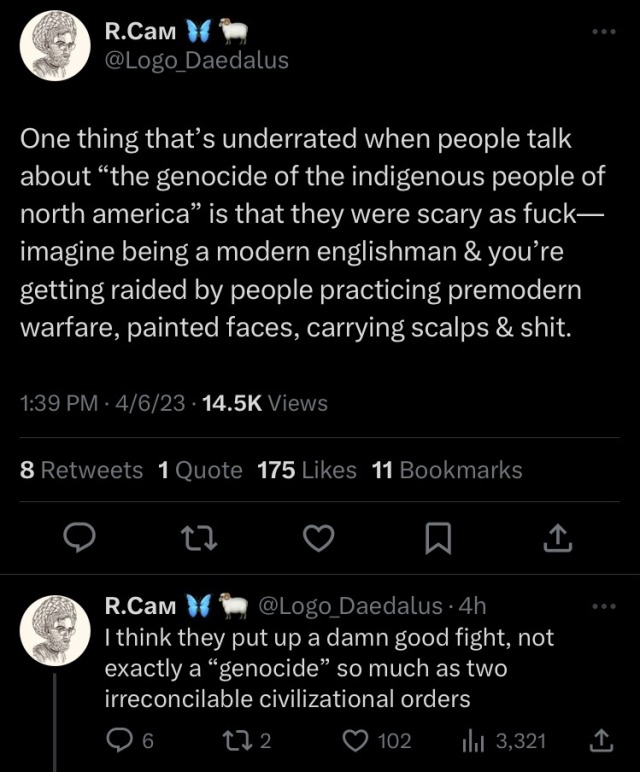
Part of it like… you know how normally tranquil animals can be scarily dangerous when they’re sick or threatened? For most of the contact period, indigenous American cultures were very sick and very threatened.
Like maybe 30 years ago Amerindian groups were still on about throwing off an old image of bloodthirsty savages taking scalps and all that. Like some band of postapocalyptic maniacs.
Postapocalyptic tales, of course, are largely a mechanism for retelling the “taming the wild frontier” narratives that were foundational to American culture.
Native Americans as frontline settlers encountered them and took as the essential nature of their race and civilizations what came through several simultaneous plagues that absolutely cratered population, followed by an alien invasion.