shrine to the prophet of americana

#history (385 posts)

Origins of the police

Origins of the police

Trueish enough. I’ve mentioned how 20th century American urban policing was heavily modeled after the FBI. Which was heavily modeled after the Pinkertons. Who were a nationwide mercenary police force with a specialty in combating (quite literally) labor unrest.

My one complaint is that it totally overlooks the British/American heritage of sheriffs, and posse comitatus, as an intermediate force between feudal men-at-arms and towns’ “hue and cry”. But then, this is a Marxist analysis and Marxist frameworks have never quite known what to do with rural yeomanry (see Lenin’s vacillating between the New Economic Policy and then “dekulakization”, or the inability of the urban and rural radicalisms of late 19th century America to form productive alliances even in areas of mutual strength like western New York, Minnesota, and Wisconsin).

Tagged: amhist history police

Is there a collective term for small polities just outside the border of a larger polity that make their name off of, I guess,...

Is there a collective term for small polities just outside the border of a larger polity that make their name off of, I guess, legal arbitrage? Providing things that are outlawed in the larger polity?

I mean what Monaco and its casinos are to France, or Macau and Singapore to China and southeast Asia, or Amsterdam and its drugging and whoring are to northern Europe. (Or maybe Bahrain to Saudi Arabia, but I’m not that clear on the specifics.)

I’m thinking mostly in terms of vice, but I suppose there’s major overlap with offshore banking, and there’s often a bit of smuggling based in the area.

America used to have Tijuana on the West Coast, and Cuba on the east. In the early 20th century Havana was a major American mafia town; the Cuban revolution and the need to create a replacement is a big part of how Las Vegas developed. Lonely desert Nevada was plenty willing to make a buck off legal arbitrage with looser gambling, prostitution, and marriage laws - offering no-fault divorce when other states didn’t, but also offering quick and easy marriage when other states required minimum ages, or parental permission, or waiting times and announcement, all intended to prop up family/patriarchal control of courtship in the face of the stability-undermining effect of frontier mobility. (Nevada here represents the solvent effect of frontier mobility. ‘Merica!) All the goofy Elvis instant-marriage chapels now are a relic of this, back when “elopement” was more of a real, actual thing. Just like Gretna Green.

You know, in an alternate timeline it could have been Hot Springs, Arkansas instead. For a while it was. Look at that page. “In 1944, the Army began redeploying returning overseas soldiers; officials inspected hotels in 20 cities before selecting Hot Springs as a redistribution center for returning soldiers… The soldiers had time to enjoy the baths at a reduced rate and other recreational activities.” Hmm.

Look at this official National Parks Service history: “Bathhouses [treating venereal diseases] employed special attendants, mercury rubbers, to administer the mercury ointment. The patient gave the prescribed mercury to the rubber who administered the ointment with either bare hands, a bath mitt, or a brush; later the rubbers wore gloves.” “[Attendants] took monthly physical examinations to make sure that patrons were not exposed to contagious diseases.” Hmmm.

Getting back to Havana, in other aspects, Miami picked up the slack. And Tijuana, I guess you can still go for prescription drugs, and San Diego teenagers down to drink, but Las Vegas stole a lot of its thunder too.

Of course now that we’ve got air transport some of that stuff’s moved even further offshore to, say, Thailand. But then, I’d be surprised if that region ever didn’t have that stuff. It’s right at the nexus of the Chinese and Indian Ocean coastal and the Asian archipelago trade routes, which means sailors; you’ve got mouths of the the Mekong and Chao Phraya systems, which means you’ve got the guys moving trade goods along inland routes (You know what we call guys moving trade goods along inland routes today? Truckers.); plus it’s been on the borderlands of various land empires, which means expats, functionaries and soldiers posted away from home.

(You know where in American history inland and coastal shipping met at the borderland of multiple empires? New Orleans.)

Look at all the temples, you’ll see how far the tourist trade goes back. Religious complexes are and always have been tourist sites. A lot of smaller ones, boasting the foot of St. Whoever or the largest statue of Buddha of this particular material in this particular pose, are like Wall Drug or the world’s largest ball of whatever - tourist traps located just off an otherwise featureless segment of major trade and transit routes, surviving by drawing in travelers eager for distraction. While the bigger ones become destinations of pilgrimage in their own right - the statistics I can find seem pretty speculative, but I hear around 10% of Muslims make Hajj in their lifetimes, while 70% of Americans visit one of the Disney parks.

(You know what’s a famous story about the coexistence of prostitutes and religious tourist destinations? The Hunchback of Notre Dame.)


Tagged: history amhist tourism sex tourism

Pretext, Past, Posterity

I don’t think the question of what really actually truly happened in Ferguson - at any stage - is really even all that important, the whole thing was just a pretext anyway.

- = - = -

Benghazi. I swear this loops back in in three paragraphs in a productive way, stick with me. The official Republican complaint about Benghazi - what even was it? Something about not sending backup, or a coverup? Whatever.

But fundamentally it’s a pretext. I mean some people sincerely, unkshakeably care about the pretext. But the actual issue is about the Arab Spring, the actual issue is “Who Lost The Maghreb?”. With the implied answer “the Democrats, by doing that dumb Carter thing where you only support foreign allies who are nice and polite and democratic and don’t repress and torture and massacre their citizens, and then when the ones you abandon fall and the people who replace them - the people who had been being repressed and tortured and massacred - come to power and start doing shit that you hate, that is completely incompatible with the things you most emphatically and sincerely want, go ‘Oh shit, right, that’s why we were supporting that guy in the first place’”.

But the awkward thing, the reason they run with this pretext instead of saying it explicitly (like they did with the original “Who Lost China”), is that going Carter in the Ummah didn’t start with Obama, this started with Bush the Younger and the neoconservatives, and a lot of it that happened under Obama’s watch was under the influence of holdovers from the Bush era - Robert Gates and all that. And in any case unlike Carter, Obama had a second term in which to reverse course himself, and now the military is back running Egypt and Mubarak was just released scot-free.

- = - = -

Ferguson, Mike Brown, all that’s a pretext. And a lot of people sincerely, unkshakeably care about the pretext, but the actual issue is that even as the civil rights movement of the 1950s-70s has been institutionalized as a sacred part of our national history, the actual gains made - “let’s flip the national switch away from repressing black people, and towards helping them” - have been allowed to gradually erode. Because white people found that completely incompatible with the things they most emphatically and sincerely wanted, and remembered why they had the switch on repress in the first place.

And the awkward thing, that makes this difficult to address head-on, is that it was “First Black President” Bill Clinton that blessed the erosion. The Democrats had, since LBJ, been the party of “let’s keep the switch in the helping position”. And between LBJ and Clinton, 1968 to 1992, 8 whole terms, the Democrats only won one term as President. Carter. With the whole Vietnam, Watergate, Nixon tailwind at his back.

And Clinton got elected, and more significantly got re-elected! By taking the Democrats’ hand off the switch. Federal funding for 100,000 more cops. Welfare reform. (Subtextually, federal funding for how many fewer black babies?) School uniforms, which was rinkydink but was the idea was “yes, we are willing to walk back ‘60s-style freedoms in order to further discipline urban black kids - you know, the gangbangers, the crack babies, the superpredators.”

Sister Souljah - I used to wonder what that was even about, I’m no rap genius but I at least recognize big names and I’ve never even heard of her in any other context. Does anyone cite Sister Souljah as a musical influence? But I’ve come to realize that was the point - deliberately picking a fight with someone who didn’t actually matter (and thus bore no cost) - just to make a point, a branding point.

“The Democratic Party: Once Again Willing To Tell Uppity Blacks To Stuff It”

“First Black President” Bill Clinton took the Democrats’ hand off the switch and at least let other hands pull it back to “repress”. And under actual first black President Barack Obama, of the Democratic Party, who owes two elections to being black, and at least one to black votes entirely, putting it back hasn’t even been on the agenda.

And I can see how you’d get upset.

-=-=-

“What we really need is for everyone - black, white, whatever - to respect each other.”

Okay, that’s correct, and that’s impossible, because here’s the thing. When people say they want “respect”, what they mean is they want other people to acknowledge their own conception of the world, where they’re the protagonist, and their story is the main plotline, and everyone else is, I guess, NPCs? Or at least, at least for those other people to not explicitly challenge that conception, to allow them to maintain that fiction to themselves.

Which doesn’t necessarily set you at odds, a good share of NPCs are allies, or questgivers, or shopkeepers, or background characters, and most people prefer the paragon path, and in the normal course of things you get along fine.

But only as long as there’s nothing important at stake that can only be resolved by conflict. If that NPC is the only source for a good drop, and you’re sure they’re not going to be critical to any of your future quests…

“He was murdered for jaywalking!” Even accepting that framing, here’s the thing. Physically being in the street is important. The inciting incident of the Hamburg Massacre, back during Reconstruction, was white guys angry about black guys standing in the road blocking traffic.

Because two objects can’t occupy the same space at the same time. The fundamental example of something that can only be resolved by conflict.

You know, if you look in the right parts of the web, where white people complain about black people in complete, properly spelled, passive-aggressive sentences, one of the most commonly recurring stories is black guys walking, or having a conversation, in the middle of the road, and they can see I’m waiting, and they don’t get out of the way, don’t even make an effort to let me through.

(There’s a tumblr post with half a million notes on it. Right here.

i know i give white people a lot of shit but u guys are really nice. like when the light turns green and there’s a white pedestrian that’s almost across the street u guys always do that jog thing. i know it’s kind of insignificant but i appreciate it white people. u and ur half jog thing.

)

The flip side of that story of course is “what the fuck this is a public road and I’m as much the public as you are so why the hell would you think it’s my duty to stop using it how I want so you can use it how you want, Mr. King Shit of the World?”

(“Mr. King Shit of the World” is the hostile way of saying “protagonist”.)

And you know how much you fucking hate it, how much of a personal affront you take it when NPC pathfinding is so fucked up that they block a door and you can’t get through? (Alternately, when collision detection is set up so that random NPCs can force you out of the way, maybe knock you out of a dialogue tree or screw up a quest?)

Gives you the unshakeable sense that this world was not properly designed for you, for the purpose of furthering your plotline.

And if these issues came up in the last update, you’d want a patch to revert them. You’d go on the devs’ forums and bitch forever, it’s like the devs don’t even care about the players, and you’d threaten to never support anything they did again, take your money and give it to some other devs, and devs, WHERE’S THE FUCKING PATCH.

And the patch, of course, is white supremacy. (It also buffs your class so you’re not grinding for fucking ever just to spend your loot on repairs and potions, and reduces your random encounter rate in safe zones.)

“But this isn’t a game, this is REAL LIFE!”

If you ever end a sentence with “REAL LIFE” in all caps you are being an idiot, I guarantee it. Yeah, the fact that the stakes of this game are real, that’s gonna make you more willing to let things slide? That’s not how people work. Not enough of them to hold a coalition together.

- = - = -

The activists are worked up! There’s a new civil rights movement coming! We! Will! Fight!

The veneration of the civil rights movement of the 1950s-60s, that makes people think that’s the only and inevitable way this can play out. Let’s set aside the way those gains eroded with time (same as the movement of the 1860s-70s, as Reconstruction gave way to Redemption). You know what I’m reminded of? The civil rights movement of the 1910s-20s.

You didn’t hear about that one? The founding of the NAACP, Garveyism, W.E.B. DuBois, black troops returning from European service in WWI, sharecroppers moving north to work the factories, pumped up to reclaim the promise of Reconstruction. Meanwhile, a countrywide surge in leftist radicalism, and new wave of immigrants asserting their claim on America. You don’t hear about it, because it didn’t win. The Palmer Raids, the First Red Scare, the Red Summer of 1919, the Tulsa Riot, the founding of the Second KKK.

Well, let them try, it won’t matter because trends suggest the, aah, “Coalition of the Ascendant” will gain overwhelming dominance in the intermediate future, right? Yeah, white Americans noticed that back then, too. That’s why they cut off immigration and started pushing eugenics.

Not convinced things’ll turn out like that this time around, but they could. Learn your history, kids, it keeps you from looking the fool.

- = - = -

I grew up in the Huxtable ‘80s and the End of History ‘90s, I kind of expected the two classic nations of America to merge, black into white, just as the white ethnics had the generations before.

Who knows what we’d call the amalgam, maybe still “white” just to play up the ridiculousness of it all, maybe some hyphenated neologism to bridge the gap, like we played up “Anglo-Saxon” to meld the English and German populations that originally formed the white American nation, or coined “Judeo-Christian” later on.

But I’m less and less certain of that. You look at the people saying interesting things about race these days, they’re pushing other possibilities, each with their three-letter acronyms. The left-racebloggers pushing “PoC”, “Persons of Color”, the idea that there’ll be white on one side and on the other this black-hispanic-asian-amerindian coalitional nation. The right-racebloggers “NAM”, “Non-Asian Minorities”, suggesting a white/asian against black/brown split.

And then there’s always the possibility that things’ll go the classic American route, where there’s black on one side and everybody else eventually joins “white”, earns a spot specifically defining themselves against “black”. Given a choice between the two, it’s an awfully appealing option.

- = - = -

Race is the fundamental tragedy of American history. A tragedy being where everyone’s understandably, sympathetically human, even (especially) in their failings and shortcomings and trespasses, and the inevitable consequence is suffering.

Tagged: history amhist afamhist race

19th Century European Politics

People: Boo! Boo!
Monarch: Nobility, are they booing me?
Nobility: Ah, no, they're saying "Boo-urgeoise. Booo-urgeoisie!"
Monarch: Are you saying "boo", or "boo-urgeoisie"?
People: Booo!
Liberals: *We* were saying "boo-urgeoisie".

Tagged: history

kontextmaschine once implied that the ‘cultural marxism’ stuff was pushed by capitalism against actual marxism. was that a...

countersignal:

kontextmaschine once implied that the ‘cultural marxism’ stuff was pushed by capitalism against actual marxism. was that a thing?


Yeah, well, The Establishment, and the CIA, being fairly exempt from electoral pressure, had the latitude to be competent. After WWII there was a lot of actual, real support for communism in Europe, on either side of the Iron Curtain. Partially for the same reason as the fascist renaissance in ex-Warsaw bloc countries - they reaped the goodwill of being the ones to really stand up against The Hated Occupiers - partially because there really were a lot of poor ex-peasants coming from a century-long tradition of struggling to cast off the remnants of feudalism.

And the Marshall Plan and all that, we tried to guide who we could to Yay Capitalism, and rig electoral systems to keep the commies out - huge cash dumps to friendly parties, election rules weighted to get NATO-friendly results, skullduggery where necessary - above all we kept the interior ministries (who pay the police and count the votes) friendly - coups where necessary.

But there were some people we were never going to get with that, so we at least tried to guide them to less-bad fallback positions. If you want ownership of productive forces in common, in accordance with the general will of the people, how about a welfarist social democracy with nationalized industry! Like England, which spent most of the Cold War under a Labor party proclaiming Clause IV. And if they were absolutely dedicated to communism, they were guided towards a form that was at least not a cadet branch of the Lenin dynasty ruling in Moscow.

And that happened domestically, too. The Soviets did promote communism in America for their own purposes yes, but it’s not like communism hadn’t had a following in America before that, particularly among the downtrodden and the thoughtful types. Communism didn’t firmly equal Marxism equals Russia until the Russian Revolution, but Edward Bellamy didn’t even live to see the 20th century. And so they were ripe for co-opting too.

If blacks organize and press identitarian claims as blacks, or pan-Africanists, well at least they weren’t organizing and pressing their claims as communists, which was a real, live possibility. If the students are pressing their claims as hedonists… (there was major campus unrest in the 1950s over “in loco parentis” parietal rules, because what’s the point of having women around but to fuck them?)

And of course, to the extent the Soviets were actively trying to undermine and fracture our society with art and ideas, we were doing the same thing. Am I saying we were morally equivalent? Yes, of course. Everything is morally equivalent to everything at a value of null. More importantly, strategically equivalent.

Encounter magazine, dissident authors, abstract expressionism. We didn’t stir up tensions along racial lines so much as religious - Muslims in the ‘Stans, yes, also Catholics in Poland (JPII wouldn’t be the first time a papal election turned out awfully convenient for a dominant power, and we were into some darkside shit in Italy that touched the Vatican at the margins…) and Jews in Russia.

You know, in national mythology, “the Nazis were bad because” didn’t really end in “the Holocaust” until the 1970s? “The Jews” were awfully communist-associated, after all. But then the white ethnics were integrated into white, and the various Israeli wars shook things up to the point they ended up on our side (and transformed their public image from kibbutzim to Rambos), and we managed to cast “Jewish repression” as the bad thing they did, and so it goes, so it goes.

Tagged: history cold war amhist

New York’s Pneumatic Tube Mail Network The pneumatic tube mail was a postal system operating in New York City from 1897 to...

mapsontheweb:

New York’s Pneumatic Tube Mail Network

The pneumatic tube mail was a postal system operating in New York City from 1897 to 1953 using pneumatic tubes. Following the creation of the first pneumatic mail system in Philadelphia in 1893, New York City’s system was begun, initially only between the old General Post Office on Park Row and the Produce Exchange on Bowling Green, a distance of 3,750 feet. Eventually the network stretched up both sides of Manhattan Island all the way to Manhattanvilleon the West side and “Triborough” in East Harlem, forming a loop running a few feet below street level. Travel time from the General Post Office to Harlem was 20 minutes. A crosstown line connected the two parallel lines between the new General Post office on the West Side and Grand Central Terminal on the east, and took four minutes for mail to traverse. Utilizing the Brooklyn Bridge a spur line also ran from Church Street in lower Manhattan to the general post office in Brooklyn (now Cadman Plaza) taking four minutes. Operators of the system were referred to as “Rocketeers”. Wikipedia

More reading on the Network

From The Works: Anotamy of a City by Kate Ascher

Tagged: history amhist

MATTOON, Ill., Sept 9. - Groggy as Londoners under protracted aerial blitzing, this town’s bewildered citizens reeled today...

pureamericanism:

MATTOON, Ill., Sept 9. - Groggy as Londoners under protracted aerial blitzing, this town’s bewildered citizens reeled today under the repeated attacks of a mad anesthetist who has sprayed a deadly nerve gas into 13 homes and has knocked out 27 known victims.

Seventy others dashing to the area in response to the alarm, fell under the influence of the gas last night.

All skepticism has vanished and Mattoon grimly concedes it must fight haphazardly against a demented phantom adversary who has been seen only fleetingly and who so far has evaded traps laid by city and state police and posts of townsmen.

Tagged: history amhist

The Partisan Leader - Wikipedia, the free encyclopedia

The Partisan Leader - Wikipedia, the free encyclopedia

The Partisan Leader; A Tale of The Future is a political novel by the antebellum Virginia author and jurist Nathaniel Beverley Tucker. A two-volume work published in 1836 in New York City and in 1837 in Washington, D.C. under the pen-name “Edward William Sydney,”[1] the novel is set thirteen years into the future, in 1849, and imagines a world where the American states south of Virginia have seceded from the Union. The story traces the formation of a band of Virginia insurgents who seek to free their state from federal control and adjoin it to the independent Southern Confederacy.

Tagged: same as it ever was amhist history secession secessionism

Black History Month (Orthodox): Introduction

Went back to the Black Pride framing shop the other day to get this old double-hemisphere map print done up.

The place, like my house, is in essentially the black neighborhood of the state, so it makes sense there’s a market for appealing to pride in your black heritage. God knows Portland’s got plenty of opportunities to flatter your white heritage - Scandanavian, Scottish, Irish, German (click that one, ‘dwracu). Hell, the retro-rustic chickens/mason jars/filament bulbs aesthetic we breathe like oxygen these days is basically the midwest-American variant. (And that’s not even to mention the black/white heritage fusion places.) Even the Portland city flag (which you see more often than the American) is a Scandanavian cross, only kinked a bit and with an outdoorsy color scheme, which is pretty much Correct.

Looking around the shop there was all sorts of Egyptian-themed jewelery and busts of Nubian princesses and Zulu motifs and whatnot, which like the Swahili lingustics of Kwanzaa are a little eyebrowable as icons for proud black Americans given that Afro-America mostly traces its lineage to slaves from Western Africa. But how different is that from proud white Australians around here posting pictures of Viking warriors and Roman ruins and Viennese architecture? As long as they don’t crawl too far up their own fantasias or try to fabricate irredentist causus belli out of it, both have my blessing.

(Of course, this Pan-Africanism does have roots in a multinational and intermittently violent campaign towards regime change which… hrm.)

Aaaaaaanyway, this all reminded me that I’ve had a few essays stewing for a while on black history in America that I had in my head to post for Black History Month, only for two years now I’ve missed it. Probably because I don’t have any schoolteachers reminding me by running lessons about peanut butter. So screw it, I’m declaring Black History Month (Orthodox), lasting from now until whenever I finish up. I’ll be tagging the stuff (plus some archives) as afamhist, riffing off the “amhist” tag I shamelessly stole from monetizeyourcat, PBUH. (Who will hopefully recover from her show trial and purge by the sad anime transmarxists before too long and eventually deliver that “Oregon as Peak Free Soil/Free Laborism” piece I’ve been looking forward to for damn near two years now.)

Anyway. First up: The Crack Era, or why gangsta rap is closer to haiku than funk.

Tagged: history afamhist amhist black history month

kaanekii answered your post: Do I have any followers who were born … ye Allow me to tell you a story, child. "Stay...

briangefrich:

kaanekii answered your post: Do I have any followers who were born …

ye

Allow me to tell you a story, child.

image

“Stay awhile and listen!”

Back around the time you were born, the Internet was a toddler too, and very little illustrates this like a game called Elf Bowling. This game from NStorm hit the web in 1998. Like many of the whack-a-mole games of that time, it was very simple and involved physical abuse.

In this case, Santa was bored and decided to go bowling, using his elves as pins while a reindeer watched.

image

The elves scream in high-pitched synchronized fear every time Santa bowls, and their crushed bodies are swept away into darkness by a giant squeegee.

image

Also, the game is really boring, like all bowling games.

Because the internet was still in diapers, of course it went completely viral in 1999.

And it kind of destroyed the Internet.

See, back in those days, most email users were using a program like Outlook Express to download messages to their computer.

image

This was before webmail was a thing. A majority of users at this time were still on dial-up (some were lucky enough to get a steady 56k connection, but many would be stuck at 33.6, or even worse, 18.8) and email systems were built to quickly move tiny text messages back and forth. A huge essay-like email to your mom explaining why you need more money? That’s a kilobyte or two in plain text and an email system blasts that out with no issues.

Elf Bowling is 1.1mb.

With a strong 56k connection, 1.1mb takes at least two and half minutes to download.

Outlook Express 5, which came with Windows 98, had a default server timeout of 60 seconds.

In 1999, everybody emailed it to everyone they know.

I was working as an internet tech support rep at the time, and here’s what happened:

  1. Elf Bowling would appear in your inbox on the server.
  2. You would attempt to download new messages.
  3. Everything before Elf Bowling would download fine.
  4. The server would time out trying to download the Elf Bowling file.
  5. The email would not be deleted from the server or marked as downloaded.
  6. Later on you’d try to get new messages and it would start to download Elf Bowling again, preventing new emails from getting through.

Eventually, it might download, or when you called tech support they had you increase the timeout, but then you’d play the stupid game and try to send it to every person you’ve ever met with an email address.

For the entire holiday season that year, email servers were under assault by this stupid game.

And that was only one half of the story. The file that was being sent around was elfbowling.exe.

People were downloading and running an unknown executable file.

Eventually, a chain email started going around, warning that elf bowling was a virus and it was going to delete all the information on your computer on Dec 25th at midnight, but this was determined to be a hoax.

There are two points here:

First off, fuck you, Elf Bowling

image

Secondly, kaanekii, marvel at where we have come in just your lifetime. I can watch Doctor Who streaming in HD on my phone, and just 16 years ago, one megabyte of Santa being a jackass almost destroyed the Internet’s email infrastructure.

image

Tagged: history nethist

I asked seven anthropologists, archaeologists, and historians if they would rather have been a typical Indian or a typical...

I asked seven anthropologists, archaeologists, and historians if they would rather have been a typical Indian or a typical European in 1491. None was delighted by the question, because it required judging the past by the standards of today—a fallacy disparaged as “presentism” by social scientists. But every one chose to be an Indian. Some early colonists gave the same answer. Horrifying the leaders of Jamestown and Plymouth, scores of English ran off to live with the Indians. My ancestor shared their desire, which is what led to the trumped-up murder charges against him—or that’s what my grandfather told me, anyway.

As for the Indians, evidence suggests that they often viewed Europeans with disdain. The Hurons, a chagrined missionary reported, thought the French possessed “little intelligence in comparison to themselves.” Europeans, Indians said, were physically weak, sexually untrustworthy, atrociously ugly, and just plain dirty. (Spaniards, who seldom if ever bathed, were amazed by the Aztec desire for personal cleanliness.) A Jesuit reported that the “Savages” were disgusted by handkerchiefs: “They say, we place what is unclean in a fine white piece of linen, and put it away in our pockets as something very precious, while they throw it upon the ground.” The Micmac scoffed at the notion of French superiority. If Christian civilization was so wonderful, why were its inhabitants leaving?

Like people everywhere, Indians survived by cleverly exploiting their environment. Europeans tended to manage land by breaking it into fragments for farmers and herders. Indians often worked on such a grand scale that the scope of their ambition can be hard to grasp. They created small plots, as Europeans did (about 1.5 million acres of terraces still exist in the Peruvian Andes), but they also reshaped entire landscapes to suit their purposes. A principal tool was fire, used to keep down underbrush and create the open, grassy conditions favorable for game. Rather than domesticating animals for meat, Indians retooled whole ecosystems to grow bumper crops of elk, deer, and bison. The first white settlers in Ohio found forests as open as English parks—they could drive carriages through the woods. Along the Hudson River the annual fall burning lit up the banks for miles on end; so flashy was the show that the Dutch in New Amsterdam boated upriver to goggle at the blaze like children at fireworks. In North America, Indian torches had their biggest impact on the Midwestern prairie, much or most of which was created and maintained by fire. Millennia of exuberant burning shaped the plains into vast buffalo farms. When Indian societies disintegrated, forest invaded savannah in Wisconsin, Illinois, Kansas, Nebraska, and the Texas Hill Country. Is it possible that the Indians changed the Americas more than the invading Europeans did? “The answer is probably yes for most regions for the next 250 years or so” after Columbus, William Denevan wrote, “and for some regions right up to the present time.”

Quoted from the essay “1941” written by Charles C. Mann, about the major impact that Native Americans had on the Americas (ecologically and culturally) before white people invaded, bringing their diseases and shoving Christianity down the Indians’ throats and murdering them and banning their cultures.

Check out the whole piece (which is rather long). (P.S thanks to @cazalis for sending me this great link)

another excerpt:

Human history, in Crosby’s interpretation, is marked by two world-altering centers of invention: the Middle East and central Mexico, where Indian groups independently created nearly all of the Neolithic innovations, writing included. The Neolithic Revolution began in the Middle East about 10,000 years ago. In the next few millennia humankind invented the wheel, the metal tool, and agriculture. The Sumerians eventually put these inventions together, added writing, and became the world’s first civilization. Afterward Sumeria’s heirs in Europe and Asia frantically copied one another’s happiest discoveries; innovations ricocheted from one corner of Eurasia to another, stimulating technological progress. Native Americans, who had crossed to Alaska before Sumeria, missed out on the bounty. “They had to do everything on their own,” Crosby says. Remarkably, they succeeded.

When Columbus appeared in the Caribbean, the descendants of the world’s two Neolithic civilizations collided, with overwhelming consequences for both. American Neolithic development occurred later than that of the Middle East, possibly because the Indians needed more time to build up the requisite population density. Without beasts of burden they could not capitalize on the wheel (for individual workers on uneven terrain skids are nearly as effective as carts for hauling), and they never developed steel. But in agriculture they handily outstripped the children of Sumeria. Every tomato in Italy, every potato in Ireland, and every hot pepper in Thailand came from this hemisphere. Worldwide, more than half the crops grown today were initially developed in the Americas.

Maize, as corn is called in the rest of the world, was a triumph with global implications. Indians developed an extraordinary number of maize varieties for different growing conditions, which meant that the crop could and did spread throughout the planet. Central and Southern Europeans became particularly dependent on it; maize was the staple of Serbia, Romania, and Moldavia by the nineteenth century. Indian crops dramatically reduced hunger, Crosby says, which led to an Old World population boom.

Along with peanuts and manioc, maize came to Africa and transformed agriculture there, too. “The probability is that the population of Africa was greatly increased because of maize and other American Indian crops,” Crosby says. “Those extra people helped make the slave trade possible.” Maize conquered Africa at the time when introduced diseases were leveling Indian societies. The Spanish, the Portuguese, and the British were alarmed by the death rate among Indians, because they wanted to exploit them as workers. Faced with a labor shortage, the Europeans turned their eyes to Africa. The continent’s quarrelsome societies helped slave traders to siphon off millions of people. The maize-fed population boom, Crosby believes, let the awful trade continue without pumping the well dry.

Back home in the Americas, Indian agriculture long sustained some of the world’s largest cities. The Aztec capital of Tenochtitlán dazzled Hernán Cortés in 1519; it was bigger than Paris, Europe’s greatest metropolis. The Spaniards gawped like hayseeds at the wide streets, ornately carved buildings, and markets bright with goods from hundreds of miles away. They had never before seen a city with botanical gardens, for the excellent reason that none existed in Europe. The same novelty attended the force of a thousand men that kept the crowded streets immaculate. (Streets that weren’t ankle-deep in sewage! The conquistadors had never heard of such a thing.) Central America was not the only locus of prosperity. Thousands of miles north, John Smith, of Pocahontas fame, visited Massachusetts in 1614, before it was emptied by disease, and declared that the land was “so planted with Gardens and Corne fields, and so well inhabited with a goodly, strong and well proportioned people … [that] I would rather live here than any where.”

and another excerpt:

In as yet unpublished research the archaeologists Eduardo Neves, of the University of São Paulo; Michael Heckenberger, of the University of Florida; and their colleagues examined terra preta in the upper Xingu, a huge southern tributary of the Amazon. Not all Xingu cultures left behind this living earth, they discovered. But the ones that did generated it rapidly—suggesting to Woods that terra preta was created deliberately. In a process reminiscent of dropping microorganism-rich starter into plain dough to create sourdough bread, Amazonian peoples, he believes, inoculated bad soil with a transforming bacterial charge. Not every group of Indians there did this, but quite a few did, and over an extended period of time.

When Woods told me this, I was so amazed that I almost dropped the phone. I ceased to be articulate for a moment and said things like “wow” and “gosh.” Woods chuckled at my reaction, probably because he understood what was passing through my mind. Faced with an ecological problem, I was thinking, the Indians fixed it. They were in the process of terraforming the Amazon when Columbus showed up and ruined everything.

(via badass-bharat-deafmuslim-artista)

1491 is decent. Read it, then continue to Cronon’s Changes in the Land.

Tagged: history amhist changes in the land william cronon charles c. mann

Happy Labor Day

Happy Labor Day

People loved their work once, and it didn’t matter if they worked in the public sector or in the private one. The men who worked in the CCC would take their grandchildren to see the forests they planted, while the men from the auto plants would point out the cars they’d built as they passed them on the new interstate highway system. The women who fastened the engines on the wings would watch the B-17’s fly off to make a liar out of Goering, and the women who taught in the public schools would point with pride when one of their old students got elected mayor. Work was about making money, certainly. It was about feeding the family and keeping the roof where it was, and maybe having a little left over at the end of the day, or at the end of the week, for some amusement. Maybe a trip to Lincoln Park or White City or a hundred other places, where you could take a moment and enjoy the cool of the evening, music riding the nightwind from a dance pavilion down along the lake.
But it was also about Doing A Job, and doing it well, which was different than simply Having A Job. It was about making good cars and strong steel and sturdy furniture. It was about learning a craft, even if what you were doing wasn’t recognized as one. There was a craft in tightening rivets, or feeding the open-hearth furnace, or planing the wood just so. You had your craft, and the person next to you had theirs, and, when all the work was done, and all the craft was practiced, and practiced well, there was something you could look at with pride and say, that is something I have given to the world. Job well done, as they used to say. You could teach seventh grade civics and then, one day, you’re on a podium outside of City Hall. That kid right there, you could say. That kid is something I have helped give to the world. Job well done, as they used to say.
Unions were greatly responsible for the pride that people took in the work they did, especially in the middle of the last century, when unions helped build the most formidable middle class in human history.
-— -— -—

There was an autoworker, Ben Hamper, who wrote a column in the Flint (later Michigan) Voice, which was the alt-weekly Michael Moore first made his name by running. A lot of his columns got collected and repackaged in an excellent book, Rivethead that I read in college.
I read it in a class by Stuart Blumin, who was my favorite professor and de facto advisor. He was an American historian, focused on labor and class and the development of capitalism, you could tell he was heavily influenced by EP Thompson and the Communist Party Historians Group over in the UK.
He was quite open that he had expected Communism to ultimately triumph, and that he had been wrong about that, and in subtext that he had wanted it to ultimately triumph, and didn’t think he had been wrong about that.
Anyway, Rivethead. The story is that Hamper was born in 1956, a fairly clever kid growing up in Flint, Michigan, the chronological and geographic apex of American industrial unionism, where everyone’s dad worked for GM.
And he could have gone to college but he gets some girl pregnant and so he goes to work on the assembly line not even really out of obligation or Catholic guilt or whatever but because that seems as good a life course as any, it’s what every man he’s known does, under the mighty UAW the pay’s on par with the kind of “educated” jobs you could get anyway, why not.
And so he goes to work on the line and eventually he ends up writing a column about it, and he talks about the color of the factory culture, playing soccer with rivets for balls and cardboard boxes for goals, drinking mickeys of malt liquor in your car on lunch break, the absurd fursuited mascot “Howie Makem, The Quality Cat” that GM would feature at rallies and shop-floor tours, being laid off in economic downturns and put into the “job bank” where you get paid waiting to be rehired in the next upswing, developing a perfect rhythm with your partner, training into a rhythm so perfect you can each trade off doing the two-person job yourself for 4 hours while the other one goes out to a bar on the clock, the dignity and solidarity of the American worker.
And time goes on and eventually his marriage fails but he takes it in stride, and his column gets recognized and he takes pride in that and then eventually he has an epiphany, and a complete breakdown, which are basically the same thing. And the inciting incident is when an older line worker, some guy he’d looked up to as a model of quiet, philosophical stolidity, just shits himself and is barely coherent enough to even notice this and he realizes the guy hadn’t been a Zen master, he’d just been checked-out mindless drunk on the line every day.
And he realizes that the rivethead life is destroying him, that the only thing holding it together was a budding alcoholism, and that it’s doing the same to all his co-workers, and looks back and realizes it had done the same to every grown-up man he knew, his father and uncles that growing up he had looked up to as models of masculine strength and fortitude really had just had their spark snuffed out and the life beaten out of them long before, and whatever pride they took in the cars out on the road was a defensive attempt to locate in an external form the sense of self-value that had been exterminated within them.
When Marx talked about “alienation”, well.
And he went crazy, and couldn’t bear to work on the line anymore, and there’s no redemption, that’s where the book ends.
And that was a theme that cropped up again in Professor Blumin’s class, that there were two great working class traditions that echoed through the ages, and they were
1) avoiding work
and
2) drinking
Back in the premechanized age of small-group workshop manufacturing, workers would celebrate “Saint Monday”, which was to say just not showing up for work, hung over after the weekend.
(This was riffing off of Catholic feast days, or holy days, from which we take the word “holiday”, and as time went on counted an increasing share of the days of the year. There was a reason that poor workers were aligned with the Church, and nobility, in “Altar and Throne” coalitions resisting the development of industrial capitalist liberal democracy.)
In the ‘80s, the crap time of American auto manufacturing, one trick that was passed around (pre-internet, so by word of mouth largely) was to look at the codes stamped on car bodies, which would tell you what day of the week they were manufactured, and to avoid Mondays and Fridays. Because those days had the highest defect rates, because the workers tended to be drunk, or hungover, or absent.
And back in the workshop days, you’d drink at work. Apprentices would be sent out for growlers or buckets of beer, there were elaborate rules of who in the hierarchy of workers was expected to buy rounds for who and when. And there was hellacious resistance to attempts to get them to knock this off, as the industrial era kicked into swing.
Those great satanic mills, where women and children worked in shifts at great water- or steam-driven sewing and spinning machines, stories of little kids getting their hands mangled by the machinery? One of the major reasons women and children were preferred was because they would actually show up on time every day, and stay sober around all those hand-manglers.
And I mean, this maybe sounds like an argument for socialism. Though not of any actually-existing- variety, as capitalist propaganda will be glad to tell you, Soviet work culture, at least when the morale thrills of the Revolution and Great Patriotic War faded from personal to institutional memory, was all about shirking and vodka.
So those complaints about how America celebrates Labor Day instead of May Day, ignoring the true meaning of labor - solidarity - in favor of mindless distraction? Psssh. Labor Day is a celebration of the truest, most ancient, most fundamental traditions of labor: not working (especially on Mondays), and getting drunk.
Happy Labor Day!

Tagged: work: the curse of the drinking class history labor day labor rivethead

The thing about Africa, why it’s got so many parasites and viruses and bacterial diseases and crazy deadly animals is that...

The thing about Africa, why it’s got so many parasites and viruses and bacterial diseases and crazy deadly animals is that that’s where humans evolved, and that’s where proto-humans evolved, and that’s where the primates that proto-humans came from evolved, which means that the stuff there is co-evolved with humans. It survived ages and ages of contact with humans, a good deal of things there recognize humans as predators and have anti-human defenses, or worse yet recognize them as prey.

Like, as soon as humans got to the Americas they killed the megafauna. Wooly mammoths? They just ganged up on them with spears. African Elephants? You try to gang up on an elephant with spears, they will fuck you up. You just look shifty around a wild elephant, they will fuck you up. Elephants will fuck you up for the hell of it. Gunpowder finally tipped the balance in our favor.

American bison? As soon as guns were introduced to their environment they went from abundant as hell to nearly extinct. You would just walk up to a herd and pick them off one by one and they would be all “huh”? You ever heard of the Big 5, the classic safari set of all-time badass animals to hunt? Lion, elephant, rhino, leopard, buffalo. You know which one kills the most hunters? The buffalo. Because if one of those fuckers sees you get close it will immediately charge at you full speed to gore you.

The American alligator? Rednecks will wrestle those things for fun. The Nile crocodile? Count human children as favored prey.

Australia’s a bit different, everything’s deadly there because it’s so resource-poor, in water and minerals, so it’s heavily selected for incredibly efficient killers. One of the most efficient ways to kill, in terms of resource expenditure, is poison, which is why so many desert animals are poisonous, which is why everything in Australia is poisonous.

That’s why governments and meta-governments try to maintain such a strong taboo against chemical weapons, not so much that it’s a particularly horrible way to kill but because it’s such an efficient way to kill - anyone with access to 1880s-level technology can perform AoE attacks with a huge radius and near-100% lethality - and they’re trying to keep human power struggles from turning into Australia.

Tagged: history africa evolution

During the Bubonic Plague, doctors wore these bird-like masks to avoid becoming sick. They would fill the beaks with spices and...

zacharielaughingalonewithsalad:

cellarspider:

twinkletwinkleyoulittlefuck:

purrsianstuck:

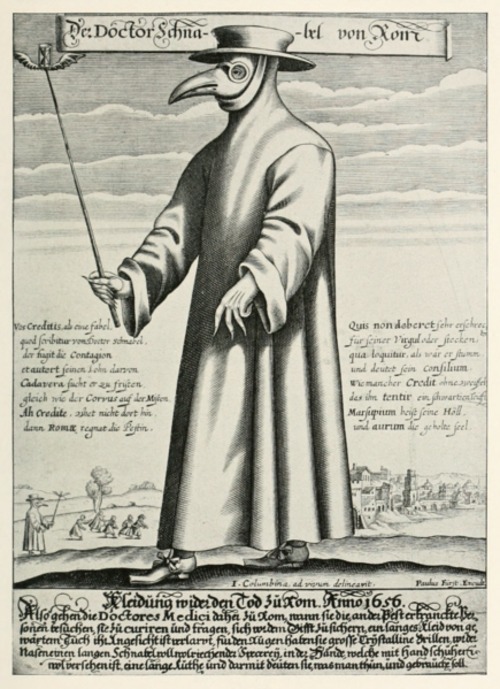
During the Bubonic Plague, doctors wore these bird-like masks to avoid becoming sick. They would fill the beaks with spices and rose petals, so they wouldn’t have to smell the rotting bodies. 

A theory during the Bubonic Plague was that the plague was caused by evil spirits. To scare the spirits away, the masks were intentionally designed to be creepy. 

Mission fucking accomplished

Okay so I love this but it doesn’t cover the half of why the design is awesome and actually borders on making sense.

It wasn’t just that they didn’t want to smell the infected and dead, they thought it was crucial to protecting themselves. They had no way of knowing about what actually caused the plague, and so one of the other theories was that the smell of the infected all by itself was evil and could transmit the plague. So not only would they fill their masks with aromatic herbs and flowers, they would also burn fires in public areas, so that the smell of the smoke would “clear the air”. This all related to the miasma theory of contagion, which was one of the major theories out there until the 19th century. And it makes sense, in a way. Plague victims smelled awful, and there’s a general correlation between horrible septic smells and getting horribly sick if you’re around what causes them for too long.

You can see now that we’ve got two different theories as to what caused the plague that were worked into the design. That’s because the whole thing was an attempt by the doctors to cover as many bases as they could think of, and we’re still not done.

The glass eyepieces. They were either darkened or red, not something you generally want to have to contend with when examining patients. But the plague might be spread by eye contact via the evil eye, so best to ward that off too.

The illustration shows a doctor holding a stick. This was an examination tool, that helped the doctors keep some distance between themselves and the infected. They already had gloves on, but the extra level of separation was apparently deemed necessary. You could even take a pulse with it. Or keep people the fuck away from you, which was apparently a documented use.

Finally, the robe. It’s not just to look fancy, the cloth was waxed, as were all of the rest of their clothes. What’s one of the properties of wax? Water-based fluids aren’t absorbed by it. This was the closest you could get to a sterile, fully protecting garment back then. Because at least one person along the line was smart enough to think “Gee, I’d really rather not have the stuff coming out of those weeping sores anywhere on my person”.

So between all of these there’s a real sense that a lot of real thought was put into making sure the doctors were protected, even if they couldn’t exactly be sure from what. They worked with what information they had. And frankly, it’s a great design given what was available! You limit exposure to aspirated liquids, limit exposure to contaminated liquids already present, you limit contact with the infected. You also don’t give fleas any really good place to hop onto. That’s actually useful.

Beyond that, there were contracts the doctors would sign before they even got near a patient. They were to be under quarantine themselves, they wouldn’t treat patients without a custodian monitoring them and helping when something had to be physically contacted, and they would not treat non-plague patients for the duration. There was an actual system in place by the time the plague doctors really became a thing to make sure they didn’t infect anyone either.

These guys were the product of the scientific process at work, and the scientific process made a bitchin’ proto-hazmat suit. And containment protocols!

reblogging for the sweet history lesson

You know how malaria was defeated?

Well wait, you know what malaria is? It’s this mosquito-borne parasitic illness, you just get sick, and then you die. You know why swamps are considered places of death? Today we’re like “wetlands are critical verdant natural habitat, the kidneys of the world, and it’s important to protect them”. It’s because swamps had still enough water for egg-laying, so they were full of mosquitos, who were full of malaria, so if you hung around them you’d just fucking die.

What was the treatment? Well for thousands of years there wasn’t one. If enough generations of people lived in malarial areas they’d eventually be selected for resistance, because if they didn’t have it they’d die.

That’s why African-Americans have such high rates of sickle-cell anemia, because that comes from a recessive trait that codes for resistance, because they descend from slaves captured and exported from the wet western coast of Africa or inland along rivers, which meant mosquitos, which meant malaria.

They were imported from west Africa because the Caribbean and the Atlantic coasts of South America and the modern southern US were great climates for growing valuable cash crops that required intensive agricultural labor, but they were wet and malarial, and if you put a lot of people with ancestors from cool dry central-to-northern Europe there and had them work outside, especially in large groups, they would get malaria, and then they would die.

That’s why of all the places they “discovered” and colonized, the only places really thickly settled by Northern Europeans were Australia, South Africa, and the northern coasts of North America and southern coasts of South America, because they were drier temperate zones, or the mountainous/hilly highlands where it was cold and gravity made the rivers run fast, so they wouldn’t get malaria and die.

If you could kill the mosquitos that would help (that’s why DDT was invented and used in extermination campaigns everywhere), if you could drain the wetlands that would help (that’s why so many were destroyed, one of first things that set Rome off on the course to world-empire was draining the swamps around the city), eventually we finally developed drug treatments, the first one discovered was quinine.

You know how that was discovered? When Europeans were first establishing dominion in South America, a guy on the cold mountain highlands of the Pacific coast noticed the locals chewed this bark to keep from shivering. He was like “hmm, people with malaria shiver a lot, maybe this would treat malaria!” and it did!

It’s still not clear how quinine treats malaria, but it’s established that it has nothing to do with the mechanism by which it stops cold people from shivering. This was a complete fluke.

The father of the kid across the street that I played with when I was a kid ran a business. His business model was basically to comb through thousands of wild unsubstantiated claims of, basically, “alternative medicine”, which is what we call folk medicine as practiced by white people who live in subdivisions and watch TV. They’d try to find the few that might have potential, and then run them through initial tests, and taking the ones that showed some results and run them through further tests, in hopes of eventually finding something, most likely something that could be sold on to a pharmaceutical company who would have the resources to do further tests on the by this point maybe 20% chance it would do something and 5% chance it could be a profitable product.

His one big hit was Cold-Eeze. They were the Cold-Eeze guys. Someone was like “zinc is a miracle cure for my sickly child”, because, you know, resonant frequencies and homeopathy and chiropraxis (fuck “chiropractic”, that is not a well-formed noun). And so a ton of tests later, as far as they could tell zinc ions happened to be able to bind to the same sites on the nasal membrane where the cold virus would.

(except zinc tastes awful, and most of the flavorings you could use would bind to zinc salts in ways that they wouldn’t bind to those sites, but a particular patentable formulation - zinc gluconate glycine - would work without tasting like ass. And then as soon as the product got popular there were mass-market knockoffs that used other zinc formulations that didn’t do shit)

The problem with this business model, of course, was that most of the people pitching you ideas are either woo-woo quacks or snake oil sales/con-men, and thus if by random chance they hit on something that worked, you’d still be in business with woo-woo quacks or snake oil sales/con-men, who would take every opportunity to fuck everything up, but that’s another story.

Tagged: history malaria quinine afamhist

tl;dr: Germany and their ally America won WWII in 1991

Pretty much every country that fought in WWII used it as a crucible in which to reforge their respective nations, and so it’s understandable that what we know now of the war is basically mythological. Not in terms of like, dates and names and locations, the who/what/when/where is mostly accurate, but in terms of meaning - the why.

In the last decade it’s becoming more and more of a mainstream understanding that America didn’t beat Germany in WWII, the fighting on the Western Front wasn’t nearly as important as the Soviet effort on the Eastern Front. Yes, yes, correct. More than that though, America barely even fought on the Western Front. Our contribution wasn’t in frontline combat but in logistics. Logistics is the least sexy (but most important) part of any war, and America was to the British Empire what the Urals were to the Soviet Union - an industrial base located beyond German bombing range.

Without American food, and the ability to build cargo ships with which to deliver food (including from the rest of the Empire - the British homeland hadn’t fed itself since the 18th century) faster than U-Boats could sink them, the British population would have starved, revolted, and deposed any government that refused to sue for peace. The idea that American wartime food rationing was necessary to feed “our boys fighting overseas” was a polite fiction, better for morale than the truth that it was to free up food for export to essentially bribe allied civilians to stay on-side.

Remember that one of the sore points of interwar Germany was that the German surrender came with the field armies in decent and even advancing strategic position, under pressure from hunger-stoked socialist rebellion on the homefront - the “stab-in-the-back” or Dolchstoß. Of course today you see that often dismissed as a myth, the “Dolchstoßlegende”. Dismissed, of course, by the mainstream historiographers aligned with the regimes which legitimized themselves against the regime that legitimized itself on it. (Let’s call it the “Dolchstoßlegendelegende”, and then call it a day.)

To the extent the Ukrainian famine of the 1930s was deliberately induced and targeted by Stalin, I think it would have to have been a prophylactic against a Soviet equivalent - preemptively liquidating potential fifth columnists, cutting the numbers of mouths to be fed, and denying any German occupation a source of recruits or agricultural workers.

(Of course, the notion that Ukrainians might turn against Russia and in favor of Western Europe, under the influence of fascist sentiment stoked by local elites for personal gain is properly considered just another of those legenden, no less ridiculous than the notion that Japanese-Americans might hold loyalty to the former portion of their hyphenation over the latter.)

I’m wandering a bit afield but I also want to say, when you hear said that Stalin’s purges of the military were so stupid, didn’t he know he was purging some of the best soldiers Soviet Russia had? Well, soldiers Russia had maybe, the question is in that counterfactual where they stuck around would, would Russia stay Soviet? The Russian Revolution was deliberately incited by Germany to knock Russia out of a World War.

Career army types - a lot of times, their loyalty is to the army. Maybe to the nation, but the government? Eh. A lot of the higher-ups purged had started off in the Imperial Army and had made one transition already. And lower ranks, well, their loyalty is to their superiors, as it should be, right? (The Russian Navy, by contrast, spent the early 1900s occasionally rebelling against everyone because their institutional continuity had been shattered by the near-total wipeout of the Russo-Japanese war.) Governments change, but any state needs an Army, after all. Vladimir Putin started off serving the Soviets.

Okay enough digression. Without American food, and Britain thus pressured to make peace, Germany not only could have shifted the resources, ground and air forces defending the Atlantic coast to the Eastern front but would have freedom of the seas, and thus access to supplies from the overseas colonies of Axis powers (including France and the Netherlands), and from the neutral countries of South America (which had considerable economic ties with Germany). It also would have been able to open fronts and supply troops from the Black and Levantine Seas, Persian Gulf, and Pacific coast of Russia.

Without American industrial production, the other Allies wouldn’t have enjoyed nearly as much functional range from their resource bases. This would suck in general, most particularly it would limit the British ability to sustain their Northern African forces, and of the Soviets to operate in Azerbaijan, Iran, and the ’stans. With these forces weakened, it was concievable that Axis forces could gain control of the Suez Canal (greatly degrading Britain’s connections with its colonies in India, Africa, and Oceania) and middle eastern oil fields (a huge coup, hydrocarbon shortages were the major limitation on German capabilities, resolving them would have allowed for significant gains in production and much improved ability to advance and supply forces eastward into Russia.)

So yes, to say that America’s role in the European theater of WWII was really about making and shipping, not fighting isn’t to short its contribution - it truly did provide the margin of victory. The Normandy landings and opening of a Western front of ground combat were dramatic, made for great stories, but they didn’t change the outcome of the war. At least not in the sense of “will Germany win” - that had already been decided in the negative. It just changed the details of who they lost to. And what difference did that make? Well…


People say WWII should be considered as a continuation of WWI. There’s something to that, there’s something to that.

Here’s another idea, though - WWII was continuous with the Cold War, and before even V-E Day, America had switched sides to fight with the Germans, and specifically the German right, against the Russians, and to a lesser extent France and the UK. It was a brilliant betrayal, the maneuver by which America came to rule the world.

I mean, we didn’t side with the Nazis, per se, except to the extent that under Gleichschaltung everything in Germany not specifically anti-Nazi was officially Nazi. Rather, their coalition partners - the Christian democrats, the Junkers, the Heer, the industrial capitalists who had allied with the volkisch streetfighters to fight socialism and were perfectly willing to switch allegiance to the American strong horse for the same purpose.

That explains why long after it was obvious the war was a loss the German forces kept fighting on the eastern front - to hold off the Russians long enough for the Americans to reinforce Germany, or to fight westward to link up with (“surrender to”) American armies.

That explains why America never really pulled the trigger on “denazification”, the attempt to purge German government and society of fascists and fellow travelers, and instead turned around and purged its own government and society of communists and fellow travelers in the Second Red Scare.

That explains the Marshall Plan - America rebuilt western Europe, because America had conquered it.

That explains Bretton Woods, pegging European currencies to the dollar, and thus subordinating their economies to the American economy. (and the “Eurozone” as successor, subordinating European economies to Germany). How do you know Germany lost WWI? Because the Treaty of Versailles imposed punishing reparations on Germany, redirecting its economic output to Britain and France. The result of WWII was the redirection of Britain and France’s economic output to America and Germany.

That explains American support for decolonization in Africa and Asia, most glaringly in the Suez Canal Crisis, where America used the whip hand on Britain and France to support Nasser’s move to pry the canal - and Egypt generally - from their hands. By choking off their colonial empires, America blocked their ability to return to parity through primitive accumulation.

This explains de Gaulle - pulling out from NATO, fighting to hold on to Algeria and Vietnam, pursuing French nuclearization for energy independence and military sovereignty - he was pushing back, and since the Soviet collapse France has been subtly reassembling its African empire - in any potential American/Chinese/Islamic struggle for Africa, they’re the wild card.

That explains the postwar American development of a conceptual vocabulary - “totalitarianism”, “authoritarianism”, “statism”, “central planning”, horseshoe theory, “human rights” - by which communism and fascism were positioned as varieties of a broader unitary category and America assured itself that it had always been at war with Eurasia.

(The “Cultural Marxist” meme, that the Frankfurt School and their ideas represented a communist attempt to subvert America, is particularly ironic. The Frankfurt School and their ideas were embraced and actively promoted by the core of mainstream America - the government, businesses, universities, the Protestant churches - because at core their ideology was - liberal, yes - anti-communism.)

This doesn’t, as far as I know, explain the (at the time, surprise) death of Franklin Roosevelt, and replacement by Harry Truman, a man whom power brokers had installed for the express purpose of lining up an anti-leftist succession. But wouldn’t it be wild if it did?

This doesn’t explain much about the Pacific theater - that was America and Japan competing over who would inherit the European imperial holdings in Asia. Japan did fight to the last, America did conquer it outright, and did purge it in the aftermath.

It does explain the later takeback of that purge in the name of anti-communism, and Truman’s decision to use nuclear weapons. Not only as a demonstration and warning to Russia, but to hasten its surrender. You hear it said it was to pre-empt the need for a costly and painful invasion, that’s not really true. America had total naval and air superiority and could have just starved Japan into submission - its infrastructure shattered, even with peace it was essentially in a state of famine until the late 1950s. America wanted Japan to surrender while they were still the only ones around to surrender to, rather than face a division with the Soviets like Korea and Vietnam.


So. All those teenagers from around the world who follow me for god only knows what, next time in History class you’re asked how WWII ended, now you know. Falling back in the face of Soviet advances, Germany peeled off America from the Allies, decisively sewing up the Western Front. After negotiating a tense decades-long armistice, they eventually starved (and subverted) Russia into submission in the early 1990s. This completed, they realized their long-held dream of eastward expansion and hegemony over continental Europe.

Tagged: history amhist wwii world war ii revisionist history

The Monroe Doctrine is nominally an American guarantee of sovereignty to the independent nations of the Americas, but really...

The Monroe Doctrine is nominally an American guarantee of sovereignty to the independent nations of the Americas, but really from the get go it was a claim to hemispheric dominion (all “guarantees of sovereignty” basically are, true sovereignty guarantees itself) as the successor to Spain.

It was originally proclaimed in the context of the ultimately successful independence movements of Spain’s various continental possessions, as local elites took advantage of Spain’s Napoleonic-era vulnerability to carve out their own feifdoms.

This doctrine effectively claimed the Americas as part of the US economy and sphere of influence without the necessity of formal annexation (as direct integration of the Catholic, Hispanophone, feudal, indigenous and hybridized, cultures of South America into America was too big an ask for a United States that was still struggling to reconcile its own northern mercantile republicanism and southern extractive feudalism.)

The young empire of America got away with it mostly because it wasn’t worth the bother for anyone else to contest the claim - inland South and Central America were largely too malarial or, on the Pacific side, mountainous for intensive development; extractable or already extracted precious metals had largely been exported to Europe already (prompting inflation which reduced the value of further extraction); the railroad, steamship, and refrigeration infrastructure that would enable the later perishable fruit trade was yet to be developed.

Tagged: history amhist monroe doctrine

This is absolutely true. Back before the (mostly German) petrochemical/pharmaceutical industries developed cost-efficient ways...

This is absolutely true. Back before the (mostly German) petrochemical/pharmaceutical industries developed cost-efficient ways of processing hydrocarbons, guano was a major source of chemical stocks. 

Before the widespread employment of synthetic fertilizers (indirectly converting hydrocarbons to calories), guano was a major agricultural input and the ability to boost food production (and thus feed population, and thus raise armies) gave a significant advantage to powers which controlled it (and thus naval powers vs. land powers generally).

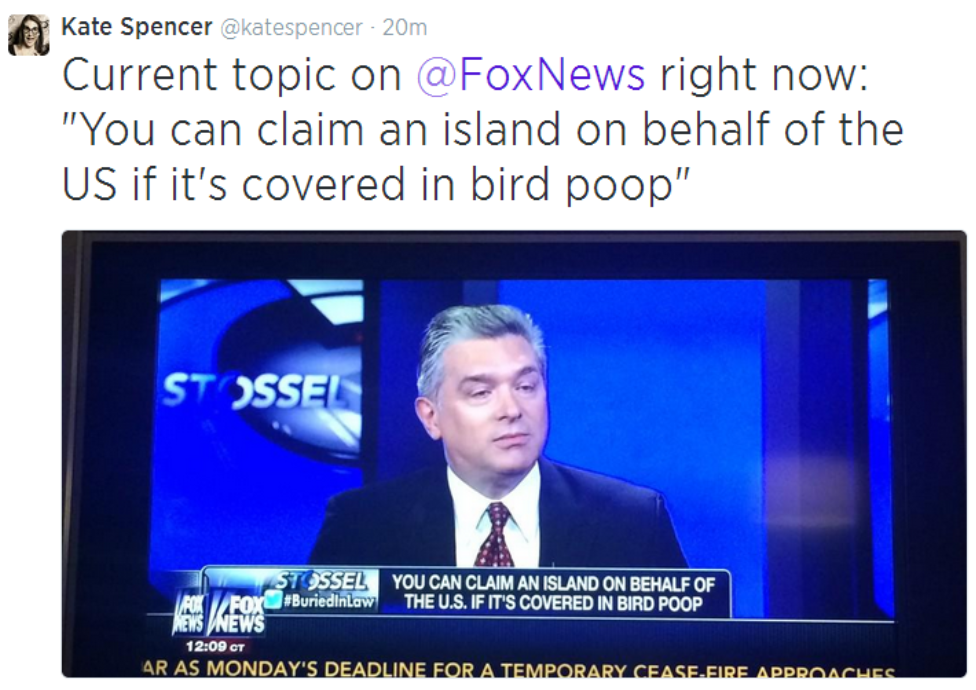
Also as a pretext, the Guano Islands Act allowed America to claim outposts that were vital for fueling/restocking purposes to extend naval power far enough to defend the Asian/Pacific possessions inherited from victory in the Spanish-American War.

Tagged: history amhist

John the Painter - Wikipedia, the free encyclopedia

John the Painter - Wikipedia, the free encyclopedia

Jaimes Aitken, 18th century British homegrown terrorist, radicalized on a trip to America

Tagged: history amhist terrorism John the Painter

I mean, let's not get too misty-eyed about the good old days here, when I say that with civic pacification through militia...

I mean, let’s not get too misty-eyed about the good old days here, when I say that with civic pacification through militia callups carrying heavier political costs there was pressure for authorities to defuse or preempt conflict in other ways, yeah, “other ways” could mean civil negotiation and yielding to public pressure, but it could also mean the preemptive deportation, framing, or targeted assassination of potential protest leaders.

Tagged: history amhist

And how, before the development of SWAT teams, did police handle things that fell under "significantly more intense than normal...

And how, before the development of SWAT teams, did police handle things that fell under “significantly more intense than normal operations, but not pacification of public unrest”, like say an outlaw gang holed up in their hideout and willing to fight off the authorities?

Well, a lot of times they would just deputize a lot of citizens, which is to say basically create an official armed mob, and just go at it with the understanding that their side would likely take casualties.

I see people complaining about the violence of modern society and it’s like what? You have no idea.

Tagged: history amhist