shrine to the prophet of americana

#history (385 posts)

Pearls Before Swine - Rocket Man This song, written the day of the first moon landing, is such a product of its time. I mean...

Pearls Before Swine - Rocket Man

This song, written the day of the first moon landing, is such a product of its time. I mean the musical style obv., but particularly the assumptions encoded in it.

First off that space travel will become a commonplace analogous to trucking, but moreover that husband/fathers’ lives will be more defined by work for pay and purpose than by any emotional connection to their wives or children, and the elegaic acceptance that this masculine work will carry the risk of injury or death.

Tagged: history amhist

Public mental health

slatestarscratchpad:

athrelon:

It’s a commonplace that the massive gains in life expectancy in the 1900s are in large part due to public health improvements - vaccinations, sanitary childbirth, smoking cessation, and the like.  To be sure medicine improved too, but most of the value was in the low hanging fruit - “suddenly having antibiotics” and basic chemotherapy, for instance.  By comparison, high-tech treatment of severe diseases such as genomic targeting of cancer have so far had relatively little quantitative effect on QALYs.  Rather than health care, a lot of value seems to come from public health - preventative measures and lifestyle improvements to make people less likely to get major illnesses in the first place.

Mental health, however, seems entirely focused on the health care side of things and lacks a public health component.  We have drugs and therapies to treat major depression, bipolar, psychosis, and so on, but relatively little attention to how lifestyle factors affect our subjective experience and might predispose us to eventually developing the major maladies.  And so we end up with situations where half of grad students and a third of medical students demonstrate symptoms of depression, but nobody panics at the stressors and social isolation that might be causal here, the way they’d panic if they saw med students taking smoke breaks between patients.

Clearly the low-hanging fruit is simply to be personally attentive to your “mental health hygiene” and lean against the popular paths when they conflict with it.  It’s not totally obvious what policy/institutional responses are realistic, particularly with the recent hullabaloo over how colleges handle acute cases of mental health problems.

Actually, quite a few things seem like “public mental health” to me:

1. The self-esteem movement, growth mindset movement, etc.

2. Everything in the category of people on Tumblr posting “Remember, you’re beautiful and wonderful and perfect the way you are!”

3. Various government efforts to remove toxins that damage brain health, for example pesticides implicated in ADHD

4. Trigger warnings.

5. Everything in the category of transgender rights could be seen as a public mental health intervention.

6. You bring up residents as an example of an untreated high-risk population, but before I started my residency I had go to to some incredibly annoying patronizing lecture where they told us how to schedule our time and gave us tips for dealing with stress and so on.

You might prefer evidence-based public mental health, but it’s really hard to get good evidence on these sorts of things - the early studies said self-esteem was great, then later more rigorous ones found that it wasn’t.

There was a big mental hygiene movement in late 19th cen. and early 20th cen. America, though it was pretty well entwined with notions of social, physical, and moral hygiene, educational reform, and the Progressive movement generally.

In terms of acting on environmental factors, slum clearance, the building of parks, and the Playground Movement could be seen as part of or allied to the mental hygiene movement.

(When I talk about entwinement consider the YMCA - it offered young transient workers an alternative site of residence and socialization to bars and taverns [social], gymnasiums and athletic facilities to encourage exercise [physical], in service of a vision of Muscular Christianity [moral] which blamed many of the faults of urbanizing society on the feminization of cultural institutions.)

Early intervention was also big component - it was held that many mental disorders such as anarchism, homosexuality, and gender deviance were the fault of mothers, particularly poor mothers from immigrant and rural-transplant communities, who were incompetent at properly acculturating their children, and urged their sidelining in childraising in favor of (usu. upper-class) professionals and (same, also female) social workers. This was also the origin of the notion of “juvenile delinquency”.

Other mental hygiene initiatives of the period included the construction of asylums, forcible institutionalization, and the sterilization of the congenitally mentally unfit, by analogy to existing public health interventions of professionalized sterile hospitals, quarantine, and vector control.

Tagged: amhist history

Study the past, if you would divine the future.

Study the past, if you would divine the future.
Confucius

Tagged: yep yeeeeeeeepp history

but why do we have to get married and have children why can’t we just get a group of friends and live happily ever after in an...

severnayazemlya:

thathopeyetlives:

cyborgbutterflies:

chroniclesofrettek:

honey-andrevolution:

sexpot-titzgerald:

sprinklesobourbon:

thegestianpoet:

seansoo:

but why do we have to get married and have children

why can’t we just get a group of friends and live happily ever after in an apartment and share the profits

i’d be much happier that way

this is the most millennial thing ive ever read 

Nothing wrong with this, you can have roof parties and grill food.
Better yet just save up together and buy a small house split the bills and mortgage.

- the nuclear family as an economic unit has really only existed for a few hundred years, across part but not all of the world

- the nuclear family unit is the easiest to exploit under capitalism, because parents have to work externally to provide for their children. They work to pay for child care for their children while they work. They work to earn money to feed their kids and to give them nice things to make up for all the time they spend away, at work.

- a huge amount of labour is necessary every day to keep a family fed, their house clean, etc. some families are wealthy enough to outsource this by hiring staff, most are not.

- capitalism is a pointless middleman in this. we should just live cooperatively.

- share houses and intentional communities are awesome

- people of different life stages function well together because they have complimentary needs and abilities

- kids are less of a stress and burden in a home with lots of different adults to provide support and love, as well as sharing household tasks.

- destroy capitalism through cooperativism.

^^^

“- capitalism is a pointless middleman in this. we should just live cooperatively.”

Just make sure you have a friend who likes to clean, one who likes to cook, someone who likes to do laundry, someone who likes to take care of children, and make sure you’re all ok spending 50%+ of your time together without getting on each other’s nerves for a couple decades. A simple task for any neurodivergent, socially awkward person.

Sharing a house with many friends/romantic partners great and I can’t wait to do it.

But sharing a house with random strangers? People who might be abusive, mean, bigoted, or just plain impossible to deal with?

That sounds about as bad as family to me. I’m all for cooperation between people but at the same time I am scared because there are many out there who would hurt me and I’d rather have some input in deciding who to live with.

I don’t want to share a house with anyone but my wife and children. Every roommate I have ever had I ended up getting annoyed at.

But it could be very nice to live in a village, esp. a Weltraumburg fractal urban village.

what’s the history of the nuclear family? when/where did it originate?

emmanuel todd says it predates modernity: he thinks family structure influenced the development and speed-of-uptake of modernity, and for anyone whose name isn’t an australian seaworld park, causal relations can only travel in one direction in time.

this says it’s been around in at least part of europe for as far back as anyone can tell.

Historically, it’s completely typical for unmarried adults to live in semicommunal group housing. Not only with (extended) family but if away from home with people who are at least initially strangers - boarding houses, YMCAs, dormitories, fraternities, military barracks, work camps, residential hotels, social clubs and taverns with attached rooms.

The expectation that single adults will necessarily live individually in single-occupancy residences is of about as recent origin as the expectation that married adults will live in nuclear families in detached suburban houses.

Tagged: history amhist

A funny thing about free-range chickens is that they get taken as part of this retro-rustic thing - chickens wandering around...

A funny thing about free-range chickens is that they get taken as part of this retro-rustic thing - chickens wandering around outside in a bucolic setting, that’s the traditional way to raise your meat.

And that is ridiculous. The traditional way to raise meat chickens is on large-scale factory farms, because raising meat chickens wasn’t a tradition at all until the mid-20th century, with roots in the 1930s.

Now chickens had been raised for food, and been eaten, before then, but that’s to say that they were raised for eggs, and chicken meat was essentially a waste product of the egg industry.

There were historically two types of chicken that were eaten. One was “stew hens” - egg-layers who had aged out of productivity, so named because the aged meat (layers being bred for durability, not tenderness) was tough and thus favored tenderization through slow-cooking.

The other were “spring chickens” - surplus male chickens that were killed at a young age, after their sex (and thus uselessness as layers) became obvious.

(Chick sexing can separate males from females at hatching, but to do it reliably requires enough training and experience that chicken sexer is a skilled job in its own right, something modern large-scale farms find useful to hire but not worth the expense to barnyard farmers.)

Spring chickens, obviously, were preferred for their tenderness, but this raised their price, and the young age decreased the amount of meat on their bones. And both types coming from lines bred for laying, neither had all that much to begin with. So chicken was something of a luxury meat. (As historically were most skeletal muscle meats - the poor ate organ meats, trimmings, tendons, bone marrow, fat, and blood, to the extent they ate meat at all.)

Which makes sense - if you assume that all stew hens lay about 200 eggs a year in 2 years of production, AND that there’s no chick sexing so that there’s one spring chicken per hen, AND treat the two types as equivalent AND completely ignore unsaleable losses to disease or predators that still means only one chicken breast is produced per 17 dozens of eggs.

So knowing that you realize Herbert Hoover’s 1928 campaign slogan of “a chicken in every pot” wasn’t just offering the promise of no one going hungry, but further of widespread access to petty luxury.

Tagged: history amhist food

Since music has become an almost general amusement, nothing is more useful than a shop that has assembled all kinds of music...

Since music has become an almost general amusement, nothing is more useful than a shop that has assembled all kinds of music from ancient to modern. Such is on offer at the business we are announcing today that will be opened the 22nd of this month… The subscription will be 24 livres per year, in exchange for which sum the subscriber can take whatever piece of music that they would like.

The first music subscription service, 1765. “He was promptly sued.”

From the blog post 250 Years of Music Subscription Services.

(via bmichael)

Tagged: history same as it ever was

Wolf extermination is land improvement

Wolf extermination is land improvement

So after a long and overwhelmingly successful campaign to exterminate wolves in America we’re starting to actively try to reverse course and reestablish wolves in the wild. And part of that involves retrospectively casting the earlier extermination efforts as the product of some sort of misguided fear or ignorance but bitch please, we knew exactly what we were doing, it was cold, pragmatic land improvement.

Now, our stock image of “land improvement” is agricultural - grading land flat, draining wetlands, adding irrigation, so as to enable it to produce more crops. You’ll remember that a lot of the formal ideology of American settler-colonial land appropriation was that the native inhabitants didn’t have ownership of the land because they hadn’t made it theirs by performing such land improvements, and were instead something like long-term vagrants.

(As a side-note, in early America land clearance was effectively free or even profitable if you were tied into the transatlantic economy - a landowner could hire a gang of men to chop down the trees on his plot and then immediately pay for the effort by reselling the wood, depending on the local markets and geography either raw as fuel or construction material, or instead processed into lumber, furniture components or [in the deep woods where transport was toughest] by burning to ash for use in lye manufacture. Keep in mind that in this period wood was quite dear back in Europe, while in the New World it basically grew on trees.)

Now, as you’ll know if you followed my recommendation to read Changes in the Land, American natives actually did perform extensive operations on land to improve its productivity, but were often overlooked in this because what they were optimizing weren’t the familiar forms of either manorial or smallholder agrarianism. The classic example is setting regular forest fires, which cleared out underbrush and allowed for fresh green growth, thus increasing the carrying capacity for game like deer, thus increasing the productivity for hunting and gathering.

(Another side-note: you see similar if less intentional dynamics today. When people talk about deer-human conflict - car crashes, nibbled gardens, etc. - as a result of humans pressuring deer through invading their habitat that’s exactly wrong. That stuff gets worse as exurban development continues because humans are creating new deer habitat. The deep woods are too tangled and impassible for deer and don’t have enough sunlight to support nibbling-height plant growth. Plains are better food-wise but too vulnerable - deer escape predators by bounding over undergrowth that predators can’t follow through. So their ideal habitat are edgelands - lightly wooded areas, ideally with access to marginally more and less overgrown regions. And exurban development functionally creates edgeland.)

So once a few years ago I took Blue Bitch from Portland to Missoula and back, for a cousin’s wedding. Got a few good stories out of that. Did you see that New York Times package? I should tell you my Sandpoint story sometime.

And back in Portland OR-7 had been in the news, this wolf with a tracker that was the first wolf known in Western Oregon for more than half a century, and he wandered down around to California (first known for nearly a whole) and against all odds found a mate and birthed a litter, real heartwarming story. But after I crossed over the Cascades range, and intensifying as I continued east into Idaho and Montana, I started to run into merchandise, on gas station shelves, pickup truck bumpers, locals’ torsos, that all ran around themes like Fuck Wolves; or Kill Wolves; Wolves Can Go To Hell; Kill All Fucking Wolves, Who Can Go To Fucking Hell, And Then The Fucking Wolf-Loving Hippies Too. I was actually a little impressed at how many variations on the theme they managed to pull off.

Because wolf extermination was land improvement. Like, we knew wolves were apex predators and important to the functioning of the natural ecosystem when we killed them, THAT’S WHY WE KILLED THEM. By killing the apex predators we became the apex predators, and wolf-cleared lands became much more productive for hunting. The state government of Alaska sends helicopters out to kill wolfpacks every year for this exact reason, to enrich the hunting prospects. (A substantial share of the Alaska population derives a nontrivial portion of their yearly diet from wild game.) By replacing the apex predator with ourselves we allowed for animal husbandry - livestock raising - which is essentially hunting plus low time preference.

It wasn’t because we were afraid of them although their reputation as mankillers (mostly lone forest travelers in prey-scarce seasons) sure didn’t fucking help their cause, it was an economic decision. We killed them as an act of land improvement, to raise the yield of hunting and animal husbandry.

Now of course animal husbandry and hunting don’t provide as much calories per acre as intensive agrarianism, but they’re still perfectly viable for regions with lower population densities or ill-suited to agriculture - soil too rocky or acidic, insufficient water, no easy transportation to markets for low-value, high-volume bulk products.

And this - the mountainous terrain of eastern Oregon into the Rockies - was hunting and animal husbandry land, this was the land, the culture, the economy made viable by wolf extermination, and so I’m not surprised they said Fuck You to wolves and wolf reintroduction, because wolf reintroduction was basically saying Fuck You to them.

After I found a hotel for a night I ended up in a bar, struck up a conversation with a local, wanted to know what it was like from that side. It was basically like you’d expect - that the government that acted in their name had abandoned the duty of protecting their livelihood from predators was improper, that it would actively try to stop them from protecting themselves was repugnant. She attributed it to city folk in Portland who couldn’t imagine what it was like to be a farmer. (Nearby Idaho, for example, started annual wolf hunts as soon as federal protection as “endangered species” was lifted.)

I said that wasn’t true, Portland’s the earthiest city I know, people are very in touch with the land and the truth of fundamental production, there are lots of people who can imagine what it’s like to be a farmer.

And let that sit a beat and then delivered the punchline: …there’s just more people who can imagine what it’s like to be a wolf.

Which is it, really, that for all the foofaraw what we’re doing is actively and intentionally degrading a functional segment of our polity in the name and interests of those not only not our countrymen but not even our species, and when they ask why we would do this, and what we’re offering in return we basically tell them - they who actually fucking know from wolves - “well, it’s really cool to think of yourself as a wolf”.

She also said Portlanders wouldn’t be so positive if they were the ones who had to deal with the consequences. Which is completely correct. In LA and Portland, I’ve seen some of the greenest, circle-of-life ecology types get quite tetchy about coyotes sneaking into their yards and eviscerating their housepets. Their precious social media star reduced to a mess of fur and blood, the skull’s hard to chew so they often leave the head intact, dangling off a stripped spinal cord.

And yeah when a farmer comes across a calf like that okay maybe it’s not ~a member of his family~, instead it’s just his job and his retirement and college savings accounts. So hey.

Tagged: amhist history

Not Our Independence Day | Jacobin

Not Our Independence Day | Jacobin

Our favored categories can start to look strange when we turn a light on the realities of the American Revolution. The revolution involved coalitions of people who were deeply divided regionally, economically, socially, politically, so anything the big-time founders did agree on will be pretty revealing.

I’d say they were largely agreed on the virtues of representative government — it’s what they’d had for generations, what they saw being threatened — but to question your question somewhat, I’d also note that across the board, from the planters to the financiers to the upper farmers and lawyers, the right of representation in no way equated with democracy, which at the time would have meant “manhood suffrage”: disconnecting the right of political participation from property ownership.

The founders who held power were agreed in their fear and loathing of that idea. Their ideology of rights and liberty was bound up, from ancient times — at least in their minds it was — with protecting property. So both the economic liberalization promoted by the high-finance Hamilton, and the more agrarian program that the slave-economy Madison advanced (once he realized what his old friend in nationalism Hamilton was up to), recoiled from democracy, a term the founders used negatively whenever they referred to placing power in the hands of the unpropertied.

That free yet unpropertied class was big, by the way, in founding-era America. In my view, egalitarian goals, as you’ve put it, were not on the minds of any of the well-known founders, for all of their other differences.  That includes mutually divided nationalists like Washington, Hamilton, Madison, and Adams and state-sovereigntist, anti-nationalists like Patrick Henry.

Tagged: history amhist

George Washington: *writes letter to congress about how his dastardly rival, horatio gates, is planning to lead a military coup...

George Washington: *writes letter to congress about how his dastardly rival, horatio gates, is planning to lead a military coup against congress to settle claims of wages never paid to soldiers, and how he, the great and wise one, heard of this when the coup plotters unfortunately told his aide alexander hamilton, and settled everybody down with a great speech, but congress should pass a bill anyways that guarantees pay for soldiers AND for rich creditors by implementing a widely unpopular tax in order to stave off any future military coup*
Congress: *Passes the tax with haste*
Later Historians: "Gosh, it's so excellent that George Washington was so committed to democracy. There could be no ulterior motives here. This calls for another statue of our God-King."

Tagged: history amhist

the funniest and best thing i’ve learned while doing research for this shakespeare project is that in the late 19th century,...

gruntledandhinged:

thegestianpoet:

soulpants:

the funniest and best thing i’ve learned while doing research for this shakespeare project is that in the late 19th century, there was this group called the american acclimatization society and their thing was bringing european plants and animals to the u.s. so one member was this guy named eugene schieffelin and he was like obsessed with shakespeare, so he went, “hey, wouldn’t it be cool if we tracked down EVERY SPECIES OF BIRD SHAKESPEARE EVER MENTIONED and brought them ALL to America” so he rounded up like a hundred European starlings and released them in central park, and now there are upwards of 200 million starlings in North America and they cause around $1 billion worth of damage to crops every year, all because shakespeare mentioned them exactly ONCE in Henry IV part 1

#the shakespeare fandom is wild

truth.

Tagged: history amhist

The Revolution was not a single struggle, but a series of four separate Wars of Independence, waged in very different ways by...

lambdaphagy:

The Revolution was not a single struggle, but a series of four separate Wars of Independence, waged in very different ways by the major cultures of British America.  The first American Revolution (1775-76) was a massive popular insurrection in New England.  An army of British regulars was defeated by a Yankee militia which was much like the Puritan train bands from which they were descended.  These citizen soldiers were urged into battle by New England’s ‘black regiment’ of Calvinist clergy.  The purpose of New England’s War for Independence, as stated both by ministers and by laymen such as John and Samuel Adams, was not to secure the rights of man in any universal sense.  Most New Englanders showed little interest in John Locke or Cato’s letters.  They sought mainly to defend their accustomed ways against what the town of Malden called ‘the contagion of venality and dissipation’ which was spreading from London to America.

Many years later, historian George Bancroft asked a New England townsman why he and his friends took up arms in the Revolution.  Had he been inspired by the ideas of John Locke?  The old soldier confessed that he had never heard of Locke.  Had he been moved by Thomas Paine’s Common Sense?  The honest Yankee admitted that he had never read Tom Paine.  Had the Declaration of Independence made a difference?  The veteran thought not.  When asked to explain why he fought in his own words, he answered simply that New Englanders had always managed their own affairs, and Britain tried to stop them, and so the war began.

In 1775, these Yankee soldiers were angry and determined men, in no mood for halfway measures.  Their revolution was not merely a mind game.  Most able-bodied males served in the war, and the fighting was cruel and bitter.  So powerful was the resistance of this people-in-arms that after 1776 a British army was never again able to remain in force on the New England mainland.

The second American War for Independence (1776-81) was a more protracted conflict in the middle states and the coastal south.  This was a gentlemen’s war.  On one side was a professional army of regulars and mercenaries commanded by English gentry.  On the other side was an increasingly professional American army led by a member of the Virginia gentry.  The principles of this second American Revolution were given their Aristotelian statement in the Declaration of Independence by another Virginia gentleman, Thomas Jefferson, who believed that he was fighting for the ancient liberties of his ‘Saxon ancestors.’

The third American Revolution reached its climax in the years from 1779 to 1781.  This was a rising of British borderers in the southern backcountry against American loyalists and British regulars who invaded the region.  The result was a savage struggle which resembled many earlier conflicts in North Britain, with much family feuding and terrible atrocities committed on both sides.  Prisoners were slaughtered, homes were burned, women were raped and even small children were put to the sword.

The fourth American Revolution continued in the years from 1781 to 1783.  This was a non-violent economic and diplomatic struggle, in which the elites of the Delaware Valley played a leading part.  The economic war was organized by Robert Morris of Philadelphia.  The genius of American diplomacy was Benjamin Franklin.  The Delaware culture contributed comparatively little to the fighting, but much to other forms of struggle.

The loyalists who opposed the revolution tended to be groups who were not part of the four leading cultures.  They included the new imperial elites who had begun to multiply rapidly in many colonial capitals, and also various ethnic groups who lived on the margins of the major cultures:  notably the polyglot population of lower New York, the Highland Scots of Carolina and African slaves who inclined against their Whiggish masters.

– David Hackett Fischer, Albion’s Seed.

Tagged: history amhist 'merica

on the fourth of july, remember that american independence was a land grab

monetizeyourcat:

you hear this a lot, but what does it mean, specifically?

the pre-1776 americans who came from a sex, race, and class background that enabled them to participate in the conventional history of america sought to buy into aristocracy as a system of production. they were the youngest sons of minor aristocrats, the children of men with rank and no land, successful but socially limited military officers. there were people other than white men in america, but our history is not defined by them, they were not in power, they struggled to survive and their voices are faint and hard to hear. even the reality of working-class life in america among white men is largely silent; children read thomas paine’s agitation for the bourgeois revolution in america but nothing about his labor agitation in the us and england, nothing about his work as a corsetmaker or his parallel struggles to break into the bourgeoisie personally and defend workers as a class. we learn about the composition of washington’s teeth.

more people know washington had teeth extracted from slaves than know he was rich, and had an obvious and immediate material interest in the revolution as a wealthy planter.

george washington was arguably the richest man in america. not in money, although there is that. he was rich in land; he was a successful surveyor, planter, and politician. “politician” makes sense to us, and while it meant different things in the 18th century (and certainly he would have rejected any attempt to identify him that way) it’s something we can comprehend pretty well.

the planter class were slaveowners. this was a universal fact of revolutionary america; there was nowhere near enough ‘free’ labor in america to maintain their massive, highly inefficient cash crop farms. expanding the population of slaves in america was a major priority to intensify production.

before the cotton gin made cultivars of cotton that grew outside of fertile bottomland economically viable under even plantation slavery by reducing the titanic amount of labor necessary to make their bolls usable for fiber, the major cash crop of america was tobacco.

in america, because of peculiarly american mythology, we tend to believe that in the late 1700s and most of the 1800s people didn’t understand crop rotation or soil nitrogen. even in the context of european agriculture this is incorrect. soil nutrition was an incomplete science, and the primary fertilizer in the west was not an efficient nitrogen source but bone meal, yet american planters understood the basics of crop rotation and fertilization. they simply refused to use them because they would have driven up costs.

the rudiments of the agricultural revolution were things that wealthy american planters chose to forget. this is why america is larger than europe and has only been a food exporter in living memory - not because it is infertile, but because its economy was one of indifference to fertility, and this set down powerful cultural roots and industrial norms. the dust bowl was a product of this history as much as anything.

in slavery times, wealthy american planters planted a crop of tobacco on every surface available to them on good land - and they could tell if land was good for tobacco by means of both common knowledge about agriculture and surveyors’ trade secrets. a good way to tell in virginia was to count the pines.

they continued to plant tobacco season after season, crop after crop. the land was never given rest, never allowed to lay fallow. no land capable of raising tobacco was used for anything else; food and feed crops that would have partially restored soil were grown on bad, rocky, marginal soil.

in a few years, the best land used this way would become utterly infertile, and would be allowed to revert to barrens. the semi-indigent white smallholders of the antebellum south filled this vacuum, and in struggling to make do with an agricultural technology adapted for intensive, land-destructive agriculture, degraded soil still further.

the planters who had used up land then acquired more. land was cheap; formally it was necessary under english law to acquire title from natives, the english system of transfer of title was not a native institution and was easy to use to steal land. the american mythology includes a story about settlers buying manhattan for $50, and a riposte that this represented an easement and not a permanent purchase to the native lenape. there are also stories about natives selling land they did not own. these are both applicable in some cases, inapplicable in others; the interface between white settlers and natives was unstable and heterogeneous. in most cases, white title to land under english law was only ever ambiguous at best, and the land bought in this way rapidly became incapable of supporting people outside of the deformed european style of agricultural production prevalent in america. even if the system were not rigged against natives, economic pressure would still have created a comprador class which sold out and moved north and west, and this would still have intensified political struggles among natives and between natives and white settlers.

these conflicts, and legal hassles for the british government, lead to the proclamation of 1763. we hear mostly about it forbidding squatting - white settlers moving over the mountains and claiming land without title. in the american popular imagination this is what the revolution changed.

the reality is that the main thrust of the proclamation of 1763 was that the purchase of native land in america by private agents was forbidden, and all such purchases had to be formal purchases by agents of the crown itself. to a planter class whose bloated, vampiric way of life depended on shady and frequently illicit private land deals between themselves and natives, this was a deadly threat. from the word go, it was challenged by planters - who, being sustained by the legal system in a basically predatory life, in general took pains to be literate in the formal law of england and keep copies of significant precedents in common law courts - using a forged version of the pratt-york opinion.

the pratt-york opinion held that the british east india company was within its rights to purchase land from princely states in india. it held, unambiguously, that its decision did not apply to america, and american skeptics always expressed scorn and ridicule about the idea it suggested of dealing with indian “princes” and “governments”. (after the war, john marshall made it clear that there was no homology in the eyes of anglo-american law between the formal, legitimate governments of the raj and american indian nations.) but when you think about it, the same logic was really at work: the british east india company was an agent of the crown in its own right so its expropriating land from natives was in the crown’s interest even without its formal say-so. and so in a sense were american planters agents of the crown in this capacity. if george washington, the richest man in america, was not an agent of the crown in north america, who even was?

forged versions of this opinion, which clipped off language making it unambiguous that the decision was inapplicable to america, circulated widely. they are in evidence in the personal effects of washington, jefferson, lewis and clark. whatever the crown said, the land grab would continue, be damned any border or line. more land was needed so more land would be taken.

before, during, and after the revolution, washington was a surveyor; he wrote down the characteristics of land which white people had seen but had not investigated in depth for its suitability for plantation agriculture. he took the best land of the west for himself. it was not considered unseemly or ridiculous that he would do this even while on campaign; it was a necessary part of his profession and a universal behavior of the plantation aristocracy.

the use of land in this way continued after the war, and especially after the war with tecumseh’s confederacy was won at tippecanoe; land was close to free for the first white people to survey it, and cheap as dirt for the rich planters that came after them.

this is how americans became rich. this is how american capital came to exist. this land grab logic extended into the west, and this is part of the reason oregon was settled so far in advance of the great plains - the thick, dry grasses of the modern breadbasket of the us were not suitable country for cash crops, and only at its southern margins did plantation slavery ever successfully advance.

it is sometimes treated as inevitable that this should have ended, that plantation slavery reached its zenith before the civil war and the civil war was part of its decline. but this country was literally founded by people who stole land to farm so intensively with slave labor that it was destroyed for agriculture for generations - and those people would never have imagined most of what we think of as ‘the south’ being subject to their economic system. it was not suited for tobacco or long-staple cotton. but american and european industry, whose hunger for production was insatiable, found a way.

this form of production followed exploration, opening, and exploitation of native nations distant from white settlement by a diverse class of explorers and outdoorsmen. it followed that exploration and opening more or less everywhere. when we read histories of the rest of america we encounter other, less discussed cash crops, far outside of the main area of plantation slavery: ginger, indigo. (ginger in particular was a cash crop because of british merchants’ penetration of markets in china.) the same economic logic that applied in plantation slavery applied everywhere, and while some crops were limited by the absence of free labor, enormous families and punitive economic policies against the indigent were tailored to minimizing that. the same economic idea - land is limitless and can be destroyed without consequence, and labor can be someone else’s problem - underlay everything america did. it underlaid acquisitions of millions of acres of land with no conceivable economic use to agriculturists.

it underlies, in distant echoes, the modern american system, where the acquisition and mortgaging of domestic land is one of the primary ways capital disburses to the middle-class; where intensive use of land in existing settlements under gentrification follows a predictable pattern of exploration, exploitation, expropriation, and transfer to large investors. state violence is not the end-all and be-all of this legalized theft but it is always present and always on the side of capital and its agents.

and the american innovation, the core of the american experiment, is that if you have enough money you’re as good as god’s vicar on earth. it worked for washington and it works for your landlord.

happy fourth of july, everybody!
Tagged: history amhist this is a moneycat appreciation blog 'merica holidays

Proposed: the 1980s farm crisis (which was where family farming finally died in America) at some level fed into the development...

Proposed: the 1980s farm crisis (which was where family farming finally died in America) at some level fed into the development of anti-abortion activity and identity in the same period, by way of agrarian-magical fertility rites.

It’s a recurring notion among human agricultural societies that the health of the land, and of the crop, rely, through sympathetic magic, on the enactment of human fertility, in ritual or actual childbearing

These fertility cults constitute a folk religion symbiotic with any variety of nominal official religions, if not actively parasitic and tending to supplant

At some fundamental level the failure of the agrarian economy is understood or at least felt as a result of the failure of women to bear children, and for them to return to fertility will renew the golden age

To perform abortions is, essentially, to perform black witchcraft, cursing the crop and ruining the harvest; if a witch has cursed your crop the solution is to kill the witch.

This would explain the origin of Operation Rescue in the mid-1980s, and why it would choose Wichita of all places for its Summer of Mercy, this would explain the geographic distribution of the most intense anti-abortion sentiment and violence, this would explain why if you drive too far into farm country the cultural footprint consists of decaying human settlements and roadside signs condemning abortion or beseeching women to give birth

Tagged: history amhist abortion folk religion religion

Like you might think “hey maybe there’s something to a more wicked boom/bust cycle, maybe buffered by debt forgiveness in...

Like you might think “hey maybe there’s something to a more wicked boom/bust cycle, maybe buffered by debt forgiveness in bankruptcy, after all creative destruction, etc. etc.“

In practice a lot of it is whoever had free and clear cash on hand could buy land - farmland, mines, forests - then use the cashflow from that to buy more in downturns when people couldn’t make mortgage, consolidate into these ridiculous resource barons.

I do kind of worry about Disney and big pharma doing that with IP today though

Tagged: history amhist

what do you think of the gold standard?

Anonymous asked: what do you think of the gold standard?

I admit there are vulnerabilities in the central banking/fiat system of currencies but we’ve got a decent track record of avoiding them and even in those countries where shit goes kablooey it only does so periodically and usually in response to external shocks that were going to fuck *something* up.

On the other hand we’ve gone without a central bank, or on a gold standard before, and not only does that system have its own vulnerabilities

(market corners, speculative attack, the whole economy going crazy in one direction or another because the mining industry or war expenditures on the other side of the world were not particularly concerned with the American business cycle, shortages of specie that choked the economy until they were innovated around through introduction of private currencies issued by multiple non-central banks that would then completely collapse because they weren’t backed by taxation backed by a repressive apparatus)

, but they happened ALL THE FUCKING TIME

Tagged: history amhist

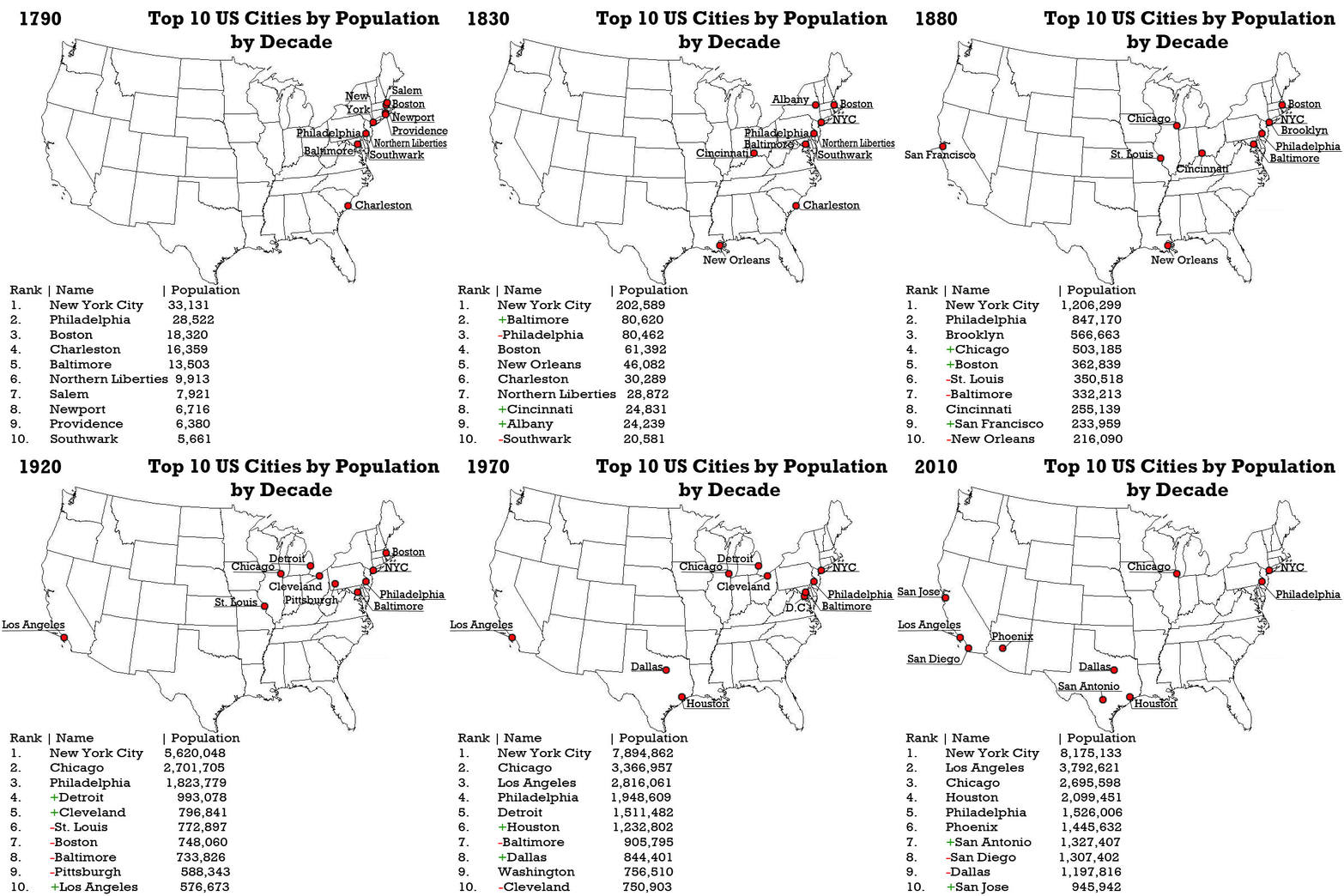
Top Ten Largest US Cities by Decade, 1790-2010

mapsontheweb:

Top Ten Largest US Cities by Decade, 1790-2010

Tagged: history amhist

So for the record, even to the extent that The Good Olde Days Of Moral Uprightness were a real thing (and in some ways they...

So for the record, even to the extent that The Good Olde Days Of Moral Uprightness were a real thing

(and in some ways they were, moving part being the instrumental fact that your reputation mattered when your social world would consist of the same 200 people your whole life, in which standing waves of morality could be maintained)

people never waited for marriage to have sex

they waited for ENGAGEMENT

which is why in 19th century novels rakes making false promises of marriage are such a thing

Tagged: history

Someone asked about that “German cosplayers” bit, as I hoped they would. Answering here so I can tag and link. So the thing...

Someone asked about that “German cosplayers” bit, as I hoped they would. Answering here so I can tag and link.

So the thing is, the 19th-20th century attempts by the settler-colonial power structure of America to forcibly assimilate its indigenous remnant population - residential schools, prohibitions on traditional languages and practices, etc. - were reasonably successful. To the point that when the ‘60s-‘70s American Indian Movement came along and a lot of them decided to reassert their distinctiveness by reviving the Old Ways, they often realized that no one around still had a comprehensive memory of how the Old Ways went.

But.

Over in the German lands, the 19th and early 20th centuries were marked by very influential Romantic movements that emphasized outdoor nature experience, traditional cultures, and preindustrial crafts.

Meanwhile, the works of American novelist James Fenimore Cooper had proven quite popular in German translation. Cooper specialized in romantic outdoors adventures featuring white men adopting Native American ways. (It doesn’t come up often these days, but a lot of early American settlers [escaped slaves too] ended up assimilating to native cultures.)

Then German author Karl May wrote even more popular novels in the 1800-1910s, Western-set adventures featuring the outdoorsman partnership of the German Old Shatterhand and the Apache Winnetou. These were huge in Germany, there’s a bit in Inglorious Basterds that references this.

Soo, add this outdoors preindustrial romanticism to this Native American pop culture fad and a lot of Germans were like “You know what’s a great idea? Going into the woods and pretending to be injuns.” So they started reenactment societies.

Now that’s a crapshoot. Civil War reenactors are pretty accurate, but they have copious contemporary records in their own language to go from. OTOH, Renaissance Faires have nothing to do with the Renaissance, and are mostly based on 1970s liberationist retellings of 19th-20th cen. nationalist retellings of earlier Christian retellings of earlier mythologizations of earlier history still.

But the thing was for one, you know Germans, always gotta do things the proper way, for two, Germany was in a *huge* anthropological boom at the time.

That’s the thing about Indiana Jones fighting Nazi archaeologists - by WWII, Germany was world leader in the field. Just like all the humanities, and social sciences, and physical sciences, and engineering, and… What they didn’t have was land and thus, especially before the Green Revolution and USN-backed freedom of the seas, food. In good times they could source from the exporting regions of the Americas, African coasts, and Baltic watersheds, but in bad times the Royal Navy was all “haha NOPE, enjoy your famine ;)”

So these reenactors ended up practicing some serious fidelity to the sources, and passed these practices down within their own subculture. With the result that come the 1970s, a lot of American tribes ended up sending members to Europe to learn their own traditional cultures from these German hobbyists.

Tagged: history amhist amindhist

Is Another Crisis Looming? | Jacobin

Is Another Crisis Looming? | Jacobin

Profits are a particularly critical indicator of the state of a capitalist economy because they are generally understood to drive investment. Investment in turn has a determining effect on jobs, wages (to the extent that an increase in jobs increases workers’ bargaining power), and a growing tax base that can support social programs.

Why hoard money? Because the ‘80s. They’re building walls against takeover. In a flat market you not only need to scrape the barrel looking for profit opportunities you have to take care to not be cannibalized as an opportunity yourself.

That was the lesson of the ‘80s, that a privately held company might do better playing long ball than one chasing risky peaks, but publicly traded, it’d just get bought out by the whippersnappers with bubble money from a peak. Junk bonds, takeover sharks, “murders and executions”, etc.

Now traditionally the way to stop that was regulation, antitrust, etc, keep any entity from being too big itself. But the problem there was Japan. Japan was not only recovered from WWII and emerging as an export power, it was buying up big properties and assets in the U.S. and Europe. That’s the subtext behind Die Hard being set in “Nakatomi Plaza”. That’s the subtext behind a LOT of '80s-'90s pop culture: Japan Is Coming To Eat Us.

And part of that was they were in a ridiculous bubble themselves, and their economy was built around keiretsu, which… imagine a world with serious antitrust enforcement, then imagine the opposite. Like, active government trust enforcement.

And the regulated old money Postwar Consensus slow-n-steady US was vulnerable to that.

Now the countermove woulda been protectionism. People project all modern conservatism back onto Reagan but he was in big protectionist trade wars with Japan.

But the thing was that we were competing for the loyalty of the “developing world”. With the Soviets, with China, with South American “third way” socialism.

(Which potential depended on seizing and redistributing US capital’s assets, which is why we kept up the Cuba embargo so long, to make the point that even if cooling-off, acceptance and trade might be the best outcome of a non-iterated game, We Will Not Allow This To Be A Viable Option)

And our offer was “hey, do the democratic-capitalist industrialization thing and you can join us in Coca-Cola and Disney Present: Bluejeans World, it’ll be *great*.” But keiretsu-dominated Japan in the '80s was really the first non-Western country to pull it off, with chaebol-dominated Korea and similar Asian tigers waiting in the wings, and to slap them down too hard for uppity presumption would’ve been… awkward.

There’s a lot of stuff that made sense because Cold War and stuck around on inertia. And there were attempts to challenge that in the '90s!

Iraq War I was Saddam being all “Cold War’s over, now we can stop holding off WWIII with this outdated Yalta Conference balance of power and make borders make sense the old-fashioned way, with the strong eating the weak!”

(and Bush the Elder retorting “NATO Is Its Own Purpose”)

Ross Perot was “the Cold War is over, we can stop pretending to believe in free trade”. Pat Buchanan’s “culture war” intervention into the 1992 election was “the Cold War is over, we can stop pretending to believe in free trade AND multiculturalism”.

Now some of that’s finally crumbling. Cuba finally got regular, with TPP free trade’s lost its sheen, Bush the Younger - history is going to reevaluate that guy WAY upwards, and part will be the Bush Doctrine, finally biting the bullet and giving up on organizing the Islamic world around a plan for keeping British allies in ex-Ottoman lands.

Multiculturalism, eh.

Sooooo. Protectionism was out. So the defenses that evolved were, on the national level, allowing the consolidation of industry and finance into “national champions”, and trying to keep a low-level bubble going at all times. Greenspanism.

(Also keeping substantial portions of the economy shielded as “national defense”. If you look askance at China or Turkey’s military for being so involved in their national economies, consider

1. How much of the U.S. economy, particularly manufacturing and design, is arms exports or internal military spending

2. The margins on some of these contracts

3. The security clearances on some of these contracts

4. The wait time on non-military applications for clearance screening, especially in relation to the bidding, staffing, and subcontracting cycles on these contracts.

BONUS 5. The way American tribute from vassal states is funneled through these industries as exports and particularly continuing services and parts contracts.

[which are also a planned obsolescence killswitch when allies go rogue - why the Taliban still had their RPGs but not our Stingers]

THAT’S why Australia is spending so many billions on our jets now, why it was important that the UK buy Trident from us, because that’s how vassal/lord relations work - they kick in coin and a share of fighting men, we pledge protection.)

Where was I? On the firm level. On the firm level the big defense against takeover was to take on debt. Ideally, take on debt for stock buybacks that raise your valuation out of shark range, but importantly debt just dangerous enough that a steady workaday company could manage but these mayflies would face too much downside risk in a downswing.

So that kinda worked, I guess. The big thing now is that the financial regulations after the '07 crash actually worked, but their big moving part is “having promoted national champions, we will now make the holding of large amounts of risky debt by sizeable corporations as bothersome and expensive - in money and several colors of influence - as possible”.

Meanwhile junk bond raiders have grown up into private equity and hedge funds, and every one’s competing with sovereign wealth funds. Which at that point you are not only trying to outbid a guy who buys thousands of slaves to construct a palace for his harem, you are trying to outbid *all* those guys, while they are your government’s closest allies in their single biggest region of interest.

Tagged: History amhist

Girolamo Savonarola - Wikipedia, the free encyclopedia

Girolamo Savonarola - Wikipedia, the free encyclopedia

Girolamo Savonarola (Italian: [savonaˈrɔːla]; 21 September 1452 – 23 May 1498) was an Italian Dominican friar and preacher active in Renaissance Florence. He was known for his prophecies of civic glory, the destruction of secular art and culture, and his calls for Christian renewal. He denounced clerical corruption, despotic rule and the exploitation of the poor.

…the Florentines expelled the ruling Medici and, at the friar’s urging, established a “popular” republic. Declaring that Florence would be the New Jerusalem, the world center of Christianity and “richer, more powerful, more glorious than ever”,[1] he instituted an extreme puritanical campaign, enlisting the active help of Florentine youth.

Tagged: this is a medium-context blog same as it ever was Wikipedia history