shrine to the prophet of americana

#history (385 posts)

Re: Yalta, do you think black separatism could ever have worked? (i.e. yielded an internally stable state with...

Anonymous asked: Re: Yalta, do you think black separatism could ever have worked? (i.e. yielded an internally stable state with not-unusually-contested borders?)

Well, depends on your unspoken terms, really.

Haiti was a country that did and does exist, if you want to talk about the U.S. in particular Liberia is a country that did and does exist. If you want to keep things to the American mainland, the Seminole - who came from fugitive slaves as much as North American autochthons - had effective sovereignty over the Florida peninsula for a while, there were other maroon colonies besides.

If you’re talking about the ‘60s wave, Amerikkka was never going to let a definitionally oppositional state establish from its sovereign territory in the middle of the Cold War, come the fuck on. (That same Cold War pressure also brought things like elite accomodation to black demands and the replacement of the draft with an all-volunteer military so as to keep eyes on the prize and not internal race war.)

I think a lot of contemporaries realized that and so the more practical enthusiasm got channelled into pan-Africanism as decolonization proceeded apace. There were GOING to be Westphalian states run by blacks for blacks, with borders and institutions, and hopes were high.

T’Challa, Marvel Comics’ “Black Panther” that’s getting some heat right now, is a daydream of those diaspora hopes for post-colonial leadership - a strong, noble philosopher-warrior-leader who drives his particular country on to technological self-sufficiency, then dominance (South Africa managed to build a modern economy, jet-set cities, and a nuclear military on a base of black labor, after all) while standing up for all of Africa as a continent and a people.

(You will remember that Rastafari, originating in the early 20th century in the black diaspora, holds early pan-Africanist Marcus Garvey as a prophet and Emperor of Ethiopia Haile Selassie - at establishment head of the only indigenous government in Africa - as a messiah.)

In practice, the warrior leaders weren’t that noble, the philosophers weren’t that strong. Rather than standing for Africa entire, the newly independent countries engaged in border warring (that was largely Cold War shit - after the Sino-Soviet split a lot of countries got to host 3-way proxy wars, which no doubt was fun). Rather than even standing for their own countries entire, politics tended to shake out along lines of tribal identities that were meaningless in the diaspora, with at best an ideological gloss that was efficiently shed with the collapse of the Soviet Union.

All that said, I think an alternate history (or future) where this panned out, and maybe drew return migration from the diaspora is still more likely than the establishment of a black-identity state on North American mainland.

I think rather than an encompassing concept of “blackness” organically emerging from the wisdom of the native African people, this would likely involve a founder state establishing an “African” identity that’s heavily salted with their own particularity, expanding across the continent, brutally suppressing other local identities over the course of several generations in favor of this “Africanism” in a way that uncomfortably reminds of European colonialism, and that any inspirational “pull” factor on the diaspora would be matched by a “push” factor as other states increasingly consider inhabitants sympathetic with the identity of this rising power to be suspect aliens, but hey.

Tagged: amhist afamhist history

Those who do not learn from history are condemned to have no helpful analogies to use against their ideological opponents, much...

argumate:

Those who do not learn from history are condemned to have no helpful analogies to use against their ideological opponents, much like the fall of the holy city of Constantinople to the Sultan’s cannons in 1453.

Tagged: history

The 1980s AIDS plague started closer to WWII than today

The 1980s AIDS plague started closer to WWII than today

Tagged: amhist AIDS HIV GRIDS history

I wonder how many of the people who say “political violence is never acceptable” remember when they’re speaking that the United...

zennistrad:

I wonder how many of the people who say “political violence is never acceptable” remember when they’re speaking that the United States was literally only made possible by a revolution.

And revolutionary violence wasn’t limited to Minutemen and redcoats, either. An important part of colonists coming together to resist the crown was the purging of Loyalists and dissenters.

Patriots abused people, beat them, mocked them, pelted them with rocks, coated their bare skin with hot tar and feathers and ran them out of town on a rail, formed into mobs and laid siege to their houses, drove them from their jobs, homes, cities on threat of death.

America was made possible by a campaign of violent mob harassment.

Tagged: history amhist

Aren’t you pretty? Unveil yourself! (French Algeria, 1930s?)

historylover1230:

Aren’t you pretty? Unveil yourself! (French Algeria, 1930s?)

Tagged: history same as it ever was

A Playboy for President

A Playboy for President

Much of what seems strange and reactionary about Trump is tied to what was normal to a certain kind of Sinatra and Mad Men-era man — the casual sexism, the odd mix of sleaziness and formality, even the insult-comic style.

But while that male culture was “conservative” in its exploitative attitudes toward women, it was itself in rebellion against bourgeois norms and Middle-American Christianity. And if Hillary is a (partial, given her complicated marriage) avatar of Gloria Steinem-era feminism, her opponent is an heir of the male revolutionary in whose club Steinem once went undercover: Hugh Hefner…. Hefner passed from a phenomenon to a sideshow, while a more feminist vision of liberation became the official ideology of the liberal upper class.

But only gradually and partially. The men’s sexual revolution, in which freedom meant freedom to take your pleasure while women took the pill, is still a potent force, and not only in the halls of Fox News. From Hollywood and college campuses to rock concert backstages and Bill Clinton’s political operation, it has persisted as a pervasive but unspoken philosophy in precincts officially committed to cultural liberalism and sexual equality.

This fundamentally rings true, close to what I was getting at in that Something for Everyone post.

Separating The Sixties into two is an interesting and possibly productive angle though. You have the Playboy Sixties (which started in the Fifties of course, the same time as campus unrest first flared up, this time against “in loco parentis” parietal rules that tried to keep the male students and the co-eds from fucking. My dad mentions being in near-riots at Cornell over this, in a narrative by which “panty raids” where men would en masse storm women’s dorms and steal their underwear were a blow for freedom.) The Swinging Sixties, what Austin Powers (who woken up assumed communism had won and condoms were for sailors) was riffing on. The Sinatra Sixties. The sixties where the popular New Face Of America was a charming young president with a picture-perfect wife and family and a steady stream of models and actresses piped in the back door.

And THEN, distinct from that, you have the minority-liberationist 60s, the feminist 60s. Which was not obviously or inevitably incompatible with the white man’s ‘60s. That the Civil Rights Movement of the ‘50s demanding membership in white society would eventually be eclipsed by a black nationalism asserting pride in distinct blackness was not obvious or inevitable. Betty Friedan’s original goal had been, taking heterosexual pairing as a given as the correct state of mature women, to make it work for both parties. And her warning of the “Lavender Menace” of lesbians coming to prominence in late-60s feminism came from a suspicion that given the chance, these women who were not drawn to men and were increasingly articulating theories of feminism based on complete life without men were unlikely to spend the feminist reputational capital she’d cultivated on Making Marriage Great Again.

And points to him for pointing out that the Playboy stuff and so much of that period’s masculinity wasn’t the last hurrah of a long stable maleness but a new-at-the-time innovation that was understood as counter to existing stability.

Like, do you remember that 1965 Playboy interview where Sean Connery, deputized as James Bond, agent of masculinity, extrapolated from his character to expound on the necessity of violence in maintaining correct male-female relations?

PLAYBOY: How do you feel about roughing up a woman, as Bond sometimes has to do?

CONNERY: I don’t think there is anything particularly wrong about hitting a woman–although I don’t recommend doing it in the same way that you’d hit a man. An openhanded slap is justified–if all other alternatives fail and there has been plenty of warning. If a woman is a bitch, or hysterical, or bloody-minded continually, then I’d do it. I think a man has to be slightly advanced, ahead of the woman. I really do–by virtue of the way a man is built, if nothing else. But I wouldn’t call myself sadistic. I think one of the appeals that Bond has for women, however, is that he is decisive, cruel even. By their nature women aren’t decisive–“Shall I wear this? Shall I wear that?”–and along comes a man who is absolutely sure of everything and he’s a godsend. And, of course, Bond is never in love with a girl and that helps. He always does what he wants, and women like that. It explains why so many women are crazy about men who don’t give a rap for them.

That came more than 20 years after the publication of Generation of Vipers, a popular and influential 1942 nonfiction book on how baleful but widespread trends of women in positions of influence or control over men in the name of morals and propriety - “momism” were turning us into a cosseted, failed, unworthy nation.

Tagged: amhist history sex roles megaloid momworship ross douthat

History: the Kontextmaschine summary: Pts. I-II

I. it was grubby and everyone was trying to win but then someone did

II. FOR NOW

Tagged: history the dialectic damocles

The Columbian Exchange - plants and animals that first crossed the Atlantic between 1492 and 1650

maptitude1:

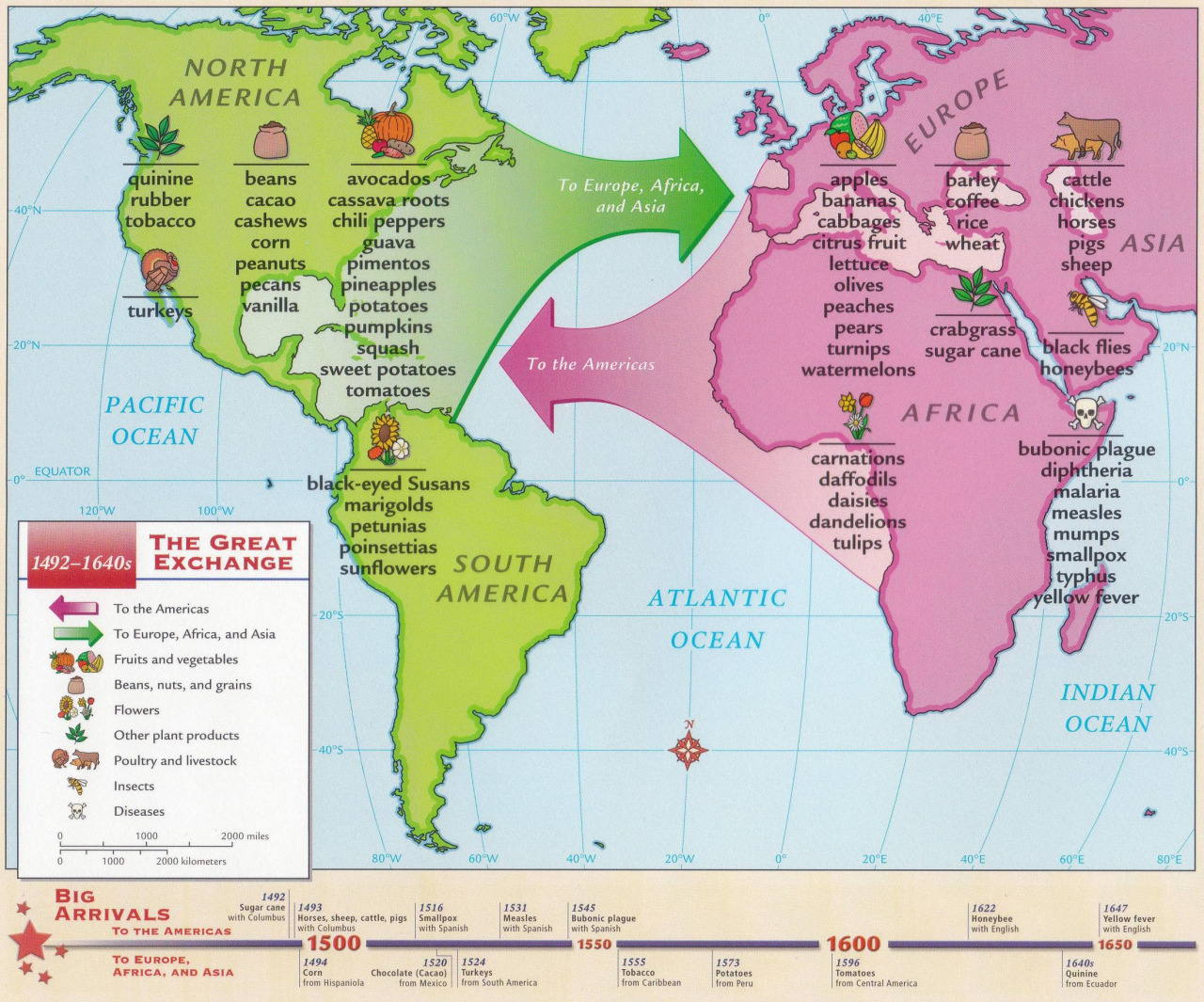
The Columbian Exchange - plants and animals that first crossed the Atlantic between 1492 and 1650

Tagged: history

“One Reason Germany Slows Down,” Montreal Star, July 23, 1938.   “Here’s the situation in Czechoslovakia as another major crisis...

anatomy-lesson:

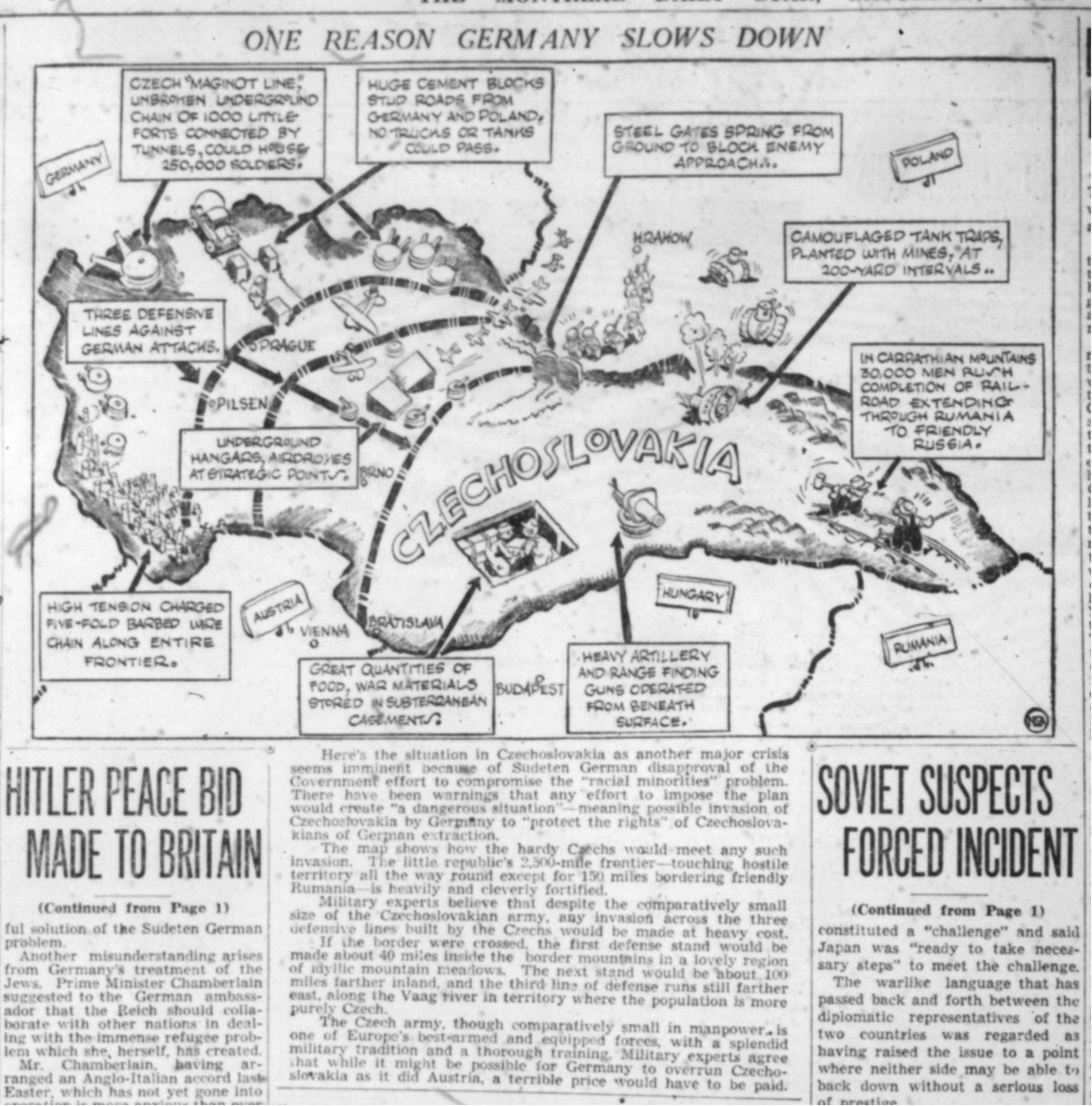
“One Reason Germany Slows Down,” Montreal Star, July 23, 1938.  

“Here’s the situation in Czechoslovakia as another major crisis seems imminent because of Sudeten German disapproval of the Government effort to compromise the ‘racial minorities’ problem.  There have been warnings that any effort to impose the plan would create a ‘dangerous situation’ - meaning possible invasion of Czechoslovakia by Germany to ‘protect the rights’ of Czechoslovakians of German extraction.

The map shows how the hardy Czechs would meet any such invasion.  The little republic’s 2500-mile frontier - touching hostile territory all the way round except for 150 miles bordering friendly Rumania - is heavily and cleverly fortified.

Military experts believe that despite the comparatively small size of the Czechoslovakian army, any invasion across the three defensive lines built by the Czechs would be made at heavy cost.”

Tagged: history

Sexmission (Polish: Seksmisja) is a 1984 Polish cult comedy science fiction action film. It also contains a hidden political...

pyramidenpapist:

Sexmission (Polish: Seksmisja) is a 1984 Polish cult comedy science fiction action film. It also contains a hidden political satirelayer specific to the time and place of its production.


The two protagonists, Max and Albert, played by Jerzy Stuhr and Olgierd Łukaszewicz, respectively, submit themselves in 1991 to the first human hibernation experiment. Instead of being awakened a few years later as planned, they wake up in the year 2044, in a post-nuclear world. By then, humans have retreated to underground living facilities, and, as a result of subjection to a specific kind of radiation, all males have died out. Women reproduce through parthenogenesis, living in an oppressive feminist society, where theapparatchiks teach that women suffered under males until males were removed from the world.

The cold-shoulder treatment Max and Albert receive from the women, their character differences and specific realities of future life serve as background of many humorous encounters. The plot thickens when it turns out that the females have no interest in the rebirth of men, and that for the good of society, the two males are to be killed or “naturalised”, i.e. undergo a sex-change. While trying to break away, Max and Albert find out the impact of their masculinity on women. With one of the scientists on their side, the men choose freedom and prefer to escape and die outside. In doing so, they discover the truth: radiation was just a feminist lie to keep women underground and the surviving male population were “naturalised” into women by the feminists when they took power in the post-war period. As a result of discovering the truth, both Max and Albert begin thinking of bringing the world back to normal.

Tagged: holy shit poland history culture war

How France Continues Slavery & Colonialism in the 21st Century - Global Black History

How France Continues Slavery & Colonialism in the 21st Century - Global Black History

More on how France maintains its former African colonies as vassal states

Tagged: history france

Human remains could still be seen at Waterloo a year after the battle. A company was contracted to collect the visible bones...

davidsevera:

Human remains could still be seen at Waterloo a year after the battle. A company was contracted to collect the visible bones and grind them up for fertilizer. Other Napoleonic battlefields were also reportedly scoured for this purpose. In November 1822 a British paper reported:

It is estimated that more than a million of bushels of human and inhuman bones were imported last year from the continent of Europe into the port of Hull. The neighbourhood of Leipsic, Austerlitz, Waterloo, and of all the places where, during the late bloody war, the principal battles were fought, have been swept alike of the bones of the hero and of the horse which he rode. Thus collected from every quarter, they have been shipped to the port of Hull, and thence forwarded to the Yorkshire bone grinders, who have erected steam-engines and powerful machinery, for the purpose of reducing them to a granulary state. In this condition they are sent chiefly to Doncaster, one of the largest agricultural markets in that part of the country, and are there sold to the farmers to manure their lands. The oily substance, gradually evolving as the bone calcines, makes a more substantial manure than almost any other substance, particularly human bones. It is now ascertained beyond a doubt, by actual experiment upon an extensive scale, that a dead soldier is a most valuable article of commerce; and, for ought known to the contrary, the good farmers of Yorkshire are, in a great measure, indebted to the bones of their children for their daily bread. It is certainly a singular fact, that Great Britain should have sent out such multitudes of soldiers to fight the battles of this country upon the continent of Europe, and should then import their bones as an article of commerce to fatten her soil!

Also:

The flood of teeth onto the market after the Battle of Waterloo was so large that dentures made from them were known as “Waterloo teeth.” They were proudly advertised as such, since it meant the teeth came from relatively healthy young men.

(Source)

Tagged: history

Weird Obsolete Dog Shit

1) the Turnspit Dog, bred to run hamster wheels powering mechanical rotisseries

2) the Velo-Dog, a type of collapsible pistol for shooting at the packs of dogs that would chase after early bicyclists

Tagged: history

There were thousands of these buildings made during the Safavid dynasty, about the 16th century CE in Iran. They were built to...

coolthingoftheday:

There were thousands of these buildings made during the Safavid dynasty, about the 16th century CE in Iran. They were built to collect the droppings as fertilizer for melon and cucumber fields. However, in modern times, chemically produced fertilizers have drastically reduced the viability of the bird guano industry, and as a result not many of these structures have survived to the present day. 

Tagged: history

I remember you mentioning once that in the late 70s big oil starting backing the Republican Party and how it effected election...

Anonymous asked: I remember you mentioning once that in the late 70s big oil starting backing the Republican Party and how it effected election outcomes. You mentioned various other shifts in support among different sections of the bourgeoisie for the two parties too though I can't remember what exactly. Is there a book that you've read that has some kind of comprehensive history of soft money and where its gone in American politics?

antoine-roquentin:

It’s not comprehensive, but it’s what we’ve got. Right Turn, by Thomas Ferguson. This copy is sadly kinda fucked up but it’s free so whatever.

Tagged: amhist history

Children of Kindergartens in an antireligious demonstration in Moscow, 1929. The banners read ‘Parents do not confuse us, do not...

zolotoivek:

Children of Kindergartens in an antireligious demonstration in Moscow, 1929. The banners read ‘Parents do not confuse us, do not celebrate Christmas or put up trees’ and ‘Bring up your children with teachers, not god’.

Tagged: history

Portland’s Albina district gentrified. Its public school, Boise-Eliot/Humboldt, didn’t.

Portland’s Albina district gentrified. Its public school, Boise-Eliot/Humboldt, didn’t.

Interesting article, but I say that coming in knowing the context. If you didn’t, I suspect the fact that a famously liberal American city is in 2016 proudly trying to maintain designated schools for black students seems a little underexplained.

Okay. So in the 1960s Portland moved to desegregate its schools. Like other cities, it attempted to create rough parity among schools’ racial makeup despite huge residential segregation by busing students to schools far from their home neighborhoods. Like other cities, there was serious resistance from parents and the program proved politically unsustainable, collapsing by the late ‘70s.

So far so America, but the novel thing here is it was the black parents taking the lead in resisting bussing and returning to neighborhood schools.

For one, with the black population representing a sliver of the district’s total (a resource extraction economy isolated from Dixie, with a white nationalist “free soil/free labor” heritage, Portland missed out on the manufacturing-driven Great Migration and remains the whitest major city in the US) and concentrated in the redlined Albina neighborhood, their children were disproportionately the ones being dragged on hourlong commutes across town.

For another, well, integration proved unsatisfying. After years of seeing their children spread so thinly they represented a critical mass nowhere, under a district making a point of giving them the same education it gave white students, the black community began to appreciate the virtues of black schools embedded in black neighborhoods under the influence of black parents where black teachers-cum-role-models taught students amid an atmosphere of proud and enthusiastic blackness.

(Similar desires on behalf of black Brooklynites turned into a huge shitshow a decade earlier in New York - after attempts to set up schools under autonomous black neighborhood control, the United Federation of Teachers went on a devastating and successful months-long strike in defense of the prerogatives of its (heavily Jewish) membership, shattering the city’s black-Jewish-labor social democratic coalition just in time for the ‘70s debt crisis and ultimately spurring the development of neoconservatism.)

So, a bit over a decade after black Portland’s leadership pushed for school integration under the NAACP, it ended up pushing black schools for black kids, this time under the Black United Front. A great example of the contemporary turn in black activism from equal rights and civic inclusion to black pride and nationalism, tbh.

And as far as I can tell people seemed more or less satisfied with the outcome and no one particularly wanted to tear the system down and it’s continued like that since, and now you know.

Tagged: amhist afamhist history portlandportlandportland

European Russia, 1916.

mapsontheweb:

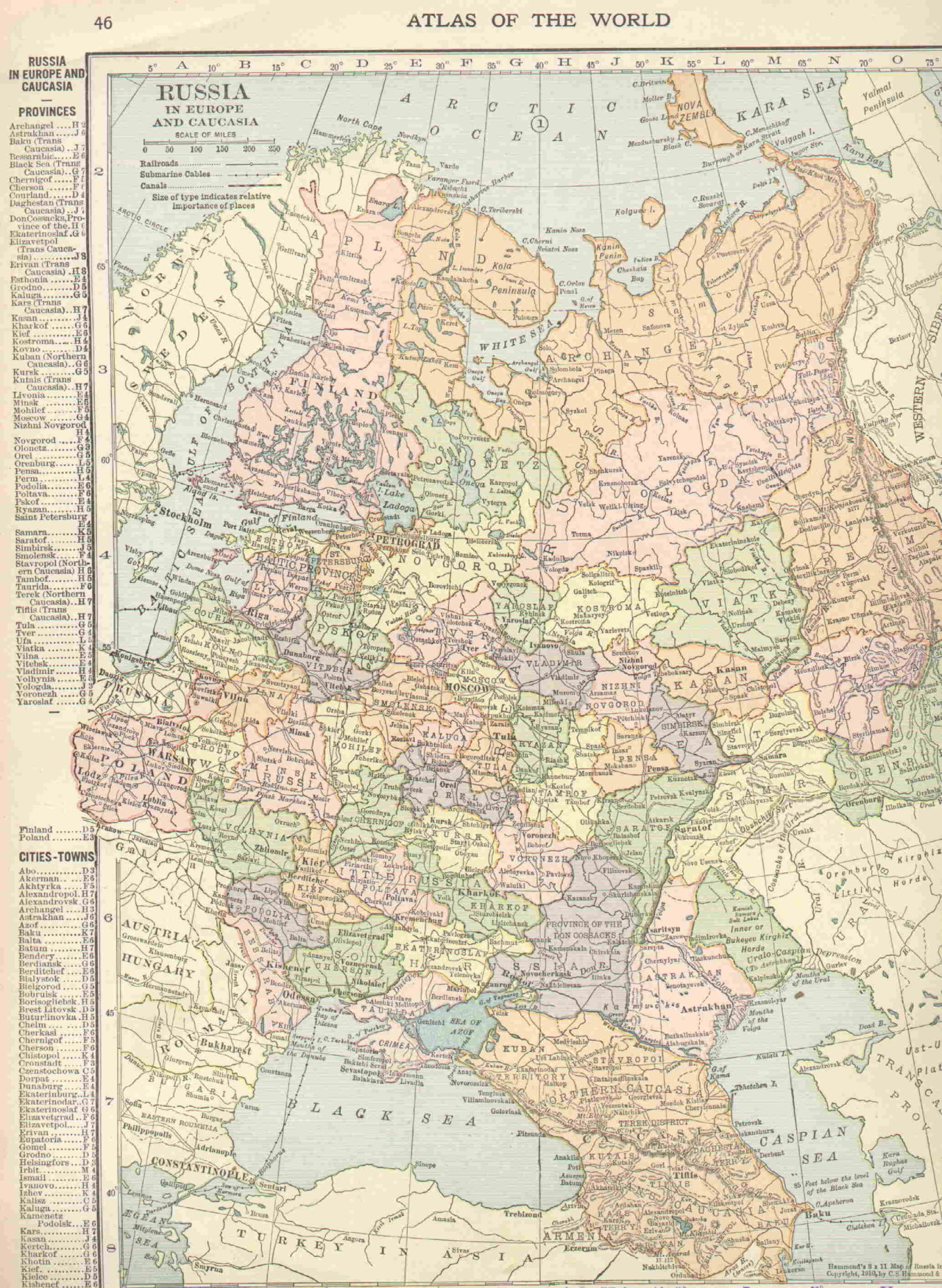
European Russia, 1916.

Tagged: history

Quincy Stamp Mill Process c. 1900 Historic American Engineering Record Heritage Conservation & Recreation Service Eric M. Hansen...

Quincy Stamp Mill Process c. 1900
Historic American Engineering Record
Heritage Conservation & Recreation Service
Eric M. Hansen
(1978)

Tagged: amhist history

I’m reading this book about anti-religious thought during the era people call the “Classical Age” of Islamic scholarship and...

memecucker:

I’m reading this book about anti-religious thought during the era people call the “Classical Age” of Islamic scholarship and holy shit some of these people in the 9th century have such strongly worded polemics like basically calling all religion entirely idiotic. There isn’t too much detailed info about them with the exception of al-Razi because he was a titan when it came to discoveries in other fields like medicine (though most of his anti-religious texts are lost) and to an extent al-Rawandi though the text of his we have most intact is in the context of heavy quotation in a Sufi rebuttal but the descriptions are pretty interesting. Like one response to al-Rawandi has the author going “I realized at this point he wasn’t just attacking only our Mutazalite school but in general Islam and even all people of religion”


Like you didn’t see such forceful and explicit attacks on religion in European thought until the Enlightenment and even then it took until the 19th century for people to be as vehement especially when it came to the topic of God so like when people are like “anti-theism is Eurocentric” that’s just such an ironically Eurocentric view of the world

Tagged: history same as it ever was