shrine to the prophet of americana
#history (385 posts)
It’s been said before but if public libraries weren’t a fact of society and were proposed today they would be roundly rejected...
It’s been said before but if public libraries weren’t a fact of society and were proposed today they would be roundly rejected as pie in the sky communism
they started as private initiatives that were eventually nationalized as vital infrastructure and are maintained on inertia and constituency even as they and the role they were established to fill drift off in separate directions into the aether
more than either libertarians’ or statists’ idealism, that’s how things tend to go
Class Combat
Class Combat
great historical analysis of working class physical culture in the contemporary US vs Xi’s China
The empire had fallen long before it collapsed. Corrupt elites ruled from a distance. Industry fragmented in slow motion, plundered by the rich and slowly pieced apart by foreign competition. For common people, the possibility of any sort of stable life slowly faded. The future itself seemed to recede into an impenetrable darkness, thick with the sound of some as-yet-unseen chaos slouching toward the present. The gap between the dim light of everyday life and that rapidly approaching night was filled with bone-deep madness. Tradition rotted from the inside out. Opiates muted the misery of ever-expanding unemployment and unrest bloomed in its thousand forms. Religious sects bloomed across the heartland. On the coasts, overburdened, underfunded cities sprawled outward even as their cores were flooded with unprecedented wealth. Slums spiraled in a fractal pattern around glittering ports. Foreign powers pressed inward from a distance, the military overextended and inefficient. Weaker armies fought asymmetrical wars against the empire at its edges. Corrupt officials were assassinated in broad daylight. Militias grew in the rural areas, filled with young, featureless men hoping to push out the foreigners and make a great nation strong once again.
I just saw a video title on YouTube that said something like “Why is glass transparent?” And that’s an interesting question and...
I just saw a video title on YouTube that said something like “Why is glass transparent?” And that’s an interesting question and I’m sure it’s great that the video exists but my first thought was like “Because glass is terrible, obviously.” Because it’s unwieldy and let’s out warmth and needs to be heated to hundreds of degrees to be shaped and turns into hundreds of tiny daggers if you drop it. Why the hell would we bother with that if it didn’t have some magical quality like being totally transparent despite being solid? Glass is transparent because if it weren’t, we’d use something else.
looking through my “me” tag and this is apparently what I was thinking 3 years ago
If you’re still curious we did not start working glass for its transparency. It was most likely started as a sanitary concern. Glass is easy to clean with soap and water, once it’s cleaned out you can use it again for anything and no germs or flavor from the previous meal or drink will remain.
Other materials at the time, namely clay, would absorb flavors and germs meaning that if you ate beef off a clay plate your next meal with that plate could have beef flavor and microbes common on cow meat on it. That would leak out seemingly at random no less. Heck imagine a sick person coughing into their soup bowl and then months later their germs hiding in the clay would pop out to infect whole new people.
Also the earliest human use of glass we know of is for its sharpness. Pre-historic people would use volcanic glass as sharp knives for food preparation. Also beads. Pretty much any new substance humans get their hands on for most of our history we immediately try to make into beads.
The fact that it could become see through was a side benefit.
this is amazing and I’m really glad I reblogged that old bullshit post because I got to learn this
All very interesting.
Plus: Pretty much any new substance humans get their hands on for most of our history we immediately try to make into beads
Including Trinitite, which is what the ground turns into under an atomic blast. Yep. People saw bits of radioactive bombed-out melted desert and thought “let’s make jewelry out of this!”
However, it’s worth noting that the transparency was initially pursued just because it made wine look nicer
Roman glass production developed from Hellenistic technical traditions, initially concentrating on the production of intensely coloured cast glass vessels. However, during the 1st century AD the industry underwent rapid technical growth that saw the introduction of glass blowing and the dominance of colourless or ‘aqua’ glasses.
(…)
As a result of these factors, the cost of production was reduced and glass became available for a wider section of society in a growing variety of forms. By the mid-1st century AD this meant that glass vessels had moved from a valuable, high-status commodity, to a material commonly available: “a [glass] drinking cup could be bought for a copper coin” (Strabo, Geographica XVI.2).
(…)
The siting of glass-making workshops was governed by three primary factors: the availability of fuel which was needed in large quantities, sources of sand which represented the major constituent of the glass, and natron to act as a flux. Roman glass relied on natron from Wadi El Natrun, and as a result it is thought that glass-making workshops during the Roman period may have been confined to near-coastal regions of the eastern Mediterranean.[11] This facilitated the trade in the raw colourless or naturally coloured glass which they produced, which reached glass-working sites across the Roman empire.[11]
“You want to protect free speech and privacy? Embrace the idea that threatening the press for doing their jobs is damaging. Consider asking yourself who in history is known for trying to silence journalists for saying things that they don’t like. Then look at where you’re standing. Which side of history are you actually on?”
— Mikki Kendall, Neo-Nazis have threatened CNN employees’ families. Many writers already know what that’s like. (Opinion)
During the American Revolution, printer James Rivington’s Gazette was something of a proto-NY Times: Manhattan-based, but with a broad circulation and the most international coverage in the colonies. It was also the biggest newspaper not to tilt to the rebels, first offering a platform to all factions and then increasingly Loyalist.
This was not universally well-received. Isaac Sears, the privateer-trader who organized the merchants of New York into the Sons of Liberty, pushing back against British regulation which cut into their profits and backed by the threat of mob violence, described Rivington thus:
He would appear as a leading man amongst us, without perceiving that he is enlisted under a party as a tool of the lowest order; a political cracker, sent abroad to alarm and terrify, sure to do mischief to the cause he means to support, and generally finishing his career in an explosion that often bespatters his friends.
I have known a Statute of Lunacy taken out, upon a degree of conduct less exceptionable than this I have described: If the relations of our politician, should find his estate wasted by means of his patriotism, and they choose to improve upon this hint, I assure them, it is heartily at their service.
They did not. (A “Statute of Lunacy” was the period version of involuntary psychiatric commitment)
The Sons of Liberty arranged a series of hanging-in-effigies of Rivington, complete with a poem by revolutionary poet Philip Freneau framed as a satisfying confession before the gallows, and he was arrested by the New York Provincial Congress.
This not availing, an angry mob besieged Rivington and his family, driving them to the safety of a British warship, sacked his office and press, and seized his lead type to be melted down and cast into bullets.
They then faced and wheeled to the left, and marched out of town to the tune of Yankee Doodle. A vast concourse of people assembled at the Coffee House, on their leaving the ground, and gave them three very hearty cheers.
- Connecticut Journal, Nov. 20, 1775
A selected history of Central and Eastern European geopolitics since the 30 Years War, in rhyme
The Russians, the Prussians, the Hessians and Hussars
The Sarmatic Plain is for fighters and not lovers
Succession and Seven, Habsburg-Hohenzollern
Silesia, Great Northern, Partition, Napoleon
Vienna restores what was Corsican-stolen
Tsars build an empire in the in the Balkans and Poland
‘48 come the nations, aristos fight back
West into to Alsace along iron track
Confederation then Empire, Klein oder Groß
Serbian hospitality falls short as a host
Central Powers, Entente, peasants come off the benches
The Whites, the Reds, the Bolshies, the Menshes
The Axis, the Allies, the Treaty, the Pact
Tito and Hoxha, Ben-Guiron, Sadat
FRG, DDR, USA’s GDP
Finlandizing with tanks, Checkpoint Charlie
Solidarność, the Pope, mujaheddin, the Umma
Gorbachev, Yeltsin, shelling the Duma
New World Order, federal Europe, R2P, IMF
History stops and restarts, repeating itself

just by the way I got into late 19th century american police corruption and politics because of you and whoa it's fascinating, I...
Anonymous asked: just by the way I got into late 19th century american police corruption and politics because of you and whoa it's fascinating, I would greatly enjoy if you would go on
more like “son buddy johnny “large ears” mcmaster, my main man, my most promising recruit [agressive back pat] what’s here gonna happen is that if me your favourite mentor get the newspaper boy to get me more happy news about our beloved senator, then I can pretty much guarantee that big boss “honey pot” oreilly is gonna hear about your mom’s flower shop”Oh nice. Def. read Plunkett of Tammany Hall if you haven’t, if that’s not the link I got you into this with in the first place.
One thing I’m looking into lately is lynching and vigilante law. Got the standard background picture of lynching as a specifically racial Dixie thing but realizing that much of the country, between the Civil War and the 1920s, was developing traditions of extralegal killing.
I talked here about the Unwritten Law, that a man was entitled to (=routinely acquitted of) stalk and kill those who put hands on his women. Meanwhile the “true man” and “American mind” doctrines set into law something like modern Stand Your Ground laws. In popular conception the list of things a true man was not expected to tolerate rather than deploy righteous violence was longer, in practical application it turned on the testimony of survivor-defendants.
Not just individuals committed individual acts but communities came together, enacted deadly purges, and then published triumphant histories about it, as Regulators, Moderators, Committees of Vigilance.
(cf. the Vehmic courts of medieval Germany, particularly the resemblance of the Gilded Age to feudalism insofar as the state secures magnates’ holdings and leaves the people to themselves)
The World War II Japanese invasion of Hawaii and the Hawaii overprint note. After the attack on Pearl Harbor in December 7th,...
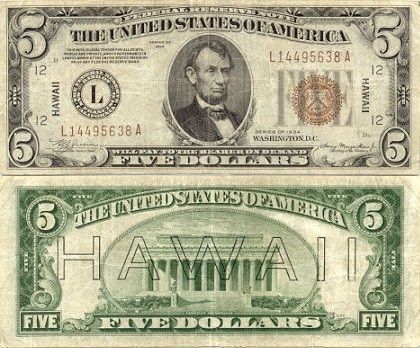
The World War II Japanese invasion of Hawaii and the Hawaii overprint note.
After the attack on Pearl Harbor in December 7th, 1941, it was feared that the next move of the Japanese was to invade Hawaii. One concern of a possible Japanese invasion was the possibility that the Japanese could get there hands on millions of dollar of American currency and use it to fund their war effort. Across the Hawaiian Islands, millions of dollars worth of hard currency was held by banks, financial institutions, businesses, and private citizens.
To solve this problem, the US Federal Reserve created an emergency “Hawaii” note to replace all currency on the islands. The Hawaii notes were only legal tender in Hawaii and were declared worthless anywhere else. To distinguish between real US dollars and Hawaii notes, the new notes featured a brown Federal Reserve seal and the word “Hawaii” was printed in large capital letters across the back of the bill, with the addition of two small overprints on the front. Specially issued by the San Francisco Federal Reserve Bank, they came in denominations of $1, $5, $10, and $20.
On July 15th, 1942 citizens of Hawaii were ordered to turn in all their cash in exchange for the Hawaii notes. In total, around $200 million of cash was collected and burned. In 1944, when it was clear that no invasion of Hawaii would occur, issuance of Hawaii notes was discontinued and normal cash was once again issued to Hawaii. Recall of Hawaii notes began in 1946, although many bills were saved as curios and souvenirs. Today surviving examples are popular collectors items.
Pope Anastasius II - Wikipedia
Pope Anastasius II - Wikipedia
Pope Anastasius II (died 19 November 498) was Pope from 24 November 496 to his death in 498.[1] He was an important figure trying to end Acacian schism, but his efforts resulted in the Laurentian schism, which followed his death. Anastasius was born in Rome, the son of a priest,[2] and is buried in St. Peter’s Basilica.[3] While all the 49 popes that preceded him were canonized, he is the first pope in history who has not been canonized.rough, dude
Chinese restaurants are now a cultural fixture, as American as cherry pie. Startlingly, however, there was once a national...
Chinese restaurants are now a cultural fixture, as American as cherry pie. Startlingly, however, there was once a national movement to eliminate Chinese restaurants, using innovative legal methods to drive them out. Chinese restaurants were objectionable for two reasons. First, they threatened white women, who were subject to seduction by Chinese men, through intrinsic female weakness, or employment of nefarious techniques such as opium addiction. In addition, Chinese restaurants competed with “American” restaurants, thus threatening the livelihoods of white owners, cooks and servers; unions were the driving force behind the movement.
Robert Tombs on the opponents of the Falklands War: The Falklands victory did not, however, mean a new spirit of national unity....
Robert Tombs on the opponents of the Falklands War:
The Falklands victory did not, however, mean a new spirit of national unity. It won vilification as well as praise for Thatcher. The mainly left-wing minority (with a few dissident Tories and Liberals) who had opposed the war were bitter at what they saw as the whipping up of militaristic nationalism by “an absolutely Victorian jingoist.” Tony Benn found it “embarrassing to live in Britain at the moment.” Intellectuals mostly agreed and expressed their feelings in films, works of art and documentaries. The writer Alan Bennett described it as “the Last Night of the Proms erected into a policy.” The historian E. P. Thompson predicted that Britain would suffer “for a long time, in rapes and muggings…in international ill will, and in the stirring up of ugly nationalist sentiment.” The feminist journal Spare Rib denounced Thatcher’s display of “male power.” The Established Church had to be pressed hard to hold a service of “thanksgiving” rather than “reconciliation” at St. Paul’s. For some their alienation from a country whose mood they disliked was deepened—better a country in decline than one revived by the “Falklands factor” and the tabloid Sun. R. W. Johnson in the New Statesman (17 June 1982) dissented, echoing Orwell in 1940: the left “have always proclaimed their hatred of military aggression and of fascism…But when it comes to the crunch they find they hate a right-wing Tory prime minister even more.” Left-wing historians produced works deconstructing British and English national identity and what they saw as the malign legacy of empire and “Churchillism.” Some realized that they had fundamentally misjudged how most people felt. The Marxist historian Eric Hobsbawm thought there had been “a public sentiment that could actually be felt” and “anyone of the Left who was not aware of this grassroots feeling…ought seriously to consider his or her capacity to assess politics.”
Reading the Wikipedia article about the Albanian invasion, I’m like “ah, a rare success for Italy”, which spent both World Wars...
Reading the Wikipedia article about the Albanian invasion, I’m like “ah, a rare success for Italy”, which spent both World Wars as the Comedy Option of the major powers. “How’d they do that?”
“The invasion was poorly planned and executed, but Italian officers training the Albanians rendered the country completely indefensible.”
“I see.”
The Killer's Trail
The Killer's Trail
Oh man, you know what I just remembered? That time in the ‘90s when some guy went on an interstate murder spree and disappeared, and then while he was an active news story on the Ten Most Wanted list he emerged to finish it off by killing Gianni fucking Versace and people still don’t know what that was about
That drew me to this September 1997 article, which fascinated me in its own right because there’s something here I want to draw your attention to. Two things, actually.
First, I assume Vanity Fair still commissions some decent longform, but look how fucking lush this is - 12,500 words, people even tangentially related to the subject interviewed across several states, 16 months in development and published a year after the last bodies were cold.
I’m not gonna say this was the norm, but the norm was still a bit off in that direction back then. Newspapers and TV news would deliver their first draft of history the next day, and a spry reader might subscribe to a few weekly magazines, but past that things just developed at a slower pace. Or, rather, things developed on their own and a while later you’d hear a reasonable account of what happened.
I suppose CNN was already disrupting towards a constant news cycle though, MSNBC and Fox News had launched as me-toos in 1996.
(As point One-and-a-Half, notice how in a pre-Internet world how much social power Cunanan acquires just by reading a lot, remembering things, and other people being unable to check or refute his claims)
Second, another “look into a lost world” in this 20-year-old article is just how natively fluent everyone is in a psychiatric idiom. It’s not really Freudian per se, the old man was already musty in 1997, but a thoroughgoing sense that you can explain someone by reference to the development of their psyche, that they pursue this desire this way but encounter this obstacle and that warps them this way in response…
Some of the cops come from the FBI profiling tradition so fair enough. (Should note the idea of the “serial killer” only dates to the 1980s and the concept of “profiling” got a lot of attention in response I suspect as much as anything as a way for the state to reassure the citizenry that in a relatively un-surveilled, pre-computerized, pre-DNA testing world, they had some defense. This was the context for Silence of the Lambs.)
And maybe it was the author who chose that angle for the piece but geez, her interviewees sure gave her a lot of quotes to work with, it’s really striking how people with even limited contact with Cunanan feel confident talking past observed actions to the nature of his character, on to inferred internal motivations and placing their experience in the context of a narrative or character arc.
Now this was all gay culture in the not yet normie mid-90s, where you might expect people to have a more complex sense of the relationship between interiority and social performance than the average bear. But remembering back it’s just like the writing - this was maybe an outlying case, but things in general did used to be noticeably more like that, now that I think of it.
And maybe that could be done poorly, and even done properly it wasn’t ~scientific~, a bit of Freudian speculation plus a bit of residual Christian “spiritual development”, each put through a few washes of folksy popularization before combining and then put through a few more. “Scientism” wasn’t as strong as it is now, I really have the sense it was more accepted that if some social or hard science expert made a claim about human experience and supported it by reference to math or scientific consensus it was much further “in bounds” for a humanities expert - a reverend, an analyst, a Foucauldian critic - to rebut them by reference to their own traditions.
This was what Alan Sokal was peeved about, and are we better for living in his world now? Honestly I think maybe when a guy who’s intense into hard S&M bashes a guy’s face in with a hammer as part of a murder spree we should consider “huh, maybe he’s a sadist, what’s that about?”
(I have seen a bit of a spike in essayistic psychoanalysis lately with people trying to explain the 4chan/alt-right nexus but you can tell they’re just equipping polemic arms, clumsy in their mouths, not the idiom they see their own lives through)
The flip side of all this, of course, is I’m reading through this whole psychological profile of an article, noting all the times Cunanan varied between reclusive or despondent to life-of-the-party, five-figure spending sprees, sudden intense violence and I’m wondering when they’d speculate he was bipolar. (Actually, I was wondering if it would still be “manic-depressive” back then.)
And the answer is… never. And you realize that “having X mental condition” as a way to understand yourself or others was not yet the thing it now is, the big breakthrough of that narrative into mainstream culture was in 1993-4 with Listening to Prozac and Prozac Nation (I once intended to borrow the latter from the library and picked up the former instead, which was not as bad as the time I intended to rent Steel Magnolias and got Magnolia).
Now I’m not suggesting Eli Lilly created “chronic depression” to match Prozac in the same way Listerine created “chronic halitosis”. But I am saying a consequence of bringing their breakthrough blockbuster SSRI to market was the cultivation of a narrative with a constituency by which you took the drug and were your self, whereas before you had been under the influence of something that was in hindsight distinct from your self. And this narrative matching experience, and being socially validated, in a way Valium or Halcion weren’t.
And that this was not always a typical way to think of the self, even when sympathetically thinking of imperfect or damaged selves. And that reading this 20-year old article, by a writer who debuted in the ‘70s, and then looking up to this blue website, it’s really striking how much older ways of discussing the self have faded away and the Prozac experience seems to have been generalized to bear that weight.
me: haha remember in the '80s when there was a radfem/Christian conservative coalition against porn? me: and remember how it was...
me: haha remember in the '80s when there was a radfem/Christian conservative coalition against porn?
me: and remember how it was pushed back by like, BDSM lesbians? haha they never really figured into anything else what was that?
also me: they were kind of representing the then-current "queer kink sex fun" tendency in America, on account of they were the ones not busy dying of AIDS
It was the priest as an idler and destroyer of the household, who gained ascendancy over women through the confessional, that...
It was the priest as an idler and destroyer of the household, who gained ascendancy over women through the confessional, that the soldiers and leaders attacked more than the priest as magician or upholder of the old order. The revolutionaire was no theologian. even if he talked of superstition, and the real reason for his prejudice against the confessional was the power he felt it gave the priest over his womenfolk. Such prejudices at times came near to misogyny and there are many examples of this in the expressions of the san-culottes, the commissairs and the representants en mission. This anti-feminism was fortified by the frequently furious opposition from the village women which they encountered on their iconoclastic missions-more than one revolutionaire had to take to their legs to escape their fury. But most of all the soldiers held a grudge against women because of the way they let themselves be seduced by the lying and lazy priests. At Bec du Tarn, Huegny, a Toulouse commissaire civil ‘thundered against fanaticism, and in particular against women, who were more easily seduced by it; he said that the Revolution had been made by men, and women should not be allowed to make it backtrack…” Dartigoeyte, representant en mission in the Gers, gave vent to similar feelings in his tirade against the devotes of Mirande: “And you, you bloody bitches, you are their whores [the priests’], particularly those who attend their bloody masses and listen to their mumbo jumbo,’ but he also had a word for the “jean-foutres of husbands who are naive enough to accompany them [and who] simply show what cuckolds they are by doing so.’
From The People’s Armies by Richard Cobb (via lovegodsmashtyrants)
“The Cathedral has cucked us!” - the fucking French Revolution





California and the End of White America
California and the End of White America
This is Ron Unz reposting a thorough 1999 article of his about the development of racial politics in 1990s California, framed around 3 high-profile, racially relevant ballot initiative campaigns.
It’s fascinating because it very clearly foreshadows and leads into where we are now, right down to its terminal predictions (the attempt to put racial issues in politics to rest and realign around a cross-racial citizenship faces difficulties and cannot be assumed, there is a real risk the system will continue on current logic with whites developing a conscious political identity in response), and yet as Unz depicts them - and he was in the weeds here - the actual motivations of the players involved are near-completely incomprehensible from a modern standpoint, a measure of how fast things change.
That is one critique I have, on how fast things change, Unz puts the 1992 “Rodney King” riots as the moment that put Californian whites on notice that their comfortable paradise was threatened by racial unrest.
Now, I really do want to emphasize the scale of this shift - as I’ve mentioned before, California during most of the 20th century was a white middle class bastion of conservative Republicanism. For all its Summer of Love, hippie, surfer girl, Black Panther mystique, it was a reliable Republican presidential vote from the end of the FDR-Truman New Deal Dynasty all the way up through Bush the Elder in ‘88 (excepting the Goldwater/Johnson landslide).
Like, if you’ve got a modern sense of what “California” and “Los Angeles” mean, that’s a bit jarring, and the shift was jarring as hell to live through. This explains Steve Sailer. If you’ve ever wondered what explains Steve Sailer, this explains Steve Sailer.
But, for all that I find Unz’s depiction of the ’92 riots as an end to innocence a bit wishful. For one, the Watts Riots of 1965, Hunter’s Point ’66. But closer at hand than that, I can off the top of my head think of several prominent artistic depictions of a racially tense California that were produced just prior to this, indicating that the tensions were on thinking people’s minds.
There’s White Men Can’t Jump, which basically shared Unz’s “no illusions, but this might just work out” tack, released almost exactly a month before the riots. Falling Down, an elegy for white middle class LA, was released almost a year afterwards on an accelerated production schedule but still written prior.
Closest to my heart, Neal Stephenson’s Snow Crash is a fantastic projection of period SoCal, gated communities and franchised everything, and its looming specter of the “The Raft” threatening to arrive and swamp the locals is drawn partly from the Mexican immigrant wave that usually gets dated contemporary to the ’84 Summer Olympics, and partly from the Asian “boat people” refugee wave all the way back in the 1970s.
So, maybe up to that point it registered as “nothing LAPD nightsticks can’t solve”, but the idea that racial tensions weren’t noticed as a threat strikes me as a bit of a stretch.
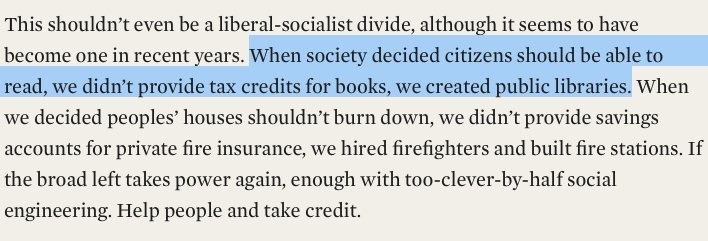
This is flatly, literally, directly untrue. Tax-funded public libraries and fire companies didn’t catch on until the late 19th...
This is flatly, literally, directly untrue. Tax-funded public libraries and fire companies didn’t catch on until the late 19th century, but society had supported literacy and fire suppression long before that, through indirect subsidy.
Periodical mailing rates at or below cost propped up circulation and made a subscription model viable, and requirements to publish legal notices and records of proceedings ensured that newspapermen and printing houses were kept afloat with a regular supply of business.
Fire companies - well you do sometimes see appropriations for capital outlays like fire engines but for operating expenses many did operate as fire insurance (by government charter), fund themselves through salvage rights, or by lotteries and tontines (by special government approval, compare how many current US states restrict “games of chance” like Bingo to charitable fundraising).
This is dumb
Page 11 of 20