shrine to the prophet of americana

#history (385 posts)

What's your take on Democrat infighting over Ilhan Omar?

Anonymous asked: What's your take on Democrat infighting over Ilhan Omar?

antoine-roquentin:

kontextmaschine:

antinegationism:

I may be an immigrant, but I believe in good old fashioned American values. Like apple pie, baseball, and unquestioning support for the state of Israel.

You joke, but “Foreign policy yoked by fixations of incompletely metlted immigrant cultures” is a longstanding trait of America

A lot of the Industrial Age immigrants came from countries with failed revolutionary movements. Liberal, nationalist, socialist, anti-clericalist, altar-and-throne clericalist, all of which picking up the French “the people should rule” theme and ran with it

Oh and did they ever get pissy about it. A lot of the northern or central euro types hated Prussia, which was the “feudal modernism” authoritarian state that was grindingly taking over continental Europe and helped to suppress people’s risings. So they hated Prussia, and its successor state “Germany”.

Which was complicated by the fact that German immigrants were probably the second most prominent nation in America, after Anglophone whites but before blacks (and they were filtered on “Germanophone who doesn’t want to live under European governments, anyway”)

But then in WWI the federal state started to pull together and aimed itself against “Germany” and all those populations bandwagoned on and created a massive wave of anti-German domestic repression that we mostly overlook now except Wisconsin v. Yoder

Also the Irish, christ, the Irish, their immigrants and descendants were always trying to get us in a war with the U.K. — the preeminent Atlantic naval force — over their own shit.

Hell they launched Al Qaeda-style attacks from us - starting w/ the Fenian Raids of the 1860s, where Civil War veterans spontaneously invaded Canada and invited Britain to spank us where they had merely love tapped us in 1812. The hilarious thing about Boston getting mad about that Rolling Stone cover “romanticizing” their bomber. From the Fenian Dynamite Campaign of the 1880s into the 1990s peace process, the city of Boston was the world HQ of terrorist bombing romanticization.

Maybe there’s a tie-in to “people smoking the scraped propaganda resin of the last defining war” tho, there’s also the bit where the US’s first soft antileft dictatorship, the Alien & Sedition Acts, was resisting an anti-British, pro-(Revolutionary) French sentiment taken too far

in one of the fenian raids, since there was no canadian militia of note between buffalo and toronto, the key leadership apparently pulled the entire military history class of university of toronto, who were about to take exams, to be military officers. they promptly assumed the correct stances for napoleonic war-era and moved into a box formation (ie what you do when cavalry charges at you circa 1812). the dudes they were fighting were all civil war veterans who apparently handled their single shots so well that everybody assumed they were using repeating rifles. the canadians got completely wrecked and 3 of the students died. it was a rout. anyways the fenians got freaked out at their success and assumed the british were doing some kind of crazy pincer movement and so they swam back to the us and hundreds of them got arrested or drowned.

Tagged: amhist history canhist

a singular scuit. just one. 

brunhiddensmusings:

cameoamalthea:

brunhiddensmusings:

threeraccoonsinatrenchcoat:

badgerofshambles:

a singular scuit. just one. 

an edible cracker with just one side. mathematically impossible and yet here I am monching on it.

‘scuit’ comes from the french word for ‘bake’, ‘cuire’ as bastardized by adoption by the brittish and a few hundred years

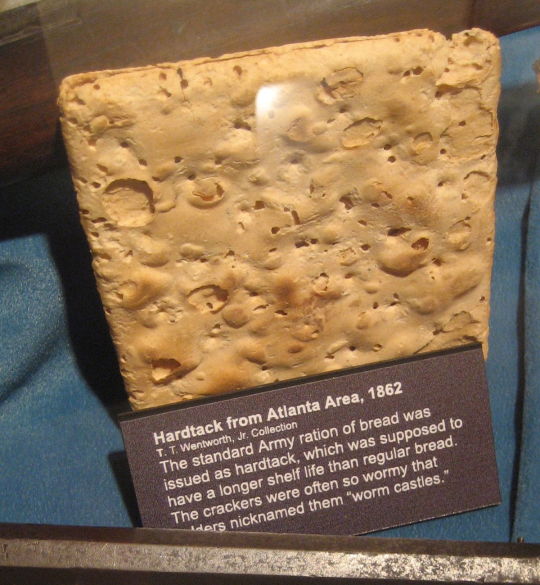
‘biscuit’ meant ‘twice-baked’, originally meaning items like hardtack which were double baked to dry them as a preservative measure long before things like sugar and butter were introduced. if you see a historical doccument use the word ‘biscuit’ do not be fooled to think ‘being a pirate mustve been pretty cool, they ate nothing but cookies’ - they were made of misery to last long enough to be used in museum displays or as paving stones

‘triscuit’ is toasted after the normal biscuit process, thrice baked

thus the monoscuit is a cookie thats soft and chewy because it was only baked once, not twice

behold the monoscuit/scuit

Why is this called a biscuit:

when brittish colonists settled in the americas they no longer had to preserve biscuits for storage or sea voyages so instead baked them once and left them soft, often with buttermilk or whey to convert cheap staples/byproducts into filling items to bulk out the meal to make a small amount of greasy meat feed a whole family. considering hardtack biscuits were typically eaten by dipping them in grease or gravy untill they became soft enough to eat without breaking a tooth this was a pretty short leap of ‘just dont make them rock hard if im not baking for the army’ but didnt drop the name because its been used for centuries and people forgot its french for ‘twice baked’ back in the tudor era, biscuit was just a lump of cooked dough that wasnt leavened bread as far as they cared

thus the buttermilk biscuit and the hardtack biscuit existed at the same time. ‘cookies’ then came to america via german and dutch immigrants as tiny cakes made with butter, sugar/molasses, and eggs before ‘tea biscuits’ as england knew them due to the new availability of cheap sugar- which is why ‘biscuit’ and ‘cookie’ are separate items in america but the same item in the UK

the evolution of the biscuit has forks on its family tree

Tagged: history

"Because a war could not start until the herald had delivered his message, heralds were not always welcome. When the French...

deusvulture:

alexanderrm:

shacklesburst:

deusvulture:

“Because a war could not start until the herald had delivered his message, heralds were not always welcome. When the French herald carrying the colors of the duchy of Alençon arrived in Brussels in 1635 to present a declaration of war to the Spanish ruler Don Fernando, known as the Cardinal-Infante, he discovered that the Cardinal-Infante refused to grant him an audience. To fulfill his mission, the French herald tossed a copy of the declaration of war from his horse into the middle of an angry crowd. The Spanish herald, however, urged those gathered not to touch the paper lest doing so count as accepting the declaration and thus starting the war. The French herald then raced to the border where he nailed two additional copies to a post and notified the mayor of a nearby village about the postings.”

This is exactly the kind of munchkinning that often gets branded as unrealistic in contemporary (fan)fiction. So naturally I’m sooo here for this.

Sauce? This sounds like it’s from a larger work on Heralds and I really want to see the context. Was there some kind of enforced norm that you couldn’t attack someone until they got your declaration of war?

Basically, yes, there was. This passage is from “The Internationalists: How A Radical Plan To Outlaw War Remade The World”, a lively book of popular legal history that I just finished reading and reviewed here. They were talking about the pre-20C norms governing the declaration of war, which had a number of traditional legal significances: most importantly for practical purposes, that soldiers couldn’t be tried or punished for murder, arson, robbery, etc. that they committed in the course of a declared war (the book provides an extended example, but long story short, a surprise invasion is a good way to get your guys executed in ways that would be much more provocative if they were done to “actual soldiers”).

Territorial gains and monetary plunder acquired in declared war were also unambiguously legal posessions, unlike stuff you might get by hiring pirates or whatever, which was a little suspect. So the incentives were the opposite of today: in favor of soldiers meeting on the battlefield in declared interstate wars over specified grievances, and against indefinite guerilla warfare that’s not associated with state entities.

(The book is basically all about how these international legal norms changed in the 20th century to the system that we know today. It’s a good read.)

Tagged: history

me: all we are is dust in the wind, dude also me: oh man my natural lifespan has me alive for a full 2% of human history and...

me: all we are is dust in the wind, dude

also me: oh man my natural lifespan has me alive for a full 2% of human history and aware for 1% of it

Tagged: history

Did people use water bottles in the 1800s? How was water transported on a personal basis? Water skins were a thing right? Why...

argumate:

trust-me-i-just-get-weirder:

Did people use water bottles in the 1800s? How was water transported on a personal basis? Water skins were a thing right? Why the fuck do I care?

nah people only drank gatorade back then to avoid waterborne diseases

They used waterskins, canteens, jugs, buckets and barrels for short-term storage or transport and stayed closer to natural (rivers, springs, ponds) and artificial (wells, fountains, cisterns) water sources to refill them from; they brewed (small) beer which kept better preserved for longer storage or further transport in kegs and glass bottles.

Tagged: history

Kind of weird the one political development of the past decade I haven’t seen the QAnon types attribute to elite child...

Kind of weird the one political development of the past decade I haven’t seen the QAnon types attribute to elite child prostitution rings is the party-discipline parliamentization of the US Congress, given the U.K. investigation into similar things a few years ago touched on party whips using “dirt books” of secrets to blackmail MPs into toeing the line

I dunno. It would certainly be weird if there weren’t youth brothels in the capital of the greatest empire the world has ever known. And I mean, it probably connects to people you’ve heard. Given Jefferey Epstein. Given how our sitting president sourced his companions from NYC “modeling studios” in the ‘80s, srsly.

But that’s what it looks like. It’d be a Georgetown townhouse or a NoVa mansion or a Silver Spring penthouse, not the basement of a busy public pizza parlor, what the fuck, numbskulls. And that’s speaking as someone who’s actually known a pizza place that had slaves in the basement. (The owner brought over guys from his old country village, took their passports, and gave them $8/day as cooks)

I think these folk panics seem to serve the purpose of mythologically concretizing forces that are too abstract for the people to congeal against directly. Like I think in the ‘80s, day care workers were NOT in fact abusing children as part of satanic rituals. I think that was transposed from the underlying Christian conservative concern “the decline of traditional religion and rise of working mothers threatens our ability to shape children to reproduce our society as is”.

But who do you punish for that? What law do you charge them with? How do you create a spectacular enough narrative to make working mothers feel abusively neglectful? So, the myth steps in, to concretize things and provide scapegoats.

Something you learn looking into the hounding of Oscar Wilde and Alan Turing is that anti-gay repression was understood as a play to the working-class who understood queer shit as like “part of rich toffs’ decadent leisure for which they take and consume our sons”. Which given how class stratification and rent boys and rough trade work, hm ok (there was a big male brothel scandal in 1889 London that started with a 15 year old messenger boy found carrying the absurd sum of fourteen shillings and eventually threatened to tangle up the Crown Prince), but it’s hard to miss that that’s also a transparent concretization of capitalist exploitation

Tagged: history

The Last Station

xhxhxhx:

In the summer of 1964, Christopher Rand visited Los Angeles on assignment from the New Yorker. His writing for the magazine, published in Los Angeles: The Ultimate City (New York: Oxford University Press, 1967), feels like an artifact from the last moment when ordinary Americans felt that science and engineering could remake the world for the benefit of humankind.

Rand visits a base in the Santa Monica Mountains that directs the fire control planning for the 330 square miles around it:

I was shown a large map-room there, with consoles full of communications gear, these tended by two or three men around the clock. The man in charge said that the post had seventy-six fire companies and seven ambulances available, and patrols on the move in all directions. If a brush fire was even suspected in the hills, he said, the post would get six fire companies and two chief officers onto the scene as soon as possible; they would be sent from various quarters because movement was so hard in that terrain. Then if the blaze got serious, more and more equipment would be sent from nearby points, and meanwhile still more would be moved up, as reserves, into the vacancies. “In a big fire we keep redeploying constantly,” he explained, and it all reminded me of our infantry operations in Korea – even to the possibility of air strikes, which the station could call in, if they were needed, much as a regimental command post might.

He heads to Irvine, where the architectural firm William Pereira is creating a whole community from ranch land. (“This is Irvine Ranch,” his guide tells him. “It was the only thing that could stop those suburbs from spreading.”) Pereira himself speaks: “Right now my kind is in command,” he says. “We have sold the idea that planning is necessary, and we have generations of development ahead of us. We have the palette here and we’ll see what we can do with it.”

Rand speaks to the Pereira partner running the Irvine field office, James Langenheim, who tells him about the firm’s plans for Catalina:

“Catalina,” said Lagenheim, “can’t be developed for a few years anyway, because its population can’t increase much till the water and transport problems are solved. We think desalinization will take care of the water; it is being studied now, you know, in Southern California. We hope it can be done economically in a few years, which would free us on that score in a decade. As for transport, the island is now served by airlines and, in the summer months, a boat from Wilmington, in the Los Angeles port area, but the boat is too slow and infrequent for the population we visualize. We are looking forward to cheaper, more efficient helicopter service or to improved hydrofoils that can operate in the channel there, which is often choppy. This, too, should take a few years. It all delays our plan, but at least it gives us a lead-time for more thorough research; we are, for instance, trying to find just where the Indians used to live on Catalina, so we will know more about the ground water. And we are getting a chance to indoctrinate the Catalina population about planning in general. Not to mention indoctrinating Los Angeles County, to which the island belongs, about its problems and its future.”

Rand saw in Century City, a high-rise community built with capital from Alcoa, Lazard Frères, Tishman, and the Pennsylvania Railroad, a new Los Angeles. “Capital is coming from many directions,” he wrote, “and this force, together with others – the influx, the technology, the dreams of the planners – is pushing the projected Los Angeles toward realization.”

Like Century City, Los Angeles would grow up:

It accords, also, with certain accepted ideas about the modern city. For one thing it should have much high-rise living in it. Heretofore L.A. has run to single-family houses. This has been partly due to a fear of earthquakes and partly to the small-town, or rural, Midwestern background of so many Angelenos. The idea of every-man-his-own-landlord-and-every-man-his-own-chauffeur has been thought a key to freedom of some sort. (And also to social standing. “There was a matter of image,” an L.A. write has said in discussing the aversion here to high-rise. “A homeowner had more status than an apartment dweller.”) But now that prejudice is passing. Real-estate economists and analysts, who abound in L.A., point out that the big U.S. crop of war-babies recently attained their early twenties, an age that favors apartment living; they say this has sped the change. They also say, more simply, that close-in land prices (not to mention taxes) preclude one-family homes for most people. There has recently been a slump in all real-estate activities in L.A., but prior to that slump – in the early ‘sixties – three-quarters of the dwelling units built were going up into the third dimension, and this is making it more like other cities.

Rand says this all without a hint of irony or doubt, even when he compares fire control in the Santa Monica Mountains to the land campaign in Korea. There is confidence and optimism in the people he speaks to, and Rand himself is not anxious or fearful.

It is hard to imagine anyone writing like this in the New Yorker today.

Los Angeles may be the ultimate city of our age. It is the last station, anyway, of the Protestant outburst that left northern Europe three centuries ago and moved across America: the last if only because with it the movement has reached the Pacific. There are other cities on our West Coast, but none so huge or dynamic as Los Angeles, or so imbued with the Northern wilfulness in battling nature. L.A., as its people often call it, is the product to a rare degree of technology. Though built on a near-desert, it is the most farflung of the world’s main cities now, and probably the most luxuriously materialistic. It is also – apart from the big “underdeveloped” cities, with their shantytown outskirts – the fastest growing in population. With its hinterland, of Southern California, it is gaining nearly a thousand inhabitants a day, and is expected to go on gaining indefinitely. The Angelenos, its people, are prone to live in the future and to project their statistics forward; the visitor hears them talk more about 1980 than about next year. “This is an optimistic city,” a friend here told me recently. “If something is built wrong it doesn’t matter much. Everyone expects it to be torn down and rebuilt in a decade or two.”

These are the opening words of a piece that end with the same sense of optimism about human potential: “the builders of L.A. keep building,” Rand writes. “L.A. is bound up with technology like no other city in history, and technology has a will of its own.”

But what is striking is how little has changed, and how little the city of today reflects the dreams of 1964. They stopped building, and everything we had hoped for – “the influx, the technology, the dreams of the planners” – never came to be. It is as though the country went into the darkness and never emerged.

Catalina never became much bigger than it was in 1964. Today, there are fewer than five thousand people on the island’s 48,000 acres. Philip Wrigley, chewing gum magnate and owner of the island, deeded 42,000 of those acres to a nature conservancy in 1975.

Catalina never became a haven for golf carts and pleasure craft. Los Angeles did not become Century City. Pereira’s firm designed the airports of Baghdad and Tehran, but they did not indoctrinate Los Angeles. Instead, the Californians came to fear growth and change. They stopped building. 

Every day I pray that they will tear it down and build again.

Tagged: jfc the california ideology amhist los angeles history

Kevin Starr: Gold Rush California was primarily a man’s world, at least until the mid-1850s; and, yes, it could be wild, free,...

xhxhxhx:

Kevin Starr:

Gold Rush California was primarily a man’s world, at least until the mid-1850s; and, yes, it could be wild, free, unconstrained, exuberant. Such a vision of the Gold Rush as festival shivaree, as high jinks in the Mother Lode, can be found as early as the first humorists to cover the event … This interpretation of the Gold Rush as a fun-filled and affirmative adventure survived through numerous celebrations …

There is something to be said for this interpretation, even when it is qualified. The Gold Rush did constitute a collective psychic release—a sense of youth, heightened expectations, freedom from constraints of all kinds—in the Argonaut generation of young men, and the smaller number of women, who came to El Dorado in search of the Golden Fleece.

Kevin Starr, in the very next paragraph:

As historian John Boessenecker has demonstrated, the murder rate in the mines was horrendous—an annual rate of 506.6 homicides per 100,000 population in Sonora, for example, in 1850–51, which is fifty times the national homicide rate of 1999. Outside the Mother Lode it could be even more dangerous. As historian (and former San Francisco deputy police chief) Kevin Mullen has documented, San Francisco averaged a homicide rate of 49 per 100,000 between 1849 and 1856, six times the 1997 homicide rate of that city. Los Angeles County, meanwhile, saw forty-four murders between July 1850 and October 1851, which translates to an annual rate of 414 homicides per 100,000. Between September 1850 and September 1851, the homicide rate in the city of Los Angeles and its suburbs spiked off the graph at 1,240 per 100,000, which remains the all-time high homicide rate in the annals of American murder. If California ever had anything resembling the Wild West—meaning cowboys and shoot-outs—it was Los Angeles County in the early 1850s; until, that is, the formation in 1853 of the Los Angeles Rangers, a permanent posse that would in the course of one year capture and execute more than twenty alleged miscreants. Between 1849 and 1853, Boessenecker estimates, there were more than two hundred lynchings in the Mother Lode. As courts and a criminal justice system began to assert themselves, that number fell to one hundred throughout the state between 1853 and 1857. Still, lynching remained an option in California down through the nineteenth century. The last old-fashioned Gold Rush–style lynching—that of five men in Modoc County—occurred as late as May 1901.

wild, free, unconstrained, exuberant

With the conspicuous exception of Josiah Royce, most nineteenth-century historians considered lynch law a tragic necessity, given the feebleness of legal institutions in the first years of the Gold Rush. To bolster their assessment, they pointed to the fact that most lynchings involved hearings before an elected tribunal, which heard evidence and pronounced sentence and hence possessed an element of legitimacy, indeed represented a resurgence of Anglo-Saxon legal traditions. Contemporary historians, however, combing through surviving records, have noted the disproportionate number of Hispanics being lynched and tend to link lynch law with larger patterns of race-based antagonism.

a collective psychic release

Tagged: amhist history

Well into the 2010s, American political elites of both parties shared a common vision. They remained gripped by a cold-war...

bemusedbibliophile:

Well into the 2010s, American political elites of both parties shared a common vision. They remained gripped by a cold-war imagination that saw the ascendancy of American liberalism not as a unique confluence of events generated by the combination of the Depression, war, and Soviet competition, but rather as the country’s natural and permanent progression. Men like John McCain and Obama believed so deeply in this story because they had worked and suffered for it, and it had given their lives a larger meaning. And for periods in American life, if one kept to the proper circles, it could actually feel true: wealth was indeed generated, excluded groups were included, and threatening adversaries were defeated.

The problem turned out to be that neither the ideals nor the institutions were up to the challenges to come. Structural economic problems had been mounting for decades, and new problems had been created in the meantime. The US invasions of Afghanistan and Iraq were international adventures larger than any since the Vietnam war. The global financial crisis underscored the precariousness of middle- and working-class economic security and exposed the scale of the divide between haves and have-nots. As the country reeled from near-economic collapse, the carceral state’s generational effects on poor and black communities led to mass protest and social rebellion. The years 2014–16 saw more civil unrest than any time since the early 1970s.

Apparently unrelated, each of these crises was the result of policies based in core cold-war assumptions: the moral value of American interventionism, the faith in market liberalism, and the presumption that American institutions were bending toward racial equality, simply in need of small-scale reforms. The policies that had set the nation down these paths had been enacted precisely because they fit so well within the cold-war frame. And as political elites responded, the dominance of that frame led them back to the same old cold-war toolkit: more intervention (Libya, Syria, Yemen), more marketized social services (Obamacare), more minor racial adjustments (body cameras, sensitivity training).

The size of these crises would have made them difficult to contain under any circumstances. But political leaders confronted another new reality: the growing intractability of the American constitutional structure. Starting in the years immediately after the breakup of the Soviet Union, then accelerating with the election of the first black president in 2008, American political decision-making became defined by paralysis. Even if political elites had had the creative imagination to pursue large-scale change—as the New Dealers did before the cold-war consensus took hold—it now became impossible for reforms of almost any kind to make their way through governing institutions short of a supermajority.1

In the 1990s, encomiums to the Constitution were taken for granted. It was commonplace for scholars and commentators, drawing on arguments that flourished at the beginning of the cold war, to praise James Madison and Alexander Hamilton for devising the very features in the US Constitution that promoted deadlock. According to this conventional wisdom, checks and balances warded off tyranny: by limiting the power of any single political actor, they ensured that one did not need a society of “angels” for democracy to function.

But as pre-cold-war reformers understood, American political institutions actually require precisely the opposite to work: a near-angelic degree of social cohesion (if not agreement on political ends) among empowered elites. The cold-war order had in fact been forged on two related facts. The first was an organized working class that helped deliver the supermajorities needed to defeat barriers to mass democracy in the 1930s, and then mustered enough electoral strength in the decades that followed to expand, or at least protect, the social safety net their efforts had secured. Just as essential, the confrontation with the Soviet Union fostered cohesion among political elites in ways that produced the conditions for compromise, most dramatically evidenced during the period of 1960s civil rights legislation. When the Republican senator Everett Dirksen helped break the Southern filibuster of the 1964 Civil Rights Act, declaring, “The time has come for equality of opportunity. . . . It will not be stayed or denied,” he was speaking the same liberal universalist language as Lyndon Johnson and was motivated, regardless of the partisan divide, by much the same vision of the country and its global mission.

With working-class organizations weakened, it has become hard to see how any political coalition can elect a supermajority capable of overcoming the Constitution’s roadblocks. At the same time, the US’s enemies, from marginal global players like North Korea to weak nonstate actors like al Qaeda or ISIS, hardly present an existential competitor in the style of the USSR. There are no longer external incentives for elite agreement. Instead, a combination of intense party polarization and the profound influence of money have left the legislative branch constitutively unable to confront fundamental social issues. And as Obama’s post-2010 time in office made clear, even the ever-more-powerful executive branch is limited when it comes to reshaping domestic policy.

The dysfunction is not a matter of our institutions alone. When the Bushes and Clintons of the world reached political power, what it meant to be American had a very specific content. Politicians knew what homilies they had to repeat to be taken seriously by party gatekeepers and thus rise to prominence. They had to defend Constitution and country, and to see in the founding principles a basic commitment to universal equality. They had to embrace free enterprise as the greatest economic system on earth. They had to speak glowingly about American exceptionalism and the country’s global responsibilities. Every one of these views remained seriously contested within sections of the public, on both the right and the left. Members of the white citizens’ councils in the South did not simply stop believing in white nationalism. Similarly, the radical political activism of the 1960s and ’70s, which challenged the combined evils of white supremacy, capitalism, and militarism, did not simply evaporate with the resignation of Nixon. These threatening ideas were suppressed, often through force by the state, and they were disavowed—even if still expressed under cover of “dog whistles”—by the two main political parties. There may have been popular constituencies for beliefs that fell outside the polite consensus, but those constituencies had no explicit home in establishment politics.

But with more than two decades having passed since the cold war, and the republic’s basic institutions paralyzed, the country was overdue for a reckoning. In the Republican Party, the candidates of the old center-right, like Jeb Bush and John Kasich, were dispatched with ease. In the Democratic Party, Clinton ran as an old-fashioned cold warrior, with a flag-waving party convention that looked, and at times even sounded, like what Nixon or Reagan might have offered, embracing the national security establishment and repeating the truisms of the postwar order (“We are great because we are good”). This strategy won Clinton the most votes, from her party and the general voting public, but the center of political gravity nevertheless shifted elsewhere. On the left, those who championed Sanders and rallied to social movements have not hesitated to critique capitalism, defend socialism, reject the national security state and hyper-incarceration, and call for both a dismantling of the banks and an end to racial and class inequality on a structural level. On the right, new life has been breathed into perhaps the most powerful pre-cold-war ideological position in American history: the long-standing combination of anti-elitism, economic populism, and white nationalism, stretching in various permutations from Thomas Jefferson and Andrew Jackson to Tom Watson, Father Coughlin, and George Wallace.

The differences between Trump’s and Wallace’s political trajectories are instructive. In 1972, Wallace’s third attempt to claim the Democratic nomination was derailed by an assassination attempt. But his failure overall was also due to coordinated efforts within the party to deny him the nomination. A significant part of Lyndon Johnson’s 1964 primary strategy involved running popular local surrogates against Wallace in the states where Wallace ran. In 2016, no analogous effort was mobilized against Trump. Part of the reason was that in the 1960s and ’70s, elites still appreciated the power of overt white supremacy. Four decades later, the leadership in both parties simply could not believe that their invocations of “American values” would fail to blunt the appeal of an old man who trafficked in explicit racism and misogyny, and who embodied elements of the past long assumed to have been politically vanquished. But Trump’s success was in part due to his advanced age. Raised in the early days of the cold war, he gave voice to the sentiments and vitriol of a previous era when white nationalism was active enough that it had to be aggressively tamped down. This might also explain why Trump’s parallel figure on the left was also a septuagenarian. In his youth, Sanders joined the Young People’s Socialist League, a group that originated in the Progressive-era Socialist Party. He came of age with a politics that predates the cold war—perhaps this, and their rise outside the party process for culling nonestablishment voices, are the two men’s only real similarities.

Aziz Rana, “Goodbye Cold War,” n+1 (Winter 2018) (x)

basically

Tagged: not wrong history amhist

3 things to understand about Iraq War I that make Iraq War II make sense 1) it was the apex of Reagan’s renormalization of war...

3 things to understand about Iraq War I that make Iraq War II make sense

1) it was the apex of Reagan’s renormalization of war after Vietnam

They called it curing the Vietnam Syndrome. Started small - Granada, which proved you couldn’t salami-slice us in the Caribbean, all the South American stuff that flew as “the Drug War” and was largely using our lessons-of-Nam (F-teen fighters, look-down AWACS and SIGINT, in-country trainers who know the local ways…) to reassert the Monroe Doctrine

Panama! You know Ronald Reagan made his foreign-policy name before presidency by denouncing the treaty that turned control of the canal over to the country we’d set up as a convenient fiction. It was like when Egypt claimed the Suez canal to choke off (with American subtle moneyman backing) the French and British empires! But we were doing it for free, for what, to sooth Jimmy Carter’s soul?

We didn’t even go to war, we arrested the head of state and put him in US prison. Who’s a convenient fiction? Who’s a convenient fiction still?

2) The Dems, especially the “Watergate class” of Nixon-backlash Democrats were ferociously opposed to Iraq I in large part because they saw 1). They warned of it like people warned of Iraq II - endless tarbaby trap that alienates everyone, flag-draped coffins, etc. The Republicans stuck by their pres and a segment of the newer, more professional, technocratic, post-hippie Atari Democrats backed it, incl. especially Al Gore

3) The war was a riotous success, international backing (we had tried to pretend the UN mattered for a decade after WWII before the Cold War took off, but it was social democratic bullshit and we (probably) had to shoot down Dag Hammarskjold’s plane when he threatened to take the equal sovereignty of post-colonial African states seriously, we tried again for another decade AFTER the Cold War), a quick in and out victory. The “Highway of Death” turkey shoot and all where we proved Air Power Can Too Win A War By Itself mightve been a pretext to war-crimes us but we won and were the only country that could project power a foot off its doorstop against opposition so

Tagged: amhst history

The England of the East

xhxhxhx:

On the morning of May 27, 1905, a small Japanese fleet met the Russian Baltic Fleet as it steamed into the Straits of Tsushima. Seven months earlier, the tsar had ordered the fleet to leave its base at Kronstadt. Now, halfway around the world, it was exhausted, demoralized, and in desperate need of supplies. The Russians made a last, desperate dash for Vladivostok. They never made it. By the following morning, the Japanese had destroyed six Russian battleships and captured the other two, and they had not lost a single ship. Five thousand Russian sailors were taken prisoner. 

At the peace conference at Portsmouth, the Japanese won the Liaotung Peninsula, the South Manchurian Railroad Company’s rights in Manchuria, South Sakhalin, and recognition for Japan’s paramount interests in Korea. No longer would Russia trouble the Japanese in Korea. That November, the Korean Empire became a Japanese protectorate.

The Russo-Japanese War was a psychological shock for the colonized peoples of the world. Lord Curzon, the British Viceroy in India, observed that the reverberations of Japanese victory had “gone like a thunderclap through the whispering galleries of the East.” Sun Yat-sen, traveling down the Suez Canal during the war, was asked whether he was Japanese; the Arab had observed vast armies of Russian soldiers being shipped back fo Russia from the Far East, which seemed a sure sign of Russia’s defeat. “The joy of this Arab,” wrote Sun, “as a member of the great Asiatic race, seemed to know no bounds.”

In South Africa, a young lawyer named Mohandas Gandhi wrote that “so far and wide have the roots of Japanese victory spread that we cannot now visualize all the fruit it will put forth.” A Hunanese schoolboy named Mao Zedong memorized a Japanese song taught by his music teacher, a former student in Japan:

The sparrow sings, the nightingale dances,

And the green fields are lovely in the spring.

The pomegranate flowers crimson, the willows green-leafed,

And there is a new picture.

Jawaharlal Nehru, reading the news in provincial India, found it stirred up his enthusiasm. “I waited eagerly for the papers for fresh news daily,” although he found Japanese history rather hard to follow and preferred “the knightly tales of old Japan and the pleasant prose of Lafcadio Hearn.” He began dreaming of Indian freedom, and his own role in freeing Asia from European domination. “I dreamt of brave deeds, of how, sword in hand, I would fight for India and help in freeing her.”

Of course, by the time Nehru heard the news from Tsushima, he was with his mother and sister on the train from Dover to Harrow. It happened to be just before Derby Day, and he and his family went to see the race. Still, the news put him in “high good humour.” Lord Curzon’s dyspepsia notwithstanding, the young Nehru would not be alone in his enthusiasm, whether at Harrow or at Epsom Downs.

Pankaj Mishra describes the Battle of Tsushima as the first act in The Revolt Against the West and the Remaking of Asia. “For the first time since the Middle Ages, a non-European country had vanquished a European power in a major war,” he wrote, and now Japan threatened Europe in a way that no colonized people ever had. It was not an uncommon sentiment at the time. As the Illustrated London News put it, “Europe has not recovered from the shock of finding out that the Japanese are a great people.”

The irony is that whatever succor their Chinese or Indian subjects might have felt, the English were as happy with the Japanese victory as any colonized people. “Every Englishman will join in the joy which is felt in the land of his allies,” wrote the North China Herald, the paper of British merchants in the Shanghai concession. In London, it was the greatest victory since the Battle of Trafalgar. “In the hundred years gone by since Nelson decided the destinies of Europe,” wrote The Times, “no such action has been fought at sea as that which begun on Saturday in the Straits of Tsushima, and no such victory has been won.”

Japan had been Britain’s treaty ally since 1902, whereas Russia threatened Britain’s interests in South Asia and the Far East. Britain shared the general sentiment that Japan had raised Asia to the level of Europe, but this was no bad thing: Henry Wilson, a pro-Japanese journalist, observed that “The era of inequality between the races is over. Henceforth white and yellow man must meet on an equal footing.” The Times wrote that Japan had proven itself to European powers “judged by every standard of modern civilization,” and their victory confirmed the wisdom of the Anglo-Japanese Alliance:

We can conceive no surer way of averting the danger of racial antagonism, if it in reality exists, than an alliance between the two Island Empires of the West and the East based on a community of peaceful interests, on joint responsibilities of mutual defence, and on kindred ideals of patriotism, progress, and freedom.

Even before the war, the British had seen Japan as Britain’s mirror image, a plucky island nation bringing the light of liberalism to the benighted peoples of the Far East. The North China Herald had welcomed the alliance as the coming together of “the Englands of the West and the East,” and a guarantee of “peace and the open door for all.” The Times’ correspondent in Tokyo wrote that Japan was fighting as “the champion of ideals which Anglo-Saxons, all the world over, hold in reverence.” 

If Japan bloodied Russia’s nose in the process, that was all the better. Wilson wrote that “it cannot be denied by thinking men that [Japan], rather than Russia, represents civilized ideas, the freedom of human thought, democratic institutions, education and enlightenment – in a word, all that we understand by progress. It is Russia who stands for barbarism and reaction …” Britain hoped that Japan would protect liberal interests in the Far East, and accordingly British interests in the Pacific: ending Russia’s southward drive into China, and opening the door to foreign commerce in China outside European spheres of influence. Perhaps Japan would bring about the “Japanising of China,” and hence “the uplifting of this Empire by the spread of Western enlightenment and civilisation.”

As Lord Curzon’s observation makes clear, however, the settlers in the empire and its dominions were never so inclined to respect the Japanese. Although the British Columbia press praised the “inspired” patriotism and welcomed the renewal of the Anglo-Japanese Alliance, some worried that the emergence of Japan as a world power would mean “the dominance of the yellow races in Asia” and a menace to Australia and the Pacific.

Two weeks before Tsushima, delegates from local labor organizations in San Francisco founded the Japanese and Korean Exclusion League, dedicating themselves to ending Asian immigration into California. The American Federation of Labor had already issued a resolution opposing all Asian immigration. In the British Empire, the “great white walls” the Dominions had raised against Chinese and Indian labor were now threatened by the Japanese. Lord Curzon wrote that “when challenged about the place of India in the Empire, [the Indian] replies that the Empire is nothing to him, since it cannot insure for the Indian his rights as a British subject in Australia, or British Columbia, or the Transvaal.” Curzon observed that this phase in colonial opinion was not likely to be either “fortuitous or transient,” but was likely, as time passed, “to stiffen into harder forms.” 

On October 11, 1906, the day after the ratification of the Treaty of Portsmouth in Tokyo, the San Francisco school board decreed that ethnic Japanese students were to be forced into a segregated school, so that white children “should not be placed in any position where their youthful impressions may be affected by association with pupils of the Mongoloid race.” The New York Sun’s correspondent in Tokyo told his editors that “the exclusion of Japanese children from the public schools of California cuts this child-loving nation to the quick.” In Japan, some broadsheets urged the Japanese navy to make a detour to California to rescue the Japanese of San Francisco: “It will be easy work to awaken the United States from her dream of obstinacy when one of our great Admirals appears suddenly on the other side of the Pacific.”

President Roosevelt was disgusted by the San Francisco segregation order. He sent a cabinet member to San Francisco to persuade the school board to reverse itself. They ignored the message, and sent back the messenger.  In his annual message to Congress, Roosevelt condemned the segregation order as a “wicked absurdity” enacted by a “small body of wrongdoers.” The Japanese had “won in a single generation the right to stand abreast of the foremost and most enlightened peoples of Europe and America; they have won on their own merits and by their own exertions the right to treatment on a basis of full and frank equality.” After months of pleading, Roosevelt persuaded San Francisco to reverse its segregation order, but only in exchange for concrete steps to end Japanese immigration. Roosevelt signed an immediate executive order barring Japanese aliens in Hawaii from migrating to the mainland.

In 1907, the Asiatic Exclusion League sponsored a mass demonstration in Vancouver that ended in a race riot. In the aftermath, the federal opposition leader Robert Borden joined local leaders in defending the rioters, as British Columbia was and must remain “a White Man’s province.” In 1907 and 1908, Canada, Australia, and the United States all came to “Gentlemen’s Agreements” with Japan, barring almost all further immigration. Although Japanese subjects had the right of free entry into Canada under the Anglo-Japanese Treaty, Japan agreed to use administrative measures to limit further immigration to Canada. They would refuse passports to all manual laborers requesting permission to travel to the United States. The rising tide of Asian migration was stopped, and “full and frank equality” postponed.

The Anglo-Japanese Alliance eventually withered away, but not before one final victory. On August 15, 1914, the Japanese demanded that the Germans relinquish their base in Tsingtao, “the root of the German influence which forms a constant menace to the peace of the Far East.” Germany was no more inclined to respect Japan’s demand than Russia had been: “They can tell this to a Russian but not to a German,” one German in Tsingtao wrote in his diary. Wilhelm II said that “it would shame me more to surrender Tsingtao to the Japanese than Berlin to the Russians.” Although the Kaiser would not live to see the surrender of Berlin, Germany would ultimately have to do both.  

On November 7, the German garrison asked the Allies for terms. Only the German and Japanese chiefs of staff and a Japanese naval officer signed the terms of surrender; the British were neither consulted nor asked to put their name to the document. A week after the surrender, a representative of the emperor handed the British troops at Tsingtao a parchment expressing the emperor’s pleasure at their participation in the battle, along with a consignment of cigarettes bearing the emperor’s chrysanthemum crest. The British got the cigarettes and the Japanese got the peninsula.

During the Russo-Japanese War itself, however, one young German believed that Japan was the country’s natural ally. “For national reasons, I had already taken sides, and in our little discussions at once sided with the Japanese,” he wrote, two decades later, from his cell in Landsberg Prison. “In a defeat of the Russians,” wrote Adolf Hitler, “I saw the defeat of Austrian Slavdom.” 


This topic was suggested by a Patreon backer.

Keep reading
Tagged: history

From the somethingawful forums, the live thread when 9/11 happened

garbage-empress:

criticalforest:

From the somethingawful forums, the live thread when 9/11 happened

http://www.truegamer.net/SA_911/911%20SATHREAD/

This thread was wild, especially because the OP was posting webcam photos from nearby right after the first plane hit. Possibly before CNN even reported on it. 

wow terrorists hijacking a plane that’s fucking rich, you idiot, you complete buffoon

This poster might be one of the first dozen people in history to publicly accuse Osama Bin Laden, possibly before any news agencies, and their post has the words “ROTFL Owned” in it.

Tagged: history yesterday belonged to meme amhist

Los Angeles birthed Pentecostalism and America barely even notices that it has a new religion running free taking over...

Los Angeles birthed Pentecostalism and America barely even notices that it has a new religion running free taking over continents

LA was a hot scene in the 20th Century that gave us the Foursquare Church, Objectivism, Scientology and EST, also The Source Family, The Manson Family, Tensegrity, Esalen, New Age cults, UFO cults, Nazi cults, Nazi UFO cults

That’s how these things go, in waves like any other industry, Mormonism was only the most famous thing to come out of the Burnt-Over District in the Third Great Awakening

Christianity was only the most famous thing to come out of Jerusalem of the period, that’s the deepest joke of Life of Brian, that it’s not a joke

Tagged: amhist history religion pentecostalism the california ideology

Traffic management that involves prioritizing some throughput over others is the norm, not some weird thing Comcast thought up...

squareallworthy:

Traffic management that involves prioritizing some throughput over others is the norm, not some weird thing Comcast thought up to make more money. We don’t demand that roads treat all vehicles alike, or that delivery companies treat all packages alike. Yes, as far as a wire is concerned, 01010101 is the same as 11110000, but we don’t have to be limited by a wire’s dumbness. Insisting that the switching system treats them the same ignores what bytes are for. Some information really is more important.

The United States absolutely insisted that railroads treat all cargo alike, that is the foundation of the national regulatory state, even before the New Deal.

Because before it started doing that the dynamic of an open frontier bottlenecked through monopoly routes of transportation made economy of scale so powerful it started a death-spiral of economic centralization, that was where the robber barons and trusts (to later be busted) came from

So much of the 20th century regulatory state was beta tested on 19th century railroads – Social Security (after railroad pensions), workers’ comp and workplace safety law, wire (telegraph and telephone) regulations, public utilities, the trucking and airline regulations that ended under Carter

But yes, we very much have made demands like that for the sake of fending off structural capture tending towards oligarchy

Tagged: amhist history

Half-Mourning Dress 1910-1912 The Victoria & Albert Museum

mumblingsage:

yamino:

iamingrid:

yamino:

omgthatdress:

Half-Mourning Dress

1910-1912

The Victoria & Albert Museum

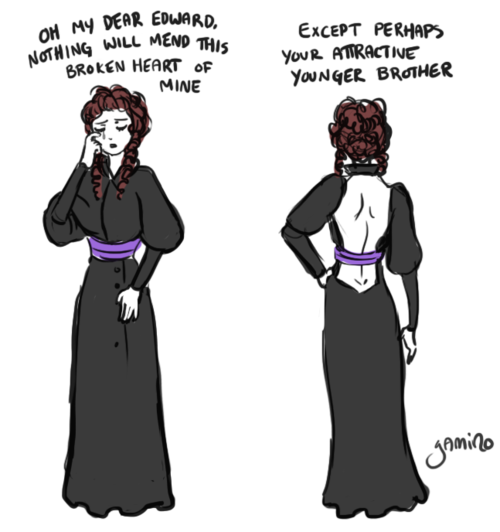
What’s a “half-mourning” dress?  Mourning in the front, party in the back?

Half-Mourning was the third stage of mourning for a widow. She would be expected to mourn her husband for at least two years, the stages being Full Mourning, Second Mourning and Half-Mourning. The different stages regulated what they would be wearing, with Full Mourning being all black and with no ornamentation, including the wodow’s veil, and the stages after that introducing some jewellery and modest ornamentation. When in Half-Mourning you would gradually include fabrics in other colors and sort of ease your way out of mourning. 

Wow, I am happy you made that joke so I could interpert it as a serious question and have an excuse to ramble on about clothing customs of the past, I am a historical fashion nerd.

That’s very informative, but I’m going to stick with my original head canon:

image

I love both the informed fashion history and the hilariously off-the-wall halves of this post.

Tagged: history

One thing that gets overlooked in discussing “respectability politics”. The civil rights movement of the 1950s-60s? Dominated by...

One thing that gets overlooked in discussing “respectability politics”. The civil rights movement of the 1950s-60s? Dominated by the black church, marches dressed all formal? That aesthetic wasn’t just some attempt to prove blacks were bougie enough to deserve rights or something.

The thing about preachers and suit-and-tie types delivering speeches invoking Protestant Christianity and American ideals, arrayed against vulgar, corrupt officials, their brutish followers and police thugs, bound by ethnic solidarity and pursuing their selfish interest through brute, unadorned force?

That was exactly how northern progressives – Republicans and the “good government” Democrats who sometimes joined with them in “fusion coalitions” – understood themselves in contrast to the white ethnic machine politics that dominated big cities.

It was saying to the educated professional elites outside Dixie, “your struggle and our struggle were the same struggle all along”.

This is in contrast to the previous civil rights movement of the 1910-20s, which drew more on the then-contemporary imagery of the revolutionary masses and got absolutely walloped by the powers that be.

Tagged: amhist afamhist history respectability politics

With Burning Concern

oligopsoneia:

thathopeyetlives:

warpedellipsis:

historical-nonfiction:

“Mit brennender Sorge” or “With Burning Concern” was a papal letter secretly smuggled into Germany and read from every Catholic pulpit on Palm Sunday, 1937. The letter was written in German, not the usual Latin, so everyone could understand. It condemned the Reich Government. It implied that everyone in Heaven was laughing at Hitler, a “prophet of nothingness”. It denounced the exaltation of one race or blood over another, ie racism.

The day after “Mit Brennender Sorge,” the Gestapo raided the churches to confiscate all the copies they could find, and the presses that had printed the letter were closed.

Well that’s neat. I thought the nazis kept up claiming they were catholic/christian though? Were they summarily excommunicated or was there politics blocking formally doing that?

The Nazis were more Lutheran-focused as far as I can tell. Catholics were a minority in Germany, and Hitler mostly just appropriated what he could, which wasn’t much, and marginalised or ignored what he couldn’t. Within Germany there was no mass persecution of lay Catholics based only on confession, while in the places they conquered like Poland, the Church was targeted for annihilation.


The Protestantism side of things is horrifying, though. Rather than the idiot’s anti-Semitism that does not know that the Christ was a Jew or the well-read fool’s version that claims that rabinnical Judaism is not Jewish, they established a true horror: an idolatrous, triply heretical, and generally grotesque un-Church called Positive Christianity that presented Jesus as an Ayran hero who was martyed for his resistance against the Jews and which agreed neither with the Apostle’s Creed nor with the very simple notion that Mankind should give honor to the Lord of Hosts, the Holy Spirit, Jesus the Christ, and which rather established the mortal Fürher as its central figure.


This was in *combination* with the ugliness of Nazi neo-paganism and the nihilism of cynical atheism.


As to the (lack of) reaction of the Holy See, the Pope had harshly criticized Mussolini’s Fascism as well as Nazism. I can think of a number of possible reasons: the interwar interpretation of the Holy See’s neutrality principle, the fact that Italy could hit the Vatican where it lived, the Nazis being apostates who didn’t merit formal excommunication and weren’t quite the Church’s responsibility, or who even knows.

At times it is understandable to wish that the Pope had instead preached an ecumenical Crusade, buried Hitler under a flowing wave of Christian partisans, and be tempted to have burned him and his lieutenants in pennance for their horriffic sins.

Quadragesimo anno marked a turn of the Church towards the right in the wake of the Great Depression, turning (or at least corresponding to the turning of) Catholic parties, where they functioned as swing votes, against democracy, which Pius XI had always been skeptical of. So I do think there’s some positive responsibility there, though of course the Church itself as well as all the individual Catholic parties were composed of many different actors who acted in different ways. 

@warpedellipsis​: the keystone of Nazi-Catholic relations was the Reichskonkordat of 1933, basically a peace and neutrality treaty between the Reich and the Church.

OK so before the rise of modern states, the Church took on much of what would be considered domestic or social policy today, and in the German lands that remained Catholic through the Wars of Religion the Church retained significant presence not just as a liturgical body, but through institutions of schooling, health care, poor relief, etc.

This brought on great tensions with the rest of the Protestant, centralizing, modernizing society, most prominently with the Kulturkampf (from which we take the term “culture war”) of the mid-19th century – effectively, a government-led crusade against the Church, ultimately blunted for reasons of pragmatic realpolitik but constantly threatening to reemerge under new conditions.

German Catholics were represented by the Centre Party, and the Nazis appeared the only coalitionmate not existentially antagonistic. Liberals, communists, and social democrats alike resented the church for its ties to a feudal aristocracy it longed to resurrect. Jews and atheists, with their historic grievances, concentrated on the left, as did the public servants who stood to gain from the replacement of Church with government institutions. Meanwhile the traditional right had its roots in strong-central-state Protestant aristocrats who saw the Church as a rival, and industrialists wary of its anti-capitalist social teachings and outreach to workers.

The Reichskonkordat was the price the Centre Party extracted in return for voting with the NSDAP for the Enabling Act of 1933, which removed legislative checks on the executive and ushered in dictatorship. The Nazis themselves never acquired a majority under open elections. I think a lot of interwar comparisons to contemporary politics are overblown, but that’s one thing worth considering – how can right-extremists build a broad enough base to assume power? By credibly promising not to crush a religious faction when no one else can.

Anyway there were tensions, this encyclical included (which the Reich understood as a violation of the negotiated peace by the Church) and who knows how the thousand-year reign would have gone, but so long as the Reich stood it was more or less upheld – when under the policy of Gleichschaltung private civil society institutions were collapsed into party-state appparatuses, Catholic groups were some of the few left independent.

Tagged: history

So with Trump grumbling about FCC licensing some people are digging up Nixon-era grumbling on the same topic, that’s a start....

So with Trump grumbling about FCC licensing some people are digging up Nixon-era grumbling on the same topic, that’s a start.

But the REAL way that FCC licensing was leveraged was with regards to newspaper companies getting into first radio and then TV. Newspaper barons and editors were always powerful players in the political world, often upstream of senators and even bosses, but negotiations with over the number of stations one company could own, or own in one market gave government the whip hand - newspapers might have high profit margins, especially as the number per city fell, but maximum volume and no room for expansion, while broadcasting was the future.

Liscensing of individual stations would be premised on its being found to serve the public interest, which the bright young things running things since FDR - the open-minded, college-educated, even queer-positive types of their day – might understand as eschewing dangerous politics in favor of What All Right-Thinking People Knew

Weighing heavily on their mind that when Europe just tried to mix democracy with a vibrant and competitive mass media it polarized society into extremisms that turned and fell upon each other in the greatest apocalypse the world had ever seen, so

One Sulzbergerian even-handed newspaper per city and a handful of poorly-differentiated TV networks all pushing the same Postwar Consensus, radio operating under the Fairness Doctrine, a lot of the cultural blandness people associate in retrospect with the ‘50s, that was brought about by effort

The Mayflower Doctrine, I’d never even heard of that before Wikipedia right now. FDR’s regulations on broadcast editorializing, so that they would present responsible takes on public issues, rather than any old (fake news?) ones their (maybe anti-New Deal) owners or advertisers favored.

It was a Postwar Liberal Consensus, that’s why conservatives strained against it, especially after the ‘60s when coalitions and issues had shifted, ESPECIALLY under Reagan, whose victories seemed to affirm them as the proper agents of public authority. That’s why Reagan ended the Fairness Doctrine, that’s why so much conservative/Republican infrastructure is alternative channels for mass communication and coordination – AM talk, religious broadcasting, large-scale direct mail, national networks of activist cells piggy-backing off church or housewives’ affinity groups.

Tagged: amhist history

It’s funny how ideas can still look ridiculous on the merits even when they work Like how “dead bodies can be brought back to...

It’s funny how ideas can still look ridiculous on the merits even when they work

Like how “dead bodies can be brought back to life with a jolt of electricity” is haha woo-woo at the same time there’s a drive to put emergency defibrillator kits in public places

Or how ridiculous the turn-of-the-century anarchist “we will destroy monarchy and government in general by personally assassinating individual rulers” was but then Gavrilo Princip assassinated Franz Ferdinand, bringing about the destruction of age-old monarchies and governments in general

Tagged: history

Been thinking about foreign tariffs and how they were necessary before an income tax. But not in the literal "we swapped one for...

Been thinking about foreign tariffs and how they were necessary before an income tax. But not in the literal “we swapped one for the other as a funding stream” sense but “they were necessary to systems based on point-of-production excise taxes as indirect taxation of population for states too weak to tax directly”

Like, in an agrarian society you can at least put together a Domesday Book every so often to know what productive land you have and do something with that but when you move on to trade and even pre-factory workshop manufacturing…

So you control something narrower upstream – the classic example is French salt monopolies, you need salt for flavor and preservation and human survival, there are a finite known amount of salt mines and trade ports to assign tax agents to supervise…

Free trade is usually contrasted with protectionism these days but why were there internal tariff barriers in centralized Sun King France, it wasn’t to protect the regions from each other but to segregate salt (& etc.) catchment areas so you could levy tariffs targeted to not disrupt each economic region too much

(and secure guaranteed markets for the corresponding sources, governments bid these monopolies out tax farming-style)

These systems were still in memory when America developed its “public utility” model of collective monopolies, but oh, here’s another example you might be familiar with, Gandhi!

You know how “Mahatma” Mohandas Gandhi was arrested protesting against British colonial monopolies in salt production, evaporating saltwater to make his own? But it wasn’t just that a lucrative industry was reserved for gora, salt was so ruinously expensive because that was how a Raj that didn’t have a damn clue what Arjun Sixpack was up to in some remote village extracted wealth on the basis of population – the price included your taxes to the Empire

Gandhi wasn’t complaining about structural racism, it was a tax protest

Tagged: taxes on tea and paper for America too boston tea party history taxes