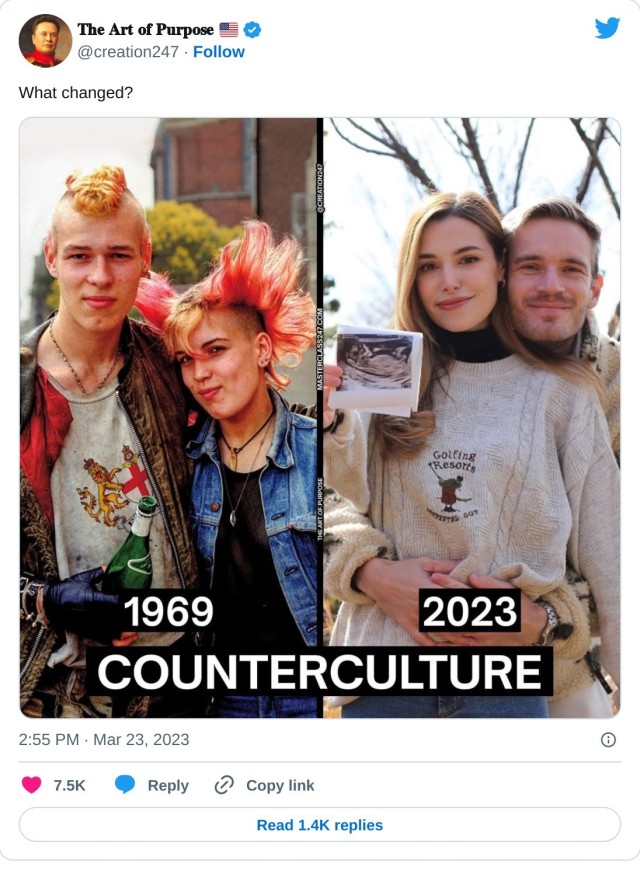
100% correct
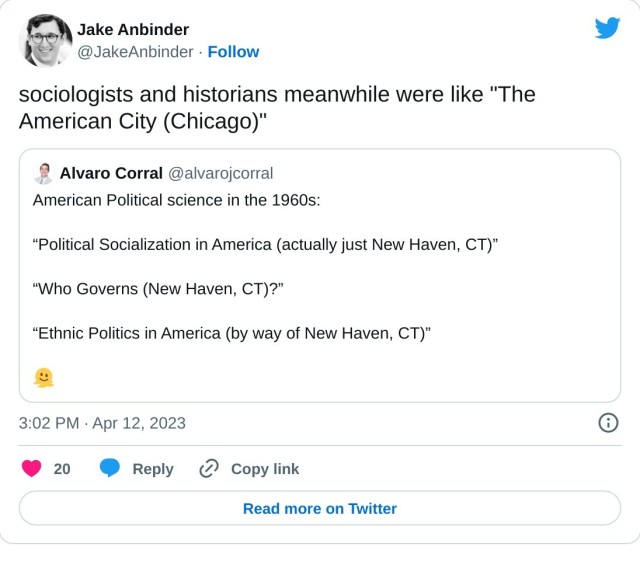
100% correct
historical memory does eventually expire, even when it comes to The Sixties
So if we’re all doing our retrospective takes on the Iraq War, mine was… it wasn’t that big a deal? In scale, direction, and costs borne and imposed it was basically well within norms for what the country might get distracted with over a two-decade period.
Already within my lifetime the specter of the Vietnam War, once much more significant in national affairs, looms not nearly as large as I remember it doing in the ‘80s (indeed, the easy victories of the “Desert Shield/Storm” Iraq excursion of the early '90s were specifically hailed for dispelling this “Vietnam Syndrome”), as colorful but not particularly important chapter of 20th Century American history.
While the action did not serve to renew America’s post-Cold War unipolar “hyperpower” moment, I honestly don’t think it accelerated its end any, which looks to be more a product of the development of China and reassertion of Russia than any “Clash of Civilizations”.
…the Iraq War – the (cultivated) reaction to it, and then the backlash to that reaction, and then the fallout from the actual war being such a huge debacle – ended the decade-and-a-half End of History.
Even if it had no lasting geopolitical impact whatsoever (which seems like a stretch), its impact on the American psyche was quite enough to be a History-Defining Big Deal all by itself.
Which seems like it would be your jam.
I mean that was the way it happened, but if not for that then…?
Like, if it didn’t have military commitments at the time the US might’ve engaged harder in the Crimea crisis, and the Syrian civil war would have been obviated and the big refugee flow to the EU preempted. That’s the two things I can see going differently.
If the Iraq and Vietnam wars aren’t major events, what qualifies? I assume you’d say that the world wars were more important globally, and the civil war was more important nationally, but are there any non-war events that make the cut?
The World Wars were, the Civil War was, the Cold War as a whole was, Iraq’ll get put with Afghanistan and Granada, the old Desert Storm/Shield, Yugoslavia and the “R2P” era as “miscellaneous post-Cold War search for purpose”
just like the Gilded Age is “miscellaneous post-Civil War search for purpose”
So if we’re all doing our retrospective takes on the Iraq War, mine was… it wasn’t that big a deal? In scale, direction, and costs borne and imposed it was basically well within norms for what the country might get distracted with over a two-decade period.
Already within my lifetime the specter of the Vietnam War, once much more significant in national affairs, looms not nearly as large as I remember it doing in the ‘80s (indeed, the east victories of the “Desert Shield/Storm” Iraq excursion of the early '90s were specifically hailed for dispelling this “Vietnam Syndrome”), as colorful but not particularly important chapter of 20th Century American history.
While the action did not serve to renew America’s post Cold War unipolar “hyperpower” moment, I honestly don’t think it accelerated its end any, which looks to be more a product of the development of China and reassertion of Russia than any “Clash of Civilizations”.
I mean, I’m pretty sure it was a big deal for Iraqis.
Yeah, I imagine the American War will stay on Vietnamese school curricula longer than the Vietnam War does on American.
history will vindicate me! I mean you can’t prove it won’t; we’re both going to be dead for most of it. but I can’t prove that history won’t vindicate you either, I guess. so in a way we can both win. this is the gift of history
<Such-and-such figure> has won the verdict of history… For now.
those who do not learn from history are condemned to repeat it without getting any of the references to earlier episodes
I kinda hate it when historians are like “the point of history is surely not to compile a dry record of events, but to extract some deeper lessons or patterns from those events”. Like, no! The dry record of events part is the only epistemically reasonable part of this whole deal! Your field is so good at dry records of events and so bad at extracting larger patterns! Leave searching for patterns to people who study things in which meaningful patterns exist in the first place, and recognize that there’s nothing wrong with the fact that history is largely random unrelated shit happening in a row.
Type of guy that has a plan to separate the record-keeping and pattern-seeking branches of history into different departments.
Proposal to supersede the “Web 1.0, Web 1.5, Web 2.0” with overlapped, distinguishing Eras. The eBay Era/the Amazon Era, The Casual Encounters Era/the Tinder Era, The Yahoo Era/the AltaVista Era/the Google Era
I grew up with textbooks that mostly engaged the Johnson impeachment as colorful novelty, the only time that provision ever came up
Scientists like to proclaim that science knows no borders. Scientific researchers follow the evidence where it leads, their conclusions free of prejudice or ideology. But is that really the case? In Freedom’s Laboratory, Audra J. Wolfe shows how these ideas were tested to their limits in the high-stakes propaganda battles of the Cold War.
Wolfe examines the role that scientists, in concert with administrators and policymakers, played in American cultural diplomacy after World War II. During this period, the engines of US propaganda promoted a vision of science that highlighted empiricism, objectivity, a commitment to pure research, and internationalism. Working (both overtly and covertly, wittingly and unwittingly) with governmental and private organizations, scientists attempted to decide what, exactly, they meant when they referred to “scientific freedom” or the “US ideology.” More frequently, however, they defined American science merely as the opposite of Communist science.
Uncovering many startling episodes of the close relationship between the US government and private scientific groups, Freedom’s Laboratory is the first work to explore science’s link to US propaganda and psychological warfare campaigns during the Cold War. Closing in the present day with a discussion of the recent March for Science and the prospects for science and science diplomacy in the Trump era, the book demonstrates the continued hold of Cold War thinking on ideas about science and politics in the United States.
hm
I 100% believe that the American academy’s reflex of saying that “of course the study of history has nothing to do with lessons for today” was a hysterical Cold War reaction against Marxist historical materialism