70sscifiart:
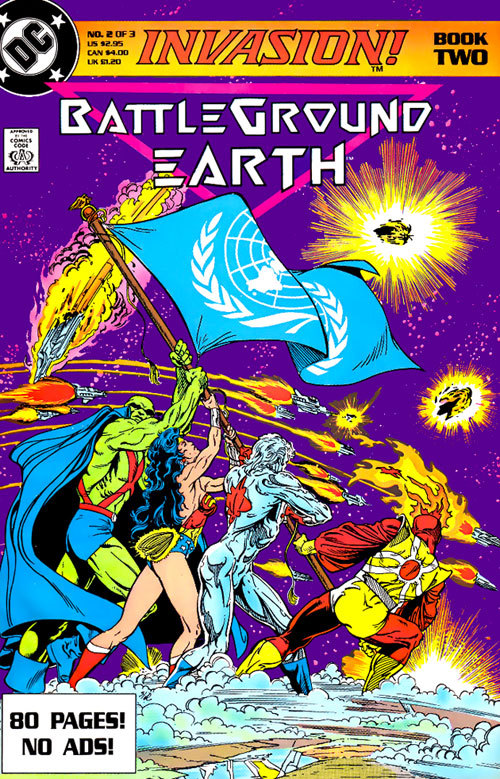
Here’s a fun read on the history between Marvel and DC
This and its predecessor are well worth a read.
I do have some objections - I don’t know how you can write a history that goes “In recent decades, in competing with Marvel DC found strength in mining their legacy, eliminated their multiverse and then immediately brought the same ideas back, introduced themes of cosmic myth, and became obsessed with recapturing ‘80s Miller/Moore-era magic and aiming at ‘mature’ audiences” and not ONCE mention Sandman and the Vertigo stuff - but it’s pretty solid.
It’s true, Watchmen and Dark Knight Returns marked the end of the Bronze Age and the beginning of whatever the ‘90 to today are. On the one hand grim antiheroes with Liefield pouches everywhere, but more thematically (and respectably) comics about comics with a sense of “okay, what if this shit were real”.
I’ve said before, the basic conceit of Watchmen was “okay, say there were superheroes, and they followed trends where there was a Golden Age of pulpy musclemen, and a Silver Age of scientific wonders, and a Bronze Age of social tension and self-questioning how and why would that have happened?” And then they explore how actual people might feasibly have behaved under those conditions.
The omnipitent, omnipresent figure associated with America would have been used as a Cold War superweapon, and also would have had a distant relationship to petty mortals. ‘70s disillusion with power would have redounded against superheroes as tools of the man, excoriated them as unchecked authorities, prompted calls for government control, and celebrated them as free men and vigilantes, even though these things are all in complete conflict. The woman who wore a skintight bodysuit and worked with a bunch of macho types would have been harassed and treated as a sexual object, the kind of woman who would decide to wear a skin-tight bodysuit and chase fame going on well-publicized adventures with a bunch of macho types would probably have a complex relationship to this fact, the daughter she raised in loose post-60s fashion into the shoulderpadded ‘80s would have a complex relationship to THAT fact, etc., etc.
And that was revolutionary! And around the same time, Dark Knight Returns made the point, “if Batman was real, he’d basically be a psychologically damaged para-fascist”. Which is almost conventional wisdom now, but that was revolutionary!
Of course before all that was Crisis on Infinite Earths which even established the idea “what if all this mythology was part of one coherent world”, and it was more mainstream and had an accordingly pulpy definition of “coherent”, but it was still a stab in this new direction, and set up the idea of a “generational” progression of heroes.
Sandman was, for all the goth brooding, not all that psychologically introspective or realist, but it was all in on attempting to tie stories in together. Dream was basically the embodiment of Story, and the Sandman universe was basically a meta-story for telling stories about storytellers and the stories they tell, which managed to weave into one coherent universe not only a bunch of early pulp-era comic books but basically the entire sum of Western and Near-Eastern history and mythology.
Moore’s League of Extraordinary Gentlemen did the same stuff with the Victorian literature from which the pulp tradition originated, then Grant Morrison and The Invisibles, and then if that wasn’t enough The Filth, which was kind of a riff on the very act of maintaining a comics continuity, only written with the subtle grace of a fucking sledgehammer - it literally features the characters gazing upon the giant hand of the (dead) Author/God holding a pen towards the end - with all sorts of juvenile-“mature” vulgarity along the way, basically a 13-issue adventure in crawling up his own asshole. I hear his recent run on Batman did an admirable job of integrating the character’s mythology, even the silly ‘60s stuff, into a respectable whole though.
One thing you rarely hear of these days is Marvel’s 1994 Marvels series, even though the “superpowers at street level” stuff presaged the feel of Powers, Astro City, and Top 10.