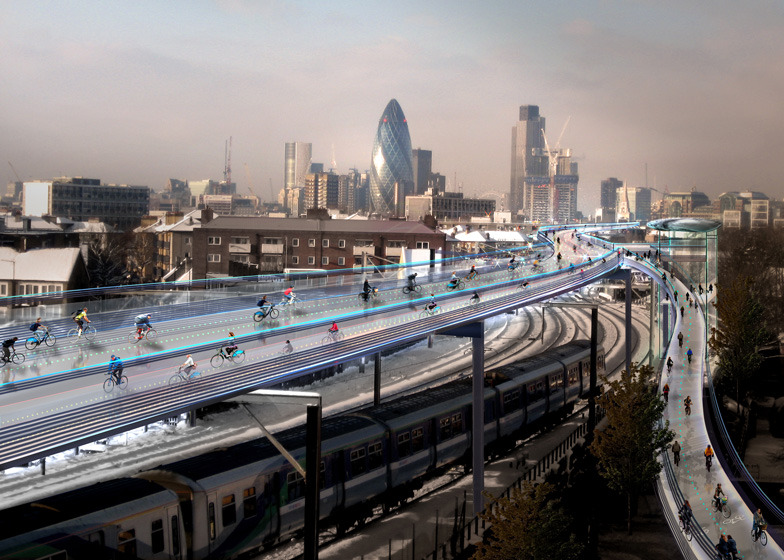
This past year, fourteen cyclists died on the streets of London. With the dangerous city roads in mind, British architect Norman...
This past year, fourteen cyclists died on the streets of London.
With the dangerous city roads in mind, British architect Norman Foster has unveiled Skycycle: a network of car-free bicycle paths elevated above London’s railways.
If this concept is approved, it could actually appear in 20 years.
(Thanks to robertsharp for tweeting us this tip!)
I’m a cyclist and this looks stupid as hell.
great idea i bet they’re definitely going to run elevated bicycle paths into working class neighborhoods where ppl actually ride bikes b/c they can’t afford cars and not just run elevated bicycle paths into wealthy districts where ppl only ride bikes for fun because it’s not like urban cycling promotion campaigns have already been largely directed at making biking safer and easier for the wealthy while leaving it just as dangerous and inconvenient for the ppl who are most reliant on urban cycling LOLLLLLLLLLLLLLLLLLLLLLLLLLLLLLLLLLLLLLLLLLLLLL
Los Angeles had one of these more than a century ago.
You know, paved roads took off in America in the late 19th century in response to the desires of well-off urban bicyclists who liked to take pleasure trips into the countryside. It was called the “good roads movement”.
The “safety” (chain-driven) bicycle had just gotten invented and bicycling boomed big. Armies were considering swapping bicycles for horses in their mounted infantry units. The urban middle classes took to them as a means of personal transportation that didn’t require feed and stabling. The problem with both was that unpaved dirt roads were difficult and damaging at the best, outright impassable at the worst.
And so there was a big drive to pave country roads. A lot of the activists were gentry youths who were into the pastoral-twee Romantic esthetic (but not enough to, you know, actually abandon economic power centers and go back to the land) and appreciated pleasure riding through the countryside.
It was pitched in pamphlets and traveling presentations to local farmers (America was overwhelmingly agricultural at the time) as for their benefit - no more rutted roads that turned to quagmires in rainy season, breaking cart wheels and impeding access to markets.
Which, fair enough. Ill-maintained dirt roads were a bitch, but on the other hand those farmers were the ones who elected the road commissions, and didn’t care for the taxes or corvee labor necessary to maintain them.
The corvee labor thing was effectively experienced by landowners as a cash tax, as they would hire others to discharge their obligation. This took advantage of the vast pool of unlanded seasonal labor an agrarian economy requires at planting and harvest time. In summers these vagabonds would tend to wander the countryside spending their wages and raising hell. Summer road work was a two-birds-one-stone solution, arguably preferable to the other traditional solution of hiring them as soldiers and starting minor summer border wars.
(Compare the ability to hire replacements in the Civil War draft, compare also the way that my father worked on a 1950s road crew that was effectively a summer job program for high school and college boys.)
And so if they didn’t want to pay for literally dirt-tier technology, fuck if they wanted to pay for this. So the appeals often included offers of annexation into the nearby cities, who would bear the burden of paving (and other utilities) on their broader tax-bases. In return for city politicians attaching their names to the project and expecting reliable votes in return.
And another force paying for all those pamphlets and whatnot was land speculators and developers. What suburbs existed had been connected to the urban core by trains, trams or omnibuses. The high capital cost of which limited routes and stops, which limited how much land could be profitably developed to that within walking distance of a line or stop, promoting dense village-style development. Paved roads and bicycles opened the way for lower-density diffusional development.
An ironic thing is that just as the momentum built for this, the split-log drag was invented, which was an incredibly simple device that made regrading and maintaining dirt roads much much easier.
So the roads were paved, the bikes went out, the suburbs got built, eventually the bikes became motorcycles, eventually the motorcycles became automobiles. And suburban sprawl, the abandonment of collective transportation, and the paving of paradise began about a century and a half ago, under a coalition of machine politicians, profit-chasing land barons, and twee young fixie-riding bourgeois bicycle activists.