shrine to the prophet of americana

#amhist (618 posts)

why is los angeles where los angeles is

rustingbridges:

why is los angeles where los angeles is

The first transcontinental railroad ran to San Francisco, and when a southern route was built the obvious western terminus was San Diego, but San Francisco elites feared the growth of another California power center so they pulled strings to get it redirected to Los Angeles, which was originally the agricultural lands feeding a Spanish mission and had no natural port. (They first built long piers around Malibu and then an artificial breakwater-protected harbor down by Long Beach.)

Then in 1892, the city was found to sit atop a major oil field and a drilling boom ensued, then in WWI the existence of a large labor force without strong left-labor organization like elsewhere on the west coast and in coastal shipping range of the wood-producing Pacific Northwest made it ideal to spin up a military aircraft industry.

Then after WWI, the booming Mediterranean-climate city drew a lot of immigrants from post-Ottoman lands as their national restructurings wrang out, then the motion picture industry relocated there from upstate New York for the weather and to get distance from Thomas Edison’s IP-enforcing goons, then in WWII that defense aerospace industry got even bigger, carrying the region through the Cold War.

Tagged: los angeles kontextmaschine does hollywood history amhist

I’ve lived through the Spanish Flu, WWI WWII, The Red Scare, The Great Depression, The Korean War, the Teapot Dome Scandal and...

butt-hash:

I’ve lived through the Spanish Flu, WWI WWII, The Red Scare, The Great Depression, The Korean War, the Teapot Dome Scandal and the Civil Rights Movement!  My life is fucking swag bro.

1963 I’m fucking ready…come at me!!!!

Tagged: same as it ever was amhist

100% correct

100% correct

Tagged: amhist historiography

centrally-unplanned:

liberalsarecool:

minmaneth:

bellybuttonblue2:

just sayin’

This should be taught in school.

Important to teach the actual version then!

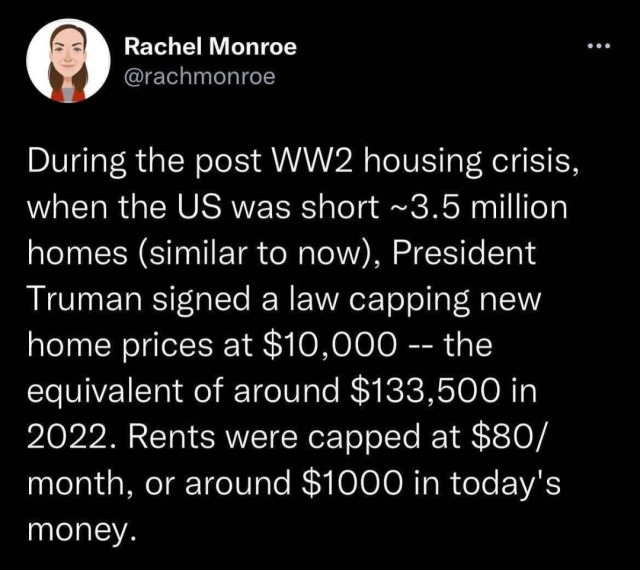
This is likely referring to the May 1946 Emergency Housing Program, and attempts to continue it through 1947. For one, rent control was not imposed ‘post-ww2’ - they were imposed in 1940, alongside…price controls for everything else. The large majority of the US economy was subject to price controls during the war to create stability and allocate materials to the war effort. After the war these controls began to be relaxed - what is being referred to here is an attempt to *continue* the rent controls that existed while other price controls slipped away.

Which in 1946 the US did do - alongside of course millions in federal funding directly building housing construction, blocks on the export of housing materials, and assurance contracts to providers of profit and financing. This did build a ton of homes, but huge gaps started emerging - in particular rent control was pushing tons of housing into the sales/ownership market, as there were more loopholes there, which veterans couldn’t afford. In December of 1946 Truman tried to redouble his efforts for the next year in a speech, which is where those numbers come from:

Permission To Build Homes

During 1946, a large volume of dwelling units has been put under construction and the completion rate of these homes has been increasing from month to month. Nevertheless, the veterans’ need remains extremely urgent and we recognize this by continuing to give veterans preference for every dwelling unit constructed for sale or rent.

However, from now on any person who wishes to build a home for his personal occupancy will be permitted to do so, subject to certain restrictions. This will increase the over-all housing supply and, in many instances, make additional homes available for veterans. The construction of housing will be authorized by Federal permits.

The major restrictions which will be imposed are:

1. The proposed dwelling must be designed for year-round occupancy.
2. The total floor area will be restricted.
3. In the case of rental housing projects, maximum rents, excluding charges for services, will be set at a project average not exceeding $80 per unit. Rentals will also be established for individual houses built for rental purposes.

The permit system will be simple. It will not be necessary to have sales prices set, or to meet the standards and inspection requirements of the present priority system.

You will note the housing sale cap of $10k was already abandoned by this point, being present in earlier versions.

This program failed to be implemented at scale - some of it was of course, but the majority of its tenents were rejected as the housing situation worsened and the desire of Congress to continue centralized price controls waned. In June of 1947 Congress passed the Housing & Rent Act, which Truman considered a bitter disapointment:

To the Congress of the United States

I have today signed H.R. 3203, the Housing and Rent Act of 1947, despite the fact that its rent control provisions are plainly inadequate and its housing provisions actually repeal parts of the Veterans’ Emergency Housing Act which have been most helpful in meeting the housing needs of veterans.

Had I withheld my signature, national rent control would die tonight. It is clear that, insofar as the Congress is concerned, it is this bill or no rent control at all. I have chosen the lesser of two evils.

It kept some controls of course, but nothing like what was outlined in that tweet - at this point even veterans had turned against such controls, as reported in a large American Legion report in 1947. Much housing was built, but it was far short of the goals and large affordability and access issues remainded.

Finally it seems worth noting that these controls were not especially onerous: the median housing price for new builds in the US in 1946 was $7500, and the median rent was $60. The controls were less a “this will lower rents” and more a “this will work as a short-hand to prevent new construction from trying to exploit gaps in our system of throwing financing at build projects.” (Source from same analysis above)

Now this whole thing, generally referred to as the Wyatt Program, is very interesting - it would be unfair to say that just because it lasted a year and didnt fulfill all its goals it was a failure; the problem of housing veterans in the US was gigantic after all, failure in some form was assured. Im sure many lessons could be learned from the Wyatt Program.

But we all know what the tweet is saying: “Hey, if we just imposed rent control today, housing prices would go down and people would still build, just like they did in 1946”. And that is summary of what was happening in 1946-1947 that is completely divorced from the reality of the housing market, the reality of the policy’s strategy, the reality of how it was implemented, and the reality of how successful it was.

With all that considered, I rank this tweet A Lie - but I suppose if you were charitable you could give it a “passes on a technicality” as those controls did exist in some form at some point in time.

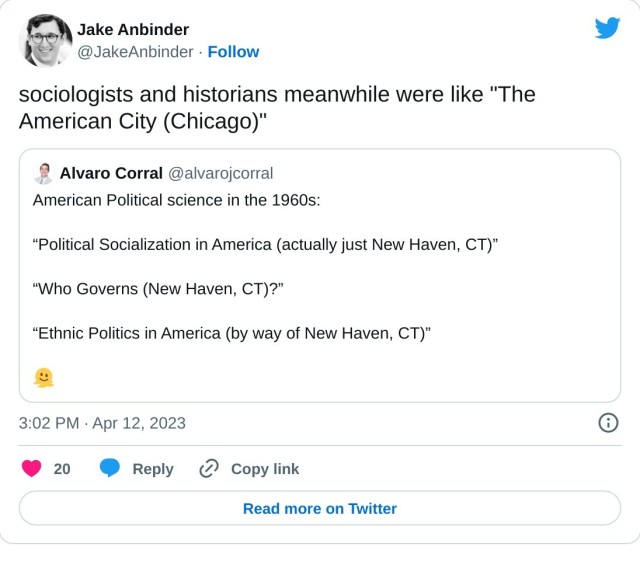
Tagged: amhist

Starting to suspect the best historical analogue for Joe Biden might be Dwight Eisenhower, as a moderate establishmentarian...

Starting to suspect the best historical analogue for Joe Biden might be Dwight Eisenhower, as a moderate establishmentarian president that got in after a sharp realignment by the other party, served to provide steady leadership and rehabilitate his own party going forward, checking further radicalism, but disappointed his party’s ultras by not rolling things back to status quo ante or supporting harder-edged pushback like McCarthy

Tagged: joe biden dwight d. eisenhower amhist same as it ever was dwight eisenhower

God, musta clicked something cause suddenly all my Twitter For You is all people sharing their commune dreams I actually learned...

God, musta clicked something cause suddenly all my Twitter For You is all people sharing their commune dreams

I actually learned in college about American commune moments of the Second, Third, and Fourth (the hippie Age of Aquarius) Great Awakenings, they’re remarkably similar

“What if there was a place where all you and your weirdo friends could live apart from the rest of the world in a way that supported you through common enterprise” is exactly what my small town boarding school fantasy is about and it is not conceived as a commune for good reason

Tagged: amhist same as it ever was communalism commune if your commune rejects material luxuries but does not mandate abstinence status will DEF get expressed as differential sexual access

You know I wonder how much delay in ending the Vietnam War came not from military/geostrategic considerations but (sympathetic,...

You know I wonder how much delay in ending the Vietnam War came not from military/geostrategic considerations but (sympathetic, understandable) apprehension for how giving antiwar forces a win would affect the domestic balance of power and culture

Tagged: amhist

Is Leave It to Beaver (1957-1963) still in memory as an icon of the pre-Sixties era of American culture? Or as contemporaries...

Is Leave It to Beaver (1957-1963) still in memory as an icon of the pre-Sixties era of American culture?

Or as contemporaries like My Three Sons (1960-1973) fall out of memory (I remember it from Nick at Nite, which was the retro rerun late nite block from the early days of the normally child-targeted cable TV station Nickelodeon) is it looting their corpses to be the era’s last signifier standing?

Tagged: amhist cultural memory leave it to beaver camelot

Chest slapping retard weighs in

apoliticalfemdommunist-deactiva:

Chest slapping retard weighs in

Part of it like… you know how normally tranquil animals can be scarily dangerous when they’re sick or threatened? For most of the contact period, indigenous American cultures were very sick and very threatened.

Like maybe 30 years ago Amerindian groups were still on about throwing off an old image of bloodthirsty savages taking scalps and all that. Like some band of postapocalyptic maniacs.

Postapocalyptic tales, of course, are largely a mechanism for retelling the “taming the wild frontier” narratives that were foundational to American culture.

Native Americans as frontline settlers encountered them and took as the essential nature of their race and civilizations what came through several simultaneous plagues that absolutely cratered population, followed by an alien invasion.

Those guys were living in a postapocalypse.

Tagged: amhist history

aorish-deactivated20251222:

triviallytrue:

anexperimentallife:

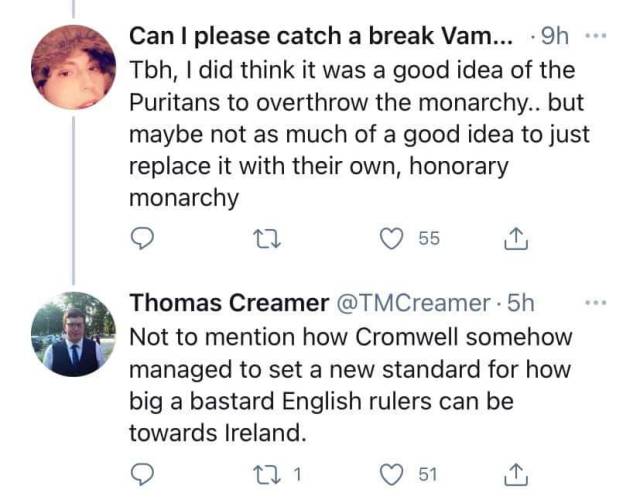
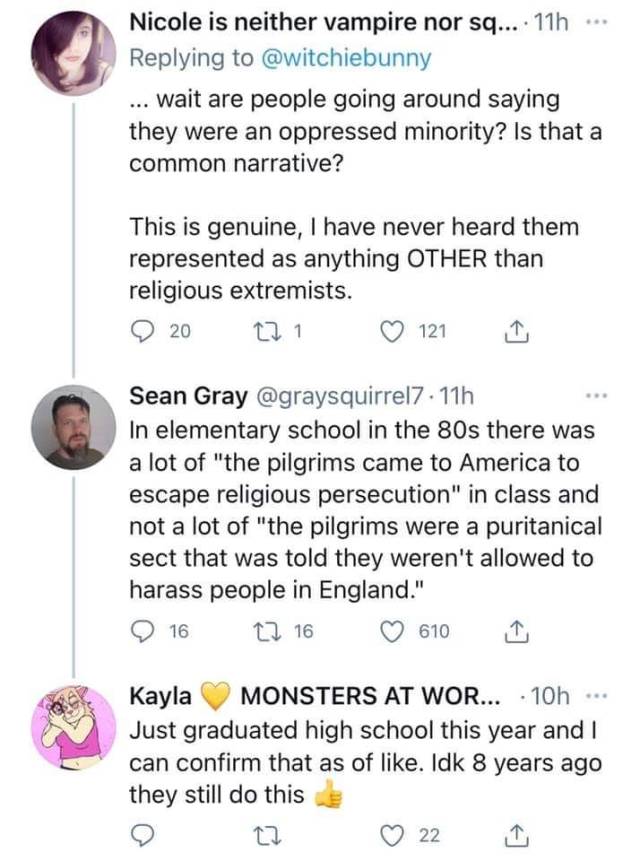
many genuinely repressed religious minorities are also religious extremists, this is not a binary

Often their extremism is why they’re being repressed, even!

Or vice versa.

Tagged: amhist

…is that John Daly?

machine-elf-paladin:

kontextmaschine:

kontextmaschine:

…is that John Daly?

Like, John Daly was the drunk redneck shitkicker of otherwise upper class-marked professional golf, but he could really wail a ball, really the significant thing about Tiger Woods in the late ‘90s was he could hit a ball as far as John Daly but with the control of everyone else

Was Happy Gilmore based on him or something? Because I read that description and damn.

Well, I can say it would have been fuckin’ weird to make a 1996 professional golf culture-clash movie while remaining unaware of that '91 rookie.

Daly had an Upper South blue-collar background that fits in with that demographic’s early-90s incorporation into the national mainstream (what, you thought evangelical Christianity, post-Billy Ray Cyrus country music and the NASCAR boom just… happened?), and that same inclusionary moment for the Long Island Jewish kid who’s a troublemaker but loves his bubbe was kind of what Sandler was about, the transposition makes sense

Tagged: adam sandler happy gilmore 90s90s90s amhist john daly

So if we're all doing our retrospective takes on the Iraq War, mine was… it wasn't that big a deal? In scale, direction, and...

eightyonekilograms:

balioc:

kontextmaschine:

So if we’re all doing our retrospective takes on the Iraq War, mine was… it wasn’t that big a deal? In scale, direction, and costs borne and imposed it was basically well within norms for what the country might get distracted with over a two-decade period.

Already within my lifetime the specter of the Vietnam War, once much more significant in national affairs, looms not nearly as large as I remember it doing in the ‘80s (indeed, the easy victories of the “Desert Shield/Storm” Iraq excursion of the early '90s were specifically hailed for dispelling this “Vietnam Syndrome”), as colorful but not particularly important chapter of 20th Century American history.

While the action did not serve to renew America’s post-Cold War unipolar “hyperpower” moment, I honestly don’t think it accelerated its end any, which looks to be more a product of the development of China and reassertion of Russia than any “Clash of Civilizations”.

…the Iraq War – the (cultivated) reaction to it, and then the backlash to that reaction, and then the fallout from the actual war being such a huge debacle – ended the decade-and-a-half End of History.

Even if it had no lasting geopolitical impact whatsoever (which seems like a stretch), its impact on the American psyche was quite enough to be a History-Defining Big Deal all by itself.

Which seems like it would be your jam.

Yeah this post is just nuts to me. Even if you set aside the immense suffering of the Iraqis themselves, which you absolutely should not do, off the top of my head I can name three colossal impacts of the Iraq War plus a fourth probably-colossal one.

  1. It killed neoconservatism stone dead. The neocons had steadily built their prestige and influence over the 80s and 90s, and with the second Bush Administration they had finally graduated to being the official ideology of the Republican Party, to the point where even plenty of liberals at the time were at least flirting with it. Then Iraq completely shattered their credibility, the GOP has pivoted hard to Burnhamist paleoconservatism, and now the seven or eight remaining neocons in Washington are at their sad little #NeverTrump parties, the most marginal of the marginal.
  2. Related to this, since OP is not exactly a young Democrat I don’t think he understands just how deeply disillusioned and cynical a lot of young American leftists became towards the Democratic party specifically because of Iraq. In a couple swing states, Hillary Clinton only lost by a few tenths of a percent, where Democratic turned plummeted compared to Obama in 2012. Could Hillary have won in 2016, completely discrediting Trumpism and vindicating all the predictions that it would be the suicide of the GOP, if not for her support of the Iraq War? We will never know, but it is crazy to not even consider the possibility.
  3. It was directly responsible for the Ukraine war. Prior to Iraq, Russia was not exactly a friendly state but at least somewhat tried to participate in the legitimacy of the international order. Iraq firmly convinced them that the international order was bullshit, which is why South Ossetia was annexed in 2008 as warmup to Ukraine in 2014 and the war today.
  4. See “the decade of concern” by the Scholar’s Stage. tl;dr, armed forces have to do a complete overhaul every 10-15 years, the Iraq War hit pause on the overhaul of that process for the US military and so now they’re scrambling to complete this overhaul in the 2020s, during which time we are extremely not ready for a Chinese invasion of Taiwan. If that invasion does happen this decade, Iraq will be a major part of why.

Okay,

First I mean, I’m starting from the premise that American unipolar dominance would end in some way in a similar timeframe, maybe if you were savescumming you could get 20 more years out of it. And 2000s-era neoconservatism, as an ideology premised on that dominance, would have necessarily been discredited with it. That cancels out on both sides of the counterfactual.

Similarly for 3, “national rivals come to realize that America is overextended and cannot maintain international hegemony” was baked in already with the expiration of the post-Cold War honeymoon.

“It had significant shaping effects on the composition and balance of domestic factions.” ok I’ll give you that. But so did Vietnam!

Antiwar activity was hugely important to party realignment! This was how primary-based presidential nomination came into being! The weapons spending-earned loyalty of labor vs. the ferment of campus activism introduced an education gap within the Democratic Party that is hugely important to this day!

But like… okay? You can learn that in college, but it’s not part of the central narrative of America.

Yeah, we strained the post-Vietnam “all-volunteer force” and the slimmed-down post-Cold War capital structure, remember “stop-loss orders”? And school friends who enlisted all reported encountering some guys who musta got in by lowered standards. But we made it through, and you could honestly put “and this operation strained existing systems and traded off against preparation vs. other enemies” in the histories of any war, but you don’t. (Unless you know in advance those vulnerabilities get exploited in the next chapter)

Tagged: amhist

So if we're all doing our retrospective takes on the Iraq War, mine was… it wasn't that big a deal? In scale, direction, and...

baconmancr:

kontextmaschine:

balioc:

kontextmaschine:

So if we’re all doing our retrospective takes on the Iraq War, mine was… it wasn’t that big a deal? In scale, direction, and costs borne and imposed it was basically well within norms for what the country might get distracted with over a two-decade period.

Already within my lifetime the specter of the Vietnam War, once much more significant in national affairs, looms not nearly as large as I remember it doing in the ‘80s (indeed, the easy victories of the “Desert Shield/Storm” Iraq excursion of the early '90s were specifically hailed for dispelling this “Vietnam Syndrome”), as colorful but not particularly important chapter of 20th Century American history.

While the action did not serve to renew America’s post-Cold War unipolar “hyperpower” moment, I honestly don’t think it accelerated its end any, which looks to be more a product of the development of China and reassertion of Russia than any “Clash of Civilizations”.

…the Iraq War – the (cultivated) reaction to it, and then the backlash to that reaction, and then the fallout from the actual war being such a huge debacle – ended the decade-and-a-half End of History.

Even if it had no lasting geopolitical impact whatsoever (which seems like a stretch), its impact on the American psyche was quite enough to be a History-Defining Big Deal all by itself.

Which seems like it would be your jam.

I mean that was the way it happened, but if not for that then…?

Like, if it didn’t have military commitments at the time the US might’ve engaged harder in the Crimea crisis, and the Syrian civil war would have been obviated and the big refugee flow to the EU preempted. That’s the two things I can see going differently.

If the Iraq and Vietnam wars aren’t major events, what qualifies? I assume you’d say that the world wars were more important globally, and the civil war was more important nationally, but are there any non-war events that make the cut?

The World Wars were, the Civil War was, the Cold War as a whole was, Iraq’ll get put with Afghanistan and Granada, the old Desert Storm/Shield, Yugoslavia and the “R2P” era as “miscellaneous post-Cold War search for purpose”

just like the Gilded Age is “miscellaneous post-Civil War search for purpose”

Tagged: amhist history historiography same as it ever was

So if we're all doing our retrospective takes on the Iraq War, mine was… it wasn't that big a deal? In scale, direction, and...

So if we’re all doing our retrospective takes on the Iraq War, mine was… it wasn’t that big a deal? In scale, direction, and costs borne and imposed it was basically well within norms for what the country might get distracted with over a two-decade period.

Already within my lifetime the specter of the Vietnam War, once much more significant in national affairs, looms not nearly as large as I remember it doing in the ‘80s (indeed, the easy victories of the “Desert Shield/Storm” Iraq excursion of the early '90s were specifically hailed for dispelling this “Vietnam Syndrome”), as a colorful but not particularly important chapter of 20th Century American history.

While the action did not serve to renew America’s post-Cold War unipolar “hyperpower” moment, I honestly don’t think it accelerated its end any, which looks to be more a product of the development of China and reassertion of Russia than any “Clash of Civilizations”.

Tagged: amhist history iraq war revisionist history same as it ever was

Something American urbanist praise of Japanese real estate development forms needs to grapple with is that the call for frequent...

kontextmaschine:

Something American urbanist praise of Japanese real estate development forms needs to grapple with is that the call for frequent construction and demolition is leveraged to sustain a small construction work sector as a sink for the would-be underclass, almost in place of a welfare system “floor”. (This interestingly means construction labor is often articulated with organized crime, but in a manner completely different from how it is in the US)

I mean given the postwar American administrative order the occupation authorities were almost certainly getting reports from labor economists on the distinctions with the New York and Italian systems at the time

Tagged: amhist meanwhile in japan

Cute little story about the old days of Orange County.... bring back tge criminals please Newport Beach is so borong now..

plum-soup:

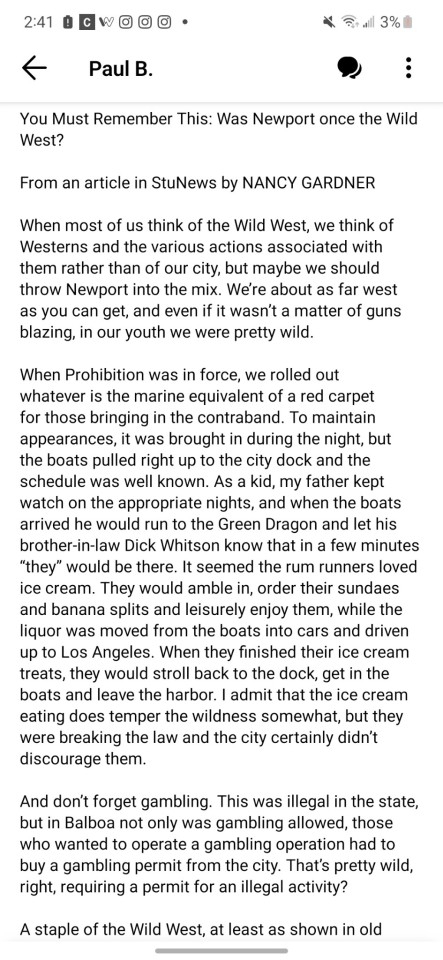
Cute little story about the old days of Orange County…. bring back tge criminals please Newport Beach is so borong now..

Tagged: amhist

Founding Fathers react after seeing John Hancock’s signature on the Declaration of Independence. (1776 - Colorized)

fakehistory:

Founding Fathers react after seeing John Hancock’s signature on the Declaration of Independence. (1776 - Colorized)

Tagged: amhist history sexual media

One of the great tragedies of the Rust Belt* is that it did not define itself as a distinct cultural region until well after its...

pureamericanism:

One of the great tragedies of the Rust Belt* is that it did not define itself as a distinct cultural region until well after its great era of flourishing was over. For the century from about 1850-1950, this area was not merely the industrial heart of the nation, but also its cultural center. And yet the inhabitants of the area, if they thought of themselves as having a regional identity at all, it was as inhabitants of the generic ‘north’. Its status as a center of cultural innovation was pooh-poohed by the fact that the nation’s political and intellectual elite was, even as it is today, strongly based to the coastal northeast, and this Eurocentric elite had a very different set of priorities than the cultural avant-garde of the as-yet-unRusted-Belt. This area produced little in the way of ‘high art’ in the expected form of novels, symphonies, and oil paintings. But what it did produce…

In 1900, Chicago was the occult capital of the nation, a hotbed of wild theorizing and underground publishing of all manner of Theosophical weirdness. Meanwhile, Louis Sullivan and Frank Lloyd Wright were producing the first wholly indigenous tradition of monumental architecture, setting a pattern for all of urban modernity. The Dayton, Ohio based Wright brothers - often abused in pop-historiography as some sort of rude mechanicals - were slowly and methodically systematizing the science of aerodynamics in preparation for the first ever instance of heaver-than-air flight in human history, with world-shaking consequences. And up in Detroit, Henry Ford was not merely revolutionizing transportation and manufacturing, but setting a standard for industrial relations that would create an unbelievably influential model for decades to come. It might sound strange to modern ears to cite Henry Ford as a bleeding-edge figure, but Fordism served as an inspiration to both Bolsheviks and Fascists, as well as to domestic New Dealers, while simultaneously pleasing and alarming old-fashioned Anglo liberals. The Long 20th Century is a series of footnotes to the Rust Belt Golden Age.

As can be seen from this too-brief summary of the luminaries of the epoch, it was a deeply unique Golden Age, characterized by cultural traits all its own. Technical prowess, utopian visions, and thorough systematization were its characteristics, as was a sense that a lone individual or small group could, through sheer innovative genius, change the world. While the archetype of the Mad Scientist is based on Mitteleuropean models, it was here in Mittelamerika that it achieved its apotheosis. The definitive cultural history of this region and era has yet to be written**, which just shows how underappreciated the underlying unity still is, but it in a large part contributed to the dynamic optimism that we all now take for granted as distinctively ‘American.’ But as the area felt the collapse of the long bubble economy that funded its flourishing, and its brightest sons and daughters fled west to contribute to the explosion of creativity along the Pacific slope that is now likewise collapsing, it finally awakened to a sense of unity that had previously been hidden by arbitrary State boundaries.

That, at some point, this area will again be the center of some sort of vigorous culture seems an inevitability of human geography, but will it again share the same features of optimism and technical prowess, or were those mere incidental features of a bunch of people with a Protestant work ethic suddenly getting access to the tremendous wealth provided by a vast agricultural base + fossil fuels? Man alive, I don’t have the slightest clue, but I hope that there is some sort of afterlife or metempsychosis so I can find out.

* here roughly defined as the geographical area constrained by an irregular polygon whose points are Syracuse, Pittsburgh, Cincinnati, St. Louis, Davenport, Green Bay, and Flint.

** unless it has and i’m just ignorant of it, in which case please let me know so i can rest easy that i don’t need to do any work and can just sit down and read the thing. honestly, even tangentially related book recommendations are appreciated.

Tagged: amhist rust belt

theaudientvoid:

Tagged: androids dreaming of electric sheep amhist not really tho

I regret to inform you that American Girl's latest dolls are from that ye olde historical setting of *1999* i feel my sanity...

birdrhetorics:

thegirlwholied:

I regret to inform you that American Girl’s latest dolls are from that ye olde historical setting of *1999*

i feel my sanity slipping

OH NO

Tagged: 90s90s90s amhist history