One of the biggest pop stars of the ‘80s and into the mid-‘90s. She’s still doing something I’m sure. (One search later… releasing “Bitch I’m Madonna” ft. Nicki Minaj. Correct.)
And a big part of her schtick was Catholic burlesque. Rosaries and crucifixes as fashion accessories, songs titled “Like a Virgin”, “Angel”, “Papa Don’t Preach” (about standing up to patriarchy by… not aborting an unintended pregnancy, dedicated to the Pope), and “Like a Prayer”, like holy shit, look at that video. (Music videos were the most important art form of the 1980s.) I’d say calling herself “Madonna” was the topper, but that was her (and her mother’s) birth name. Nominative determinism, I guess.
The context here is that it was only in the 1970s that the “white ethnics” - descended from mostly Catholic, Jewish, or Orthodox immigrants from southern and eastern Europe, began being considered as fully the same race as plain “white”, which had heretofore been more specifically Protestant/secularist North/Western Europeans. You still saw echoes of the distinction into the ‘90s, uptight WASPs as opponents to the cool protagonists in cultural works by people who had lived through when that was plausibly a thing.
And part of the twist was that Catholicism had been coded as sexually repressive, particularly upon women but Madonna made a thing of invoking it as an accessory to female sexual assertion, very eroticized videos, wearing see-through clothing and lingerie on tour, you know back in the day she… wait, I should establish some other stuff first.
Also the other big thing she did was pull in this whole multi-racial, multi-sexuality dirty poor NYC thing - New York was still recovering from the bankrupcty of the 1970s, not yet made it to Giuliani Time and the walking-back of the last time we tried not repressing black people. So if we’re talking pop cultural touchstones it wasn’t quite Taxi Driver or The Warriors NYC anymore, but still a ways off from Friends NYC, let alone Sex in the City or Girls’. Ghostbusters/Burton Batman NYC, I guess.
So a lot of sexual contact with hot brown-skinned men in her videos and as backup dancers, also queer culture - “vogueing” and a lot of other things from NYC “ballroom” society (all you babby genderweirds should watch Paris is Burning if you haven’t yet, I am nothing if not insistent that one should learn the history of one’s people), in 1992 releasing a coffee table book of pansexual celebrity kink erotica.
Okay. Anyway, you know back in the day she was known for having her limousine driven through the (predominantly black and Puerto Rican) Lower East Side and picking up teenage boys off the street to use for the night? After a while the locals got tired of this, learned to recognize her limo, and threw trash at it.
I guess you could peg Lady Gaga as her successor, doing queer burlesque at the moment of their incorporation into the mainstream. Also she does that “present yourself as the perfect accessible celebrity friend/avatar to your audience” thing that Taylor Swift does better. Honestly, I think the big problem with her though is that music videos aren’t as big a thing though (and have better competition as “media for young people to consume”) so her visual peacocking doesn’t count for as much anymore.
I wonder exactly which day it was that the amount of time Comedy Central had spent broadcasting The Daily Show finally caught up to the amount of time they had spent broadcasting PCU
This was supposed to be a culture war joke, in fairness on further reflection I was like “yeah but maybe put all the hours of South Park, Tosh.0, and The Man Show on the PCU side too.” Maybe the Kilborn years, even.
Okay, for the benefit of all the followers I’m getting with absurd ages in their profiles, let me explain this one.
When Comedy Central started in the ‘90s, they didn’t have much original programming, and what they did was mostly one-off (but frequently rerun) specials - filmed standup sets, basically.
So what they ran was mostly secondhand content they’d picked up rights to, and what was most common were these two movies, I swear to god I’d seen them run back to back and then over again, I’m pretty sure I’ve seen the same one run twice in a row. One was Throw Momma From The Train, a Danny DeVito comedic riff on Strangers On A Train.
The other was PCU, a campus comedy in the Animal House vein starring a visibly balding Jeremy Piven. It was a lovable frat fighting the dean and his Young Republican lackeys, but (because “boat shoe and dinner jacket-wearing WASPs” were overdone and increasingly anachronistic as villains by then) there was a third faction that took the brunt of the mockery: earnest, censorious social issue activists. Thus the title. The climax involved the activists protesting the big frat party (tagline: “Everyone Gets Laid”), but then realizing “holy shit, we’re against drinking, sex, parties, freedom, and fun, we’re the bad guys” and giving up and chilling out and hooking up with the frat members.
Because obviously you were supposed to see that as the only acceptable position for anyone with any pretensions to being cool and with it. Like I said, '60s-derived social liberalism used to offer something for everyone.
If you don’t know who Howard Stern is, he was the foremost crude “Morning Zoo” radio DJ in the country.
Like, in the '90s, white, blue collar (or “dudebro”) tits-n-beer vulgarity was plausibly coded left/liberal/Democratic. And that’s a little disorienting to remember.
I mean hell, Benny Hill was aired in part by an official arm of the most socialist Anglosphere government ever. Benny Hill.
If you’ve never seen Benny Hill, it’s from the British “light entertainment” tradition, a little variety but kind of sketch comedy, only a lot of the “comedy” was basically dirty old man leering. Sketch leering. Episodes famously ended with sped up comedic chase scenes where Benny would try to catch and grope some pretty young girls, then turn and run away as they tried to catch and punish him.
Now by the '90s that was already a bit off, but still, it ran in reruns on Comedy Central. It ran on fucking PBS.
If you ever wonder why intelligent educated sensitive me is wary of if not actively hostile to so much of what passes for modern cultural liberalism, it’s because it pattern-matches so closely not only to the apocalypse visions conservatives were warning of when I was growing up, but to the liberals’ versions as well.
Our favored categories can start to look strange when we turn a light
on the realities of the American Revolution. The revolution involved
coalitions of people who were deeply divided regionally, economically,
socially, politically, so anything the big-time founders did agree on
will be pretty revealing.
I’d say they were largely agreed on the virtues of representative
government — it’s what they’d had for generations, what they saw being
threatened — but to question your question somewhat, I’d also note that
across the board, from the planters to the financiers to the upper
farmers and lawyers, the right of representation in no way equated with
democracy, which at the time would have meant “manhood suffrage”:
disconnecting the right of political participation from property
ownership.
The founders who held power were agreed in their fear and loathing of
that idea. Their ideology of rights and liberty was bound up, from
ancient times — at least in their minds it was — with protecting
property. So both the economic liberalization promoted by the
high-finance Hamilton,
and the more agrarian program that the slave-economy Madison advanced
(once he realized what his old friend in nationalism Hamilton was up
to), recoiled from democracy, a term the founders used negatively
whenever they referred to placing power in the hands of the
unpropertied.
That free yet unpropertied class was big, by the way, in founding-era
America. In my view, egalitarian goals, as you’ve put it, were not on
the minds of any of the well-known founders, for all of their other
differences. That includes mutually divided nationalists like
Washington, Hamilton, Madison, and Adams and state-sovereigntist,
anti-nationalists like Patrick Henry.
George Washington: *writes letter to congress about how his dastardly rival, horatio gates, is planning to lead a military coup against congress to settle claims of wages never paid to soldiers, and how he, the great and wise one, heard of this when the coup plotters unfortunately told his aide alexander hamilton, and settled everybody down with a great speech, but congress should pass a bill anyways that guarantees pay for soldiers AND for rich creditors by implementing a widely unpopular tax in order to stave off any future military coup*
Congress: *Passes the tax with haste*
Later Historians: "Gosh, it's so excellent that George Washington was so committed to democracy. There could be no ulterior motives here. This calls for another statue of our God-King."
the funniest and best thing i’ve learned while doing research for this shakespeare project is that in the late 19th century, there was this group called the american acclimatization society and their thing was bringing european plants and animals to the u.s. so one member was this guy named eugene schieffelin and he was like obsessed with shakespeare, so he went, “hey, wouldn’t it be cool if we tracked down EVERY SPECIES OF BIRD SHAKESPEARE EVER MENTIONED and brought them ALL to America” so he rounded up like a hundred European starlings and released them in central park, and now there are upwards of 200 million starlings in North America and they cause around $1 billion worth of damage to crops every year, all because shakespeare mentioned them exactly ONCE in Henry IV part 1
The Revolution was not a single struggle, but a series of four
separate Wars of Independence, waged in very different ways by the major
cultures of British America. The first American Revolution (1775-76)
was a massive popular insurrection in New England. An army of British
regulars was defeated by a Yankee militia which was much like the
Puritan train bands from which they were descended. These citizen
soldiers were urged into battle by New England’s ‘black regiment’ of
Calvinist clergy. The purpose of New England’s War for Independence, as
stated both by ministers and by laymen such as John and Samuel Adams,
was not to secure the rights of man in any universal sense. Most New
Englanders showed little interest in John Locke or Cato’s letters. They
sought mainly to defend their accustomed ways against what the town of
Malden called ‘the contagion of venality and dissipation’ which was
spreading from London to America.
Many years later, historian George Bancroft asked a New England
townsman why he and his friends took up arms in the Revolution. Had he
been inspired by the ideas of John Locke? The old soldier confessed
that he had never heard of Locke. Had he been moved by Thomas Paine’s
Common Sense? The honest Yankee admitted that he had never read Tom
Paine. Had the Declaration of Independence made a difference? The
veteran thought not. When asked to explain why he fought in his own
words, he answered simply that New Englanders had always managed their
own affairs, and Britain tried to stop them, and so the war began.
In 1775, these Yankee soldiers were angry and determined men, in no
mood for halfway measures. Their revolution was not merely a mind game.
Most able-bodied males served in the war, and the fighting was cruel
and bitter. So powerful was the resistance of this people-in-arms that
after 1776 a British army was never again able to remain in force on the
New England mainland.
The second American War for Independence (1776-81) was a more
protracted conflict in the middle states and the coastal south. This
was a gentlemen’s war. On one side was a professional army of regulars
and mercenaries commanded by English gentry. On the other side was an
increasingly professional American army led by a member of the Virginia
gentry. The principles of this second American Revolution were given
their Aristotelian statement in the Declaration of Independence by
another Virginia gentleman, Thomas Jefferson, who believed that he was
fighting for the ancient liberties of his ‘Saxon ancestors.’
The third American Revolution reached its climax in the years from
1779 to 1781. This was a rising of British borderers in the southern
backcountry against American loyalists and British regulars who invaded
the region. The result was a savage struggle which resembled many
earlier conflicts in North Britain, with much family feuding and
terrible atrocities committed on both sides. Prisoners were
slaughtered, homes were burned, women were raped and even small children
were put to the sword.
The fourth American Revolution continued in the years from 1781 to
1783. This was a non-violent economic and diplomatic struggle, in which
the elites of the Delaware Valley played a leading part. The economic
war was organized by Robert Morris of Philadelphia. The genius of
American diplomacy was Benjamin Franklin. The Delaware culture
contributed comparatively little to the fighting, but much to other
forms of struggle.
The loyalists who opposed the revolution tended to be
groups who were not part of the four leading cultures. They included
the new imperial elites who had begun to multiply rapidly in many
colonial capitals, and also various ethnic groups who lived on the
margins of the major cultures: notably the polyglot population of lower
New York, the Highland Scots of Carolina and African slaves who
inclined against their Whiggish masters.
you hear this a lot, but what does it mean, specifically?
the pre-1776 americans who came from a sex, race, and class background that enabled them to participate in the conventional history of america sought to buy into aristocracy as a system of production. they were the youngest sons of minor aristocrats, the children of men with rank and no land, successful but socially limited military officers. there were people other than white men in america, but our history is not defined by them, they were not in power, they struggled to survive and their voices are faint and hard to hear. even the reality of working-class life in america among white men is largely silent; children read thomas paine’s agitation for the bourgeois revolution in america but nothing about his labor agitation in the us and england, nothing about his work as a corsetmaker or his parallel struggles to break into the bourgeoisie personally and defend workers as a class. we learn about the composition of washington’s teeth.
more people know washington had teeth extracted from slaves than know he was rich, and had an obvious and immediate material interest in the revolution as a wealthy planter.
george washington was arguably the richest man in america. not in money, although there is that. he was rich in land; he was a successful surveyor, planter, and politician. “politician” makes sense to us, and while it meant different things in the 18th century (and certainly he would have rejected any attempt to identify him that way) it’s something we can comprehend pretty well.
the planter class were slaveowners. this was a universal fact of revolutionary america; there was nowhere near enough ‘free’ labor in america to maintain their massive, highly inefficient cash crop farms. expanding the population of slaves in america was a major priority to intensify production.
before the cotton gin made cultivars of cotton that grew outside of fertile bottomland economically viable under even plantation slavery by reducing the titanic amount of labor necessary to make their bolls usable for fiber, the major cash crop of america was tobacco.
in america, because of peculiarly american mythology, we tend to believe that in the late 1700s and most of the 1800s people didn’t understand crop rotation or soil nitrogen. even in the context of european agriculture this is incorrect. soil nutrition was an incomplete science, and the primary fertilizer in the west was not an efficient nitrogen source but bone meal, yet american planters understood the basics of crop rotation and fertilization. they simply refused to use them because they would have driven up costs.
the rudiments of the agricultural revolution were things that wealthy american planters chose to forget. this is why america is larger than europe and has only been a food exporter in living memory - not because it is infertile, but because its economy was one of indifference to fertility, and this set down powerful cultural roots and industrial norms. the dust bowl was a product of this history as much as anything.
in slavery times, wealthy american planters planted a crop of tobacco on every surface available to them on good land - and they could tell if land was good for tobacco by means of both common knowledge about agriculture and surveyors’ trade secrets. a good way to tell in virginia was to count the pines.
they continued to plant tobacco season after season, crop after crop. the land was never given rest, never allowed to lay fallow. no land capable of raising tobacco was used for anything else; food and feed crops that would have partially restored soil were grown on bad, rocky, marginal soil.
in a few years, the best land used this way would become utterly infertile, and would be allowed to revert to barrens. the semi-indigent white smallholders of the antebellum south filled this vacuum, and in struggling to make do with an agricultural technology adapted for intensive, land-destructive agriculture, degraded soil still further.
the planters who had used up land then acquired more. land was cheap; formally it was necessary under english law to acquire title from natives, the english system of transfer of title was not a native institution and was easy to use to steal land. the american mythology includes a story about settlers buying manhattan for $50, and a riposte that this represented an easement and not a permanent purchase to the native lenape. there are also stories about natives selling land they did not own. these are both applicable in some cases, inapplicable in others; the interface between white settlers and natives was unstable and heterogeneous. in most cases, white title to land under english law was only ever ambiguous at best, and the land bought in this way rapidly became incapable of supporting people outside of the deformed european style of agricultural production prevalent in america. even if the system were not rigged against natives, economic pressure would still have created a comprador class which sold out and moved north and west, and this would still have intensified political struggles among natives and between natives and white settlers.
these conflicts, and legal hassles for the british government, lead to the proclamation of 1763. we hear mostly about it forbidding squatting - white settlers moving over the mountains and claiming land without title. in the american popular imagination this is what the revolution changed.
the reality is that the main thrust of the proclamation of 1763 was that the purchase of native land in america by private agents was forbidden, and all such purchases had to be formal purchases by agents of the crown itself. to a planter class whose bloated, vampiric way of life depended on shady and frequently illicit private land deals between themselves and natives, this was a deadly threat. from the word go, it was challenged by planters - who, being sustained by the legal system in a basically predatory life, in general took pains to be literate in the formal law of england and keep copies of significant precedents in common law courts - using a forged version of the pratt-york opinion.
the pratt-york opinion held that the british east india company was within its rights to purchase land from princely states in india. it held, unambiguously, that its decision did not apply to america, and american skeptics always expressed scorn and ridicule about the idea it suggested of dealing with indian “princes” and “governments”. (after the war, john marshall made it clear that there was no homology in the eyes of anglo-american law between the formal, legitimate governments of the raj and american indian nations.) but when you think about it, the same logic was really at work: the british east india company was an agent of the crown in its own right so its expropriating land from natives was in the crown’s interest even without its formal say-so. and so in a sense were american planters agents of the crown in this capacity. if george washington, the richest man in america, was not an agent of the crown in north america, who even was?
forged versions of this opinion, which clipped off language making it unambiguous that the decision was inapplicable to america, circulated widely. they are in evidence in the personal effects of washington, jefferson, lewis and clark. whatever the crown said, the land grab would continue, be damned any border or line. more land was needed so more land would be taken.
before, during, and after the revolution, washington was a surveyor; he wrote down the characteristics of land which white people had seen but had not investigated in depth for its suitability for plantation agriculture. he took the best land of the west for himself. it was not considered unseemly or ridiculous that he would do this even while on campaign; it was a necessary part of his profession and a universal behavior of the plantation aristocracy.
the use of land in this way continued after the war, and especially after the war with tecumseh’s confederacy was won at tippecanoe; land was close to free for the first white people to survey it, and cheap as dirt for the rich planters that came after them.
this is how americans became rich. this is how american capital came to exist. this land grab logic extended into the west, and this is part of the reason oregon was settled so far in advance of the great plains - the thick, dry grasses of the modern breadbasket of the us were not suitable country for cash crops, and only at its southern margins did plantation slavery ever successfully advance.
it is sometimes treated as inevitable that this should have ended, that plantation slavery reached its zenith before the civil war and the civil war was part of its decline. but this country was literally founded by people who stole land to farm so intensively with slave labor that it was destroyed for agriculture for generations - and those people would never have imagined most of what we think of as ‘the south’ being subject to their economic system. it was not suited for tobacco or long-staple cotton. but american and european industry, whose hunger for production was insatiable, found a way.
this form of production followed exploration, opening, and exploitation of native nations distant from white settlement by a diverse class of explorers and outdoorsmen. it followed that exploration and opening more or less everywhere. when we read histories of the rest of america we encounter other, less discussed cash crops, far outside of the main area of plantation slavery: ginger, indigo. (ginger in particular was a cash crop because of british merchants’ penetration of markets in china.) the same economic logic that applied in plantation slavery applied everywhere, and while some crops were limited by the absence of free labor, enormous families and punitive economic policies against the indigent were tailored to minimizing that. the same economic idea - land is limitless and can be destroyed without consequence, and labor can be someone else’s problem - underlay everything america did. it underlaid acquisitions of millions of acres of land with no conceivable economic use to agriculturists.
it underlies, in distant echoes, the modern american system, where the acquisition and mortgaging of domestic land is one of the primary ways capital disburses to the middle-class; where intensive use of land in existing settlements under gentrification follows a predictable pattern of exploration, exploitation, expropriation, and transfer to large investors. state violence is not the end-all and be-all of this legalized theft but it is always present and always on the side of capital and its agents.
and the american innovation, the core of the american experiment, is that if you have enough money you’re as good as god’s vicar on earth. it worked for washington and it works for your landlord.
It’s a recurring notion among human agricultural societies that the health of the land, and of the crop, rely, through sympathetic magic, on the enactment of human fertility, in ritual or actual childbearing
These fertility cults constitute a folk religion symbiotic with any variety of nominal official religions, if not actively parasitic and tending to supplant
At some fundamental level the failure of the agrarian economy is understood or at least felt as a result of the failure of women to bear children, and for them to return to fertility will renew the golden age
To perform abortions is, essentially, to perform black witchcraft, cursing the crop and ruining the harvest; if a witch has cursed your crop the solution is to kill the witch.
This would explain the origin of Operation Rescue in the mid-1980s, and why it would choose Wichita of all places for its Summer of Mercy, this would explain the geographic distribution of the most intense anti-abortion sentiment and violence, this would explain why if you drive too far into farm country the cultural footprint consists of decaying human settlements and roadside signs condemning abortion or beseeching women to give birth
Like you might think “hey maybe there’s something to a more wicked boom/bust cycle, maybe buffered by debt forgiveness in bankruptcy, after all creative destruction, etc. etc.“
In practice a lot of it is whoever had free and clear cash on hand could buy land - farmland, mines, forests - then use the cashflow from that to buy more in downturns when people couldn’t make mortgage, consolidate into these ridiculous resource barons.
I do kind of worry about Disney and big pharma doing that with IP today though
Anonymous asked: what do you think of the gold standard?
I admit there are vulnerabilities in the central banking/fiat system of currencies but we’ve got a decent track record of avoiding them and even in those countries where shit goes kablooey it only does so periodically and usually in response to external shocks that were going to fuck *something* up.
On the other hand we’ve gone without a central bank, or on a gold standard before, and not only does that system have its own vulnerabilities
(market corners, speculative attack, the whole economy going crazy in one direction or another because the mining industry or war expenditures on the other side of the world were not particularly concerned with the American business cycle, shortages of specie that choked the economy until they were innovated around through introduction of private currencies issued by multiple non-central banks that would then completely collapse because they weren’t backed by taxation backed by a repressive apparatus)
Someone asked about that “German cosplayers” bit, as I hoped they would. Answering here so I can tag and link.
So the thing is, the 19th-20th century attempts by the settler-colonial power structure of America to forcibly assimilate its indigenous remnant population - residential schools, prohibitions on traditional languages and practices, etc. - were reasonably successful. To the point that when the ‘60s-‘70s American Indian Movement came along and a lot of them decided to reassert their distinctiveness by reviving the Old Ways, they often realized that no one around still had a comprehensive memory of how the Old Ways went.
But.
Over in the German lands, the 19th and early 20th centuries were marked by very influential Romantic movements that emphasized outdoor nature experience, traditional cultures, and preindustrial crafts.
Meanwhile, the works of American novelist James Fenimore Cooper had proven quite popular in German translation. Cooper specialized in romantic outdoors adventures featuring white men adopting Native American ways. (It doesn’t come up often these days, but a lot of early American settlers [escaped slaves too] ended up assimilating to native cultures.)
Then German author Karl May wrote even more popular novels in the 1800-1910s, Western-set adventures featuring the outdoorsman partnership of the German Old Shatterhand and the Apache Winnetou. These were huge in Germany, there’s a bit in Inglorious Basterds that references this.
Soo, add this outdoors preindustrial romanticism to this Native American pop culture fad and a lot of Germans were like “You know what’s a great idea? Going into the woods and pretending to be injuns.” So they started reenactment societies.
Now that’s a crapshoot. Civil War reenactors are pretty accurate, but they have copious contemporary records in their own language to go from. OTOH, Renaissance Faires have nothing to do with the Renaissance, and are mostly based on 1970s liberationist retellings of 19th-20th cen. nationalist retellings of earlier Christian retellings of earlier mythologizations of earlier history still.
But the thing was for one, you know Germans, always gotta do things the proper way, for two, Germany was in a *huge* anthropological boom at the time.
That’s the thing about Indiana Jones fighting Nazi archaeologists - by WWII, Germany was world leader in the field. Just like all the humanities, and social sciences, and physical sciences, and engineering, and… What they didn’t have was land and thus, especially before the Green Revolution and USN-backed freedom of the seas, food. In good times they could source from the exporting regions of the Americas, African coasts, and Baltic watersheds, but in bad times the Royal Navy was all “haha NOPE, enjoy your famine ;)”
So these reenactors ended up practicing some serious fidelity to the sources, and passed these practices down within their own subculture. With the result that come the 1970s, a lot of American tribes ended up sending members to Europe to learn their own traditional cultures from these German hobbyists.
Profits are a particularly critical indicator of the state of a
capitalist economy because they are generally understood to drive
investment. Investment in turn has a determining effect on jobs, wages
(to the extent that an increase in jobs increases workers’ bargaining
power), and a growing tax base that can support social programs.
Why hoard money? Because the ‘80s. They’re building walls against takeover. In a flat market you not only need to scrape the barrel looking for profit opportunities you have to take care to not be cannibalized as an opportunity yourself.
That was the lesson of the ‘80s, that a privately held company might do better playing long ball than one chasing risky peaks, but publicly traded, it’d just get bought out by the whippersnappers with bubble money from a peak. Junk bonds, takeover sharks, “murders and executions”, etc.
Now traditionally the way to stop that was regulation, antitrust, etc, keep any entity from being too big itself. But the problem there was Japan. Japan was not only recovered from WWII and emerging as an export power, it was buying up big properties and assets in the U.S. and Europe. That’s the subtext behind Die Hard being set in “Nakatomi Plaza”. That’s the subtext behind a LOT of '80s-'90s pop culture: Japan Is Coming To Eat Us.
And part of that was they were in a ridiculous bubble themselves, and their economy was built around keiretsu, which… imagine a world with serious antitrust enforcement, then imagine the opposite. Like, active government trust enforcement.
And the regulated old money Postwar Consensus slow-n-steady US was vulnerable to that.
Now the countermove woulda been protectionism. People project all modern conservatism back onto Reagan but he was in big protectionist trade wars with Japan.
But the thing was that we were competing for the loyalty of the “developing world”. With the Soviets, with China, with South American “third way” socialism.
(Which potential depended on seizing and redistributing US capital’s assets, which is why we kept up the Cuba embargo so long, to make the point that even if cooling-off, acceptance and trade might be the best outcome of a non-iterated game, We Will Not Allow This To Be A Viable Option)
And our offer was “hey, do the democratic-capitalist industrialization thing and you can join us in Coca-Cola and Disney Present: Bluejeans World, it’ll be *great*.” But keiretsu-dominated Japan in the '80s was really the first non-Western country to pull it off, with chaebol-dominated Korea and similar Asian tigers waiting in the wings, and to slap them down too hard for uppity presumption would’ve been… awkward.
There’s a lot of stuff that made sense because Cold War and stuck around on inertia. And there were attempts to challenge that in the '90s!
Iraq War I was Saddam being all “Cold War’s over, now we can stop holding off WWIII with this outdated Yalta Conference balance of power and make borders make sense the old-fashioned way, with the strong eating the weak!”
(and Bush the Elder retorting “NATO Is Its Own Purpose”)
Ross Perot was “the Cold War is over, we can stop pretending to believe in free trade”. Pat Buchanan’s “culture war” intervention into the 1992 election was “the Cold War is over, we can stop pretending to believe in free trade AND multiculturalism”.
Now some of that’s finally crumbling. Cuba finally got regular, with TPP free trade’s lost its sheen, Bush the Younger - history is going to reevaluate that guy WAY upwards, and part will be the Bush Doctrine, finally biting the bullet and giving up on organizing the Islamic world around a plan for keeping British allies in ex-Ottoman lands.
Multiculturalism, eh.
Sooooo. Protectionism was out. So the defenses that evolved were, on the national level, allowing the consolidation of industry and finance into “national champions”, and trying to keep a low-level bubble going at all times. Greenspanism.
(Also keeping substantial portions of the economy shielded as “national defense”. If you look askance at China or Turkey’s military for being so involved in their national economies, consider
1. How much of the U.S. economy, particularly manufacturing and design, is arms exports or internal military spending
2. The margins on some of these contracts
3. The security clearances on some of these contracts
4. The wait time on non-military applications for clearance screening, especially in relation to the bidding, staffing, and subcontracting cycles on these contracts.
BONUS 5. The way American tribute from vassal states is funneled through these industries as exports and particularly continuing services and parts contracts.
[which are also a planned obsolescence killswitch when allies go rogue - why the Taliban still had their RPGs but not our Stingers]
THAT’S why Australia is spending so many billions on our jets now, why it was important that the UK buy Trident from us, because that’s how vassal/lord relations work - they kick in coin and a share of fighting men, we pledge protection.)
Where was I? On the firm level. On the firm level the big defense against takeover was to take on debt. Ideally, take on debt for stock buybacks that raise your valuation out of shark range, but importantly debt just dangerous enough that a steady workaday company could manage but these mayflies would face too much downside risk in a downswing.
So that kinda worked, I guess. The big thing now is that the financial regulations after the '07 crash actually worked, but their big moving part is “having promoted national champions, we will now make the holding of large amounts of risky debt by sizeable corporations as bothersome and expensive - in money and several colors of influence - as possible”.
Meanwhile junk bond raiders have grown up into private equity and hedge funds, and every one’s competing with sovereign wealth funds. Which at that point you are not only trying to outbid a guy who buys thousands of slaves to construct a palace for his harem, you are trying to outbid *all* those guys, while they are your government’s closest allies in their single biggest region of interest.
An introduction to the rationalist, Christian, free-loving rural utopian communism of 19th century America, as seen through the frame of Smallville and the Superman mythos.
Chapter 1. Honest Graft and Dishonest Graft
Chapter 2. How To Become a Statesman
Chapter 3. The Curse of Civil Service Reform
Chapter 4. Reformers Only Mornin’ Glories
Chapter 5. New York City Is Pie for the Hayseeds
Chapter 6. To Hold Your District: Study Human Nature and Act Accordin’
Chapter 7. On The Shame of the Cities
Chapter 8. Ingratitude in Politics
Chapter 9. Reciprocity in Patronage
Chapter 10. Brooklynites Natural-Born Hayseeds
Chapter 11. Tammany Leaders Not Bookworms
Chapter 12. Dangers of the Dress Suit in Politics
Chapter 13. On Municipal Ownership
Chapter 14. Tammany the Only Lastin’ Democracy
Chapter 15. Concerning Gas in Politics
Chapter 16. Plunkitt’s Fondest Dream
Chapter 17. Tammany’s Patriotism
Chapter 18. On the Use of Money in Politics
Chapter 19. The Successful Politician Does Not Drink
Chapter 20. Bosses Preserve the Nation
Chapter 21. Concerning Excise
Chapter 22. A Parting Word on the Future Party in America
Chapter 23. Strenuous Life of the Tammany District Leader
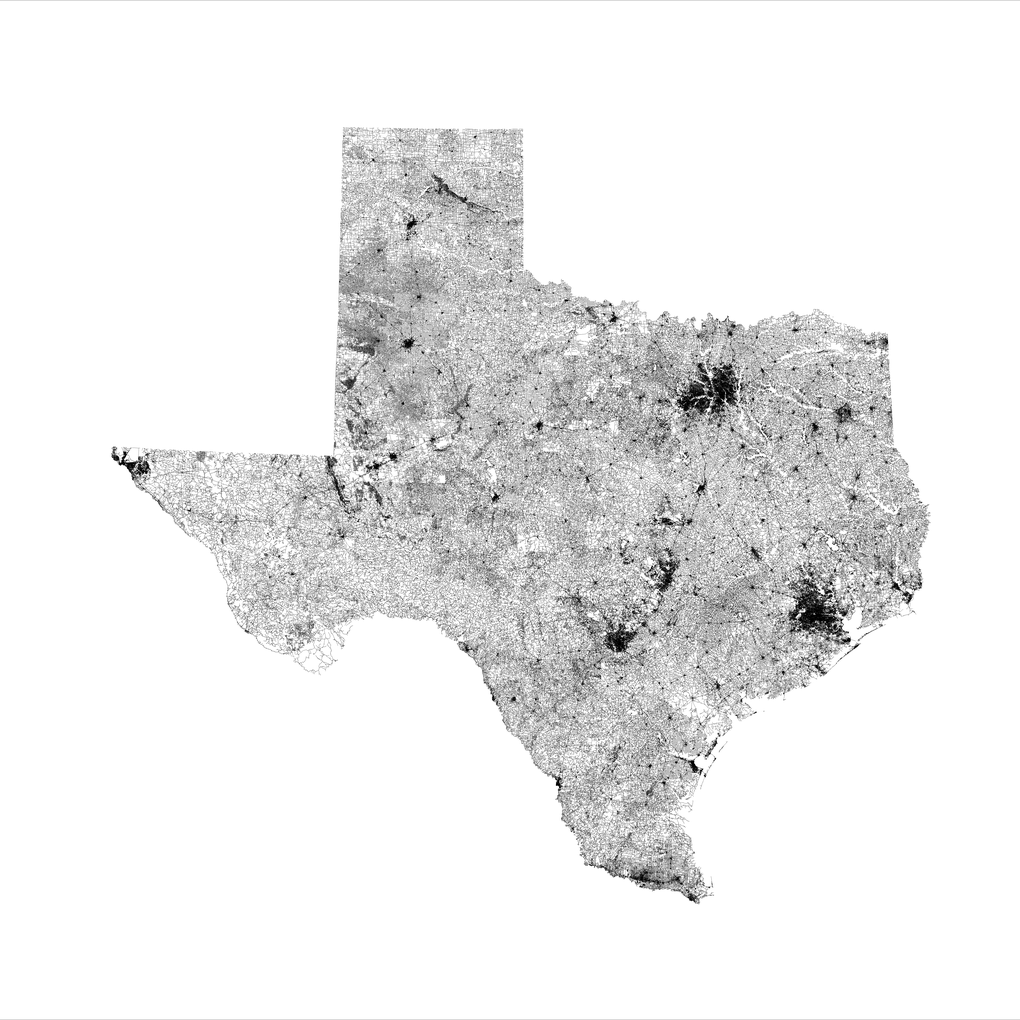
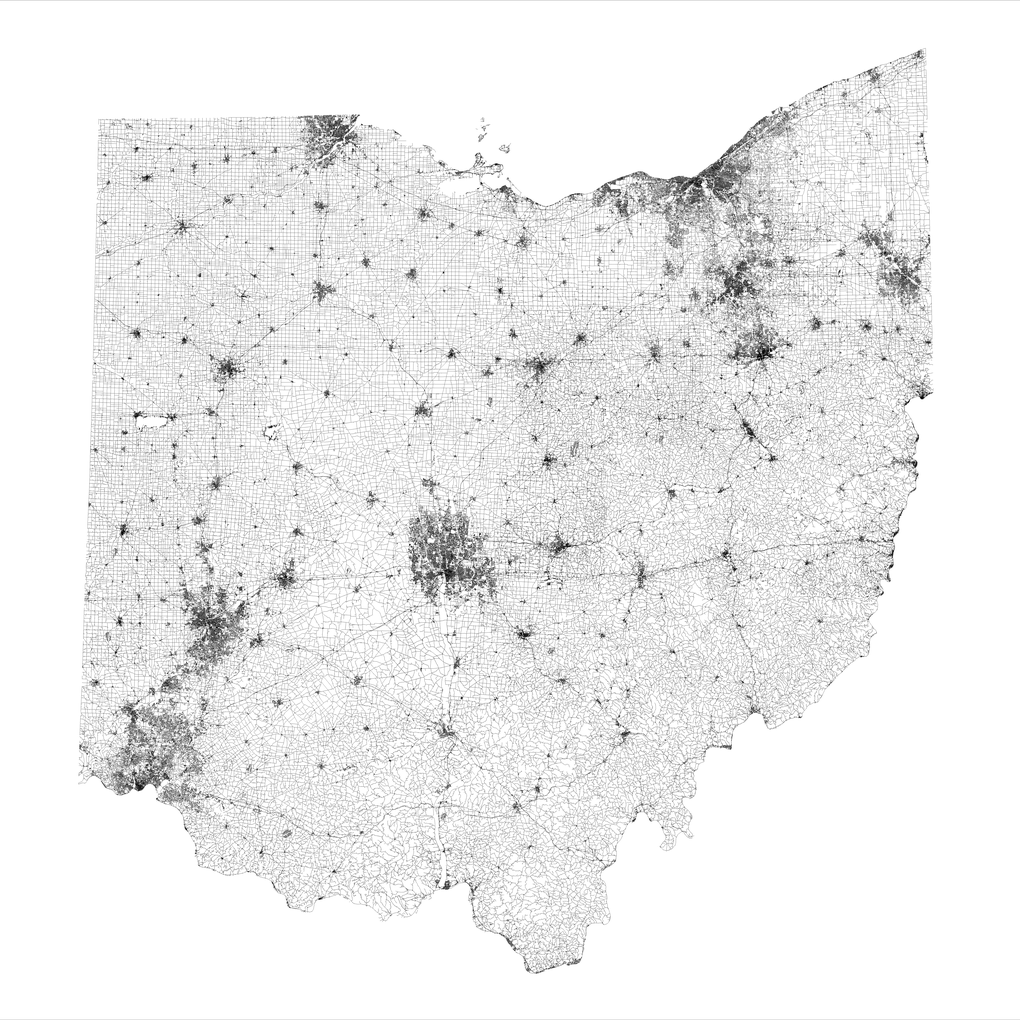
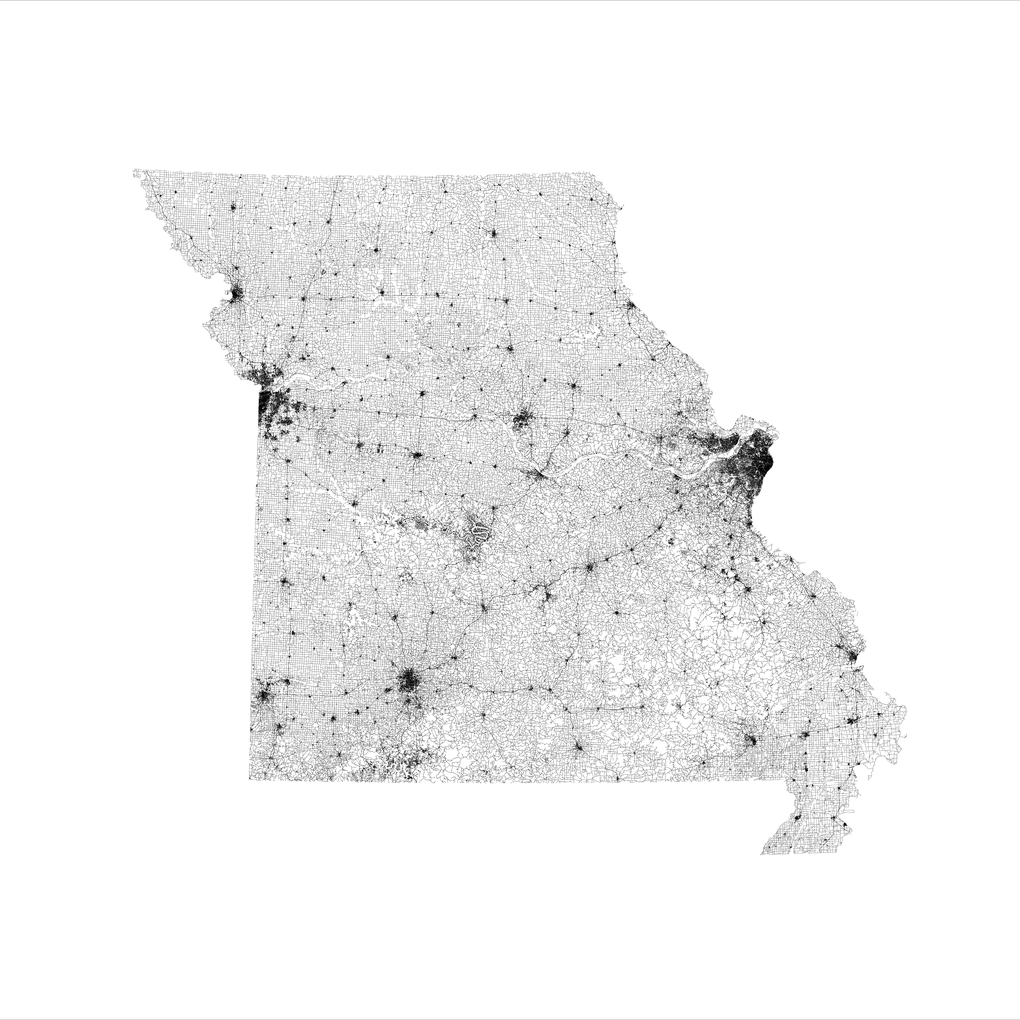
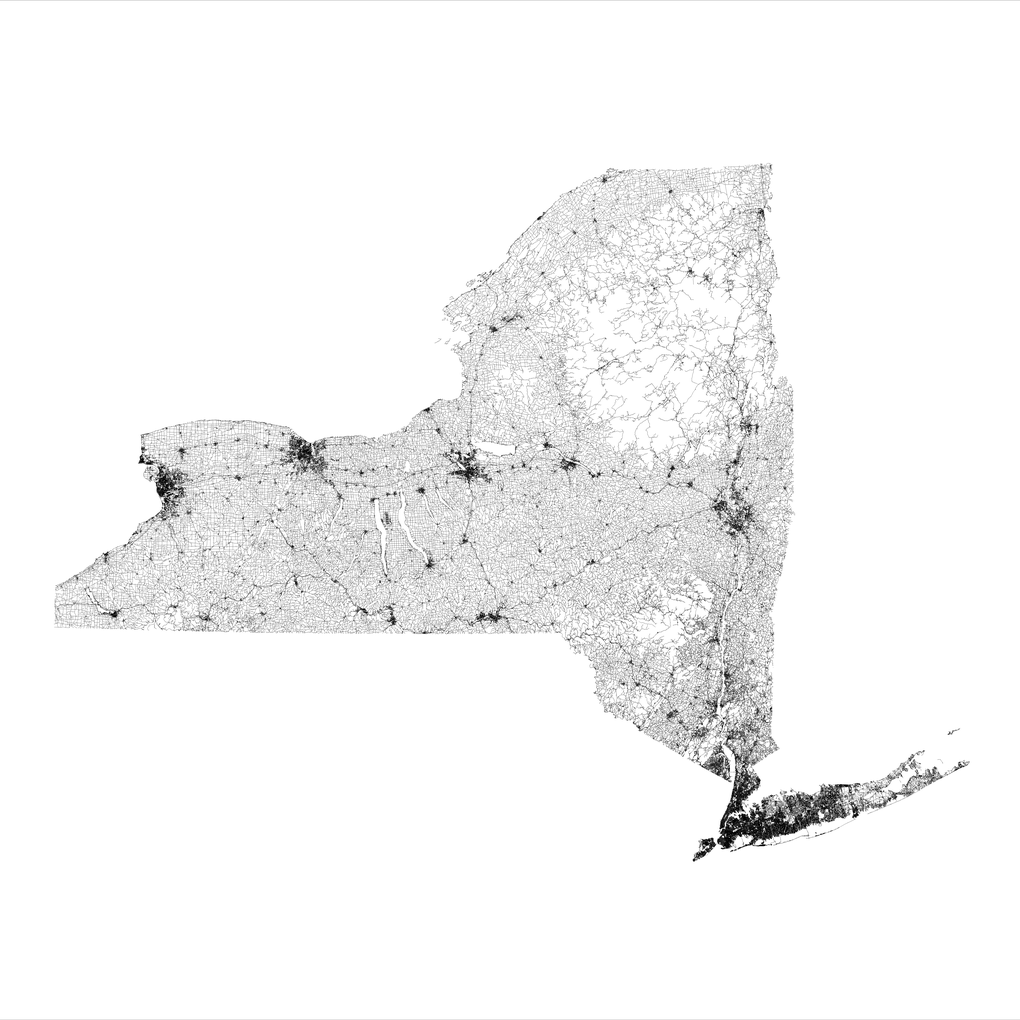
This map, featuring every road in the United States of America, assembled by Reddit user WestCoastBestCoast94, looks like a cartographer’s dream come true. It doesn’t take an expert to glean information from the map, like the location of major cities — dark, tight webs — and mountains — long, thin stretches of white.
Before the adoption of the secret (”Australian”) ballot, ballots would be printed by party members and handed out to voters at the polling places:
By the middle of the nineteenth century the ballot was used in almost
all of the United States. The term “ballot,” however, meant one or
several pieces of paper which contained the names of the candidates and
the designation of the offices, and which were used by the electors in
voting. The ballots could be either written on printed; but were, as a
matter of fact, almost always printed.
In appearance and form the ballots varied in different states and in
different elections. The ticket of each party was separate, and, as a
general rule, could be distinguished, even when folded, from all other
tickets as far as it could be seen. Frequently the party tickets were of
a different color. In a municipal election in Massachusetts the
Republicans used a red ticket and the opposition a black one; and in the
same state state
in 1878 the Republican ticket had a flaming pink border which threw out
branches toward the center of the back, and had a Republican
indorsement in letters half an inch high.[52]
In another election in Massachusetts the Republicans used a colored
ballot, while the Democratic ticket was white with an eagle so heavily
printed as to show through the ballot.[53]
In one election in Orangeburg County, South Carolina, the Republican
ticket was of medium-weight paper, with the back resembling a
playing-card, and, according to statements made, could be recognized
across the street. The Democrats had a tissue-paper ticket of a
pale-blue color. There were two sizes of this tissue-paper ticket, so
that the smaller could be folded in the larger one, and an outsider
could not tell that there was more than one ticket being voted.[54] The Democratic ticket used at the polls in Charleston, South Carolina, had a red checked back and was printed with red ink.[55] Tissue-paper ballots were used quite extensively throughout the South.
One object in making the ballots so easily distinguishable was to
enable the ignorant elector to obtain the ticket he wished to vote; but
it was usually easy to counterfeit the opposition ticket. A facsimile of
the opposing party ticket would be printed, containing, however, all or
sometimes only a few of another party’s nominees. This was so skilfully
done at times as to deceive even the most careful voter. Another reason
for making the tickets distinguishable was to discover how the elector
voted. This was the greater of the two evils, and greatly facilitated
corruption and intimidation.
During the Civil War and Reconstruction period this condition became
intolerable, and led to the enactment in fifteen states of laws
prescribing the color of the paper and the kind of ink to be used in the
printing of the ballot. Maine[56]
was the pioneer state in this movement, the law in this state having
been passed as early as 1831. Maine was followed, in 1867, by
Connecticut,[57] Indiana,[58] and Virginia;[59] by Ohio[60] and West Virginia[61] in 1868; by Kentucky[62] and Illinois[63] in 1872; by Missouri[64] and Florida[65] in 1877; by Massachusetts[66] and Texas[67] in 1879; by New York[68] in 1880; and by Delaware[69] and Alabama[70]
in 1881. The provisions of the New York law are typical. It provided
that “each and all ballots used at any such election shall be upon plain
white printing paper, and without any impression, device, mark, or
other peculiarity whatsoever upon or about them to distinguish one
ballot from another in appearance, except the names of the several
candidates, and they shall be printed with plain black ink.”[71]
This law also failed to accomplish its purpose, because the several
parties used different shades of white. In Ohio, for example, the
Republicans used a very white paper, while the Democrats adopted a cream
color. So it was still possible to tell what ticket an elector voted.
California[72] and Oregon[73]
tried to secure a uniform weight and color of paper by requiring the
ballots to be printed on paper furnished by the secretary of state.
There was great variety in the number of tickets used in the
different states. Twelve states required the names of all candidates
voted for at an election to be written or printed on a single ticket.[74] Massachusetts allowed the elector to vote for the several candidates on a single ballot or on separate tickets.[75]
The elector in New York in 1882, or Florida in 1889, had to vote for
the candidates of his choice on eight tickets, while a voter in Nebraska
in 1887 was compelled to use nine.
The states which required separate ballots for different offices had
as many combinations as the particular legislature thought desirable,
and it is almost impossible to discover any common principle guiding
their actions. Six states required officers voted for by all the
electors of the commonwealth
to be elected on a separate ticket. Five states required separate
ballots for presidential electors. Seven states placed candidates for
Congress on a distinct ticket. Other offices placed on a separate ballot
were: judicial, in four states; justice of the peace, in three states;
county officers, in four states; and city or town officers, in three
states.[76]Constitutional amendments were sometimes printed separately.
The size of the ballot was regulated in only five states: Massachusetts,[77] Delaware,[78] Indiana,[79] Alabama,[80] and California.[81]
Since the law made no provision for the printing or distribution of
the ballots, the party organizations, prior to the day of election, saw
that the tickets were printed. Usually a select committee on printing
took charge of the entire matter of getting up the ballot, seeing that
it conformed to the law, and that the tickets were properly folded,
bunched, and distributed throughout the organization. In New York City[82]
the tickets for Tammany Hall and the county democracy were distributed
under the supervision of a committee of the organization. The assembly
district bag was delivered to the assembly district leaders, and by them
to the election district leaders. In the Republican party, the tickets
were delivered to the district leaders. Thus the district leaders had
control of a vital part of the election machinery. They could destroy or
fail to distribute the tickets, and then there would have virtually
been no election.
The tickets were given to the voter in advance of the election, or
they could be obtained near the polling-place on the day of election.
Each party customarily had a ticket booth for each polling-place and
attached to it a number of ticket peddlers.
As the elector approached the polling-place, he was met by these
ticket peddlers, who were only too anxious to supply him with their
party tickets, and a close watch was kept to see what party ticket he selected.
The tickets were usually folded, and, from the voter’s habit of
carrying them in the vest pocket, become known as “vest-pocket tickets.”
The provisions of the California law of 1850 are typical of the
procedure inside the polling-place: “Whenever any person offers to vote,
the inspector shall pronounce his name in an audible voice, and if
there be no objection to the qualification of such person as an elector,
he shall receive this ballot, and in the presence of the other judges
put the same, without being opened or examined, into the ballot box.”[83]
Seven states required the ballot to be numbered, and the same number
recorded on the list of voters opposite the voter’s name. This worked
against the secrecy of the ballot[84] by making it possible to identify the ballot cast by any elector.
Even more open to abuse was the provision in three states permitting
the voter to write his name on the back of the ballot. The Pennsylvania
constitution of 1873 provided that “any elector may write his name upon
his ticket, or cause the same to be written thereon and attested by a
citizen of the district.”[85] What an opportunity for fraud this presented! The signature of the elector was required by the Rhode Island[86] laws of 1822 and 1844. The signature of the elector was permissible in Indiana[87] from 1867 to 1881.
As long as universal suffrage exists there will probably be more or
less bribery of voters. It is hard, however, to imagine a system more
open to corruption than the one just described. The ballots were not
only distinguishable, but the briber was permitted to have full view of
the voter’s ticket from the time it was given to him until it was
dropped in the ballot box. Money, or “soap,” as it was called, with
increasing frequency was used to carry elections after the Civil War.
Moreover, the buying of votes was not confined by any means to the city,
but was freely used in the country as well. One writer described the
conditions as follows:
This sounds like exaggeration, but it is truth; and these are facts
so notorious that no one acquainted with the conduct of recent elections
now attempts a denial–that the raising of colossal sums for the
purpose of bribery has been rewarded by promotion to the highest offices
in the government; that systematic organization for the purchase of
votes, individually and in blocks, at the polls has become a recognized
factor in the machinery of parties; that the number of voters who demand
money compensation for their ballots has grown greater with each
recurring election; … . men of standing in the community have openly
sold their votes at prices ranging from fifteen to thirty dollars; and
that for securing the more disreputable elements–the “floaters,” as
they are termed–new two dollar bills have been scattered abroad with a
prodigality that would seem incredible but for the magnitude of the
object to be obtained.[89]
It was charged that the bribery of voters in Indiana in 1880 and 1888
was sufficient to determine the result of the election. In 1888 it was
commonly reported that one item in the Republican expense account was
one hundred thousand dollars paid to W. W. Dudley toward the expense of
carrying Indiana by “blocks of five.”[90]
The use of money has indeed become a serious menace to American
institutions, and was filling thoughtful citizens with disgust and
anxiety. Many electors, aware that the corrupt element was large enough
to be able to turn the election, held aloof altogether.
Intimidation was just as rife as bribery, and was largely traceable to the same cause–the non-secret ballot. According to a report of a committee of the Forty-sixth Congress,[94]
men were frequently marched or carried to the polls in their employers’
carriages. They were then supplied with ballots, and frequently
compelled to hold their hands up with their ballots in them so they
could easily be watched until the ballots were dropped into the box.
Many labor men were afraid to vote and remained away from the polls.
Others who voted against their employers’ wishes frequently lost their
jobs. If the employee lived in a factory town, he probably lived in a
tenement owned by the company, and possibly his wife and children worked
in the mill. If he voted against the wishes of the mill-owners, he and
his family were thrown out of the mill, out of the tenement, and out
of the means of earning a livelihood. Frequently the owner and the
manager of the mill stood at the entrance of the polling-place and
closely observed the employees while they voted.[95]
In this condition, it cannot be said that the workingmen exercised any
real choice. The need of a secret ballot to protect debtors and the
laboring class was especially urgent.
A third consequence of the non-secret ballot was the opportunity it
gave for fraud, particularly the stuffing of the ballot box. By this the
writer does not mean to imply that it was responsible for such frauds
as the false-bottom ballot box, but the failure to provide an official
ballot gave a great opportunity for an elector to deposit more than one
ballot. This was particularly true of the thin or tissue-paper ticket,
where one or two smaller ballots could be folded inside a larger one
without an outsider being able to tell that there was more than one
ticket being deposited.[96]
Yet the inside ballot could be so folded that it would fall out if the
outer ballot was shaken a little when it was being voted, or if a
friendly judge would materially assist by shaking the box, before it was
opened to count the votes.
This evil was recognized, and it was commonly provided that ballots
found folded or rolled together should not be counted. Since skilful
manipulation could separate these double votes, it was generally
required by statute that, “If after having opened or canvassed the
ballots, it shall be found that the whole number of them exceeds the
whole number of them
entered on the poll lists, the inspector shall return all the ballots
into the box, and shall thoroughly mingle the same; and one of the
inspectors, to be designated by the board, shall publicly draw out of
such box, without seeing the ballots contained therein, so many of such
ballots as shall be equal to the excess, which shall be forthwith
destroyed.”[97]
In drawing out the excess number, there was opportunity for corruption
and narrow partisanship, and many charges were made of gross
discrimination against certain parties.
Throughout the 1870s and 1880s, in response to the Long Depression, working people began to organize in order to protect their interests from the rich. In rural areas, this primarily took the form of the Farmer’s Alliance, while in urban areas, industrial unions united under the banner of the Knights of Labor.
Just as the Greenback Party folded, a new wave of agrarian unrest swept through the West and the South fueled by a new economic downturn in the late 1880s, falling prices, low rainfall, and a more conservative Supreme Court that made it nearly impossible for states to regulate interstate rail rates. In the South, the effects of the crop lien system resulted in even more hard times as farmers lost their homesteads to foreclosures, threatening a whole generation with the reduced status of landless peasants.
Southerners got an added dose of personal humiliation. When the Civil War ended Dixie’s capital base was destroyed. Banks were so rare that small farmers turned to local merchants to carry them over until the cotton crop was harvested. These merchants came to be known as the ‘‘furnishing man’’ or ‘‘the man’’ to the local African American community. In the ‘‘crop lien’’ system the furnishing man advanced the local farmer food and equipment during the growing season in exchange for a lien against his crop. Every week or two the farmer would arrive at the general store with a list of needs. The furnishing man pulled from his shelves all or some of what the farmer wanted, based on an assessment of what he already was owed and what he thought the crop would eventually bring for the year. He entered each item in the account book. For a can of beans that might cost 10 cents for a cash customer, the farmer was charged 14 cents plus interest, so by the end of the season the cost of the beans amounted to 19 or 20 cents or double that to a cash customer. The farmer could not grow his own food or trade with another merchant. He was locked in to his crop lien with the one merchant who governed his economic life in a state of near bondage. The arrangement was repeated in millions of similar transactions throughout the South. It is safe to say that more than three-quarters of all farmers, white and black, were locked-in to the crop lien system. When the cotton was picked, the farmer and merchant would meet at the local gin and settle the account for the year. With the decline in commodity prices, the crop did not always ‘‘pay out,’’ so the farmer’s debt might be carried over to the next season. Eventually the farmer might have to turn over the deed to the farm to make a final settlement. He could become a sharecropper or tenant or pack up and move west to Texas for a new start.
Each year more than 100,000 southern farmers moved across the Mississippi to the Lone Star State. When the southern farmer moved west, he faced a set of problems similar to those of the wheat and corn farmers of the Great Plains. He needed a social outlet, knowledge of scientific farming, and a way to confront the capitalists who controlled the railroads and supply houses. Reduced prices for his crops and lower rainfall compounded his problems. In 1883, A. O. Davis, a former Mississippian raised under the crop lien system organized a farmers’ alliance in Texas. Davis, a great speaker whom the farmers could relate to because of his background, attracted large crowds with his denunciations of the railroads, credit merchants, and the ‘‘money power.’’ Other speakers joined Davis with a message of self-help and self- respect, instilling in the farmers the idea of uniting and transforming the dynamics of their relationships with the powers that kept them in a state of near peonage. The Alliance organized cooperatives for buying supplies and equipment and selling cotton in bulk without middlemen.
Eventually, the Southern Farmers’ Alliance had three million members. When opposition arose from merchants and bankers, the Alliance concluded that political activity was the only way out. A similar movement known as the Northern Alliance was founded in Kansas with a membership of more than two million. Delegates from the Northern and Southern Alliances met in 1889 to agree on a common program. Foremost was the solution proposed by the Greenbackers, an expansion of the money supply. Only now they demanded free coinage of silver as the solution, along with a graduated income tax and government ownership of railroads. Local parties put Alliance candidates on the ballot in 1890. Speakers included ‘‘Pitchfork’’ Ben Tillman of South Carolina, ‘‘Sockless’’ Jerry Simpson of Kansas, James Weaver of Iowa, and the inimitable ‘‘Queen Mary’’ Elizabeth Lease of Kansas, whose famous line, ‘‘you farmers have got to stop raising corn and start raising hell,’’14became a rallying cry. With so much enthusiasm 53 congressmen were sent to Washington.
Encouraged by their success, the Alliances met in Cincinnati in May 1891, to form an independent political party called the People’s Party, commonly known as the Populists. A nominating convention was called for Omaha on July 4, 1892. The 1,400 delegates nominated former Greenbacker James B. Weaver for president and James G. Field an ex-Confederate from Virginia for vice president. The plat- form protested the corruption of the political system, control of the media, and impoverishment of labor by the capitalist class. Specific planks called for unlimited coinage of gold and silver at the ratio of 16 to 1 and expansion of the money supply to $50 per capita, a graduated income tax, a government-run postal savings bank, and government ownership of the railroads and telephone and telegraph systems. The Populists wanted the government to reclaim all corporate land and natural resources in excess of their actual need.
Third Party Matters, by Don J. Green
One of the key planks in the Omaha Platform was the secret ballot. Indeed, it was number 1. It cost tens of thousands of dollars for a party to print and distribute their ballots at election time. If the Populist Party was to have any success, it would have to make sure those costs were borne by the government instead. The call was also taken up by the elitist Mugwumps, who were annoyed at the display of populism brought on by elections and wanted to calm things down, in particular by excluding illiterate voters comprehensively. Party elites quickly caught on that the key to ballots would be who was printing them and deciding who went on them, and thus passed laws that stated Democrats and Republicans would automatically be entitled to places, with third parties having to go through absurd hoops like getting the signatures of double digit percentages of the population. The issue crystallized around a series of fraudulent elections. Between 1876 and 1888, every presidential election was decided by a margin of less than a percent, or in the case of 1876, the winner, Hayes, actually received 200,000 less votes than the loser but cut a deal to cull enough fraudulent ballots that bore his party’s electoral symbol, Abraham Lincoln, but his competitor’s name, Samuel Tilden, to keep himself ahead. Consequently, states began to rewrite election laws or whole constitutions so that by 1892 38 states had the secret ballot. Part of this was to keep white supremacy going in the South. Poor black and white people would often join for Populist or Populist-Republican tickets, threatening the power of Democratic elites who saw traditional vote-buying schemes work less and less, reducing the power of the open ballot. When Mississippi rewrote its constitution in 1890, for instance, it allowed for a secret ballot, a poll tax, and a literacy test. Subsequently, 100,000 black people and 50,000 white people lost access to voting. In this way, American elites dealt with the demands of the working class by co-opting but modifying them for their own usage, a consistent them in American history.
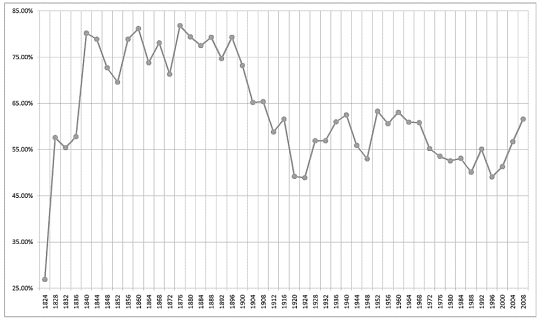
While all 50 states had secret balloting by the 1896 election, there was still the matter of the Populist Party to deal with. Once again, co-optation was the name of the game. In a normal election season, the Democrats and Republicans might nominate two candidates who varied only in a few views limited to divisions among the upper class. In this case though, Democrats decided to nominate William Jennings Bryan as candidate. Bryan supported numerous Populist platforms in rhetoric and was a skilled orator. His Cross of Gold speech was so powerful that delegates enthusiastically lifted him up and carried him out on their backs. His anti-gold standard plank won him the backing of the Populist Party, which felt that it couldn’t nominate another candidate and split the vote. Much of America’s rich rallied around Bryan’s opponent, William McKinley, feeling that Bryan had gone too far in his quest for working class votes and offended them greatly. They poured in money, giving McKinley’s campaign the dubious distinction of being the most expensive in American history, and giving his campaign manager, Mark Hanna, the chance to pull out all sorts of new dirty tricks (famous Hanna quote: “There are two things that are important in politics. The first is money and I can’t remember what the second one is.”) Hanna’s propaganda implied that Bryan was a revolutionary who would destroy the economy. But Bryan himself was still supported by numerous American businessmen, including Randolph Hearst, Thomas Kearns, and Oliver Belmont. When Bryan lost, the Populist Party was demoralized, and its supporters largely exited the political scene, convinced there was nothing that voting offered them. The Populist Party went into a tailspin and contested its last election in 1908. Anti-Third Party restrictions were slowly ramped up, with the worst coming between the 1930s and 1960s as a response to the renewed activism of the Great Depression. American electoral turnout reached a high point in 1896, at 79.3%, with a labour-based third party offering most American voters the feeling of a real political contest with candidates that represented their interests:
How successful was the early 20th century attempt to purge America of Germanism?
Well, successful enough that to this day historians can get away with saying that American federalism must have been inspired by the Iroquois Confederacy, confident that their audience won’t stop to note that the international statesmen and men of letters who defeated the Elector of Hanover to establish a compact of sovereign states loosely led by a supreme executive selected by electors were probably at least aware of the Holy Roman Empire.