shrine to the prophet of americana

#amhist (618 posts)

The Fire Last Time | New Republic

The Fire Last Time | New Republic

This is a good companion piece to that “Days of Rage” post that was going around a few months ago.

Gives context for how things felt “from the other side”, also gives some color to the radical lawyers that got filed as “institutions”. Reminds you they were going to trial, arguing that their clients were revolutionaries more legitimate than a tyrannical standing government, and seeing that affirmed by lawfully constituted juries.

Which is a downright English faith in the ability of the people to use the law to challenge the regime, honestly. That’s where we were in the 70s.

In one direction, consider how the emergence of these radical lawyers connects to the post-war expansion of higher education access. In another direction, consider this as the context for Bill Clinton’s 1994 crime bill and 1996 AEDPA. Remember, the function of Bill Clinton was to relegitimize the Democrats as an executive party by renouncing the ‘70s.

That’s also the context for my take on Mumia Abu-Jamal, which was still a cause even in Naomi Klein-era The Nation. I think he probably did kill officer Daniel Faulkner, I doubt that Ed Rendell and the Philly PD - still substantially organized as a direct tool of violence - acting “properly” could have won a conviction in the formal justice system operating under period constraints.

And that the outcome - leaning on the system to yield conviction, result that he’s neither ‘70s-style freed or directly punished with extrajudicial violence, an optimistic intention of the death penalty in the ‘80s eventually ground down to indefinite imprisonment… well, that’s the story of American crime policy since.

Tagged: amhist

Wage-Slavery and Republican Liberty | Jacobin

Wage-Slavery and Republican Liberty | Jacobin

oligopsonoia:

As early as the late 1820s, urban workers seized on the inherited republicanism of the American Revolution and applied it to the wage-labor relationship. They organized themselves city-by-city into the first self-conscious political parties of labor and their main campaign was against “wage-slavery.”

They argued that the wealthy “keep us in a state of humble dependence” through their monopoly control of the means of production. As Thomas Skidmore, founder of the Workingmen’s Party of New York, put it:

thousands of our people of the present day in deep distress and poverty, dependent for their daily subsistence upon a few among us whom the unnatural operation of our own free and republican institutions, as we are pleased to call them, has thus arbitrarily and barbarously made enormously rich.

Their “humble dependence” meant that they had no choice but to sell their labor to some employer or another. Their only chance of leading a decent life was if some employer would give them a job. Though formally free, these workers were nonetheless economically dependent and thus unfree. That is why they saw themselves as denied their rightful republican liberty, and why wage-labor merited the name slavery. Skidmore made the comparison with classical slavery the most explicit:

For he, in all countries is a slave, who must work more for another than that other must work for him. It does not matter how this state of things is brought about; whether the sword of victory hew down the liberty of the captive, and thus compel him to labor for his conqueror, or whether the sword of want extort our consent, as it were, to a voluntary slavery, through a denial to us of the materials of nature…

The critique of wage-slavery in the name of republican liberty could hardly be clearer.

Given their analysis of wage-labor, these artisan republicans were inexorably led to radical conclusions about the conditions that could restore workers their full independence. Every leading figure of these early workingmen’s parties made some form of the argument that “the principles of equal distribution [of property be] everywhere adopted” or that it was necessary to “equalize property.” Here, the “property” to be equally distributed was clearly means of production. And it was to be distributed not just in the form of land, but cooperative control over factories and other implements.

I mean okay, but it’s downright weird to talk so much about this and only so glancingly (“not just in the form of land”) mention how these tensions were instead addressed through the constant expansion of the frontier

Tagged: amhist manifest destiny homesteading primitive accumulation free soil free labor

TIL that The Clansman, the book Birth of a Nation was adapted from, was the middle volume of a trilogy that began AS A GRITTY...

TIL that The Clansman, the book Birth of a Nation was adapted from, was the middle volume of a trilogy that began AS A GRITTY REBOOT OF UNCLE TOM’S CABIN

Tagged: same as it ever was pulp fiction amhist reconstruction AU

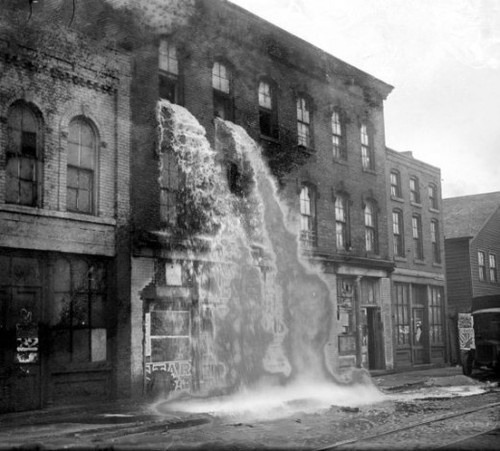
Streams of confiscated liquor pour out of upper windows of three-story storefront in Detroit during Prohibition, 1929 via reddit

historicaltimes:

Streams of confiscated liquor pour out of upper windows of three-story storefront in Detroit during Prohibition, 1929

via reddit

Tagged: amhist

The Killer's Trail

The Killer's Trail

Oh man, you know what I just remembered? That time in the ‘90s when some guy went on an interstate murder spree and disappeared, and then while he was an active news story on the Ten Most Wanted list he emerged to finish it off by killing Gianni fucking Versace and people still don’t know what that was about

That drew me to this September 1997 article, which fascinated me in its own right because there’s something here I want to draw your attention to. Two things, actually.

First, I assume Vanity Fair still commissions some decent longform, but look how fucking lush this is - 12,500 words, people even tangentially related to the subject interviewed across several states, 16 months in development and published a year after the last bodies were cold.

I’m not gonna say this was the norm, but the norm was still a bit off in that direction back then. Newspapers and TV news would deliver their first draft of history the next day, and a spry reader might subscribe to a few weekly magazines, but past that things just developed at a slower pace. Or, rather, things developed on their own and a while later you’d hear a reasonable account of what happened.

I suppose CNN was already disrupting towards a constant news cycle though, MSNBC and Fox News had launched as me-toos in 1996.

(As point One-and-a-Half, notice how in a pre-Internet world how much social power Cunanan acquires just by reading a lot, remembering things, and other people being unable to check or refute his claims)

Second, another “look into a lost world” in this 20-year-old article is just how natively fluent everyone is in a psychiatric idiom. It’s not really Freudian per se, the old man was already musty in 1997, but a thoroughgoing sense that you can explain someone by reference to the development of their psyche, that they pursue this desire this way but encounter this obstacle and that warps them this way in response…

Some of the cops come from the FBI profiling tradition so fair enough. (Should note the idea of the “serial killer” only dates to the 1980s and the concept of “profiling” got a lot of attention in response I suspect as much as anything as a way for the state to reassure the citizenry that in a relatively un-surveilled, pre-computerized, pre-DNA testing world, they had some defense. This was the context for Silence of the Lambs.)

And maybe it was the author who chose that angle for the piece but geez, her interviewees sure gave her a lot of quotes to work with, it’s really striking how people with even limited contact with Cunanan feel confident talking past observed actions to the nature of his character, on to inferred internal motivations and placing their experience in the context of a narrative or character arc.

Now this was all gay culture in the not yet normie mid-90s, where you might expect people to have a more complex sense of the relationship between interiority and social performance than the average bear. But remembering back it’s just like the writing - this was maybe an outlying case, but things in general did used to be noticeably more like that, now that I think of it.

And maybe that could be done poorly, and even done properly it wasn’t ~scientific~, a bit of Freudian speculation plus a bit of residual Christian “spiritual development”, each put through a few washes of folksy popularization before combining and then put through a few more. “Scientism” wasn’t as strong as it is now, I really have the sense it was more accepted that if some social or hard science expert made a claim about human experience and supported it by reference to math or scientific consensus it was much further “in bounds” for a humanities expert - a reverend, an analyst, a Foucauldian critic - to rebut them by reference to their own traditions.

This was what Alan Sokal was peeved about, and are we better for living in his world now? Honestly I think maybe when a guy who’s intense into hard S&M bashes a guy’s face in with a hammer as part of a murder spree we should consider “huh, maybe he’s a sadist, what’s that about?”

(I have seen a bit of a spike in essayistic psychoanalysis lately with people trying to explain the 4chan/alt-right nexus but you can tell they’re just equipping polemic arms, clumsy in their mouths, not the idiom they see their own lives through)

The flip side of all this, of course, is I’m reading through this whole psychological profile of an article, noting all the times Cunanan varied between reclusive or despondent to life-of-the-party, five-figure spending sprees, sudden intense violence and I’m wondering when they’d speculate he was bipolar. (Actually, I was wondering if it would still be “manic-depressive” back then.)

And the answer is… never. And you realize that “having X mental condition” as a way to understand yourself or others was not yet the thing it now is, the big breakthrough of that narrative into mainstream culture was in 1993-4 with Listening to Prozac and Prozac Nation (I once intended to borrow the latter from the library and picked up the former instead, which was not as bad as the time I intended to rent Steel Magnolias and got Magnolia).

Now I’m not suggesting Eli Lilly created “chronic depression” to match Prozac in the same way Listerine created “chronic halitosis”. But I am saying a consequence of bringing their breakthrough blockbuster SSRI to market was the cultivation of a narrative with a constituency by which you took the drug and were your self, whereas before you had been under the influence of something that was in hindsight distinct from your self. And this narrative matching experience, and being socially validated, in a way Valium or Halcion weren’t.

And that this was not always a typical way to think of the self, even when sympathetically thinking of imperfect or damaged selves. And that reading this 20-year old article, by a writer who debuted in the ‘70s, and then looking up to this blue website, it’s really striking how much older ways of discussing the self have faded away and the Prozac experience seems to have been generalized to bear that weight.
Tagged: amhist history it's media

me: haha remember in the '80s when there was a radfem/Christian conservative coalition against porn? me: and remember how it was...

me: haha remember in the '80s when there was a radfem/Christian conservative coalition against porn?
me: and remember how it was pushed back by like, BDSM lesbians? haha they never really figured into anything else what was that?
also me: they were kind of representing the then-current "queer kink sex fun" tendency in America, on account of they were the ones not busy dying of AIDS

Tagged: history amhist

California and the End of White America

California and the End of White America

This is Ron Unz reposting a thorough 1999 article of his about the development of racial politics in 1990s California, framed around 3 high-profile, racially relevant ballot initiative campaigns.

It’s fascinating because it very clearly foreshadows and leads into where we are now, right down to its terminal predictions (the attempt to put racial issues in politics to rest and realign around a cross-racial citizenship faces difficulties and cannot be assumed, there is a real risk the system will continue on current logic with whites developing a conscious political identity in response), and yet as Unz depicts them - and he was in the weeds here - the actual motivations of the players involved are near-completely incomprehensible from a modern standpoint, a measure of how fast things change.

That is one critique I have, on how fast things change, Unz puts the 1992 “Rodney King” riots as the moment that put Californian whites on notice that their comfortable paradise was threatened by racial unrest.

Now, I really do want to emphasize the scale of this shift - as I’ve mentioned before, California during most of the 20th century was a white middle class bastion of conservative Republicanism. For all its Summer of Love, hippie, surfer girl, Black Panther mystique, it was a reliable Republican presidential vote from the end of the FDR-Truman New Deal Dynasty all the way up through Bush the Elder in ‘88 (excepting the Goldwater/Johnson landslide).

Like, if you’ve got a modern sense of what “California” and “Los Angeles” mean, that’s a bit jarring, and the shift was jarring as hell to live through. This explains Steve Sailer. If you’ve ever wondered what explains Steve Sailer, this explains Steve Sailer.

But, for all that I find Unz’s depiction of the ’92 riots as an end to innocence a bit wishful. For one, the Watts Riots of 1965, Hunter’s Point ’66. But closer at hand than that, I can off the top of my head think of several prominent artistic depictions of a racially tense California that were produced just prior to this, indicating that the tensions were on thinking people’s minds.

There’s White Men Can’t Jump, which basically shared Unz’s “no illusions, but this might just work out” tack, released almost exactly a month before the riots. Falling Down, an elegy for white middle class LA, was released almost a year afterwards on an accelerated production schedule but still written prior.

Closest to my heart, Neal Stephenson’s Snow Crash is a fantastic projection of period SoCal, gated communities and franchised everything, and its looming specter of the “The Raft” threatening to arrive and swamp the locals is drawn partly from the Mexican immigrant wave that usually gets dated contemporary to the ’84 Summer Olympics, and partly from the Asian “boat people” refugee wave all the way back in the 1970s.

So, maybe up to that point it registered as “nothing LAPD nightsticks can’t solve”, but the idea that racial tensions weren’t noticed as a threat strikes me as a bit of a stretch.

(corrected from previous)

Tagged: amhist history california race

This is flatly, literally, directly untrue. Tax-funded public libraries and fire companies didn’t catch on until the late 19th...

This is flatly, literally, directly untrue. Tax-funded public libraries and fire companies didn’t catch on until the late 19th century, but society had supported literacy and fire suppression long before that, through indirect subsidy.

Periodical mailing rates at or below cost propped up circulation and made a subscription model viable, and requirements to publish legal notices and records of proceedings ensured that newspapermen and printing houses were kept afloat with a regular supply of business.

Fire companies - well you do sometimes see appropriations for capital outlays like fire engines but for operating expenses many did operate as fire insurance (by government charter), fund themselves through salvage rights, or by lotteries and tontines (by special government approval, compare how many current US states restrict “games of chance” like Bingo to charitable fundraising).

This is dumb

Tagged: history amhist

The Wayne Republican Tradition

The Wayne Republican Tradition

When you talk about “Rockefeller Republicans”, I don’t know how many people today even have an idea of who the Rockefeller family were, I’m not sure how much information that name carries.

So, uh, think of the Wayne family. Bruce and his late parents. “Wayne Republicans”. Basically the same thing - urban-based dreams of social uplift through monumental programs overseen by men born into more money than God. Vague social liberalism that disdains bourgeois morality from an aristocratic direction, anti-corruption, pro-Establishment to the extent the Police Commissioner always takes their calls.

That was a big part of the Republicans during the post-War period - the conservatives were just one faction, and often a losing one. Wasn’t just titanic heirs but small businessmen (maybe equivalent city fathers to their small towns, though) and professionals - the Republicans were the party of the postgraduate educated.

The Republicans were opposed to national health care all along, Ronald Reagan dropped a spoken word album about it in 1961. Part of that was green eyeshade deficit hawkery (that was a big part of their brand, the later pivot away from this to tax cutting was understood through the framework of “Two Santa Claus Theory”, which is an actual and very important thing in postwar American politics, “Two Santa Claus Theory”). And part of it was “grr, socialism boo”. But really, a lot of it wasn’t in resistance to what this would mean for taxpayers, or patients, or even the country, so much as doctors, who were a big Republican constituency.

Because doctors were professionals – by guild understandings that predated the United States, they owned their own practices, regulated and judged each other, were granted a degree of authority over those who came to them needing something important they were not qualified to provide themselves. They resisted the thought of themselves as merchants, and loathed the thought of themselves as employees or civil servants.

A lot of the “disappointingly moderate” Republican-appointed Supreme Court justices over the years actually fit fine with the Wayne Republican tradition. Sandra Day O’Connor, first woman on the court, put there as a payoff from Reagan to the moderate faction - the Republicans arguably the feminist party, albeit a “Lean In” type. After all, if you saw a woman in an executive role before the ‘70s, it was probably in the Daughters of the American Revolution or some society gala-type charity NGO. And those “first woman to go to X school”, well, the families that would think to send a daughter off to law or medical school were a subset of the families that would think to send a child at all.

Hell, for a while, the Republicans were even the more abortion-friendly party. The Democrats were the Catholic party after all. The Republicans were the Protestant-as-humanistic-heritage-charity ones, the ones who eugenically spaced their three children two years apart unlike those grubby Papists, the ones with mistresses, the ones with bourgeois life courses to even be diverted from. Not to mention the doctors who cleaned up after amateur abortions or offered black-market ones themselves.

(But not like legalization was priority one, c’mon, Bruce Wayne’s dad was a surgeon, you think he doesn’t know a guy?)

Anyway this was what Goldwater (with his base of ideologues and country & western extractive industry - for most of the 20th century the white military middle-class paradise of California was an anchor of conservative Republicanism) was fighting against, what Reagan (California Über Alles) eventually defeated. The Wayne Republican tradition still stumbled along until let’s say Dole/Kemp ’96, that was the last hurrah and the ticket’s total failure to generate any enthusiasm whatsoever (two years after Newt Gingrich’s Congressional “Republican Revolution” breakthrough with conservative southern and suburban whites) heralded its end.

Well, you could maybe see the administrations of the two Bushes as an intermediate form, an attempt to graft the old money social uplift tradition to the religious base the Republicans cultivated in the 1980s in search of a sort of Christian Democracy. “Thousand Points of Light”, “Compassionate Conservatism”, New World Order and nation-building abroad, the ADA, NCLB, environmental laws and Medicare Part D at home.

But the bipartisan abandonment of Bush the Younger and the coalitional realignments through Obama and Trump seem to have rendered even this a dead end. As things stand in 2017, “progressive social programs paid for by taxation, sensitive to the economic interests of professionals and capital-holders” is thoroughly Democratic territory.

Tagged: amhist history rockefeller republicans batman kontextmaschine classic

“Hello! Ma Baby” is a Tin Pan Alley song written in 1899 by the songwriting team of Joseph E. Howard and Ida Emerson, known as...

“Hello! Ma Baby” is a Tin Pan Alley song written in 1899 by the songwriting team of Joseph E. Howard and Ida Emerson, known as “Howard and Emerson”.[1] Its subject is a man who has a girlfriend he knows only through the telephone. At the time, telephones were relatively novel, present in fewer than 10% of U.S. households, and this was the first well-known song to refer to the device.[2] Additionally, the word “Hello” itself was primarily associated with telephone use — “Hello Girl” was slang for a telephone operator even through the first world war — though it later became a general greeting for all situations.

Tagged: same as it ever was amhist

St. Louis Post-Dispatch, Missouri, February 2, 1896

itwashotwestayedinthewater:

yesterdaysprint:

St. Louis Post-Dispatch, Missouri, February 2, 1896

they were on some next level shit in 1896

Tagged: amhist

Have you read the David Hines piece (about Days of Rage) on Status 451? It seems similar to some of your topics of interest....

utilitymonstermash asked: Have you read the David Hines piece (about Days of Rage) on Status 451? It seems similar to some of your topics of interest. What do you think about it?

Apparently enough people are going to keep asking me about this, so I may as well answer.

I saw it back when it was tweets, it’s nice to see someone bringing up the forgotten lessons of history and I think it’s basically on target, but I do have some reservations:

For one, the Weatherman or PR independence types were kind of prisoners of the Cold War and it’s normal to release prisoners after you win, their patron collapses, and their cause is obsoleted, I think that context is underaccounted for.

More than that, though I think there are points where his comparisons of the power of left-insurrection and right-insurrection (finding the first stronger) are improperly treated as suggestive of the efficacy of left-insurrection against right-government, like under Trump

Thinking that point through further - that the right holds state security forces, I almost wonder if you shouldn’t go through there and count those state security forces as “institutions”, and strong ones, available to right-insurrection. Because looking back, attempts to overthrow the government from the right tend to come from there.

Paradigmatic example is the Spanish Civil War - the Republicans were the government, but the Nationalists were the army and state security forces that overthrew said government.

Like, around and after the Days of Rage period, Frank Rizzo, Ed Rendell, and Rudy Giuliani did oversee the use of unsanctioned violence to defeat their enemies and move the political situation in a congenial direction, directly in the face of officially legitimated government policy. They just used police forces. They weren’t even punished with light sentences, and more than “assistant professor”, they became mayors, governor, plausible candidate for President.

How’s that for institutional support?

Tagged: amhist

'President Reagan'

'President Reagan'

At the appointed hour, Deaver knocked on the door. Reagan grunted and Deaver heard him roll over, so he knocked again, saying: “It’s eight o'clock. You’re going to be inaugurated as President in a few hours.”

“Do I have to?” Reagan called back. Then he laughed.

Trying to make his beaten and bitter predecessor feel more comfortable, he rolled out old Hollywood stories, a couple of them about his days at Warner Brothers studios under Jack Warner.

“He kept talking about Jack Warner,” Carter said later to his communications director, Gerald Rafshoon. “Who’s Jack Warner?”

Led by former Secretary of State Henry Kissinger, the party’s elders came within minutes of persuading Reagan to take Ford as his running mate, not so much as Vice President but as a kind of co-president in charge of foreign affairs and budgetary matters. A joke, which took notice of Reagan’s supposed laziness, made the rounds on the floor of the Republican convention: “Ford will be president before nine, after five, and on weekends.”

In the weeks before his inaugural, with staff and press concentrating on who would man the new government, the President-elect spent his own time outlining the inaugural address. To him, the words were more important than the men who served him, aides he usually just called “the fellas,” often because he could not remember all their names. He was helped this time by a fellow named Ken Khachigian, a Los Angeles lawyer who had written for President Nixon and done a good deal of the heavy word-lifting on the 1980 campaign speeches. As he always did, Reagan began by chatting for twenty minutes or so about his ideas and gave Khachigian a six-inch pile of the four-by-six index cards he had used and edited for speeches over the years. In his transition meetings with Carter, Reagan had not taken a note nor made a serious comment during the President’s long and complicated issue briefings, but at the end of the first and most important session - use of nuclear weapons was one topic - he noticed that Carter used three-by-five cards listing the subjects of the hour-long talk. “Can I get copies of those?” Reagan asked as he stood up to leave.

With his writer taking notes, Reagan began dictating themes:

He also told Khachigian to find the script of a World War II movie. “It was about Bataan,” he said. An actor named Frank McHugh, Reagan remembered, said something like: “We’re Americans. What’s happening to us?” The writer found the line, which was somewhat different from what Reagan recalled, and used it as a finale in the first draft of the speech he brought to the President-elect on January 4: “We have great deeds to do…. But do them we will. We are after all Americans.”

They were watching television. Steve Bell of ABC News was talking about the crisis, about Carter and his men working on the details of transferring money to the Iranians. The image of an Iranian mob appeared; the President-elect pursed his lips and muttered: “Shitheels!”

Tagged: inauguration amhist ronald reagan same as it ever was

You know what this “Women’s March on Washington” suddenly reminded me of? Louis Farrakhan’s “Million Man March” of 1995. Which...

You know what this “Women’s March on Washington” suddenly reminded me of? Louis Farrakhan’s “Million Man March” of 1995.

Which came in the wake of the “angry white men” election of 1994 that broke the decades-long Democratic lock on Congress

Around the time of those Promise Keepers rallies

Golden age of maleness as a base for mass action I guess

Tagged: amhist 90s90s90s

THE👏DEPARTMENT👏OF👏ENERGY👏AS👏A👏CABINET👏POSITION👏IS👏A👏WORKAROUND👏FOR👏POSTWAR👏INTERSERVICE👏RIVALRY👏OVER👏NUCLEAR👏WEAPONS

THE👏DEPARTMENT👏OF👏ENERGY👏AS👏A👏CABINET👏POSITION👏IS👏A👏WORKAROUND👏FOR👏POSTWAR👏INTERSERVICE👏RIVALRY👏OVER👏NUCLEAR👏WEAPONS

Tagged: rick perry amhist

Unpopular opinion: Pawn Stars is actually a really good popular history show; the bits explaining and contextualizing the...

Unpopular opinion: Pawn Stars is actually a really good popular history show; the bits explaining and contextualizing the artifacts “customers” “bring in” do a good job of exploring history through material culture in a non-academic register; the other stuff is a human interest/conflict hook but it works; if you (correctly) compare it to PBS kids shows it’s got as much or more history per minute as 3-2-1 Contact had science, Where in the World is Carmen Sandiego had geography, or Sesame Street had shapes/colors/numbers/letters

Tagged: pawn stars history amhist

so I don’t really like how the Final Fantasy series got really J-poppy from X (okay 8) on, because whatever J pop culture was...

so I don’t really like how the Final Fantasy series got really J-poppy from X (okay 8) on, because whatever J pop culture was right then didn’t interest me as much as the postwar themes I’d gotten used to seeing

(this weird sunny day/elegaic loss thing that in retrospect was some transparent working-through-the-postwar shit - the Ghost Train in FFVI, Porco Rosso-era anime when it made sense for Patlabor to make a whole series about police mecha and have episodes be about the maintenance crew dealing with the summer heat and subtle longing between colleagues on the drive to an offsite conference)

and I think they’ve found a good balance with FFXV, that’s what got me going on Japanese hairstyles the other day, you notice it but it registers as a variant of something you grok.

which gets you the relief to notice the things that are like-you-could-have-been but aren’t, like the way the music titles and styles invoke this concept of Frenchness as high-status romantic

and I could point out how between Perry’s Opening of Japan and WWII the islands’ most important external contacts were German and how Europe in the Japanese imaginary is still kinda tinted by this third-hand take by way of Victorian Prussia

but I could also point out that the English word “deluxe” comes from the French de luxe and a lot of that was Industrial Age London merchants on a superlative treadmill grasping for a fancy way to say “fancy”

Which also casts light on something else - Atomic Age marketing conventions, where spaceships and atoms and associated adjectives came into style for a while? What Fallout riffs on? That was a real expression of (Made in) American pride. America had until the First World War lived in Australia-style cultural shadow of other continents, to the point where “French” or “English” or “Continental”, basically “not American” was a common idiom for “quality”.

In a very real sense, “We fucking nuked Hiroshima” surpassed “We’ve got some nice paintings in Paris” as the symbol of earthly power that brands wanted to associate themselves with because people who matter wanted to associate their personalities with, that was the 1950s.

Eventually France matched Trinity with Reggane and Bikini with the bikini

Tagged: history amhist

So Quakers consider themselves prohibited from doing evil (like going to war) but not compelled to prevent others from doing...

So Quakers consider themselves prohibited from doing evil (like going to war) but not compelled to prevent others from doing evil (as pacifists, how would they?) and the legislative result, in colonial Pennsylvania, was a long tradition of pragmatically backing nonbelievers’ violent initiatives ON THE CONDITION that they were worded so they could have been nonviolent if they wanted and their failure to so be was no knock on the Quakers.

Like during the Revolution, Benjamin Franklin got them to make appropriations for “fire engines”, and “corn” (which at the time just meant “fine discrete grains”, cf. “peppercorn”) and used it to buy cannons and gunpowder, which everyone understood would be the result

Tagged: pennsylvania amhist history

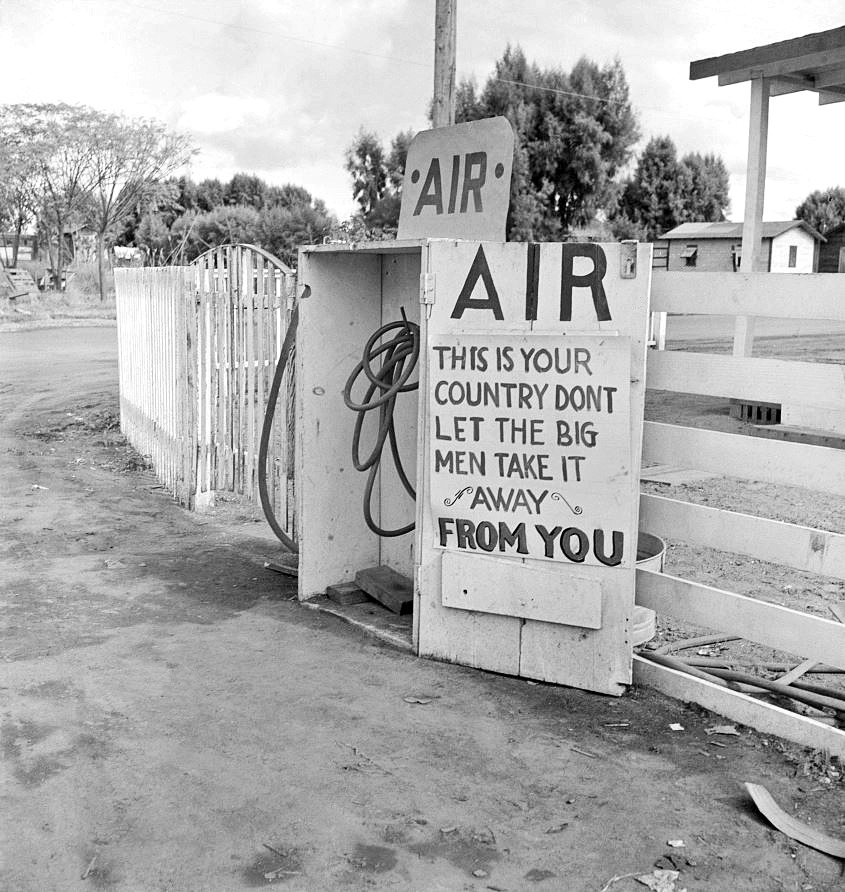
Air Kern County, California, November 1938

back-then:

Air
Kern County, California, November 1938

Tagged: history amhist

Proposed: the best model for Trump’s cabinet is the Gilded Age, when Presidents with no previous national political profile had...

Proposed: the best model for Trump’s cabinet is the Gilded Age, when Presidents with no previous national political profile had to balance between securing their position by distributing portfolios to allied factions and maintaining chain-of-command loyalty

as compared to more recent models where national party elites “audition” to head professional apparatuses whose goals and personnel are broader than and prior to any given administration

Tagged: amhist gilded age potus donald trump