shrine to the prophet of americana

#amhist (618 posts)

The Korean War is weird because on one hand it was one of those wars not even like Iraq II so much as Afghanistan where it's not...

The Korean War is weird because on one hand it was one of those wars not even like Iraq II so much as Afghanistan where it’s not only an unsatisfying result but it doesn’t matter that much cause it turns out to have been pretty peripheral to the American narrative and interests anyway, but on the other it’s like our last great war of large-scale maneuver – more than WWII where we pretend the Battle of the Bulge was even in the same ballpark as any continental army’s land warfare experience, shading more into what people expected of World War III in those pre-ICBM days

And on the third hand we kind of had the WWII mindset (and the broad draftee military fighting it) still around and going and preparing for WWIII, and writing this into the national epic – like, the Korean War was known as “The Forgotten War”, something that I absorbed by osmosis having been born 3 decades afterwards because, unlike the many truly forgotten wars in American history, people remembered it – there was a memorial in my hometown, and representation at civic holiday parades, M*A*S*H may really “have been about” the Vietnam War, but it was set in the actual historic Korean War.

Tagged: korean war amhist

You see the ironic thing is the association with Fortunate Son is probably going to be one of the last things about the Vietnam...

mourning-again-in-america:

kontextmaschine:

You see the ironic thing is the association with Fortunate Son is probably going to be one of the last things about the Vietnam War to fade from memory.

Like how people remembered “Remember the Alamo!” long after they, in fact, remembered the Alamo.

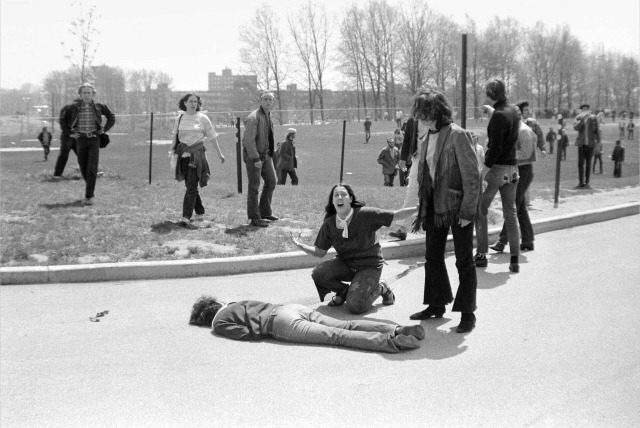
Do you think Crosby, Stills, Nash and Young’s “Ohio” will last?

not nearly as long as that one photo

and mostly as trivia to it

Tagged: amhist la pieta

You see the ironic thing is the association with Fortunate Son is probably going to be one of the last things about the Vietnam...

You see the ironic thing is the association with Fortunate Son is probably going to be one of the last things about the Vietnam War to fade from memory.

Like how people remembered “Remember the Alamo!” long after they, in fact, remembered the Alamo.

Tagged: amhist

“gen z is so loud and rude and disrespectful!” good. they might actually accomplish something.

apricops:

“gen z is so loud and rude and disrespectful!” good. they might actually accomplish something.

– Gen Z


Seriously, from over-drawing lessons from the 60s – and specifically, the 90s’ reinterpretation of the 60s to flatter and intellectualize the Boomers fully coming into their own as heirs to the country, and the lessons learned under later periods built on that 90s understanding – there’s this widespread youth sense that “if I’m not getting my way, it’s because I haven’t been enough of a brat about it!”

But that understanding could only bear so much weight, the 2010s was a festival of putting too much on it, and now it’s fallen through. And the rest of society has realized it doesn’t need to placate those brats, or win an argument against them, just stop taking them seriously and let it wither on the vine. You already saw it with “defund the police”!

And reimplement the pre-60s – pre-90s, really – understanding of things, which is, “you act in a way acceptable to the rest of society, and in particular your seniors running the established order, or the hammer comes down

Tagged: culture war 2023 generation gap vibe shift amhist

The drafters of the Constitution were fluent in Greek and Latin. George Washington's speeches read like they're in fucking...

jadagul:

necarion:

The drafters of the Constitution were fluent in Greek and Latin. George Washington’s speeches read like they’re in fucking Latin, translated into English.

But you know what else feels like a Latin construction?

“A well regulated Militia, being necessary to the security of a free State, the right of the people to keep and bear Arms, shall not be infringed.”

I wonder if this was entirely unambiguous to Madison because of how his brain parsed Latin grammar?

This had never occurred to me, but now that you mention it I can’t unsee it.  The grammar looks so incredibly Latin.

The first half is an ablative absolute.  The second half is a fucking gerundive.  The sentence looks like it was translated from Latin, but as an exercise where you’re trying to prove you can read the Latin and so you’re not even trying to render it into idiomatic English.  No wonder it’s confusing!

(This article makes the same observation, and argues that this implies the second amendment is only protecting militias; I don’t think the piece is quite right, though.  It says the ablative absolute gives the “reason” for the following clause, but I think the Dickinson College link I gave, which is not trying to discuss politics, gives a better account: it’s the cause or circumstances of the following clause, which is much less specific.  You can see this article arguing for the opposite conclusion and also name-checking the ablative absolute, but I think it’s a less persuasive case—even though I’m not really persuaded by the first one either.)

But yeah, no wonder the amendment seems weird.  It is!  It’s not really written in English.

But then I look at the rest of the Bill of Rights and I get basically the same vibes from all of it.  It’s all super weird.

One thing I notice is how much of it is in the passive voice.  The First Amendment is active (and not coincidentally probably the easiest to read and parse); the Sixth is formally active but has a lot of passive voice in it; and all the others are straight up passive voice.  “No soldier shall…be quartered in any house”; “The right of the people to be secure in their persons…shall not be violated”; “Excessive bail shall not be required”; etc.  You also get the sort of baroque nested clauses and running series of conjunctions that comes up a lot in Latin.  

And something like the Fourth Amendment:

The right of the people to be secure in their persons, houses, papers, and effects, against unreasonable searches and seizures, shall not be violated, and no warrants shall issue, but upon probable cause, supported by oath or affirmation, and particularly describing the place to be searched, and the persons or things to be seized.

reads like a passage from Cicero, where he stacks up ten clauses in one sentence and you don’t know what the fuck he’s talking about until you get to the end.  

Tagged: 'merica amhist

i've read two Philip K Dick novels, both of which involved the Earth being gradually abandoned as it becomes uninhabitable, in...

raginrayguns:

i’ve read two Philip K Dick novels, both of which involved the Earth being gradually abandoned as it becomes uninhabitable, in one of them because of radioactive dust, in the other because of global warming. Recently I started on a book of his short stories, and a lot of them involve people living in the aftermath of apocalyptic wars. It seems similar, but neither of the novels involve wars. The radioactive dust in “Do Androids Dream of Electric Sheep” was unexplained iirc, whereas one of the short stories I read had the world becoming uninhabitable due to radioactive fallout from a nuclear war. Anyway, more of a fixation than id realized, though idk exactly a fixation on what

Dick’s mind is really in the period from the end of WWII to the consolidation of the Cold War in the ‘50s, I’d say it’s a projection of the pre-ICBM fear of nuclear war as the inevitable third step of progression in World War strategic bombing which would finish off the entire old European system of civilization

Tagged: philip k. dick pulp fiction amhist

This bar playing Motown and Camelot-era pop and it's like… do you realize how much of the Boomers' senses of the ambient culture...

This bar playing Motown and Camelot-era pop and it’s like… do you realize how much of the Boomers’ senses of the ambient culture they were born into was actually derived from these Jewish songwriters ventriloquizing Negros?

Tagged: amhist

Louis & Clark Expedition setting out with a Corps of Discovery logo in the NASA "worm" style

Louis & Clark Expedition setting out with a Corps of Discovery logo in the NASA “worm” style

Tagged: amhist

Compared to ecologically and topographically similar regions of Europe or east Asia, the northeastern United States is unusually...

pureamericanism:

Compared to ecologically and topographically similar regions of Europe or east Asia, the northeastern United States is unusually heavily forested. One might think “well, yeah, the U.S. hasn’t been settled by agriculturalists for as long and is less densely populated, obviously there’s going to be less percent land cleared for farms,” but this is not so! Everywhere in the northeast, our forests rise from what were once old fields. In 1860, for instance, Maine was only 60% forested by land area. Today, that proportion is closer to 90%.

We owe our current landscape to two great waves (and several smaller ones) of farm abandonment. The first happened in the decades after the Civil War, when for various reasons* northeasterners (mostly from New England) packed up their pitchforks and decamped to the midwest. This had been going on before the war too, of course, but up until then it had not been in numbers enough that the northeastern farms stopped being worked. There was always a son or two left to till up more stones from the Vermont field. But that changed after the war, and the fields started to revert to oak and maple and pine. Indeed, much of the early formal scientific study of American forestry and ecology happened in these old Yankee fields and young Yankee forests, by outdoorsy young men from Harvard with names like a Lovecraft protagonist.

The second great wave was in the Great Depression and World War 2, when for various reasons** people from all the rougher sorts of terrain the east has to offer - from West Virginia to Indiana’s Brown County to the Ozarks and back to the Catskills - left their farms to come down and seek work in the then-thriving industrial cities. Much of the hilly landscape of the east that had previously been dotted with small subsistence farms, full of exactly the barefoot gap-toothed hillbillies who captured the imagination of urban popular culture with their exotic poverty and folkways when they suddenly appeared in Cleveland, or wherever, in 1933.

These pulses of farm abandonment have left very specific patterns written in the ecologies of the northeast. For instance, the fact that the poor ridgetop farms that were once extremely common in Southern Ohio and Indiana were nearly all abandoned in the 1930s and ‘40s means that the forests that now grow there are uniformly approaching their first century (excepting, of course, where there’s been logging in the meantime.) This is almost exactly long enough for the process of ecological succession to complete itself, and the forests to move into their mature phase.

And so you read books written in the '50s, '60s, or '70s about these areas, and you notice how common early successional species are, everywhere chokecherry and black birch. Whereas today the only evidence you may see of the forest’s relative youthfulness is a few very large bigtooth aspens nearing the end of their lives, surrounded by tulip poplars and chestnut oaks that will endure for many years after all the aspens are dead.

*Young men returning from war with a restlessness and a desire to leave home again; those same young men posted far from home during the war and realizing just how awful the New England soil is, lmao; Republican government policy writtrn explicitly to favor small homesteaders heading west; the late 19thc. crash in agricultural prices (as, in a few short decades, the Great Plains, the Australian wheat belt, parts of the Kazakh and Siberian steppes, the plains of South Africa, and the Argentine pampas were all put under the plow for the first time, and during an era of global free trade) making many small farms entirely unsustainable.

**Years of erosion on fields carelessly laid out on steep terrain; the Great Depression making running a small farm, ah, difficult; economic modernisation making staying as a subsistence farmer a damn foolish thing to do; new roads and automobiles making fleeing to the city easier than ever; and the TVA and other federal land grabs displacing hundreds of thousands of people.
Tagged: amhist history

I mean, the British did spend three centuries trying to genocide my ancestors and all, but they didn't succeed and seem to have...

aorish-deactivated20251222:

I mean, the British did spend three centuries trying to genocide my ancestors and all, but they didn’t succeed and seem to have stopped trying. And it sure is convenient that we all speak their language now.

And you can hate on America all you want for literally anything else, but postwar Britain becoming a vassal state to the former British colony my great-*grandparents fled to will never not be funny to me. Hard not to read the American reception of the British monarchy as essentially “Oh, how quaint, those posh little vassals of ours have still got themselves a king, that’s adorable.” I still think they should kill him though.

I do like how America’s all gruff like “hon hon hon, our founding involved freeing ourselves from a king, so anti-monarchism is a key part of our national traditions”, and then look at the UK and be like “but not this one, this one’s quaint and charming” when like, that one was the one!

Tagged: amhist

Occasional reminder that the American intervention into WWI really was to secure our investments, American money had funded the...

Occasional reminder that the American intervention into WWI really was to secure our investments, American money had funded the war but it was necessary to conclude things before the European nations were totally exhausted if the loans were ever to be repaid (between the Dawes, Young, and Marshall Plans, many were not!)

Occasional reminder that America invested the payment on this debt on industrialization that first yielded the Roaring 20s boom but went on to enable the country to serve as the WWII arms-producing “Arsenal of Democracy” and produce a postwar Golden Age of consumer bounty, which is to say this expenditure of American lives to fatten bondholders’ pockets really was key, as much as (rather, continuous with, as a succession crisis of the global order) WW2, to its later global dominance and world-beating quality of life

Tagged: amhist history

Your two options folks

centrally-unplanned:

collapsedsquid:

maxknightley:

collapsedsquid:

Your two options folks

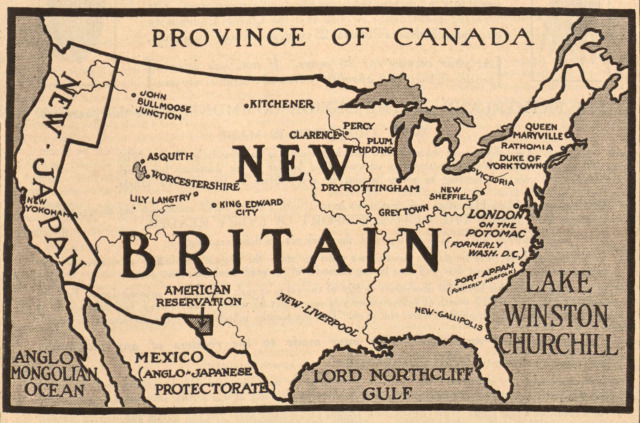
Thoroughly mystified by the top one. “America colonized heavily by the British with a bunch of cities named after English cities” is just… America again. The bottom one at least makes sense even if it’s absurd (minus the part where the Central Powers cede a bunch of territory to Japan, an allied nation in WWI, for seemingly no reason)

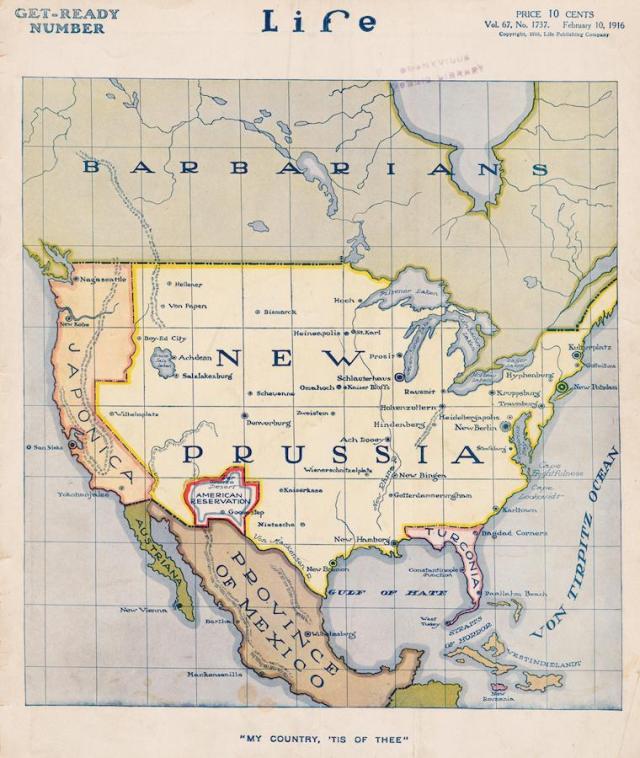
The [first] map appeared on the cover of The Fatherland, a pro-German weekly paper established at the start of the war, with the title ‘New Map of the D.S.E. - Dependent States of England - Formerly U.S.A.’

It was published in response to Life magazine’s famous cover [second pic here] imagining the country conquered by the Central Powers and Japan:

As I always comment, love how both sides of the war agree “oh yeah also Japan your ostensible ally is gonna backstab you and take California”, a totally reasonable and justified fear in the 1910’s for sure.

Why are they agreed that Americans will be put on a reservation in specifically El Paso?

Tagged: geography amhist

Thread by @owenbroadcast on Thread Reader App

utilitymonstermash:

when we think of the protestant reformation, we think of:
martin luther, calvin, those guys, vs. the catholic church.

however in reality, there was a third group, that they both disliked.

if we imagine europe as a small video game, basically martin luther and calvin broke away, and locked down a bunch of territory pretty quickly.

so, in those realms, but mostly in places they didnt swiftly lock down, there were other groups who they themselves disagreed with. a lot. martin luther and calvin were fine using state power to enforce their views in territory we might casually say they “secured”.
so if you disagreed with them, who were you? you were a third group of sectarians - meaning, mostly a coalition of the fringes. you were just part of a third folder, and lots of people in this folder had nothing to do with each other, except this odd position they were now in.

so, what did these groups believe in? well, lots of stuff. there isnt one thing they all had. some had a few of these, some had only one or two. just going off the top of my head, heres some things, some major and common, some really fringe and weird:

(just to be clear no one group had all these, some may be just one weird random group. DYOR)

not doing infant baptism (i.e. believers baptism)
not using state power to enforce their beliefs
pacifism
sabbatarianism (i.e. hardcore doing the sabbath, sometimes on saturday)

getting revelation themselves
keeping property in common or hyper communal stuff
mega apocalypticism
unitarianism
universalism (no hell)

could just keep going on here. but, lets get to the point.

theres two points:
A) the descendants of these groups, which range from full on, “yeah thats my grandfather” to “retaining a slighlt influence thats hard to spot” get lumped in with the magisterial protestant reformers

i went on a long quest to understand american christianity. i suppose understanding such a large phenomena in full is basically impossible. but this was a huge piece of the puzzle. if i was going to come out the gate with an explosive attention grabbing statement, it would be:
it kind of seems like

america isnt a protestant country.

america is a radical reformation country.
everything just makes sense after realizing this.

Tagged: amhist

Making a political cartoon – Donald Trump standing paused before a curtain with two openings, each with a framed portrait...

sighinastorm:

kontextmaschine:

Making a political cartoon – Donald Trump standing paused before a curtain with two openings, each with a framed portrait besides, one of Grover Cleveland and one of Adlai Stevenson – to send back to the 2006 APUSH DBQ, as part of a warlock’s curse

“Please explain this political cartoon.” —Me

They both fought presidential rematch elections: Stevenson lost to Eisenhower in 1952 and then again in 1956; Grover Cleveland as president lost re-election to Benjamin Harrison in 1888 but defeated him to return in 1892.

Tagged: amhist same as it ever was

The hilarious thing is that as late as the 90′s Boomers were still seen as the generation in the shadow of their WWII-vet...

northshorewave:

northshorewave:

The hilarious thing is that as late as the 90′s Boomers were still seen as the generation in the shadow of their WWII-vet parents, whom they selfishly spited by refusing to grow up. Bill Clinton was the first boomer president, literally and figuratively, he liked McDonalds and jazz music and that was enough for some of the old establishment gatekeepers of the time to declare him Unfit to Lead.

And I guess this has just passed from common knowledge to historical curiosity because I see not a hint of irony, or acknowledgement that this just happens every thirty years or so, from people who see boomers as a uniquely privileged, uniquely evil class in American history, the eternal oppressor in the way a 19th century Marxist might talk of ‘the aristocracy’. And yes those people are idiots, but sometimes you have to push back on idiocy.

@kontextmaschine help me out here.

Not terribly sure what you’re looking for, so I’ll just riff that both the general positivity around the early-90s Desert Shield/Storm Iraq War and the later-90s “Greatest Generation” WWII commemorations and cinema revival were used by Boomers to distance from earlier Vietnam War opposition and use war to reconnect with their parents’ generation.

Meditate on the role of the Vietnam War in Forrest Gump’s 90s Boomer-experience pageant.

Tagged: 90s90s90s amhist

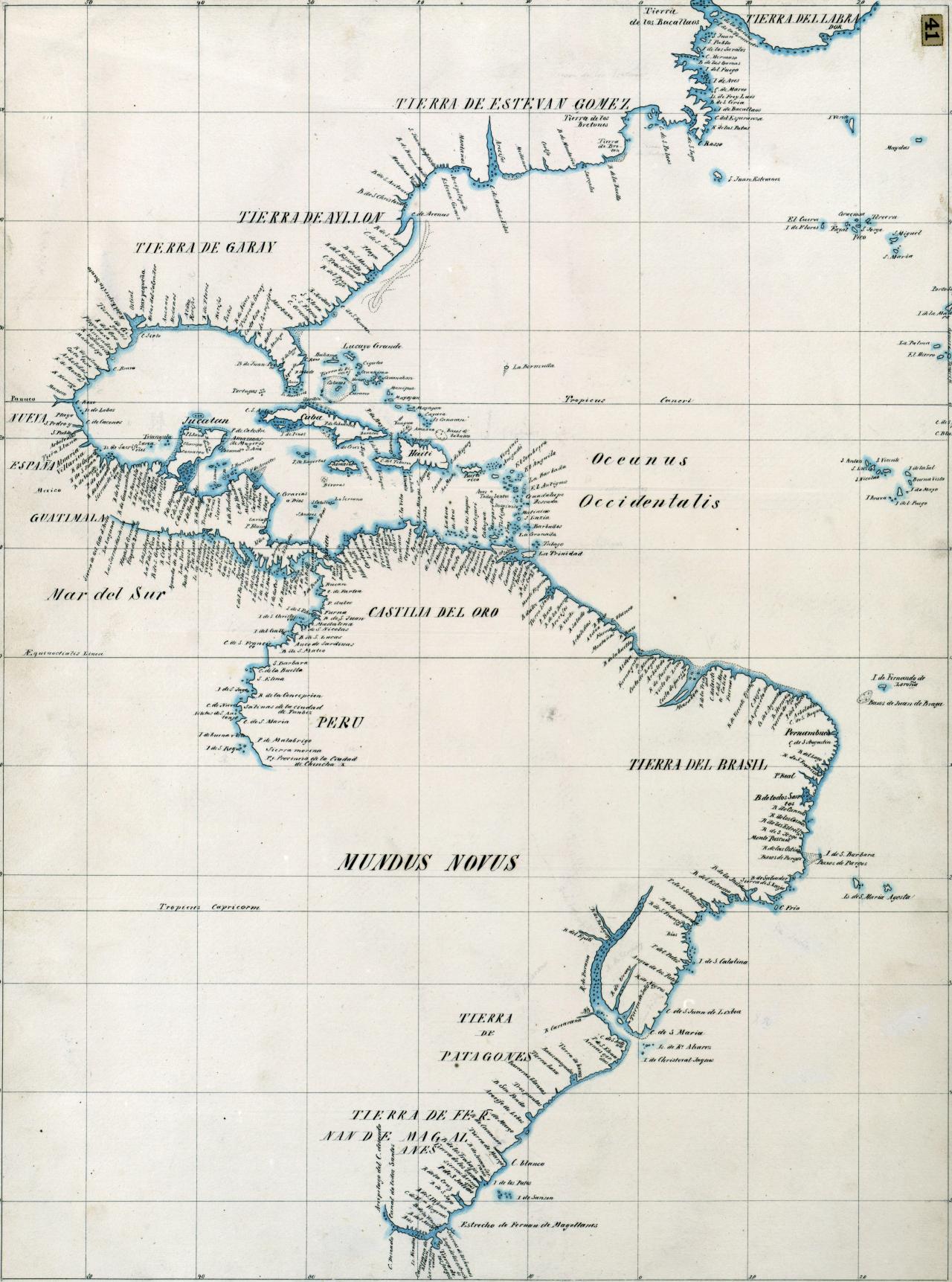
1529 Map of the Americas by Diego Ribero

mapsontheweb:

1529 Map of the Americas by Diego Ribero

That’s interesting, it implies Pacific coast exploration began from shipyards built on the far side of the isthmus of Darien? I don’t have much background on the period.

Tagged: history amhist geography

The Misconception About Baby Boomers and the Sixties

kontextmaschine:

kontextmaschine:

There are many canards about that generation, but the most persistent is that the boomers were central to the social and cultural events of the nineteen-sixties. Apart from being alive, baby boomers had almost nothing to do with the nineteen-sixties.

A much larger number of young Americans went to Vietnam than dropped out.

You know, this is a really good point: the median young American involved in an organized effort to end the Vietnam War in the 1960s and early 1970s was a soldier and his organization was the Army.

Youth culture is manufactured by people who are no longer young. When you are actually a young person, you can only consume what’s out there. It often becomes “your culture,” but not because you made it.

More bangers.

Tagged: not wrong amhist

The Misconception About Baby Boomers and the Sixties

kontextmaschine:

There are many canards about that generation, but the most persistent is that the boomers were central to the social and cultural events of the nineteen-sixties. Apart from being alive, baby boomers had almost nothing to do with the nineteen-sixties.

A much larger number of young Americans went to Vietnam than dropped out.

You know, this is a really good point: the median young American involved in an organized effort to end the Vietnam War in the 1960s and early 1970s was a soldier and his organization was the Army.

Tagged: amhist

The Misconception About Baby Boomers and the Sixties

There are many canards about that generation, but the most persistent is that the boomers were central to the social and cultural events of the nineteen-sixties. Apart from being alive, baby boomers had almost nothing to do with the nineteen-sixties.

Tagged: history amhist

So the American occupations rigged the Italian and Japanese post-WWII election systems pretty steeply, as a necessary condition...

centrally-unplanned:

kontextmaschine:

eightyonekilograms:

kontextmaschine:

kontextmaschine:

So the American occupations rigged the Italian and Japanese post-WWII election systems pretty steeply, as a necessary condition of keeping Communists out of power (who were expected from Iron Curtain precedent to eliminate any possibility of being removed from power and defect to the Soviet Bloc).

If you will remember your economic materialism this is what you would expect from industrial powers without imperial hinterlands. (This is what the WWII authoritarian culture-states were meant to prevent while they assembled empires!)

@youzicha said: Didn’t @xhxhxhx discuss this petty exhaustively, concluding that the Japanese election system wasn’t rigged?

Maybe? My context is the Cornell Asian Studies program, which is a feeder for/academic arm of the American foreign service/intelligence/military area experts, where my professors were like “oh, my grad advisor was at that postwar conference, he told us how they rigged it”

The major elements were

  • Orchestrating a merger of the Liberal and Democratic Parties into the pan-establishmentarian LDP, supported by advisors and cash drops
  • Multi-member districts in cities, where Communists having greatest strength, 22 individual districts would elect 22 communists but one unified proportional city would send 12 and a smattering of others
  • Not updating district borders as rural population flooded into cities, creating “rotten borough” districts the LDP could buy with agricultural subsidies

So I minored in Asian Studies (Japan) but beyond just learning about Japan, it was in part an education in mechanics of postwar American empire.

My context is the Cornell Asian Studies program, which is a feeder for/academic arm of the American foreign service/intelligence/military area experts,

Huh, is that why my Japanese classes had surprisingly few weebs? Everyone there was planning to go into foreign service and I just didn’t notice?

(I think another factor was that Cornell had a class on Japanese pop culture, and some friends who took it reported that it was full of weebs, so I just assumed that was the quarantine keeping them out of the language class)

That’s more at the grad level (and FALCON) really, but those types make it into normal language classes too. (Well, the good 6/7 credit linguistics track sleeved down from FALCON, which is really built for the Defense Language Proficiency Test, not the 4 credit “functioning as a businessman” one built for the Japanese State Department’s JLPT).

Oh god, I took the pop culture class the first year it was offered, as one of the last ones leaving class once the nihonjin Anthropology professor wearily sighed that he had NOT expected this (a sophomore girl with striped armwarmers challenging his authority on “being a person living in Japan” based on her dad having been at the branch office there in childhood)

Was Nakanishi-sensei still there when you were taking classes? She was my fave.

I think I am team “not rigged” but its really just like definitions (I have no Cornell inside gossip, sorry!) Like the Liberal Party and the Americans absolutely sat down and tried to coordinate together against leftist parties at times, and they did so aggressively. But at a certain point, that is just politics - coalition partners, funding political parties, making deals with unions or businesses, that is just how the sausage of elections is made.

Even as you get into the district proportioning, campaign laws about who can run, etc. that is all pretty normal politics! I don’t like it, and I think the US and UK electoral systems are, in a certain sense, ‘rigged’. But its a loose definition - and in Japan’s case, given that the Socialist Party won the first election and was running the government in 1947, I don’t think anything more than loose applies.

I also as I have mentioned tend to be a SCAP downplayer - they changed Japan much less than they claimed, with the real work of building the system being done by the deep Japanese political-state apparatus. As such, the US only played a secondary role in this process; and I think that is apparent because Japan’s one party state only emerges in 1955, well after the US had left. The impact of the US authority in Japan was probably on net a boost to lefitst parties, as in the beginning they purged right-wing factions and pushed for a western-style legalism that enshrined things like universal voting rights and such.

But this isn’t my area too much, I know the economics better than the politics of the post-war period.

Well the Japanese electoral system was deliberately designed to include all those “normal” features by the American government, which had input on the design as consequence of being the occupying force, that in turn by virtue of having conducted a successful amphibious military campaign against the previous government, is the thing

Tagged: history amhist rekishi