shrine to the prophet of americana

#amhist (618 posts)

I think one of my biggest realizations out of our country’s latter-day tensions is there’s a black nation in the United States,...

I think one of my biggest realizations out of our country’s latter-day tensions is there’s a black nation in the United States, amalgamated from separate origins like the American/white one was assembled from Scottish, French, English, later Italian etc.

Which is a change from my 90s End of History model of like, an ill-treated subculture within the same people as me, or even my later one as the latest wave of immigrants from rural feudalism, dating to the Great Migration

That makes some things make sense - MLK as the consensus like, president of the black nation, and that Al Sharpton and Jesse Jackson’s occasionally farcical insertion of themselves into every “black issue”, everywhere, was a competition to succeed him

Segregation, the whole water fountains thing, goes from a blatant insult to a surreal China Mieville attempt to maintain two states for the nations - a white bourgeois metropole and a South American extractive colony - in the same place, which is destabilizing because I was never trained into a moral sense that Havana should by right have as nice facilities as Boston or anything

It explains a lot of what’s happened since Obama got elected. I see a lot of black writers now gawping that white people (like me) expected the Obama election to be a final resolution of racial tensions and not like, the opening of some sort of settlement process. Because they saw it as the black nation getting its deserved seat at the table of US government, AT LAST

But yeah, speaking for myself and the other whites, yeah, we saw it on the model of (Catholic) JFK being elected as a sign of a new golden age where the “white ethnics” became white together, and black people would be White now - maybe we’d make something up like “Judeo-Christian” or “Abrahamic”, maybe we’d just leave it there for comics to get easy dunks on.

That’s what all those well-meaning years were for, right? Of giving to the United Negro College Fund ads on football, and euphemizing inner-city crime as multicultural graffiti gangs on the shows you train your kids on, or ESPN commercials where multicultural office friends come together around The Game, or the reconciliation ministries at megachurches that are ESPN At Prayer

(huh, broadcast sports. that’s why the NFL stung and Huffy Young Man Journalism swapping MLB for NBA matters)

so what was it for, then?

Tagged: amhist afamhist race

the postwar ‘40s and early ‘50s were this weird liminal period not yet obvious that the old empires were dead or that America...

the postwar ‘40s and early ‘50s were this weird liminal period not yet obvious that the old empires were dead or that America wasn’t going communist just like everybody else, or that “going communist” meant “becoming a satellite state of Russia under the Lenin Dynasty”

I’m kind of reminded by our modern “housing crisis”, we were starting on a big Euro-style public housing program back then for a similar crisis but then seeing how quick the Austro-Hungarians fell into the Warsaw Pact void rattled us and so with our petroleum infrastructure we had Levittown instead

this was when we really invested in the ideology of “anti-totalitarianism”, horseshoe theory, put 1984 on the high school curriculum to reinforce that whatever our WWII propaganda had said, we were always at war with Eurasia

Tagged: amhist 1940s

Today, deterrence through classical music is de rigueur for American transit systems. Transportation hubs from coast to coast...

xhxhxhx:

Today, deterrence through classical music is de rigueur for American transit systems. Transportation hubs from coast to coast play classical music for protective purposes. Brahms bounces through bus stops and baggage claims. Travelers buy Amtrak tickets to Baroque Muzak at Penn Station; Schubert scherzos grace the Greyhound waiting area in New York’s Port Authority Bus Terminal; Handel’s Water Music willows over the platforms of Atlanta’s MARTA subway system. Beyond big cities, the tactic extends to small towns and suburbs across the continent. In Duncan, British Columbia, Pavarotti’s tenor tones patrol the public park dispersing late-night hooligans, while the Lynchburg Library in Virginia clears its parking lot with a playlist highlighted by such scintillating soundtracks as Mozart for Monday Mornings and A Baroque Diet. In the most dramatic account of concerto crime-fighting, the Columbus, Ohio, YMCA reportedly dissolved a sidewalk brawl between two drug dealers simply by flipping on Vivaldi’s Four Seasons.

Baroque music seems to make the most potent repellant. “[D]espite a few assertive, late-Romantic exceptions like Mussorgsky and Rachmaninoff,” notes critic Scott Timberg, “the music used to scatter hoodlums is pre-Romantic, by Baroque or Classical-era composers such as Vivaldi or Mozart.” Public administrators seldom speculate on the underlying reasons why the music is so effective but often tout the results with a certain pugnacious pride. As a Cleveland official explained, “There’s something about Baroque music that macho wannabe-gangster types hate.” The police chief of Tacoma, Washington, echoed the same logic (and the same phrasing): “By playing classical music, we hope to create an unpleasant environment for criminals and gangster-wannabes.” One London subway observer voiced the punitive mindset behind the strategy in bluntest terms: “These juvenile delinquents are saying ‘Well, we can either stand here and listen to what we regard as this absolute rubbish, or our alternative — we can, you know, take our delinquency elsewhere.’”

so if transit systems play classical music to flush out the poor, do shopping malls play pop music to flush out the middle class?

because i hate it

I definitely remember “mall music“ as a distinct kind of elevator music/Musak

Oh man there’s another thing I get to explain to the kids - midcentury American public spaces used to subscribe to services that provided unobtrusive, inoffensive-to-the-point-of-being-offensive background music

I remember it being a collection of original compositions and downtempo instrumental arrangements of recognizable tunes. This maybe had something to do with how playing mainstream/’freelance” not for-hire musicians in public requires paid licensing from ASCAP (American Society of Composers, Authors and Publishers) or BMI or SESAC or something

anyway that kind of ended around the same time that TV shows (and to an extent, movies) stopped using original scores and started using popular music, in the mid-’90s

(actually the TV story is pretty interesting, from 21 Jump Street and Miami Vice pioneering it in the ‘80s to the WB teen soaps running post-episode “as heard on” segments in the ‘90s to be a more appealing venue to “break” bands

Well the ‘90s were a time of TV pushing to be an alternate venue to radio to break through, MTV was the progenitor obvs but Little Fluffy Clouds broke through a Volkswagen commercial or something, didn’t it? And a Hooverphonic song.

Actually actually, there’s a lot of interesting stuff there - the ‘90s were when video games (say, Wipeout XL and Gran Turismo) were on CDs with the capacity and started licensing pop music. You know those deals go through your publisher and not your record label and thus present an alternate funding stream?

And around the same time film soundtracks were establishing themselves as an independent profit source - Prince’s “Batdance” didn’t thematically match the 1989 Batman movie at all, but it made the soundtrack a must-buy. Probably the apex there was Baz Luhrmann’s ‘96 Romeo + Juliet, structured around the soundtrack and shot-by-shot lush like a music video)

Tagged: 90s90s90s amhist muzak elevator music

documerica:  john h white… chicago, 1973 @ usnationalarchives

jonasgrossmann:

documerica:  john h white… chicago, 1973 @ usnationalarchives

true funny story, the African-American association with basketball comes from the Playground Movement of the early 1900s

That was like “we need open space for urban residents esp. kids to run and play so they don’t picnic and fuck in our city graveyards”

And basketball (originally a Canadian indoor winter sport, thus Hoosiers and the Minnesotan Prince’s shirts v. blouses matches) was the perfect small court sport, smaller than sandlot baseball

AND THEN come the Great Migration all these negroes showed up in the northern American rust belt cities with all these b-ball courts waiting for them

Tagged: amhist afamhist

Why did texas get so big. yeah there was cattle and cotton and some lumber and then oil, but oklahomas produced more oil than...

Anonymous asked: Why did texas get so big. yeah there was cattle and cotton and some lumber and then oil, but oklahomas produced more oil than texas until the 30s and 40s and didnt get anywhere near as big even then. like what possible justification is there for dallas being 6, 7, 8 million people, it doesn't even have a navigable river, just trains and then an airport

Yeah you know, I could tell you the story of postwar California by rote but I’m pretty vague on Texas. Probably involves LBJ.

I mean it was big to start with, the eastern part is a huge swath of midwest-quality farmland with a warm climate and a Caribbean shore. (The eastern part of Oklahoma was Indian Territory)

Dallas was born in the railroad age, which made the navigable river-less inland part of that eastern part accessible and worth farming. Being located at a railroad crossroads makes about as much sense as Pittsburgh, Kansas CIty, or St. Louis being founded at river convergences. And then when it became the highway age Dallas is one of the best-highwayed cities in the world, that’s probably where the LBJ part comes in

Tagged: amhist

Seems like the WHCD gave the MSM bluechecks a taste of the viper cult’s venom and they spat it out, interesting to see what...

Seems like the WHCD gave the MSM bluechecks a taste of the viper cult’s venom and they spat it out, interesting to see what comes of that

Reminder again that at the start of Reagan’s term young journalists were in the same position - coming off a generational shift and the experience of previous replacement of a Bad, Not Us administration with a Very Us Thus Good one, with a mission that looked like “holding power to account” from the inside and “presuming to correct the electorate’s self-rule” from the outside

and when the pendulum swung back and The Smiling Fascist came to power they were Ready to Resist

(I mean in fairness he DID take office using substanceless mass media charisma to push a vision of volkish renewal, delivering a program of aggressive militarism, labor suppression, and renewed repression of the subaltern-as-contaminant right when it seemed an alternative had taken hold)

And part of that getting cut off at the knees after a year or so was editors and other previous-generation gatekeepers reigning it in, not even on the principle of “These things must be respected”, but “Jesus Christ, take that shit to Village Voice or The Nation, our audience is the public not your team”

Tagged: it's media amhist

at this point the C.L.I.T. from Jay and Silent Bob Strike Back is maybe the biggest impression ‘90s animal activist “terrorism”...

at this point the C.L.I.T. from Jay and Silent Bob Strike Back is maybe the biggest impression ‘90s animal activist “terrorism” left on American culture

Tagged: amhist 90s90s90s

U.S. Attorney James Comey speaks to the press after the indictment of Martha Stewart, June 2003

popculturediedin2009:

U.S. Attorney James Comey speaks to the press after the indictment of Martha Stewart, June 2003

Tagged: amhist james comey jim comey

So the thing about the ‘94 Clinton crime bill is that both the “100,000 new cops on the street” and the “midnight basketball”...

So the thing about the ‘94 Clinton crime bill is that both the “100,000 new cops on the street” and the “midnight basketball” community services provisions jiujitsued right-wing concerns (anti-crime, pro-”block grant”) to bring back (fungible) federal grants to cities.

Such federal grants had been central to national policy as recently as Nixon but their decline afterward (Ford’s “Drop Dead” to NYC was refusing to backstop the expensive city welfare state that continued to expand as the city shrunk) had a lot to do with the period “urban crisis”, and choked off the pork and patronage that held Democratic urban machines together.

Clinton’s been catching a lot of shit for the bill, but now that the cities have revived and effectively become the Democrats’ sole base of power, he deserves some credit for that angle.

Tagged: amhist

From the somethingawful forums, the live thread when 9/11 happened

garbage-empress:

criticalforest:

From the somethingawful forums, the live thread when 9/11 happened

http://www.truegamer.net/SA_911/911%20SATHREAD/

This thread was wild, especially because the OP was posting webcam photos from nearby right after the first plane hit. Possibly before CNN even reported on it. 

wow terrorists hijacking a plane that’s fucking rich, you idiot, you complete buffoon

This poster might be one of the first dozen people in history to publicly accuse Osama Bin Laden, possibly before any news agencies, and their post has the words “ROTFL Owned” in it.

Tagged: history yesterday belonged to meme amhist

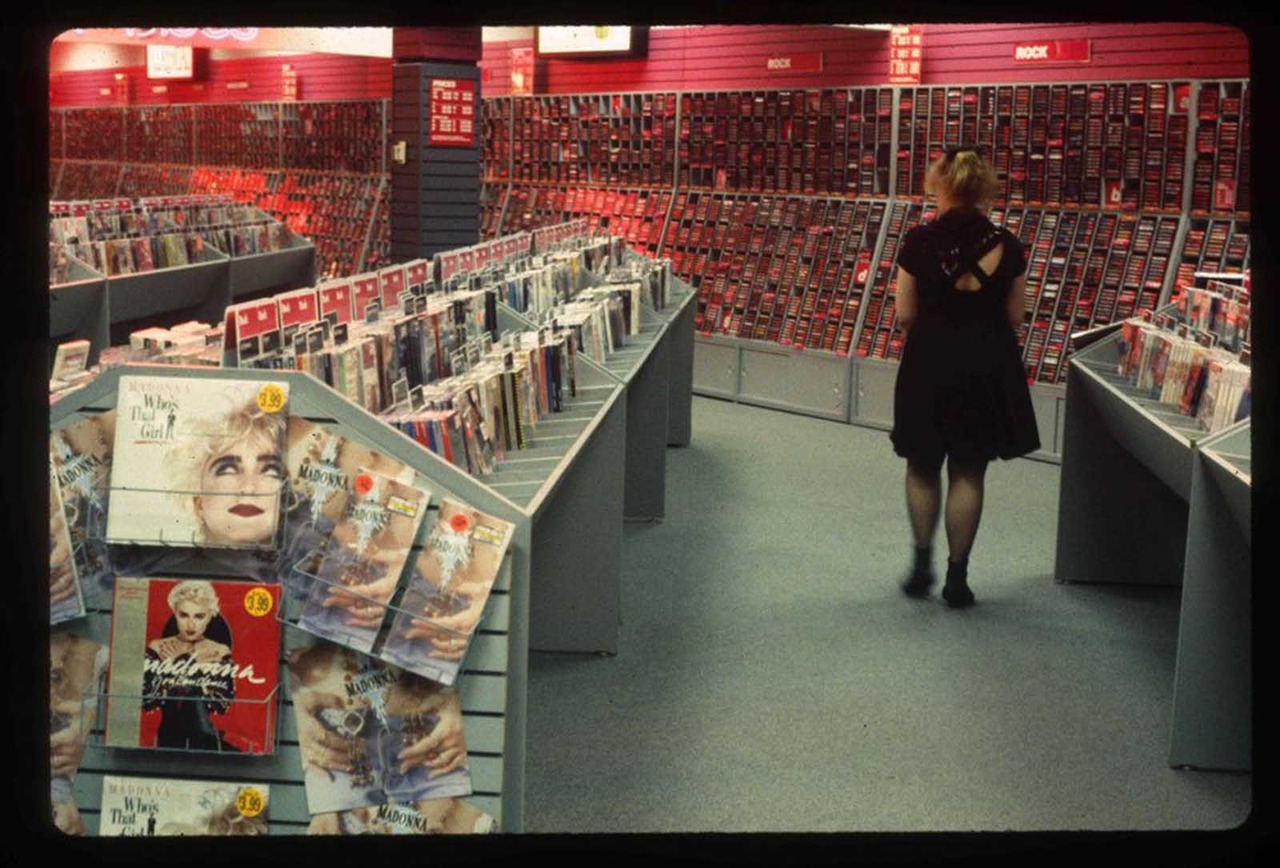
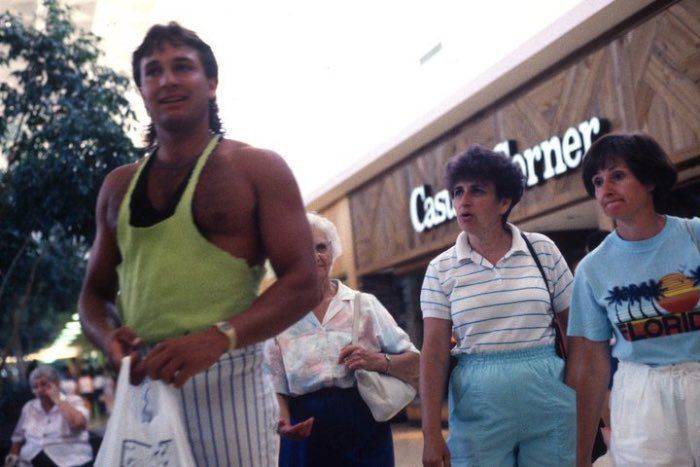
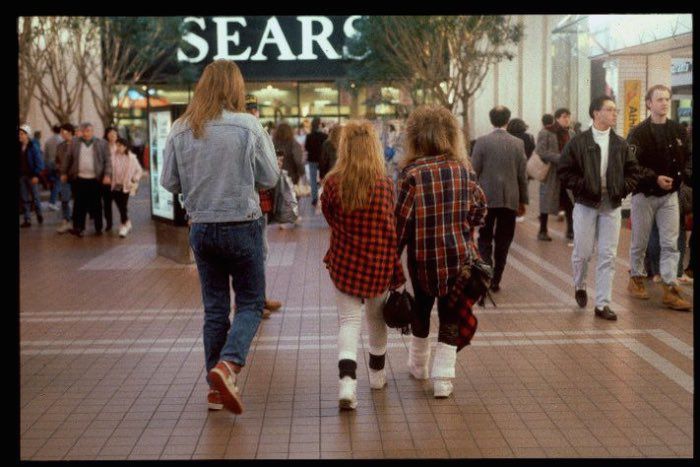
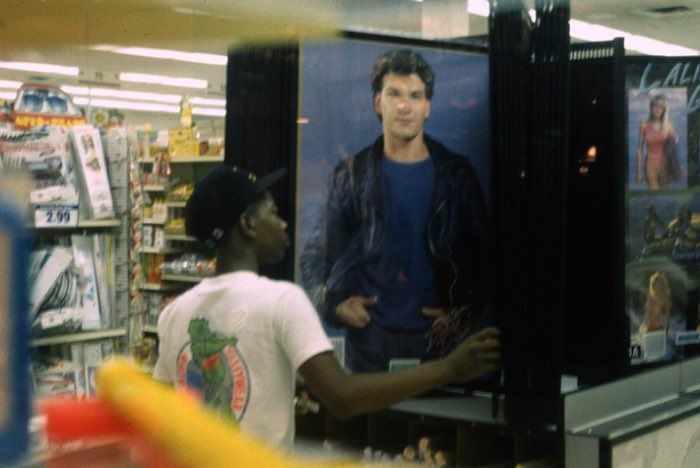
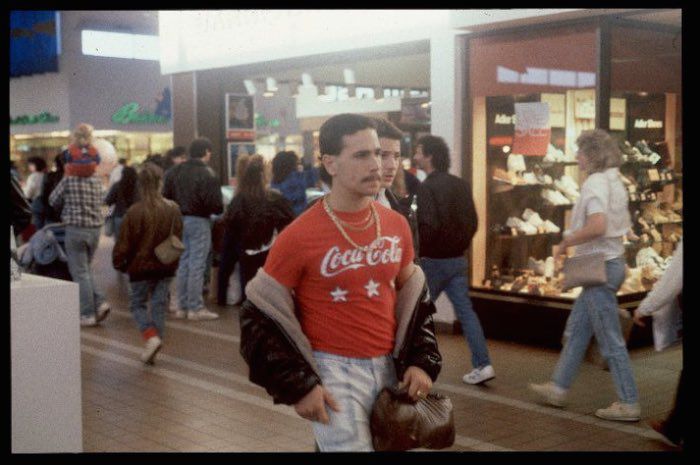
Michael Galinsky - Malls Across America, 1989

c86:

Michael Galinsky - Malls Across America, 1989

Tagged: amhist

ICE Wants to Be an Intelligence Agency Under Trump

ICE Wants to Be an Intelligence Agency Under Trump

I have been rolling my eyes at a lot of the “ICE will be the spearpoint of the new Trumpian reich” stuff coming out of the left recently but this… is actually something worth keeping an eye on.

“The Government” is not a monolithic whole but a semi-integrated collection of squabbling feifdoms and “The FBI is the agency in charge of federal domestic policing/repression” is a descriptive statement, not a normative one. At various points in American history the equivalent role’s been filled by the US Marshals, the US Postal Inspection Service, Treasury Department agents - the Secret Service and “revenuers” presaging the modern BATF. For a while in the Gilded Age it was the Pinkerton National Detective Agency acting directly under leading capitalists with the government cut out of the loop entirely.

The FBI’s 20th century preeminence was not foreordained but a consequence of bureaucratic maneuvering in reaction to specific moments and events – the anarchist wave of the early 1900s; WWI; the First Red Scare; Prohibition; the early automobile-era motorized bandit gangs; the Kansas City Massacre (before which the FBI didn’t carry guns or make arrests); WWII; the rise of Hollywood (and J. Edgar Hoover’s cooption of same); the Second Red Scare; COINTELPRO; RFK’s anti-Mafia crusade and the wrap-up of white ethnic urban machine politics; Cold War cocaine ‘80s Miami; the 1993 Waco seige (starting as a backfired ATF attempt at profile-raising and positioning in the face of Clinton-era budget trimming).

And now, with the FBI and the old-line three letter agencies at loggerheads with the elected executive and his party in Congress, a young upstart agency known for its enthusiastic loyalty to said executive, in the middle of a massive staffing-up, bids to expand its capabilities and portfolio…

that’s exactly the scenario under which things might change

Tagged: amhist

Been thinking on this - the relative absence of the antidiarrheal ads I remember as a staple on TV growing up. Some of that I...

Been thinking on this - the relative absence of the antidiarrheal ads I remember as a staple on TV growing up.

Some of that I bet has to do with dynamics on the *advertising* end - as I mentioned, the development of Immodium AD disrupted the field and left people scrambling for position; in general I bet ad spending in the medicalish category’s shifted to high-margin prescription drugs since the regulatory regime loosened up in 1997.

Also, it might be that the fracturing of audiences into targeted slices favors narrowly targeted ads over products with cross-demographic appeal, and I’m not watching the forensic procedurals, reality competitions, and Chuck Lorre sitcoms that still draw a broad general audience.

And the 1980s were the age of “ad wars” in general - from soda to pasta sauce to painkillers to beer to home gaming consoles, it was just a lot more common for TV ads to go negative on their competitors.

That probably has something to do with big broad economic trends, brand consolidation to the point where product categories are dominated by 2 or 3 competing national brands with no further room to expand except at each others’ expense, but not yet the Wal-mart consolidation of outlets that yanked profit share back to the retailer and disciplined manufacturers to compete on low cost

but

I’m remembering all the other digestive aids prominent in American culture over the years - from Victorian tonics and tinctures to Battle Creek cereals and crackers, malt shops and soda fountains back to the ‘80s ad age and its memorable antacid jingles: the “plop, plop, fizz, fizz” of Alka-Seltzer; R-O-L-A-I-D-S spells Relief; TUM-TA-TUM-TUM-TUMS.

And I don’t notice that as much these days either, and thinking on it “wellness” foods like wheatgrass smoothies and “high-tech nutrition” like MealSquares and Soylent don’t really touch on digestion either; I guess the closest is “probiotic” yogurt but even that’s a little abstract.

And so now I’m tending towards the latter suggestion there, that this stuff’s faded because it was a prop to the traditional American cuisine of gut-clogging grains and meats balanced by lubricating lipids and basically no fresh green vegetables that was the national standard up through the 1980s.

(Mind, for centuries that abundant, fatty, steak and milk diet was the pride of America and the envy of peasants worldwide making do on leaves and roots. Why our agricultural laborers were hale, hearty, “corn-fed” farmboys while theirs were 4’10” stooped-over peasants.)

Just like with clothing I want to call your attention that there’ve been significant quality-of-life advances in the American food sector since I’ve been alive; looking back on late-‘80s grocery shopping with my mom there were not only no southern hemisphere off-season fruits and vegetables but fresh domestic produce was more limited and staples came canned, frozen, or otherwise preserved. Meats were fattier, lower-quality cuts and more expensive; food costs took up a bigger share of income. Fresh prepared foods were basically nonexistent; the narrow selection of preserved prepared foods were longer in making and inferior in flavor and texture compared to modern microwave-ready.

There were more local bakeries with a wider variety of fresh pastries, though.

Tagged: amhist

when u said that chicago has lost almost all its cultural power since the 1980s sure but u also said houston, not 2 b 2 mean but...

Anonymous asked: when u said that chicago has lost almost all its cultural power since the 1980s sure but u also said houston, not 2 b 2 mean but honestly did houston have like literally any cultural power in the 1980s? its just known for being king of energy finaniancial sector, like what did it have purple drank slow rap

Nah it had the energy financial sector.

The OPEC embargos and slowdowns spurred a lot of oil production and when that came online in the ‘70s-early ‘80s the area boomed. Increased production in Texas (and Alaska) was part of what took America out of the ‘70s stagflation, and culturally the explosion of new money disrupting an agrarian family farm/feudal ranch culture (food production also booming in the face of international demand) was at least as important as Gordon Gekko-era junk-bond M&A Wall Street in setting the tone for the go-go yuppie “greed is good” ‘80s.

Out of that you had the hit daytime soap Dallas (OK, maybe less Houston than Texas entire, meanwhile Colorado-set Dynasty was part of the Rocky Mountain Vogue), before the show went off the air you had the era ending in a sort of moral lesson, Texas hit hardest by the S&L collapse. You had the “America’s Team” Dallas Cowboys. Below the radar, ‘80s Texas pioneered MDMA as a recreational drug.

Though I don’t blame you for being surprised, it’s hard to say what legacy that era left. The Rich Texan on the Simpsons? The reboot of Dallas? NFL cheerleaders as skimpily clad sex objects maybe, that really kicked off with the Dallas Cowboys Cheerleaders in the ‘70s

Tagged: amhist

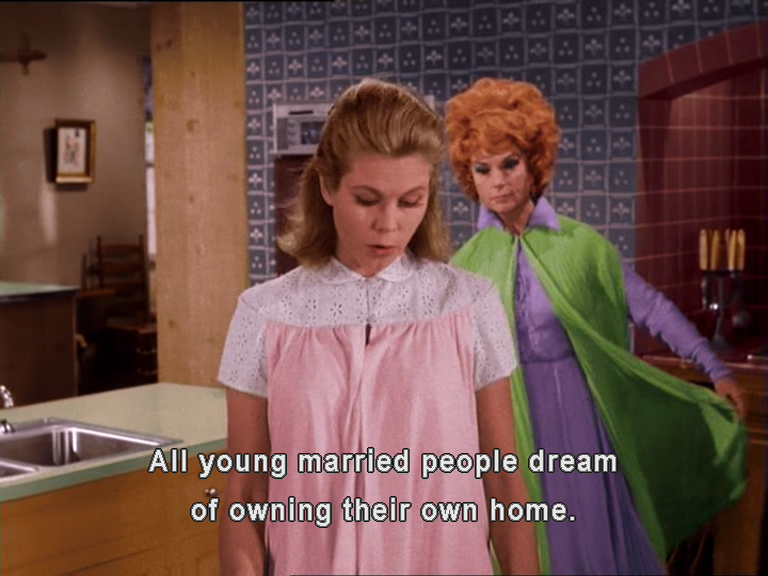
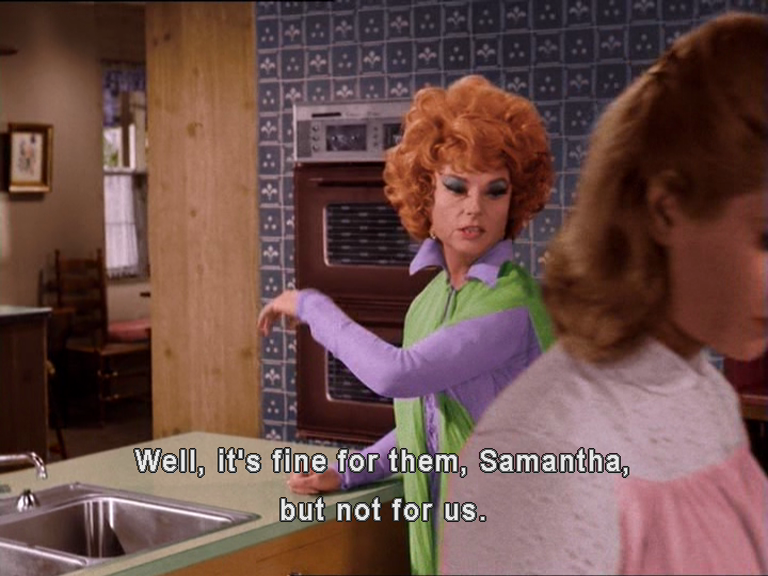
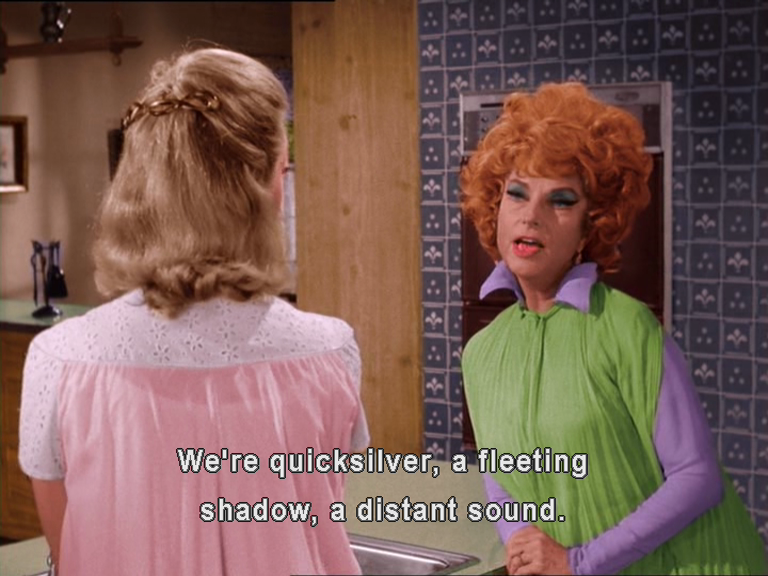
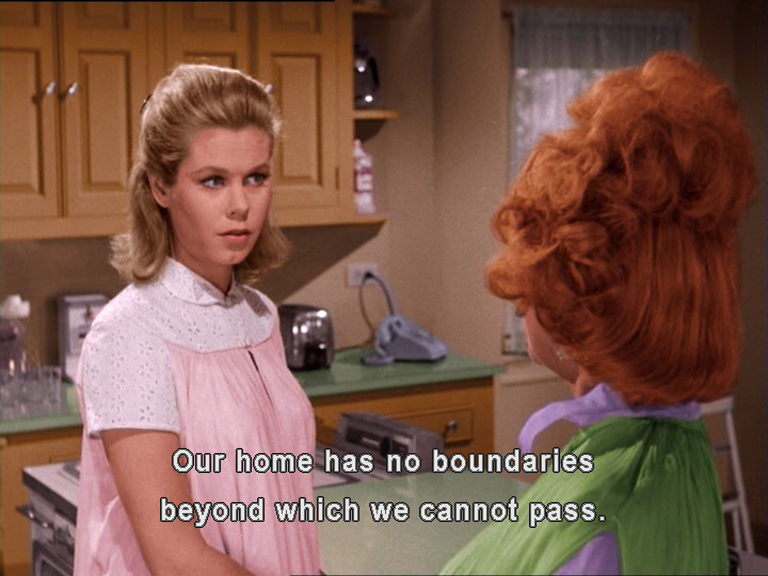
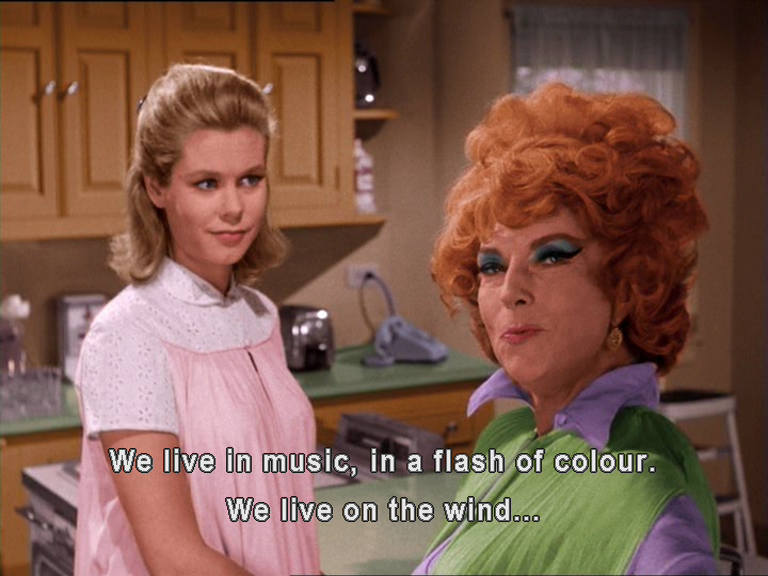
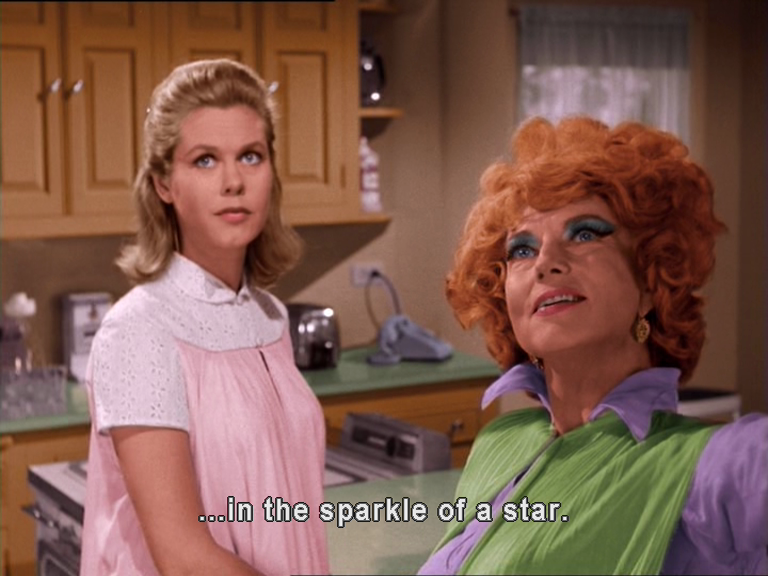
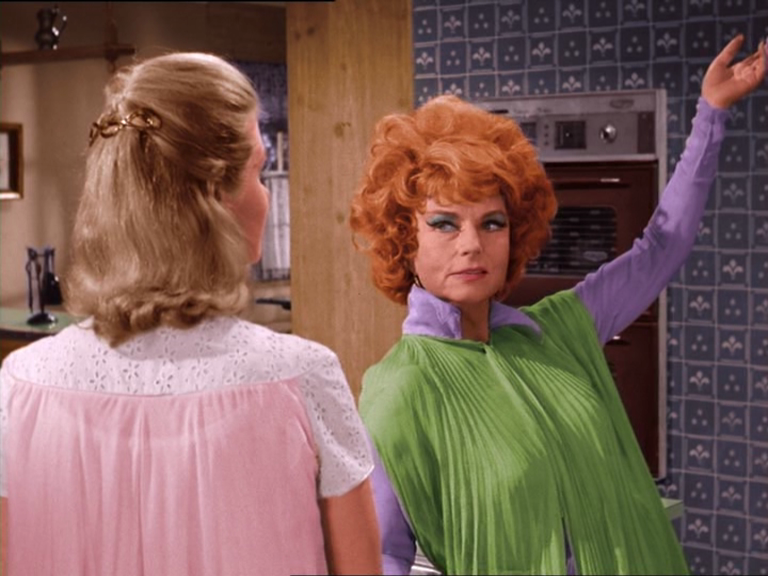
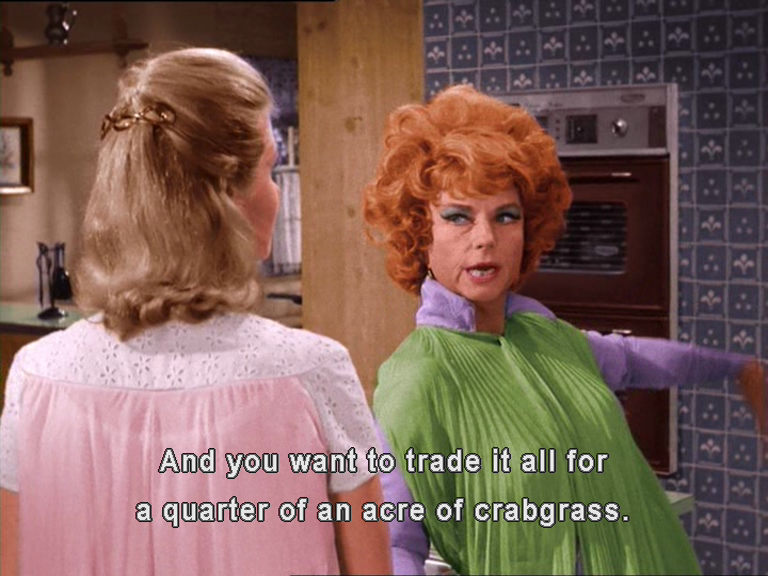
Said it before, saying it again: Endora is Gay Culture.

so-discreetly-sympathetic:

Said it before, saying it again: Endora is Gay Culture.

two things:

1) Wow, Endora was totally the basis for Lwaxana Troi on ST:TNG, huh, I just got that

2) This is a good illustration of a point I keep returning to, which is important for getting at how culture shifts back and forth, that “The Fifties” (yes, 1964 included) were NOT the last gasp of an eternal patriarchal traditional order, they were recognized at the time as a conservative retrenchment that earlier generations found disappointing.

Setting aside the backstory of Samantha and Endora as magical immortals and considering them as representing “a postwar newlywed” and “a woman from the previous generation” (coming of age in, say, the Roaring Twenties), this is a pretty good summary of the generation gap: the previous generation thought the Fifties Kids were narrow-horizoned bores who foresook worldly excitement for dreary conformity.

But if you know what you’re looking for you can see Samantha’s riposte here. For one, look at the life she gets out of committing to a love-matched partnership with a man that Endora considers unremarkably beneath her potential - a comfortable (upper-?)middle class life in a two-story house on its own plot of land, that modern decor and those modern appliances.

That’s not something the older (“Endora’s”) generation could count on before the postwar suburban Mass Middle Class. In 1940 the homeownership rate was only 43% and that’s averaging tenement-dwelling urban workers in with family farmhouses on tenuously mortgaged farms, with the middle and upper classes making up maybe a 20% remainder.

Also, just look at the two women. You notice Samantha’s not any less made-up or styled than Endora, look at the blonde halo around her radiant upturned face in panel 6. It’s just that Endora’s makeup and style is garish and vulgar. Part of that’s playing to the new format of color TV, but part of it is she’s supposed to look attention-seeking, undignified, that’s the point.

For all her theater-people rapture over the adventurous life, a central part of “adventure” for women of Endora’s generation would have been man-hunting, or rich man-hunting, as a precondition of acquiring the comfort Samantha does by settling down with a man she simply likes. And meanwhile, she has a man that she likes! Samantha legitimately loves Darrin and enjoys their life together, while Endora is the bitter, slump-faced whore-painted Avatar of Domestic UNtranquility. She’s snipingly separated from husband/warlock/stage actor/father to Samantha Maurice, who was, reading between the lines, gay anyway.

So when Endora makes that speech Samantha (and by extension a good chunk of the contemporary audience) sees it as sour grapes, putting a romantic gloss on a lack of the very stable, fulfilling home life she enjoys with Darrin. That’s really an underappreciated connection between the insular, “nesting” conformist consumerism of “The Fifties” and the unbound “flower child” hippieness of “The Sixties” – a sense that the postwar Golden Age delivered such material surplus that people could afford the luxury to kick back, take a break from competitive struggle, and live a life of their choosing based on companionship and love.

Tagged: amhist

THE PRESIDENT AND THE PRESS

THE PRESIDENT AND THE PRESS

This 1984 article on Reagan’s relationship with the media is interesting, you should read it. I was starting to just pick some paragraphs to dump here, but in excerpting you’re kind of imposing your own logic and it was starting to be a #same as it ever was one that I don’t think is really right.

It certainly presages Trump in a lot of ways, some of them more direct - the way he feels no obligation to respect the press’s self-importance and the way his supporters back him in this and roll their eyes.

Their intention from the start was to keep the press from calling the shots: No longer would reporters be the arbiters of what constitutes a crisis, nor be the judges of a President’s responsibility… [m]any people outside the Government appeared to share the view expressed by Secretary of State George P. Shultz: “It seems as though the reporters are always against us. And so they’re always seeking to report something that’s going to screw things up.” Many Americans apparently view the problem of withholding access as a defeat for the press, with little concern for the loss of information to the public.

And, like

The Administration, for example, has the stated objective of loosening Federal regulations and limiting remedies in various areas of Government, including the environment and civil rights. The press has frequently pointed to that undisputed fact when Mr. Reagan insists that he has strengthened civil rights and environmental regulations. Last summer, he asserted at a news conference that “no Administration has done more than we have done” to combat racial and sex discrimination.

But the other hand a big part of this is how good Reagan was at staying disciplined and on-message, allowing him to effectively control media focus, often in themed weeks. Compare the Trump-era running press joke of “infrastructure week”.

(One point worth making - though both screen celebrities, Reagan’s film career prepared him to take direction, speak lines someone else wrote, take on projects agents and executives pushed; while Trump’s media background is reality TV, where you throw everything you have at the wall and cut it down to what sticks in editing)

And part of it’s the underlying terrain - if you’ve got proto-#Resistance press pietists on one hand and proto-Trumpian populists making wanking motions with the other, there’s a clear implicit understanding that the latter are the overwhelming majority, if not the true volk, and the press are proper to accommodate themselves to that.

The press is also under fire from another quarter. Many of the President’s critics assert that news correspondents have failed to expose his faults and failures. In fact, the press has consistently reported on these matters, but they do not seem to be a major concern for the voters.

Part of it is… I suppose this is a really 2010s thing to think, but you really notice the absence of, say, women, minorities, and leftists in this article. If the press sees itself as in conflict with the Republican President, there’s no suggestion of articulation with any other forces that might feel the same of themselves.

From an idealist angle you can put this to stronger midcentury Sulzbergerian norms of press neutrality, either approvingly as evenhandedness or dismissively as the “View from Nowhere”. From a more materialist angle, well, the 1984 press was, more than in the ‘90s let alone now, a white, male, not-poor, pre-68-matured, straight-presenting institution, all Reagan-friendly demographics.

In the ’70s, the Democrats thought adding women, racial minorities, the young and college-educated professionals to their coalition would give them an electoral lock forevermore. For one, they took their white labor backbone for granted, but for two it took a while for those groups to understand themselves as a team, let alone a tribe. There were major ‘80s-era gaps between the Atari Democrats and the “Rainbow Coalition”, overlooked in retrospect ‘cause both were irrelevant losers until the DLC/New Democrats/Clinton machine worked up a watered-down synthesis (largely symbolic after the Dems lost Congress in ’94, anyway)

And then there’s stuff that fits together at angles you don’t expect - here’s a distinctly Reagan-unfriendly source offering complaints about horse-race journalism, framed as putting him in the same position of Reagan against the media:

The rules of engagement have also led to antagonism between the news media and [Carter VP and 1984 Democratic sacrificial goat for President Walter] Mondale. Like sports writers, political reporters are obliged to assess the chances for victory or defeat. While Mr. Mondale tries to get his message out, reporters are trying to tell their readers, viewers and listeners why they think he has had trouble getting his message out.

“Every morning I almost hate to pick the paper up - what’s this bum done today?” Mr. Mondale told The Washington Post last month, referring to himself. “The way that they analyze you, once you’re nominated for President, is without parallel.” Complaining that reporters seemed to be holding him to their own standard of performance, he said, “There’s a whole industry that dissects everything, every part of you every day, and you’re measured against this media thing. Not against who you are or what you said.”

Both Max Headroom and David Byrne’s band referred to the then-hot notion of “talking heads” - television anchors and commentators and celebrities, shot in neck-up closeup, who seemed to be displacing public intellectuals even as they seemed to operate within a fame/beauty/charm showbusiness ecology more than any world of ideas. From Neil Postman to Bloom County, this was a huge, civilizationally apocalyptic complaint about the ‘80s that I’m just not sure what to do with today.

And then it goes on from there, longer than you expect, laying out historical background. The only thing I can think to add, they mention historical complaints about the press in previous administrations, but kind of assume you, the 1984 reader, will get that.

The thing is there was a broad sense that the New/intellectual/chattering class, after seething through the ‘60s furious about Vietnam and the slow pace of Establishment reform, tasted blood with Nixon - they convinced the country to share their assessment of him [crook, tyrant] and by so doing depose him. And that with that taste of blood they had set out to undermine the subsequent presidents – Ford [hapless bumbler] and Carter [naive ditherer] – all the while, for lack of any central controlling authority, through the ‘70s the country was falling apart. We let the press run wild, dominate the elected executive to run the country for a decade and they made a mess of it, time to rein them in.

And there’s not that sense anymore. The three straight Republican presidential terms, shading into Clintonian centrism, were a bop on the nose that taught the lesson, but it’s worn off. And by Bush the Younger, those classes got back to seething. Obama gave ‘em pets. Obama gave ‘em so many pets and so many treats and they wagged their tails but that hand’s not feeding anymore and they’re looking to bite again. (Like they were in the early ‘50s before McCarthyism bopped them on the nose?)

Or wait, maybe that’s an argument that there is that sense anymore. God knows Republicans were bitching about the press catching “Bush Derangement Syndrome” in the ‘00s. And my sense and a lot of others is that something did come loose at least by 2010. But the sequences aren’t lining up – a lot of the Flight 93 election vibe was really about the press, or the academy, about the intellectual world more than the electoral, but it wasn’t a sense that “they”’d already led us into a ‘70s-analogue collapse that “we” needed to undo, it was that they were ABOUT TO lead us into one that we might not be able to get back out of.

Or maybe it recursively feeds back into that “shifting terrain” bit, that “was a broad sense” is an aggregate but even if people in similar structural positions have similar takes the aggregate changes in accordance with changes in both what takes a given position has and who/how many are in each position so it’s not a useful variable for understanding things, a multi-body correlation of forces problem. And maybe I’m just stretching a parallel past the breaking point when I opened this post by saying things don’t parallel cleanly.

I dunno. Do read it, though.

Tagged: amhist

On President Trump’s desire for a major military parade

The one point that jumps out at me is contrary to the most common takes going around I’m not sure it would actually represent a net increase in military pageantry for domestic consumption.

In recent years that stuff’s been piggybacked on to the NFL as an exclusive-to-but-universal-within American institution and seasonal cycle, but that’s falling from its perch and becoming pillarized.

Before that though, as recently as the mid-‘90s I have the sense of *more* military parades, small town parades on Independence and Memorial Day, that would include veterans but also current military personnel and equipment (and high school marching bands, and the Shriners in their fezzes and micro-cars).

Maybe that hasn’t declined it’s just that since my age hit double digits I’m not the kind of person that gets taken to see these things at 10AM on a day off. But I don’t see as many secondhand depictions of them as I remember, either.

Maybe no one is that kind of person anymore, like the decline of church attendance, a lot of it is that in a world where the height of electronic connectivity was cable TV (or maybe a huge satellite dish in the yard) and multiple phone lines in your house, it was more appealing to get up and haul out early in the morning for the sake of doing/witnessing something interesting in the presence of others.

Maybe it’s shifts in the military structure, that in going from draftee to recruit and then shrinking at the close of the Cold War, with far-flung bases closed and consolidated, any random town was less likely to have a critical mass of military equipment and military-identifying people around. Maybe I’m too close to the coastal cities and if I moved nearer to a base or to the inland places I hear veterans tend to settle it’d be different.

Maybe it’s the Vietnam veterans’ disillusionment from their military identities that left a gap that was only partly patched by Gulf War I enthusiasm, and the parade-organizing entities they avoided – American Legion, VFW – faltered. Maybe as the infantry mechanized and marches got replaced with highway commutes, parades just don’t speak to veterans’ nostalgic experience.

(Recently I’m realizing what Gulf War I really meant in the American national narrative, a kind of way to dissipate the emotional pressures of a Cold War that we won without doing anything in particular, without a climactic battle or conquest. I remember all the yellow ribbons tied around trees to performatively worry for the sake of Our Boys Overseas in what was in retrospect a farcical turkey shoot.

I remember the way Boomer liberals mellowed by age kind of used it to reconcile with the military, and thru it the “real” America, that was still kind of understood as a generation gap with religious overtones, and not fully yet the red/blue tribalism as we take it today. That would go on to be the theme of Bill Clinton’s campaign and presidency, really.

Everyone who had gutted it out through the military’s unpopular “bottom of the barrel” years in the post-Vietnam ‘70s and ‘80s got to be called up from reserves for a quick victory and fete as returning heroes. Our flag officers - Schwarzkopf, Powell - got capstone achievements to their careers, all our Fulda Gap toys - the M1 Abrams, the F-117 and B-2 stealth planes, the A-10, the Patriot theater ballistic interceptors – got a live-fire demo…)

BUT ANYWAY, in that regards I’m inclined to see a big national parade as holding the rate of military pageantry in American life steady in the face of shifts, and not as increasing it to an obscene level as some critics. And thus as a fairly anodyne innovation in symbolic Presidential ritual like turkey-pardoning or the National Prayer Breakfast, and not a terrifying totalitarian specter.

Tagged: amhist

When people talk about the 40s-50s era of 95% marginal income taxes I don’t know that they appreciate all the easy deductions,...

When people talk about the 40s-50s era of 95% marginal income taxes I don’t know that they appreciate all the easy deductions, all the ways corporations could just bear executive benefits on their books

After Truman then Eisenhower came in and the social democratic New Deal got tempered with the old Rockefeller paternalism Square Deal to make the Fair Deal

You could buy your executives a car! A company car! An executive company car! Corporate penthouses! Vacation homes! As many elite country club memberships as you can count!

(And for retirees too - the “Managerial Revolution” maybe put trained technocrats in controlling place of owners/heirs but it was a quasi-feudal lifetime role

Like public school/Pell Grant/G.I. bill academic tenure was for the intellectual class!

Like how union seniority was doing for the skilled working class

Like how they tried doing the same for the underclass with “New Property” welfare rights before they realized they were over their skis, before stagflation tolled the end of the Golden Age and the coming of neoliberalism)

The open-ended deductions for business entertainment and travel, you could treat your friends to the finest (steak & potatoes & whiskey & martinis) meals in town!

Putting money into circulation, leveraging that Keynesian multiplier!

You could hire them the best call girls! Or purchasers visiting HQ from their small towns! Multiplier!

You could fly them! Across the world! When that meant what orbital travel will in 20 years!

You could give them pensions! And their kids college educations!

You could pay your executives that way 1:1 at no limit, the one thing you couldn’t do, or could only do at 20:1 with 19 to the feds, was give them the ability to further acquire the means of production

Tagged: amhist

'Babe' Turns a Movement Into a Racket

'Babe' Turns a Movement Into a Racket

So, thoughts about this Caitlin Flanagan article:

First, it’s kind of scattershot:

Hollywood is self-serving but at least Oprah lent this movement authentic legitimacy, but… post-Jezebel new media feminism has discredited it all by… posing women as vacuous drama-queen redpill stereotype flibbertigibbets… for example using the same breezy tone to discuss how terrible it is when men disregard your desires to use you as a sexual object and how sexy it is when men hold you down and use you as a sexual object… in the name of attention- and profit-seeking.

As such it REALLY resembles the common criticism that Caitlin Flanagan is more committed to the project of putting down #MeToo in the name of feminist principles than in any particular feminist principles themselves.

I was around and aware in the ‘90s for the last culture war, or at least the mopping-up operations, how part of that was coopt the appeal of “feminist” as an identity by propping up a (good, libertarian individualist) “equity feminism” against a (bad, left-identitarian) “gender feminism”. Like, we’re talking the exact same players from the old “Independent Women’s Forum” set, Caitlin Flanagan and Kaitie Roiphe and Christina Hoff Summers, don’t think I don’t notice that.

Second, if your goal WAS to squash the momentum of this “moment”, and I and everyone else saw a counterattack coming from the get go, this is probably the right time and point to strike. A few days prior the bluecheck goodthinkers were openly trying to threaten Harper’s over running a potentially critical piece on the media men list, clearly thought they still had command, but now moving on to the Ansari stuff, they’re just huffing and puffing to explain how actually, it’s not an issue, there’s no problem here.

Now I’m not going to say that “if you’re explaining, you’re losing” – as a descriptive statement I’m not sure that’s true, and as a normative one it’s anti-intellectual and obnoxious – but it is a sign that you’ve lost tempo, you’re not setting the terms of battle anymore, you’ll need a good push to get it back, and if they get one first you might have to retreat.

Third, you know what this reminds me of? The 1975 novel Looking for Mr. Goodbar.

A New York Times #1 bestseller made into a 1977 film with Diane Keaton and Richard Gere, it was quite the conversation-starter but largely forgotten now because its concerns were so of-the-moment. That moment being the immediate aftermath of the sexual and feminist revolutions, figuring out how to incorporate the new “liberated woman” into society. New “fern”, or “singles” bars flourished as new places for people to meet for sex or companionship.

(Or rather, new places where respectable women could seek them on their own terms as patrons, rather than provisional guests or employees somewhere on the sex work spectrum.)

The plot of the book is basically this: a kindergarten teacher in New York City falls into the habit of trolling singles bars for men to have one-off masochistic sex with. That’s more or less it. I know I’ve said that before pornography was an established genre of its own, mass-market novels came a lot closer to erotica, maybe thinly masked as some sort of moral lesson, but it’s not stroke stuff. The sex isn’t that sexy or all that frequent, most of the time in between she just worries about her life - are her confidence and assertiveness too much? Too little? Is this an okay way to live? Are what she wants in bed and what she wants in life compatible?

If it’s any kind of exploitative pulp it’s true crime, starting off as an article about a 1973 killing in the Upper West Side, because the moral lesson is she gets straight-up murdered at the end.

She brings some new random home, he isn’t satisfying her so in the middle of things she just tells him to stop and leave. This is kind of presented as her finally, comfortably claiming agency. When he rolls off her and moves to finishing himself off she starts berating him, angry that he expects her to physically deal with his semen (and thematically, HIS sexual desire). Enraged, he chokes her to death with an electrical cord.

So yeah, that’s what I’m reminded of, the hit parable from the LAST time we went through this part of the cultural cycle:

“All this chase-your-desire sexual liberation is a way for women to degrade themselves as sex objects. And even if they do interpret it as empowering, they’ll mistake themselves as toe-to-toe equals with the bestial aggression of male sexuality and just get themselves hurt.”

Tagged: amhist same as it ever was

Whenever I hear “it’s like cops always go straight to a gun like it’s their only tool for resolving a situation” I think of how...

Whenever I hear “it’s like cops always go straight to a gun like it’s their only tool for resolving a situation” I think of how much the Rodney King backlash focused on breaking the long-standing nightstick/billy club blunt melee tradition

Tagged: amhist afamhist rodney king