shrine to the prophet of americana

#amhist (618 posts)

America entered World War One in the face of a lot more ferociously opposed pacifist, socialist, anti-imperialist sentiment than...

kontextmaschine:

America entered World War One in the face of a lot more ferociously opposed pacifist, socialist, anti-imperialist sentiment than our school books emphasized (they emphasized “isolationism”, foolish from the perspective of the Cold War empire)

And after the war there was a hard backlash against American entry, that it had been in the interest of rich Europe- and coastal city-based traders, investors, and transatlantic shippers

(Sub rosa, America had lent to everyone and intervened before anyone’s homeland got too rekt to repay; the flood of repayments inflated the Gatsby-ass Roaring Twenties but also funded the factory build-out that allowed the US to be the WWII Arsenal of Democracy and postwar consumer cornucopia/labor aristocracy)

That’s a big part of why interwar America was so entranced by buisnessman-public intellectuals associated with the new modern industries where domestic producers led the field, figures like aviation superstar Charles Lindbergh, assembly-line innovator Henry Ford, and Hollywood animation maestro Walt Disney!

I see people responding positively without any sense of irony so: anti-semitism. The joke is anti-semitism; that Walt Disney, Charles Lindbergh, and Henry Ford’s political interventions were known for it, and who do you think “Europe and coastal-city based traders, investors, and transatlantic shippers” were

Like anti-semitism was big in early 20th century American business, the only recent depiction I can remember is Herbert Moon from Red Dead Redemption (Rockstar Games is our new Scorcese, specializing in violent tales set in very specific periods of American history)

A lot of that was related to the rise of scale, related to the anti-chain store thing (A&P pre-super markets were the original WalMart). The concern was Jews had preferential access to Jewish-dominated networks of capital and trade that traces back to the great banking houses and manufacture/trade magnates of Europe

And I mean Jews did dominate the new form of department stores, super-retailers that dominated with their superior access to capital and goods markets

And the classic NYC Jewish housewife slogan, “never pay retail!” didn’t mean “wait for sales” or “clip coupons” but “pump your neighborhood (ethnic) connections for manufacturers/wholesalers who’ll sell to you at cost”, so if the whole “Jews favor other Jews in trade networks” was a made-up calumny, it somehow fooled the Jewish community of America’s major trade port/manufacturing center

How was this resolved? It wasn’t! The Depression->WWII cycle radically limited the role of European capital and manufacturing in the American economy, and later it came back much attenuated with the role and influence of Jews greatly reduced

Tagged: amhist market-dominant minority

America entered World War One in the face of a lot more ferociously opposed pacifist, socialist, anti-imperialist sentiment than...

America entered World War One in the face of a lot more ferociously opposed pacifist, socialist, anti-imperialist sentiment than our school books emphasized (they emphasized “isolationism”, foolish from the perspective of the Cold War empire)

And after the war there was a hard backlash against American entry, that it had been in the interest of rich Europe- and coastal city-based traders, investors, and transatlantic shippers

(Sub rosa, America had lent to everyone and intervened before anyone’s homeland got too rekt to repay; the flood of repayments inflated the Gatsby-ass Roaring Twenties but also funded the factory build-out that allowed the US to be the WWII Arsenal of Democracy and postwar consumer cornucopia/labor aristocracy)

That’s a big part of why interwar America was so entranced by buisnessman-public intellectuals associated with the new modern industries where domestic producers led the field, figures like aviation superstar Charles Lindbergh, assembly-line innovator Henry Ford, and Hollywood animation maestro Walt Disney!

Tagged: not wrong fools rush in amhist

WE WERE GOING THROUGH STORAGE TO GET A STURDY BINDER FROM THE 80S FOR SCHOOL AND MULTIPLE COPIES OF THIS FELL OUT OF ONE OF MY...

weirdmageddon:

fandomshitposter:

weirdmageddon:

weirdmageddon:

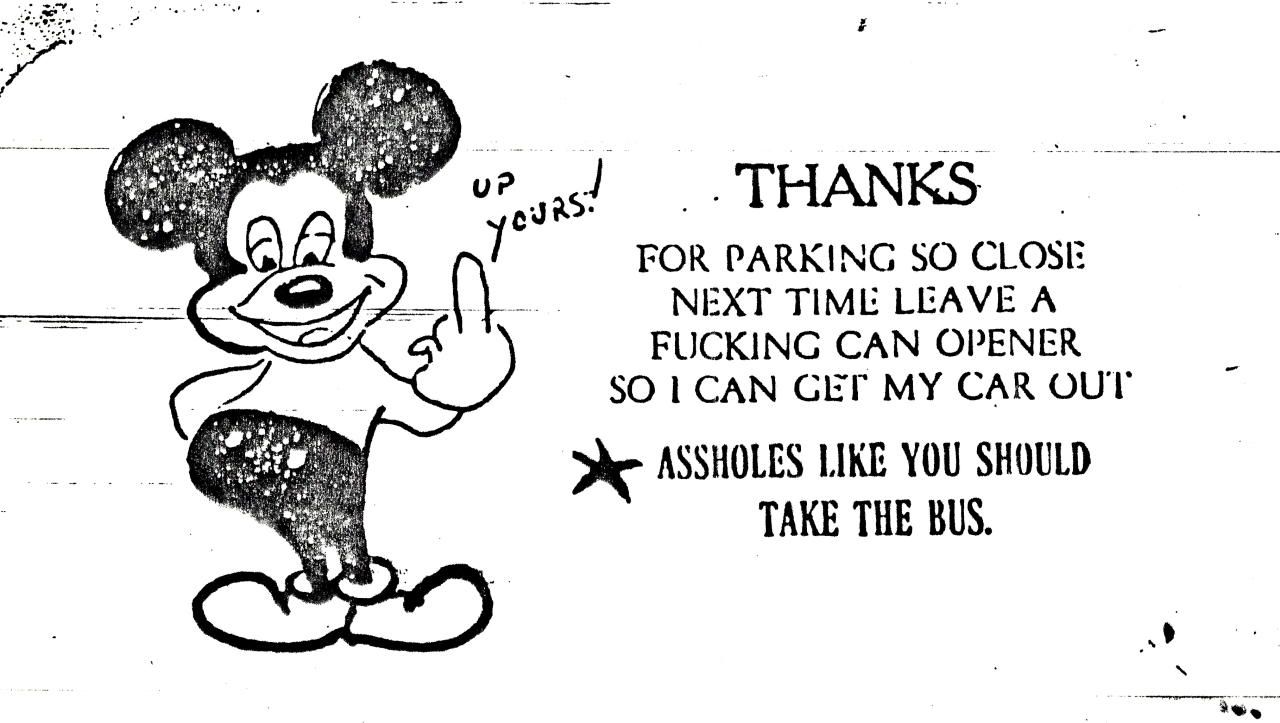
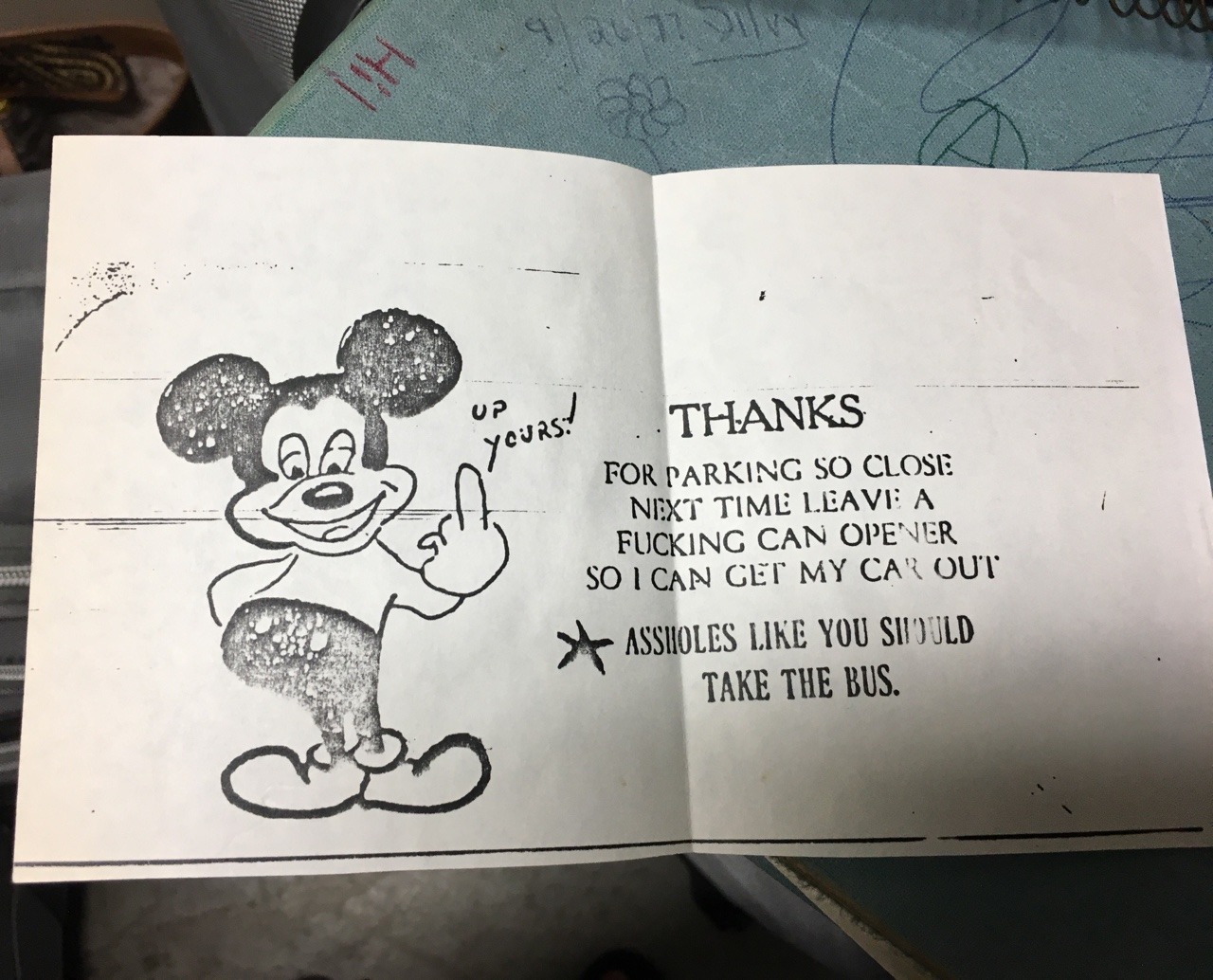
WE WERE GOING THROUGH STORAGE TO GET A STURDY BINDER FROM THE 80S FOR SCHOOL AND MULTIPLE COPIES OF THIS FELL OUT OF ONE OF MY MOMS JOURNALS IM SHITTING

im making photo copies of this when i get home

Pls upload a scan to let others make copies

image

i kept the vintage effects in. this is from the 80s, if not the late 70s

heres the full size, you can crop it as much as you need
or if you want the completely untampered scan here you go

this was part of the tensions around the shift to imported “compact” cars vs. domestic “full-size” cars in the late 70s/early-mid 80s!

Like parking lots/garages into the mid-90s would still have designated narrower “compact only” stalls

The fact this hasn’t reflexed in reverse with the shift to “crossover SUVs”/dualies etc. instead accommodated by wider “edge city” standards is interesting!

Tagged: amhist

give me one of your spiciest, most forbidden amhist takes

Anonymous asked: give me one of your spiciest, most forbidden amhist takes

kontextmaschine:

America would’ve won a total nuclear war in 1951 and MacArthur shoulda forced *Truman* to resign

the trick is realizing it woulda been a close fight ‘cause between war weariness and communist sympathy, there’d be rebellion on the American home front

like there was hella backlash after WWI which was already resisted by a big international pacifist movement

(in America we repressed but also invented the idea of the “conscientious objector” to accommodate them; in the German Empire they were hanged as traitors)

and WWII seemed to be leading to reward

(tho there was a HUGE urban affordable housing issue in the late 40s, LOL)

but Korea was kind of a weird draw, first we (= the UN, which we managed to align as ‘The First World’ here, which is why we keep the UN around and what Bush the Elder thought he was following through on with Desert Storm)

okay what was I saying? First we were “ra ra, we’re so modern and advanced, check out how far we can project power, a front-line army in SE Asia!”

and then Russia/China were like “bitch we live here and we’re huge and you’re getting too close, deal with these huge waves of infantry and tanks”

And we got the shit beat out of us but we did this cool leapfrogging combined arms transport with ships and helicopters and it was like “ha ok still kinda modern tho”

And we called it a tie and forgot about it

But point being going into Vietnam it wasn’t just feckless kids not wanting to die who shunned it but but their “Greatest Generation” (or “Silent”) parents who knew that war could pay off, but weren’t sure this one would

They hadn’t seen Saving Private Ryan yet, so


(also along the way we bombed the everloving shit out of Korea, like, the peninsula, it was the real test case for “back to the Stone Age”and we really did kill a lot of people and bring hell to a lot more in the name of securing a foothold for a vicious right-authoritarian regime, so)

Tagged: unleash Chiang amhist revisionist history korean war

give me one of your spiciest, most forbidden amhist takes

Anonymous asked: give me one of your spiciest, most forbidden amhist takes

America would’ve won a total nuclear war in 1951 and MacArthur shoulda forced *Truman* to resign

Tagged: amhist

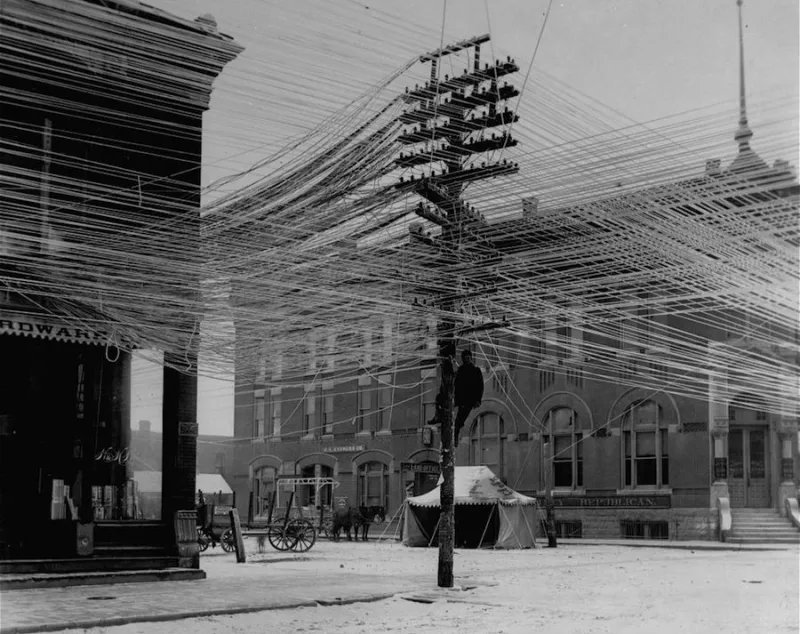
Telephone cables in Pratt, Kansas, 1911 (via here)

furtho:

Telephone cables in Pratt, Kansas, 1911 (via here)

Tagged: amhist

On January 28, 1986, the Space Shuttle Challenger and her seven-member crew were lost when a ruptured O-ring in the right Solid...

astronomyblog:

On January 28, 1986, the Space Shuttle Challenger and her seven-member crew were lost when a ruptured O-ring in the right Solid Rocket Booster caused an explosion soon after launch. This photograph, taken a few seconds after the accident, shows the Space Shuttle Main Engines and Solid Rocket Booster exhaust plumes entwined around a ball of gas from the External Tank. Because shuttle launches had become almost routine after fifty successful missions, those watching the shuttle launch in person and on television found the sight of the explosion especially shocking and difficult to believe until NASA confirmed the accident.

via: NASA on The Commons

Challenger was the last time before the 2016 election that America was being so clearly judged for its hubris. Like, Columbia was unfortunate but it just happened.

Challenger, it was like oh no we’ve gotten too good at going into space, this shuttle program isn’t generating the Apollo-level morale boost that’s like 35% of the point (40% was the option to militarize them along lines that made sense in the late ‘70s)

So they were like okay. Gotta make this one special. Let’s show the softer side of space (remember, Reagan put the first woman on the Supreme Court too) and have this big well-publicized nationwide campaign to select a schoolteacher to go into space and pick her and build her up in the media

And they build this whole national curriculum around this shuttle mission, to Get Kids Interested In Science (the friendly face of the military-industrial complex) and to show off American glory for an administration that specifically aimed to reenchant the nation after the post-Vietnam disillusionment, so they gather up classrooms worth of kids to watch the launch live

And it lifts off all magestic and soars into the air and then on live feed to all those kids it just blows up

And America doesn’t have a tradition of this, we had some offscreen deaths in Apollo 1 (not too far from its roots in test piloting, really) and there were some Soviet fatalities but the precedent was Apollo 13 where God handed NASA a catastrophic kill and days of American ingenuity downgraded it to a mission kill that merely went around the moon

And so the whole program got pulled for a review and the result was that the problem wasn’t with the technology or the engineering but the hierarchical mission-oriented culture that it inherited from the WWII military just like every other load-bearing institution in America

Tagged: amhist

Trump pardons Oregon ranchers whose case sparked Bundy takeover of refuge | OregonLive.com

Trump pardons Oregon ranchers whose case sparked Bundy takeover of refuge | OregonLive.com

Oklahomans warmly call themselves “Sooners” after the founders who settled before the territory was open for claims; Indian Removal was cooption of settler militias in the process of establishing their own southeastern frontier marches; the Proclamation of 1763 banning settlement west of the Appalachians was reviled and ignored; Texas, California, and Oregon started as unpermitted settlements

Claiming unsettled land with your own guns against explicit government prohibition, daring them to do something about it, and seeing them give in is 100% the American way.

Tagged: amhist same as it ever was

GamerGate was proof of concept for a social conservativism updated to defend secular ‘90s culture

GamerGate was proof of concept for a social conservativism updated to defend secular ‘90s culture

Tagged: gamergate amhist same as it ever was

in the 1990s it was an issue that we pretty much agreed that cigarette smoking induced terminal disease and also instead of...

in the 1990s it was an issue that we pretty much agreed that cigarette smoking induced terminal disease and also instead of universal healthcare America routed its welfare state through employers but also this “Medicaid” charity-case program which was kind of coopted from state programs which were kind of expanded from a tradition of county programs which were kind of inherited from the parishes of the Catholic Church back in the English Reformation

but the result of all this was now that we had better healthcare for this shit than pointing and saying “you’re gonna die” governments at every level felt politically obligated to provide and thus pay out the nose for it and were ticked

except the areas of the country that grew tobacco were in a specific slice of the southeast that was right in the process of switching party alignment in a narrowly balanced Congress so no one could afford to press them at the federal level

that was the last time I can remember where an important national issue was decided/had political impact on lines of geography rather than ideology

(the issue was settled extracongressionally through a legal settlement in something like a multi-state class action that at least violated the spirit of the Interstate Compact Clause)

Tagged: amhist geography

To drive home my frequently-discussed argument about how far right the Republican Party has drifted over the last 40 years or...

afloweroutofstone:

To drive home my frequently-discussed argument about how far right the Republican Party has drifted over the last 40 years or so, here’s a clip that’s recently resurfaced of Bush Sr. and Reagan in 1980 responding to the question: “do you think that children of illegal aliens should be allowed to attend Texas public schools free, or do you think that their parents should pay for their education?” 

Their responses weren’t totally based in humanitarianism- there was certainly some self-interested economics and geopolitics- but still, Bush “reluctantly” says yes and comments that:

…we are creating a whole society of really honorable, decent family-loving people that are in violation of the law… I don’t want to see a whole—if they are living here, I don’t want to see a whole—think of six and eight years old kids, being made, you know, one, totally uneducated and made to feel that they are living with outside the law. Let’s address ourselves to the fundamentals. These are good people, strong people. Part of my family is a Mexican.

Reagan says that:

Rather than making them—or talking about putting up a fence, why don’t we work out some recognition of our mutual problems, make it possible for them to come here legally with a work permit, and then, while they’re working and earning here, they pay taxes here. And when they wanna go back they can go back, and they can cross—and open the border both ways by understanding their problems.

Remember, Reagan was on the far-right wing of the Republican Party at this time. In an interview on March 2nd (the month before this debate took place, on April 23rd,) Gerald Ford said that “every place I go and everything I hear, there is the growing, growing sentiment that Governor Reagan cannot win the election.” Ford compared him to Barry Goldwater, the 1964 Republican nominee who was about equally conservative that lost in a landslide in the general election because he was seen as too conservative. Reagan wouldn’t become the ideological standard-bearer of the Republican Party until the middle of his presidency. Now, he’d be too liberal for it.

When I talk about how far cultural politics can reflex my go-to example is the Briggs Initiative, when in 1978 both Ronald Reagan and Jimmy Carter (successfully) endorsed against a California ballot proposition banning queers from teaching positions, as a pan-establishment front to establish that there was no future in anti-gay politics

And I should specify because it might not be clear from today, that wasn’t just an endorsement from the ex-Governor soon-President and the sitting President, that was an endorsement from the national avatar of political conservativism and the national avatar of evangelical Christian politics

Tagged: amhist

Hey remember that time in 2009 that California just started issuing its own currency for like a month?

Hey remember that time in 2009 that California just started issuing its own currency for like a month?

Tagged: amhist

siliquasquama replied to your photo: nycnostalgia: South Bronx, 1970s ...

xhxhxhx:

I was going to guess Berlin 1945

Jonathan Mahler, The Bronx is Burning:

In April 1976 the Yankees came home to the South Bronx. It was, more or less, the same place that the team had left two years earlier, but it bore no resemblance to the South Bronx in which Martin had played twenty-three years before that. Back then the neighborhood’s main thoroughfare, the Grand Concourse, had been known as New York’s Champs-Elysees (with Yankee Stadium as its Arc de Triomphe). Now metaphorists referenced Dresden, not Paris, when describing the area. The old Concourse Plaza Hotel, a stately building of red brick, had been shuttered after a brief and ignominious run as a welfare hotel. The South Bronx itself was losing ten square blocks, or five thousand housing units, a year to arson fires. Rows of private houses, apartment buildings, and small businesses had been gutted, leaving only blackened hulks in their wake. In the area surrounding the stadium, more than twelve hundred buildings had been abandoned. Empty lots were covered with shoulder-high weeds. Ten blocks from the ballpark, an unfinished five-million-dollar low-rise housing development, abandoned for lack of funds in 1972, was a thriving heroin den. When Charlayne Hunter-Gault, the first Harlem bureau chief of The New York Times, visited the Samuel Gompers Vocational-Technical High School in the South Bronx, she was confronted by charred classrooms and broken blackboards. Students passed around a bottle of wine during class. “It’s very difficult to generate enthusiasm,” one teacher told her, “when you feel everything is terminal.”

Deborah Wallace and Rodrick Wallace, A Plague on Both Your Houses:

Testifying in 1976 before the New York State Senate Subcommittee on Police and Fire Protection in New York City, newly retired Deputy Chief George Freidel called the fires “a metastasing cancer on the City.” In 1970, Neil Hardy, the Assistant Commissioner of Housing, had viewed housing abandonment as a spreading epidemic: “If it isn’t stopped, now sound neighborhoods will become ghost towns.” In the 1970s, the language of the civil servants charged with housing preservation borrowed words and phrases from disease medicine and epidemiology. By 1980, op-ed writers also cast their fears in disease and epidemiologic metaphors, although germ and cancer cells were not the triggering mechanism. To these writers and civil servants, fires and abandonments had become contagious, facilitating each other as HIV-infection facilitates tuberculosis.

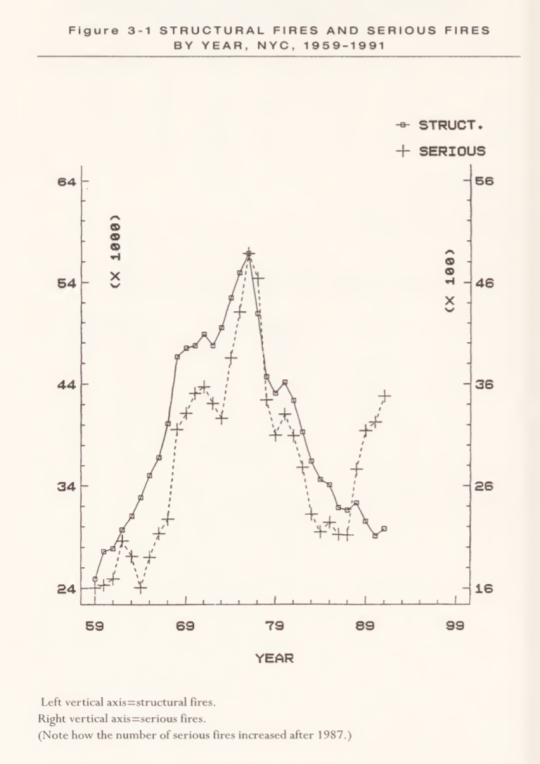
Fires have always been contagious, but, before 1968, an“immunization program” kept epidemics at bay. Fires became virulently epidemic in 1968. Before then, a large fire ushered in a period of lower-than-average fire incidence in that area because fire-prevention activities by municipal agencies focused there. Still, citywide, the number of structural fires per year grew consistently (figure3-1). After 1968, fire damage failed to trigger targeted agency action. The damage instead marked the area as neglected and negligible, and fire disease infected the area, eroding the housing stock.

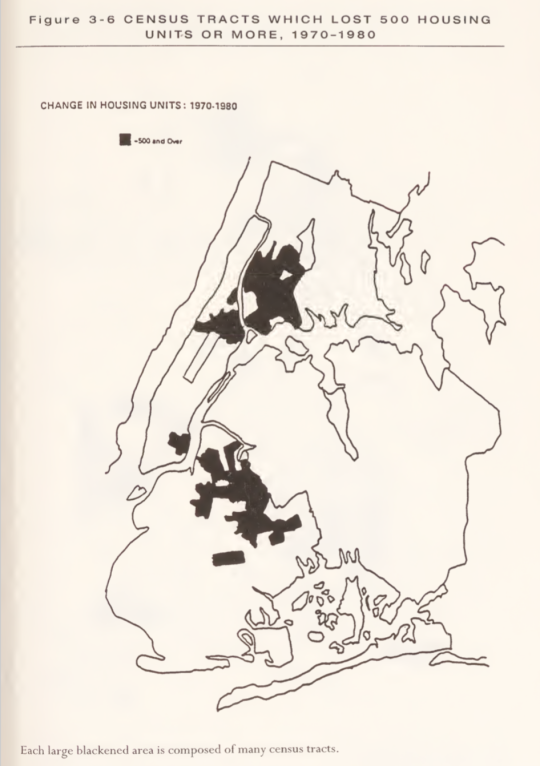
The fire epidemic crested in the 1975—77 period and ebbed because the density of susceptible housing in the path of the fire wave had fallen below critical threshold. What could burn did burn, leaving behind vast stretches of charred hulks and abandoned shells. The estimates of housing loss in the 1970s range greatly, depending on who makes the estimate and the assumptions on which it is based. The Bureau of the Census developed a data base on housing units in 1970 and in 1980 and mapped the loss between the two decadal censuses. In figure 3-6, the blackened areas are those census tracts losing at least 500 housing units during the 1970s. Each contiguous black area contains many census tracts. According to this map, hundreds of thousands of housing units were lost in these areas of concentrated housing loss, housing stock which had been stable and had served New Yorkers since before 1915.

Joe Flood, The Fires:

The urban planner Robert Moses, now retired to his Long Island beach house, but still an influential writer for The New York Times and a bevy of magazines, wanted to blacktop the whole South Bronx—with the buildings burned down and the land abandoned, most of the heavy lifting was already done. City planning commission studies from the late 1960s had recommended the same thing, taking advantage of the burnout to acquire abandoned lots on the cheap and redevelop them. Roger Starr, the head of the city’s housing department in the mid-1970s, had actually proposed a policy of “planned shrinkage,” closing hospitals and fire, police, and subway stations in places like the South Bronx and pushing out whoever was left living there. A few years later, a friend of Vizzini’s from the union recounted an interesting conversation he had with a high-ranking mayoral aide about the fires and how the city hadn’t done anything to stop them, had, in fact, encouraged the destruction with all the cuts. “Well, you can always look on the bright side,” the aide had said. “The city got rid of a million and a half undesirables.”

Kim Phillips-Fein, Fear City:

A few months earlier, in the spring of 1975, a woman named Lyn Smith wrote a letter to her senator, the liberal Republican Jacob Javits. Smith described the housing conditions in a South Bronx neighborhood near her home. The city, it seemed to her, had stopped making any effort to demolish burned-out buildings, despite their dangers. “When a house burns down they don’t destroy the frame, they leave it standing—you never know when it’s going to fall. A little boy I know or knew named Ralfy lives in the South Bronx he was playing in one of the broken down houses and he fell through the floor he’s dead now but if that building had been torn down he wouldn’t be dead.” Smith’s tone—flat, apathetic, resigned, quietly bearing witness but hardly even launching a protest—is perhaps the most haunting aspect of her missive. “I don’t know why I wrote this letter you’ll probably never read.”

Tagged: amhist

HSwMS Sverige

HSwMS Sverige

xhxhxhx:

youzicha:

There’s a talking point that “if you want higher taxes, why don’t you just write a check to the government, huh?”. In 1912 Sweden, they actually did.

In 1911 the government decided to defer the planned construction of a coastal battleship for budget reasons, and in January 1912, a group of individuals responded by founding the “Swedish Coastal Battleship Association” to raise money for it by “voluntary taxation”. Members pledged to donate, over three years, the same amount they paid in taxes in 1911. By May 1912, there were enough pledges to cover the planned budget for the ship, which was indeed ordered in November. The association raised enough money to cover the entire cost of the ship, with a little bit left over which was spent on other military improvements. There were 112,792 individual donors (2% of the Swedish population).

This reminds me of a section in James Sparrow’s Warfare State (New York: Oxford University Press, 2011):

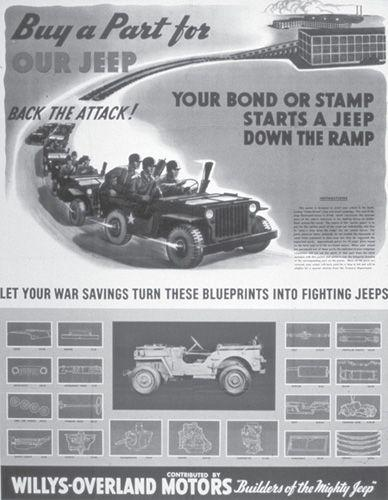
The Treasury accordingly worked the theme of equipment into as many promotions as possible. Bond drives and special promotions featured an ingenious array of equipment “sales” in which bond buyers could attach their purchases to a specific piece of matériel. Indeed, promotions featuring equipment were such a regular feature of the War Savings Staff’s activities that it maintained an accurate price list of munitions, vehicles, vessels, and other matériel as a reference for the Special Events Division and the state committees. Large items, such as a bomber, could serve as a tangible quota that a war plant or community could try to “buy” over the course of a drive. The small town of Windsor Locks, Connecticut, population 4,300, “bought” its own bomber during a forty-seven-day drive in early 1943 that netted more than $175,000. It was unusual for such a small town to make such a large “purchase,” which was a more plausible goal for cities the size of El Paso, Texas, or Napa, California. Students at Union Endicott High School were electrified in December 1943 when school officials received an official press service wire describing how the “Endicott Special,” an Airacobra fighter they had sponsored through bond purchases in the Schools at War program, had “bagged three bombers and a fighter on its maiden combat flight in the South Pacific.” After praising the “grand little ship” the students had paid for, the captain proceeded to describe in satisfying detail the fighting that had downed the four “Jap planes.” The news inspired the students to buy yet another fighter—their fourth—during a special holiday bond drive.

The Treasury’s strategy of tying bond sales to particular items needed for combat allowed bondholders to “buy” military equipment in place of the consumer durables on which they spent their disposable income in peacetime. (Courtesy of the National Archives Still Picture Records Section, ARC #513992)

This approach to setting drive quotas became quite popular, stoking competition between rival towns, local organizations, and even different shifts working in war plants. In May 1942, the Treasury found itself in the difficult position of having to explain an unfortunate navy policy to state sales organizations wanting to have their names affixed to large ships they had “bought” with bonds. Even if they could raise the bond sales commensurate with a $6.5 million submarine or a $65 million aircraft carrier, the navy would not release the name of a vessel until twenty-four hours prior to its launch. The Treasury devised a solution that allowed organizations to hang a plaque on the bow. Army policy likewise allowed “decalcomanias” to be affixed to mobile equipment such as tanks and jeeps that schools, towns, and organizations had “bought” with bonds. Treasury research found that stoking competition through such concrete goals was an extremely effective sales technique employed in the war plants attaining the highest quotas.

Individual bond buyers enjoyed an abundance of opportunities to “buy” equipment in a more personal fashion. Students could “adopt” a soldier by saving stamps toward bonds in amounts that would pay for his food, clothing, ammunition, or rifle, each of which could be displayed along with its price on a wall chart that fit nicely on a bulletin board. For those adults who wanted their bonds literally to outfit a friend or relative in the service, the V-mail Christmas bond letter was a perfect opportunity. It proved so popular during the 1944 holiday season that Morgenthau ordered it to be made available year-round as a “V-mail gift certificate.”

President Roosevelt, once again showing his finely tuned understanding of popular sensibilities, forwarded to Morgenthau a promotional idea to help civilians identify more directly with the machinery of war in April 1943. Why not follow the example of the British, the letter asked, and allow citizens to paste their war savings stamps directly onto bombs that would be dropped over Germany?

Tagged: ‘merica amhist

The Last Station

xhxhxhx:

In the summer of 1964, Christopher Rand visited Los Angeles on assignment from the New Yorker. His writing for the magazine, published in Los Angeles: The Ultimate City (New York: Oxford University Press, 1967), feels like an artifact from the last moment when ordinary Americans felt that science and engineering could remake the world for the benefit of humankind.

Rand visits a base in the Santa Monica Mountains that directs the fire control planning for the 330 square miles around it:

I was shown a large map-room there, with consoles full of communications gear, these tended by two or three men around the clock. The man in charge said that the post had seventy-six fire companies and seven ambulances available, and patrols on the move in all directions. If a brush fire was even suspected in the hills, he said, the post would get six fire companies and two chief officers onto the scene as soon as possible; they would be sent from various quarters because movement was so hard in that terrain. Then if the blaze got serious, more and more equipment would be sent from nearby points, and meanwhile still more would be moved up, as reserves, into the vacancies. “In a big fire we keep redeploying constantly,” he explained, and it all reminded me of our infantry operations in Korea – even to the possibility of air strikes, which the station could call in, if they were needed, much as a regimental command post might.

He heads to Irvine, where the architectural firm William Pereira is creating a whole community from ranch land. (“This is Irvine Ranch,” his guide tells him. “It was the only thing that could stop those suburbs from spreading.”) Pereira himself speaks: “Right now my kind is in command,” he says. “We have sold the idea that planning is necessary, and we have generations of development ahead of us. We have the palette here and we’ll see what we can do with it.”

Rand speaks to the Pereira partner running the Irvine field office, James Langenheim, who tells him about the firm’s plans for Catalina:

“Catalina,” said Lagenheim, “can’t be developed for a few years anyway, because its population can’t increase much till the water and transport problems are solved. We think desalinization will take care of the water; it is being studied now, you know, in Southern California. We hope it can be done economically in a few years, which would free us on that score in a decade. As for transport, the island is now served by airlines and, in the summer months, a boat from Wilmington, in the Los Angeles port area, but the boat is too slow and infrequent for the population we visualize. We are looking forward to cheaper, more efficient helicopter service or to improved hydrofoils that can operate in the channel there, which is often choppy. This, too, should take a few years. It all delays our plan, but at least it gives us a lead-time for more thorough research; we are, for instance, trying to find just where the Indians used to live on Catalina, so we will know more about the ground water. And we are getting a chance to indoctrinate the Catalina population about planning in general. Not to mention indoctrinating Los Angeles County, to which the island belongs, about its problems and its future.”

Rand saw in Century City, a high-rise community built with capital from Alcoa, Lazard Frères, Tishman, and the Pennsylvania Railroad, a new Los Angeles. “Capital is coming from many directions,” he wrote, “and this force, together with others – the influx, the technology, the dreams of the planners – is pushing the projected Los Angeles toward realization.”

Like Century City, Los Angeles would grow up:

It accords, also, with certain accepted ideas about the modern city. For one thing it should have much high-rise living in it. Heretofore L.A. has run to single-family houses. This has been partly due to a fear of earthquakes and partly to the small-town, or rural, Midwestern background of so many Angelenos. The idea of every-man-his-own-landlord-and-every-man-his-own-chauffeur has been thought a key to freedom of some sort. (And also to social standing. “There was a matter of image,” an L.A. write has said in discussing the aversion here to high-rise. “A homeowner had more status than an apartment dweller.”) But now that prejudice is passing. Real-estate economists and analysts, who abound in L.A., point out that the big U.S. crop of war-babies recently attained their early twenties, an age that favors apartment living; they say this has sped the change. They also say, more simply, that close-in land prices (not to mention taxes) preclude one-family homes for most people. There has recently been a slump in all real-estate activities in L.A., but prior to that slump – in the early ‘sixties – three-quarters of the dwelling units built were going up into the third dimension, and this is making it more like other cities.

Rand says this all without a hint of irony or doubt, even when he compares fire control in the Santa Monica Mountains to the land campaign in Korea. There is confidence and optimism in the people he speaks to, and Rand himself is not anxious or fearful.

It is hard to imagine anyone writing like this in the New Yorker today.

Los Angeles may be the ultimate city of our age. It is the last station, anyway, of the Protestant outburst that left northern Europe three centuries ago and moved across America: the last if only because with it the movement has reached the Pacific. There are other cities on our West Coast, but none so huge or dynamic as Los Angeles, or so imbued with the Northern wilfulness in battling nature. L.A., as its people often call it, is the product to a rare degree of technology. Though built on a near-desert, it is the most farflung of the world’s main cities now, and probably the most luxuriously materialistic. It is also – apart from the big “underdeveloped” cities, with their shantytown outskirts – the fastest growing in population. With its hinterland, of Southern California, it is gaining nearly a thousand inhabitants a day, and is expected to go on gaining indefinitely. The Angelenos, its people, are prone to live in the future and to project their statistics forward; the visitor hears them talk more about 1980 than about next year. “This is an optimistic city,” a friend here told me recently. “If something is built wrong it doesn’t matter much. Everyone expects it to be torn down and rebuilt in a decade or two.”

These are the opening words of a piece that end with the same sense of optimism about human potential: “the builders of L.A. keep building,” Rand writes. “L.A. is bound up with technology like no other city in history, and technology has a will of its own.”

But what is striking is how little has changed, and how little the city of today reflects the dreams of 1964. They stopped building, and everything we had hoped for – “the influx, the technology, the dreams of the planners” – never came to be. It is as though the country went into the darkness and never emerged.

Catalina never became much bigger than it was in 1964. Today, there are fewer than five thousand people on the island’s 48,000 acres. Philip Wrigley, chewing gum magnate and owner of the island, deeded 42,000 of those acres to a nature conservancy in 1975.

Catalina never became a haven for golf carts and pleasure craft. Los Angeles did not become Century City. Pereira’s firm designed the airports of Baghdad and Tehran, but they did not indoctrinate Los Angeles. Instead, the Californians came to fear growth and change. They stopped building. 

Every day I pray that they will tear it down and build again.

Tagged: jfc the california ideology amhist los angeles history

Kevin Starr: Gold Rush California was primarily a man’s world, at least until the mid-1850s; and, yes, it could be wild, free,...

xhxhxhx:

Kevin Starr:

Gold Rush California was primarily a man’s world, at least until the mid-1850s; and, yes, it could be wild, free, unconstrained, exuberant. Such a vision of the Gold Rush as festival shivaree, as high jinks in the Mother Lode, can be found as early as the first humorists to cover the event … This interpretation of the Gold Rush as a fun-filled and affirmative adventure survived through numerous celebrations …

There is something to be said for this interpretation, even when it is qualified. The Gold Rush did constitute a collective psychic release—a sense of youth, heightened expectations, freedom from constraints of all kinds—in the Argonaut generation of young men, and the smaller number of women, who came to El Dorado in search of the Golden Fleece.

Kevin Starr, in the very next paragraph:

As historian John Boessenecker has demonstrated, the murder rate in the mines was horrendous—an annual rate of 506.6 homicides per 100,000 population in Sonora, for example, in 1850–51, which is fifty times the national homicide rate of 1999. Outside the Mother Lode it could be even more dangerous. As historian (and former San Francisco deputy police chief) Kevin Mullen has documented, San Francisco averaged a homicide rate of 49 per 100,000 between 1849 and 1856, six times the 1997 homicide rate of that city. Los Angeles County, meanwhile, saw forty-four murders between July 1850 and October 1851, which translates to an annual rate of 414 homicides per 100,000. Between September 1850 and September 1851, the homicide rate in the city of Los Angeles and its suburbs spiked off the graph at 1,240 per 100,000, which remains the all-time high homicide rate in the annals of American murder. If California ever had anything resembling the Wild West—meaning cowboys and shoot-outs—it was Los Angeles County in the early 1850s; until, that is, the formation in 1853 of the Los Angeles Rangers, a permanent posse that would in the course of one year capture and execute more than twenty alleged miscreants. Between 1849 and 1853, Boessenecker estimates, there were more than two hundred lynchings in the Mother Lode. As courts and a criminal justice system began to assert themselves, that number fell to one hundred throughout the state between 1853 and 1857. Still, lynching remained an option in California down through the nineteenth century. The last old-fashioned Gold Rush–style lynching—that of five men in Modoc County—occurred as late as May 1901.

wild, free, unconstrained, exuberant

With the conspicuous exception of Josiah Royce, most nineteenth-century historians considered lynch law a tragic necessity, given the feebleness of legal institutions in the first years of the Gold Rush. To bolster their assessment, they pointed to the fact that most lynchings involved hearings before an elected tribunal, which heard evidence and pronounced sentence and hence possessed an element of legitimacy, indeed represented a resurgence of Anglo-Saxon legal traditions. Contemporary historians, however, combing through surviving records, have noted the disproportionate number of Hispanics being lynched and tend to link lynch law with larger patterns of race-based antagonism.

a collective psychic release

Tagged: amhist history

another sad case of a woman murdered on her way home by a random assailant with mental issues, and weirdly it immediately...

argumate:

argumate:

another sad case of a woman murdered on her way home by a random assailant with mental issues, and weirdly it immediately triggers calls for police to tackle domestic violence, which is obviously an important issue but not really related to these crimes at all, you would think.

I mean the whole problem with intimate partner violence is that many people tend to write it off or downplay it, while fucked up dude lurking in the bushes violence already gets universal condemnation.

Yeah, like The View and Sister Act’s Whoopi Goldberg put it in 2009, rape rape, to distinguish it from Roman Polanski’s ~sTaTuToRy~ rape or when they worked up “date rape” in the mid-’80s

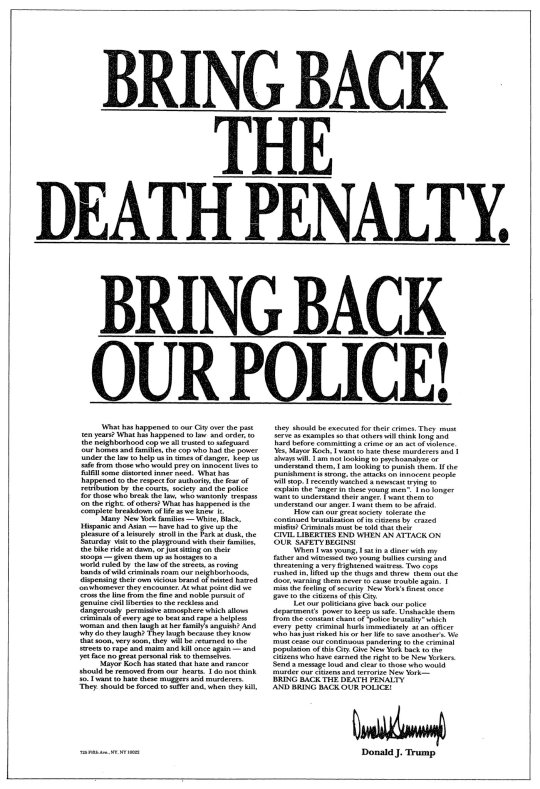
You know the Central Park Five case, where these five black kids were imprisoned for raping this jogger and then-celebrity developer now-President Donald Trump took out full page ads in the NYC newspapers

image

and he continued to insist on their guilt even years later when DNA evidence cleared them?

And that story gets told as a tale of the bad old days of framing poor black kids, the “superpredator myth” etc when the context is in the days before Giuliani Time there were like a platoon’s worth of kids wreaking havoc but those Five weren’t the ones that put DNA in her

Attacks

At 9 p.m. on the night of April 19, 1989, a group of over 30 teenagers who lived in East Harlem entered Manhattan’s Central Park at an entrance in Harlem, near Central Park North.[4] They committed several attacks, assaults, and robberies in the northernmost part of Manhattan’s Central Park.[5][6] According to The New York Times, the attacks committed that night were “one of the most widely publicized crimes of the 1980s”.[1] According to a police investigation, the main suspects were gangs of teenagers who would assault strangers as part of an activity that became known as “wilding”. New York City detectives said the term was used by the suspects themselves to describe their actions to police.[7] This account has been disputed by some journalists, who say that it originated in a police detective’s misunderstanding of the suspects’ use of the phrase “doing the wild thing”, lyrics from rapper Tone Lōc’s hit song “Wild Thing”.[8][9]

The teenagers attacked and beat people as they moved south, on the park’s East Drive and the 97th Street Transverse, between 9 pm and 10 pm.[4] Between 102nd and 105th Streets they attacked several bicyclists, hurled rocks at a cab, and attacked a man who was walking, whom they knocked to the ground, assaulted, robbed, and left unconscious.[4][10] A schoolteacher out for a run was severely beaten and kicked between 9:40 and 9:50.[4] Then, at about 10 p.m. at the northwest end of the Central Park Reservoir running track, they attacked another jogger, hitting him in the back of the head with a pipe and stick.[4][11] They pummeled two men into unconsciousness, hitting them with a metal pipe, stones, and punches, and kicking them in the head.[10][12] A police officer testified that one male jogger, who said he had been jumped by four or five youths, was bleeding so badly he “looked like he was dunked in a bucket of blood”.[13]

Assault on Trisha Meili

Trisha Meili was going for a run on her usual path in Central Park shortly before 9 p.m.[6][14][10] While jogging in the park, she was knocked down, dragged or chased nearly 300 feet (91 m), and violently assaulted.[4] She was raped, sodomized, and almost beaten to death.[15] About four hours later at 1:30 a.m., she was found naked, gagged, tied up, and covered in mud and blood. Meili was discovered in a shallow ravine in a wooded area of the park about 300 feet north of the 102nd Street Transverse.[4][15][11][16] The first policeman who saw her said: “She was beaten as badly as anybody I’ve ever seen beaten. She looked like she was tortured.”[17]

She was comatose for 12 days.[18] She suffered severe hypothermia, severe brain damage, Class 4 (the most severe) hemorrhagic shock, loss of 75–80 percent of her blood, and internal bleeding.[19][20][16][18][21] Her skull had been fractured so badly that her left eye was dislodged from its socket, which in turn was fractured in 21 places, and she suffered as well from facial fractures.[19][20][12]

The initial medical prognosis was that Meili would succumb to her injuries and die.[19] She was given last rites.[20] The police initially listed the attack as a probable homicide.[22] At best, doctors thought that she would remain in a permanent coma due to her injuries. She came out of her coma 12 days after her attack, and spent seven weeks in Metropolitan Hospital in East Harlem. When she initially emerged from her coma, she was unable to talk, read, or walk.[20][15] In early June, she was transferred to Gaylord Hospital, a long-term acute care center in Wallingford, Connecticut, where she spent six months in rehabilitation.[19][23][18] She was first able to walk again in mid-July.[24] She returned to work eight months after the attack.[25] Remarkably, she largely recovered, with some lingering disabilities related to balance and loss of vision. As a result of the severe trauma, she had no memory of the attack or of any events up to an hour before the assault, nor of the six weeks following the attack.[24]

Tagged: amhist the warriors river city ransom

And while we’re talking about the conquest of frontier land from aboriginal inhabitants: People deploring the Trail of Tears,...

shieldfoss:

evolution-is-just-a-theorem:

kontextmaschine:

And while we’re talking about the conquest of frontier land from aboriginal inhabitants:

People deploring the Trail of Tears, Indian Removal and all that - I don’t think the national government really had a choice on that one. Or rather, to the extent they had a choice, it wasn’t between ethnic cleansing and peaceful coexistence; it was between ethnic cleansing by expulsion by the federal government and ethnic cleansing by extermination by independent settler warlords, who would have then established their own sovereign states, shattering federal unity and leaving Anglo-America vulnerable to divide-and-conquer tactics from European powers. (Remember, in 1812 the British fielded a successful expeditionary force, and it’s only with the benefit of hindsight - and federal unity - clear that they wouldn’t come back to finish the job.)

The American founders were thoroughly bourgeois, in both the sense of “well-off merchants” and the more literal one of inhabiting and drawing power from the developed coastal cities. As soon as the revolution ended and the federal government was established, tensions between the mercantile coasts and agricultural interior came to the fore, most prominently in Shay’s and the Whiskey Rebellions.

(The whiskey tax at the heart of the latter was considered on the urban coast as a sin tax to be passed on to consumers, but in the interior where a lack of transport options made bulky unrefined grain an uneconomical commodity and a lack of specie prompted a turn to liquor as an alternate store of value, it was effectively an income tax and a drag on every aspect of the economy.)

A policy of coexistence with natives seems noble and honorable to moderns, and indeed it was the noble and honorable policy of the coastal elite of the time, who preferred a policy continuous with the Proclamation of 1763, disfavoring Anglo settlement of native-inhabited lands. To frontier settlers, however, this policy, by cutting off the possibility of further homesteading, meant that with the natural growth of the settler population, family holdings would either have to be further subdivided or surplus population shunted into unlanded migrant labor, reducing the agricultural population to a state of European-style peasant immiseration for the benefit of natives who were even at the most charitable not their fellow countrymen.

Settlers chafed at this and before Indian removal became a federal policy local militias in Georgia and Florida - militia being, of course, a fancy term for “whoever shows up with guns” - were of their own initiative conducting extermination campaigns against local tribes. The Creek and Seminole wars were basically a nationalization of these campaigns, as a reactive attempt by the federal government to keep control of the southeast from being wrested away by either the tribes and their escaped slave allies on one hand, or by independent settler armies on the other. “There go the people. We must follow them, for we are their leaders.”

In the end Andrew Jackson, hero of these wars, was elected President, broke the coastal mercantile hold on the federal government, and pursued a federal policy of Indian Removal. But he was elected President, with emphasis on “elected” and “President”. By coopting settler genocide the United States remained intact under the aegis of the federal government (well, for a generation). The notion of some alternate history in which the federal government holds firm and the settler militias just slink away saying “sorry” is inane. We aren’t Canadians, after all. (And even the Canadians, so proud of their First Nations relations, are changing spots now those relations are getting in the way of their petrochemical economy.) The only possible timeline that would leave the natives in control of their lands is one in which the coastal merchant classes allied with the tribes to militarily suppress their own countrymen (and even then, I’m not sure they would have had the money and manpower to pull it off).

People say “violence never solves anything”, which is insane, holding only for ridiculous definitions of “solves”. And even if, for those definitions, it doesn’t solve problems, it at least makes them stop being problems. Throughout American history, there was a regularly recurring problem: “I want that land, but it’s got injuns on it.” And so each time we applied violence, and that’s not a problem anyone faces anymore. Have you ever seen the land that’s got injuns on it these days? No one wants that land.

There’s certainly an alternate history where the federal government goes to war with the settler militias and wins.

That’s what I was thinking as I was reading OP. “If we didn’t use our power to do bad thing, other guy would do bad thing.” Or, stop me if I’m crazy, use your power to stop the other guy.

Are you factoring in the chance that European empires would support these border factions as proxy forces, cheap opportunities to split the US and carve out territory?

You know, like in the Beaver Wars, King William’s War, King Phillip’s War, the French and Indian War, the American Revolution, the Northwest Indian War, Tecumseh’s War, the War of 1812, the Creek War, or the First Seminole War?

It was too risky a chance, even for the sake of… *checks notes* …maintaining the exact proxy forces they did use on the fertile lands along your border

Tagged: amhist

Well into the 2010s, American political elites of both parties shared a common vision. They remained gripped by a cold-war...

bemusedbibliophile:

Well into the 2010s, American political elites of both parties shared a common vision. They remained gripped by a cold-war imagination that saw the ascendancy of American liberalism not as a unique confluence of events generated by the combination of the Depression, war, and Soviet competition, but rather as the country’s natural and permanent progression. Men like John McCain and Obama believed so deeply in this story because they had worked and suffered for it, and it had given their lives a larger meaning. And for periods in American life, if one kept to the proper circles, it could actually feel true: wealth was indeed generated, excluded groups were included, and threatening adversaries were defeated.

The problem turned out to be that neither the ideals nor the institutions were up to the challenges to come. Structural economic problems had been mounting for decades, and new problems had been created in the meantime. The US invasions of Afghanistan and Iraq were international adventures larger than any since the Vietnam war. The global financial crisis underscored the precariousness of middle- and working-class economic security and exposed the scale of the divide between haves and have-nots. As the country reeled from near-economic collapse, the carceral state’s generational effects on poor and black communities led to mass protest and social rebellion. The years 2014–16 saw more civil unrest than any time since the early 1970s.

Apparently unrelated, each of these crises was the result of policies based in core cold-war assumptions: the moral value of American interventionism, the faith in market liberalism, and the presumption that American institutions were bending toward racial equality, simply in need of small-scale reforms. The policies that had set the nation down these paths had been enacted precisely because they fit so well within the cold-war frame. And as political elites responded, the dominance of that frame led them back to the same old cold-war toolkit: more intervention (Libya, Syria, Yemen), more marketized social services (Obamacare), more minor racial adjustments (body cameras, sensitivity training).

The size of these crises would have made them difficult to contain under any circumstances. But political leaders confronted another new reality: the growing intractability of the American constitutional structure. Starting in the years immediately after the breakup of the Soviet Union, then accelerating with the election of the first black president in 2008, American political decision-making became defined by paralysis. Even if political elites had had the creative imagination to pursue large-scale change—as the New Dealers did before the cold-war consensus took hold—it now became impossible for reforms of almost any kind to make their way through governing institutions short of a supermajority.1

In the 1990s, encomiums to the Constitution were taken for granted. It was commonplace for scholars and commentators, drawing on arguments that flourished at the beginning of the cold war, to praise James Madison and Alexander Hamilton for devising the very features in the US Constitution that promoted deadlock. According to this conventional wisdom, checks and balances warded off tyranny: by limiting the power of any single political actor, they ensured that one did not need a society of “angels” for democracy to function.

But as pre-cold-war reformers understood, American political institutions actually require precisely the opposite to work: a near-angelic degree of social cohesion (if not agreement on political ends) among empowered elites. The cold-war order had in fact been forged on two related facts. The first was an organized working class that helped deliver the supermajorities needed to defeat barriers to mass democracy in the 1930s, and then mustered enough electoral strength in the decades that followed to expand, or at least protect, the social safety net their efforts had secured. Just as essential, the confrontation with the Soviet Union fostered cohesion among political elites in ways that produced the conditions for compromise, most dramatically evidenced during the period of 1960s civil rights legislation. When the Republican senator Everett Dirksen helped break the Southern filibuster of the 1964 Civil Rights Act, declaring, “The time has come for equality of opportunity. . . . It will not be stayed or denied,” he was speaking the same liberal universalist language as Lyndon Johnson and was motivated, regardless of the partisan divide, by much the same vision of the country and its global mission.

With working-class organizations weakened, it has become hard to see how any political coalition can elect a supermajority capable of overcoming the Constitution’s roadblocks. At the same time, the US’s enemies, from marginal global players like North Korea to weak nonstate actors like al Qaeda or ISIS, hardly present an existential competitor in the style of the USSR. There are no longer external incentives for elite agreement. Instead, a combination of intense party polarization and the profound influence of money have left the legislative branch constitutively unable to confront fundamental social issues. And as Obama’s post-2010 time in office made clear, even the ever-more-powerful executive branch is limited when it comes to reshaping domestic policy.

The dysfunction is not a matter of our institutions alone. When the Bushes and Clintons of the world reached political power, what it meant to be American had a very specific content. Politicians knew what homilies they had to repeat to be taken seriously by party gatekeepers and thus rise to prominence. They had to defend Constitution and country, and to see in the founding principles a basic commitment to universal equality. They had to embrace free enterprise as the greatest economic system on earth. They had to speak glowingly about American exceptionalism and the country’s global responsibilities. Every one of these views remained seriously contested within sections of the public, on both the right and the left. Members of the white citizens’ councils in the South did not simply stop believing in white nationalism. Similarly, the radical political activism of the 1960s and ’70s, which challenged the combined evils of white supremacy, capitalism, and militarism, did not simply evaporate with the resignation of Nixon. These threatening ideas were suppressed, often through force by the state, and they were disavowed—even if still expressed under cover of “dog whistles”—by the two main political parties. There may have been popular constituencies for beliefs that fell outside the polite consensus, but those constituencies had no explicit home in establishment politics.

But with more than two decades having passed since the cold war, and the republic’s basic institutions paralyzed, the country was overdue for a reckoning. In the Republican Party, the candidates of the old center-right, like Jeb Bush and John Kasich, were dispatched with ease. In the Democratic Party, Clinton ran as an old-fashioned cold warrior, with a flag-waving party convention that looked, and at times even sounded, like what Nixon or Reagan might have offered, embracing the national security establishment and repeating the truisms of the postwar order (“We are great because we are good”). This strategy won Clinton the most votes, from her party and the general voting public, but the center of political gravity nevertheless shifted elsewhere. On the left, those who championed Sanders and rallied to social movements have not hesitated to critique capitalism, defend socialism, reject the national security state and hyper-incarceration, and call for both a dismantling of the banks and an end to racial and class inequality on a structural level. On the right, new life has been breathed into perhaps the most powerful pre-cold-war ideological position in American history: the long-standing combination of anti-elitism, economic populism, and white nationalism, stretching in various permutations from Thomas Jefferson and Andrew Jackson to Tom Watson, Father Coughlin, and George Wallace.

The differences between Trump’s and Wallace’s political trajectories are instructive. In 1972, Wallace’s third attempt to claim the Democratic nomination was derailed by an assassination attempt. But his failure overall was also due to coordinated efforts within the party to deny him the nomination. A significant part of Lyndon Johnson’s 1964 primary strategy involved running popular local surrogates against Wallace in the states where Wallace ran. In 2016, no analogous effort was mobilized against Trump. Part of the reason was that in the 1960s and ’70s, elites still appreciated the power of overt white supremacy. Four decades later, the leadership in both parties simply could not believe that their invocations of “American values” would fail to blunt the appeal of an old man who trafficked in explicit racism and misogyny, and who embodied elements of the past long assumed to have been politically vanquished. But Trump’s success was in part due to his advanced age. Raised in the early days of the cold war, he gave voice to the sentiments and vitriol of a previous era when white nationalism was active enough that it had to be aggressively tamped down. This might also explain why Trump’s parallel figure on the left was also a septuagenarian. In his youth, Sanders joined the Young People’s Socialist League, a group that originated in the Progressive-era Socialist Party. He came of age with a politics that predates the cold war—perhaps this, and their rise outside the party process for culling nonestablishment voices, are the two men’s only real similarities.
Aziz Rana, “Goodbye Cold War,” n+1 (Winter 2018) (x)

basically

Tagged: not wrong history amhist

Golden age Americana gets like one notch trashier when you realize the omnipresent Coca-Cola was an energy drink and Hershey’s...

Golden age Americana gets like one notch trashier when you realize the omnipresent Coca-Cola was an energy drink and Hershey’s milk chocolate was an energy bar

Tagged: same as it ever was amhist