shrine to the prophet of americana

#amhist (618 posts)

Like, attempts to drive a targeted group out in American history include Hounding of Loyalists (Revolutionary War) Indian...

Like, attempts to drive a targeted group out in American history include

Hounding of Loyalists (Revolutionary War)

Indian Removal (1830s)

Mormon Exodus (1846-47)

Indian Wars (19th cen.)

West Coast Chinese Expulsions (1885-1886)

Palmer Raids and the Buford (1919-1920)

Operation Wetback (1954)

plus the colonization of Liberia in the 1820s-40s wasn’t really an expulsion, but it was an attempt to put the population of free blacks somewhere else

Tagged: amhist same as it ever was

In a bar tryna talk about the 80s and the decline of American manufacturing And I’m making the point that a constraint on trade...

In a bar tryna talk about the 80s and the decline of American manufacturing

And I’m making the point that a constraint on trade policy re:Japan was there was a real turn-of-the-80s threat that a third global trade bloc of “nonaligned” nations would congeal based on providing raw natural resources, and the US needed to make concessions to keep the “first world” bloc it led together

And this guy’s giving me shit like oh everyone knows the thing that happened in the 70s was the Arab oil embargo, what am I talking about, and I’m trying to give him that look where you tilt your head until they realize what they’re saying, like “oh, totally, the problem wasn’t nonaligned countries banding together to control resource flows, it was OPEC” but I don’t think it worked

Tagged: amhist

All you surprised that prissy moralism can coexist w/ snotty leftism with dippy liberalism in between clearly misread the 50s

kontextmaschine:

All you surprised that prissy moralism can coexist w/ snotty leftism with dippy liberalism in between clearly misread the 50s

Though you fell victim to an effort, remember how the 1998 Pleasantville uses a B&W/color gimmick to dress up the 80s as the villanous 50s?

Tagged: amhist

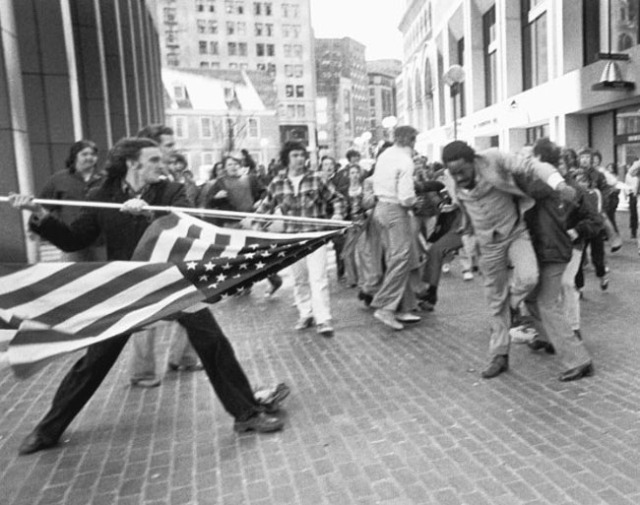
This 1976 Pulitzer-winning photo is from the Boston busing disputes People often think flag guy is preparing to run the black...

This 1976 Pulitzer-winning photo is from the Boston busing disputes

People often think flag guy is preparing to run the black guy through while another person holds him in place

In fact the situation is flag guy was waving it side to side in black guy’s face, black guy took a startled step back and tripped, and the guy behind caught him and lifted him back up

Further, the situation is that flag guy was there to protest a black member of the school board but didn’t know what he looked like, so when a completely different black guy walked out of the courthouse in professional clothes this guy started waving a flag in his face

Tagged: amhist

Perfect equipoise: a perfect fantasy. A more realistic American tableau was unfolding in Chicago, where the conspiracy trial was...

antoine-roquentin:

Perfect equipoise: a perfect fantasy. A more realistic American tableau was unfolding in Chicago, where the conspiracy trial was at its entropic height.

During jury selection, the questions the defense wanted the pool to be asked included “Do you know who Janis Joplin and Jimi Hendrix are?” and “If your children are female, do they wear brassieres all the time?” In a pretrial hearing Judge Hoffman described the “intent” standard by which the defendants were to be judged: “The substance of the crime was a state of mind.” (That was just the way Time had defined Middle America: a state of mind.) To that standard, the defense was glad to accede. When the twelve jurors turned out to be middle-class and middle-aged, except for two girls in their early twenties, Leonard Weinglass, the lead defense attorney, moved for a mistrial, claiming his clients weren’t being judged by a jury of their peers—which would have to be chosen also from people not drawn from the voter rolls, because blacks, the young, dropouts, and misfits were not well-enough represented on them.

The government had selectively indicted to display a cross-section of the monstrous personages rending the good order of American civilization: the older guru (David Dellinger); two long-haired freaks (Abbie Hoffman and Jerry Rubin); the by-any-means-necessary Negro (Bobby Seale); two SDS militants (Tom Hayden, Rennie Davis); two radical young faculty members (a chemistry professor, John Froines, and a sociology professor, Lee Weiner, who were supposed to have planned a bombing). The prosecutors warned on TV that the defendants might walk into court the first day naked.

That didn’t happen, though when court adjourned on New Year’s Eve defendant Froines and his girlfriend did pass out autographed nude posters of themselves.

The jury was sequestered every minute they were outside the Federal Building: if states of minds were on trial, even the cultural air was prejudicial (some stories they missed: the Mobilization, the Silent Majority speech, the Moratorium, the rise of Spiro Agnew, the second moon shot, the My Lai massacre). They received a respite from cabin fever the day after Christmas when they were treated to a Disney on Parade show. But even that was prejudicial: the monkeys in the Jungle Book number were go-go girls. Alice in Wonderland was done up in psychedelic patterns.

Jerry Rubin called his indictment “the Academy Award for protest.” Judge Julius Hoffman seemed to relish the notion. “Tell me something,” he asked New York Times reporter Tony Lukas, who had called up to ask for press credentials. “Do you think this is going to be the trial of the century?”

Keep reading

Tagged: amhist

idk if the rice thing is less wild than bananas being sold for a dollar apiece at the 1900s Worlds Fairs. I mean a fuckin...

Anonymous asked: idk if the rice thing is less wild than bananas being sold for a dollar apiece at the 1900s Worlds Fairs. I mean a fuckin banana? fuck our ancestors were deprived... then again it was a different banana we'll never get to taste so there's that

That was the 1876 Philadelphia Exposition, they were 10 cents, and I suppose “new fruit plantations in the tropical Americas with steam-powered lines of transport to consumer markets” was exactly the kind of important development that gets shown off at a World’s Fair

Tagged: amhist world's fair

@cactus-person It’s less about “new housing for the rich will become affordable housing for everyone else in 30-40 years;” it’s...

shieldfoss:

@cactus-person

It’s less about “new housing for the rich will become affordable housing for everyone else in 30-40 years;” it’s not as if you have low-income people moving into “used mansions” in the same way that you can get a “used car” for cheap.

You do, actually! Well, not if you mean *specifically* mansions, but I have friends on welfare who live in used luxury apartments[1], and some of the houses I’ve been looking at buying are half of something that *used* to be one big house but got divided in the middle into two separate pieces of real estate with a shared wall.

[1] Well, they were luxury apartments when they were built, with all the modern amenities like “indoor toilets” and “elevators.” “On-site laundromat” so you don’t have to go to a public one like a plebe. Etc./

I mean, poor people totally used to move into old mansions in America, they were just divided up and shared out, like the beautiful Victorians on LA’s Bunker Hill

This was something “slum clearance” and “urban renewal” and to a degree redlining and residential segregation by race and the 30-year amortized mortgage and suburbanization were specifically designed to stop, because having the nicest area in town everyone invested in become the bum zone in a generation every generation made long-term stability impossible, both like “urban planning” and “homes that hold or appreciate in value as savings vehicles instead of depreciating like consumer durables”

Tagged: amhist

Just noticed two recent posts back-to-back on this feed were about different people defining modern popular left-liberalism as a...

Just noticed two recent posts back-to-back on this feed were about different people defining modern popular left-liberalism as a mental infirmity, so smoothly I didn’t notice the thread until now looking back

Of course that’s nothing new, you see precedent in “pointy-headed” and ‘bleeding heart”, the old saying about being so open-minded your brain fell out

Which is to say that’s exactly the idiom in which this stuff does ultimately get dismissed not logically as incorrect so much as viscerally as unworthy, god knows that’s the way it’d been going in the other direction

Bonfire of the Vanities was released in 1987 and praised by Manhattan types for its verisimilitude. There’s a scene where a character - a white ethnic prosecutor, educated as a good modern - seethes through a dinner with his wife and her fellow college-grad girlfriends sniping at the horrible way The System treats minorities. While he knows the job of cleaning up petty criminality - “garbage collection” is necessary to maintaining society even if that’s mostly locking up nonwhites who are dangerous more from patheticness than maliciousness; but he knows he could never convince them and they’d just regard him as repulsive matter-out-of-place

In 1989 a white ethnic prosecutor himself ran for mayor of NYC - Rudy Giuliani. He lost the closest race in city history. In 1993 he won, against the desires of polite society, by 1997 he was inevitable, obvious all along in retrospect. No one felt weird, even in the fanciest circles, saying that it was important for the state to wield repressive force against even underprivileged minority miscreants.

Really, if those ladies still felt that it was THEY that shut up. Bill Clinton was elected in 1992 after 12 years of Republican presidents - people were surprised Roe still existed for him to save - on the pledge of “it’s the economy, stupid”, to jettison all the cultural, or minority, or whatever issues and sell the Dems as not-moneybags.

And really ever since he became the nominee and his Arkansas machine merged with the Democratic Leadership Council merged with the national Democratic Party, people (Hillary! People ticked about Neera Tanden’s role in the Hillary apparatus should know that was a lot of Hillary’s role in the Bill Clinton apparatus!) paid a LOT of attention to a LOT of petty shit to separate the Dems from the pushy fringy activists

Basically by capturing the donor base - off-the-reservation activists were defunded by instructing Dem Party donors to refuse them any donations. On penalty of being cut off from whatever power Dem Party links gave you, ask Jeffrey Epstein or Harvey Weinstein about how well that worked vis-a-vis funding romantic challenges to the whole system. (Well, ask them in 1999 and then again in 2019)

Or anyone who just needed a real estate issue resolved. (As late as the ‘80s the Nation of Islam might have been more useful in resolving a real estate issue than the elected government! But then Giuliani got his turn)

Tagged: amhist

The Bizarre History of Buca di Beppo, America’s Most Postmodern Red Sauce Chain

The Bizarre History of Buca di Beppo, America’s Most Postmodern Red Sauce Chain

For some reason “Buca di Beppo” registered as a recognized phrase in my head but I had never heard of the restaurant chain until this article.

It is a little impressive that a story that explicitly makes comparisons to the Olive Garden frames “create a theme-concept chain restaurant with the walls covered in kitschy flair in 1993″ as the result of a particular vision and not just broad trends

Particularly, the rise of “edge city” exurbanism, with developers appreciating national restaurant chains able to plug proven concepts into their fresh-built highway-convenient shopping centers - I think the current “fast casual” chain boom is pretty similar in terms of how they appeal to urban developers

Outback Steakhouse was created in Tampa in 1988 by a company formed for the purpose of generating chain restaurant concepts. If you were going to theme steak after a foreign country it should really be Argentina, but for some reason Australia was a fad in ‘80s America.

TGI Friday’s, weirdly, was descended from a 1965 Manhattan bar that pioneered the concept of the “fern” or “singles bar” through the innovation of appealing to young single women, whose presence then appealed to young single men

Tagged: amhist

Geography lesson: Texas

So the most important thing in understanding the development of Texas is that there are basically no rivers navigable further inland than Houston. That means it was mostly unsettled for so long not because it was unlivable or unfarmable but because there was no point to farming it, since you had no way of getting your crops to a demanding market.

This as much as the scrubland ecology is why the early economy was based on cattle, livestock being the only product that could move overland under its own power. Originally to Galveston for export to Caribbean slave plantations on land too valuable for cash crops to waste growing protein, later to the furthest south railhead for shipment to the stockyards of Chicago (which, built to connect the Great Lakes to the Mississippi River system, was and still is the linchpin of the American transportation network)

And this still matters! Like, one theory of modern American politics comes down to Texas and other “Sun Belt” cities offering better “affordable family formation”, in turn because they can sprawl outward 360° over the empty plains, as compared to other cities constrained by geography.

But that’s because those cities only grew in the Industrial Age past when cities had to be located around a water feature (or OK, maybe a mountain pass) in order to matter. Dallas grew up where it did because it was at the intersection of two railroads. Compare to the original Texas power city of Galveston, which (until a devastating hurricane) was not only on the coast but a Manhattan-style island

Tagged: geography amhist texas

huh so drug resistant fungi are colonising hospitals and we have no way to stop them, great, great.

argumate:

huh so drug resistant fungi are colonising hospitals and we have no way to stop them, great, great.

Every so often you see something about how the Reagan administration didn’t take HIV/AIDS seriously, and that’s true, but a data point often cited in favor of this is how much more funding went to Legionnaire’s Disease

But Legionnaire’s Disease wasn’t pattycake, the very real fear was that every hospital or other large closed environment would harbor, in its bones, a disease that would infect inhabitants and kill about 10% of victims even if didn’t evolve immunity to the deep-cut antibiotics it was vulnerable to

In the end it was mostly suppressed by improved HVAC design more than medical breakthroughs

Tagged: amhist

So something about the 1921 Tulsa race riot I don’t think gets appreciated enough: The wealth at the heart of “Black Wall...

So something about the 1921 Tulsa race riot I don’t think gets appreciated enough:

The wealth at the heart of “Black Wall Street” was windfall oil money. Oklahoma, once the “Oklahoma and Indian Territories”, were a last-chance outlet for settlement, thin soil if you had the gumption or misfortune to get it, tho people were at least used to not being white. But an early-20th oil boom left some of the most marginal landholders rich.

So the black wealth was all sudden surprise first-generation new money, money that moved off the land and into town and capitalized local black businesses and enterprises beyond (Black Wall Street). The oil boom drew a new wave of poor workers to Oklahoma looking for their lucky break and when they filtered into domestic service people remarked on how it was the only place in America with a norm of white servants in black households.

So in a very unsettled environment from the end of WWI into the mid-1920s, when “white supremacy” and “socialism” were each leading candidates for the organizing principle of the newly coherent nation, it’s not only the biggest example of physical revolt against nonwhites but the one of the biggest examples of physical revolt against capitalholders

Intersectionality!

Tagged: amhist race war class war

Fair, it was more about the visual look and the particular type of streamlined/cleanliness than the self-awareness, but thanks

Anonymous asked: Fair, it was more about the visual look and the particular type of streamlined/cleanliness than the self-awareness, but thanks

I mean it wasn’t a lark, it was a professionally shot and printed promotional item as part of a really high-profile campaign supporting 9 Lives cat food

Actually that’s an American cultural history point - this was in the context of the “ad wars” of the ‘80s. For a bunch of reasons, local and regional brands in consumer staple products had been consolidated into a few rival multiproduct comglomerates with no place to grow further but at each others’ expense; meanwhile the mass audience was still largely corralled into the big 3 TV networks.

So there were a lot of really intense ad campaigns for really trivial everyday products, often going negative on rival lines. The most famous example is Coke v. Pepsi, but there’s things still stuck in my head like the chunkiness of Prego spaghetti sauce vs. Ragu Old World Style, and the vidya “console wars” really came out of this background

Tagged: amhist ad wars 80s80s80s

What's your take on Democrat infighting over Ilhan Omar?

Anonymous asked: What's your take on Democrat infighting over Ilhan Omar?

antoine-roquentin:

kontextmaschine:

antinegationism:

I may be an immigrant, but I believe in good old fashioned American values. Like apple pie, baseball, and unquestioning support for the state of Israel.

You joke, but “Foreign policy yoked by fixations of incompletely metlted immigrant cultures” is a longstanding trait of America

A lot of the Industrial Age immigrants came from countries with failed revolutionary movements. Liberal, nationalist, socialist, anti-clericalist, altar-and-throne clericalist, all of which picking up the French “the people should rule” theme and ran with it

Oh and did they ever get pissy about it. A lot of the northern or central euro types hated Prussia, which was the “feudal modernism” authoritarian state that was grindingly taking over continental Europe and helped to suppress people’s risings. So they hated Prussia, and its successor state “Germany”.

Which was complicated by the fact that German immigrants were probably the second most prominent nation in America, after Anglophone whites but before blacks (and they were filtered on “Germanophone who doesn’t want to live under European governments, anyway”)

But then in WWI the federal state started to pull together and aimed itself against “Germany” and all those populations bandwagoned on and created a massive wave of anti-German domestic repression that we mostly overlook now except Wisconsin v. Yoder

Also the Irish, christ, the Irish, their immigrants and descendants were always trying to get us in a war with the U.K. — the preeminent Atlantic naval force — over their own shit.

Hell they launched Al Qaeda-style attacks from us - starting w/ the Fenian Raids of the 1860s, where Civil War veterans spontaneously invaded Canada and invited Britain to spank us where they had merely love tapped us in 1812. The hilarious thing about Boston getting mad about that Rolling Stone cover “romanticizing” their bomber. From the Fenian Dynamite Campaign of the 1880s into the 1990s peace process, the city of Boston was the world HQ of terrorist bombing romanticization.

Maybe there’s a tie-in to “people smoking the scraped propaganda resin of the last defining war” tho, there’s also the bit where the US’s first soft antileft dictatorship, the Alien & Sedition Acts, was resisting an anti-British, pro-(Revolutionary) French sentiment taken too far

in one of the fenian raids, since there was no canadian militia of note between buffalo and toronto, the key leadership apparently pulled the entire military history class of university of toronto, who were about to take exams, to be military officers. they promptly assumed the correct stances for napoleonic war-era and moved into a box formation (ie what you do when cavalry charges at you circa 1812). the dudes they were fighting were all civil war veterans who apparently handled their single shots so well that everybody assumed they were using repeating rifles. the canadians got completely wrecked and 3 of the students died. it was a rout. anyways the fenians got freaked out at their success and assumed the british were doing some kind of crazy pincer movement and so they swam back to the us and hundreds of them got arrested or drowned.

Tagged: amhist history canhist

What's your take on Democrat infighting over Ilhan Omar?

Anonymous asked: What's your take on Democrat infighting over Ilhan Omar?

antinegationism:

I may be an immigrant, but I believe in good old fashioned American values. Like apple pie, baseball, and unquestioning support for the state of Israel.

You joke, but “Foreign policy yoked by fixations of incompletely melted immigrant cultures” is a longstanding trait of America

A lot of the Industrial Age immigrants came from countries with failed revolutionary movements. Liberal, nationalist, socialist, anti-clericalist, altar-and-throne clericalist, all of which picking up the French “the people should rule” theme and running with it

Oh and did they ever get pissy about it. A lot of the northern or central euro types hated Prussia, which was the “feudal modernism” authoritarian state that was grindingly taking over continental Europe and helped to suppress people’s risings. So they hated Prussia, and its successor state “Germany”.

Which was complicated by the fact that German immigrants were probably the second most prominent nation in America, after Anglophone whites but before blacks (and they were filtered on “Germanophone who doesn’t want to live under European governments, anyway”)

But then in WWI the federal state started to pull together and aimed itself against “Germany” and all those populations bandwagoned on and created a massive wave of anti-German domestic repression that we mostly overlook now except Wisconsin v. Yoder

Also the Irish, christ, the Irish, their immigrants and descendants were always trying to get us in a war with the U.K. — the preeminent Atlantic naval force — over their own shit.

Hell they launched Al Qaeda-style attacks from us - starting w/ the Fenian Raids of the 1860s, where Civil War veterans spontaneously invaded Canada and invited Britain to spank us where they had merely love tapped us in 1812. The hilarious thing about Boston getting mad about that Rolling Stone cover “romanticizing” their marathon bomber, from the Fenian Dynamite Campaign of the 1880s into the 1990s peace process, the City of Boston was the world HQ of terrorist bombing romanticization.

Maybe there’s a tie-in to “people smoking the scraped propaganda resin of the last defining war” tho, there’s also the bit where the US’s first soft antileft dictatorship, the Alien & Sedition Acts, was resisting an anti-British, pro-(Revolutionary) French sentiment taken too far

Tagged: amhist

Mascots of police commands in Poland by voivedoship.

infraredarmy:

mapsontheweb:

Mascots of police commands in Poland by voivedoship.

this is the perfect example of how the cops, who are inherently violent and threatening, try to make themselves seem cute and harmless so people will give them more power and not call them out when they murder people. it’s propaganda, and pure evil. anyway tag yourself i’m mis; they’re really cute

Oh there’s something. You kids might not know that the Reagan law-n-order “tough on crime” ‘80s had an animated furry mascot, “McGruff the Crime Dog”

wearing a trenchcoat to represent “detective”, which is one of the things a trenchcoat represented in those days, the other being “flasher”, a man who would suddenly throw it open to show his naked body cause surprise! he’s an exhibitionist and the cities aren’t policed and even caught criminals aren’t punished anymore

oh he had a real ‘80s mascot catchphrase though, “Take A Bite Out Of Crime” (bcuz no one could save this whole ruined world by themselves)

Tagged: amhist

@kontextmaschine: Seriously, though – In any given overarching cultural context, either (1) disaffected youngsters are...

balioc:

@kontextmaschine:

Seriously, though –

In any given overarching cultural context, either

(1) disaffected youngsters are going to feel that the world is basically a safe and happy place in terms of its fundamental structure, where they’d be totally fine and happy if nagging authority figures and crusading zealots would just leave them alone, man; or

(2) disaffected youngsters are going to feel that the world is a screwed-up and scary place in terms of its fundamental structure, that the path of least resistance is for them to live miserably and die fast, and thus that people had better do something about the all the problems.

Even midcentury American youth culture, which is often treated as a monolithic archetype for purposes of this kind of discussion, got a lot more aggressive and moralistic as circumstances on the ground got worse. 

You can calm the self-righteous kids down the same way you can calm everyone else down: stability (especially micro-level stability), prosperity, and peace.

I would suggest that the Birth of Rock & Roll came from people prepped for (2) finding themselves in charge of (1)

Tagged: amhist

Robert A. Caro on the Secrets of Lyndon Johnson’s Archives

Robert A. Caro on the Secrets of Lyndon Johnson’s Archives

antoine-roquentin:

We requested a lot of boxes, looking through a lot of file folders that, from their description in the “Finding Aids,” one would assume contained nothing of use to me—and the wisdom of Alan’s advice was proved to me again and again. Someday, I hope to be able to leave behind me a record of at least a few of the scores and scores of times that that happened, some of which may be of interest, at any rate to fellow-historians; for now, I’ll give just one example. I had decided that among the boxes in which I would at least glance at every piece of paper would be the ones in Johnson’s general “House Papers” that contained the files from his first years in Congress, since I wanted to be able to paint a picture of what he had been like as a young legislator. And as I was doing this—reading or at least glancing at every letter and memo, turning every page—I began to get a feeling: something in those early years had changed.

For some time after Johnson’s arrival in Congress, in May, 1937, his letters to committee chairmen and other senior congressmen had been in a tone befitting a new congressman with no power—the tone of a junior beseeching a favor from a senior, or asking, perhaps, for a few minutes of his time. But there were also letters and memos in the same boxes from senior congressmen in which they were doing the beseeching, asking for a few minutes of his time. What was the reason for the change? Was there a particular time at which it had occurred?

Going back over my notes, I put them in chronological order, and when I did it was easy to see that there had indeed been such a time: a single month, October, 1940. Before that month, Lyndon Johnson had been invariably, in his correspondence, the junior to the senior. After that month—and, it became clearer and clearer as I put more and more documents into order, after a single date, November 5, 1940, Election Day—the tone was frequently the opposite. And it wasn’t just with powerful congressmen. After that date, Johnson’s files also contained letters written to him by mid-level congressmen, and by other congressmen as junior as he, in a supplicating tone, whereas there had been no such letters—not a single one that I could find—before that date. Obviously, the change had had something to do with the election. But what?

At that time, I was constantly flying back and forth between Austin and Washington. Papers don’t die; people do, and I was giving first priority to interviewing the men and women who, during the nineteen-thirties, had been members of a circle of New Deal insiders to which the young congressman from Texas had been admitted.

One member of this circle was Thomas G. Corcoran, a pixieish, ebullient, accordion-playing Irishman known as Tommy the Cork, who had been an aide to Franklin Roosevelt and had since become a legend in Washington as a political fixer and a fund-raiser nonpareil. I just loved interviewing Tommy the Cork. He was at that time in his late seventies, but if he came into the lobby of his K Street office building while I was waiting for the elevator, he would say, “See you upstairs, kid,” as he opened the door to the stairwell. And often, when I reached the eleventh floor, where his office was situated, he would be standing there grinning at me when the elevator door opened. He was, in the best sense of the word (truly the best to an interviewer anxious to learn the innermost secrets of political maneuverings), totally amoral. He cared for nothing. Once, on a morning that we had an interview scheduled, I picked up the Washington Post over breakfast in my hotel room to see his name in big headlines and read a huge story about his role in a truly sordid Washington scandal. I expected to find a broken, or at least a dejected, man when I was ushered into his office. Instead, he gave me a big grin—he had the most infectious grin—and, when I didn’t bring up the subject of the story but he could tell it was on my mind, he said, “It’s just free advertising, kid, free advertising. Just as long as they spell my name right.”

Tommy the Cork had once told me about one of his most effective fund-raising techniques. When the man he was asking for money wrote a check and handed it across the desk to him, Mr. Corcoran, no matter what the amount—no matter if it was more than he had hoped for—would look at it with an expression of disdain, drop it back on the man’s desk, and, without saying a word, walk toward the door. He had never once, he told me—exaggerating, I’m sure, but how much?—he had never once been allowed to reach the door without the man calling him back, tearing up the check, and writing one for a larger amount. And now, when I asked Mr. Corcoran what had changed Lyndon Johnson’s status in October, 1940, he said, “Money, kid, money.” Then he added, “But you’re never going to be able to write about that.” I asked why not. “Because you’re never going to find anything in writing,” he said.

For some time, I was afraid that Mr. Corcoran was right. From what I had already learned about Johnson’s obsession with secrecy, I was prepared to believe that in this particularly sensitive area he had made sure that there was going to be nothing to find. And the Cork was right on another point, too: without something in writing—documentation, in other words—even if I discovered what had happened I wasn’t going to be able to put it in my book. But the change in Johnson’s status—the fact that during October, 1940, this young congressman had been elevated to a place of some significance in the House of Representatives—made me feel it was imperative that I find out and document what had happened in that month.

Alan’s words were in my mind. I had been looking at only Lyndon Johnson’s general “House Papers,” but these boxes might not be the only ones that dealt with Johnson’s early congressional career. There were also, for example, those LBJA files, containing letters and memos to and from “close associates.” I hadn’t even begun turning the pages in them.

Corcoran had said that the answer to my question was money, and if money was involved the place to start looking was Brown & Root, the Texas road-and-dam-building firm, whose principals, Herman and George Brown (Root had died years before), had been the secret but major financiers of Johnson’s early career; by 1940, Brown & Root had already begun receiving federal contracts through Johnson’s efforts. When it came to money, there were no closer associates than Herman and George. I didn’t have much hope of finding anything in writing, but their files were files in which I should nonetheless have been turning every page.

I started doing that now. I requested Box 13 in the LBJA “Selected Names” collection and pulled out the file folders for Herman. There was a lot of fascinating material in the files’ two hundred and thirty-seven pages, but nothing on the 1940 change. George’s correspondence was in Box 12. There were about two hundred and thirty pages in his file. I sat there turning the pages, every page, thinking that I was probably just wasting more days of my life. And then, suddenly, as I lifted yet another innocuous letter to put it aside, the next document was not a letter but a Western Union telegram form, turned brown during the decades since it had been sent—on October 19, 1940. It was addressed to Lyndon Johnson, and was signed “George Brown,” and it said, in the capital letters Western Union used for its messages: “YOU WERE SUPPOSED TO HAVE CHECKS BY FRIDAY … HOPE THEY ARRIVED IN DUE FORM AND ON TIME.”

It also named the people who were supposed to have sent the checks—six of Brown & Root’s business associates. And Tommy Corcoran had been wrong: Lyndon Johnson had for once put something in writing. Attached to the telegram was a copy of his response to George. “ALL OF THE FOLKS YOU TALKED TO HAVE BEEN HEARD FROM,” it said. “I AM NOT ACKNOWLEDGING THEIR LETTERS, SO BE SURE TO TELL ALL THESE FELLOWS THAT THEIR LETTERS HAVE BEEN RECEIVED … YOUR FRIEND, LYNDON B. JOHNSON.” Johnson had added by hand, “The thing is exceeding my expectations. The Boss is listening to my suggestions, thanks to your encouragements.”

So there was the proof that Johnson had received money from Brown & Root in October, 1940 (and that it had brought him into some sort of contact with “the Boss,” Johnson’s name for President Franklin Roosevelt). But how much had the six donors sent? Why hadn’t Brown & Root sent the money itself? And, more important, what had happened to the money? How did Johnson use it? What was the mechanism by which it was distributed? There was no clue in the telegram, or in Johnson’s reply. But the money had come from Texas, and George and Herman had friends who, I knew, had contributed, at the Browns’ insistence, to Johnson’s first campaigns. Most of the contributors, I had been told, were oilmen—in Texas parlance, “big oilmen.”

I started calling for the big oilmen’s folders. And, sure enough, there was a letter, dated in October, from one of the biggest of the oilmen, Clint Murchison. Murchison dealt with senators or with the Speaker of the House, Sam Rayburn, the leader of the Texas delegation; he hardly knew the young congressman; in his letter to Johnson, he misspelled his name “Linden.” But he was evidently following Brown & Root’s lead. “We are enclosing herewith the check of the Aloco Oil Co… . for $5,000, payable to the Democratic Congressional Committee,” his letter said. Another big oilman was Charles F. Roeser, of Fort Worth: the amount mentioned in the letter I found from him was again five thousand, the payee the same.

So the recipient was the Democratic Congressional Campaign Committee, which had previously been nothing more than a moribund subsidiary of the Democratic National Committee. There were a lot of file folders in Boxes 6, 7, 8, and 9 of the Johnson House papers labelled “Democratic National Committee.” Those boxes contained thirty-two hundred pages. Some of the folders had less than inviting titles. “General—Unarranged,” for example, was a thick folder, bulging with papers that had been sloppily crammed into it. When I pulled it out, I remember asking myself if I really had to do “General—Unarranged.” But Alan might possibly have been proud of me—and I wasn’t very deep into the folder when I was certainly grateful to him. One of the six people George Brown said had sent checks was named Corwin. In “General—Unarranged,” not in alphabetical order but just jammed in, was a note from J. O. Corwin, a Brown & Root subcontractor, saying, “I am enclosing herewith my check for $5,000, payable to the Democratic Congressional Campaign Committee.” Five thousand dollars. Had each of the six men mentioned in Brown’s letter sent that amount?

The “Unarranged” file contained letter after letter with details I knew I could use. And in other folders I came across letters in which that same amount was mentioned: for example, from E. S. Fentress, who was the partner of Johnson’s patron, Charles Marsh. I knew that one of the biggest and the most politically astute of the oilmen was Sid Richardson. I looked under the name “Richardson” in file folder after file folder in different collections, without any luck. What was the name of that nephew of his whom Richardson, unmarried and childless, allowed to transact some of his business affairs? I had heard it somewhere. What was it? Bass, Perry Bass. I found that name and the donation—“Perry R. Bass, $5,000”—in yet another box in the House papers.

Letters from many big Texas oilmen of the nineteen-forties—who needed guarantees that Congress wouldn’t take away the oil-depletion allowance, and that other, more arcane tax breaks conferred by the federal government wouldn’t be touched—were scattered through those boxes. And all the contributions were for five thousand dollars. Of course, they must be. I suddenly remembered what I should have remembered earlier. Under federal law in 1940, the limit on an individual contribution was five thousand dollars. How could I have been so slow to get it? Well, I got it now. The Brown & Root contribution to the Democratic Congressional Campaign Committee, funnelled through the company’s business associates, had been thirty thousand dollars, a substantial amount in the politics of that era, and, in fact, more money than the committee had received from the D.N.C., its parent organization. And there were so many additional five-thousand-dollar contributions from Texas!

But there was a next question: how had this money resulted in such a great change in Lyndon Johnson’s status in Congress? How had he transmuted those contributions into power for himself? He had had no title or formal position with the Democratic Congressional Campaign Committee; he had tried to get one, I had learned from other files, but had been rebuffed.

I found the answer in those LBJA files. He had had George Brown instruct each of the Brown & Root contributors, and had had the other Texas contributors instructed similarly, to enclose with their checks a letter stating, “I would like for this money to be expended in connection with the campaign of Democratic candidates for Congress as per the list attached.” Johnson had, of course, compiled the list, and, while the checks received by the lucky candidates might have been issued by the Democratic Congressional Campaign Committee, each candidate received a telegram from Johnson, saying that the check had been sent “AS RESULT MY VISIT TO CONGRESSIONAL COMMITTEE FEW MINUTES AGO.”

Before the campaign was over—in that single month, October, 1940—Lyndon Johnson had raised from Texas, and had distributed to congressional candidates, campaign funds on a scale seldom if ever before given to Democratic congressional candidates from a single, central source. The documents in those boxes of Johnson’s House papers made that clear.

As I turned the pages in those boxes, I found other documents. “General—Unarranged” contained another list. There were two typed columns on each of its thirteen pages, typed by either John Connally or Walter Jenkins; each of these Johnson assistants later told me that he had been the one who had typed them. In the left-hand column were the districts of congressmen who had asked the Congressional Committee for money. In the second column were the names of the congressmen and the amount that each had asked for—tiny amounts, in the terms of later eras—and what, in the congressman’s own words, he needed it for. “MUST HAVE $250 BY THURSDAY NIGHT FOR LAST ISSUE ADVERTISING,” for example. Or “$350 BY THURSDAY. HAVE SET UP MACHINERY TO REACH 11,000 ADDITIONAL VOTERS.” Others wanted five hundred dollars “FOR WORKERS IN SPANISH AND ITALIAN DISTRICTS” or “$1,000 ON NOVEMBER 1 TO HIRE POLL WATCHERS,” or wrote, “CHANCES BRIGHT … IF WE CAN GET RIGHT AWAY $14 FOR EACH OF FIVE COUNTY PAPERS AND $20 FOR TITUSVILLE HERALD.”

And there was a third column on the page, or, rather, handwritten notations in the left-hand margin, notes dealing with each congressman’s request. The handwriting in that column was Lyndon Johnson’s. If he was arranging for the candidate to be given part or all of what he’d asked for, he wrote, “OK—$500,” or “OK—$200,” or whatever the amount was he had decided to give. If he did not want the candidate to be given anything, he wrote, “None.” And by some names he wrote, “None—Out.” (What did “None—Out” mean? I later asked John Connally. “It meant he”—the candidate—“was never going to get anything,” Connally said. “Lyndon Johnson never forgot, and he never forgave.”)

Johnson had identified a source of financing for congressional races across the United States, a source that in the past had been used principally on behalf of Presidential or senatorial candidates: Texas money. Using the power of the mighty Speaker, Sam Rayburn, he had made sure the money came only through him. When, in 1940, officials of the Democratic Congressional Campaign Committee attempted to go around him, to the source, writing directly to the oilmen to request contributions, the oilmen had asked Rayburn whom to send the money to, and then, following the Speaker’s instructions, had replied not to the committee but to Lyndon Johnson, writing, in the words of Charles Roeser, “I HAVE DECIDED TO SEND MY CONTRIBUTION … TO YOU… . I AM … LEAVING IT UP TO … YOU, TO DECIDE IN WHAT DISTRICTS THESE FUNDS CAN BE BEST USED.” And Johnson was not only deciding which candidates would get the money; he was making sure the candidates knew they were getting it from him. “I want to see you win,” he said to them in his letters and telegrams. And here is some money to help. By the time the congressmen got back to Washington in November, after the elections, and talked to one another, the word was out. There was a lot of gratitude for what Johnson had done, Walter Jenkins said: “He was the hero.”

Moreover, the congressmen were going to need money for future campaigns, and they had learned that a good way to get it—in some cases the only way—was through Lyndon Johnson. “Gratitude,” I was to write, “is an emotion as ephemeral in Washington as elsewhere, but … not merely gratitude but an emotion perhaps somewhat stronger and more enduring—self-interest—dictated that they be on good terms with him.” In that single month, Lyndon Johnson, thirty-two years old, just three years in the House, had established himself as a congressman with a degree of influence over other congressmen, as a congressman who had gained his first toehold on the national power he was to wield for the next thirty years. For someone interested in the sources of political power, as I was, those boxes in the Johnson Library contained incontrovertible evidence of the use to which economic power could be put to create political power.

To my way of thinking, I had just one question left, and there was only one man who could answer it. I might know the answer, but knowing it wasn’t proving it. Herman Brown had died before I started on my Johnson books. I had to talk to George.

I had known that wasn’t going to be easy. George and Herman had been proud of their attitude toward interviewers; they had often boasted, with some exaggeration, that neither of them had ever given an interview, and that neither of them ever would. I had been trying to talk to George ever since I started on Lyndon Johnson, with no results, or indeed response. When I telephoned and left a message with his secretary, he never called back; when I wrote him letters, there was no reply. After I became friends with Brown & Root’s longtime chief lobbyist, Frank (Posh) Oltorf, I asked Posh to intercede, and he did, several times—after which he told me quite firmly that Mr. Brown was never going to talk to me. And, if he didn’t, I was going to have a hard time proving in my book why Brown & Root had given the money—or, indeed, why in the decades after 1940 it had given Lyndon Johnson such an immense amount of financial backing.

Sometimes a sudden thought does the job. One day, I found myself in the little Texas town of Burnet. In the courthouse square, among the weathered storefronts, there was a handsome new building bearing the legend “Herman Brown Free Library.”

All at once, something occurred to me. George had loved and idolized his older brother, who had really been more like a father to him. Since Herman’s death, George had been building public monuments to him all over Texas, not only Herman Brown public libraries but a Herman Brown Hall for Mathematical Sciences, at Rice University.

There was a telephone booth nearby. From it I telephoned Posh, and asked him to call George one more time. Posh said that he wasn’t going to do that. I’m only asking you to call one more time, I said, and I want you to say just one sentence: tell him that, no matter how many buildings he puts Herman Brown’s name on, in a few years no one is going to know who Herman Brown was if he’s not in a book.

I don’t remember Posh’s reply, but he evidently made the call. The next morning, very early, before I was awake, the phone rang, and it was Mr. Brown’s secretary, asking what time would be convenient for me to meet with him.

At the meeting, I thought that Mr. Brown and I got along very well. When I was ushered into his office, I found myself with a seventy-nine-year-old man who was almost blind but still vigorous and clear of mind. After he and Herman had begun, in the nineteen-thirties, to build the Marshall Ford Dam, the biggest project on which Brown & Root had ever embarked, and had sunk much of the firm’s money into it, they had found that, because of a quirk in the law, the dam was, in Brown’s words, “illegal.” “We had already built the cableway. That cost several hundred thousands of dollars, which we owed the banks… . We had put in a million and a half dollars,” he explained to me. The federal government was supposed to appropriate the money for the dam in its 1937 session, but it had now been discovered that any appropriation wouldn’t be legal. The Browns were facing bankruptcy. Johnson, new to Congress though he was, had worked out a device to make the dam project legal. And the Browns had been grateful. (“Remember that I am for you, right or wrong, and it makes no difference if I think you are right or wrong. If you want it, I am for it 100%,” George wrote him, in another letter that I found.) And Johnson had done more for the Browns, had seen to it that they received the biggest contract they had ever received: to build the Corpus Christi Naval Air Station. He’d then seen that they were given more contracts—contracts worth hundreds of millions of dollars—to build subchasers and destroyers for the Navy, this despite the fact that, as Mr. Brown told me, “We didn’t know the stern from the aft—I mean the bow—of the boat.”

At the end of our interview, which lasted an entire day, Mr. Brown said that he had enjoyed it, and would I like to meet again. I said I would, and we went to lunch at the Ramada Club. Afterward, he took me to see the legendary “8-F,” Suite 8-F at Houston’s Lamar Hotel, where the biggest of Texas’s big oilmen and contractors met to map out the state’s political future.

amazing article. those oil tax breaks basically underpinned the profitability of what was a very risky industry for decades. they played a key role in the fates of a lot of presidents. FDR, of course, was beholden to the three texans who held the position of speaker of the house in a row in the 1930s for passage of his new deal programs. later on, political scientist thomas ferguson pinpoints one of the key factors in the fall of carter and the rise of reagan in carter ending the oil depletion allowance. it was the 1980 election when the oil industry switched from backing democrats to backing republicans, where they have remained to this day. there was actually an earlier democratic president who apparently wanted to end it too: jfk. many conspiracy theories surrounding his assassination foreground figures who were members of suite 8-f, and their belief that they would have a friendly face in an lbj presidency.

Tagged: amhist

U.S Population changes.

mapsontheweb:

U.S Population changes.

Tagged: amhist geography

Empty Realm

This is an interesting article presenting the (rightist-marked) “NPC” meme as the natural heir to the Frankfurt School critical theory critique of mass culture as a dehumanizing force of control

One more point in favor of “current dynamics are not aberrant but rather return to the norm after the aberrant postwar Golden Age” – go back before WWII and America was ABSOLUTELY a country of overcrowded cities full of hobo jungles and pompous elites and henpecking scolds and hordes of ethnicized poor and nervous young college graduates scrambling to hold on and taking their nervous energy out on sex with a demimonde of lipstick and dresses and testicles and dicks, all surrounded by a sea of rural tedium and despair.

So maybe all that was just a Boomer bubble. One that started before The Sixties, though. The postwar right realized that kinda society was a breeding ground of communism though and the first step was throwing off the Popular Front culture.

“Stifling mass culture of the 50s” gets coded right these days, but remember that Ayn Rand (who’d lived through a national culture going commie and stifling before) had big counterculture (yes!) hits in the 40s and 50s with books where a pompous, clucking clique of “progressive” mediocrities dripping syrupy moralism dominated popular media and used it to suppress the liberatory potential of superior individuals and their ideas.

The scene in Atlas Shrugged where the protagonists blow up a bridge and send a trainful of them plunging to their firey comeuppance was the Day of the Rope of its day; in reality the payoff was the McCarthyite Second Red Scare cleansing them from positions of cultural influence, clearing the way for the Counterculture

Which rose, struggled, got overconfident, got knocked back, but returned in the 90s to devour Square Culture for once and all, and dissipated as people no longer realized it needed investment in maintaining

Or were devoured by, “selling out” was really a much higher-profile concept before say 2005. Why’s Gavin McInnes scrambling to build an apparatus of cultural influence? He already built one, with VICE! And sold it out. (For like a billion dollars split a few ways, and it’s not like “magazine from 2008 with a website and publishing arm and events w/ party photographers” is a powerful form rn)

Also, recent revelations are implying that many major figures stopped pushing boundaries in public too hard in return for a lifetime supply of 19±5 year olds soooo

But ANYWAY, does show that the theoretical energy is more on the upstart right these days. Maybe that’s ‘cause theory is what you do out of power – at the same time last decade’s efflorescence of left theory, Jacobin to n+1 to Rhizzome, is being increasingly discarded by a renascent left infatuated with its own dynamic action.

Tagged: same as it ever was amhist npc meme it’s media