Appreciating how the Yellow and Orange Belt techniques of American Kenpo are a mixture of “here’s a foundational principle you can later develop at great length” and “if someone strong tries to mess with you here’s how to break his arm”
American Kenpo/ˈkɛmpoʊ/, pronounced KeMpo, is a martial art
characterized by the use of quick and powerful strikes delivered from
all of the body’s natural weapons, powered by rapid stance transitions.
The beginner is introduced to numerous basics that comprise the system
taught through the vehicle of scripted ideal scenarios that give
instructors a platform from which to introduce the concepts and
principles that Ed Parker emphasized in his teachings of American Kenpo.
The purpose of training in this manner is to increase coordination and
continuity with linear and circular motion, each basic movement when
executed correctly loads the next move, keeping the adversaries
dimensional zones in check, limiting their ability to retaliate. If the
adversary does not react as the technique sequence anticipates, the
skilled Kenpo practitioner is able to seamlessly transition into an
appropriate action drawn spontaneously from the subconscious state.[2][3][4][5]
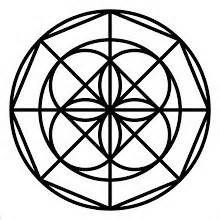
This was the school I trained in and that sounds sooo poncy, and I’m not going to pretend the ponciness is something foreign to American Kenpo, which is mostly a succession of San Fernando Valley mall katana guys working up half-mystic half-mathy systems, the school crest:
is a geometric diagram of potential limb placement shifts, but the important thing is they were mall katana guys working up systems that worked. The idea is that as you go on you assemble a repertoire of stances, and a repertoire of moves you can deliver from each stance optimized against particular enemy position/stance/vector combinations, and a repertoire of transitions from any given stance to any given stance
and these are delivered through techniques any one of which is probably a 3- or more- element combination, and through repeated practice you figure out the (ideal) combos quick but also the individual elements with a bit of experience and consideration
the one time I used it in a bar fight I chained (recover bent over from left hook) to (3-step rush) to (rush-augmented jabs to create range) to (left neutral bow stance) to (right uppercut) and when he moved to block it time slowed down and I transitioned mid-swing to (right elbow cross), that’s what that “appropriate action drawn spontaneously from the subconscious state” shit means in practice