All those fancy-themselves-saucy young leftists on Twitter like “OMG who cares about inflation, I can think of buying a house now!” gonna be surprised when they find out how increased interest rates and a few million people having the same thought to put their tens of thousands in new wealth towards buying a house do to the mechanics of inflation a/o buying a house
Do wonder how the YIMBYs whose angle is largely “make housing affordable for 30somethings with even well-paying UMC-track urban jobs!” feel.
Or the economists (they hate it). Or even the selective-college graduates who already repaid any loans (that weren’t from their parents), whose concern about its effect on their relative standing probably isn’t alleviated by all the beneficiaries grave-dancing about how they’re more thrilled if their gain comes at these copartisans’ expense.
After all that’s probably the demographic that probably corresponds best to college graduates in, say, 1974, when Michael Dukakis was elected Governor of best-educated Massachusetts and started in on winning that traditionally Republican demographic to the Republicans.
Shifting industrial development from smokestacks to the State Route 128 “Silicon Highway”, proving Democrats could work with, not against, the market, fitting in with the way hippie-back-to-the-land sensibility had evolved to yuppie rurality (John Denver, Colorado, I guess around there Vermont and Maine).
But part of that wasn’t just offering goodies, it was giving assurance that the Democrats weren’t a threat to the middle class. That’s what Willie Horton was – the Republicans saying that however appealing the Democrat economy is, electing Dukakis carried the unacceptable threat that he’d be soft on crime.
(The New Deal coalition’s memory of the Democratic Party was that they ended the Depression and gave us the Golden Age of labor aristocracy, and then by the 50s they were like “let’s break up the almost nation-within-a-nation Dixie South’s formal structures of racialized government, not go McCarthyist wild, and culturally loosen up a bit!” and they were like “yeah fair”
Then that in by the early ‘60s the Dems were like “let’s smile on this northern Negro agitation, leftist and pleasure-seeking youth upsurge!” and the traditional base was like “I dunno, could see this going wrong.” Then by the late '60s “it’s gone wrong! UNDO it!” but into the 70s the Dems just did it more.
That’s the threat.)
Meanwhile, after the '70s, stagflation, the collapse of NYC finances, bringing the money guys on board (and without industrial unions to donate out of dues, the Democratic Party qua party needed money guys to fund it) requires their sense of threat to be assuaged.
After defusing black-crime threat – not sparing the bleeding-heart-sympathetic Ricky Ray Rector from execution! – and succeeding where Dukakis failed at beating George H.W. Bush on an “it’s the economy, stupid” basis, this is why Bill Clinton was so sensitive to the bond market, why he passed a balanced budget. He was assuring them! And since, money guys and business guys are increasingly part of the Democratic coalition.
Which is to say they were realigned in. And they can be realigned right back again.
Abortion’s a cleavage Dems can probably make something of (and if that makes for a back-to-90s-coalitions-cause-breeding-kink-is-hotter-without-breeding reaction, all to the good).
I’ve mentioned that this Oregon gubernatorial election has a centrist Democrat running third-party, basically as “the good 'ol” Democrats you remember before the 2010s, attentive to the nonurban economy and regional industries" against an over-nationalized Portland party (where it’s filling with not-even-Cascadian newcomers!)“
And they’re trying to use this against her but given her tag is "Pro Choice and Pro Jobs” it’s iffy – “She might preserve our access but she won’t join with Democratic governments in Washington and California to use the west coast to save the worrrrrld!” does not feel like it’ll be that compelling if you’re not already the type to be tied into party establishments that give you Twitter talking points
Well really, if the Republicans can run “the Democrats aren’t economically trustworthy for college grads with investments, they’re soft on the crime that might spread from urban centers to your suburb, they don’t run the schools to do what they’re for (COVID closings) and instead use them to incite moral sickness in your children (CRT, trans stuff)” that’s pretty much the 80s-90s playbook right there, and it did pretty well then. Now all they have to do is usher Trump offstage.
I think old people deserve a fair hearing, one they aren’t afforded all too often in the multimedia era. I believe that the elders aren’t always wrong and the young aren’t always right. Growing up, we were lied to about all this, ironically by the people who are now old. The “never trust anyone over 30” boomer generation inculcated a sense that youth is just a form of incipient correctness. The future is theirs, so therefore they will be right about the future. Inevitably though, the young, while dictating the future, will ruin it in some glaring way. They’re human, it happens. And keeps happening.
Worse than Twitter’s baseline tone is just the omnipresent, reflexive demonization and collective will to hurt outgroup individuals. Connected to that is a panicky willingness to buy into emotionally charged stories that you don’t dare question your in-group on. Did we all become Deadspin? No, Deadspin wasn’t like this in 2008. But, if I’m honest, it was probably one more step to wherever we are. And this current place, perhaps a hell and perhaps a purgatory, is an ever-changing but seldom evolving shit show. It’s been one big refutation of the once-ballyhooed idea that we should all be speaking to each other, constantly.
What the boomers missed, however, was how they created this generation. They promoted an aesthetic of rebellious gatecrashing, then pulled up the ladder once safely ensconced. Moreover, they demeaned their privileged perch out of a moralized pique, all while ceding no purchase. This food is terrible, and such small portions, but none for you. No tradition was upheld because no tradition was offered.
So the younger generation responded in kind, not with tradition, but with an all-out assault on it. They beat the establishment, then beat themselves, and in the end, almost nothing endured.
See now I’m looking at reaction to the student debt thing and wondering whether you could shake loose some of the economist/money guy/UMC/WSJ-readers-who-in-a-previous-age-would’ve-watched-Moneyline-on-CNN-every-night (like my dad) that the Dems picked up since ‘92 loose such that the best pitch to keep them onside is anti-Trumpism, so that they’d win '24 against him but lose against DeSantis. That would be an interesting dynamic.
Friendly reminder that seeing what AI images can do now it’s ultimately a political policy product that you’ve never seen “naked thirteen-year-old girl spreading her legs”
Amusing that Stonetoss is kind of receding from where he was a year or two ago because he and his fans have too much self-respect to go all in on the Chris Rufo stuff
this is a good thing in context but it does kind of feel like the setup to one of those 70s/80s sci-fi stories where a greaser defeats tyranny with the power of rock and roll
I’m like “why am I suddenly seeing a burst of anti blurg?” and I look into it and it’s like
AO3 comfortably repels outburst
Antis linked to PRC
Asians and Asian-Americans Activated
And I’m like “Oh yes, that fits with the ‘Asian-Americans As The New White Ethnics’ (except their ancestral histories are 'resent China’, not 'love Rome’) and the 'Fujoshi Save The Internet’ plotlines!”
Like, remember back in the 2010s when I was like “hold position, things flip soon”?
Warby Parker saying they need to get my “Pupillary Distance” to make glasses but they can get it with my phone camera and I was like “but won’t that require everyone to have a reference object of the exact same size to use in the photo?” and the answer is a credit card
This is how it happens. I’ve been saying for a while that the next turn involves a revalorization of inegalitarian sexuality, this is part of it coming together.
The ‘90s Clintonian Silver Age was about taking a pause to reenchant American normalcy by #including the 60s… and it took. Standing up for post-counterculture cultural norms is now authentic American conservatism.
At the same time, the '80s had intervened. You had the cultural backlash, “family values” reassertion of child-protectiveness, you saw the Supreme Court invent the idea of “child pornography” as a category their last decades didn’t leave constitutionally protected, also the “campus rape crisis”, Take Back The Night, the broader almost proto-2010s original “political correctness” culture and canon wars PCU riffed on.
And in reaction to that, as a threat environment to be navigated if not particularly a change of heart to be internalized, the '90s didn’t push the presumed-sexual-access-to-inferiors line. Maybe even postured against it, y'know, Ben Affleck in Mallrats, who’s trying to fuck the girlfriend in a very painful place that’s not the back seat of a Volkswagen, would-totally-fuck-high-schoolers bad guy of the first movie where Kevin Smith was working for Harvey Weinstein from jump…
And yes, Weinstein and Hollywood, #MeToo, Epstein and the national elite, hell, Clinton and intern Monica Lewinsky, remember that one?, it appears that if the Boomers with a shot gave up on trumpeting it they didn’t on doing it…
How much of “nice guys”, “MRAs”, was about about guys noticing the gap here? “The world you are to inherit is in the rock-and-roll tradition of Woodstock thru '80s keg parties, the men who don’t go into domestic seclusion have a steady stream of satisfying partners, and all of this comes through a vernacular popularization of second-wave feminism!” Okay, but the last doesn’t really produce the prior.
(“Woodstock '99 was a rape fest!” well okay '94 seemed better, but by modern standards how much enthusiastic consent really was there in the mud of '69?)
Gone Girl I keep coming back to, but the book was really about the gap, about it collapsing on men in a way that was, if extreme in its particulars, rooted in the way it largely would in the 2010s.
But the thing is, “oh no these cads publicly mouthed feminist support while sexbezzling in private, now that that support has pumped feminism up enough they’re no longer safe!” has a parallel waiting, among the people who grew up with 90s culture. “Oh no feminism mouthed pro-sex Sixtiesism while building towards Puritanism in private! But now that we’ve been pumped up for counterculture sex-positivity… ::cracks knuckles::”
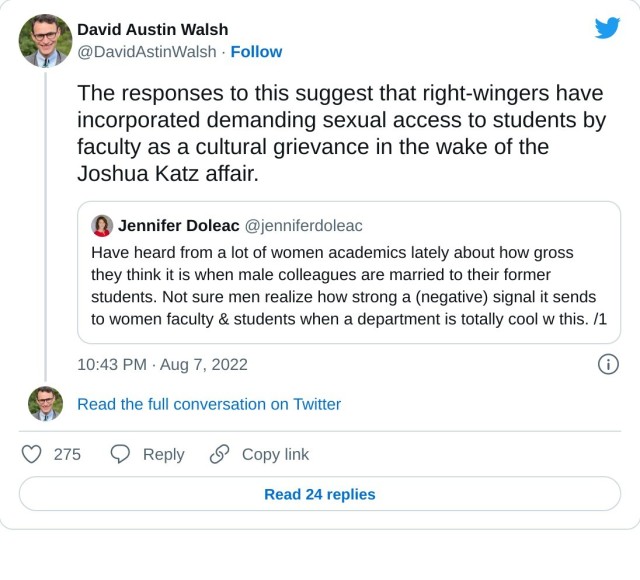
Like, what, they wouldn’t? Go read those responses OP referenced.
Add that to the way yammering about pedos and grooming marks you for avoiding by anyone worthwhile as a chud or at least anti now…
Also add the back-to-the-city thing. '80s teens-and-malls “suburbs” were really like, the San Fernando Valley, or Long Island, or relatively close-in Chicagoland. Now, in the parent-chauffeured exurbs the few outside adults an adolescent might get involved with are like, “sports coach” and “youth pastor” so I’m not sure exactly how a return to unsupervised intergenerational mixing would affect things, but it’s a change.
Guys, “what if a bunch of people moved to Portland who weren’t aligned with the preexisting culture as it stood” is the subtext of like everything in the real Portland for the last decade
Which involves things like “Portland identity involved elements of both working class AND petit bourgeois idealization; after new arrivals shifted the economy there was a reaction against them in the name of working-class Portland, in response to which bourgeois forces have been co-opting them with the understanding of defending Portlandishness.” That’s how these things go.
It also involves things like “the Oregon Democratic Party never went through the ‘70s-'80s realignment because the state was so white that race wasn’t relevant as a cleavage and Christianity/family traditionalism wasn’t enough to power a Republican relaunch, but the national party did, and new arrivals come from state political traditions that did and so replicated those practices by habit, while state Republicans out of power were drawn by national trends to a niche, but this election the whole thing is rupturing and it’s legitimately unclear what form state political coalitions will take for the next few decades”