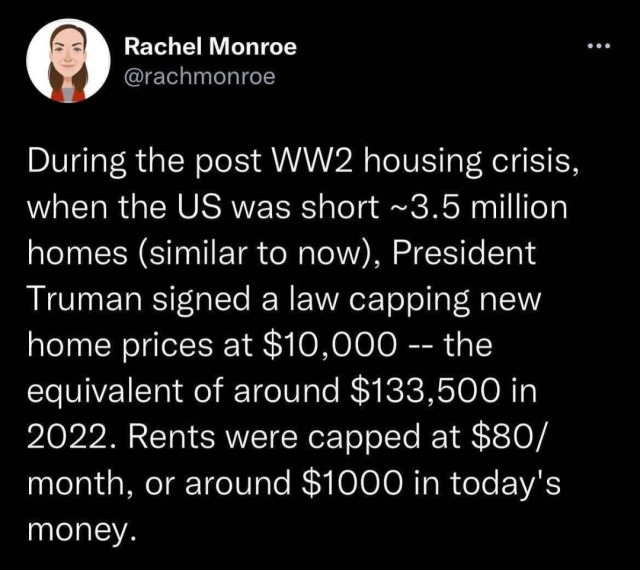
This is likely referring to the May 1946 Emergency Housing Program, and attempts to continue it through 1947. For one, rent control was not imposed ‘post-ww2’ - they were imposed in 1940, alongside…price controls for everything else. The large majority of the US economy was subject to price controls during the war to create stability and allocate materials to the war effort. After the war these controls began to be relaxed - what is being referred to here is an attempt to *continue* the rent controls that existed while other price controls slipped away.
Which in 1946 the US did do - alongside of course millions in federal funding directly building housing construction, blocks on the export of housing materials, and assurance contracts to providers of profit and financing. This did build a ton of homes, but huge gaps started emerging - in particular rent control was pushing tons of housing into the sales/ownership market, as there were more loopholes there, which veterans couldn’t afford. In December of 1946 Truman tried to redouble his efforts for the next year in a speech, which is where those numbers come from:
Permission To Build Homes
During 1946, a large volume of dwelling units has been put under construction and the completion rate of these homes has been increasing from month to month. Nevertheless, the veterans’ need remains extremely urgent and we recognize this by continuing to give veterans preference for every dwelling unit constructed for sale or rent.
However, from now on any person who wishes to build a home for his personal occupancy will be permitted to do so, subject to certain restrictions. This will increase the over-all housing supply and, in many instances, make additional homes available for veterans. The construction of housing will be authorized by Federal permits.
The major restrictions which will be imposed are:
1. The proposed dwelling must be designed for year-round occupancy. 2. The total floor area will be restricted. 3. In the case of rental housing projects, maximum rents, excluding charges for services, will be set at a project average not exceeding $80 per unit. Rentals will also be established for individual houses built for rental purposes.
The permit system will be simple. It will not be necessary to have sales prices set, or to meet the standards and inspection requirements of the present priority system.
You will note the housing sale cap of $10k was already abandoned by this point, being present in earlier versions.
This program failed to be implemented at scale - some of it was of course, but the majority of its tenents were rejected as the housing situation worsened and the desire of Congress to continue centralized price controls waned. In June of 1947 Congress passed the Housing & Rent Act, which Truman considered a bitter disapointment:
To the Congress of the United States
I have today signed H.R. 3203, the Housing and Rent Act of 1947, despite the fact that its rent control provisions are plainly inadequate and its housing provisions actually repeal parts of the Veterans’ Emergency Housing Act which have been most helpful in meeting the housing needs of veterans.
Had I withheld my signature, national rent control would die tonight. It is clear that, insofar as the Congress is concerned, it is this bill or no rent control at all. I have chosen the lesser of two evils.
It kept some controls of course, but nothing like what was outlined in that tweet - at this point even veterans had turned against such controls, as reported in a large American Legion report in 1947. Much housing was built, but it was far short of the goals and large affordability and access issues remainded.
Finally it seems worth noting that these controls were not especially onerous: the median housing price for new builds in the US in 1946 was $7500, and the median rent was $60. The controls were less a “this will lower rents” and more a “this will work as a short-hand to prevent new construction from trying to exploit gaps in our system of throwing financing at build projects.” (Source from same analysis above)
Now this whole thing, generally referred to as the Wyatt Program, is very interesting - it would be unfair to say that just because it lasted a year and didnt fulfill all its goals it was a failure; the problem of housing veterans in the US was gigantic after all, failure in some form was assured. Im sure many lessons could be learned from the Wyatt Program.
But we all know what the tweet is saying: “Hey, if we just imposed rent control today, housing prices would go down and people would still build, just like they did in 1946”. And that is summary of what was happening in 1946-1947 that is completely divorced from the reality of the housing market, the reality of the policy’s strategy, the reality of how it was implemented, and the reality of how successful it was.
With all that considered, I rank this tweet A Lie - but I suppose if you were charitable you could give it a “passes on a technicality” as those controls did exist in some form at some point in time.