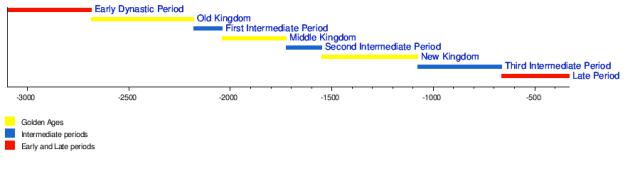
people talk about how ancient egypt lasted a really long time but it doesnt seem clear to me that it was like… a single thing in any sense that lasted thousands of years. certainly the ptolemaic dynasty wasnt the same sort of thing as the stuff that came before, it was an exterior conquest. there were literally dozens of ancient egyptian dynasties and it seems like a bunch of them were exterior conquests? like, i guess in a sense ancient egypt lasted for a really long time, but it doesnt seem like theres a meaningful sense in which it lasted *longer* than any other series of societies occupying a particular area that agriculturalized early
seems to me that *maybe* at most any one of the periods marked here is meanignfully a single “thing” that lasted a long time
the cultural continuity definitely lasted at least until the Roman conquest, i.e., Ancient Egyptian-speaking people worshipping the Ancient Egyptian gods. I don’t know what the language situation was like just before the Arab conquest, given it was part of the wider Greek-speaking eastern mediterranean world, and of course it had been mostly Christianized at that point, but insofar as it was ruled from cities on the other side of the mediterranean since the Roman conquest (big administrative change) and by the end of the roman/byzantine period its culture had changed dramatically, I think there’s a case to be made that “ancient egypt” is a coherent periodization, even if it’s not an unbroken chain of clear successor states in the modern sense.
obviously ancient egypt on the eve of the Roman conquest and ancient egypt 3,000 years earlier are probably two very different places! very different culturally and linguistically. but there’s more continuity there than with what came after, which is what I think people are emphasizing with that kind of periodization. vs. post-Roman and post-Arab conquest. similarly, when people conceptualize “China” as an entity stretching back into the mists of antiquity, vs the state that’s existed since the end of the civil war, they’re emphasizing an important continuity of culture/language/identity that has been maintained across that period even as the dynasty/state has frequently changed.
What I’m saying is it’s not clear to me that there’s MORE cultural continuity here than any other patch of land. Large cultural conversions/displacements are rare afaik
I don’t think cultural conversions are that rare–big states drawing surrounding areas into their cultural orbit and radically changing their cultures seems to be a common pattern as far back as early axial age empires. Displacement of populations, esp. from highly urbanized, densely populated areas like Egypt, does seem to be rare–Anatolia and Egypt have probably had a genetically-similar population since early antiquity–but I always assumed periodizations like this are meant for historical/cultural/linguistic/archeological purposes, not genetic ones.
(I reckon large-scale population displacements were a lot more common in northern Europe and the steppe until much later, since they had much lower population density)
Ok, I was going to pass this by because I don’t really have the spoons, but it’ll bother me if I don’t address it. There’s a lot of overthinking going on, and this is where you’ll lose yourself when you’re talking about civilisations like this.
I’ve talked a little in the comments of this post, but I’ll bring it to the fore here:
First of all: Dynasties are made up. Mantheo created them during the Ptolemaic period, and they are entirely arbitrary, and quite frankly done when Mantheo was missing a load of kings because the Egyptians themselves sorta….erased them from history. The Egyptian’s control of their own history is something we’ll circle back round to. But, the point is is that the Egyptians did not define themselves by Dynasties. They didn’t even define themselves by ‘Old/Middle/New/Late/Ptolemaic/Roman’ or any of the Intermediate periods. In fact, the only way they defined themselves was by the beginning and end of a King’s reign. There were certainly eras they wished to hide from their history (*cough*amarna period *cough*) but by and large, for the Egyptians, it was just one long continual block of time. Egyptologists use these markers as they are when we can define periods of either cultural or political change.
The reason it 'lasted longer’ is, in all honesty, fairly simple: they were quite insular, thus not actively picking fights all the time with their neighbours, and they thought Egypt was the best place on Earth so saw no need to expand much. Thus, all their resources were mostly dedicated to building and sustaining their own little world. There are also very few other civilisations to interact with at this point. If it’s just your civilisation, in contact with a couple of others, and you’ve got no idea that places such as China even exist?? Well you’re going to stay roughly in one spot, and occasionally fight with the neighbours. No one is travelling far. No one needs to. We’re in the very early stages of written history (oral history goes back far further, just ask the Australian Aborigines who have 40,000 years worth of continuous oral history), and we’re dealing with civilisations of maybe 5 million people, if that. There’s no need, or impetus, to change anything significantly. Thus, they remain as they were. There’s no more meaning than that.
Coming full circle back to the Egyptians being very in control of their own history; there is a conscious effort, on the part of the Egyptian state, to heavily archaise themselves. From the Old Kingdom onwards, there is a concentrated effort to keep the art style and culture the same as it was during their 'golden age’ i.e. the time of the Pyramids (which was a remarkably small amount of time). The Egyptians made the decision to 'freeze’ art style and cultural development so that it matched the people they were emulating. This is where people get stuck, because it’s always 'lol the Egyptians were shit at art and never changed’ and it’s not true. They could do very fluid art styles, see the Amarna period, but they actively chose not to do this. This causes the cultural continuity that you’re on about. It’s a very simple thing, and likely the Egyptians forgot the reasons they were doing it over time. It just became one of those deeply embedded cultural things: we do this because we do this. Much like British queuing I guess.
There are certainly significant upheavals in Egyptian cultural history. This is why we have the Intermediate Periods, as these were times of chaos for the Egyptians that once they were over, they swiftly set everything back to the way it was and went on as they ever had. You can’t see change in Ancient Egypt on a macro scale. There’s too much time, and we’ve got gaps in our knowledge that make all of it blur together. It’s only when you get significant incursions or change in political leadership that you get a large cultural change. This is why animal sacrifice and mummification really only begins with the Late Period and the rules of the Kushite and Persian kings. These kings bring with them their own culture, and it gets embedded into Egyptian culture. On a micro level, things were changing all the time. This is why you see differences in fashion styles, softening of consonants in the spoken language reflected in the written language as the world continues to expand and Egypt comes into contact with newer civilisations, or changes in technology and technique that while still making the same art they always have are made in an entirely new way thanks to trade. Despite all of this the Egyptians keep doing things like using an older form of the language on temple and tomb walls, despite using the newer form in every day documents, or using texts from the Old Kingdom as scribal school teaching materials in the New Kingdom (coincidentally, this is how we actually know about some of the OK texts, because we have NK copies when the originals are lost). They did this because maintaining a very set image was important to them culturally, and it remained that way throughout the entire history. Even when they are invaded, the new political elite take great pains to at least attempt to continue as it always was. When that happens, you know something was so strongly embedded in a culture that even conquers couldn’t do away with it.
Basically, the Egyptians did this to themselves, consciously and deliberately. This is why there’s so much continuity. It’s as simple as that.