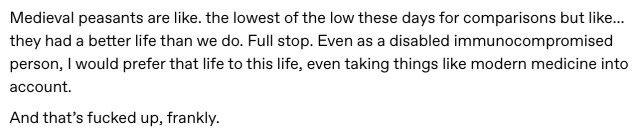
can’t put into words how much it boggles and offends me that this kind of thing has become, like, a meme of sorts? personally i love to not spend a cumulative five years or so of my life pregnant, but congratulations on not being jewish i guess, you unbelievable dumbass
That people have decided that “fewer work hours” means “better standard of living, yeah let’s ignore the anti-semitism, the minimal legal rights for women, the lack of antibiotics or modern sanitation, etc.” is particularly obnoxious, but it’s likely not even true that medieval peasants worked less than modern Americans.
First off, it’s worth noting that the 150 days figure is a matter of debate rather than settled fact, with some scholars arguing that working days could’ve numbered as many as 300 in the year (and even accounting for substantial breaks during the day workdays were often a good deal longer than 8 hours). In fact, the best-known exponent of the theory, Gregory Clark (mostly by way of popularization by the sociologist Juliet Schor), has subsequently come around to the belief that peasants worked a good deal more than that. The simple fact is that we don’t have a definitive answer as to how much work the average peasant or serf did; the figure Schor cited is one prominent hypothesis, but it’s not the only one, or substantially better-supported than various others as far as I’m aware.
The other problem with this line of reasoning, and the one I find more concerning as far as intellectual dishonesty, is how cherry-picked this idea of “work” is. We’re mostly talking about agricultural labor peasants performed for their lords, but peasants often owned livestock as well, and the requirement to feed and care for them didn’t take days off. Moreover, peasants spent time at a variety of tasks that even poorer modern people in the developed world usually buy their way out of, including making clothes, doing household maintenance by hand, and various work involved in food storage and conversion that refrigeration and economies of scale have made irrelevant to modern people. We can discuss the relative value of working for oneself, alienated labor, and so on, but the fact remains that this was work. (At this point someone may bring up “women’s work” as an argument against this claim, but it’s worth noting that many medieval women also performed a substantial amount of field labor, so it’s not as if they could stay home all day and just attend to this sort of household work.)
Even if we take the debatable “work week” figures as accurate, the fact remains that comparing someone who works X hours a week at their job and uses their wages to buy clothes off the rack and butter and bread at the supermarket (or bakes as a hobby), and either gets their landlord to fix most of the things that are wrong with their domicile or hires a professional to do so, to someone who works X hours a week at their job and then makes and mends their clothes by hand, churns their own butter and bakes their own bread, hand-rears their own cattle and chickens, and typically has to track down materials for home repairs and perform them themself, is blatantly and disingenuously apples-and-oranges.
Also, like - I really cannot emphasize enough that they’re really really really not ‘taking modern medicine into account’.
And, you know, if you think food scarcity in the modern industrialized world is bad, let me tell you about life as a peasant farmer when you happen to get two blights or bad winters or ruined harvests in a row-
They’ve decided that “work hours” only includes time generating saleable crop and none of the reproduction of labor in what’s actually a hella strong repudiation of feminist interventions into historiography