i was thinking about “a chicken for every pot” and like. why were they boiling chicken in the thirties, so often that it was the default way to cook it. was it just a poverty thing, like making broth or something to stretch it out? wouldnt that be the bones then? or did poor people not have ovens? or was it just like. a weird cultural thing
i feel like im supposed to know this cause i was reading The Domestic Revolution
i think… they did not have ovens? They had coal stoves? And you would put water on top of them
but why not have an oven
idkk
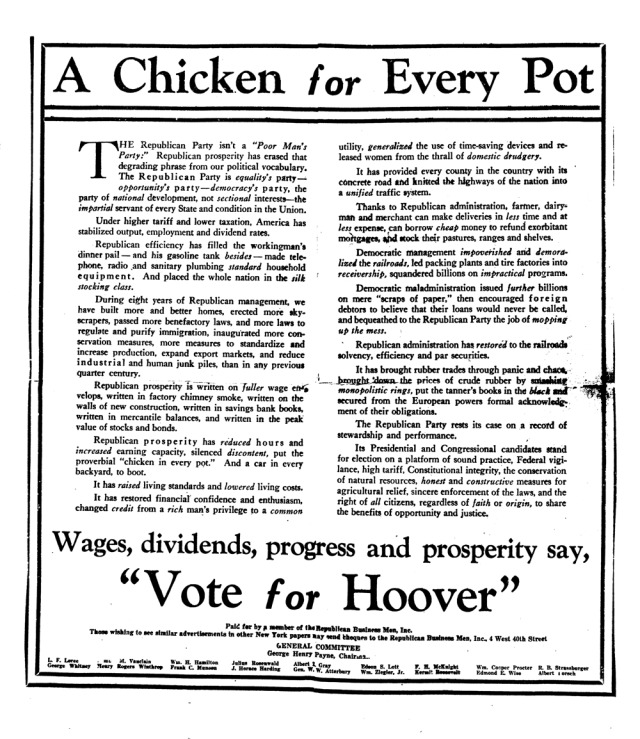
While it certainly wouldn’t have been uncommon to boil chicken well into the 20th century in the US, especially if you lived in poorer or rural areas (or even today if you live in an Asian American community), the phrase “a chicken in every pot” as a byword for general welfare long preceded Hoover’s 1928 campaign.
The original advert actually makes it clear that it isn’t a campaign promise, or even something that Americans actually did:
Republican p r o s p e r i t y has reduced h o u r s and increased earning capacity, silenced discontent, put the proverbial “chicken in every pot.” And a car in every backyard, to boot.
The phrase was originally attributed to Henri IV of France by Hardouin de Péréfixe de Beaumont in the latter’s 1661 didactic biography Histoire du roy Henri le Grand, intended as an exemplar of royal behaviour for Hardouin’s student and confessant Louis XIV. Today in France the phrase is associated with the dish poule au pot, which is a traditional chicken stew of sorts.
Le Duc [Charles Emmanuel I of Savoy], voyant un grand peuple, lui dit qu'il ne pouvait assez admirer la beauté et l'opulence de la France, et demanda à sa Majesté ce qu'elle lui valait de revenu. Ce Prince généreux et prompt en ses réparties lui répondit, « Elle me vaut ce que je veux ».
Le Duc trouvant cette réponse vague, le voulut presser de lui dire ce que la France lui valait. Le Roi répliqua, « Oui, ce que je veux, parce qu'ayant le coeur de mon peuple j'en aurai ce que je voudrai, et si Dieu me donne encore de la vie je ferai qu'il n'y aura point de laboureur en mon Royaume qui n'ait moyen d'avoir une poule dans son pot » : ajoutant, « et si je ne laisserai pas d'avoir de quoi entretenir des gens de guerre pour mettre à la raison tous ceux qui choqueront mon autorité. »
Le Duc ne répartit plus rien et se le tint pour dit.
The Duke, seeing a great people, said to [Henri IV] that he could not sufficiently admire the beauty and opulence of France, and asked His Majesty what it was worth to him in income. The generous and quick-witted Prince [in the sense the foremost leader of an area, not the son of a monarch] responded: “She is worth what I want.”
The Duke, finding this response vague, wished to urge him to say what France was worth to him. The King responded: “Yes, what I want, because having the heart of my people I will have what I want, and if God still gives me life I will make it so that there is not one plowman in my Kingdom who does not have the means to have a chicken in his pot,” adding “and if I will not fail to have what I need to support my men-at-arms in bringing to their senses all those who offend my authority.”
The Duke had nothing else to retort, and accepted what he said with no comment.