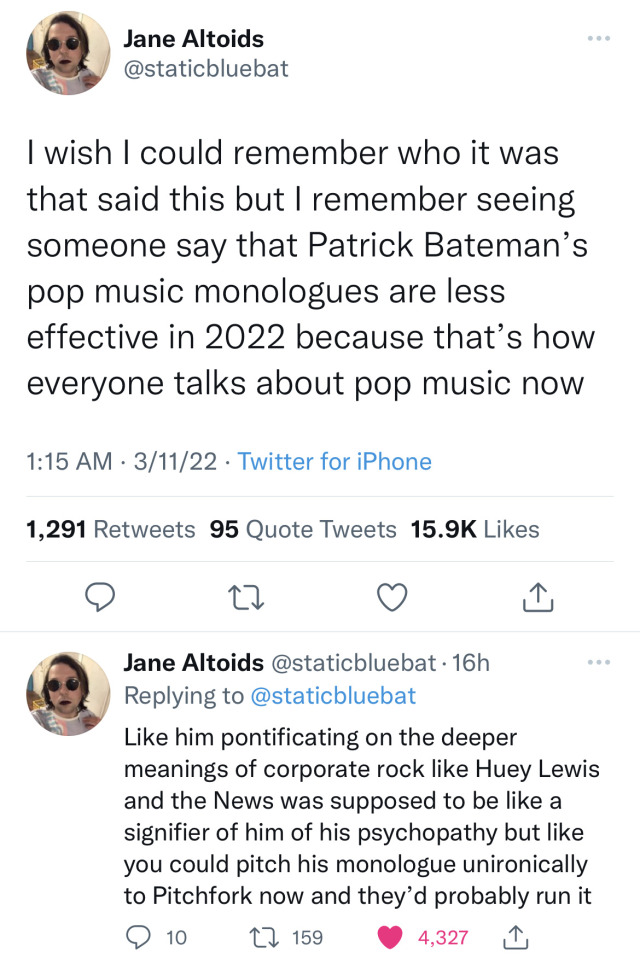
This is even more true for the Whitney Houston and Phil Collins monologues, because the Pitchfork poptimism era did in fact turn Serious Critics into huge retroactive Whitney and Phil stans (no one ever bothered going back to reevaluate poor Huey). And it’s not just Bateman “pontificating on the deeper meanings” that’s significant, but the specific themes he chooses to focus on:
“The whole album has a clear, crisp sound, and anew sheen of consummate professionalism that really gives the songs a big boost. He’s been compared to Elvis Costello, but I think Huey has a far more bitter, cynical sense of humor. […] I think their undisputed masterpiece is ‘Hip to Be Square,’ a song so catchy most people probably don’t listen to the lyrics. But they should! Because it’s not just about the pleasures of conformity and the importance of friends, it’s also a personal statement about the band itself.”
“Listen to the brilliant ensemble playing of Banks, Collins, and Rutherford. You can practically hear every nuance of every instrument. […] In terms of lyrical craftsmanship and sheer songwriting, this album hits anew peak of professionalism. […] Take the lyrics to 'Land of Confusion.’ In this song, Phil Collins addresses the problems of abusive political authority. 'In Too Deep’ is the most moving pop song of the 1980s, about monogamy and commitment. The song is extremely uplifting. Their lyrics are as positive and affirmative as anything I’ve heard in rock.”
“Did you know that Whitney Houston’s debut LP, called simply Whitney Houston, had four number one singles on it? […] It’s hard to choose a favorite among so many great tracks. But 'The Greatest Love of All’ is one of the best, most powerful songs ever written, about self-preservation and dignity. Its universal message crosses all boundaries and instills one with the hope it’s not too late to better ourselves.”
What does Patrick Bateman think makes an album great? We’ve got:
Praise of the hi-fi audio engineering,
Celebration of “professionalism” in music (as juxtaposed explicitly with the “intellectual” qualities of earlier Genesis, but also implicitly with amateurism or dilettantism in general),
Approving but vague gestures at a nebulously defined, toothless critical positioning on the part of mega-successful pop artists, and perhaps most importantly,
Emphasis specifically on positive and uplifting messages in the lyrics.
You could probably go 3 for 4 of these in any given poptimist critique, but the last two are basically freebies. Yes, you could get any of these published in Pitchfork.
The monologues certainly “signify Bateman’s psychopathy,” but I don’t think that’s the deepest version of this critique. Patrick Bateman’s psychopathy is a metaphor for the culture of the neoliberal 1980s, so look at it through that lens. It’s not just about taking pop lyrics seriously, it’s about the way that in the '80s even the production and appreciation of art were subordinated to the mission of individual self-improvement and the drive toward success. Bateman likes artists who unapologetically make pop music that sells records, and he uses that music as a tool to shape himself into his vision of a better person.
(There’s a deliberate irony here in the way his discourses on the songs’ meanings conflict with his actions: he talks about “the importance of friendship” while killing his coworker with an axe, and “abusive political authority […] monogamy and commitment” while ordering two nonconsenting women to perform sex acts on camera. Of course, this kind of hypocrisy is basically what the film is about.)
The reason it parallels contemporary pop criticism is that we’re still living in the 1980s. Neoliberalism and its values haven’t gone anywhere, but have in fact penetrated ever deeper even into ostensibly countercultural spaces. The gospel of self-empowerment preached by certain pop musicians and critics today is the exact same one that was relatively novel in the '80s and which American Psycho satirises.
In conclusion, if Patrick Bateman existed in the late 2010s, I think he would be the world’s biggest Lizzo fan. In contrast, I think he would really hate CupcakKe and Megan Thee Stallion because of the sexuality and profanity. Thanks for coming to my TED talk.