Italy’s military Chief of Staff during World War One, Luigi Cadorna, has a deserved reputation for being one of the worst commanders of the war. Bret Devereaux has a really good breakdown of all the reasons why - to summarize, if you ever find yourself fighting the 11thBattle of the Isonzo, presumably because the first ten failed, maybe you should rethink your strategy of constantly attacking mountains. Cadorna was antiquated, stubborn fool who treated his soldiers like cattle to boot.
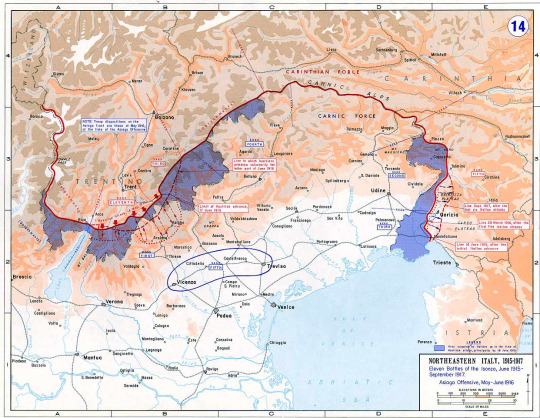
….But there is in fact a logic to his failure that I think goes underappreciated, in that Italy was in a truly *awful* strategic position in World War One. Here is a map of the Italian Front:
Ignore the battle lines, and instead focus on the terrain. The *entire* Hapsburg front for dozens of miles is mountainous, defensible terrain. There is no chance of breakthrough, no real chance of advance, just a point-by-point grind. However, this isn’t true for the Italians; once you bypass a few miles of mountains, or none at all near the east around Trieste, you are into the open fields of the Po river valley. And additionally this is very valuable land; Italy’s north is its most industrialized sector, with its economy centered around Milan just to the west of this map.
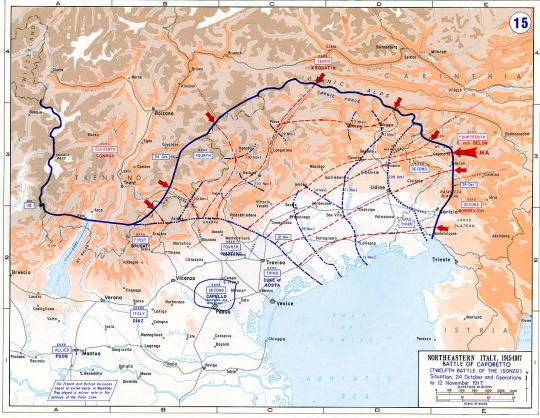
All of this terrain creates an offensive asymmetry; an Italian offensive must be sustained and will move by inches, but one Austrian offensive could achieve a breakthrough, the holy grail of military operations, and occupy valuable land - which actually happened in 1917, at the Battle of Caporetto:
Finally add to this picture the fact that Italy had one of the worst mobilization infrastructures of the war, particularly in the all-important category of rail, and as such their ability to deploy forces in *response* to enemy movements is going to be difficult.
When criticizing a military strategy, you must always answer the question “what else should have been done?” When it comes to Italy in World War One, the most common suggestion for Italy is to simply fight on another front. Send the forces to France, send them to the Middle East, operate as a supporting infantry for armies with greater offensive capabilities on better terrain. Deploy less men on this front, and be productive elsewhere. Here though is where that cursed asymmetry comes into play; it is *very* risky for Italy to deploy forces away from the Austrian front. They may only need one victory, and they can deploy forces to the front faster than Italy can. Austria can keep half the numbers Italy has for months, but if Italy draws down the numbers to match then one surprise offensive later and Venice is being shelled by artillery. Italy has to constantly keep *more* men than Austria on this front, always, to mitigate this potentiality.
So okay, Italy can’t deploy half its army to France, their forces are stuck in the Po River valley. That doesn’t mean Italy has to throw them at mountain strongholds to die by the hundreds of thousands! I mean, I agree, it doesn’t, but here is where geopolitics rears its head. Italy wasn’t attacked by the central powers; it entered the war to gain territory, specifically Austrian territory, upon victory. A victory Italy knows it can’t achieve on its own, but instead must ride on the backs of England & France. Which means Italy’s strategy is, in some ways, at the mercy of those allies.
And how do you think a strategy of “deploy our men to the Austrian border and do nothing” looks to those allies? Looks like freeloading! Austria would *love* that, due to that damned asymmetry it means it can deploy a lot of its forces away from the quiet border to more important fronts like Russia. If Italy wants to be useful, wants to ‘contribute to the war effort’, it has to attack, to make sure Austria is bleeding at least somewhat. Which the Allies understood - there was constant pressure by the Allies on Italy to do ‘something’, and 11 battles on the Isonzo was Italy’s answer to that demand. If it wanted the territories it claimed it did, it had to show its value.
Its the combination of strategic complications and political goals that tied the hands of Cadorna & the Italian military. They had no real offensive options, but had an offensive necessity, and so the worst answer emerged. None of this is a pass; Cadorna was also an awful operational commander, and there is no escaping that Italy bled its own military enough in these attacks to make them vulnerable to precisely the asymmetric breakthrough that occurred. If I was commander of Italian forces I would have bit the bullet, deployed Italian forces elsewhere to contribute, and prepared best I could defensively on the terrain, possibly building a fallback line around say Treviso where the lines are shorter and logistically better supported to make my real defense in case of a large assault. Yet such a strategy prioritizes the larger war effort over Italy’s own terrain; smart strategically, but tough politically.
So in conclusion, Cadorna was a moron, but not quite the moron one might think when you first learn about the grind on the Isonzo. There was a lot of pressure to grind.
I mean in this case the winning move for italy is not to play, right? this was a war of choice. build factories and sell france and britain guns. maybe italy could have come out of the war as a major industrial power
I would certainly agree with that; it was the path Japan took. They did declare on Germany but due to geography they simply took a few overseas bases of the Germans (primarily the German-Chinese port city of Qingdao, then Tsingtao and the source of the Chinese beer industry) then built things for the allies. Japan’s GDP hit almost 10% annual growth rates for the war period as production of anything that couldn’t be shot collapsed in the Allied countries. Italy was absolutely positioned to be in the same boat. (But of course none of this is Cadorna’s call)
Even if Italy just ~had~ to acquire territories, I do think, similar to Japan a “declaration of war but we are gonna be pretty passive about it” would have also been a winning hand. Send “expeditionary forces” to the Allied countries and fortify the border, then you get Trieste in the peace deal or somesuch. Its not like once the Hapsburg Empire fell apart the truly Italian-speaking territories had anywhere else to go. A lesser prize, but for a way lesser cost. And hey, as it turned out as the US became the dominant force in the Allied coalition it abrogated the UK-French agreement with Italy to give it expanded overseas colonies and Balkan possessions, so they never even got the greater prize anyway.
(If you are starting to think “wow Italy sure did sacrifice a ton for nothing and then got screwed in the peace deal, that must have impacted Italian politics a lot” well Benito Mussolini agrees with you.)
There was absolutely somewhere else for the Italian-speaking territories to go, Italy entered the war in hope of claiming lands along the eastern shore of the Adriatic, where Italian-speakers had long dominated the major trading port cities, but the Wilsonian settlement of the war distributed them as infrastructure to newly nationalist-autonomous Balkan states. That was the disappointment that soured Italy on those allies so bad (and well, and cause it spurred d'Annunzio’s addressing it himself by seizing Fiume, which fouled those relationships in other ways, such that Germany would be the obvious ally in WWII)