thinking about “why europe”. i feel like the more i learn about history, the more it seems that while eurasia was genuinely ahead of the americas and sub saharan africa in terms of like, “development” i guess, europe doesnt really stand out among yknow, levant, india, china, the whole crew. its not *below* them ofc, rome was insanely powerful, but it doesnt stand out. and the divergence happens pretty late, i guess the earliest you could place it is… MAYBE the 15th century? but i feel like actually placing it that far back is pushing it, and its more like 16th or 17th. idk. its confusing, and weird, but seems important. altho i guess its sort of unanswerable sophistry, its not like we can rerun the experiment. but curiosity springs eternal!
i was taught the answer was industrialization? societies had developed similar tech previously but i thought it was the particularly carnivorous british way of industrializing that made colonialism possible, but now that ive written that out its awfully britain-centric huh
industrialization is way too late! by the time industrialization got going, europe had already conquered massive portions of the americas. the scramble for africa was certainly powered by industrialization, but thats way way later
europe pulling ahead in math was imo around Newton (17th century). Mapmaking and navigation, and (as part of navigation) astronomy was extremely important I think, and not something just any society could pick up without a long tradition and trained specialists. 16th century it seems like european math was finally catching up to south indian math… so why didnt south india conquer the world?
the common answer is something like “the European landform promoted a large number of states, and the large number of European states promoted technological innovation”, or at least this kind of conquest-enabling military-maritime-mercantile innovation
unitary empire-states like China and single-state-prone areas like India can’t compete!
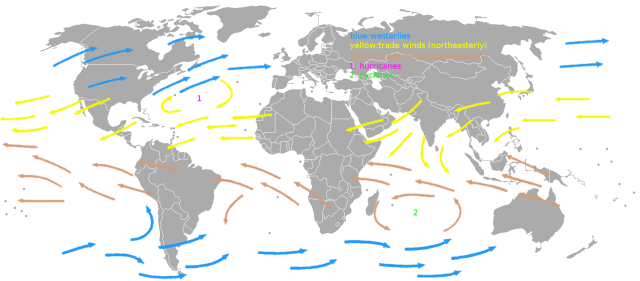
but I’m also attracted to the (new-to-me) hypothesis that it’s all about the Westerlies
That’s a fine answer but I don’t think it applies to south india in the 1500s! I mean I don’t know the history very well so I could be wrong but I think it was divided into many states?
And trigonometry and astronomy seem to have been really advanced there so I’m wondering what were they USING it for? The Dutch and Portugese were coming in and out, but did the south indians have their own ships and maps?
But regarding division being important… yeah from China it definitely seems like there were very few people that could take the initiative on big enterprises. But in Europe, besides there being various states you could go to for support, this is where joint-stock companies become important. Like… partly, you’d want to explain these things in terms of, how many attempts were made, right? And the more actors are able to gather very large resources together, the more tries there are. And the number of actors depends on both the number of states, as well as the number of non-state entities that can concentrate resources from a large number of people–which is basically just corporations
the answer i was given is that those small countries on the western extremity of europe got those two big continents all to themselves, and got to extract all they wanted, concentrate it in the metropole and thereby get even more because it was evident that innovation in navigation and financing would be rewarded.
none of the early modern indian states were in any position to do this trick because they were in the indian ocean, and so in the west african-arab-indian-indochinese-chinese trade context going back to antiquity
So, in other words, some idiot was going to do what Columbus did eventually, and as soon as they did (and got back alive), Europe was going to exploit the hell out of this fancy new territory and get the mother of all jump starts on climbing the tech tree faster than anyone else could.
So China could have done this in theory, but the Pacific is Too Damn Big and so the chances of someone doing it and getting back alive were far too small to matter. (Also possibly something about small states in competition but it’s not clear that’s even necessary here. It is AIUI not widely believed that Zhang He’s fleets could have made the trip even had they had infinite imperial backing and otherwise ideal circumstances, and that would have been probably the maximally favorable conditions in which to give China an attempt, and in that possibly-contrived scenario the large state would be acting as a benefit.)
Kim Stanley Robinson’s Years of Rice and Salt AU-where-a-plague-clears-out-Europe has the Americas discovered by Japanese sailors blown off course into San Francisco Bay, which is somewhat plausible, Japan’s maritime tradition was limited by winds and currents that would drag you off into the Pacific, but that also means there’s no tradition of open-ocean voyaging around there and no obvious pre-steamship way to get back