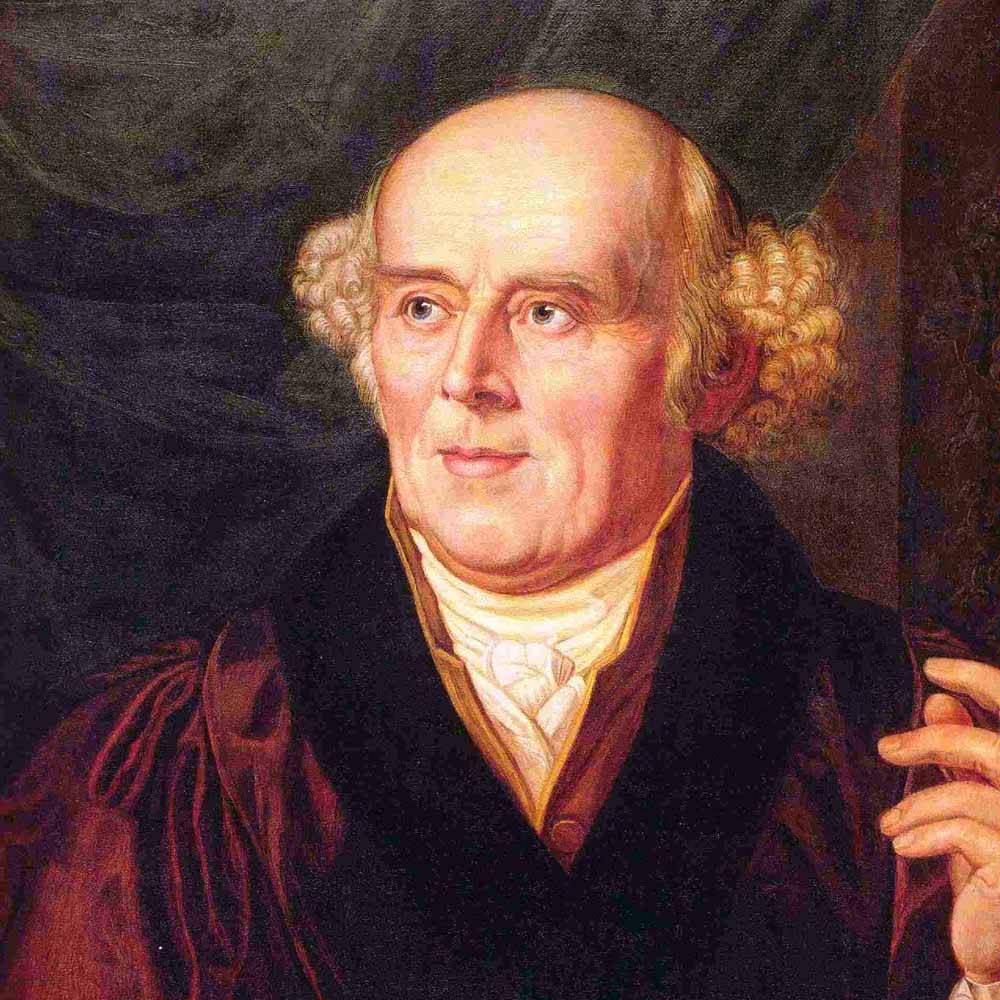
Samuel Hahnemann, often referred to as the father of classical homeopathy during the late 1700s, while translating medical...
Samuel Hahnemann, often referred to as the father of classical homeopathy
during the late 1700s, while translating medical texts between german and english, he read about the use of cinchona bark for the treatment of malaria. the bark was said to be effective against malaria because of its bitter and astringent taste (the real reason is because cinchona bark contains quinine, which is still used today, but mostly in tonic water), but this seemed preposterous to hahnemann, and he decided to try and discover the real reason for the cinchona bark’s efficacy.
to do this, he took increasing doses of the bark, and as the doses got higher, he noticed that he began to experience fevers, chills and sweats, symptoms, known collectively as the ague, very similar to those of malaria itself. he had observed that while higher doses of cinchona bark caused the ague, lower doses treated it, and from that information he developed the Principle of Similars, or “like cures like”
hahnemann continued his research by giving himself and healthy volunteers increasing doses of other natural substances, and noting their effects. he called the set of effects caused by each substance a “drug picture”. from then on, his process of deciding which treatment would be appropriate for a patient involved matching the patients symptoms (the “symptom picture”) as closely as possible to a drug picture (the diagnosis also took into account other factors such as mental and physical healthy, food preferences, and even the weather)
the second principle of classical homeopathy that hahnemann put forward was the Principle of the Minimal Dose or “theory of infinitesimals”. because such small quantities of the cinchona bark had been effective in treating malaria, hahnemann hypothesised that as dose decreases, efficacy increases, and he went on to dilute solutions down to negligible, or even non-existent, concentrations. he also believed that with each dilution of a medicine, it had to be shaken vigorously (a process called “succussion”) to cause the molecules to leave an imprint of themselves onto the solvent. each dilution/succussion process increased the solutions potency
the third principle of classical homeopathy is the Principle of the Single Remedy, which basically means that a person should be given no more than one medication at any time, and the choice of medication should be based on not only the symptoms the patient displays, but also many other factors, which i’ve already mentioned above
it’s interesting how homeopathy has changed over the centuries to what we know today, the third principle is generally disregarded, as is the first, to a certain extent. the only principle of classical homeopathy that is still relevant today is the second principle, as most homeopathic remedies are highly dilute.
if you look at the packaging of a homeopathic product, you might notice that instead of standard concentrations for each ingredient, there will be something like “200X” or “100C”, this shows how many times the product has been diluted, and what the dilution factor was. eg 200X means the product was diluted 200 times by a factor of 10 (X = 10, C = 100, etc). the number of times the solution has been diluted and undergone succussion determines the potency of the product, rather than the true concentration of active ingredient in the solution. for example if you had two solutions, one 3C and one 6X, both would have theoretically been diluted by a factor of 1,000,000, the 6X product would still be more potent because it underwent a greater number of dilutions and succussions
most of this was off the top of my head so hopefully it’s all correct and clear and maybe you learned something interesting tonight, and please keep in mind that none of hahnemann’s findings have any relevant scientific basis, and that anyone who knows even the slightest about the nature of chemistry and biology will tell you that homeopathy isn’t, and never will be, a viable alternative to actual real medicine